PackPlay: Mining semantic data in collaborative games
Nathan Green
NC State University 890 Oval Drive Raleigh, NC 27695
Paul Breimyer
NC State University 890 Oval Drive Raleigh, NC 27695
Vinay Kumar
NC State University 890 Oval Drive Raleigh, NC 27695
Nagiza F. Samatova
Oak Ridge National Lab 1 Bethel Valley Rd Oak Ridge, TN 37831
Abstract
Building training data is labor-intensive and presents a major obstacle to advanc-ing machine learnadvanc-ing technologies such as machine translators, named entity recog-nizers (NER), part-of-speech taggers, etc. Training data are often specialized for a particular language or Natural Language Processing (NLP) task. Knowledge cap-tured by a specific set of training data is not easily transferable, even to the same NLP task in another language. Emerging technologies, such as social networks and serious games, offer a unique opportunity to change how we construct training data.
While collaborative games have been used in information retrieval, it is an open is-sue whether users can contribute accurate annotations in a collaborative game con-text for a problem that requires an exact answer, such as games that would create named entity recognition training data. We
present PackPlay, a collaborative game
framework that empirically shows players’ ability to mimic annotation accuracy and thoroughness seen in gold standard anno-tated corpora.
1 Introduction
Annotated corpora are sets of structured text used in Natural Language Processing (NLP) that contain supplemental knowledge, such as tagged parts-of-speech, semantic concepts assigned to phrases, or semantic relationships between these concepts. Machine Learning (ML) is a subfield of Artificial Intelligence that studies how computers can obtain knowledge and create predictive mod-els. These models require annotated corpora to learn rules and patterns. However, these anno-tated corpora must be manually curated for each
domain or task, which is labor intensive and te-dious (Scannell, 2007), thereby creating a bot-tleneck for advancing ML and NLP prediction tools. Furthermore, knowledge captured by a spe-cific annotated corpus is often not transferable to another task, even to the same NLP task in
an-other language. Domain and language specific
corpora are useful for many language technol-ogy applications, including named entity recogni-tion (NER), machine translarecogni-tion, spelling correc-tion, and machine-readable dictionaries. The An Cr´ubad´an Project, for example, has succeeded in creating corpora for more than 400 of the world’s 6000+ languages by Web crawling. With a few ex-ceptions, most of the 400+ corpora, however, lack any linguistic annotations due to the limitations of annotation tools (Rayson et al., 2006).
Despite the many documented advantages of annotated data over raw data (Granger and Rayson, 1998; Mair, 2005), there is a dearth of
annotated corpora in many domains. The
ma-jority of previous corpus annotation efforts re-lied on manual annotation by domain experts, automated prediction tagging systems, and hy-brid semi-automatic systems that used both ap-proaches. While yielding high quality and enor-mously valuable corpora, manually annotating corpora can be prohibitively costly and time con-suming. For example, the GENIA corpus contains 9,372 sentences, curated by five part-time annota-tors, one senior coordinator, and one junior coor-dinator over 1.5 years (Kim et al., 2008). Semi-automatic approaches decrease human effort but often introduce significant error, while still requir-ing human interaction.
The Web can help facilitate semi-automatic ap-proaches by connecting distributed human users at a previously unfathomable scale and presents an opportunity to expand annotation efforts to countless users using Human Computation, the concept of outsourcing certain computational
processes to humans, generally to solve prob-lems that are intractable or difficult for comput-ers. This concept is demonstrated in our previ-ous work, WebBANC (Green et al., 2009) and BioDEAL (Breimyer et al., 2009), which allows users to annotate Web documents through a Web browser plugin for the purposes of creating lin-guistically and biologically tagged annotated cor-pora and with micro-tasking via Mechanical Turk, which allows for a low cost option for manual la-bor tasks (Snow et al., 2008; Kittur et al., 2008).
While the Web and Human Computation may be a powerful tandem for generating data and solving difficult problems, in order to succeed, users must be motivated to participate. Humans have been fascinated with games for centuries and play them for many reasons, including for entertainment, honing skills, and gaining knowl-edge (FAS Summit, 2006). Every year, a large amount of hours are spent playing online computer games. The games range form simple card and word games to more complex 3-D world games. One such site for word, puzzle, and card games is
Pogo.com1. According to protrackr,2Pogo has
al-most 6 million unique visitors a day. Alexa.com3
shows that the average user is on the site for 11 minutes at a time. When the average time spent on the site is propagated to each user, the combined time is equal to more than 45,000 days of human time. Arguably if, the games on Pogo were used to harvest useful data, various fields of Computer Science research could be advanced.
There has been a recent trend to leverage hu-man’s fascination in game playing to solve
diffi-cult problems throughHuman Computation. Two
such games include ESP and Google’s Image La-beler (Ahn and Dabbish, 2004), in which play-ers annotate images in a cooperative environment to correctly match image tags with their partner. Semantic annotation has also been addressed in the game Phrase Detectives (Chamberlain et al., 2009), which has the goal of creating large scale training data for anaphora resolution. These types of games are part of a larger, serious games, initia-tive (Annetta, 2008).
This paper introduces the Web-enabled collabo-rative game framework, PackPlay, and investigates
1
Pogo. http://www.pogo.com/
2
Protrackr.com site information and statistis-tics.http://www.protrackr.com/
3Alexa: The Web Information Company.
http://www.alexa.com/
how collaborative online gaming can affect anno-tation throughput and annoanno-tation accuracy. There are two main questions for such systems: first, will overall throughput increase compared to tra-ditional methods of annotating, such as the man-ual construction of the Genia Corpus? Second, how accurate are the collective annotations? A successful human computation environment, such as PackPlay, would represent a paradigm shift in the way annotated corpora are created. However, adoption of such a framework cannot be expected until these questions are answered. We address both of these questions in multiple games in our PackPlay system through evaluation of the collec-tive players’ annotations with precision and recall to judge accuracy of players’ annotations and the number of games played to judge throughput. We show improvements in both areas over traditional annotation methods and show accuracy compara-ble to expert prediction systems that could be used for semi-supervised annotation.
2 Methodology
We empirically show casual game players’ abil-ity to accurately and throughly annotate corpora by conducting experiments following the process described in Section 2.1 with 8 players using
the PackPlay System. The testers annotate the
datasets described in Section 2.2 and results are analyzed using the equations in Section 2.3.
2.1 PackPlay Process Flow
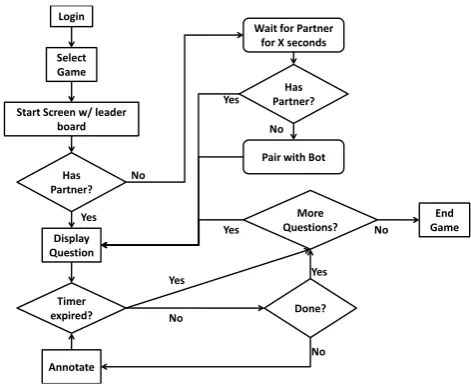
Figure 1 shows the average PackPlay process flow that a player will follow for a multi-player game. Assuming the player is registered, the player will always start by logging in and selecting the game he or she wants to play. Once in the game screen, the system will try to pair the player with another
player who is waiting. After a set time limit,
the game will automatically pair the user with a PlayerBot. It is important to note that the player will not know that his or her partner is a Player-Bot.
No
No No
No No
Yes Yes
Yes Yes
Yes Login
Select Game
Has Partner?
Wait for Partner for X seconds
Start Screen w/ leader board
Pair with Bot
Display Question
Annotate Timer
expired? Done? More Questions?
End Game Has
[image:3.595.55.291.60.253.2]Partner?
Figure 1: User process flow for PackPlay games.
First, the timer can run out; this timer is set by each game individually. Second, the player may answer the question and move on to the next question. Af-ter either one of those two options, a new question will be sampled. This cycle continues until the game session is over. This is usually determined by the game, as each game can set the number of questions in a session, or by a player quiting the game.
2.2 Data Sources
To compare named entity results, PackPlay uses sentences and annotations from CoNLL 2003, a “gold” standard corpus (Tjong et al., 2003). We use the CoNLL 2003 corpus since it has been cu-rated by experts and the PackPlay system can com-pare our players’ annotations vs those of 16 sub-mitted predictive models, also refered to as the CoNLL average, in the 2003 conference on nat-ural language learning. This paper will refer to the training corpus as the CoNLL corpus, and we se-lected it for our evaluation due to its widespread adoption as a benchmark corpus.
2.3 Metrics
To measure how thoroughly and accurately our players annotate the data, we calculate both recall (Equation 1) and precision (Equation 2), in which
αis the set of words annotated in PackPlay andβ
is the set of words in the base CoNLL corpus.
Recall= |α ∩β|
|β| (1)
Precision= |α ∩β|
|α| (2)
Each game module in the PackPlay system has its own scoring module, which is intended to im-prove the players’ precision. For this reason, scor-ing is handled on a per game level. Each game has its own leader board as well. The leader board is used to motivate the players to continue playing the PackPlay games. This is intended to improve recall for annotations in the system.
3 Games
3.1 Entity Discovery
3.1.1 Game description
Named entities are a foundational part of many NLP systems from information extraction sys-tems to machine translation syssys-tems. The abil-ity to detect an entabil-ity is an application area called Named Entity Recognition (NER). The most com-mon named entity categories are Person (Per), Lo-cation (Loc), and Organization (Org). The ability to extract these entities may be used in everyday work, such as extracting defendants, cities, and companies from court briefings, or it may be used for critical systems in national defense, such as monitoring communications for people and loca-tions of interest.
To help with the creation of more NER systems,
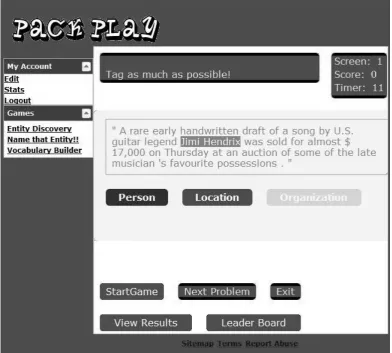
Entity Discovery (see Figure 2), a game for an-notating sentences with supplied entities was cre-ated. The goal of the game is to pair players with each other and allow them to annotate sentences together. While this annotation task could be done by one person, it is a very time consuming activ-ity. By creating a game, we hope that players will be more likely to annotate for fun and will anno-tate correctly and completely in order to receive a higher score in the PackPlay system.
3.1.2 Implementation
Entity Discoveryis implemented as asynchronous
two-player game. A synchronousgame is one in
Figure 2: Screenshot of a player annotating the Person entity Jimi Hendrix
InEntity Discovery, we made a design decision to keep a player’s partner anonymous. This should help reduce cheating, such as agreeing to select the same word over and over, and it should reduce the ability for a player to only play with his or her friends, which might enhance their ability to cheat by using other communication systems such as instant messaging or a cell phone. Since Pack-Play is still in the experimental stages, players may not always be available. For this reason, we have implemented a PlayerBot system. The PlayerBot will mimic another player by selecting previously annotated phrases for a given sentence from the database. From the human players’ point of view, nothing seems different.
Players are asked to annotate, or tag, as many entities as they can find in a sentence. Players are also told at the beginning of the game that they are paired with another user. Their goal is to annotate the same things as their partner. Our assumption is that if the game is a single player game then the
players may just annotate the most obvious enti-ties for gaining more points. By having the player to try to guess at what their partner may anno-tate we hope to get better overall coverage of enti-ties. We try to minimize the errors, which
guess-ing might produce, in a second game,Name That
Entity(Section 3.2).
To annotate a sentence, the player simply high-lights a word or phrase and clicks on a relevant
entity. For instance in Entity Discovery, a player
Figure 3: Screenshot of what the player sees at the
end of theEntity Discoverygame
3.1.3 Scoring
Scoring can be done in a variety of ways, each hav-ing an impact on players’ performance and
enjoy-ment. For Entity Discovery, we decided to give
each user a flat score of 100 points for every an-swer that matched their partner. At the end of each game session, the player will see what an-swers matched with their partner. For instance, if both players tagged “Jimi Hendrix” as a Person, they will both receive 100 points. We do not show the players their matched scores after each sen-tence, since this might bias the user to tag more or less depending on what their partner does. Fig-ure 3 shows a typical scoring screen at the end of a game; in Figure 3, the players matched 4 phrases, totaling 400 points. It is important to note that at this stage we do not distinguish between correct and incorrect annotations, just whether the two players agree.
3.1.4 User Case Study Methodology
To examine Entity Discovery as a collaborative
game toward the creation of an annotated corpus, we conducted a user experiment to collect sam-ple data on a known data set. Over a short time,
8 players were asked to play bothEntity
Discov-eryandName That Entity. In PackPlay, through-put can be estimated, since each game has a de-fined time limit, dede-fined as the average number of entities annotated per question times the num-ber of users times the average numnum-ber of ques-tions seen by a user. Unlike other systems such as Mechanical Turk (Snow et al., 2008; Kittur et al., 2008), BioDeal (Breimyer et al., 2009), or Web-BANC (Green et al., 2009), in PackPlay we define the speed at which a user annotates.
Each game in Entity Discovery consists of 10
sentences from the CoNLL corpus. These stences are not guaranteed to have a named en-tity within them. The users in the study were not
Table 1: Statistics returned from our user study for
the gameEntity Discovery
Statistic Total Mean
# of games 29 3.62
# of annotations 291 40.85
informed of the entity content as to not bias the experiment and falsely raise our precision scores. With only 8 players, we obtained 291 annotations, which averaged to about 40 annotations per user. This study was not done over a long period of time, so each user only played, on average, 3.6 games.
Two players were asked to intentionally anno-tate poorly. The goal of using poor annotators was to simulate real world players, who may just click answers to ruin the game or who are clue-less to what a named entity is. This information can be used in later research to help automatically detect “bad” annotators using anomaly detection techniques.
PackPlay also stores information not used in this study, such as time stamps for each question answered. This information will be incorporated into future experiment analysis to see if we can further improve our annotated corpora based on the order and time spent forming an annotation. For instance, the first annotation in a sentence may have a higher probability than the last annotation. It is possible that if a user answers too fast, the answer is likely an error.
3.1.5 Output Quality
Every player completes part of a 60 sentence pretest in which we know the answers. For each game, the questions are sampled without replace-ment but this does not carry over after a game. For instance, if a player finishes game 1, he or she will never see the same question twice. For game two, no question within the game will be repeated, however, the player might see a question he or she answered in game 1. Because of this, each user will not see all 60 questions, but we will have a good sample to judge whether a user is accurate or not. The ability to repeat a question in different games allows us, in future research, to test play-ers using intra-annotator agreement statistics. This tests how well a player agrees with himself or her-self. From this set of 60 questions we have calcu-lated each player’s recall and precision scores.
Table 2: Recall and precision forEntity Discovery
annotations of CoNLL data.
Per Loc Org Avg CoNLL
Avg Recall
(All Data) 0.94 0.95 0.85 0.9 0.82
Precision
(All Data) 0.47 0.70 0.53 0.62 0.83
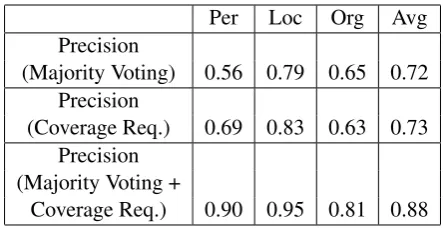
Discoveryin this experiment were 0.94, 0.95, and 0.85 for Person, Location, and Organization, re-spectively. The overall average was 0.9, which beats out the CoNLL average, an average of 16 expert systems, for recall.Entity Discovery’s num-bers are similar to the pattern seen in the CoNLL predictive systems for Person, Location and Or-ganization, in which Organization was the lowest and Person was the highest. The precision num-bers were quite lower, with an average of 0.62. When examining the data, most of the precision errors occurred because of word phrase boundary issues with the annotation and also players often are unsure whether to include titles such as Presi-dent, Mr., or Dr. There were also quite a few errors where players annotated concepts as People such as “The Judge” or “The scorekeeper.” While this is incorrect for named entity recognition, it might be of interest to a co-reference resolution corpus. The precision numbers are likely low because of our untrained players and because some of the players were told to intentionally annotate entities incor-rectly. To improve on these numbers, we applied a coverage requirement and majority voting. The coverage requirement requires that more than one player has annotated a given phrase for the an-notation to be included in the corpus. Majority voting indicates that the phrase is only included if 50% or more of the playerss who annotated a phrase, agreed on the specific entity assigned to the phrase.
As Table 3 shows, both majority voting and coverage requirements improve precision by more
than 10%. When combined, they improve the
overall precision to 0.88, a 26% improvement. This is an improvement to the expert CoNLL sys-tems score of 0.83. The majority voting likely removed the annotations from our purposefully “bad” annotators.
For future work, as the number of players in-creases, we will have to increase our coverage
re-Table 3: Precision for Entity Discovery
annota-tions of CoNLL data with filtering
Per Loc Org Avg
Precision
(Majority Voting) 0.56 0.79 0.65 0.72
Precision
(Coverage Req.) 0.69 0.83 0.63 0.73
Precision (Majority Voting +
Coverage Req.) 0.90 0.95 0.81 0.88
quirement to match. This ratio has not been deter-mined and will need to be tested. A more success-ful way to detect errors in our annotations may be to create a separate game to verify given answers. To initially test this concept we have made and set
up an experiment with a game, calledName That
Entity.
3.2 Name That Entity
3.2.1 Game Description
Name That Entity is another game with a focus
on named entities. Name That Entitywas created
to show that game mechanics and the creation of further games would enhance the value of an
an-notated corpus. In the case of Name That Entity,
we have created a multiple choice game in which the player will select the entity that best represents
the highlighted word or phrase. UnlikeEntity
Dis-covery, this allows us to focus the annotation ef-fort on particular words or phrases. Once again, this is modeled as a two-player game but the play-ers are not playing simultaneously. The goal for the player is to select the same entity type for the highlighted word that their partner selects. In this game, speed is of the essence since each question will ask for one entity as opposed toEntity
Discov-ery, which was open ended to how many entities
might exist in a sentence.
3.2.2 Implementation
As described above,Name That Entityappears to
be a two-player synchronous game. The player
is under the assumption that he or she must once again match his or her partner’s choice. What the player does not know is that the multi-player is simulated in this case. The player is replaced with a PlayerBot which chooses annotations from the
[image:6.595.305.527.106.220.2]an asynchronous game, in which one player has the task of finding entities and the other player has the task of verifying entities. This gives us a fur-ther mechanism to check the validity of entities
an-notated by theEntity Discoverygame.
As withEntity Discovery, the player’s partner is anonymous. This anonymity allows us to keep the asynchronous structure hidden, as well as judge a new metric, intra-annotator agreement, not tested in the previous game. Since it is possible that a player in PackPlay may have a question sampled
that was previously annotated in the Entity
Dis-coverygame by the same player, we can use
intra-annotator agreement. While well-known
inter-annotator statistics, such as Cohen’s Kappa, evalu-ate one annotator versus the other annotator, intra-annotator statistics allow us to judge an annota-tor versus himself or herself to test for consis-tency (Artstein and Poesio, 2008). In the Pack-Play framework this allows us to detect playerss who are randomly guessing and are therefore not consistent with themselves.
3.2.3 Scoring
Since entity coverage of a sentence is not an is-sue in the multiple choice game, we made use of a different scoring system that would reward first
instincts. While theEntity Discovery game has a
set score for every answer,Name That Entityhas a
sliding scale. For each question, the max score is 100 points, as the time ticks away the user receives fewer points. The points remaining are indicated to the user via a timing bar at the bottom of the screen.
When the player completes a game, he or she is allowed to view the results for that game.
Un-like theEntity Discoverygame, we display to the
player what entity his or her partner chooses on the question in which they both did not match. This gives us a quick and simple form of annotator training, since a player with no experience may not be familiar with a particular entity. This was seen with the players’ ability to detect an Organization entity. We expect that when a player sees what his or her partner annotates a phrase as, the player, is, in effect, being trained. However, displaying this at the end should not have any affects toward cheating since their partners are anonymous.
3.2.4 User Case Study Methodology
Of the 8 players who participated in theEntity Dis-coverystudy, 7 also playedName That Entity
dur-ing their game sessions. We did not inform the
players, but the questions asked inName That
En-titywere the same answers that the players gave in
the experiment in Section 3.1.4. The basic anno-tation numbers from our small user study can be seen in Table 4.
Table 4: Statistics returned from our user study for
the gameName That Entity
Statistic Total Mean
# of games 20 2.85
# of annotations 195 27.85
3.2.5 Output Quality
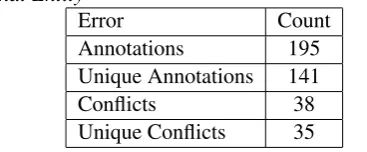
[image:7.595.314.498.426.502.2]AsName That Entity is not intended to be a solo mechanism to generate annotations, but instead a way to verify existing annotations, we did not assess the recall and precision of the game. In-stead we are looking at the number of tions, unique annotations, and conflicting annota-tions generated by our players in this game.
Table 5: Types of annotations generated byName
That Entity
Error Count
Annotations 195
Unique Annotations 141
Conflicts 38
Unique Conflicts 35
In Table 5, unique annotations refer to annota-tions verified by only one user. Of the 195 total verified annotation, 38 had conflicting answers. In the majority of the cases the players marked these conflicts as “None of the Above,” indicating that
the annotated phrase from Entity Discovery was
incorrect. For instance, many players made the
mistake in Entity Discovery of marking phrases
such as “German,” “English,” and “French” as Lo-cation entities when they are, in fact, just adjec-tives. InName That Entity, the majority of players corrected each other and marked these as “None of the Above.”
4 Conclusion
Annotated corpora generation presents a major ob-stacle to advancing modern Natural Language Pro-cessing technologies. In this paper we introduced the PackPlay framework, which aims to leverage a distributed web user community in a collabora-tive game to build semantically-rich annotated cor-pora from players annotations. PackPlay is shown to have high precision and recall numbers when compared to expert systems in the area of named entity recognition. These annotated corpora were generated from two collaborative games in
Pack-Play,Entity DiscoveryandName That Entity. The
two games combined let us exploit the benefits of bothsynchronousandasynchronousgameplay as mechanisms to verify the quality of our annotated corpora. Future work should combine the play-ers output with a player confidence score based on conflict resolution algorithms, using both inter-and intra-annotator metrics.
References
Luis von Ahn and Laura Dabbish. 2004 Labeling im-ages with a computer game. ACM, pim-ages 319-326, Vienna, Austria.
Leonard A. Annetta. 2008 Serious Educational Games: From Theory to Practice. Sense Publishers.
Ron Artstein and Massimo Poesio. 2008 Inter-coder agreement for computational linguistics. Computational Linguistics, Vol. 34, Issue 4, pages 555-596.
Maged N. Kamel Boulos and Steve Wheeler. 2007. The emerging web 2.0 social software: an enabling suite of sociable technologies in health and health care education. Health information and libraries journal, Vol. 24, pages 223.
Paul Breimyer, Nathan Green, Vinay Kumar, and Na-giza F. Samatova. 2009. BioDEAL: community generation of biological annotations. BMC Medical Informatics and Decision Making, Vol. 9, pages Suppl+1.
Jon Chamberlain, Udo Kruschwitz, and Massimo Poe-sio. 2009. Constructing an anaphorically anno-tated corpus with non-experts: assessing the qual-ity of collaborative annotations. People’s Web ’09: Proceedings of the 2009 Workshop on The People’s Web Meets NLP, pages 57-62.
FAS Summit on educational games: Harnessing the power of video games for learning (report), 2006.
Sylviane Granger and Paul Rayson. 1998. Learner English on Computer. Longman, London, and New Yorks pp. 119-131.
Nathan Green, Paul Breimyer, Vinay Kumar, and
Na-giza F. Samatova. 2009. WebBANC:
Build-ing Semantically-Rich Annotated Corpora from Web User Annotations of Minority Languages. Proceedings of the 17th Nordic Conference of Computational Linguistics (NODALIDA), Vol. 4, pages 48-56, Odense, Denmark.
Jin-Dong Kim, Tomoko Ohta, and Jun’ichi Tsujii. 2008. Corpus annotation for mining biomedical events from literature. BMC Bioinformatics, 9:10.
Aniket Kittur, Ed H. Chi, and Bongwon Suh. 2008. Crowdsourcing user studies with Mechanical Turk CHI ’08: Proceeding of the twenty-sixth annual SIGCHI conference on Human factors in computing systems, pages 453-456, Florence, Italy.
Ravi Kumar, Jasmine Novak, and Andrew Tomkins. 2006 Structure and evolution of online social net-works. KDD ’06: Proceedings of the 12th ACM SIGKDD international conference on Knowledge discovery and data mining, pages 611-617, New York, NY.
C. Mair. 2005. The corpus-based study of language change in progress: The extra value of tagged cor-pora. The AAACL/ICAME Conference, Ann Arbor, MI.
Paul Rayson, James Walkerdine,William H. Fletcher, and Adam Kilgarriff. 2006. Annotated web as cor-pus The 2nd International Workshop on Web as Corpus (EACL06), Trento, Italy.
Kevin P. Scannell. 2007. The Crbadn Project: Corpus building for under-resourced languages. Proceedings of the 3rd Web as Corpus Workshop Louvain-la-Neuve, Belgium.
Rion Snow, Brendan O’Connor, Daniel Jurafsky, and Andrew Y. Ng. 2008. Cheap and fast – but is it good?: evaluating non-expert annotations for nat-ural language tasks EMNLP ’08: Proceedings of the Conference on Empirical Methods in Natural Language Processing, pages 254–263, Honolulu, Hawaii.