Deriving syntax-semantics mappings: node linking, type shifting and
scope ambiguity
Dennis Ryan Storoshenko
Yale University Department of Linguistics
370 Temple Street New Haven, CT 06511
Robert Frank
Yale University Department of Linguistics
370 Temple Street New Haven, CT 06511 [email protected]
Abstract
In this paper, we introduce a type-shifting operation which provides a principled means of describing the derivational links required in Synchronous TAG accounts of quantification. No longer do links appear on root nodes of predicates on an ad hoc basis, rather they are generated as a part of a type-shifting mechanism over arguments of the predicate. By introducing to the sys-tem a set of sys-temporal variables, we show how this operation can also be used to ac-count for the scope interactions of clausal embedding. We then move on to consider additional cases of multiple clausal embed-ding and coordination.
1 The Issue
Investigations of the syntax-semantics interface in Tree Adjoining Grammar, particularly those mak-ing use of Synchronous TAG, grapple with the limitations imposed by the restrictiveness of tree-or set-local MCTAG. To the degree that they suc-cessfully treat the mapping between syntax and semantics in this restricted setting, this provides evidence in favor of Joshi’s hypothesis that the mild context-sensitivity of TAG is a fundamen-tal property of grammar. Nonetheless, the anal-yses that have been put forward are at times ad hoc. One wonders why a certain semantic ob-ject is associated with some piece of syntax, and why certain nodes of the syntactic representations are linked to the semantics in one manner as op-posed to another. In this paper, we report on our first efforts to formulate principles govern-ing STAG pairgovern-ings, in an effort to provide a more restrictive framework for characterizing STAG-derivable syntax-semantics mappings.
2 Tree Shapes and Type Shifting
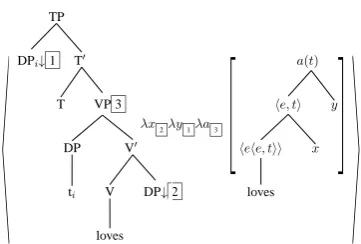
We adopt a traditional view of syntactic elemen-tary trees as the realization of a single lexical predicate and its grammatical “associates” (cf. the Condition on Elementary Tree Minimality and Theta Criterion of Frank (2002)). The corre-sponding semantic objects are composed from the meaning assignments for the lexical anchor to-gether with the meanings associated with non-projected non-terminals. Substitution nodes are interpreted as typed variables (with types deter-mined by a bijection from syntactic categories to semantic types: DP to type e, NP to type he, ti, CP, TP and VP to typet, etc. We follow Pogodalla (2004) in assuming that such variables are bound by (linear) lambda operators, and take syntactic substitution ofS intoT to correspond to (seman-tic) function application ofT toS. For a syntac-tic nodeN targeted for adjoining, we assume that the corresponding node in the semantic represen-tation is embedded beneath an abstracted function variable (with typehα, αiwhereαis the type de-termined by the category bijection for N). Ad-joining of auxiliary treeAto treeTcorresponds to application ofT toA. We assume that adjoining always applies at nodes to which it may; when no content is added, a semantic identity function is applied. Some linkages between the syntactic and semantic trees are straightforward: non-projected non-terminals are linked to the lambda operators binding their associated variables, while projected nodes in the syntax are linked to lambda operators binding variables of the appropriate hα, αi type. This gives rise to a pairing of the sort in Figure 1 for the transitive verb love.
What is less clear is how to establish the non-bijective linkages between sites for syntactic
T VP 3
DP
ti V′
V
loves DP↓2
λx2λy1λa3
a(t)he, ti
hehe, tii
loves
x y
Figure 1: Syntactic and Semantic Tree Pair for loves
DPD
every NP
N
boy
t∀xb t
he, ti
λy.boy(y)
xb
t*
e
[image:2.595.87.268.66.188.2]xb
Figure 2: Tree Set for every boy (Schema for all Gen-eralized Quantifiers)
tachment and semantic composition. Originating in Shieber and Schabes (1990), and continuing in all of the subsequent STAG-based work on scope we are aware of, it is assumed that the DP posi-tion in, say, the subject of a transitive verb-headed elementary tree is linked to both thee-type exter-nal argument of the predicate and thet-type root of the tree. This dual-linkage is mirrored in non-STAG accounts of quantification, such as the Hole Semantics-based account in Kallmeyer and Joshi (2003), and subsequent works in that tradition. No matter which type of semantic account the an-alyst prefers, it is widely accepted that quantifica-tion requires this simultaneous access to both an argument position and the root of a tree. Deriva-tionally, this is of course simply a matter of tree-local MCS combination, but in STAG, there is the additional wrinkle of derivational links. Such multiple linkages are crucial for the establishment of scope for quantificational DPs, represented as multi-component sets (MCSs) in the semantics, but not the syntax, as in Figure 2. The variable component of this MCS substitutes into thee-type argument slot, while thet-recursive scope auxil-iary tree adjoins at the semantic predicate’stroot. It is difficult to see what within the verbal pred-icate itself directly motivates a link between the DP syntactic position and the t adjoining site in the semantics. We will assume that only the
link-age between the syntactic position and the seman-tic argument slot is basic, as given in Figure 1. Once these are established, semantic trees can un-dergo an operation that creates multiple linkages in a systematic fashion. Specifically, we make use of an operation similar to argument raising from Hendriks (1988). In Hendriks’ operation, the type of an argument is lifted (Partee and Rooth, 1983) from its basicetype to the generalized quantifier
hhe, ti, titype, allowing a raised argument to ef-fectively take scope over the predicate. Applica-tion of this operaApplica-tion to the internal argument of a two-place predicate is shown in (1).
(1) he,he, tii:f ⇒ he,hhhe, ti, ti, ti :
λxe.λThhe,ti,ti.T(λye.f(y)(x))
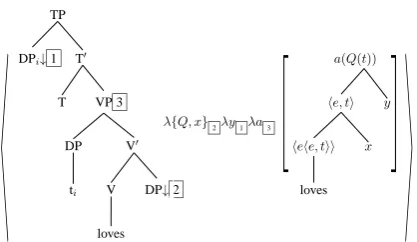
The lambda gymnastics involved here are sub-stantial. We can accomplish a similar effect with the paired STAG structure in Figure 1 in a sim-pler way, if we allow one of thee-type arguments to be linked to a new functional hα, αi variable. We represent this linkage as the combination of two variables under the scope of a single lambda operator, as shown in Figure 3. We take such set-valued lambda operators to encode the fact that the arguments must be introduced in a single derivational step, via combination with a MCS. In order to ensure that the newly introduced func-tional variable Q does not disturb the surround-ing semantic combinations, it is crucial thatQbe type-preserving (i.e., of typehα, αifor someα).
λxλyλa
a(t)he, ti
hehe, tii
P x
y
⇒λ{Q, x}λyλa
a(Q(t))he, ti
hehe, tii
P x
y
Figure 3: Schematic Example of Type Lifting in Trees (Shown for Internal Argument)
[image:2.595.309.506.522.594.2]T VP 3
DP
ti V′
V
loves DP↓2
λ{Q, x}2λy1λa3
a(Q(t))he, ti
hehe, tii
loves
x y
[image:3.595.74.283.67.188.2]Figure 4: Syntactic and Semantic Tree Pair for loves (Type-lifted Internal Argument)
lifting operations, one for each of the predicate’s arguments. These iterations of type-shifting take place after the construction of an elementary tree, but before the tree enters into any TAG combi-natory operations. That is, the links (and their relative scopes) are all in place before any sub-stitution or adjoining operations take place. What we have gained is that the additional non-bijective link which normally appears by stipulation now has a principled origin in the type-shifting opera-tion which makes it possible for a semantic MCS to combine in a single derivational step.
3 Extending Beyond Quantifiers
Type lifting is not limited to linking e-type vari-ables to quantificational scope. In principle, any argument slot can be linked to an arbitrary type-preserving function, so long as there is a MCS that can satisfy these two positions simultane-ously. One case involves infinitival complements to control predicates. Under the analysis of con-trol of Nesson and Shieber (2008), the concon-trol predicate’s semantic representation is a MCS with ane-type variable to fill the embedded subject ar-gument slot as well as at-recursive auxiliary bear-ing the predicate’s lexical content. Just as with quantifiers, we link the semantic slot for the e -type subject argument with the root t node, at which the embedding control predicate adjoins. Because this linkage is analogous to the one estab-lished in the case of quantifiers, we predict its in-teraction with other linkages to behave similarly. Specifically, we are led to expect that object quan-tifiers in the infinitival complement clause should be able to scope out of that clause, past the em-bedding control predicate (as well as quantifiers in the higher clause). This prediction is correct, as shown in (2).
(2) Someone wants to visit every European city. (want>∀,∀>want)
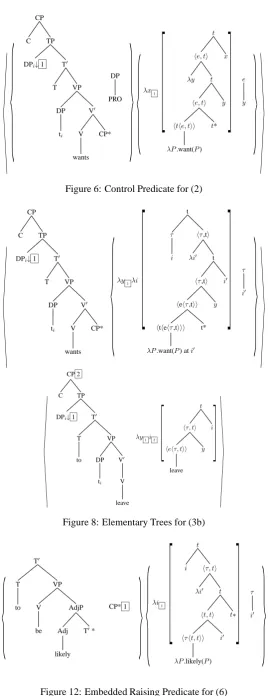
The example is derivable using the tree set for the control predicate in Figure 6, along with trees for the embedded clause and for the quantifiers, all lexical variants of the trees in Figures 1 and 2. The embedded predicate is shown in Figure 5, with type-shifting having applied in the order which yields surface scope. Recall though that inverse scope is equally possible, as we place no restriction on the order of the applications of type-shifting. The derivation proceeds as in Figure 7, with the order of the two instances of type lifting over the arguments of to visit left unspecified.
TP DPi↓1 T′T
to
VP 3
DP
ti V′
V
visit DP↓2
λ{Q, x}2λ{P, y}1λa3
a(P(Q(t))) he, tihehe, tii
visit
x y
Figure 5: Non-finite predicate to visit, type-shifted for surface scope
to visit
every city
European
want
[image:3.595.304.518.281.397.2]someone
Figure 7: Derivation Tree for (2)
The same scope facts are present in other ex-amples of non-finite clausal embedding, such as raising and ECM, as in (3).
(3) a. Some member seems to like every amendment. (seems > ∀, ∀ > seems)
b. Some member wants every minis-ter to leave. (wants > ∀, ∀ > wants)
(4) below: depending on the choice of the ma-trix predicate, the embedded event is understood to take place at a different relative time. For finite clausal complements as in (5), the temporal rela-tion must be conveyed through tense marking in the embedded clause.
(4) a. John regrets missing your talk. (τ(missing-talk)<now)
b. John anticipates missing your talk. (τ(missing-talk)>now)
(5) a. John regrets that he missed your talk.
b. John anticipates that he will miss your talk.
It is straightforward to assume that the depen-dency in (3) results from the matrix predicate pro-viding a temporal variable to the non-finite em-bedded clause. We implement this temporal vari-able using a simplified version of the presenta-tion in Kusumoto (2005); most notably, we omit from our analysis additional situation variables also present in Kusumoto’s analysis. This is done purely in the interest of keeping the semantics as clear as possible, and is not intended as an ex-plicit claim that these variables are incompatible with the analysis.
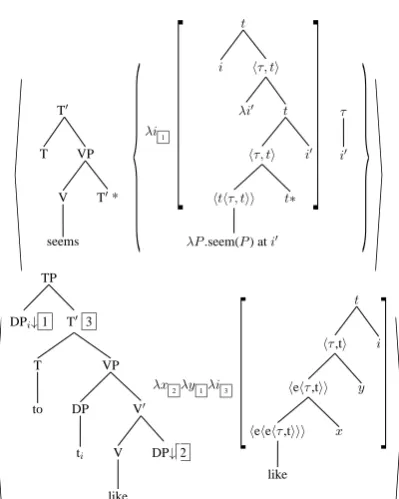
We take the temporal dependency between clauses as in (3) and (4) to indicate multicompo-nent semantics in the matrix predicate, the use of which must be licensed by type lifting in the em-bedded clause. Once again, we should expect that this instance of type lifting can be interleaved with those for embedded quantificational arguments, predicting the observed scope facts. We illustrate using the ECM case (3b), beginning in Figure 8 with the elementary trees for the two predicates. ECM want is a MCS providing a temporal vari-ableiof typeτ, similar to a control predicate pro-viding an argument of type e. The matrix predi-cate’s temporal variable can be saturated by a tem-poral indexical, whose interpretation varies with the tense of the matrix clause. Crucial to our sys-tem is the notion that there is only one such in-dexical available per derivation. The embedded clause has a similar variable slot, but as just stated, it cannot be similarly filled by an indexical. By type lifting over this position, the ECM predicate may combine in exactly the same way as a quanti-fier. The derivation in Figure 9 yields the reported scope ambiguity through underspecification of the
order of type lifting in the embedded clause. A similar process yields (3a), using the trees in Fig-ure 10, following the derivation in FigFig-ure 11.
to leave
every minister want
[image:4.595.311.511.215.465.2]some member
Figure 9: Derivation Tree for (3b)
T′
T VP
V
seems T′*
λi1
ti hτ, ti
λi′ t
hτ, ti
hthτ, tii
λP.seem(P) ati′ t∗
i′
τ i′
TP DPi↓1 T′ 3T
to
VP
DP
ti V′
V
like DP↓2
λx2λy1λi3
thτ,ti
hehτ,tii
hehehτ,tiii
like
x y
i
Figure 10: Elementary Trees for (3a)
to like
some member every amendment seem
Figure 11: Derivation Tree for (3a)
4 Multiple Predicates
Thus far, we have limited our discussion to simple cases of single clause embedding; in this section we illustrate how the proposed system will inter-act with multiple embedding, and with coordina-tion.
An example of multiple embedding is given in (6):
(6) John wants Mary to be likely to win.
8. The raising predicate, for the moment, we as-sume will have the standard TAG syntax of recur-sion on T′, meaning that it is syntactically possi-ble for both wants and to be likely to adjoin at dif-ferent nodes in the to win tree. This raises two is-sues. Firstly, both the ECM and raising predicates would be adjoining at the same node in the se-mantics, predicting ambiguity between wants and
likely. However, this ambiguity is not found, and
only the surface scope of wants>likely is
avail-able. Secondly, there is an issue concerning the interval variables. The embedded predicate to win will have one open substitution site for an interval variable in its semantic elementary tree. However, both likely and wants have such a variable to pass on. It thus seems that under the proposed syntac-tic analysis, not only do we predict an unobserved ambiguity, but an interval variable will go unused. To resolve this issue, we propose a tree set for the raising predicate as in Figure 12. Looking first at the semantics, as a clause which will adjoin into a non-finite clause, this passes down an in-terval variable, as described. However, this pred-icate itself also requires an interval argument of some sort to saturate its own typeτ argument slot, and we assume that only one temporal indexical is available per derivation. If this indexical is to be substituted into the matrix ECM predicate, then that predicate’s own interval variable must be the one which substitutes into the raising predicate. That is, wants must combine directly with likely, not to win. This is a welcome finding, as it also predicts the observed scope facts. This then leads us to discuss the syntax of this raising predicate; with an additional degenerate CP node which can serve as the destination of the ECM predicate, di-rect combination of wants into likely is now pos-sible, with the CP-recursive wants auxiliary tree adjoining to the degenerate CP tree in the set as-sociated with the raising predicate. Type-shifting over the interval variable position in likely allows the wants MCS to adjoin, and type-shifting over the interval variable in to win allows likely to ad-join, bringing the ECM predicate along, with both the T′- and CP-recursive adjoinings coming from one elementary tree set.
A slightly different problem arises when com-bining control with a raising predicate as in the similar (7):
(7) John wants to be likely to win.
First, let us consider the scope facts. As in the previous case, there is only one possible reading here, the surface scope where want scopes over
likely; it is not the case that John is likely to want
to win, rather he wants to be likely to win. Thus, the same type of chained derivation would seem to be in order. However, there is an additional com-plication: we have already made the claim that control predicates pass down a typeeargument to the clauses in which they adjoin, not typeτ. As a raising predicate, likely should never take a type eargument unless an experiencer phrase is added. Further complicating matters is the fact that the typeevariable provided by the control predicate is clearly an argument of win; this suggests that the derivation which we worked so hard to ob-viate in the previous case must be the only one available. Both want and likely should combine directly with the embedded predicate.
However, two new problems present them-selves: firstly, given that these predicates will each combine via a type-shift, we predict again there to be a scope ambiguity, contrary to fact. Furthermore, there is the additional question of the open interval variable in the raising predicate. Assuming that to be likely here is of the same form as in Figure 12, then what will fill that argument position? We have already claimed that there is only one indexical available, and Stowell’s obser-vations make it clear that there is no temporal con-nection between a control predicate and the clause it embeds. In fact, this second question extends beyond this particular example. The elementary tree for the embedded clause in Figure 5 should likewise require an interval variable which is not provided by the matrix predicate.
To resolve this issue, we propose that non-finite predicates embedded under a control predicate contain a function INF from typehτ, titot, given in (8):
(8) INF =λP.✸∃iInf.P(iInf)
had stated that because both want and likely would combine with win via a type-shift, their scopes should be permutable, but that only the surface scope is available. We speculate that it is the effect of this INF operator which serves to rule out the reading where likely outscopes want. This is be-cause such a scope would also give the INF func-tion wide scope over the whole expression, yield-ing a situation where the widest temporal opera-tor carries this contingent existential, essentially making it possible for there to be no interval at which the described events took place, which is an undesirable result. Nothing in the derivation per
se blocks this reading, rather a well-formedness
constraint on semantic outputs would do so.
T′T
to
VP
V
be
AdjP
Adj
likely T′*
t
INF hτ, ti
λi′ t
ht, ti
hτht, tii
λP.likely(P)
i′ t∗
τ i′
Figure 13: Non Finite Raising Predicate under Control
A reviewer notes that certain cases of Right Node Raising may present a particular challenge for our approach, with an example as in (9):
(9) Every boy supported and every girl protested some amendment.
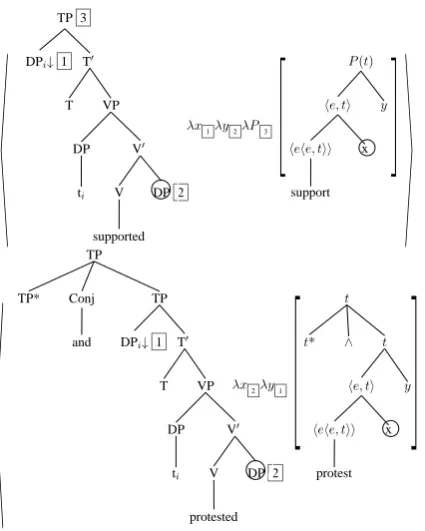
Specifically, the concern is in deriving the read-ing in which the shared argument’s existential quantifier has narrow scope relative to the uni-versals, since the right-node-raised existential ob-ject would appear to be derivationally higher than the subject quantifiers within the conjoined sen-tences. In fact, such cases can be treated if we adopt the approach to coordination presented in Sarkar and Joshi (1996), and further developed in Han et al. (2008), where examples like (9) are discussed. Under this approach, we allow ele-mentary trees to contain nodes that are marked as shared arguments. When two predicate trees with nodes targeted for sharing (indicated by a cir-cle) are combined, a node-contraction operation applies, such that the relevant shared nodes com-bine into a single node that is multiply-dominated
in both the derived syntax and semantics trees.1 In Figure 14, we update the relevant Han et al. elementary trees with our new semantic notation, dispensing for the moment with interval variables.
TP 3DPi↓1 T′
T VP
DP
ti V′
V
supported DP 2
λx1λy2λP3
P(t)he, ti
hehe, tii
support x
y
TPTP* Conj
and
TP
DPi↓ 1 T′
T VP
DP
ti V′
V
protested DP 2
λx2λy1
tt* ∧ t
he, ti
hehe, tii
protest x
y
[image:6.595.307.520.132.398.2]Figure 14: Elementary trees for Coordination
The support elementary tree contains three linked nodes: one for the subject, which is a stan-dard type e substitution site, one for the object, which is marked for contraction, and one at the root, which corresponds to λP, which binds a function of typeht, ti. The coordinator is treated as a functional element in the protest tree, pro-jected in accordance with the CETM. The second elementary tree contains two links, one each for the arguments of the verb. These elementary trees however provide two new questions regarding the application of our type-shifting operation. The first concerns the status of the object in the
sup-port tree. A crucial feature of the Han et al.
anal-ysis is that the shared object, some amendment in this case, is not duplicated, but rather shared through multiple dominance. As such, its scope part can only combine with one of the two ele-mentary trees. Thus, we do not apply the type-shifting operation at all to the support tree, as the only component of the quantificational MCS that is relevant here will be the typeevariable. Type
shifting the support tree would force the quanti-fier’s scope part into a position that does not dom-inate both of the contracted nodes after protest ad-joins at the root of support, leaving an unbound variable.
The second question concerns the application of type-shifting in the protest elementary tree. This is the first time we have explicitly dealt with the question of how to apply the type shifting op-eration in an elementary tree with more than one availabletnode. Here, we suppose that the type-shifting operation targets only the root of the el-ementary tree. That is, both the shared and non-shared arguments of protest can take scope over the coordinator. In the case of the shared argu-ment, this is treated as a necessity for proper vari-able binding in the original Han et al. presenta-tion, an observation which we echo here. How-ever, they treat it as equally necessary for the non-shared argument to take a low scope relative to the coordinator, and here our analyses diverge. We believe it should be possible to derive the reading in which the non-shared argument takes widest scope. Thus, type-shifting will link both argu-ments to the root of the protest tree.
Finally, it is just a matter of determining whether or not there is a possible derivational or-der which yields the narrow scope of the shared argument. First, we must examine the orderings of type-shifting. By first type-shifting the ob-ject position and then the subob-ject position in the
protest tree, every girl will take a wider scope
than some amendment at the root of that tree. Similarly, the subject position in support will also undergo a type-shift, allowing the subject to outscope the coordinating predicate, which does not require a type-shift to combine. Once the predicates are combined, the universals will both outscope the existential, and the coordinator.
5 Type-Shifting and Scope Interleaving
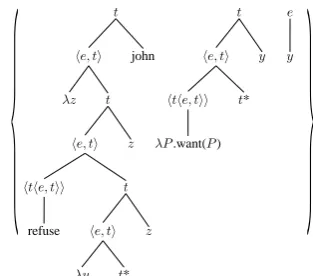
Finally, a reviewer brings the question of whether or not the type-shifting operation will allow for the derivation of quantificational scopes not read-ily derivable by conventional set-local means. Specifically, an example such as that in (10):
(10) John refused to want to visit every can-didate.
The reading of interest here is the one where John refused, for every candidate, to want to visit that
candidate. That is, refuse>∀>want. Again,
be-cause this involves a chain of control predicates, we can dispense with the interval variables for the time being and concentrate on the typee vari-ables. The reviewer is quite correct in suspecting that there is nothing inherent in the type-shifting operation which will allow us to derive this read-ing. With the tools presently available, refuse will combine with want, and the embedded quantifier is predicted to scope over or under that compound predicate, yielding either ∀ > refuse > want or refuse>want>∀.
However, we call readers’ attention to Frank and Storoshenko (2012) in this volume. There, we motivate the breaking of predicate elemen-tary trees in the semantics into “scope” and “vari-able” parts, along the same lines as the general-ized quantifiers seen here. Following a sugges-tion in Nesson and Shieber (2008), a control pred-icate becomes a 3-member MCS consisting of this scope part containing the substitution site for the external argument, the predicate part, and the type evariable to be passed down. The type-shifting operation described here is not incompatible with that analysis, though its domain of application will naturally be limited to the scope parts of those elementary tree sets which contain substitution sites for type e(or type τ) variables. Again, our account of unspecified ordering of type-shifting applies only to this component of the larger MCS, rather than to the predicate tree.
the, ti
λz t
he, ti
hthe, tii
refuse
t
he, ti
λy t*
z z
john
t
he, ti
hthe, tii
λP.want(P)
t*
y e
[image:7.595.329.486.504.642.2]y
Figure 15: Partial Semantic Derived Tree Set for (10)
3-component structure. This will combine with
visit via type-shifting. One wrinkle at this point
is that our type-shifting operation has to this point only dealt with 2-member MCSs. Either the type-shifting operation can be re-defined to allow this triplet, or our preferred interpretation at this point is to maintain that a single link is going to be cre-ated, and we rely upon the constraints of the MCS such that the components will eventually collapse into a single tree structure, needing only one link. As argued in the paper where these structures are introduced, we believe that, with some deriva-tional flexibility, they make certain scopes avail-able which are not otherwise derivavail-able. In this case, as both want and every candidate will com-bine via a type-shift targeting the same node (the root of the scope part of visit), full freedom for multiple adjoining is possible, so long as all vari-ables are properly bound. Thus, the tree com-ponent carrying the universal quantifier should be able to intervene between the twot-recursive components of want, deriving the desired reading. For more details on these scope possibilities, we refer readers to the cited paper.
6 Conclusion
In this paper, we have sought a more restric-tive framework for linking syntactic and semantic trees in STAG. Combining our modified seman-tic representations with the type lifting operation provides us a principled account for the creation of the derivational links which captured the simul-taneous substitution and adjoining of quantifica-tional MCSs. Extending this operation to type-τ temporal variables, we have shown how embed-ded quantifiers can scope over raising and ECM predicates. It remains for future work to develop a fully fleshed-out account of the temporal system sketched here, including the links between open type-τ variables and multiple possible syntactic positions where different clauses may adjoin.
Acknowledgments
The authors would like to thank the reviewers for their many helpful comments and questions which have improved the quality of this paper, particu-larly forcing us to reconcile both our submissions to this volume. All errors remain our own. This work is partially-funded by SSHRC Postdoc Fel-lowship 756-2010-0677 to Storoshenko.
References
Robert Frank and Dennis Ryan Storoshenko. 2012. The shape of elementary trees and scope possibil-ities in stag. In Proceedings of the 11th Interna-tional Workshop on Tree Adjoining Grammars and Related Formalisms.
Robert Frank. 2002. Phrase Structure Composition
and Syntactic Dependencies. Cambridge, MA: MIT
Press.
Chung-hye Han, David Potter, and Dennis Ryan Storoshenko. 2008. Compositional semantics of coordination using Synchronous Tree Adjoining Grammar. In Claire Gardent and Anoop Sarkar, editors, Proceedings of the 9thInternational Work-shop on Tree Adjoining Grammars and Related For-malisms, pages 33–41.
Herman Hendriks. 1988. Type change semantics: The scope of quantification and coordination. In E. Klein and van Benthem J., editors, Categories,
Polymorphism and Unification, pages 96–119.
Cen-tre for Cognitive Science, Edinburgh.
Laura Kallmeyer and Aravind K. Joshi. 2003. Factor-ing predicate argument and scope semantics: Un-derspecified semantics with LTAG. Research on Language and Computation, 1:3–58.
Kiyomi Kusumoto. 2005. On the quantification over times in natural language. Natural Language
Se-mantics, 13:317–357.
Rebecca Nesson and Stuart M. Shieber. 2008. Syn-chronous vector TAG for syntax and semantics: Control verbs, relative clauses, and inverse linking. In Claire Gardent and Anoop Sarkar, editors,
Pro-ceedings of the 9thInternational Workshop on Tree Adjoining Grammars and Related Formalisms.
Barbara Partee and Mats Rooth. 1983. Generalized conjunction and type ambiguity. In Rainer B¨auerle, Christoph Schwaze, and Arnim von Stechow, ed-itors, Meaning, Use, and Interpretation of
Lan-guage, pages 361–383. Berlin: Mouton de Gruyter.
Sylvain Pogodalla. 2004. Computing semantic repre-sentation: Toward ACG abstract terms as derivation trees. In Proceedings of the 7thInternational Work-shop on Tree Adjoining Grammars and Related For-malisms.
Anoop Sarkar and Aravind Joshi. 1996. Coordination in Tree Adjoining Grammars: formalization and implementation. In Proceedings of COLING’96, pages 610–615, Copenhagen.
Stuart M. Shieber and Yves Schabes. 1990. Syn-chronous tree adjoining grammars. In Papers
Pre-sented to the 13th International Conference on Computational Linguistics, volume 3, pages 253–
258.
Tim Stowell. 1982. The tense of infinitives.
C TP
DPi↓1 T′
T VP
DP
ti
V′
V
wants CP*
DP
PRO
λx1
the, ti
λy t
he, ti
hthe, tii
λP.want(P)
t*
y x
e y
[image:9.595.161.430.58.756.2]Figure 6: Control Predicate for (2)
CPC TP
DPi↓1 T′
T VP
DP
ti
V′
V
wants CP*
λy1λi
tτ
i
hτ,ti
λi′ t
hτ,ti
hehτ,tii
hthehτ,tiii
λP.want(P) ati′
t*
y i′
τ
i′
CP 2
C TP
DPi↓1 T′
T
to
VP
DP
ti V′
V
leave
λy1i2
thτ, ti
hehτ, tii
leave
y i
Figure 8: Elementary Trees for (3b)
T′T
to
VP
V
be
AdjP
Adj
likely T′*
CP* 1
λi1
ti hτ, ti
λi′ t
ht, ti
hτht, tii
λP.likely(P)
i′ t∗
τ
i′