Automatic Construction of a MultiWord Expressions
Bilingual Lexicon: A Statistical Machine Translation
Evaluation Perspective
Dhouha Bouamor
1,2N asredine Semmar
1Pier re Zwei genbeaum
2(1) CEA-LIST, Vision and Content Engineering Laboratory 91191 Gif-sur-Yvette Cedex, France (2) LIMSI-CNRS, F-91403 Orsay, France
[email protected], [email protected], [email protected]
A
BSTRACTIdentifying and translating MultiWord Expressions (MWES) in a text represent a key issue
for numerous applications of Natural Language Processing (NLP), especially for Machine Translation (MT). In this paper, we present a method aiming to construct a bilingual lexicon of MWESfrom a French-English parallel corpus. In order to assess the quality of the mined lexicon,
a Statistical Machine Translation (SMT) task-based evaluation is conducted. We investigate the performance of three dynamic strategies and of one static strategy to integrate the mined bilingual MWESlexicon in a SMT system. Experimental results shows that such a lexicon
improves the quality of translation.
Construction Automatique d’un Lexique Bilingue d’Expressions
Multi-Mots: Une Perspective d’Évaluation par un Système de Traduction
Statistique
Identifier et traduire correctement les Expressions Multi-Mots (EMMS) dans un texte constituent un défi majeur pour différentes applications du Traitement Automatique des Langues Naturelles, et surtout en Traduction Automatique. Ce présent travail présente une méthode permettant de construire un lexique bilingue d’EMMSà partir d’un corpus parallèle Français-Anglais. Afin d’évaluer la qualité du lexique acquis, une évaluation axée sur la tâche de Traduction Automatique Statistique (TAS) est menée. Nous étudions les performances de trois stratégies dynamiques et d’une stratégie statique pour intégrer le lexique bilingue d’EMMSdans un système de TAS. Les expériences menées dans ce cadre montrent que ces unités améliorent la qualité de traduction.
K
EYWORDS:
MultiWord Expressions, Bilingual Alignment, Statistical Machine Translation.1 Introduction
A MultiWord Expression (MWE) can be defined as a combination of words for which syntactic or semantic properties of the whole expression cannot be obtained from its parts (Sag et al., 2002). Such units are made up of collocations (“cordon bleu”), frozen expressions (“kick the bucket”), named entities (“New York”) etc. (Sag et al., 2002; Constant et al., 2011). These units are numerous and constitute a significant portion of the lexicon of any natural language. (Jack-endoff, 1997) claims that the frequency of MWESin a speaker’s lexicon is almost equivalent to
the frequency of single words. While easily mastered by native speakers, their interpretation poses a major challenge for Natural Language Processing (NLP) applications, especially for those addressing semantic aspects of language.
For Statistical Machine Translation (SMT) systems, various improvements of translation quality were achieved with the emergence of phrase based approaches (Koehn et al., 2003). Phrases are usually defined as simply arbitrary n-grams with no sophisticated linguistic motivation consistently translated in a parallel corpus. In such systems, the lack of an adequate processing of MWEScould affect the translation quality. In fact, the literal translation of an unrecognized
expression is the source of an erroneous and incomprehensible translation. For example, these systems would suggest“way of iron”as a translation of“chemin de fer”instead of“railway”. It is therefore important to use a lexicon in which MWESare handled. But such a resource is not
readily available in all languages, and if it exists, as described by (Sagot et al., 2005), it does not cover all MWESof a given language.
In this paper, we propose a method aiming to acquire a bilingual lexicon of MWESfrom a
French-English parallel corpus. We consider any compositional and non-compositional contiguous sequence, belonging to one of the three classes defined by (Luka et al., 2006), as a MWE. Classes of MWESwere distinguished on the basis of their categorical properties and their syntactic and
semantic fixedness degrees and consist ofcompounds,idiomatic expressionsandcollocations. Intuitively, bilingual MWESare useful to improve the performance of SMT. However, further
research is still needed to find the best way to bring such external knowledge to the decoder. In this study, we view SMT as an extrinsic evaluation of the usefulness of MWESand explore
strategies for integrating such textual units in an SMT system. Given a constructed bilingual MWESlexicon, we propose (1) threedynamic integrationstrategies in which we attempt to
change the translation model in several ways to handle MWESand (2) astatic integration
strategy in which we would like to plug these translations into the decoder without changing the model.
This paper is organized as follows: the next section (section 2) describes in some details previous works addressing the task of bilingual extraction of MWESand its applications. In
section 3, we present the method we used to build the bilingual lexicon of MWESand then
introduce in section 4 four strategies aiming to integrate MWESin an SMT system. In section 5,
we report and discuss the obtained results. We finally conclude and present our future work in section 6.
2 Related Work
In recent years, a number of techniques have been introduced to tackle the task of bilingual MWESextraction from parallel corpora. Most works start by identifying monolingual MWE
methods relying on morphosyntactic patterns (Okita et al., 2010; Dagan and Church, 1994); (2) statistical methods which use association measures to rank MWE candidates (Vintar and Fisier, 2008) and (3) Hybrid approaches combining (1) and (2) (Wu and Chang, 2004; Seretan and Wehrli, 2007; Daille, 2001; Boulaknadel et al., 2008). Each approach shows several limitations. It is, for example, difficult to apply symbolic methods to data without syntactic annotations. Furthermore, due to corpus size, statistical measures have mostly been applied to bigrams and trigrams, and it becomes more problematic to extract MWESof more than three words.
Concerning the alignment task, numerous approaches have already been introduced to deal with this issue. Some works make use of simple-word alignment tools (Dagan and Church, 1994; Lefever et al., 2009). Others rely on machine learning algorithms such as theExpectation Maximisation (EM)algorithm (Kupiec, 1993; Okita et al., 2010). In another direction, (Tufis and Ion, 2007; Seretan and Wehrli, 2007) introduce a linguistic approach in which they claim that MWESkeep in most cases the same morphosyntactic structure in the source and target
language, which is not universal. For example the French MWE“insulaire en développement”, aligned with the English MWE“small island developing”do not share the same morphosyntactic structure.
Most of the methods described above aims at identifying MWESin a corpus to construct or
extend a bilingual lexicon without any application perspective. However, few works have focused on the extraction of bilingual MWESlexicons in order to improve the performance of
MT systems by reporting improved BLEU(Papineni et al., 2002) scores. This measure calculates
the n-grams precision against a reference translation. In (Lambert and Banchs, 2005), authors introduce a method in which a bilingual MWESlexicon was used to modify the word alignment
in order to improve the translation quality. In their work, bilingual MWESwere grouped as
one unique token before training alignment models. They showed on a small corpus, that both alignment quality and translation accuracy were improved. However, in a further study, a lower BLEUscore is reported after grouping MWESby part-of-speech on a large corpus (Lambert and
Banchs, 2006). Some works have however focused on automatically learning translations of very specific MWEScategories, such as, for instance, idiomatic four character expressions in
Chinese (Bai et al., 2009) or domain specific MWEs (Ren et al., 2009). (Carpuat and Diab, 2010) introduced a framework of two complementary integration strategies for monolingual MWES
in SMT. The first strategy segments training and test sentences according to the monolingual MWESvocabulary ofWordnet. In the second strategy, they add a new MWE-based feature
in SMT translation lexicons representing the number of MWESin the source sentence. More
recently, In (Bouamor et al., 2011), we proposed a method to enrich an SMT system’s phrase table by a bilingual lexicon handling MWES. On a small corpus (10ksentences), this method
yeilds an improvement of 0.24 points in BLEUscore. This study is an extention of the approach
we presented in (Bouamor et al., 2011). We propose a method aiming to extract and align such units and study different strategies to integrate them into MOSES(Koehn, 2005), the state-of-the
art SMT system.
3 Bilingual MWE
Slexicon
In this section, we describe the approach we used to mine the bilingual lexicon of MWESfrom a sentence aligned French-English parallel corpus. This approach is conducted in two steps. We first extract monolingual MWESfrom each part of the parallel corpus. The second step consists
Pattern English/French MWEs Adj-Noun Plenary meeting/Libre circulation Noun-Adj . . ./Parlement européen Noun-Noun Member state/Etat membre Past_Participle -Noun Developped country/. . . Noun-Past_Participle Parliament adopted/Pays developpé Adj-Adj-Noun European public prosecutor/. . .
Adj-Noun-Adj Social market economy/Bon conduite administratif Adj-Noun-Noun Renewable energy source/. . .
Noun-Noun-Adj . . ./Industrie automobile allemand Noun-Adj-Adj . . ./Ministère public européen Adj-Noun-Adj . . ./Important débat politique Noun-Prep-Noun Point of view/Chemin de fer
Noun-Prep-Adj-Noun Court of first instance/Court de première instance Noun-Prep-Noun-Adj . . ./Source d’énergie renouvelable
[image:4.420.107.296.70.234.2]Adj-Noun-Prep-Noun European court of justice/. . . Noun-Adj-Prep-Noun . . ./Politique européen de concurrence
Table 1: French and English MWE’s morphosyntactic patterns
3.1 Monolingual Extraction of MWEs
The method we propose to identify monolingual MWESin a text is based on a symbolic approach.
This method is quite similar to the one used by (Okita et al., 2010). If they define patterns to handle only noun phrases, our approach takes into account both noun phrases, fixed expressions and named entities. Relatively simple, it does not use additional correlations statistics such as Mutual Information or Log Likelihood Ratio and attempts to find translations for all extracted MWES(both highly and weakly correlated MWES), to our knowledge, none of other approaches can make this claim. This method involves only a full morphosyntactic analysis of source and target texts. This morphosyntactic analysis is achieved using the CEA LIST Multilingual Analysis platform (LIMA) (Besançon et al., 2010) which produces a set of part of speech tagged normalized lemmas. Our algorithm operates on lemmas instead of surface forms which can draw on richer statistics and overcome the data sparseness problems. Since most MWES
consist of noun, adjectives and prepositions, we adopted a linguistic filter keeping only n-gram units (2≤n≤4) which match a list of 16 hand created morphosyntactic patterns. Such a process is used to keep only specificstringsand filter out undesirable ones such as candidates composed mainly of stop words (“of a, is a, that was”). In Table 1 we give an example of MWE produced for each pattern. There exists extraction patterns (or configuration) for which no MWE has been generated (i.e.Noun-Adj).
Some of the fixed expressions such as (in particular, in the light of, as regards...) and named entities (Midle East, South Africa, El-Salvador...) recognized by the morphosyntactic analyzer are added to the candidate list. Then, all extracted MWESare stored with their total frequency of
occurrence. To avoid an over-generation of MWESand remove irrelevant candidates from the
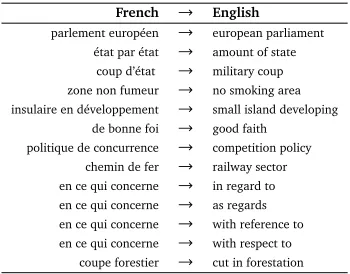
French → English parlement européen → european parliament
état par état → amount of state coup d’état → military coup zone non fumeur → no smoking area insulaire en développement → small island developing
de bonne foi → good faith politique de concurrence → competition policy
chemin de fer → railway sector en ce qui concerne → in regard to en ce qui concerne → as regards en ce qui concerne → with reference to en ce qui concerne → with respect to
[image:5.420.129.304.70.207.2]coupe forestier → cut in forestation
Table 2: Sample of aligned MWES
3.2 Bilingual Alignment
Bilingual alignment is achieved by a method which consists in finding for each MWE in a source language its adequate translation in the target language. Traditionally, this task was handled through the use of external linguistic resources such as bilingual dictionaries or simple-word alignment tools. We propose aresource-independantmethod which simply requires a parallel corpus and a list of input MWE candidates to translate. Our approach is based on aspects of distributional semantics (Harris, 1954), where a specific representation is associated to each expression (source and target). We associate to each MWE anNsized vector, whereNis the number of sentences in the corpus, indicating whether or not it occurs in each sentence of the corpus. Our algorithm is based on the Vector Space Model (VSM). VSM (Salton et al., 1975) is a well-known algebraic model used in information retrieval, indexing and relevance ranking. This
vector space representationwill serve, eventually, as a basis to establish a translation relation between each pair of MWES. To extract translation pairs of MWES, we propose an iterative,
greedy alignment algorithm which operates as follows:
1. Find the most frequent MWEex pin each source sentence.
2. Extract all target translation candidates, occurring in all sentences parallel to those containingex p.
3. Compute a confidence valueVCon f for each translation relation betweenex pand each
target translation candidate.
4. Consider that the target MWE maximizingVCon f is the best translation.
5. Discard the translation pair from the process and go back to 1.
The confidence valueVCon f is computed on the basis of theJaccard Index(1). J accard=V Ist
s+Vt+Ist (1)
This measure is based on the numberIstof sentences shared by each target and a source MWE.
appear independently of each other (VsandVt) increased byIst. In table 2, a sample of MWES
aligned by means of the algorithm described above.
From observing some pairs, we notice that our method presents several advantages: In order to find the adequate translation of a MWE and contrary to most previous works (Dagan and Church, 1994; Ren et al., 2009) using simple-word alignment tools to establish word-to-word alignment relations, our method captures the semantic equivalence between expressions such as“insulaire en dévelopement”and“small island developing”without any prior information about word alignment. It also permits the alignment of idioms such as à nouveau→once moreor evenétat par état→amount of stateand works for MWESfor which multiple correct target
MWEs exist. For instance it captures that theMWE “en ce qui concerne”could be translated by
“in regard to”, “with reference to”, “with respect to”and even by“as regards”.
4 Integration strategies
In the previous section, we described the approach we followed to mine the bilingual lexicon of MWES. In order to assess the lexicon’s quality, we carried out in a previous work (Bouamor
et al., 2011) an intrinsic evaluation in which we compared the obtained pairs of bilingual MWES
to a manual alignment reference. On a small set of 100 French-English parallel sentences derived from the Europarl corpus, our approach yielded a precision of 63, 93% , a recall of 62, 46% and an F-measure of 63, 19%. As it lacks a common benchmark data set for evaluation in MWE extraction and alignment researches, we carry out an extrinsic evaluation based on an SMT application and use MOSES(Koehn, 2005) as our BASELINEsystem. However, as we
mentioned in section 1, the difficulty lies in how to integrate MWESinto such systems. To do
so, we propose three dynamic integration strategies in which the translation model is amended in severals ways, and a static integration strategy in which we plug MWESinto the decoder
without changing the model. We compare their performance in section 5.
4.1 Dynamic integration strategies
4.1.1 New Translation model with MWEs
Phrase tables are the main knowledge source for the machine translation decoder. The decoder consults these tables to figure out how to translate an input candidate in a source language into the target one. However, due to the errors in automatic word alignment, extracted phrases might be meaningless. To alleviate this problem, we add the extracted bilingual MWE as a parallel corpus and retrain the translation model. In this method (TRAIN), we expect that by
increasing the occurrences of bilingual MWES, considered as good phrases, a modification of
the alignment and the translation probability will be noticed.
4.1.2 Extention of the phrase table
In this method, we attempt to extend the BASELINEsystem’s phrase table by integrating the
found bilingual MWEScandidates. We use the Jaccard Index (proposed for each pair of MWEs)
to define the translation probabilities in the two directions and set the lexical probabilities to 1 for simplicity. So, for each phrase in a given input sentence, the decoder will take into account bilingual MWESwhen searching for all candidate translation phrases. This method is denoted
4.1.3 New feature for MWES
(Lopez and Resnik, 2006) pointed out that better feature mining can lead to substantial gain in translation quality. We followed this claim and extended TABLEby adding a new feature
indicating whether a phrase is a MWE or not. The aim of this method (FEAT) is to guide the
system to choose bilingual MWESreturned by our aligner instead of the BASELINE’s system
phrases.
4.2 Static Integration strategy
In this method, noted FORCED, we want to bring the bilingual MWESlexicon to the decoder without changing the translation model. For this claim, we used theforced decoding modeof the Moses system. The decoder has anXML markup schemethat allows the specification of translations for parts of the sentence. In its simplest form, we can indicate to the decoder what to use to translate certain words or phrases in the sentence. So we represented each MWE occuring in the test set by its adequate XML markup scheme, using the translation pair of the lexicon. Below is an example of representing the MWEà nouveauin the test set.
. . . sembler êtreà nouveaumis en accusation, le ministère public . . .
⇓
. . . sembler être<mwetranslation=“once more”>à nouveau< /mwe>mis en accusation, le ministère public . . .
5 Experiments
5.1 Data and tools
We used the French-English Europarl (Koehn, 2005) corpus of parliamentary debates as a source of the parallel corpus. To train the BASELINEsystem’s translation model, we extracted 100000
pairs of sentences from the corpus. First, we tokenized, cleaned up the training corpus and kept only sentences containing at most 50 words. We mined the bilingual lexicon of MWESfrom
the same training corpus. Because the lexicon contains only lemmas of MWEs and the forced decoding mode of Moses is not currently compatible with factored models, the translation model was trained on lemmas instead of their surface forms. Training data were annotated with lemmas by means of the TreeTagger Toolkit1. Next, word-alignment for all the sentences
in the parallel training corpus is established and uses the same methodology as in phrase-based models (symmetrized GIZA++alignments) to create the phrase table. We also specified a language model using the IRST Language Modeling Toolkit2to train a lemma based tri-gram
model on the total size of the Europarl corpus (1.8Msentences). Afterwards, we applied the above-described integration strategies.
The features used in the BASELINEsystem include: (1) four translation probability features, (2)
one language model and (3) word penalty. For the "TRAIN" method, bilingual MWESare added
into the training corpus, as results, new alignments and phrase table are obtained. For the "TABLE" method, bilingual units are incorporated into the BASELINEsystem’s phrase table. In "FEAT", an additional 1/0 feature is introduced for each entry of the phrase table. Concerning the FORCEDmethod, it keeps the same models as BASELINE. Afterwards, the obtained models
Method BLEU TER
All_Test MWEs_Test All_Test MWEs_Test
BASELINE 28.85 30.83 55.44 53.59
Dynamic
TRAIN 28.87 31.06 55.38 53.32
TABLE 28.82 30.88 55.42 53.46
FEAT 28.95 31.06 55.48 53.56
Static
FORCED 28.20 29.19 56.01 55.05
Table 3: Translation results in term of BLEUand TER
were tuned by Minimum Error Rate Training (Och, 2003) on a development set of 4000 pairs of sentences.
5.2 Results and discussion
We conducted two test experiments:All_TestandMWEs_Test. For this, werandomlyextracted 1000 parallel sentences from the corpus described above to construct theAll_Testtest corpus. In order to measure the real contribution of bilingual MWEShandled by different translation models, we constituted theMWEs_Testcorpus, in which we kept only sentences of theAll_Test
corpus containing at least one MWE of the lexicon. This corpus contains 323 pairs of sentences. We evaluate the translation quality of the described dynamic and static strategies on the two test sets with respect to BLEU(Papineni et al., 2002) score, which is based onn-gramprecision,
and Translation Error Rate (TER) (Snover et al., 2006), which generalizes edit distance beyond
single-word edits. For this evaluation, we consider one reference per sentence. Table 3 reports the obtained results.
The first substantial observation, as can be seen, is related to the BLEUscores which vary
according to the test set type. Concerning theAll_testcorpus, the best improvement is achieved by the FEATdynamic strategy, in which we add a new feature indicating wether a phrase in
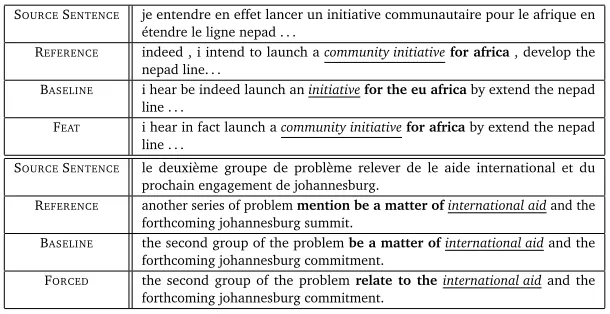
the phrase table is a MWE or not. Compared to the BASELINE, this method reports a gain of +0.1 point in BLEUscore. The first translation example in Table 4 points out the contribution
of the introduced feature to the performance of the translation approach. Contrary to the BASELINEsystem, which translates the unit“initiative communautaire”as simply“initiative”, the
FEATstrategy adequately translates both the MWE“initiative communautaire”→“community initiative”and its immediate right context(“for africa”). Lower BLEUscores are achieved by
TABLEand FORCEDwrt. the BASELINEsystem. For theMWEs_Testcorpus, which considers only
sentences containing MWESof the lexicon, we notice that all dynamic integration strategies
report increased BLEUscores compared to the BASELINEand the static integration strategy
(FORCED). The FEATand TRAINmethods achieve a gain of+0.23 BLEUpoints over the BASELINE
system. The TABLEstrategy comes next with a slighly improved BLEUscore showing a gain of +0.05 BLEUpoints. However, the FORCEDstatic strategy reports lower scores on bothAll_Test
andMWEs_Testtest corpora. This can certainly be explained as follows: while forcing the decoder to translate a MWE with a given MWE candidate, even if it is a good translation, it fails to adequately translate the immediate left or right context of the MWESwhich consequently
lowers the BLEUscore. For example, in the second example of Table 4, both systems suggest a
SOURCESENTENCE je entendre en effet lancer un initiative communautaire pour le afrique en
étendre le ligne nepad . . .
REFERENCE indeed , i intend to launch acommunity initiativefor africa, develop the
nepad line. . .
BASELINE i hear be indeed launch aninitiativefor the eu africaby extend the nepad
line . . .
FEAT i hear in fact launch acommunity initiativefor africaby extend the nepad
line . . .
SOURCESENTENCE le deuxième groupe de problème relever de le aide international et du
prochain engagement de johannesburg.
REFERENCE another series of problemmention be a matter ofinternational aidand the
forthcoming johannesburg summit.
BASELINE the second group of the problembe a matter ofinternational aidand the
forthcoming johannesburg commitment.
FORCED the second group of the problemrelate to theinternational aidand the
[image:9.420.64.369.69.226.2]forthcoming johannesburg commitment.
Table 4: Translation examples. Note that the text is lemmatized. We underline MWESand put
in bold different suggestion of immediate left or right context.
Method p-value(95%C I)
All_Test MWE_Test
BASELINE -
-TRAIN 0.1 0.05
TABLE - 0.3
FEAT 0.01 0.01
Table 5: Statistical significance test of BLEUimprovements in term ofp-value
phrase“relever de”. It is important to note that this translation could be supported if we have for each source sentence multiple references. In an earlier study, (Ren et al., 2009) proposed a strategy quite similar to the FEATmethod in which they indicate for each entry in the phrase
table wether a phrase contains adomain specific bilingualMWE. For the medical domain, their method gained+0.17 of BLEU score compared to the baseline system, a lower improvement than the one reported by the FEATmethod. The question that arises based on these different
results is: Is it possible to claim that the system having the best score is the best one? In other words, are the obtained results for the different experimental settings statistically significant?
In order to assess statistical significance of previously obtained test results, we use thepaired bootstrap resamplingmethod (Koehn, 2004). This method estimates the probability (p-value) that a measured difference in BLEUscores arose by chance by repeatedly (10 times) creating new
virtual test sets by drawing sentences with replacement from a given collection of translated sentences. If there is no significant difference between the systems (i.e., the null hypothesis is true), then this shuffling should not change the computed metric score. We carry out experiments using this method to compare each of the methods TRAIN, TABLEand FEAT, yielding
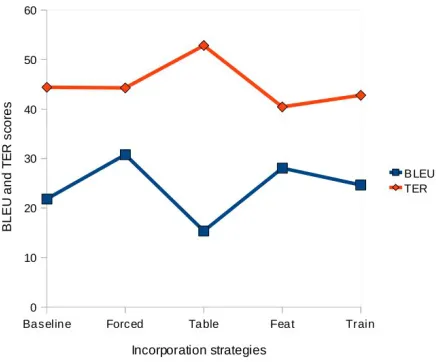
Figure 1: Lexical evaluation of MWESin term of BLEUand TER
Table 5 displays reportedp-valuesat the edge of the 95%confidence interval(CI). As can be observed, the results vary from insignificant (atp>0.05) to highly significant. On both test set results, we notice that improvements achieved by the FEATintegration startegy are
statistically significant. However, the small improvement of BLEUscore yielded by the TABLE
method (having ap-value of 0.3) is non significant. The reason being that we used theJaccard Index, a measure defined for comparing similarity and diversity of sample sets, to define a translation probability. This could be adjusted by transforming obtained Jaccard Index for each pair of MWE to a translation probability in order to ensure the uniformity and consistency of translation probabilities in the phrase table.
The BLEUmetric reports only global improvements and does not show significant differences that
can be revealed by human evaluation. This observation motivated us to set up a fine-grained
lexical evaluationof MWESin theMWEs_testcorpus. We kept only MWESon the test corpus
and manually created the gold standard from the reference. We translated the new test corpus according to dynamic and static integration strategies and computed BLEUand TERscores.
Figure 1 illustrates obtained results. As one can note, a gain of almost+9.8 BLEU,−0.2 TER
points are achieved by the FORCEDstrategy. This confirms that the worsening of BLEUscores in previous experiments are not affected by the quality of the bilingual MWESlexicon. We notice
also that both TRAINand FEATstrategies report higher scores (respectively 24.67 and 28.06
6 Conclusion
We proposed in this paper a hybrid approach to identify and find bilingual MWES
correspon-dences in a French-English parallel corpus. The alignment algorithm we propose works only on many to many correspondences and deals with highly and weakly correlated MWESin a given sentence pair. In order to assess the lexicon’s quality, we investigated the performance of three dynamic strategies and of one static strategy to integrate the mined bilingual MWE lexicon in the MOSESSMT system. We showed that the FEATmethod, in which we add a new feature indicating whether a phrase is a MWE or not, brings a small but statistically significant improvement to the translation quality of the test sets. We also introduced a lexical evaluation of MWESunits based on the measure of BLEUscore.
Although our initial experiments are positive, we believe that they can be improved in a number of ways. We first plan to set up a large scale evaluation by enlarging the size of the training corpus. In all experiments, we trained a translation model on lemmas instead of surface forms. We will make use of a generation model to generate adequate surface forms from lemmas. In addition to their application in a phrase based SMT system, we plan to evaluate the impact of the mined lexicon on the relevance of a cross-language search engine results. We also expect to extract such textual units from more available but less parallel data sources:comparable corpora.
References
Bai, M., Y., J.-M., C., K.-J., and Chang, J. S. (2009). Acquiring translation equivalences of multiword expressions by normalized correlation frequencies. InProceedings of EMNLP.
Besançon, R., De Chalendar, G., Ferret, O., Gara, F., Laib, M., Mesnard, O., and Semmar, N. (2010). Lima: A multilingual framework for linguistic analysis and linguistic resources development and evaluation. InProceedings of LREC, Malta.
Bouamor, D., Semmar, N., and Zweigenbaum, P. (2011). Improved statistical machine transla-tion using multi-word expressions. InProceedings of MT-LIHMT, Barcelona, Spain.
Boulaknadel, S., Daille, B., and Driss, A. (2008). A multi-term extraction program for arabic language. InProceedings of LREC, Marrakech, Morocco.
Carpuat, M. and Diab, M. (2010). Task-based evaluation of multiword expressions:a pilot study in statistical machine translation. InProceedings of HLT-NAACL.
Constant, M., Tellier, I., Duchier, D., Dupont, Y., Sigogne, A., Billot, S., et al. (2011). Intégrer des connaissances linguistiques dans un crf: application à l’apprentissage d’un segmenteur-étiqueteur du français. InActes de TALN, Montpellier, France.
Dagan, I. and Church, K. (1994). Termight: Identifying and translating technical terminology. InProceedings of the 4th Conference on ANLP, pages 34–40, Stuttgart, Germany.
Daille, B. (2001). Extraction de collocation à partir de textes. In Maurel, D., editor,Actes de TALN 2001 (Traitement automatique des langues naturelles), Tours. ATALA, Université de Tours.
Harris, Z. (1954). Distributional structure.Word.
Koehn, P. (2004). Statistical significance tests for machine translation evaluation. InProceedings of EMNLP.
Koehn, P. (2005). Europarl: A parallel corpus for statistical machine translation. InProceedings of MT-SUMMIT.
Koehn, P., Och, F., and Marcu, D. (2003). Statistical phrase-based translation. InProceedings of the Human Language Technology Conference of the North American Chapter of the Association for Computational Linguistics, pages 115–124, Edmonton, Canada.
Kupiec, J. (1993). An algorithm for finding noun phrases correspondences in bilingual corpora. InProceedings of the 31st annual Meeting of the Association for Computational Linguistics, pages 17–22, Columbus, Ohio, USA.
Lambert, P. and Banchs, R. (2005). Data inferred multi-word expressions for statistical machine translation. InProceedings of MT SUMMIT.
Lambert, P. and Banchs, R. (2006). Grouping multi-word expressions according to part-of-speech in statistical machine translation. InProceedings of the Workshop on Multi-word Expressions in a multilingual context.
Lefever, E., Macken, L., and Hoste, V. (2009). Language-independent bilingual terminology extraction from a multilingual parallel corpus. InProceedings of the 12th Conference of the European Chapter of the ACL (EACL 2009), pages 496–504, Athens, Greece. Association for Computational Linguistics.
Lopez, A. and Resnik, P. (2006). Word-based alignment, phrase based translation:what’s the link? InProceedings of the association for machine translation in the Americas: visions for the future of machine translation, pages 90–99.
Luka, N., Seretan, V., and Wehrli, E. (2006). Le problème de collocation en tal. InNouveaux cahiers de linguistiques Française, pages 95–115.
Och, F. (2003). Minimum error rate training in statistical machine translation. InProceedings of ACL.
Okita, T., Guerra, M., Alfredo Graham, Y., and Way, A. (2010). Multi-word expression sensitive word alignment. InProceedings of the 4th International Workshop on Cross Lingual Information Access at COLING 2010, pages 26–34, Beijing.
Papineni, k., Roukos, S., Ward, T., and Zhu, W. J. (2002). Bleu: a method for automatic evaluation of machine translation. In40th Annual meeting of the Association for Computational Linguistics.
Ren, Z., Lu, Y., Liu, Q., and Huang, Y. (2009). Improving statistical machine translation using domain bilingual multiword expressions. InProceedings of the Workshop on Multiword Expressions : Identification, Interpretation, Disambiguation and Applications, pages 47–57.
Sag, I., Baldwin, T., Francis Bond, F., Copestake, A., and Flickinger, D. (2002). Multiword expressions:a pain in the neck for nlp. InCICLing 2002, Mexico City, Mexico.
Salton, G., Wong, A., and Yang, C. (1975). A vector space model for automatic indexing. In
Communications of the ACM, pages 61–620.
Seretan, V. and Wehrli, E. (2007). Collocation translation based on sentence alignment and parsing. In Benarmara, F., Hatout, N., Muller, P., and Ozdowska, S., editors,Actes de TALN 2007 (Traitement automatique des langues naturelles), Toulouse. ATALA, IRIT.
Snover, M., Dorr, B., Schwartz, R., Micciulla, L., and Makhoul, J. (2006). A study of translation edit rate with targeted human annotation. InProceedings of Association for Machine Translation in the Americas.
Tufis, I. and Ion, R. (2007). Parallel corpora, alignment technologies and further prospects in multilingual resources and technology infrastructure. InProceedings of the 4th International Conference on Speech and Dialogue Systems, pages 183–195.
Vintar, S. and Fisier, D. (2008). Harvesting multi-word expressions from parallel corpora. In
Proceedings of LREC, Marrakech, Morocco.