ORIGINAL RESEARCH
White Matter Abnormalities Are Related to
Microstructural Changes in Preterm Neonates at
Term-Equivalent Age: A Diffusion Tensor Imaging
and Probabilistic Tractography Study
Y. Liu A. Aeby D. Bale´riaux P. David J. Absil V. De Maertelaer P. Van Bogaert F. Avni T. Metens
BACKGROUND AND PURPOSE: Preterm infants have a high risk of brain injury and neurodevelopmental impairment, often associated with WMA on conventional MR imaging. DTI can provide insight into white matter microstructure. The aim of this study was to investigate the association between WMA on conventional MR imaging and DTI parameters in specific fibers in preterm neonates at term-equivalent age.
MATERIALS AND METHODS: Seventy preterm neonates (39 boys and 31 girls) were included in the study. WMA were classified as no, mild, moderate, or severe. Probabilistic tractography provided tract volumes, FA, MD,//, and⬜in the CST, SLF, TRs, and corpus callosum. Data were compared by using MANOVA, and adjustment for multiple comparisons was performed.
RESULTS: Important associations were found between WMA and microstructural changes. Compared with neonates with no WMA (n⫽41), those with mild WMA (n⫽27) had significantly increased⬜ and MD in the left ATR, the left sensory STR, the bilateral motor STR, and for⬜also in the right CST; FA decreased significantly in the left sensory STR. Diminished tract volumes and altered diffusion indices were also observed in the 2 neonates with moderate WMA.
CONCLUSIONS:Altered DTI indices in specific tracts, with⬜as most prominent, are associated with mild WMA in preterm neonates at term-equivalent age.
ABBREVIATIONS:ATR⫽anterior thalamic radiation; CST⫽corticospinal tract;//⫽longitudinal diffusivity;⬜⫽transverse diffusivity; MANOVA⫽multivariate analysis of variance; MD⫽mean diffusivity; pre-OL⫽pre- and immature oligodendroglial cells; PTR⫽posterior thalamic radiation; SLF⫽superior longitudinal fasciculus; STR⫽superior thalamic radiation; TRs⫽thalamic radia-tions; WMA⫽white matter abnormalities
T
he incidence of preterm birth is increasing and accounts for 5%–13% in industrialized countries.1Preterm infantsare at high risk of brain injury and poor neurodevelopmental outcome. Motor disabilities are typical, with approximately 2%–7% of preterm infants developing cerebral palsy,2usually associated with cystic periventricular leucomalacia on MR im-aging.3-5Cognitive, behavioral, and social difficulties are more
common than motor dysfunction6,7; however, their
correla-tion with imaging is still debated. They may be associated with subtle WMA—for example, diffuse excessive high signal in-tensity on T2-weighted images8and other abnormal T1 or T2
signals.9,10Woodward et al11have shown that WMA on
con-ventional MR imaging at term-equivalent age (gestational age
of 40 weeks) predict adverse neurodevelopmental outcomes at 2 years of age in preterm infants. However, the evaluation of conventional MR imaging is limited in qualitative assess-ments, and it does not provide information on the extent of the injury in specific white matter pathways.
DTI is currently the best noninvasive technique to assess microstructural changes in white matter pathways. DTI en-ables quantitative assessment of brain normal structures and lesions by calculating FA, MD,//, and⬜. FA expresses the fraction of anisotropic diffusion. MD corresponds to the di-rectionally averaged magnitude of water diffusion. //
ex-presses the parallel diffusion to white matter fibers; a marked decrease of//reflects axonal injury.12⬜expresses the per-pendicular diffusion to the fiber direction; an increase of⬜ indicates reduced oligodendroglial integrity around the axons.12
Fiber tracking allows the visualization of white matter tracts. Previous studies have showed significant region-spe-cific changes in diffusion indices in preterm infants with WMA at term-equivalent age.13-15However, the diffusion in-dices of these studies were obtained from predefined ROIs in white matter but not in specific fiber tracts. Only a few studies have used DTI and tractography for the assessment of white matter injury in neonates,16,17and most tractography studies were performed on children older than 2 years of age and usually in a small cohort.18-20Little is known about the
micro-structural changes in specific fiber tracts in the preterm brain Received June 28, 2011; accepted after revision August 3.
From the Departments of Radiology (Y.L., D.B., P.D., J.A., F.A., T.M.) and Pediatric Neurology (A.A., P.V.B.), and Laboratoire de Cartographie Fonctionnelle du Cerveau (A.A., P.V.B.), ULB-Hoˆpital Erasme, Brussels, Belgium; and Institut de Recherche Interdisciplinaire en Biologie Humaine et Mole´culaire and Department of Biostatistics and Medical Infor-matics (V.D.M.), ULB, Brussels, Belgium.
This work was supported by grants from the Fonds Xe´nophilia (ULB), and the Fond de la Recherche Scientifique of Belgium (project grant No. 1.5.149.10).
Please address correspondence to Yan Liu, MD, Department of Radiology, ULB-Hoˆpital Erasme, 808 Lennik St, 1070 Brussels, Belgium; e-mail address: [email protected]
Indicates open access to non-subscribers at www.ajnr.org
indicates article with supplemental on-line tables. http://dx.doi.org/10.3174/ajnr.A2872
PEDIATRICS
ORIGINAL
at term-equivalent age, and to our knowledge, no study has yet shown the association between microstructural changes by fi-ber tracking and WMA graded according to Woodward et al.11
In this study by using DTI and probabilistic tractography, we investigated DTI parameters (tract volume, FA, MD,//,
and⬜) in the CST, SLF, TRs, and corpus callosum. The aim of the study was to investigate whether WMA on conventional brain MR imaging are related to diffusion changes in specific fiber tracts.
Materials and Methods
Patients
During a 5-year period (from October 2005 to September 2010) in our institution, 301 preterm neonates underwent brain MR imaging
without sedation for detecting lesions related to premature birth.11
Two hundred twenty-six neonates were excluded from the study due to the movement artifacts on conventional MR imaging or on DTI. Furthermore, we excluded 3 neonates with known malformations or
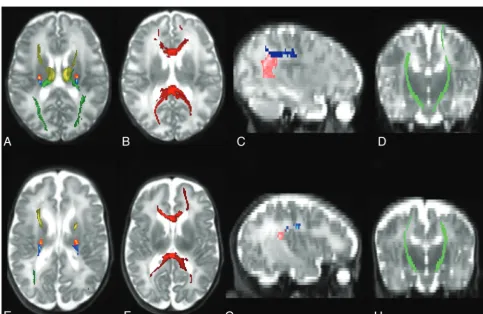
[image:2.594.53.533.57.214.2]Fig 1.Tracts are shown on T2-weighted images in neonate with no WMA, scanned at 36 weeks corrected gestational age (A–D) and in neonate with moderate WMA, scanned at 38 weeks (E–H). Axial images (A, E) show the TRs (ATR in yellow, motor STR in yellow-red, sensory STR in blue and PTR in dark green). Axial images (B, F) show the corpus callosum (dark red). Sagittal images (C, G) show the frontoparietal SLF (dark blue) and parietotemporal SLF (pink). Coronal (D, H) images show the CSTs (light green). Images were obtained from a 1.5T magnet (Philips Achieva, Best, The Netherlands).
Table 1: WMA assessment at conventional MRI
Characteristics Score 1 Score 2 Score 3
White matter signal abnormality Normal Focal regions Multiple regions
(⬍2 regions per hemisphere) (⬎2 regions)
34/70 (48.6%) 15/70 (21.4%) 21/70 (30.0%)
White matter volume loss Normal Mild reduction with increased ventricular size (EI⫽0.3–0.36)
Marked reduction with increased ventricular size (EI⬎0.36)
61/70 (87.1%) 9/70 (12.9%) 0/70 (0%)
Cystic abnormalities Normal ⬍2-mm single focal cyst Multiple cysts or a single larger (⬎2 mm) focal cyst
66/70 (94.3%) 0/70 (0%) 4/70 (5.7%)
Ventricular dilation Normal Mild-moderate enlargement of the frontal, temporal, and occipital horns
More global enlargement of the frontal, temporal, and occipital horns
57/70 (81.4%) 12/70 (17.2%) 1/70 (1.4%)
Thinning of the corpus callosum Normal Focal thinning in the corpus callosum Global thinning across the entire corpus callosum
54/70 (77.2%) 15/70 (21.4%) 1/70 (1.4%)
[image:2.594.52.536.372.686.2]congenital infections: 1 infant with Chiari type III, 1 with polymicro-gyria, and 1 with congenital cytomegalovirus infection. Finally, 72 preterm neonates with applicable DTI sequences and conventional MR imaging were studied.
The study was approved by the ethics committee of our institution (Reference: P2004/207 and P2009/234), and informed written paren-tal consent was obtained for each participant.
MR Imaging Data Acquisition
MR imaging examinations were performed with a 1.5T magnet (Achieva; Philips Healthcare, Best, the Netherlands) equipped with an 8-channel sensitivity encoding head coil. The following sequences were acquired for all subjects: 1) sagittal 3D T1-weighted gradient-echo images, 2) coronal and axial T2-weighted turbo spin-gradient-echo im-ages, 3) axial inversion recovery imim-ages, 4) axial T2*-weighted gradi-ent-echo images, and 5) spin-echo EPI images. For DTI acquisitions,
we used the following parameters: TR/TE, 5888/92 ms; FOV, 220⫻
220 mm; 32 noncollinear diffusion-sensitizing gradient directions
with a diffusion sensitivity ofb⫽600 s/mm2and a 2⫻2 mm2in-plane
resolution; acceleration factor (sensitivity encoding), 2.2; section thickness, 2.3 mm; and scanning time, 3 minutes 40 seconds.
No sedation was used; neonates were spontaneously asleep, posi-tioned in a vacuum immobilization pillow to minimize body and head movements. Ear muffs were placed to minimize noise exposure. Oxygen saturation and electrocardiography were monitored throughout the acquisition.
Assessment of White Matter Injury
Two readers, experienced neuroradiologists (D.B. and P.D.), inter-preted conventional MR imaging (sequences 1– 4), blinded to the subject’s clinical condition but informed of the subject’s gestational age at birth and corrected gestational age at MR imaging.
WMA were graded according to Woodward et al,11by using 5
characteristics, each with a score of 1 (normal), 2 (mild abnormality), and 3 (moderate-severe abnormality) (Table 1). These 5 assessments of the cerebral white matter were then combined to give an overall WMA score, which was categorized in 4 groups: no abnormality (total score, 5– 6), mild abnormality (total score, 7–9), moderate abnormal-ity (total score, 10 –12), and severe abnormalabnormal-ity (total score, 13–15). In Table 1, the ventricular dilation was assessed by using the Evans Index, defined as the maximal frontal horn ventricular width divided
by the transverse inner diameter of the skull.21
Disagreements on classification were resolved by consensus, and cases with unresolved discrepancies at consensus were excluded from further analysis.
Data Postprocessing
Data analysis was performed by using the software FSL
(http://www.fmrib.ox.ac.uk/fsl).22
Image Preparation
[image:3.594.300.532.56.404.2]Image artifacts due to eddy current distortions and head movements were minimized by registering the DTI from 32 directions to the B0
Table 2: FA in each tract
Preterm with No WMA
(n⫽41)
(mean) (SD)
Preterm with Mild WMA
(n⫽27)
(mean) (SD) P Value Preterm with Moderate WMA
(n⫽2)
CST (left) 0.28 (0.03) 0.27 (0.04) .022 Case 1: 0.25 Case 2: 0.21 CST (right) 0.28 (0.04) 0.26 (0.04) .005 Case 1: 0.22 Case 2: 0.27 Frontoparietal SLF
(left)
0.17 (0.03) 0.16 (0.03) .020 Case 1: 0.12 Case 2: 0.13 Frontoparietal SLF
(right)
0.18 (0.02) 0.16 (0.03) .004 Case 1: 0.11 Case 2: 0.15 Parietotemporal SLF
(left)
0.17 (0.02) 0.16 (0.03) .077 Case 1: 0.09 Case 2: 0.14 Parietotemporal SLF
(right)
0.16 (0.02) 0.15 (0.03) .191 Case 1: 0.11 Case 2: 0.14 ATR (left) 0.19 (0.02) 0.18 (0.03) .012 Case 1: 0.16 Case 2: 0.16 ATR (right) 0.19 (0.02) 0.18 (0.03) .045 Case 1: 0.12 Case 2: 0.17 Motor STR (left) 0.25 (0.03) 0.23 (0.04) .005 Case 1: 0.22 Case 2: 0.20 Motor STR (right) 0.25 (0.03) 0.24 (0.05) .024 Case 1: 0.19 Case 2: 0.24 Sensory STR (left) 0.24 (0.03) 0.22 (0.03) ⬍.001a Case 1: 0.15 Case 2: 0.17 Sensory STR (right) 0.23 (0.02) 0.22 (0.04) .006 Case 1: 0.17 Case 2: 0.18 PTR (left) 0.21 (0.03) 0.20 (0.03) .103 Case 1: 0.09 Case 2: 0.15 PTR (right) 0.21 (0.02) 0.20 (0.03) .009 Case 1: 0.11 Case 2: 0.17 Corpus callosum 0.26 (0.03) 0.24 (0.03) .016 Case 1: 0.14 Case 2: 0.18
aThePvalue reaches statistical significance after controlling for false discovery rate (P⬍
.003).
Table 3: MD (*10ⴚ3mm2/s) in each tract
Preterm with No WMA
(n⫽41)
(mean) (SD)
Preterm with Mild MWA
(n⫽27)
(mean) (SD) P Value Preterm with Moderate WMA
(n⫽2)
CST (left) 1.340 (0.10) 1.362 (0.09) .027 Case 1: 1.45 Case 2: 1.45 CST (right) 1.338 (0.09) 1.377 (0.12) .005 Case 1: 1.45 Case 2: 1.34 Frontoparietal SLF
(left)
1.45 (0.10) 1.45 (0.12) .458 Case 1: 1.57 Case 2: 1.51 Frontoparietal SLF
(right)
1.43 (0.10) 1.46 (0.12) .071 Case 1: 1.53 Case 2: 1.43 Parietotemporal SLF
(left)
1.48 (0.07) 1.48 (0.09) .634 Case 1: 1.57 Case 2: 1.51 Parietotemporal SLF
(right)
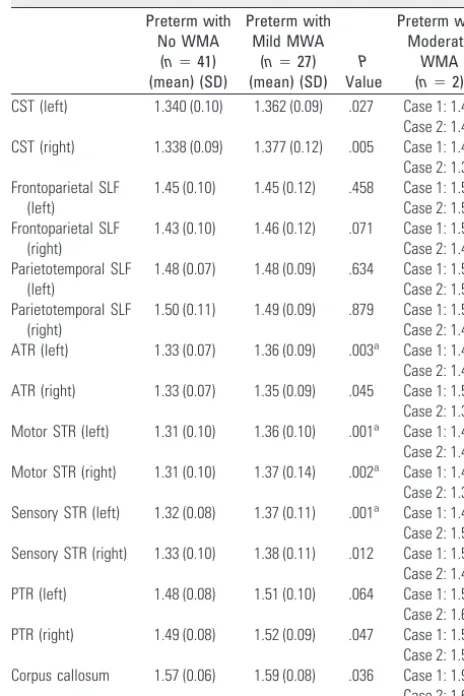
1.50 (0.11) 1.49 (0.09) .879 Case 1: 1.51 Case 2: 1.45 ATR (left) 1.33 (0.07) 1.36 (0.09) .003a Case 1: 1.47 Case 2: 1.44 ATR (right) 1.33 (0.07) 1.35 (0.09) .045 Case 1: 1.54 Case 2: 1.36 Motor STR (left) 1.31 (0.10) 1.36 (0.10) .001a Case 1: 1.45 Case 2: 1.47 Motor STR (right) 1.31 (0.10) 1.37 (0.14) .002a Case 1: 1.43 Case 2: 1.32 Sensory STR (left) 1.32 (0.08) 1.37 (0.11) .001a Case 1: 1.48 Case 2: 1.51 Sensory STR (right) 1.33 (0.10) 1.38 (0.11) .012 Case 1: 1.50 Case 2: 1.40 PTR (left) 1.48 (0.08) 1.51 (0.10) .064 Case 1: 1.57 Case 2: 1.60 PTR (right) 1.49 (0.08) 1.52 (0.09) .047 Case 1: 1.51 Case 2: 1.54 Corpus callosum 1.57 (0.06) 1.59 (0.08) .036 Case 1: 1.92 Case 2: 1.63
aThePvalue reaches statistical significance after controlling for false discovery rate (P⬍
[image:3.594.53.283.61.404.2]images.19Maps of the diffusion indices were obtained by using FSL
Diffusion Toolbox.23
Probabilistic Tractography
The bundles were reconstructed in each subject by 1 investigator
(Y.L.) by using multitensor probabilistic tractography.24,25The masks
were identified and manually placed by 2 neuroradiologists (Y.L. and D.B.) in consensus for each tract. The CST was tracked by using a seed mask in the cerebral peduncle and a waypoint mask in the precentral
gyrus.26The SLFs were tracked separately into 2 parts27,28: the
fron-toparietal SLF and the parietotemporal SLF. For the fronfron-toparietal SLF, a seed mask covered the frontal white matter and the waypoint mask covered the frontoparietal white matter on coronal sections; for the parietotemporal SLF, the seed mask was the same as the waypoint mask of the frontoparietal SLF, and the waypoint mask covered the
temporal lobe on an axial section.27The TRs were studied separately
in 4 subradiations27: ATR, the motor and sensory STR, and the PTR.
A seed mask was positioned in the bottom of the thalamus, and a waypoint mask, in the anterior limb of the internal capsule for the ATR, in the precentral gyrus for the motor STR, in the postcentral gyrus for the sensory STR, and in the occipital lobe for the PTR. The corpus callosum was tracked by symmetric seed masks drawn on
ei-ther side of the midline.19
The original tracts were normalized by the total number of
sam-ples going from the seed ROI to the target ROI.25Finally, the obtained
connectivity distributions were thresholded with a probability of
0.2% for the corpus callosum and 2% for the bilateral tracts.27,29,30
The tract volume and diffusion indices (FA, MD,//, and⬜) of
each tract were evaluated by using FSL calculations.27
Statistical Analyses
All statistical analyses were performed with the Statistical Package for the Social Sciences, Version 15 (SPSS, Chicago, Illinois). A 1-sample Kolmogorov-Smirnov test was performed to detect a possible depar-ture from normality of our variables. A MANOVA was used to com-pare tract volumes and diffusion indices between WMA groups; the corrected gestational age at MR imaging was considered as a
covari-ate. After controlling for false discovery rate,31statistical significance
was reached whenP⬍.003.
Results
Of the 72 preterm neonates who were recruited, 2 were ex-cluded due to disagreement between readers on the conven-tional MR imaging assessment. Seventy neonates were in-cluded in the tractography study, and their clinical characteristics collected from patient medical records are given in On-line Table 1. Forty-one neonates were classified as having no WMA; 27 neonates, with mild WMA; 2 neonates, with moderate WMA; and no neonate, with severe WMA. Be-cause of the small sample size (n⫽2) of the moderate group, statistical analyses were only performed between the groups with no WMA and with mild WMA.
Clinical Characteristics
There were no significant differences in any of the clinical characteristics between the neonates with no and with mild WMA (data not shown).
Tract Volume in Relation to WMA
Tract volume results are detailed in On-line Table 2. No sig-nificant differences were found in tract volume between neo-nates with no WMA and with mild WMA. In case 1 with mod-erate WMA, showing diffuse white matter signal-intensity abnormalities, multiple cystic lesions, and thinning of the cor-pus callosum, some tract volumes were relatively small com-pared with the mean volumes in the neonates with no WMA (Fig 1). Case 2, showing diffuse white matter signal-intensity abnormalities and ventricular dilation, had no obviously de-creased tract volume.
FA in Relation to WMA
Neonates with mild WMA had significantly lower FA in the left sensory STR compared with neonates with no WMA; in the 2 neonates with moderate WMA, we observed decreased FA values in the CST, SLF, TRs, and corpus callosum (Table 2).
MD in Relation to WMA
[image:4.594.52.283.54.405.2]Neonates with mild WMA had significantly higher MD in the left ATR, the left sensory STR, and the bilateral motor STR compared with neonates with no WMA; in the 2 neonates with moderate WMA, we observed increased MD values in the CST, SLF, TRs, and corpus callosum (Table 3).
Table 4:⬜(10ⴚ3mm2/s) in each tract
Preterm with No WMA
(n⫽41)
(mean) (SD)
Preterm with Mild WMA
(n⫽27)
(mean) (SD)
P
Value
Preterm with Moderate
WMA
(n⫽2)
CST (left) 1.14 (0.10) 1.17 (0.12) .007 Case 1: 1.29 Case 2: 1.29 CST (right) 1.14 (0.10) 1.19 (0.13) .001a Case 1: 1.28 Case 2: 1.16 Frontoparietal SLF
(left)
1.33 (0.11) 1.34 (0.13) .291 Case 1: 1.48 Case 2: 1.41 Frontoparietal SLF
(right)
1.31 (0.10) 1.35 (0.13) .033 Case 1: 1.45 Case 2: 1.32 Parietotemporal SLF
(left)
1.35 (0.07) 1.36 (0.10) .403 Case 1: 1.50 Case 2: 1.40 Parietotemporal SLF
(right)
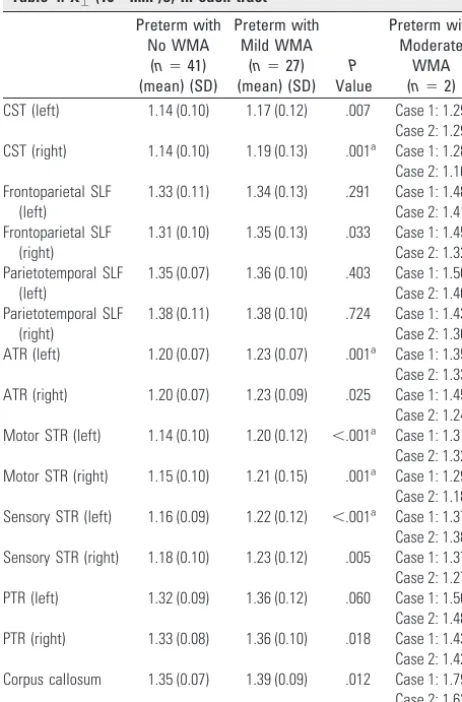
1.38 (0.11) 1.38 (0.10) .724 Case 1: 1.43 Case 2: 1.36 ATR (left) 1.20 (0.07) 1.23 (0.07) .001a Case 1: 1.35 Case 2: 1.33 ATR (right) 1.20 (0.07) 1.23 (0.09) .025 Case 1: 1.45 Case 2: 1.24 Motor STR (left) 1.14 (0.10) 1.20 (0.12) ⬍.001a Case 1: 1.31 Case 2: 1.32 Motor STR (right) 1.15 (0.10) 1.21 (0.15) .001a Case 1: 1.29 Case 2: 1.18 Sensory STR (left) 1.16 (0.09) 1.22 (0.12) ⬍.001a Case 1: 1.37 Case 2: 1.38 Sensory STR (right) 1.18 (0.10) 1.23 (0.12) .005 Case 1: 1.37 Case 2: 1.27 PTR (left) 1.32 (0.09) 1.36 (0.12) .060 Case 1: 1.50 Case 2: 1.48 PTR (right) 1.33 (0.08) 1.36 (0.10) .018 Case 1: 1.43 Case 2: 1.42 Corpus callosum 1.35 (0.07) 1.39 (0.09) .012 Case 1: 1.79 Case 2: 1.63
aThePvalue reaches statistical significance after controlling for false discovery rate (P⬍
//in Relation to WMA
No significant differences in//were found between the
neo-nates with no and mild WMA; in the 2 neoneo-nates with moderate WMA, no obvious changes were observed in//(On-line
Ta-ble 3).
⬜in Relation to WMA
Neonates with mild WMA had significantly higher⬜in the left ATR, the left sensory STR, the bilateral motor STR, and the right CST compared with neonates with no WMA; in 2 neo-nates with moderate WMA, we observed increased⬜values in the CST, SLF, TRs, and corpus callosum (Table 4).
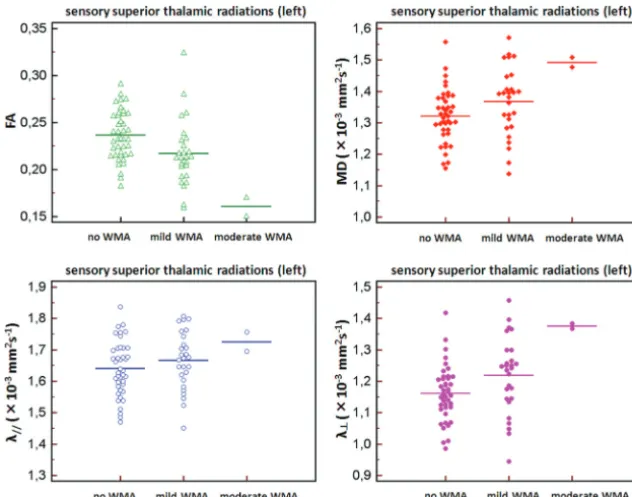
Figure 2 shows the diffusion indices in the left sensory STR in neonates with no WMA, mild WMA, and moderate WMA.
Discussion
In this structural MR imaging study, we demonstrated impor-tant associations between WMA on conventional MR imaging and microstructural changes in specific fiber tracts by using DTI and probabilistic tractography. Compared with neonates with no WMA, those with mild WMA had significantly in-creased⬜and MD values in the left ATR, the left sensory STR, the bilateral motor STR, and for⬜also in the right CST; FA decreased significantly in the left sensory STR. Diminished tract volumes and altered diffusion indices were also present in the 2 patients with moderate WMA.
The findings of microstructural changes in specific fiber tracts are consistent with previous DTI studies on predefined ROIs in white matter tissues. WMA were found to be related to changed diffusion indices, in particular to the⬜in sensori-motor regions.13-15The increased ⬜values imply reduced oligodendroglial integrity around the axons.12At
term-equiv-alent time, few WM fibers have completely myelinated. In this “premyelinated” stage, pre-OL start to ensheath the axons. The pre-OL are especially vulnerable due to dynamic
develop-ment during the last trimester of pregnancy, and the loss of pre-OL is the most common injury to the preterm brain.32-36
The decrease of pre-OL is counteracted by an increase in oli-godendroglial progenitors, shown in several animal mod-els37,38; however, these cells might not have the capacity to
further differentiate to become mature myelin-producing cells. Therefore, the altered diffusion indices in this study may relate to the disruption of pre-OL development, which leads to a failure of pre-OL ensheathment of axons. No significant as-sociation found in//suggests that disrupted premyelinating
oligodendroglia is the major correlate with WMA rather than axonal pathology.
In neonates with mild WMA, we found bilaterally de-creased FA in the sensory STR that, after adjustment for mul-tiple comparisons, was statistically significant at the left side only (Table 2). Because 3 eigenvalues of water diffusion de-crease together in the premyelinated period, FA values could have no significant changes in the premyelinated stage.39In
general, myelination starts from posterior to anterior and sen-sory pathways myelinate before motor pathways40; therefore,
the altered FA values could emerge earlier in the sensory pathways.
Specific white matter fibers contribute to brain functional networks as information transmitters. The CST and STR are the sensorimotor-related fibers. The CST originates from the frontal cortex, but most fibers come from primary motor and premotor areas, containing mostly motor axons.41The STR projects from the ventrolateral nuclei to the frontoparietal cortex, mainly including the motor and somatosensory cor-tex.24,42The ATR is the projection connecting the frontal
cor-tex and the thalamus; the frontal corcor-tex is considered to play an important role in cognitive and executive functions.43In
[image:5.594.135.451.44.292.2]tural changes in those fiber tracts might be responsible for later neurodevelopmental deficits in motor and cognitive func-tions. In forthcoming studies, these tracts could be selectively studied and correlated with possible neurodevelopmental out-comes in patients with mild WMA at term-equivalent age.
Beyond the microstructural association, no significant dif-ferences were found in tract volumes between neonates with no WMA and mild WMA, and only 1 neonate with moderate WMA had some relatively decreased tract volumes. This might suggest that tract volumes were not significantly associated with the subtle WMA.
These findings in tract volumes and diffusion indices are only partly in agreement with the results of de Bruïne et al,16
who studied fiber tracts in very preterm infants by tractogra-phy and found no association between tract lengths and the degree of white matter injury. Our results were different from their findings at the microstructural level: They showed a strong association between DTI indices and the gestational age at MR imaging, but those DTI values were independent of WMA. These different results in diffusion indices might be due to the wide range of gestational age when infants un-derwent MR imaging because some of their infants were imaged after 46 weeks. Gestational age at MR imaging plays an important role in the changes of diffusion indices,44
espe-cially in the first year of life.45In our study, there was no
sig-nificant difference in the gestational age at MR imaging be-tween groups; however, the gestational age at MR imaging was considered as a covariate when we performed the comparisons.
We evaluated WMA on conventional MR imaging accord-ing to the scores of Woodward et al,11because they studied a large population (167 infants) and included the neurodevel-opmental outcome at 2 years of age (corrected for prematu-rity). Moreover, in our study, we used a careful approach of evaluation to define the degree of abnormalities in 5 charac-teristics because it was based on a subjective reading. The con-ventional MR imaging was first evaluated by 2 readers blindly. Second, a consensus was required for the inconsistent catego-rized cases as well as for the consistent categocatego-rized cases with different scores in⬎2 characteristics. Two cases were excluded due to unresolved discrepancies at consensus. We had a cohort of 70 preterm neonates, but only 2 of them (3%) were classi-fied into the moderate group and there was no neonate with severe WMA, which was less than the amount in other studies with the same classification.11,15However, those studies in-cluded very preterm neonates (born at⬍30 weeks), so those infants might be more sensitive to the effects of extreme pre-maturity, like greater risks of mortality and morbidity.1
An-other limitation of the present study was that we did not per-form DTI and tractography in healthy term neonates, so we were not able to compare our preterm neonates with healthy term neonates.
Conclusions
Altered DTI indices in the CST, STR, and ATR, with⬜as the most prominent, were associated with mild WMA on conven-tional MR imaging in preterm neonates at term-equivalent age.
Acknowledgments
We thank Doni Tamblyn for her assistance in language editing.
References
1. Slattery MM, Morrison JJ.Preterm delivery.Lancet2002;360:1489 –97 2. van Haastert IC, Groenendaal F, Uiterwaal CS, et al.Decreasing incidence and
severity of cerebral palsy in prematurely born children. J Pediatr
2011;159:86 –91
3. Fazzi E, Orcesi S, Caffi L, et al.Neurodevelopmental outcome at 5–7 years in preterm infants with periventricular leukomalacia. Neuropediatrics
1994;25:134 –39
4. Ohgi S, Akiyama T, Fukuda M.Neurobehavioural profile of low-birthweight infants with cystic periventricular leukomalacia.Dev Med Child Neurol
2005;47:221–28
5. Ramenghi LA, Rutherford M, Fumagalli M, et al.Neonatal neuroimaging: go-ing beyond the pictures.Early Hum Dev2009;85:S75–77
6. Holsti L, Grunau RV, Whitfield MF.Developmental coordination disorder in extremely low birth weight children at nine years.J Dev Behav Pediatr
2002;23:9 –15
7. Taylor HG, Minich NM, Klein N, et al.Longitudinal outcomes of very low birth weight: neuropsychological findings. J Int Neuropsychol Soc 2004 10:149 – 63
8. Dyet LE, Kennea N, Counsell SJ, et al.Natural history of brain lesions in ex-tremely preterm infants studied with serial magnetic resonance imaging from birth and neurodevelopmental assessment.Pediatrics2006;118:536 – 48 9. Inder TE, Wells SJ, Mogridge NB, et al.Defining the nature of the cerebral
abnormalities in the premature infant: a qualitative magnetic resonance im-aging study.J Pediatr2003;143:171–79
10. Maalouf EF, Duggan PJ, Rutherford MA, et al.Magnetic resonance imaging of the brain in a cohort of extremely preterm infants.J Pediatr1999;135:351–57 11. Woodward LJ, Anderson PJ, Austin NC, et al.Neonatal MRI to predict neuro-developmental outcomes in preterm infants.N Engl J Med2006;17:727–29 12. Song SK, Sun SW, Ramsbottom MJ, et al.Dysmyelination revealed through
MRI as increased radial (but unchanged axial) diffusion of water.Neuroimage
2002;17:1429 –36
13. Cheong JL, Thompson DK, Wang HX, et al.Abnormal white matter signal on MR imaging is related to abnormal tissue microstructure.AJNR Am J Neuro-radiol2009;30:623–28
14. Counsell SJ, Shen Y, Boardman JP, et al.Axial and radial diffusivity in preterm infants who have diffuse white matter changes on magnetic resonance imag-ing at term-equivalent age.Pediatrics2006;117:376 – 86
15. Skio¨ld B, Horsch S, Hallberg B, et al.White matter changes in extremely pre-term infants: a population-based diffusion tensor imaging study.Acta Paedi-atr2010;99:842– 49
16. de Bruïne FT, van Wezel-Meijler G, Leijser LM, et al.Tractography of develop-ing white matter of the internal capsule and corpus callosum in very preterm infants.Eur Radiol2011;21:538 – 47
17. Thompson DK, Inder TE, Faggian N, et al.Characterization of the corpus callosum in very preterm and full-term infants utilizing MRI.Neuroimage
2011;15:479 –90
18. Hoon AH, Stashinko EE, Nagae LM, et al.Sensory and motor deficits in chil-dren with cerebral palsy born preterm correlate with diffusion tensor imaging abnormalities in thalamocortical pathways. Dev Med Child Neurol
2009;51:697–704
19. Counsell SJ, Dyet LE, Larkman DJ, et al.Thalamo-cortical connectivity in chil-dren born preterm mapped using probabilistic magnetic resonance tractog-raphy.Neuroimage2007;34:896 –904
20. Thomas B, Eyssen M, Peeters R, et al.Quantitative diffusion tensor imaging in cerebral palsy due to periventricular white matter injury. Brain
2005;128:2562–77
21. Evans WA.An encephalographic ratio for estimating ventricular enlargement and cerebral atrophy.Arch Neurol Psychiatry1942;47:931–37
22. Smith SM, Jenkinson M, Woolrich MW, et al.Advances in functional and structural MR image analysis and implementation as FSL.Neuroimage2004; 2(suppl 1):S208 –19
23. Bassi L, Ricci D, Volzone A, et al.Probabilistic diffusion tractography of the optic radiations and visual function in preterm infants at term-equivalent age.Brain2008;131:573– 82
24. Behrens TE, Johansen-Berg H, Woolrich MW, et al.Non-invasive mapping of connections between human thalamus and cortex using diffusion imaging.
Nat Neurosci2003;6:750 –57
25. Johansen-Berg H, Behrens T.Diffusion MRI.London, UK: Elsevier; 2009:333– 52, 434 –36
26. Wakana S, Caprihan A, Panzenboeck MM, et al.Reproducibility of quantita-tive tractography methods applied to cerebral white matter.Neuroimage
2007;36:630 – 44
lan-guage networks in a population of healthy preterm neonates at term-equiva-lent age: a diffusion tensor imaging and probabilistic tractography study.
Neuroimage2010;51:783– 88
28. Makris N, Kennedy DN, McInerney S, et al.Segmentation of subcomponents within the superior longitudinal fascicle in humans: a quantitative, in vivo, DT-MRI study.Cereb Cortex2005;15:854 – 69
29. Aeby A, Liu Y, De Tie`ge X, et al.Maturation of thalamic radiations between 34 and 41 weeks gestation: a combined voxel-based study and probabilistic trac-tography using diffusion tensor imaging. AJNR Am J Neuroradiol
2009;30:1780 – 86
30. Powell HW, Parker GJ, Alexander DC, et al.Hemispheric asymmetries in lan-guage-related pathways: a combined functional MRI and tractography study.
Neuroimage2006;32:388 –99
31. Benjamini Y, Hochberg Y.Controlling the false discovery rate: a practical and powerful approach to multiple testing.J R Statist Soc B1995;57:289 –300 32. Khwaja O, Volpe JJ.Pathogenesis of cerebral white matter injury of
prematu-rity.Arch Dis Child Fetal Neonatal Ed2008;93:153– 61
33. Volpe J.Neurology of the Newborn.Philadelphia: W.B. Saunders; 2008 34. Volpe JJ.Brain injury in premature infants: a complex amalgam of destructive
and developmental disturbances.Lancet Neurol2009;8:110 –24
35. Back SA, Luo NL, Borenstein NS, et al.Late oligodendrocyte progenitors coin-cide with the developmental window of vulnerability for human perinatal white matter injury.J Neurosci2001;21:1302–12
36. Haynes RL, Folkerth RD, Keefe RJ, et al.Nitrosative and oxidative injury to premyelinating oligodendrocytes in periventricular leukomalacia.J Neuro-path Exp Neurol2003;62:441–50
37. Yang Z, Covey MV, Bitel CL, et al.Sustained neocortical neurogenesis after neonatal hypoxic/ischemic injury.Ann Neurol2007;61:199 –208
38. Sizonenko SV, Camm EJ, Dayer A, et al.Glial responses to neonatal hypoxic-ischemic injury in the rat cerebral cortex.Int J Dev Neurosci2008;26:37– 45 39. Dubois J, Dehaene-Lambertz G, Perrin M, et al.Asynchrony of the early
mat-uration of white matter bundles in healthy infants: quantitative landmarks revealed non-invasively by diffusion tensor imaging.Hum Brain Mapp2008; 29:14 –27
40. Kinney HC, Armstrong DL.Perinatal neuropathology.In: Graham DI, Lantos PE, eds.Greenfield’s Neuropathology. London, UK: Arnold; 2002:557–59 41. Davidoff RA.The pyramidal tract.Neurology1990;40:332–39
42. Passingham RE, Stephan KE, Ko¨tter R.The anatomical basis of functional localization in the cortex.Nat Rev Neurosci2002;3:606 –16
43. Anderson V, Jacobs R, Harvey AS.Prefrontal lesions and attentional skills in childhood.J Int Neuropsychol Soc2005;11:817–31
44. Hu¨ppi PS, Dubois JDiffusion tensor imaging of brain development.Semin Fetal Neonatal Med2006;11:489 –97