A WiFi-ZigBee Building Area Network Design of High
Traffics AMI for Smart Grid
Hoi Yan Tung1, Kim Fung Tsang1, Hoi Ching Tung1,2, Veseline Rakocevic2, Kwok Tai Chui1, Yat Wah Leung3
1Department of Electronic Engineering, City University of Hong Kong, Hong Kong, China; 2School of Engineering & Mathematical
Science, City University London, London, UK; 3Department of SEEM, City University of Hong Kong, Hong Kong, China.
Email: [email protected]
Received August 5th, 2012; revised September 5th, 2012; accepted September 11th, 2012
ABSTRACT
A WiFi-ZigBee hybrid BAN solution, namely WiZBAN, is proposed and implemented to cater for the development of high traffic AMI for smart grid application. It is important to highlight that the major challenge of WiZBAN is to handle the high density environment which results in heavy traffic loading and weak signal propagation. To overcome the cap-tioned problem, Vertical Backbone Communication (VBC) and Horizontal Floor Communication (HFC) are defined for WiZBAN. The WiZBAN consists of WiZBAN Gateway (WiZGW), WiZBAN Meter Hub (WiZBAN) and WiZBAN In Home Display (WiZIHD) which caters for the smart grids services including smart metering and demand response. The WiZGW is the entrance of WiZBAN and connects WiZBAN to utilities. The WiZGW also teams up with WiZMH to enables VBC. On the other hand, WiZMH serves as the interception point of VBC and HFC. It interacts with smart me-ters and sets up the HFC together with WiZIHD to provide the user interface for end users. To shorten the transmission time, WiFi is adopted for VBC while ZigBee is applied to HCF to overcome the weak signal propagation. To investi-gate the performance of WiZBAN, a case study has been conducted based on an existing 23 floor residential building. From the measured and simulated results, the average round trip delay of demand response and smart metering are found to be 0.6 s and 9 s respectively.
Keywords: Advance Metering Infrastructure; Building Area Network; WiFi; ZigBee; Delay
1. Introduction
Smart grid is well recognized by scientists as effectively way out of the global warming. The battle between global warming and environment is identified by the in- ternational society. Scientists devote their effort to de- velop renewable energy and governments control energy consumption by issuing regulation. Agreements for the reduction of green house gas (GHG) emission have been signed between utilities and governments. To meet the goal of GHG reduction, utilities implement Demand Side Management (DSM) program which modifies customer’s electricity consumption behavior (and other utility sup- plies) to shape the electricity demand in a beneficial manner to both customers and utilities. Demand shaping objectives include conservation, peak demand reduction, demand relocation, demand control and load growth. By encouraging off-peak energy consumption, the efficiency of power plant is maximized in order achieve a win-win situation for both users and utilities. Users may pay less their electricity bills and utilities may cut the cost in- curred from building and operating new power plants to
meet the growth in electricity demand. Nevertheless, DSM involves large amount of data and interactive communication which brings the emergence of Advance Metering Infrastructure (AMI) for smart grid.
to monitor the power need and usage of residents of the corresponding building. In order to provide inexpensive data transfer, data are packed together efficiently so that they can be carried by an economical BAN-HANs wire- less communication. The packed data are then carried (as a group) by a more expensive 3G carrier which normally serves a much wider area. Since the data size is much higher in BAN, it is believed that in the design of BAN, the geographic location of the smart meter in high rises should also be considered. In HRAMI, meters on the same floor are commonly placed and packed closely to one another in a metering room. These meters are sup- posed to communicate with HAN devices, such as In Home Displays (IHDs), power sockets, light switches etc. which are located in premises at a distant away from the meter room. The communications on a floor are referred as “Horizontal Floor Communication” (HFC). In reality, the meters send the energy data to the utility backend server via the BAN GW typically every 15 - 30 minutes, such data aggregation renders traffics handled by BAN GW much heavier than HFC and such communications in the vertical backbone is referred as “Vertical Back- bone Communication” (VBC). Difficulties encountered in BAN include highly shielded thick concrete wall em- bedded with steel bars surrounding the meter room and the lift-well typically nearby. These structures prohibit signal propagation and are a strong deterrent to high speed data. Therefore, researchers generally believe that the design of the current AMI will not fit for the role of the BAN and an efficient design for HTAMI for BAN is sought for.
To overcome the captioned challenges, a WiFi-ZigBee hybrid BAN design, namely WiZBAN, is proposed in this paper. As mentioned in the earlier text, the BAN is divided into HFC and VBC. HFC handles the data trans- mission between the IHDs and smart meters which nor- mally has shorter communication distance and less traffic loadings but with higher difficulties in signal propagation due to complex structure of floor plan. Apart from com- municating with smart meters, IHDs also interact with HAN to perform Demand Response (DR). Owing to the popularity of ZigBee in HAN, the trend of IHD devel- opment is that ZigBee communications are deployed. At the same time, ZigBee is also widely adopted by differ- ent Smart Metering (SM) systems attributed to its mesh capability which reduces the signal propagation difficul- ties. Therefore, ZigBee is proposed for HFC of WiZBAN.
ment because Wireless Local Area Network (WLAN) has been already deployed in numerous of high rise to enable internet access. The popularity of WiFi is due to its promising performance. With latest Multiple Input Multiple Output (MIMO) and Orthogonal frequency- division multiplexing (OFMD) technologies, WiFi signal penetrates through concrete wall easily with a relatively high data transmission speed. Therefore, WiFi is inevita- bly suitable for VBC. To investigate the performance of WiZBAN, a case study has been conducted by using OPNET. This paper is organized as follows: The tech- nology overview is given in Section 2. A system over- view and architecture of WiZBAN is presented in Sec- tion 3 and the delay model of WiZBAN is discussed in Section 4. The performance evaluation of WiZBAN so-lution is discussed in Section 5. Finally, a conclusion is given in Section 6.
2. Technology Overview
WiZBAN has adopted a hybrid solution which equips WiFi and ZigBee technology to handle VBC and HFC respectively. In this section, a brief introduction of two technologies would be given.
2.1. WiFi
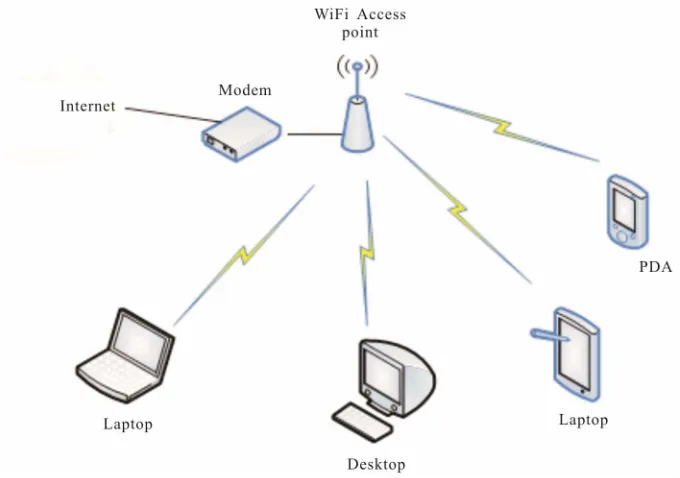
WiFi is a common wireless application for computer communication and Ethernet network [4]. As shown in Figure 1, WiFi provides fast connection, relatively better range, higher data rate transmission and security protec- tion for desktop, laptop and Personal Digital Assistant (PDA). WiFi is a standard of IEEE 802.11 family for wireless local area network as shown in Table 1. Despite 802.11AC claims the highest transmission speed, nowa- days, common WiFi application is using version of 802.11g and 802.11n.
2.1.1. 802.11g
802.11g is the third modulation standard for Wireless LAN. It works in the 2.4 GHz band (like 802.11b) but operates at a maximum raw data rate of 54 Mbit/s, or about 22 Mbit/s net throughput. 802.11g hardware is fully compatible with 802.11b hardware. Details of in- teroperating version b and g occupy much of the linger- ing technical process. In a 802.11g network, however, the presence of a legacy 802.11b participant will signifi-
Figure 1. WiFi architecture.
Table 1. Wireless standard of IEEE 802.11 family.
Protocol Freq. (GHz) BW (MHz) Data Rate (Mbit/s) Modulation Indoor Range (M) 802.11a 5/3.7 20 54 OFDM 35 802.11b 2.4 20 11 DSSS 35 802.11g 2.4 20 54 OFDM, DSSS 38 802.11n 2.4/5 20 40 288.8 600 OFDM 70
802.11ac (Draft) 5
20 40 80 160
700.8 1600 3466.4 6933.6
OFDM -
The modulation scheme used in 802.11g is OFDM with Direct Sequence Spread Spectrum (DSSS). Even though 802.11g operates in the same frequency band as 802.11b, it can achieve higher data rates because of its heritage to 802.11a modulation.
2.1.2. 802.11n
802.11n is an amendment which improves upon the pre- vious 802.11 standards by adding MIMO. 802.11n oper- ates in both the 2.4 GHz and the lesser used 5 GHz bands. The IEEE has approved the amendment and it was pub- lished in October 2009. Prior to the final ratification, enterprises were already migrating to 802.11n networks based on the WiFi Alliance’s certification of products conforming to a 2007 draft of the 802.11n proposal.
The popularity of WiFi is due to its promising per- formance. With latest MIMO and OFMD technologies, WiFi signal penetrates through concrete wall easily with a relatively high data transmission speed. Therefore,
WiFi is definitely suitable for VBC of WiZBAN. It is pointed out that WiFi does not possesses the smart en- ergy profile and it is inherent fast data rate renders itself more suitable for data aggregation in VBC.
2.2. ZigBee
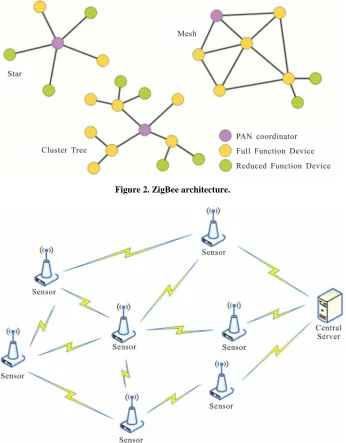
ZigBee is another WPAN standard of IEEE 802.15.4 [5,6]. It has some common attributes with Bluetooth such as short-range transmission, low cost of production, low data rate and low power consumption. For comparison, ZigBee is more energy conservable than Bluetooth and perfect solution for smaller packets over a large network. The life-span of ZigBee can last for years which are es- pecially suitable to SM and home automation. Operating with over 65,000 devices, a ZigBee network is widely used in home and building automation as well as game and medical sensors.
3. WiZBAN Overview
This section introduces the AMI and explains the role of WiZBAN in supporting AMI services. Generally, AMI (Figure 4) provides end to end metering and DR service which involve three basic AMI elements: the IHD, the smart meter and the utility server. The smart meter
[image:4.595.125.471.273.716.2]result, the peak demand of electricity is reduced. The IIHD not only provides the timely consumption and pricing information by interacting with the smart meter but also teams up with other ZigBee home automation devices such as light switches, power outlets, computers and appliances to form a HAN and thus facilitating the aim of home automation and energy management. To
Figure 2. ZigBee architecture.
Figure 4. AMI overview.
conduct the DR, the utility server shuts down some ap- pliances in the case of shortage of electricity experienced by the utility, and in such a circumstance, consumers may enjoy a lower energy rate.
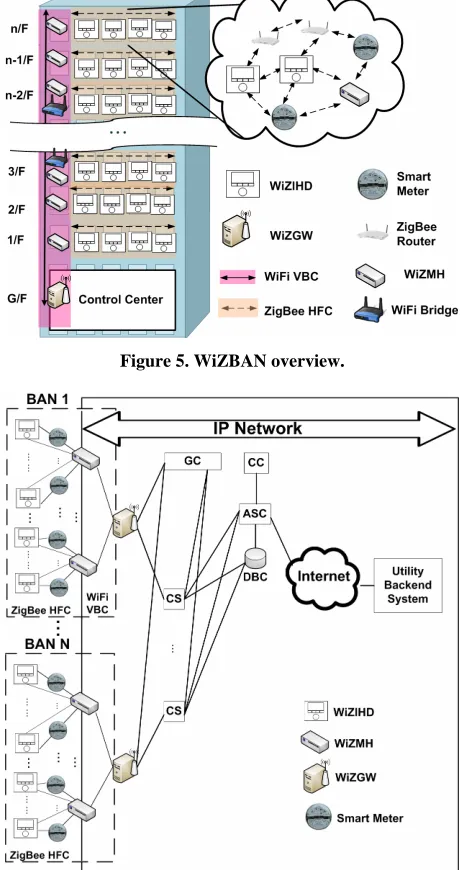
To enable the captioned AMI services in high rises, WiZBAN has been developed for intra building commu- nication. Generally, WiZBAN is divided into two parts: VBC (backbone for ordinary AMI) and HFC (mesh floor networks for HAN services). Since the smart meters are centralized in meter rooms which are located on different floors, a WiFi network has been setup for VBC to handle the heavy metering traffic. The WiFi backbone network consists of WiFi ZigBee Gateway (WiZGW) and WiFi ZigBee Meter Hub (WiZMH). WiZGW does not only play the role of BAN GW but also monitors and governs the operation of the WiZMH. By integrating with WiFi access point, WiZGW collects meter readings from WiZMH through the WiFi VBC and WiZMHs are con- nected to meters using ZigBee communication. On the other hand, WiZGW also provides socket communication interface to the utility server for meter reading collection through an IP network via either a GSM/HSPA device or a Ethernet network. To extend the coverage of WiFi VBC, WiFi Bridge are deployed if deemed necessary. The attention is then drawn to the ZigBee HFC which is a ZigBee network connecting WiFi ZigBee IHD (WiZIHD) and WiZMH. WiZMH is a meeting point of WiFi VBC and ZigBee HFC and it translates both Zig- Bee and WiFi protocol. With embedded ZigBee coordi- nator, WiZHM teams up with ZigBee router and WiZIHD to support the real time meter reading service and DR. The overview of WiZBAN is shown in Figure 5.
To gain more insight, attention is drawn to the infor- mation system architecture of WiZBAN (Figure 6). The information system architecture consists of the following system components: WiFi ZigBee IHD (WiZIHD), WiFi ZigBee Gateway (WiZGW), WiFi ZigBee Meter Hub (WiZMH), Central Station (CS), Gateway Cluster (GC), Database Cluster (DBC), Administration Server Cluster (ASC), Configuration Client (CC). The functionalities of the components are described as follows:
[image:5.595.307.538.88.264.2]1) WiFi ZigBee IHD (WiZIHD)
Figure 5. WiZBAN overview.
Figure 6. Information system architecture of WiZBAN.
The WiZIHD collects meter readings from WiZMH through ZigBee HFC to provide timely consumption in- formation to the consumer.
2) WiFi ZigBee Meter Hub (WiZMH)
The WiZHM collects meter readings from smart meter via ZigBee communication and sends meter readings to the WiZGW through the WiFi VBC.
3) WiFi ZigBee Gateway (WiZGW)
The WiZGW monitors and governs the operation of the WiZMHs The WiZGW also provides socket commu- nication interface to the CS for meter reading collection through IP network via either a GSM/HSPA device or a Ethernet network.
4) Central Station (CS)
[image:5.595.307.538.92.527.2]resources of CS and provides backup operation log to DBC. This is a master-slaves server structure with re- dundancy to provide high availability.
6) Database Cluster (DBC)
The DBC provides data storage of meter readings, system settings, operation log, and mirroring backup over multiple database servers.
7) Administration Server Cluster (ASC)
The ASC provides administration functionality for system setting/configuration, scheduling, monitoring, and meter readings access for server. This is a master-slaves server structure providing high availability.
8) Configuration Client (CC)
The CC provides user interface system setting/con- figuration, monitoring and operation scheduling of sys- tem devices.
4. Delay Model of WiZBAN
In this section, the delay model of WiZBAN is presented. Since WiZBAN includes ZigBee and WiFi and is sup- porting two services, the delay incurred betweent he conversion must be known. In this paper, a model ac- counting for such a delay is developed. The delay model is divided into three sections: ZigBee HFC, WiFi VBC and service. Consider a high rise with Nf floors covering
by k WiFi bridges and each floor is divided into Na
apartments. Assuming a smart meter stores Nr record for
data recovery and the record length is Nb bytes.
4.1. ZigBee HFC
Based on [6,7] the throughput of ZigBee communication, Thbps, is given by:
1max
b P bps
Th Th (1)
where Thmax is the maximum throughput of IEEE
802.15.4 in 2.4 GHz and the probability of Bit Error Rate, Pb, is given by:
2 0 2 0 0 0 2 1 π j E R N b b j E
P e dR Q
N N
where Eb/N0 is the energy per bit to noise power spectral
density ratio. The HFC delay for an apartment a, DHFC(a),
is given by [6,7]:
of hop between WiZIHD and WiZMH. Therefore, the average HFC delay, DHFC, is obtained as:
HFC 1 HFC a N a a D a D N
(3)4.2. WiFi VBC
Based on [8], the throughput of multi-user WiFi commu- nication, Thmu, is given by
max , rate, 2
2 1
msg usr e
mu
e
Th n n p
Th
p
(4)
where Thmax is the maximum throughput of nusr user
IEEE 802.11network transmitting nmsg byte data with
Rate Mbps and the packet error probability, pe, is given
by: 1 backoff 1 1 CW usr n e P
(5) where CWbackoff denoted as the mean of contention win-
dow depends directly on the number of collision , as it doubles on each packet collision. The RTS/CTS packets are used and so delay for single Transmission, Ds, is
given by:
data
ACK BO RTS CTS
DIFS 3 SIFS
s
D T
T T T T
(6)
where DIFS is Distributed coordination function Inter-frame Space duration, SIFS (Short InterInter-frame Space), is the small time interval between the data frame and its acknowledgment while Tdata, TACK, TRTS and TCTS are the
transmission duration of data packet, acknowledgement packet, ready to send packet and clear to send packet respectively. The general form transmission duration for l byte data (Tl) is given by:
l mu
l T
Th
(7)
Furthermore, TBO is the back off time that given as:
min BO CW TS 1 usr T n
(8) where CWmin represents the minimum contention win-
VBC delay for floor f, DVBC(f), with k WiFi bridge is de-
fined as:
VBC 1 1 s
f
f
D f k D
N
(9)
And the average VBC delay, DVBC, is obtained as:
VBC 1 VBC
f N
f
f
D f
D
N
(10)4.3. Service
SM and DR are two major services supported by WiZBAN and the performance of WiZBAN is defined in this section. The SM transmission involves meter reading collection from ZigBee meters via WiZMH which then forwards the data to WiZGW via WiFi bridges. There- fore, the SM service delay includes a single hop ZigBee transmission delay and a VBC delay. As a result, the SM service delay for specific fth floor, DSM(f), is defined as:
SM MAC
VBC
8 b
bps
a
N L L
D f D
Th
N D f
f
(11)
SM SM
1
f N
f
D D
(12)On the other hand, the DR involves data transmission from WiZGW to WiZIHD which consists of VBC and HFC. As a result, the DR service delay for apartment a on fth floor, DDR(f,a), is defined as:
DR , HFC VBC
D f a D a D f
(13)5. Performance Evaluation
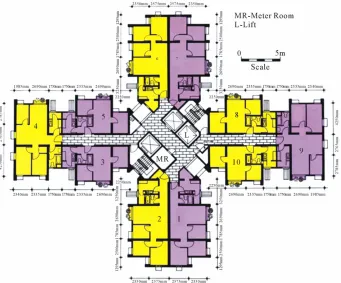
A case study has been conducted in an existing typical Hong Kong residential high rise building [9] for the de- sign and investigation of the performance of WiZBAN. As shown in Figure 7, the building has 23 floors and each floor hosts 10 residential apartments. Therefore there are altogether 230 meters. Since it is difficult to obtain measured data for the entire building, a small amount of measured results (with best effort) is collected. Based on the measured data, simulation model will be developed to predict the overall network performance (of the whole building). As a result, a simulation OPNET model is developed to project the WiZBAN performance for the entire building (23 floors). OPNET is an accurate model describing the behavior of network performance from physical layer to network layer and is popularly adopted by researchers [10], thus OPNET is also adopted in this investigation.
The SM service delay for the entire building, DSM, is
[image:7.595.129.470.437.720.2]given as:
with internet cable while WiZMH was a laptop computer with a ZigBee USB dongle. The devices and system specification are given in Figure 8 and Table 2 respec- tively. For valuation purpose, the WiFi network is con- figured such that the five-floor backbone network (WiFi bridge locates on third floor) and a floor network (locat- ing on the 5th floor, i.e. Nf = 5) forms a single ZigBee
mesh network. It is important to pinpoint that the online site investigation aims to verify the practicability of WiZBAN.
This section aims at investigating the service delay of DR and SM. Therefore, two scenarios were setup during the onsite investigation. To investigate the DR service performance, WiZGW was configured to generate DR for every l5 minutes. The WiZIHDs replied the request by sending back a confirmation. After the confirmation was verified, the WiZGW recorded the DR Round Trip Delay (RTD) for the entire process. Five hundred records were monitored (typically 5 days work) in order to pro- vide reliable basis data to smooth out irregularities due to potential inference and other possible factors like tem- perature and humidity change. The results obtained from the experiment are summarized in Figure 9.
(a)
(b)
Figure 8. WiZBAN system protocol. (a) ZigBee router; (b) WiZMH.
Record length, Nb (bits) 32
ZigBee AES 128bit enabled Payload length, Lp (Bytes)
60 ZigBee Packet length, Lz (Bytes) 127
WiFi WPA enabled payload length, LE (Bytes) 2310
[image:8.595.307.537.98.412.2]WiFi Packet length, Lw (Bytes) 2364
Figure 9. DR service RTD of different apartments for Nf =
[image:8.595.308.537.102.415.2]5.
Figure 9 gives RTD and hop count, c, between WiZIHDs (I1 - I10) and WiZGW for Nf = 5(on 5th floor).
In general, the RTDs are strongly related to c because more hops imply a longer routing path. Among I1 - I10,
the values of c of I5 and I8 (i.e. c = 3) are the highest and
thus their RTDs are also ranked top two in all scenarios. The discrepancy of RTD I5 and I8 is given by the random
back off period (TBO) during the media access which also
known as media access delay (DMAC). On the other hand,
the lowest two RTDs are recorded from I1 and I2 (~0.2s)
because both of them have reached the WiZGW with shortest path (i.e. c = 3). It can be concluded that the floor network design of WiZBAN are practical and the average RTDs of WiZIHDs is 0.32 s for Nf = 5. Attention
is drawn to the fact that the discussion up to this point only focuses on the case of the single floor network. Based on the practical floor network design, the DR ser- vice delay under different multi-storey buildings are in- vestigated by OPNET simulation. Apart from the DR, SM is another focus of this study. To reflect the real situation and understand the impact of the height of building (the density of traffic) on service delay, five backbone networks were setup for Nf = 1 - 5. The testing
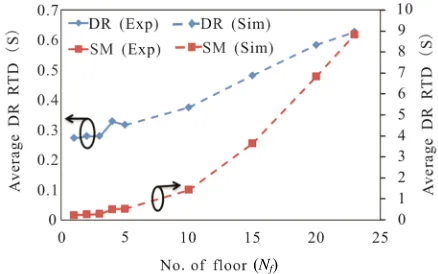
[image:8.595.93.250.456.704.2](locating in the meter room of ground floor). The WiZGW collected the metering reading from WiZMH by broadcasting MRO requests. WiZMHs then sent all me- ter reading records to WiZGW. After verifying the re- ceived data, the WiZGW recorded the duration of the entire process—this is considered as SM RTD. Such processes were repeated for five hundred times during both experiment and simulation and the average RTDs between the WiZMHs and WiZGW were measured. These experimental result were compared with the simu- lation results for Nf = 10, 15, 20 and 23. The experimen-
tal and simulated results of both SM and DR services are plotted in Figure 10.
Figure 10 investigates the average RTD of SM and DR where Nf = 1 - 23. In general, the average RTD of
both SM and DR are found to be directly proportion to the height of building since c (between WiZMH and WiZGW) increase as the height increases. As the result, average RTD increases. The average RTD of SM is longer than DR because average DR RTD is measured for specific apartment while the average SM RTD is re- ferred to the entire building. From Figure 10, the average RTD of SM and DR are projected as 9 s and 0.6 s respec- tively for the entire testing site (a 23 floor residential building with the floor plan show in Figure 7). By inte- grating WiFi and ZigBee technology, a total wireless BAN solution, namely WiZBAN, has been successfully developed to support the real time smart grid applica- tions.
6. Conclusion
Advance Metering Infrastructure (AMI) is an initial step for smart grids development which provides a real time service between the end user site and utilities. To extend the use of AMI from the individual home to high rise building (implying high traffics), the concept of Building Area Network (BAN) has been proposed by researchers. In this paper, a WiFi ZigBee hybrid BAN solution, namely WiZBAN, is proposed and implemented to cater
[image:9.595.61.280.572.709.2](Nf)
Figure 10. The average RTD of DR and SM service for Nf =
1 - 23.
for fast and efficient deployment of AMI in high traffic area such as high rises It is important to highlight that the major challenge of WiZBAN is to handle the high den- sity environment which results in heavy traffic loading and weak signal propagation. To overcome the captioned problem, Vertical Backbone Communication (VBC) and Horizontal Floor Communication (HFC) are defined for WiZBAN. WiZBAN consists of WiZBAN Gateway (WiZGW), WiZBAN Meter Hub (WiZBAN) and WiZ- BAN In Home Display (WiZIHD) which caters for the smart grids services like smart metering and demand response. WiZGW is the vital element of WiZBAN to connect WiZBAN to utilities and it teams up with WiZMH to enables VBC. On the hand, WiZMH interacts with smart meters and is the interception point of VBC and HFC. WiZMH also setup the HFC together with WiZIHD to provide the user interface for end users. To shorten the transmission time, WiFi is adopted for VBC while ZigBee is applied for HCF to overcome the weak signal propagation. To understand the performance of WiZBAN, a case study has been conducted based on an existing 23 floor residential building. From the simulated result, average round trip delay of demand response and smart metering are 0.6 s and 9 s respectively.
7. Acknowledgements
The support from Innovation to Realization Funding Scheme with project No. 9666007, CityU Applied Re- search Grant with project No. 9667063, the Center for Power Electronics, City University of Hong Kong and the Citycom Technology Ltd. are gratefully acknowl- edged.
REFERENCES
[1] Y.-H. Jeon, “QoS Requirements for the Smart Grid Com- munications System,” International Journal of Computer
Science and Network Security, Vol. 11, No. 3, 2011, pp.
86-94.
[2] Y. Simmhan, Q. Zhou and V. K. Prasanna, “Chapter: Semantic Information Integration for Smart Grid Appli-cations,” Green IT: Technologies and Applications, 2011,
pp. 361-380.
[3] Z. M. Fadlullah , M. M. Fouda, N. Kato, A. Takeuchi, N. Iwasaki and Y. Nozaki, “Toward Intelligent Machine-to- Machine Communications in Smart Grid,” IEEE Com-
munications Magazine, Vol. 49, No. 4, 2011, pp. 60-65.
doi:10.1109/MCOM.2011.5741147
[4] IEEE Std 802.11, “IEEE Standard for Information Tech- nology-Telecommunications and Information Exchange between Systems-Local and Metropolitan Area Net- works-Specific Requirements—Part 11: Wireless LAN Medium Access Control (MAC) and Physical Layer (PHY) Specifications,” 2007.