OPTIMAL CONTROL PROBLEMS OVER SPLINE SPACES
A Thesis presented for the degree of
Doctor of Philosophy in Electrical Engineering
in the
Uni versity of Canterbury.
Christchurch. New Zealand.
by
F. S. Chou, B.Sc. (Hons.)
l , _ /
ACKNOWLEDGEMENTS
For his patient guidance and invaluable advice throughout the
period of this research, I am deeply indebted to my thesis supervisor,
Dr. H. R. Sirisena.
I would like to thank the University Grants Committee of New
Zealand for the award of a Postgraduate Scholarship.
Finally, I wish to thank Miss B. V. Nottingham for typing the
CHAP'rER 1
1.1 1.2
1.3
1.4
CHAP'rER 2
2.1 2.2 2.3 2.4 2.5 2.6
2.7
CHAPTER 3
3.1 3.2 3.3 3.4 3.5 INTRODUCTION
Numerical Methods for Optimal Control Problems
The Ha<thematical Programming Approach
Distributed Parameter Systems
Thesis Organization
References
THE CONTROL PARAMETRIZATION PROCEDURE
Introduction
Review of Spline Functions
Problems without Constraints
Problems with Terminal Constraints
Problems with Control Constraints
Problems with State Constraints
conclusions
References
- ERROR BOUNDS FOR THE CON'l'ROL PARAME'l'RIZ.ATION
PROCEDURE
Introduction
Unconstrained Problems - Linear Quadratic Case
Unconstrained Problems - General Case
Problems with Fixed Terminal State
4.2
4.3
4.4
4.5
CHAP'rER 5
5.1 5.2 5.3 5.4 5.5 5.6
CHAPTER 6
6.1 6.2 6.3 6.4 6.5 6.6
The SP Procedure for General Control Problems The SP Procedure for a Class of
P:t:oblems
Problems with Linear Constraints Conclusions
References
Control
ERROR BOUNDS FOR THE STA'rE PARAMETRIZATION PROCEDURE
Introduction
The Ritz Procedure
Linear Quadratic Problems Multivariable System Problems Nonlinear Problems
Conclusions References
- THE S'l'ATE PARM1ETRlZATION PROCEDURE FOR DISTRIBUTED P ARANETER SYS'rEHS
In"troduction
Classification of Distributed Systems Multivariate Spline Functions
APPENDIX A
B
l' .. PPENDIX C
References
MATHEMATICAL BACKGROUND
A SUMM.i\RY OF PARAMETRIZATION PROCEDURES
SOLUTION OF A BOUNDARY CONTROL PROBLEM
137
138
142
In this thesis we report on investigations into the numerical
solution of deterministic, continuous-time optimal control problems via
parametrization techniques. These methods involve the linear expansion
of one or more problem variables (Le. control, state, co-state) in terms
of functions. In this way the original optimal control problem
c2m be reduced -to a finite-dimensional minimization problem which may be
solved numerically using standard mathematical prograrruning algorithms.
Two specific techniques are considered here; we refer to them as
the control pa.rametrization (CP) and the state parametrization procedures
(SP) . As their names imply, the CP and SP procedures involve the
expansion of the control and state, respectively, in terms of basis
functions.
The importance of splines in the interpolation and approximation
of functions is well known. In this research the viability of employing
splines in conjunction with the above mentioned parametrization procedures
is examined. The rates of convergence of the CP and SP solutions are
also analysed; under smoothness conditions, explicit error
bounds are derived for the control, state and cost functional convergences._
Numerical results supporting the validity of these error bounds are
presented.
All the numerical computations in this research have been done on
the University of Canterbury Burroughs 6700/7700 machine using
u
inf
sup
T
x
Ixl
Ilx II
x
Dn X,X (n)
a
S
h
Is an element of
Is a subset of
Union
Intersection
Infimmu, or greatest lower bound
, or least upper bound
n-dimensional Euclidean space
of x.
Euclidean inner product of x and y.
Modulus of
x
Norm of X
Derivative of x with to time t. nth-derivative of x with to time t.
of functions with continuous ath order derivatives
on
of functions with continnous ath order
derivatives.
CHAPTER 1
INTRODUC'rION
1.1 NUMERICAL METHODS FOR OPTIMAL CONTROL PROBLEMS
The two or advances in modern control theory have been ( a) the
dynamic approach of Bellman [lJ based upon the of
and (b) the maximum principle of Pontryagin
[2J
is an extension of the classical calculus of variations.The main result of the dynamic programming approach to the continuous
time control problem is the Hamilton-Jacobi-Bellman
for the
differential
return function. In general this is a nonlinear part.ial
which is extremely difficult to solve
However, in those special cases when a closed form solution to the HJB
can be found, the optimal control is obtained as a feedback law;
that is, the optimal control is determined as a function of the state.
The programming technique was originally deve for discrete
time control problems. For these problems, application of the
results in a set of recursive relations which can be conveniently
solved on a digital computer. The chief drawback of programming
is its enormous computer storage requireYt1ents. This has been
overcome by the state increment algorithm of Larson
In comparison to dynamic programming, the maximum of
a more popular approach to the numerical solution of the
control problem. Numerical methods based on the maximum principle
can be classified as one of two types. The first includes
all ·the so-called indirect methods which are based on l:he t,vo point
of the maximum principle to the optimal control problem. Some of the
better known techniques belonging to this category are described below.
(1) Quasilinearization [4J: 'rhis method the nonlinear 'rPBVP by a sequence of linear boundary value problems which can be solved
'1'he major drawback of this method is that a good initial guess of the
solution is usually necessary for convergence. However, if the method
converges, i t does so quadratically to the solution.
(2) Invariant imbedding [5]: This procedure imbeds the TPBVP within a
class of more general initial value problems.
(3) Shooting method [6]: This method iterates on the initial values
of the costate variables, leaving their terminal conditions unsatisfied
until the solution is obtained. The main difficulty with this approach
lies in -the fact that boundary conditions are highly sensitive to small
changes in initial conditions because the state-costate system of equations
is inherently unstable.
The second category of numerical methods are the so-called direct
.methods which seek to prescribe a minimizing sequence of state and control
functions without solving the TPBVP. For further details concerning these
methods the text by Sage
[7J
can be consulted. Some important direct methods are described below.(1) Gradient method: Also known as the method of steepest descent,
this is a control iterative procedure in which corrections to the control
are made in the direction of most rapid change in the cost functional.
The algorithm is based on calculating the first order effects of the control
on the cost functional, and is therefore a first order method. Initial
convergence is usually excellent, but in a vicinity of the optimum convergence
becomes slow.
and conjugate
Two variants of the basic gradient method are the min-H
The min-H method was proposed by Kelley
[8J
and proceeds as follows:guess a nominal control, then solve for the state and costate. Keeping
the state and costate fixed, determine the control which minimizes the
Hamiltonian; this control is then used for the next iteration.
developments of this method can be found in [51J.
Further
The conjugate gradient method was originally developed by Lasdon
et. aL [9J as an extension of the conjugate gradient method of Fletcher
and Reeves [lOJ in finite-dimensional space. This algorithm is reported
to possess superior convergence properties to the basic gradient method.
(2 ) The method of second variations: This is an extension of the
gradient method based on considering the second-order effects of the control
on the cost functional as well as the first-order ones, resulting in greatly
improved convergence characteristics near the optimum. However, in addition
to being a more complicated algorithm than the gradient method, i t has a
smaller region of convergence and requires a reasonably good (convex)
nominal solution [48].
(3 ) The mat_hematical programming approach [llJ: This procedure replaces
the original optimal control problem by a stat:ic optimization problem, and
constitutes the subject of our present investigation.
method in greater detail.
1.2 THE MATHEMATIClili PROGRA~~ING APPROACH
vIe now review t_he
The development of mathematical programming (MP) is in an advanced
stage: a well established theory is in existence and a wide range of highly
sophisticated comput';l-tional techniques are a;railable for the numerical
solution of MP problems. To exploit the theoretical and computational
e cons-ti tutes the primary obj ecti ve of the ~1P
consists of two steps. Firstly, an optimal control
reformulated as an MP problem via a discretization scheme. The
l>1P problem is -then solved by means of a suitable computational
Among the earliest to apply this approach to the solution of
control are Zadeh and Whalen [12J in 1962. Early
'l'he
is
of
the MP
-the
generally employ some finite difference scheme to discretize
control problem, but many papers have since
various discretization schemes. Some of -these schemes will be discussed
later. But for the moment we shall review some MP techniques.
Review of Mathematical
The of an MP problem are:
(a) a scalar objective function 4>(x) of the vector variable X,
(b) avec-tor function g (x) representing inequali-ty constraints I and
(c) a vector function h(x) representing equality constraints.
The statement of the
MP
problem is:minimize
<P(x)
I subject to g(x) ~ 0, h(x) ~ 0. (1. 1)An MP is called a linear programming problem when its
objective function 4> and constraints g and h are all linear; other'N'ise i t
is called a nonlinear programming problem. An important special case of
the latter is the programming problem in which g and h are linear
while the objective function 4> is quadratic. Other special classes of MP
problems include
programming (see
Numerous
)
.
programming, integer prograrf'Jlling and convex
are available for the numerical solutio.) of .t--1P
numerical 'techniques of ~W, the more impo,rtant ones include,
(1) the Simplex algorithm [14J fox: linear programming,
(2)
Wolfe's algorithm [lSJ for quadratic programming,(3) the method of feasible directions [16J"
(4) the projection method [17J f [18J of Rosen, and
(5) the sequential unconstrained minimization technique, originally
proposed by Carroll [19J and developed further by E~iacco and McCormick [20J.
Some of the above methods involve intermediate solutions of
uncon-strained minimization problems. Numerical techniques for unconstrained
minimization are divided into two groups: direct search methods and
descent methods.
(1) Direct search methods the evaluation of function values but not their gradients.
include,
Well known. algorithms belonging to this group
(a) pattern search method [21J of Hooke and Jeeves f
(b) Rosenbroek's method of rotating coordinates
[22],
and(c) Powell's method [23J.
(2) Descent methods require the evaluation of gradients as well as
function values. In general, descent methods are more efficient than
direct search methods. At each iteration of a descent technique a descent
direction is computed and the minimum of the objec'l:ive function is then
searched in that direction. Each descent method is characterized by the
particular manner in \-lhich these search directions are generated.
of descent methods are,
(a) method of steepest descent,
(b) second order gradient method,
(c) method of conjugate gradients, and
(d) variable metric'method.
Of the examples listed above I the s'ceepest descent method is the simplest. The search directions used here are the locally steepest
directions" Computations wi,th this method have proved to be rather
unsatisfactory. rEhis poor performance can be attributed to the fact that
the steepest descent method converges asymptotically in a two~dimensional
space (see [24])"
The overall performa.nce of the second order gradient method is quite
good, and its convergence is particularly good in the vicinity of the
minimum. However, the computational load for each iteration is quite large.
The method of conjugate gradien'ts was first used by Hestenes and
Steifel
[25J
to sol ve system~ of linear equations by minimizing thecorres-ponding quadratic objective function. This was later generalised to
general functions by Fletcher and Reeves [lOJ. This rnethod is efficient
and does not suffer from the drawback mentioned above for the steepest
descent method.
The variable metric method was proposed by Davidon and extended by
Fletcher and Powell
[27J.
'rhe me thod exhibits convergence propertiessimilar to that of the second order gradient method.
Discretization Schemes
The initial in the implementation of the HP approach to an optimal control problem is to select a discretization scheme. Using this
scheme, a finite-dimensional optimization problem is obtained as an
apprm<-imation to the original op'cimal control problem. In general, different
discretization schemes will lead ·to different !;jP problems and therefore to
different approximate solutions of the optimal control problem. For a
of the scheme to the original must be
reason-ably close to the true solution. Moreover, the solution
should improve as the discretization is gradually refined. Other features
of a discretization scheme to be considered are the ease of implementation
of the scheme and the complexity of the resulting MP Examples
of discretization schemes for optimal control include,
(1) finite difference,
(2) control parametrization,
(3) Ritz-Trefftz,
(4) approximation,
(5) Ritz-Galerkin,
In
based on
4
of this thesis, an alternative discretization schemesome components of the state vector will be introduced.
We shall refer to this procedure as,
(6) state parametrization.
Of the above mentioned examples, the finite difference scheme (see
Tabak and Kuo [llJ) is the simplest. It involves the discretization of
the time variable : the entire time interval under consideration is divided
into sub-intervals of equal size. Throughout each sub-interval of time,
the control and s·tate a:t:e assumed to be constant. The state equation is
a finite difference equation, and the cost funct.ional is
o.pprox·-imated by a finite summation which is to be minimized with respect to the
constant control.
Each of the remaining procedures (2) to (6) involves the
parametriz-ation of one or more of the following
and (c) co-state.
For instance, the control parametrization
involves making the following approximation on the control variable:
u(t)
m E
i=l
q.I/!.(t) I (1. 2)
l l
where IjJ l ' . . .
,I/!
ill are knm'111 basis functions of time and qil . - -, ~ are unknowncoefficients. The control is said to be parametrized by ql" -., because
once these are specified, the control function can be found from
(1.2)
The corresponding state vector can be determined by integrating the state
, which in turn means that ·the cost functional J can be evaluated.
Thus, the original optimal control problem reduces to that of finding the
values of ql""~ which minimize the cost J.
The Ritz-Trefftz procedure
[29J
involves the parametrization of theco-state, while the trajectory approximation procedure
[30J
involves theof both the state and co-state. In the Ritz-Galerkin
[31]
the control, state and co-state are all parametrizedsimultaneously. A more detailed summary of these procedures can be found
in B.
A closely related to the Ritz-Galerkin procedure is
described Neuman and Sen
[32J
I whereby the control and stab2 aresimul-and required to satisfy a weakened version of the
state through the use of the collocation procedure.
In their paper
[26]
on the generalized gradient method for optimalcontrol lem3 vJith state inequality constraints and singular arcs,
Mehra and Davis out that instead of treating the control variable
as the variable all the time, i t is sometimes advantageous to
treat a state variable as the independent variable. This point 6f view is
in the state parametrizat.ion procedure to be introduced in
We now consider the choice of basis functions for the zation
Generally, standard families of functions like the
tric functions and Legendre polynomials can be employed.
onal results using polynomials are reported in [32J, while
polynomials are employed in
[33J.
A class of functions that have received considerable attention in recent times are the spline functions. These are
with continuity requirements only slightly less stringent than the
nomials. Nevertheless, spline functions possess certain desirable
not shared by polynomials which make them particularly attractive for use
in and approx'imation (see
[50J).
In this thesis we shall be ly concerned with the application of spline functions in the controlparametrization and sta-te parametrization procedures.
In a series of articles [29],
[31J, [34]
et. ale examinedthe convergence properties of the Ritz-Trefftz and Ritz-Galerkin
In particular, explicit error bounds which indicate the rates at which the
approximate solutions converge to the true solutions are derived in 'the
case lilhere spline functions are employed. Extensions of this work to the
control parametrization and state parametrization
in Chapters 3 and 5 of this thesis.
are contained
1.3 DISTRIBUTED PARA.fvlETER SYS'rEt.-1S
Up to now, our discussion has been concerned with control problems
involving systems described by ordinary differential eqnations, know'll as
lumped parameter systems, or simply,
many problems oecurring in physical
described by partial differential
However, there are
which involve systems
Such are knO'>l11 as
distributed parameter 8ysl:e111S, or simply, distributed systems, in which
"I:he state variables are dependent on one or more spatial coordinates in
addition to time.
Among the first papers to appear in this area have been those of
Butkovskii and Lerner [35J and Butkovskii [36J. These early efforts have
been directed towards generalising the theory for lumped problems to
accommodate distributed problems. Specifically, a maximum principle for
distributed problems was developed in the above mentioned articles.
Pioneering work in this field has also been done by Wang
[17J,
who extendedthe fundamental concepts of controllability, observability and stability to
the distributed case. Subsequently, much work has been done towards putting
the control theory of distributed systems onto a solid mathematical
found-ation. In particular, Balakrishnan
[38J
and Lions[39J
have formulatedand analysed distributed control problems in abstract settings (viz. Banach
and Hilbert spaces) using the tools of functional analysis. In spite of
the significant progress achieved in recent years, the theoretical
develop-ment of distributed control is far from complete, especially in regard to
nonlinear problems.
From a computational point of view,the solution of distributed
control problems represents a much more formidable task than the solution of
lumped control problems with increased prograil1Il\ing complexity as well as
increased computer time and memory requirements. Hence the development of
efficient numerical algorithms for solving distributed problems is of
great importance. We now review some of the available numerical techniques
for distributed problems.
One popular approach to developing numerical methods is to extend
the conjugate gradient method and the method of second va1:'iations have
all been extended to various classes of distributed problems, (see [40J I
Another popular approach is to reformulate the distributed problem
as a lumped problem. This can be achieved using a finite differencing
technique
[42J.
For problems involving independent controlvariables, the'Galerkin procedure can also be used to obtain the approximate
lumped problem (see
Bosarge et. al.
[45J
I [46J have presented the Ritz-'l'refftz andRitz-Galerkin procedures distributed problems involving parabolic systems.
In Chapter 6 we develop the state parametrization procedure for distributed
as an extension of the procedure introduced in Chapter 4 for
lumped problems.
1.4 THESIS ORGANIZATION
The chapter headings for the remainder of the thesis together vlith
an abstract for each chapter are as follows:
Chapter 2: The Control Parametrization Procedure.
The CP procedure for solving optimal control problems is
reviewed, with emphasis on the use of functions.
The transformation technique for convertin9 control
involving control or state variable inequality constraints
into problems withou,t constraints is described. Computational
Chapter 3:
Chapter 4:
Chapter 5:
Chapter 6:
Chapter 7:
Error Bounds for the Control Pa:cametrization Procedure.
Convergence of the CP procedure is examined. Error
estimates for the approximate control, state and cost
functional over arbitrary fini te'-dimensional approxima-tion
spaces are obtained in the L
2-norm. For the CP approx·~
imations over spline spaces, explicit o:cder bounds are
derived. Computational results supporting these error
bounds are presented.
The State Parametrization Procedure.
The SP procedure for solving optimal control problems is
developed. The procedure is then specialised to the class
of control problems whose state equations can be expressed
in the phase variable fo:cm. Computational results employing
cubic splines are presented for two specific examples.
Error Bounds for the State Parametrization Procedure.
Convergence of the SP procedure is examined. Error bounds
for the SP approximations over spline approximation spaces
are es-tablished for a class of control problems.
The State Parametrization Procedure for Distributed Parffineter
Systems.
The SP procedure is extended to a wide class of distribllted
control problems. Con~utational results using multivariate
splines in conjunction with the SP procedure are presented.
The convergence of the procedure is also examined.
General Conclusions.
The contributions of this thesis are slmmlarised and directions
REFERENCES
R. Bellman: Dynamic Programming, Universit.y Press,
Princeton, N.J., (1957).
L. S. , V. G. Boltyanskii, R. V. Gamkrelidze and
E. F. Mishchenko: rrhe Mathematical of Optimal Processes,
Wiley, N.Y , (1962).
[3J R. E. Larson: State Increment Dynamic Programming, American
Elsevier, N.Y., (1968).
R. Bellman and R. Kalaba: Quasi1 and Nonlinear Boundary Value Problems, Elsevier Press, N.Y., (1965).
E. S. Lee: inearization and Invariant Imbedding, Academic
Press, N.Y., (1968).
P. B. Bailey and L. F. Shampine: On Methods for TPBVP, J. Math. Anal. and Appl., Vol.18 (1967) pp.45~58.
[7] A. P. Sage: Optimum Systems Control, Prentice-Hall, Englewood Cliffs "
N.J., (1968).
H. J. Kelley: Method of Gradients, in Techniques,
G. Leitman ed., Academic Press, (1962).
[9J L. S. Lasdon, S. K. rHtter and A. D. Waren: The Conjugate Gradient
Method for Control Problems, IEEE Trans. Automatic
Control, AC-12 (1967) pp.132-138.
R. Fletcher and C. Reeves: Function JVIinimization by Conjugate
[13J
[16J
D. Tabak and B. C. Kuo: Optimal Control by Mathematical Programming,
Prentice-Hall, Englewood Cliffs, N.J., (1971).
L. A. Zadeh and B. H. Whalen: On Control and Linear
Programming, IRE AC-7 (1962) pp.45-46.
S. Vajda: Ma'thematical Programming, Addison--Wesley, Reading,
Mass. (1961).
G. B. Dantzig: Linear Programming and Extensions, Princeton
University Press, Princeton, N.J., (1963).
P. Wolfe: The Simplex Method for Quadratic Programming, Econometrica,
Vol.27 (1959) pp.382-398.
G. Zoutendijk: Methods of Feasible Directions, Elsevier, Amsterdam,
(1960) •
J. B. Rosen: The Gradient Projection Method for Nonlinear Programming I: Linear Constraints, SI~i J. . Math., Vol.S (1960),
pp.181-217 .
J. B. Rosen: 'The Gradient Proj ection Method for Nonlinear Programming II~ Nonlinear Constraints, SI~l J. . Math., Vol.9 (1961)
pp.514-532.
C. W. Carroll: The Created Response Surface Technique for Optimizing
Nonlinear Restrained Systems, Op. Res., 9 (1961).
A. Fiacco and G. HcCormick: Nonlinear
Unconstrained Minimization Techniques, wi
Sequential
, N.Y. (1968).
[2
R. Hooke and T. A. Jeeves: Direct Search Solution of Numer::'cal andStatistical Problems, Journal of the ACH, Vol.8 (1961), pp.212··
[22J
H. H. Rosenbrock: An AutomCltic Method for Finding the Greatest::or Least Value of a Function, Computer J., Vol.3 (1960),
pp.175-184.
[23J M. J. D. Powell: An Efficient Method for Finding the Minimum of
a Function of Several Variables without Calculating Derivatives,
Computer J., Vol. 7 (1964) pp 147-151.
[24J
J. Kowalik and M. R. Osborne: Methods for Unconstrained Optimizat.ion·Problems, Elsevier, N.Y., (1968).
[25J M. Hestenes and E. Stiefel: Method of Conjugate Gradients for
Solving Linear Systems, Report 1659, National Bureau of
Standards, (1952).
[26] R. K. Mehra and R. E. Davis: A Generalized Gradie:t:lt Nethod for Optimal Control Problems with Inequality Constraints and
Singular Arcs, IEEE Trans. Automatic Control, AC-l7 (1972)
pp.69-79.
[27J R. Fletcher and M. ,J. D. Powell: A Rapidly Convergent Descent Method for Minimization 1 Computer J. I Vol. 6, (1963).
[28J H. H. Rosenbrock and C. Storey: computational Techniques for
Chemical Engineers, Pergamon, London (1966).
[29J W. E. Bosarge, Jr. and O. G. Johnson: Direct Nethod Approximation to the State Regulator Problem Using a Ri tz-Trefftz SuJ:loptimal
Control, IEEE Trans. Automatic Control, AC~15 (1970)
pp.627-631.
1)
oJ
L. L. Lynn, E. S. Parkin and R. L. Zahradnik: Near-Optimal ;::ontro1 by ec Approximation, Ind. Chem Fund., Vol.9[31J W. E. Bosarge, ,Jr., O. G. Johnson, R. S. McKnight and
v'l.
P. 'l'imlake:The Ritz-Galerkin Procedure for Nonlinear Control Problems,
SIAM J. Numer. AnaL, VoL 10 (1973), pp.94-llL
[32] C. P. Neuman and A. Sen: Weighted Residual Methods in Optimal Control,
IEEE Trans. Automatic Control, AC-19 (1974) pp.67-69.
[3~
G. J. Lastman: Suboptimal Open Loop Control of Nonlinear SystemsUsing Approximations for the Controls, Int. J. Con·trol, Vol.20
(1974), pp.289-303.
[34J W. E. Bosarge I Jr., and O. G. Johnson: Error Bounds of High Order
Accuracy for the State Regulator Problem via Piecewise Polynomial
Approximations, SIAM J. Control, Vol.9 (1971), pp.15-28.
[35J A. G. Butkovskii and A. Ya. Lerner: '1'he Optimal Control of Systems
wi th Distributed Parame"ters, Automation and Remote Control,
Vol.2l (1960) ~ pp.472-477.
A. G. Butkovskii: The Maximum Principle for Optimum Systems with
Distribut~ed Parameters, Automation and Remote Control, Vol.22
(1962), pp.1156-1169.
~
P. K. C. Wang: control of Distributed Parameter Systems, Advancesin Control Systems, Academic Press, N.Y. (1964).
[38J A. V. Balak.rishnan: Optimal Con tro 1 Prob lems in Banach
SIAM J. Control, Vol.3 (1965).
[39J J. L. Lions: Optimal Control of Systems Governed by Partial Differential Equations, Springer-Verlag, Berlin (1971).
[J~J J. H. Holliday and C." Sto:n:;y: Numerical Solution of Certain
Nonlinear Distributed Parameter Opt.imal Control Problelrs I
[4jj D. E. Cornick and A. N. Hichel: Numerical Optimization of
Distributed Parameter Systems by the Gradient
Method, IEEE Trans. Automatic Control, AC-17 (1972) pp.358-362.
A. P. and S. P. Chaudhuri: Gradient and Quasilinearization Techniques for Distribu'ted Parameter Systems,
Int. J. Control, VoL6 (1967) pp.81-98.
[43J C. P. Neuman and A. Sen: A Rapid Sub-Optimal Control Algorithm
for Dist:r:ibuted Parameter Regulator Int. J. Control,
Vol.16 (1972) pp.539-548.
[44J L. L. Lynn and R. L. Zahradnik: The Use of Orthogonal Polynomials
in the Near-Optimal Control of Distributed by Trajectory
, Int. J. Control, Vol.12 (1970), pp.1079-1087.
W. E. , Jr., O. G. Johnson and C. L. Smith: A Direct Method to the Linear Parabolic Problem over
Mul t i variate Spline Bases, SIAl"I J. Numer. AnaL, VoL 10 (1973)
pp.35-49.
[46J R. S. McKnight and W. E. Bosarge, Jr.: The Ri tz-Galerkin Procedure
fOT Parabolic Control Problems, SIAM J. Control, VoLll (1973)
pp.510-524.
[n]
G. Strang and G. J. Fix: An Analysis of the Finite Element Method,Prentice-Hall, N.J. (1973).
A. E. Jr. and Y. C. Ho: Appli(~d Optimal Control, Blaisdell,
T. J. Walder and C. Numerical Solution of an Optimal
Temperature Problem, The Chemical Engineering J . , VoL 1 (1970) pp.120--128.
[so]
J. H. Ahlberg IE. N. Nilson and J. [ j . ~valsh: The Theory of Splinesand Their Applications, Academic Press, N.Y. (1967).
[511
H. G, Go1:tlieb: Rapid Convergence to Optimum Solutions using aCHAPTER 2
'rEE CONTROL PARi"METRIZATION PROCEDURE
2.1 INTRODUCTION
The primary purpose of the present chap-ter is to revievl the control
parametrization (CP) procedure for solving optimal control problems with special emphasis on the use of spline functions
Suppose that we have an optimal control problem requiring the
minim-ization of a cost functional J (u) over 'the space of admissible controls U.
The CP procedure discretizes the problem by restricting the control variable to a subset C of U which is parametrized by m real variables.
m This involves
specifying the members of C ,to be of the form,
m
u(t) F(q,t) (2.1)
m
where F is a known function of the m-dimensional parameter vect~or qeE .
The function F specifies the form of the parametrization.
If only controls belonging to C are considered, then the cost m
func,tional reduces to a iU,l1ction of q, and we write,
J (u) J (q)
The original goal of minimizing J(u) over U is now replaced by that of
(2.2)
minimizing J(q)' over C .
m Assuming the existence of a solution, the new
problem of determining the optimal values of q l ' . · ' ,qm is generally a much
simpler task 'than t~he original problem which involves optimiza'tion in
'rhe case when F is a linear function of q is of particular
importance i equation (2.1) 1.:hentakes the form
m
u(t) L:
i=l
q.1jJ. (t) (2.3)
1 1
where ~J l ' . . . ,1jJ m are known functions of time called basis functions. In
this case C becomes an m-dimensional linear space over the scalar field E,
m
and we call C an approximation subspace of U. m
Sometimes the basis functions can be specially constructed to suit
the problem in hand (see [lJ,
[2J).
Otherwise standard families of functions may be used, some examples being the polynomials, trigonometricfunctions, Legendre polynomials, Bessel functions and Hermite polynomials.
Extensive computational results using Chebyshev polynomials have been
reported by Lastman
[16].
Hicks and
[2]
presented computational results employing a control parametrization consisting of a bang-bang portion followed by a polynomialcurve. The parameters to be optimized in this case are (a) the switching
times for the bang··bang portion and (b) the coefficients for the polynomial
curve. The static optimization was performed using the direct search
technique of Rosenbrock. However/ this to be rather unsatisfactory,
as nominal controls tended to converge to different final controls,
even -though the final values of the cost were in close agreement with one
another. This difficulty appears to be due to the flatness of the cost
surface in the vicinity of the optimum, which causes direct search methods
.to be severely affected by truncation and round-off errors in compnting the
cost.
In view of this problem, Sirisena
[J]
suggested that the staticextended to problems involving constraints [4J.
In section 2.3 we review the basic CP procedure for the unconstrained optimal control problem. Extension of the procedure to problems with
terminal constraints is reviewed in section
2.4.
In sections 2.5 and 2.6 the transformation technique for converting problems involving control or state variable inequality constraints into unconstrained problems is reviewed. Throughout, the use of spline functions has been emphasised. The fundamentals of func·tions will now be reviewed.2.2 REVIEW OF SPLINE
A function (or spline) is a polynomial which satisfies a strong smoothness condition. It is a natural generalisation of the polynomial, yet i t possesses certain features not shared by polynomials which make it attractive for the purposes of interpolation and approximation. For a comprehensive treatment of spline functions refer to the text by
Ahlberg, Nilson and Walsh
[5
J .
In this section \ve review some basic facts about spline functions. We shall begin with a couple of definit.ions.Definition: Consider an interval ,bJ on the real line and a strictly increasing sequence of real numbers t ,tl, ... ,t , where
o N
a to < t l < ••• < tN b.
The set
P
=
{t ,tl, ... ,t } is said to be a partition ofo N ,bJ, and the
elements of P are called kno'cs (or nodes). The mesh size h of P is defined by
De Given a p {t ,tl, .•. ,t } of the interval
o N
,b] ,
a function s(t) of a with knots t ,tl, ... ,t is a function
o N
defined on [a,b] having the following
(i) in each sub-interval (ti,t
i+l ), where i ~ O,l, ... ,N-l,
s(t) is a polynomial of a or less.
(ii) s(t) and its derivatives of order up to a-.l are continuous in
(alb)
It is clear from the above definition that a spline function of
a is a function in 1[a,b1 whose derivative of order a is piecewise
constant.
Given a partition P {t ,tl, .. o,t }, let us now consider the set
o N
of all splines of degree a over the partition P. It is easy to see that such a set is a linear space over the field of real numbers. NOw, each
spline s(t) in the space is continuously differentiable (a-I) times in
th
and the a derivative of s Ct) is a constant in each sub-interval
(t
i ,t;i+l) I i=O, I, ... ,N-I. Hence s(t) is parametrized by the initial
values of s(t) and its first (a-I) derivatives together with the value of
. th d " h u b ' 1 ( l·ts a erlvatlve over ea,c s -lnterva t. t
1
I i=O,l, . . . ,N-l.
Therefore, the dimension of this linear space is N+a, and henceforth i t
a+l . a+l
shall be denoted by S (t " " / t ), SN' or
o N
basis
Bases
It follows from the theory of linear spaces that there exists a
a+l
containing N+a elements for the spline space
S
(t , ... , t ).a N
1'4oreover, this basis is not unique. To construct one such basis, we note
a+l
that every s(t) E
s
(t " " I t ) can beo
N
in the formwhere p (t) is a polynomial of degree c( or less, and (t- ) 0. is the
0. +
truncated power function defined as follows:
r
(t_t,)o.
,
if t ?; t.t
1 1(t-t, )0. 1 +
0 if t ~ t.
1
(2.6)
0. 0. 0.
Therefore the set {l/t, ... , t , (t-t~)+, ... , (t-t
N_1)+} is a basis for
1
(t p • • , t ) .
o N
The B-splines of Schoenberg
[6J
provide another possible splinebasis. In spline interpolation problems, the use of B-splines gives rise
to better numerical stability than the use of bases constructed with
tn.mcated power functions (see
[91).
A feature of the B-spline is that i t has fini·te supporti that is l i t is non-zero only on a finite region.In fact, i t was shown by Curry and Schoenberg
[7J
that the B-splines areof minimal support; that is, no other basis functions can be found which
have smaller support regions than those of the B-splines. Another property
of the B-spline is that i t is strictly positive within its support region
which'is restricted to 0.+1 adjacent intervals.
Let us consider now the bi-infinite partition {t.}~ of the real
J. 1==-<0
line. The B--spline
IP.
(t) of degree 0, which is non-zero over the in-terval1
(ti,ti+o.+l) is given by the formula,
lji,(t) :=
1 (t, 1+0.+ I-t, ) 1
i+o.+l
l:
j==l
i+o.+l {(t,-t)o./ II
J + m=i
mfj
(t ,-t )}. (2.7)
J m
·The above definition provides the normalized form of the B-splinej in other
words,
1 (2.8)
In the case of a uniform partition, the of order ex are
merely translates of one another along the real line. To illustrate this
point, suppose that the knots in the partition are given by t. = jh for all J
j, where h is the constant mesh size of the partition. Then i t
can be shown that,
~J.(t) == ljJ.('t-t . . ).
1 J 1 - J
(2.9)'
Furthermore, a change in the mesh size of the uniform partition simply
means a re-scaling of the independent variable in the formula for s.
Consider the partition Z == {i}~ whose nodes are the integers, and let
1=-00
ljJ(t) be the of order ex which is non-zero over the interval [i,
{t.}~ is ano·ther uniform partition, wher'e t. = ih,
1 1=-00 1
and let ¢(t) be the B-spline of order ex which is non-zero over the interval
<P (t)
The functions IjJ and <P are then related by the formula
IjJ
(~
- j+i)h (2.10)
The B~spline ljJ(t) starts from zero at t if monotonically increases
t i l l i t reaches its maximum at the poin1: t i + (a+l)/2, then monotonically
decreases t i l l i t returns to zero at t
=
i -I- a+
1. Horeover, IjJ issymmetrical about its point of maximum. Explicit formulas for typical
B-splines of orders 1, 2 and 3 over the partition Z are (i) linear spline
r
1+
t, ~) (t) :='\ 1 t,
l,
a
(ii) parabolic spline
l-~J (t)
l(
)2
2 I t t ,
]
--2 + t2 ' ' 0 2t
+
0,
2
t I
1 2
~t
2' f
t
Eta]
tE:
[o,lJ
elsewhere
t £:
,0]
t £ [
O,JJ
t E [ 1,
~I
(iii)
cubic spline
(1
) 3
6
2+t
,
t E:2 2 1 3
3
t
2t ,
t E:[--1,0 ]
lj!
(t)
:::: 2t
2
13 -1-
2
t E:[0,1
J
1 3
I
6(2~t) I t £[1,2 ]
L
a
elsewhere
2.3 PROBLEMS WITHOUT
In this section we review the CP procedure for the unconstrained
Bolza problem.
Although spline approximation spaces are employed here,
the method to be described can be generalised to the case of a general
parametrization with obvious modifications.
For clarity of presen·ta·tion,
only single-input systems will be considered; the generalisation to
multivariable systems is straightforl.vard.
Problem
Consider the dyn<Jmical system described by
x(t)
f(x(t), u(t),
t ) ,and the cost functional
x (0) x
o
J(u)
==O[X(T) ,TJ
+
f~
¢(x(t), u(t), t) c1t,
where x(t) is an n-dimensional s·tate vector and u(t) is
ascalar-valued
control variable belonging to the set of admissible controls
U.The
(2.11)
(2.12)
optimal control problem is to find the admissible control ul< that minimizes
the cost fW1ctional: '
Method
Firstly, a suitable partition of the time interval [O,,z] is chosen.
For convenience, we shall assume that the partition is uniform:
o
==
Twhere N is the number of sections into which
,T]
is divided by the parti'tion, and t.J jh (O:Sj:SN), where h = TIN is the uniform mesh size.
h
An
arbitrary spline function 1.1 of order a over the partition (2.13)may be expressed in the form
h
\1 (t) ::::
N+a
l:
i==l
q.lj!. (t) I
1 1 (2.14 )
a+l
where {lj!l ,lj!2
,···,lj!N+a}
is a basis for the spline space Sh . In general,a+
U will be the space of piecewise continuous controls, so S h U fo.r
non-negative integer
a.
-h
a+l
TheCP procedure involves finding the control u € Sh which
minimizes the cost functional:
. a+l . h
It is clear that 51.nce 8
h 1S a subset of U, we must ave that
J(u*) :S J(rih) , so in general;h will only be sub-optimal.
(2.15)
For a given basis {lj!l ,lj!2 , ... ,lj! }, the control u is parametrized
N+a
Hence the functional J(u) may be
considered an o;rdinary function of these parameters, and we write
-J(u) - J(Ql,Q2, ... ,QN+a)' (2. 16)
It was
recorrul1~nded
by Sirisena[3J
that the optimization of J beperformed using a 'Jradient search method, for insta.nce the
requires the evaluation of t:he yradient of J with respect to each parameter
q. . 'l'hese gradients may be computed as described below.
1
The Hamilton H is defined in the usual manner,
H(x(t) ,u(t) ,;\(t) ,t) :: ~(x(t) ,u(t) ,t)
+
<;\(t) ,f(x(t) ,u(t) , t » .The co-state equations are given by
dH
dX '
de [.:.:(T) ,T]
dx(T)
and by standard vari ai.:ional arguments, i t can be shown that
Remarks
3J 3q.
1
dH
-;:;:-:- 1J.i. (t)dt
aU 1 i 1,2 , ••. , N+a
(i) As the number of sections N is increased, we do not necessarily
(2.17)
(2.18)
(2.19)
have a monotonic decrease in the minimum cost
J(~h),
unless the partitionis successively refined.
(ii) The internal knots t l , t , . . . , t of the partition may be assumed
2 N-l
to be variable, and treated as additional parameters to be optimized.
Expressions for the gradients of J with respect to these knots have been
derived in
[3J.
It is clear that whereas the control is a linear functionof the parameters q ,q , . . . ,q , i t is a nonlinear function of the variable
1 2 N+a knots t l , t , ... , t
2 N+a If the optimal control profile is smooth, there is probably not much to be gained from using variable knots. However, i f there
are discontinuities in the optimal control profile, i t would almost cert:ainly
be profitable to optimize the internal knot locations as well.
(iii) 'l'he parametrization introduced by Sirisena in
[3J
implicitly employsa basis which is closely related to the truncated power functions; the
basis functions are 6f the form
i .=:: l,2, .... ,a
2.4 PEOBLEMS WI'l'H TERMINl\L CONSTRAINTS
In this section we briefly review the CP procedure for problems in which the st,ate vector is constrained at the final time. The procedun~
to be described here is due to Sirisena and Tan [4J.
The problem statement of section 2.3 is assumed, with the addition of the following terminal constraint:
1) [X(T) ,T]
=
0, (2.20)where 1) is an t-dimensional vector.
Method of Approach
As in the procedure for the unconstrained problem, the first step
is to select a suitable partition. The control is then parametrized as a
spline function as in equation (2.14).
The terminal constraint (2.20) is treated as ~ equality constraints on the parameters ql"'" ~+a . The optimization subject to equality cons'traints can be handled using numerical techniques like the gradient
projection algori,thm of Eosen. Further details concerning the implementation
of the CP procedure may be found in [4J.
Eemarks
Given a particular problem, and assuming that N and a are fixed,
. . a+l h h . 1 .
must there always eX1st a control ],n Sh suc that t. e term1na constral.nt
1)
[x
(T) ,T]o
is satisfied? Intuitively, we feel that, provided N and aare sufficiently large, such a control should indeed exist.
We can show this to be true for a constant linear system. Suppose
that the following system
x ::::
Ax + bu (2.21)n-dimensional vector" (The dependence, of x and u on t have not been
explicit,ly above for the sake of notational convenience).
'Ehen the augmented syst,em
(2.21a)
wi th u (1.+ 1 as the new control variable can be shown to be cont.rollable by
applying the usual controllability criterion, (see
[11J).
Suppose now that we require u I to be piecewise constant. This cH
is equivalent to the introduction of sampling to the system (2.21a). The
effect of sampling on the controllability of a continuous linear system
has been investigated by Kalman, Ho and Narendra [lOJ for the case of
constant sampling period. It was found tha·t, provided the sampling
frequency is sufficiently large, there should be no loss of controllability.
Hence the (2.21) is controllable using only elements of Sh 0.+1
provided that the mesh size h is small.
Notation
Henceforth we shall simplify our notations by omitting the argument
list after each function whenever i t is convenient to do so without causing
confusion.
2.5 PROBLEMS WITH CON'l'ROL CONSTRlUNTS
Optimal control problems occurring in practice often involve
inequality constraints on the state and control variables. These constraint-:s
C(x,u,t) ~
o.
(2.22)When the function C is independent of x, the constraint is then called a control constraint:
C (u,t) ~
o.
By far the most important class of control constraints is that of saturation-type constraints of the form
c(t) ::. u(t) ;;: d(t) (2.23)
In this section we demonstrate that ·the CP procedure is applicable to problems involving saturation-type constraints through the use of suitable transformations of variables. Problems involving state constraints are considered in sec·tion 2.6.
Problem Statement
~'le consider here the problem of minimizing the cost functional
for the n-dimensional system
x
f(x,u,t) , x(o)x
o
subject to the con-tl:ol constraint (2.23). For the sake of clarity we shall assume C and u to be scalar-valued functions.
Method of
The transformation technique we use here involves 'defining the control variable u in terms of a new variable
v
by means of a suitable(2.24)
(2.25)
'Elms, for the const_raint (2.23) we define the new variable \) by.
u (t)
6(\),t) ,
(2.26)where
e
is any function that satisfies the conditionc(t) ~
e
(\),t) ::: d(t) (2.27)for all possible values of
v.
The CP then proceeds with the parametriza-tion of the new control variable
\)(t) F(q,t) (2.28)
where q is the m-dimensional parameter vector.
We nOVl need to derive the gradient of the cost J(q) with respect to q. Using standard variational
aH
a\)
av
dt Iwhere H is the Hamiltonian defined in the usual way, H :: ~
+
<A,f> Iand A- is the co-state vector given by
ClH
dX I
I we can show that
Finally, using. (2.26) and (2.28), 'ehe expression (2.29) may be written
dB dU
of Transforma-tion
de
dV
dF
dq dt.
(2.29)
(2.30)
(2.31)
(2.32)
We now look at tvlO possible forms of the -transformation
e.
The first example is one which is well known in the context of mathematical programming (see [12J):e
(v,t)+
However, the computation of transcendental functions is quite expensive,
and a computationally simpler aH:ernative is the f0110win(j transformation:
d (t) , if vet) > d(t)
6(v,t)
v
(t) , if c(t):s
vet) :S d(t) (2.34)c (t) , if vet) < c(t)
The main draw-back of the above "clipping" transformation is that
converg-ence to the solution is not always obtained. For instance, i f the
nominal control lies completely outside 'the feasible region, the CP procedure employing the transformation (2.34) breaks down. Nevertheless, in those
instances when i t does work, i t appears to work well. Highly satisfactory
computational results using the "clipping" transformation in conjunction
with the CP have been reported by Sirisena and Tan
[4J.
Numerical Example
The CP described above was used to solve the following Rayleigh problem which was taken from [13J.
For the described by
(0) -5
find the control u* that minimizes
J
J
o
2.S(
xl 2+
u 2) dtSubject to the control magnitude constraint
I
u (t)I
:s
1 for all t ELO
I 2 .The transformation (2. 33) ~'las to reduce the above
to an c. unconstrained problem in the new control variable \! given
u :;; sin \) .
The variable \) was parametrized as a pal':abolic spline over a uniform
of ,2. with N sections. 'l'he problem was solved for N=2 and N=4; and for each N used, two nominal controls were employed, viz. \):::0
It was found that the control converged to the same value
afte):: fl':om the two different nominal controls. The
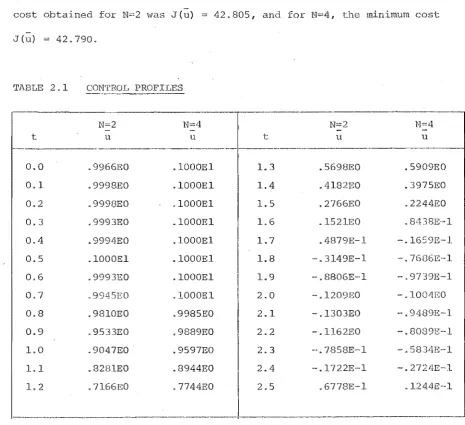
control for N==2 and N=4 are summarised in Table 2.1. 'I'he minimum
cost obtained for N=2 was J (u) = 42.805, and for N=4, the minimum cos·t
J(u) == 42.790.
TABLE 2.1 CONTROL PROFILES
-~"'~""
N=2 N==4 N==2
-
-
-t u u t u u
---~ .. -~
0.0 .9966EO .1000El 1.3 .5698EO .5909EO
0.1 .9998EO .1000El 1.4 .4182EO • 3975EO
0.2 .9998EO .1000El 1.5 .2766EO .2244EO
0.3 .9993EO .1000El 1.6 .1521EO .8438K-l
0.4 . 999tJEO .1000El 1.7 .4879E-l -.1659E-I
0.5 .1000El .1000El 1.8 -.3149E-l .76B6E--l
0.6 .9993EO .1000El 1.9 -.8806E-·1 -.9739E-l
0.7 .9945EO .1000El 2.0 -.1209EO -.1004EO
0.8 .9810EO .9985EO 2.1 -.1303EO -.9489E-l
0.9 .9533EO . 9889EO 2.2 -.1l62EO -.8089E-l
1.0 .9047EO • 9597EO 2.3 '".7858E-l .5834E-l
1.1 .8281EO . 8944EO 2.4 -.1722E-l -.2724E-l
1.2 .7166EO . 7744EO 2.5 .6778E-l . 1244E .. l
[image:40.555.55.521.241.666.2]2.6 PROBLEr.1S WITH S'I'Nl'E
We considered the use of appropriate tY'ansformai:ion in section 2.5
to handle control constraints. This approach is extended here to problems
involving state constraints of the form (2.22) in which the constraint
function C contains the state x explicitly.
The system equation (2.25) and the cost functional (2.24) are
assumed here. We begin defining a new variable zthrough the
trans-formation
c(x,u,t) :::: 8(z,·t) (2.35)
where 8(z,t) is a negative function. We assume here ,that C is linear in
x and u. This assumption ensures that the form of the constraint function
C does not implicitly impose constraints on z. And i t was for the same
reason that we only considered saturation-type control constraints in the
previous section. Fortunately, the linearity of C is not a restrictive condition, as most constraints appearing in control problems are formulated
as linear constraints.
Having specified the transformation (2.35), we can then obtain the
transformed (unconstrained) problem following the procedure described in
[14]
by Jacobson and Lele. In that article, the authors suggested usingthe particular transformation
8(z,t) (2.36)
Nevertheless, any negative function 0 may be used, and the procedure
. described in.
[)4]
regarding the conversion of the original problem to the new unconstrained problem to the general case with obviousBasically, there are two cases to consider. If C con"tains u
explicitly, equation (2.35) can be solved for 1.1 in terms of
x
andz,
and 1.1can be eliminated from the original optimal control problem. The result
is an unconstrained problem in the new control variable z. If C does
not contain u explicitly, then the equation (2.35) is differentiat.ed with "to t unt.il 1.1 appears. that the constraint (2.35) is
of order Pi -that is, u appears for the first time in dPC/dtP • Then the original problem converts into an unconstrained problem of increased
dimension , with the new control variable dPz/dt
P .
Numerical
The method described above was applied to two sample problems.
The transformation of Jacobson and Lele were employed to reduce each problem
to an unconstrained one. And in each case the new control variable was
parametrized as a linear
Example L
rvIinimize J
for the
x(o) == 0 subject to the first-order constraint
x(t) ~ sin(nt)
+
a •where a _ n/3/12 - .5 == -.046550 (to 5 significant figures).
This problem has been taken from
[lSJ.
and has the exact solutionJ
6a+
3 Io
:s
t..
< 1/6 1.1* (t) ncos(nc) r 1/6:::
t:::1/2
The minimum cost for the problem is
J*
= 1.0992(to
5significant figures)
Employing<the transformation (2.36), we have
x (t)
sin(l1t)
a =="2
1 z 2 (t).By differentiating the above equation and making use of the state equation,
we obtain
U
zZl
+l1C08(l1t) ,
where zl
Z.From the above defining equation for z, we find that
z(O)1~':2a
(we could have chosen the initial condition
z (0) :::: - 1=2a ,bu·t it
does not matter which one is used).
The transformed problem is then:
minimize
Jfor the system
1
2
x
=
zZl
+
l1COS(l1t)
x(o)
o
0)
=
Because the state x is not present in the performance index, the corresponding
s-tate equation is actually now redundant.
Our new control variable is z
,and we parametrized i-t as a limc:ar
1
spline over a uni form partition of
[0,
IJ wi th N sections.
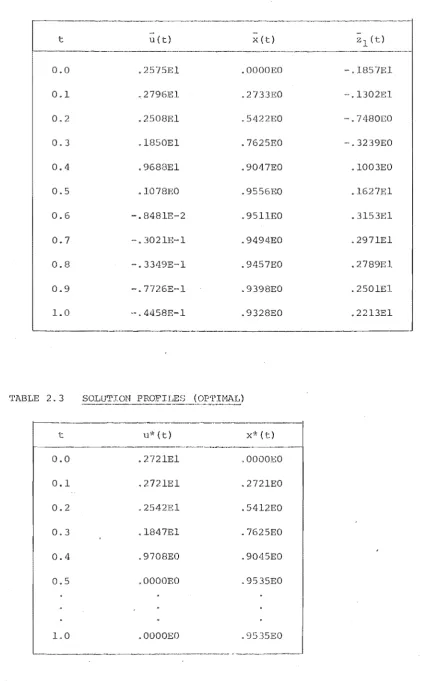
A solution was
obtained for N=5, and the minimum cost obtained was
1.1014,
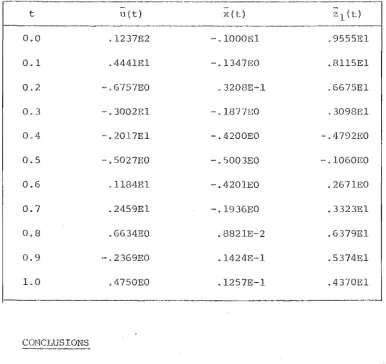
The approximate solution obtained is summarised in '['able 2.2, whi Ie the
TABLE 2.2
t u(t) x (t)
0.0 .2575El .OOOOEO
0,1 .2796El .2733EO
0.2 .2508El .5422EO
0.3 .1850El .7625EO
0.4 . 9688El .9047EO
0.5 .1078EO .9556EO
0.6 -.8481E-2 .95l1EO
0.7 -.3021E-l . 9494EO
0.8 -.3349E-l .9457EO
0.9 -.7726E-l .9398EO
1.0 "".4458E-l .9328EO
TABLE 2.3 PROFILES
t u*(t) x,~ (t)
0.0 • 2721El .OOOOEO
0.1 .2721El . 2721EO
0.2 .2542El .54l2EO
0.3 .1847El .7625EO
0.4 .9708EO .9045EO
0.5 .OOOOEO .9535EO
[image:44.555.57.489.80.762.2]2
. . . J -_ fl (x2
+
2 5 2) dMln1mlze 0 1 x
2
+
.00 u tfor the second-order system
:::::
+
u,ect to the first-order constraint (t) S(t-.5) 2 +.5 ~ O.
This problem has been taken from [14J. Application of -the ·trans-formation (2.36) gives rise to the following unconstrained problem
-ZZI
+
16t - 8 --Iz z (0)
=
-15
J
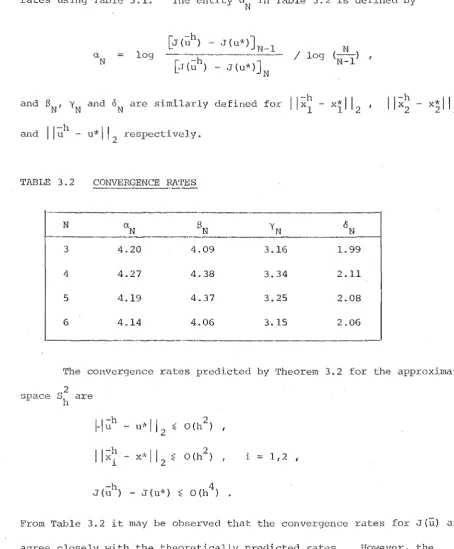
The new control variable zl ,vas parametrized as a linear over a uniform of [O/IJ containing N sec·tions. The problem was solved for N=5, and the results are summarised in Table 2.4. 'l'he minimum cost obtained was
0.17177.
The above was solved by Lastman [16J using Chebyshev polynomials in conjunction with the CP procedure. He obtained the minimum cost 0.17401
TABLE 2.4 SOLu'rION PROFILES
t
0.0
0.1
0.2
0.3
0.4
0.5
0.6
0.7
0.8
0.9
1.0
2.7 CONCLUSIONS
In this
optimal control
u(t) x(t) ~~l (t)
.1237E2 -.lOOOEI ,95
. 4441El ~.1347EO • B115E
-.6757EO . 320SE-I
.3002El - .1877EO
-.2017EI -.4200EO .4
-.5027EO -.5003EO
. 1184El -.420lEO .267
.2459El -.l936EO .332
.6634EO .882IE-2 .6
. 2369EO .l424E-l .5
. 4750EO .l257E-l .4
we have reviewed the CP procedure for
vii th fixed final time. The basic ,vas first described for the unconstrained problem. It was then seen thal the
procedure could be to problems involving terminal constraints
because such constraints can be treated as equality constraints on the
parameters. It was also 8ho;"n that problems Itlith control or state variable
inequality constraints could be handled through the use of
transformations of variables to co~vert these constrained
unconstrained ones.
We have also reviewed some basic material on
t:he use of splines in the CP procedm..? has been
into
functions, and
Finally,
some :cesulLs of employing splines in conjunct.:lon with the CP
[image:46.555.87.474.100.464.2]REFERENCES
[1] T. J. Walder and C. Storey: Numerical Solution of an Optimal
Temperature Problem, The Chemical Engineering J., Vol.l (1970) pp.120-l28.
G. A. Hicks and W. H. Approximation Methods for Optimal
Control Synthesis, Can. J. Chern. Eng., Vol.49 (1971) pp.522-52a
[3] H. R. Sirisena: Computation of Optimal Controls Using a Piecewise
Polynomial Parametrization, IEEE Trans. Automatic Control,
AC-18 (1973) pp.409-4ll.
[4J H. R. Sirisena and K. S. Tan: Computation of Constrained Optimal
Controls Using Parametrization Techniques, IEEE Trans. Automatic
Control, AC-19 (1974) pp.43l-433.
[5J J. H. Ahlberg, E. N. Nilson and J. L. Walsh: ']~he Theory of Splines
and Their Applications, Academic Press, N.Y. (1967).
[6J I. J. Schoenberg: Contributions to the Problem of Approximation of Equidistant Data by Analytic Functions, Quart. • Ma·th. 1
Vol.4 (1946), Pt A, pp.45-99i Pt B, pp.112-141.
[7J H. B. Curry and 1. J. Schoenberg: On Polya Frequency Functions. IV., J. Analyse Math., Vol.17 (1966) pp.71-107.
[aJ R. Fletcher and M. J. D. Powell: A Rapidly Convergent Descent
Hethod for r-1inimization, Computer J., VoL6 (1963) pp.J.63~·168.
[9 J T. N. E. Greville: Introduction to Spline Functions, in Theory
and Applications of Funct.ions, ed. 'r.N.E. GreviJle,