Blind Equalization for
Tomlinson-Harashima Precoded
Systems
Rubyet Adnan
A thesis submitted in partial fulfilment of the requirements for the degree of
Master of Engineering in
Electrical and Electronic Engineering at the
University of Canterbury, Christchurch, New Zealand.
ABSTRACT
At a communications receiver the observed signal is a corrupted version of the
transmit-ted signal. This distortion in the received signal is due to the physical characteristics
of the channel, including multipath propagation, the non-idealities of copper wires and
impulse noise. Equalization is a process to combat these distortions in order to recover
the original transmitted signal. Roughly stated, the equalizer tries to implement the
in-verse transfer function of the channel while taking into account the channel noise. The
equalizer parameters can be tuned to this inverse transfer function using an adaptive
algorithm. In many cases, the algorithm uses a training sequence to drive the
equal-izer parameters to the optimum solution. But, for time-varying channels or multiuser
channels the use of a training sequence is inefficient in terms of bandwidth, as
band-width is wasted due to the periodic re-transmission of the training sequence. A blind
equalization algorithm is a practical method to eliminate this training sequence.
An equalizer adapted using a blind algorithm is a key component of a bandwidth
efficient receiver for broadcast and point-to-multipoint communications. The initial
convergence performance of a blind adaptive equalizer depends on the higher-order
statistics of the transmitted signal. In modern digital systems, Tomlinson-Harashima
precoding (THP) is often used for signal shaping and to mitigate the error propagation
problem of a decision feedback equalizer (DFE). The concept of THP comes from
pre-equalization. In fact, it is a nonlinear form of pre-equalization, which bounds the
higher-order statistics of the transmitted signal. But, THP and blind equalization are
often viewed as incompatible equalization techniques.
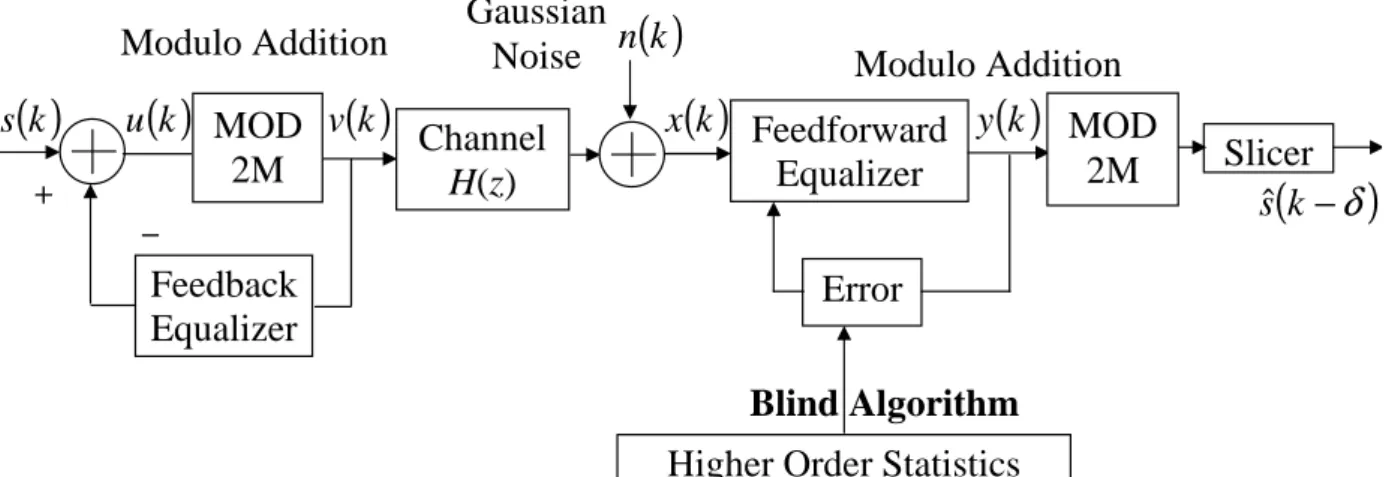
In this research, we give multiple scenarios where blind equalization of a
THP-encoded signal might arise. With this motivation we set out to answer the question,
iv ABSTRACT
combination of a Tomlinson-Harashima precoder on the transmitter side and a blind
equalizer on the receiver side. By bounding the kurtosis of the THP-encoded signal, we
show that THP actually aids the initial convergence of blind equalization. We find that,
as the symbol constellation size increases, the THP-encoded signal kurtosis approaches
that of a uniform distribution, not a Gaussian.
We investigate the compatibility of blind equalization with THP-encoded signals
for both SISO and MIMO systems. In a SISO system, conventional blind algorithms
can be used to counter the distortions introduced in the received signal. However, in
a MIMO system with multiple users, the other users act as interferers on the desired
user’s signal. Hence, modified blind algorithms need to be applied to mitigate these
interferers. For both SISO and MIMO systems, we show that the THP encoder ensures
that the signal distribution approaches a non-Gaussian distribution. Using Monte Carlo
simulations, we study the effects of Tomlinson-Harashima precoding on the performance
of Bussgang-type blind algorithms and verify our theoretical analysis.
The major contributions of this thesis are:
• A demonstration that a blind equalizer can successfully acquire a THP-encoded
signal for both SISO and MIMO systems. We show that THP actually aids blind
equalization, as it ensures that the transmitted signal is non-Gaussian.
• An analytical quantification of the effects of THP on the transmitted signal
sta-tistics. We derive a novel bound on the kurtosis of the THP-encoded signal.
• An extension of the results from a single-user SISO scenario to multiple users and
a MIMO scenario. We demonstrate that our bound and simulated results hold
for these more general cases.
Through our work, we have opened the way for a novel application of training
sequence-less equalization: to acquire and equalize THP-encoded signals. Using our
proposed system, periodic training sequences for a broadcast or point-to-multipoint
system can be avoided, improving the bandwidth efficiency of the transceiver.
Fu-ture modem designs with THP encoding can make use of our advances for bandwidth
ACKNOWLEDGEMENTS
I would sincerely like to thank all those people who played a part in the completion of
this thesis. Special thanks to my supervisor, Dr. Lee M. Garth, for his guidance, help
and consistent encouragement.
Special thanks to my fellow postgraduate colleagues in the Communications
Re-search Group. I would like to thank you all for the times we spent together, sharing
knowledge in all of the meetings. You have made my postgraduate life more colorful
and precious.
I would also like to thank my parents for their love and consistent support in the
completion of this project and their encouragement of my pursuit of a higher degree
and achievements. Lastly, thank you Allah for your mercy, love and grace, being with
CONTENTS
ABSTRACT iii
ACKNOWLEDGEMENTS v
ABBREVIATIONS AND ACRONYMS xv
CHAPTER 1 INTRODUCTION 1
1.1 Bandwidth-efficient Communication Systems 1
1.2 Adaptive Equalization 2
1.3 The Blind-THP Scenario 3
1.4 Literature Review 5
1.5 Outline of Thesis 7
CHAPTER 2 BACKGROUND 9
2.1 SISO Channel Model 9
2.2 Decision Feedback Equalization and Pre-equalization 10
2.3 MIMO Channel Model and DFE 14
2.3.1 MIMO Channel Model 14
2.3.2 MIMO DFE 15
2.4 Tomlinson-Harashima Precoding 17
2.5 Blind Equalization 20
2.6 Blind Equalization for MIMO Systems 22
2.6.1 Condition for MIMO Channel Identification 22
2.6.2 Initial Convergence Condition for MIMO Blind
Equal-izer 24
2.6.3 Modified Bussgang Algorithms for MIMO Systems 26
CHAPTER 3 IMPLEMENTATION AND ANALYSIS OF
THP-BLIND EQUALIZATION 31
3.1 DFE-based Precoding Operation 31
3.2 THP: Kurtosis Bound 39
3.2.1 Effect of THP on Blind Equalization 40
3.2.2 Analytical Bound on the Kurtosis for THP-Generated
Signals 44
viii CONTENTS
CHAPTER 4 SIMULATION RESULTS 55
4.1 Simulations for SISO Systems 55
4.2 Adding a New User to a SISO System 58
4.3 Simulations for MIMO Systems 64
CHAPTER 5 CONCLUSION 71
5.1 Research Summary 71
5.2 Further Research 72
LIST OF FIGURES
1.1 Proposed blind equalization model for THP system 3
2.1 General model of a communication system 9
2.2 Decision Feedback Equalizer 11
2.3 Pre-equalization at the transmitter side 13
2.4 Block diagram of MIMO channel model 14
2.5 Decision Feedback Equalizer for a 2 ×3 system 17
2.6 SISO Tomlinson-Harashima Precoder 18
2.7 Output vs. input for the modulo adder 18
2.8 MIMO Tomlinson-Harashima Precoder 19
2.9 Graphical representation of CMA from [1] 21
2.10 Graphical representation of MMA from [1] 21
2.11 Graphical representation of RCA from [1] 22
2.12 MIMO system with linear equalizer 23
3.1 Training sequence mode for DFE 32
3.2 Use of feedback filter of DFE in precoder 32
3.3 Training sequence mode for MIMO DFE 33
3.4 Use of feedback filter of MIMO DFE in precoder 34
3.5 MMSE for different values for zero of the channel and propagation delay 37
3.6 Channel impulse response from [2] 38
3.7 MSE during training sequence 38
3.8 Comparison of DFE tap weight magnitudes 39
x LIST OF FIGURES
3.10 THP model for single-zero channel 41
3.11 Linear and nonlinear regions of the THP 42
3.12 Prefiltered signal kurtosis for 4-QAM over single-zero channel (a)
with-out and (b) with modulo operator 42
3.13 Prefiltered signal kurtosis for 16-QAM over single-zero channel (a)
with-out and (b) with modulo operator 43
3.14 2×2 MIMO THP system 44
3.15 Prefiltered signal kurtosis for 4-QAM in u1(k) stream over single-zero
MIMO channel (a) without and (b) with modulo operator betweenu1(k)
and v1(k) 45
3.16 Prefiltered signal kurtosis for 16-QAM inu1(k) stream over single-zero
MIMO channel (a) without and (b) with modulo operator betweenu1(k)
and v1(k) 45
3.17 Sawtooth input-output function of the modulo adder 46
3.18 4-QAM (a) data source and (b) channel output constellations 51
3.19 Histograms of prefilter outputs for 4-QAM (a) without and (b) with
modulo addition 52
3.20 Histograms of prefilter outputs for 64-QAM (a) without and (b) with
modulo addition 53
4.1 Magnitude frequency response of 300 m of 0.4 mm distribution cable 56
4.2 Impulse response of 300 m of 0.4 mm distribution cable 56
4.3 Magnitude frequency response of composite VDSL channel 57
4.4 MSE Trajectory of DFE for VDSL Channel 58
4.5 Residual error for SISO system 59
4.6 Single-input multiple-output communications system 60
4.7 Adding a new user to a SISO system 60
4.8 Frequency responses of two different bandpass channels 61
4.9 Residual error for receiver of user 2 62
4.10 Equalizer output for receiver of user 2 62
LIST OF FIGURES xi
4.12 Equalizer output of user 2’s receiver for null channel 63
4.13 Residual error of user 2’s receiver for null channel 64
4.14 Equalizer output constellations in training mode for first receiver 65
4.15 Equalizer output constellations in training mode for second receiver 66
4.16 MSE during training for first receiver 66
4.17 MSE during training for second receiver 67
4.18 Equalizer output constellations for first receiver 68
4.19 Equalizer output constellations for second receiver 68
4.20 Receiver modulo output constellations for first receiver 69
4.21 Receiver modulo output constellations for second receiver 69
4.22 Residual error for first receiver 70
LIST OF TABLES
3.1 Kurtosis for M-ary ASK 48
3.2 Kurtosis for M-ary QAM 50
ABBREVIATIONS AND ACRONYMS
ADSL Asymmetric Digital Subscriber Line
ASK Amplitude Shift Keying
CMA Constant Modulus Algorithm
CSI Channel State Information
DFE Decision Feedback Equalizer
HDSL High Bit-Rate Digital Subscriber Line
i.s.i. Intersymbol Interference
i.u.i. Interuser Interference
LMS Least Mean Square
MIMO Multi-Input Multi-Output
MMA Multi Modulus Algorithm
MSE Mean Squared Error
MMSE Minimum Mean Squared Error
QAM Quadrature Amplitude Modulation
RCA Reduced Constellation Algorithm
SIMO Single-Input Multiple-Output
xvi ABBREVIATIONS AND ACRONYMS
SNR Signal-to-Noise Ratio
THP Tomlinson-Harashima Precoding
VDSL Very High Bit-Rate Digital Subscriber Line
Chapter 1
INTRODUCTION
1.1 BANDWIDTH-EFFICIENT COMMUNICATION SYSTEMS
Bandwidth is one of the precious commodities in modern high-speed communication
systems. With widespread broadband adoption the demand for bandwidth is constantly
increasing. The greater the bandwidth, the greater the scope is for achieving high speed
communications. From a commercial point of view, transmission power and speed are
the performance measures for any communication system. Example high speed wireline
communications systems are Asymmetric Digital Subscriber Lines (ADSL) and Very
High-Bit Rate Digital Subscriber Lines (VDSL) [4]. But, with a training sequence
overhead these connections do not exploit their full potential bandwidth. Each time a
user is connected to the receiver a training sequence has to be sent. To improve the
bandwidth efficiency of the system, this training sequence should be removed.
In recent times the use of multiple antennas at both sides of a communication
sys-tem has been widely investigated [5]. These so-called multiple-input multiple-output
(MIMO) systems can increase the channel capacity and overall transmission rate over
conventional single-input single-output (SISO) systems. Example MIMO systems
in-clude spatial division multiple access (SDMA) systems in wireless communications and
vector coded systems in VDSL wireline communications [6]. But, with the increase of
system capacity in MIMO communication systems comes more co-channel interference.
To combat this interference, the receiver needs to employ MIMO equalizers. At the cost
of bandwidth efficiency, a training sequence-based adaptive equalizer can again
sepa-rate and recover the multiple signals at the receiver. Again, the removal of training
2 CHAPTER 1 INTRODUCTION
1.2 ADAPTIVE EQUALIZATION
An adaptive equalizer is a crucial receiver component for a bandwidth-efficient
com-munication system. Because of its adaptive nature, it can track the changing channel
conditions and then reduce the distorting effects introduced by the channel. In a SISO
system, sources of distortion include the lowpass filtering by the channel and additive
channel noise. In a MIMO system, another source of distortion is interuser interference
(i.u.i.) due to the other users sharing the channel. SISO or MIMO adaptive equalizers
try to mitigate these effects and recover the original transmitted data within a certain
margin of error.
Conventional trained equalizers require exact knowledge of a portion of the
trans-mitted signal at the receiver. They compare the received data with the training
se-quence, adapting the equalizer taps to minimize a cost function such as the mean
squared error (MSE) [7]. But, for bandwidth-efficient communication systems,
par-ticularly broadcast or point-to-multipoint systems, bandwidth is wasted due to the
requirement of repeated transmissions of the training sequence. Blind equalizers, on
the other hand, are able to start up without a training sequence. Instead of using a
training sequence, blind algorithms depend on the higher-order statistics of the
trans-mitted signal.
A widely-used family of blind algorithms is based on the Bussgang algorithm, with
a relatively simple cost function which is directly related to the kurtosis of the
trans-mitted signal [8]. The effect of the source distribution on the convergence of Bussgang
equalizers has been investigated in [1], [9] – [12]. It has been found that the
conver-gence behavior is consistently good for platykurtic or sub-Gaussian sources [11]. Also,
the initial condition for successful convergence of blind equalizers has been found to be
dependent on the excess kurtosis of the combined channel-equalizer response [13], [14].
Thus, the distribution of the transmitted signal, characterized by the kurtosis, plays a
key role in the performance of Bussgang equalizers. As we will show, by bounding the
transmitted signal kurtosis, we can ascertain the potential performance of
Bussgang-type algorithms.
1.3 THE BLIND-THP SCENARIO 3
the training sequence, there are also alternative equalizer structures such as the DFE,
which can be used to get rid of the distortions in the received signal. The DFE has a
feedforward equalizer, a feedback equalizer and a threshold device. The presence of the
two equalizers in the DFE enables it to outperform a conventional linear equalizer in
terms of reduced MSE. But, because of its feedback structure, an incorrect decision by
the threshold device is fed back, leading to error propagation. When a reverse channel
is available, this error propagation can be eliminated by placing the feedback equalizer
in the transmitter.
Tomlinson-Harashima Precoding (THP) [15], [16] is a well known method to
elim-inate error propagation in a DFE. It has been adopted in a wide variety of modern
communication systems with reliable feedback channels. In this thesis we study the
effect of THP on the source distribution and blind equalization performance. We show
that THP bounds the higher-order statistics of the transmitted signal.
1.3 THE BLIND-THP SCENARIO
We now consider the combination of blind equalization and THP. Our goal is to study
the performance of blind equalization algorithms for Tomlinson-Harashima Precoded
(THP) signals in a communication system as shown in Fig. 1.1. Such a system might
s
( )
k
v
( )
k
( )
k
n
sˆ
(
k
−
δ
)
y
( )
k
x
( )
k
THP
Precoder
Blind
Equalizer
Slicer
Gaussian
Noise
Channel
Figure 1.1 Proposed blind equalization model for THP system
arise in the following scenarios:
1. In modern digital broadcasting or point-to-multipoint systems, such as VDSL,
4 CHAPTER 1 INTRODUCTION
same time, to increase the overall bandwidth efficiency of the system, receiver
set-top boxes can be blindly initialized, instead of using a conventional trained
sequence-based adaptive algorithm.1
2. Another scenario is in a MIMO-based broadcast system with users blindly trained
to the broadcast signal at different times. By using spatial information, a MIMO
system can increase the system robustness and capacity. If the precoding is
done in the transmitter, then adding a new user using a blind algorithm at the
receiver side again increases the bandwidth efficiency of the overall system. In [6]
and [18] THP is implemented for MIMO systems, yielding good noise reduction
performance.
3. A final scenario is in military applications, where an operative wants to intercept
a precoded signal without a training sequence. Blind equalization would enable
the interception of an encrypted or scrambled signal.
To characterize the performance of the system shown in Fig. 1.1, in this thesis we
consider THP in conjunction with conventional Bussgang-type algorithms. We
demon-strate that THP has a bounding effect on the transmitted signal kurtosis, which in
turn affects the start-up performance of Bussgang-type algorithms. Unlike previous
researchers, we study the effect of THP on the transmitted signal kurtosis. We find
that THP bounds the kurtosis of the signal below that of a Gaussian, yielding a
sub-Gaussian transmitted signal distribution, which is advantageous for blind equalization.
To extend the conventional SISO Bussgang-type algorithms to MIMO systems, the
algorithms need to be modified to eliminate the effect of i.u.i. We consider the
conver-gence properties of these modified algorithms for MIMO versions of THP signals. We
then use Monte Carlo simulations to verify our kurtosis bounds and to prove that blind
equalization is viable for THP systems for a variety of signal constellations for both
SISO and MIMO systems.
1.4 LITERATURE REVIEW 5
1.4 LITERATURE REVIEW
Many researchers have derived alternative adaptive equalization algorithms to mitigate
i.s.i. Lucky [19] was the first to propose a truly adaptive equalization algorithm, using
a zero-forcing criterion and the output of the threshold device as the reference signal.
This so-called “decision-directed” equalizer can be considered the first blind technique,
as it relies on a receiver-generated reference instead of a training sequence. Then, the
MSE criterion for adaptive equalization was independently derived by Gersho [20] and
Proakis and Miller [21]. The extensively-used Least Mean Square (LMS) algorithm was
developed by Widrow and Hoff [22]. A comprehensive tutorial covering all aspects of
adaptive equalization can be found in [23]. Generally, these equalizers require exact
knowledge of the transmitted signal during the initial adaptation.
Sato first introduced the idea of a training sequence-less equalizer in [24].
Go-dard [25] then generalized Sato’s algorithm to two dimensions and then proposed his
own algorithm relying on the higher-order moments of the channel outputs. Treichler
and coworkers [26], [27] renamed Godard’s algorithm the Constant Modulus Algorithm
(CMA), popularizing it by showing its effectiveness. It was not until 1984 that
Ben-veniste and Goursat [28] coined the term blind equalization. Unfortunately, CMA
suf-fers from the problem of constellation rotation. Recently, the Multi Modulus Algorithm
(MMA) was proposed in [29], which removes this rotation.
But, these blind algorithms only work properly if the transmitted signal is
non-Gaussian, as Gaussian signals have higher-order statistics which are zero [8], [10], [30].
So, we cannot directly detect a Gaussian signal using most blind algorithms [9], [10],
[31]. The idea of modifying a Gaussian-like signal to make it more non-Gaussian (using
precoding) is proposed in [17]. This facilitates the use of adaptive blind equalization
for an HDSL-application in the German Telekom subscriber network. But, this
modi-fication requires a very highly complex transmitter design. Other problems associated
with blind algorithms are the speed of the convergence and the residual mean squared
error. A variety of solutions to these problems have been proposed (see e.g. [32],[33]).
Many adaptive equalization structures can be used. From a maximum likelihood
6 CHAPTER 1 INTRODUCTION
Viterbi detector, is optimal. Unfortunately, the complexity of the detector increases
ex-ponentially with the channel length, making it difficult to implement for channels with
long impulse responses. A widely-used alternative nonlinear equalization technique is
the DFE. The first paper on the DFE was published by Austin [34]. Monsen [35] then
optimized the DFE using minimum MSE analysis. For a comprehensive tutorial on
the working principle of the DFE see [36]. Its feedback equalizer uses the previously
detected symbols to subtract their contribution to the i.s.i. in the symbol which is
cur-rently being detected. But, this is contingent on the exact detection of the previous
symbols. If incorrect decisions are fed back and subtracted from the present symbol,
error propagation results. To get rid of this error propagation, the feedback equalizer
can be placed in the transmitter, which is commonly known as pre-equalization.
THP is one such pre-equalization technique, proposed by Tomlinson [15] and
Ha-rashima and Miyakawa [16] independently. Other researchers (e.g. Laroiaet al. [37],[38])
have extended THP to incorporate trellis coding without a loss of coding gain. However,
because these extensions make the transmitter structure very complex and difficult to
analyze, here we concentrate on THP, which is very simple to implement.
As mentioned before, the combination of THP and blind equalization was previously
proposed by Fischer et al. [17], but they did not analyze the performance of
Bussgang-type blind algorithms for general THP-shaped source distributions as we do. For the
case of MIMO systems, cost-function based blind algorithms have been generalized by
Papadias and Paulraj [39] – [41] and Li and Liu [3]. In these papers, they modify
the basic Bussgang algorithm to counter the effects of cross-correlation between the
transmitted signals. Once again they show that a non-Gaussian signal distribution is
necessary for blind equalization in this multiuser scenario.
MIMO versions of THP have been derived for the case when Channel State
In-formation (CSI) is available in the transmitter. In [6] Ginis and Cioffi use the QR
decomposition of the channel matrix to derive a matrix form DFE. The feedback
ma-trix of the DFE is then used as the MIMO THP in the transmitter. Similar analysis is
done by Fischer et al. in [42], using a multidimensional DFE to implement the precoder.
1.5 OUTLINE OF THESIS 7
transferred to transmitter. In [43], the performance of linear and nonlinear precoding
methods for MIMO systems has been analyzed. As a nonlinear precoding method THP
is used and it is implemented as a multidimensional DFE. The optimal matrix filters
are calculated using Wiener Filter theory. In [44] THP is combined with a
succes-sive optimization technique, which uses the singular value decomposition to find the
feedforward and feedback filter matrices. It also uses the DFE in the transmitter side.
1.5 OUTLINE OF THESIS
The thesis is organized as follows. In Chapter 2, background material on the channel
model, decision feedback equalization, Tomlinson-Harashima precoding and
Bussgang-type blind algorithms for SISO and MIMO systems are presented. We also review
the convergence conditions for MIMO blind equalizers and introduce MIMO versions
of Bussgang-type blind algorithms which meet these conditions. In Chapter 3, we
derive the decision feedback equalizer tap weights to use in the transmitter of a THP
system for both SISO and MIMO systems and analytically bound the kurtosis of a
THP-encoded signal. In Chapter 4, we verify our analytical results using Monte Carlo
simulations. In Chapter 5, we conclude with the core results of this thesis and indicate
Chapter 2
BACKGROUND
In this chapter, we review in detail the decision feedback equalizer (DFE), the
Tomlinson-Harashima precoder (THP) and Bussgang-type blind algorithms. We consider both
SISO and MIMO systems. In Sections 2.1 and 2.2 we give general descriptions of
the channel model and the DFE for SISO systems. The same descriptions for MIMO
systems are given in Section 2.3. SISO and MIMO versions of THP are discussed in
Section 2.4. Finally, in Sections 2.5 and 2.6 we review Bussgang-type blind algorithms
for SISO and MIMO systems.
2.1 SISO CHANNEL MODEL
In a communication system the transmitted signal passes through an inter-symbol
interference (i.s.i.) producing channel. In addition, the signal is corrupted by noise.
Generally, the noise is assumed to be additive, white, Gaussian and independent of the
transmitted signal. Such a communication system is shown in Fig. 2.1. After Nyquist
n
(k
)
)
(k
s
v
(k
)
x
(k
)
sˆ
(
k
−
δ
)
Transmitter
Channel
Receiver
Gaussian
Noise
Figure 2.1 General model of a communication system
10 CHAPTER 2 BACKGROUND
vectorx, the effects of the channel can be represented using
x=Hs+n, (2.1)
where
H =
h1 h2 · · · hL 0 · · · 0 0 h1 h2 · · · hL 0 0
0 0 . .. ... ... ... 0
0 · · · 0 h1 h2 · · · hL
x= [x(k) x(k−1) · · · x(k−Nf+ 1)]T
s= [s(k) s(k−1) · · · s(k−Nf + 1−L+ 1)]T
n= [n(k) n(k−1) · · · n(k−Nf + 1)]T (2.2)
and H is the Nf by Nf +L−1 channel convolution matrix, and its elements are the
channel impulse response of length L. Here, (·)T denotes the transpose. Vector n
contains the mean-zero i.i.d. noise samples with variance σn2, which are assumed to be
independent of the transmitted symbols in s. The transmitted symbols are assumed
to be i.i.d. with mean zero and varianceσ2s.
2.2 DECISION FEEDBACK EQUALIZATION AND PRE-EQUALIZATION
To remove the i.s.i. and noise, an adaptive equalizer tries to learn and invert the channel.
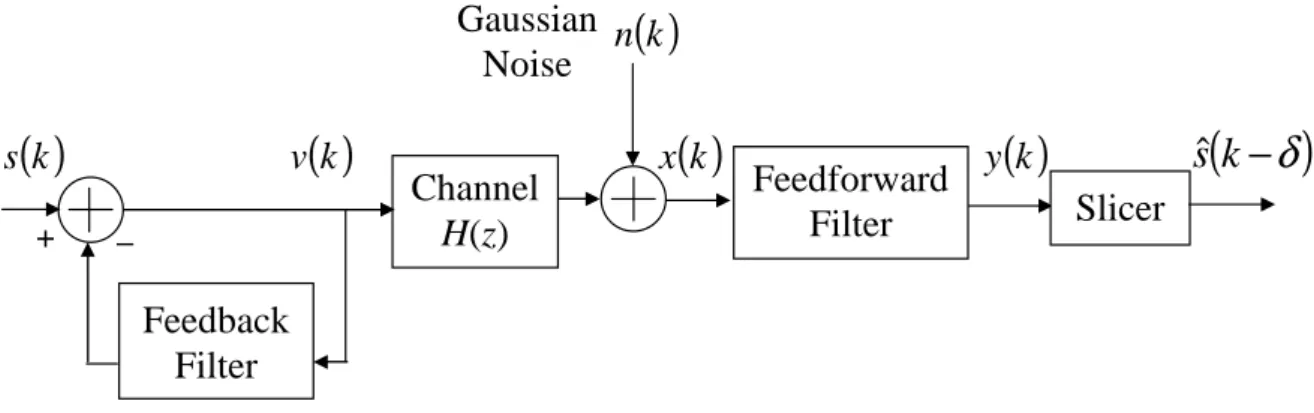
A widely-used structure is the decision feedback equalizer (DFE) shown in Fig. 2.2,
which comprises of a feedforward filter, a feedback filter and a threshold device. In the
DFE the sequence of observations to be equalized is applied to the feedforward filter,
and the decisions made on previously detected symbols are applied to the feedback
filter. The function of the feedback filter is to subtract out that portion of the i.s.i.
produced by previously detected symbols (often called precursors) from the estimates
of the future samples [35].
2.2 DECISION FEEDBACK EQUALIZATION AND PRE-EQUALIZATION 11
n
( )
k
x
( )
k
y
( )
k
sˆ
(
k
−
δ
)
Channel
Feedforward
Filter
Feedback
Filter
+
–
Gaussian
Noise
DFE
Slicer
Figure 2.2 Decision Feedback Equalizer
by vectors
f = [f1f2 · · · fNf]
T b= [b
1b2 · · · bNb]
T. (2.3)
At time k, the feedforward filter contains the Nf channel observations, denoted by
x. During equalizer training, instead of using the slicer outputs, the actual mean-zero
i.i.d. transmitted symbolss(k) corresponding to the equalizer outputs are fed into the
feedback filter. Thus, the DFE tries to recover the symbol s(k−δ) with propagation
delay δ, and hence the input to the feedback filter is sB = [s(k−δ −1)s(k−δ −
2) · · · s(k−δ−Nb)]T.
Now, the feedforward and feedback data vectors and weight vectors of the DFE can
combined as
z =
x
−sB
w=
f
b
, (2.4)
yielding slicer inputy(k) =wHz, where (·)H represents the Hermitian transpose. The
feedback filter will work well provided that the decisions made by the slicer are correct.
However, if the slicer starts to give wrong estimates, then the feedback filter starts to
propagate errors, and, because of the feedback property, this error propagation starts
12 CHAPTER 2 BACKGROUND
tap weights of the DFE cannot avoid error propagation.
Wiener filter theory can be used to derive the optimum tap weights by minimizing
the mean squared error (MSE) difference between the desired signal and the received
signal [7]. Statistically, the Wiener filter depends on the autocorrelation matrix and
cross-correlation vector of the transmitted signal. For a given integer propagation delay
δ, the Wiener filter taps can be calculated using the formula
wδ=R−δ1pδ. (2.5)
The optimum tap weights correspond to the delayδfor which the MSE is the minimum,
which is found using
δopt= arg min
1≤δ≤Nf+L−1−Nb
σs2−pHδ R−δ1pδ, (2.6)
where Rδ denotes the autocorrelation matrix
Rδ= E{z zH}=
E{x x
H} −E{x sH B}
−E{sBxH} E{sBsHB}
, (2.7)
and pδ is the cross-correlation vector
pδ =E{zs∗(k−δ)}=
HE{ss
∗(k−δ)}
−E{sBs∗(k−δ)}
. (2.8)
As both the symbols and noise are i.i.d., it can be shown that
E{x xH}=σ2sHHH +σ2nINf E{sBsHB}=σs2INb
E{x sHB}=HE{s sHB}=H
Oδ×Nb
σ2sINb
O(Nf+L−1−δ−Nb)×Nb
, (2.9)
2.2 DECISION FEEDBACK EQUALIZATION AND PRE-EQUALIZATION 13
MATLAB notation, we can write
E{x sHB}=σ2sH(:, δ+ 1 :δ+Nb), (2.10)
where H(:, i : j) denotes the i-th through j-th rows of H. Similarly, because of the
independence of the symbols and noise, the cross-correlation vectorpδ has the form
pδ =
σ
2
sH(:, δ) 0Nb×1
. (2.11)
After the training is completed, assuming a reliable reverse channel exists, a
practi-cal way of stopping error propagation in the DFE is to shift the feedback filter from the
receiver side to the transmitter side, which is possible due to the linearity of the overall
transceiver system and channel model. This results in the equalization system shown in
Fig. 2.3. If we retain the same symbol power levels fors(k), linear pre-equalization
per-forms equivalently to linear equalization at the receiver [45]. If, however, we normalize
the transmitted power, then the performance of the precoded system is degraded. This
is because the pre-equalization filter typically causes signal power enhancement at the
transmitter power amplifier. One way to avoid this signal power enhancement without
degrading the system performance is to introduce a limiter or non-linearity into the
feedback loop. This is known as precoding, which we discuss further in Section 2.4.
n
( )
k
( )
k
s
v
( )
k
x
( )
k
y
( )
k
sˆ
(
k
−
δ
)
Channel
H(z)
Slicer
Feedforward
Filter
Feedback
Filter
+ –
Gaussian
Noise
14 CHAPTER 2 BACKGROUND
2.3 MIMO CHANNEL MODEL AND DFE
Now let us consider a more general MIMO system with NT transmitters and NR
re-ceivers. The channel between each transmitter and receiver is assumed to be a
complex-valued baseband channel. The MIMO channel model and corresponding DFE are now
presented in Sections 2.3.1 and 2.3.2.
2.3.1 MIMO Channel Model
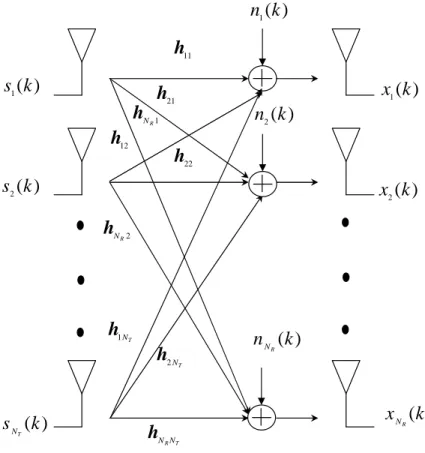
Figure 2.4 shows a block diagram of ourNT×NRMIMO communication model. Using
)
(
1k
s
)
(
2k
s
)
(k
x
R N)
(k
n
NR)
(
2k
n
11h
21h
1 R Nh
12h
22h
2 R Nh
T N 1h
T RN Nh
T N 2h
)
(
1k
n
)
(k
s
T N)
(
1k
x
)
(
2k
x
Figure 2.4 Block diagram of MIMO channel model
the notation of [46], the channel output at the j-th receiver (1≤j≤NR) at timek is
xj(k) = NT
X
i=1 ℓXi−1 m=0
2.3 MIMO CHANNEL MODEL AND DFE 15
where hm
ji represents the channel impulse response between the i-th input and j-th
output, with memory (ℓi−1). Similar to the SISO model, the symbols from the i-th
transmitter si(k), i= 1, . . . , NT, are assumed to be i.i.d. with zero mean and variance
σ2
s. The additive noise at thej-th receivernj(k) is assumed to be Gaussian, i.i.d. with
zero mean and variance σ2n. The signal and noise are again assumed to be mutually
independent.
The channel impulse response can be represented as a vector denoted by hji =
[h0ji h1ji · · · h(ℓi−1)
ji ]. Now, at a time k all the channel outputs can be grouped in a
vector to represent the channel output in the form
x(k) = LX−1 m=0
Hms(k−m) +n(k), (2.13)
whereHm is theNR×NT MIMO channel matrix corresponding to them-th lag of the
MIMO channel impulse response of the form
Hm=
hm11 hm12 · · · hm1NT
..
. . .. ...
hmNR1 hmNR2 · · · hmNRNT
(2.14)
ands(k) is theNT ×1 input vector at timek. HereL= maxiℓi denotes the maximum
length of all the component channel impulse responses.
2.3.2 MIMO DFE
The corresponding MIMO DFE, comprising of feedforward filters, feedback filters and
threshold devices, can be used to remove the i.s.i. and i.u.i. in a MIMO channel. Again,
let Nf and Nb represent the length of each of the feedforward and feedback filters,
respectively. We define component matrix Fm to contain the NR×NT feedforward
16 CHAPTER 2 BACKGROUND
The matrix forms of Fm and Bm are
Fm =
fm
11 · · · fNmT1 ..
. . .. ...
fm
1NR · · · f m NTNR
, Bm =
bm
11 · · · bmNT1 ..
. . .. ...
bm
1NT · · · b m NTNT
, (2.15)
where each fm
ij denotes the m-th tap of the feedforward filter for thei-th transmitter
and j-th receiver, and eachbm
ij denotes them-th tap of the feedback filter between the
i-th and j-th transmitters. Alternatively, we can group all of the tap weights for a
particular i-th transmitter and j-th receiver (or transmitter) in the vectors
fij = [fij0 fij1 · · · fNf−1
ij ]T, 1≤i≤NT, 1≤j≤NR
bij = [b0ij b1ij · · · b Nb−1
ij ]T, 1≤i, j≤NT. (2.16)
Now, the equalizer output can be expressed as
y(k) = Nf−1
X
m=0
FHmx(k−m)− NXb−1
m=0
BHmsB(k−m), (2.17)
where sB is the input vector to the feedback filter. During equalizer training, instead
of the slicer outputs, the corresponding transmitted data symbols,si(k), i= 1, . . . , NT,
again are fed into the feedback filters. The input vectorsBis filled with the transmitted
data symbols and has the form
sB(k) = [s1(k−δ1) s2(k−δ2) · · · sNT(k−δNT)]
T. (2.18)
The MIMO DFE tries to recover all the independent transmitted symbols with
propagation delay δi, which lies in the interval 0≤δi ≤Nf +L−1 [46]. To find the
delay for each transmitter, we send an impulse from each transmitter. Each impulse
passes through NR different paths before reaching the receiver. For example, for the
MIMO DFE structure for a 2×3 system (Fig. 2.5), if transmitter 1 sends an impulse,
then it reaches the corresponding receiver having travelled over three different channels.
2.4 TOMLINSON-HARASHIMA PRECODING 17
Slicer
Slicer
) ( 2 k s ) ( 1 ks
h
1121
h
12h
31h
22h
32h
) ( 1 k n ) ( 2 k n ) ( 3 k n ) ( 2 k x ) ( 3 k x ) ( 1 kx f11
21 f 12 f 22 f 13 f 23 f ) ( 1 k y ) ( 2 k y 21
b
12b
(
1)
1
ˆ k−δ s
(
2)
2
ˆ k−δ s – – + + 11
b
22b
Figure 2.5 Decision Feedback Equalizer for a 2×3 system
third path is between h13 and f31. The net delay for transmitter 1 is then computed
using the combined channel-equalizer response due to the three channels.
Similar to the SISO case, assuming a reliable reverse channel, the feedback filters of
the MIMO DFE can be transferred to the transmitter to mitigate the error propagation
problem. But this causes signal power enhancement at the transmitter side. Again,
MIMO precoding can be used to reduce this enhancement.
2.4 TOMLINSON-HARASHIMA PRECODING
In a THP system the equalization is done in the transmitter using an inverse modulo
filter. Therefore, error correction coding techniques can be applied in the same way
as for channels without i.s.i. Note that to construct the optimal modulo filter, the
channel transfer function needs to be known at the transmitter both for SISO and
MIMO systems.
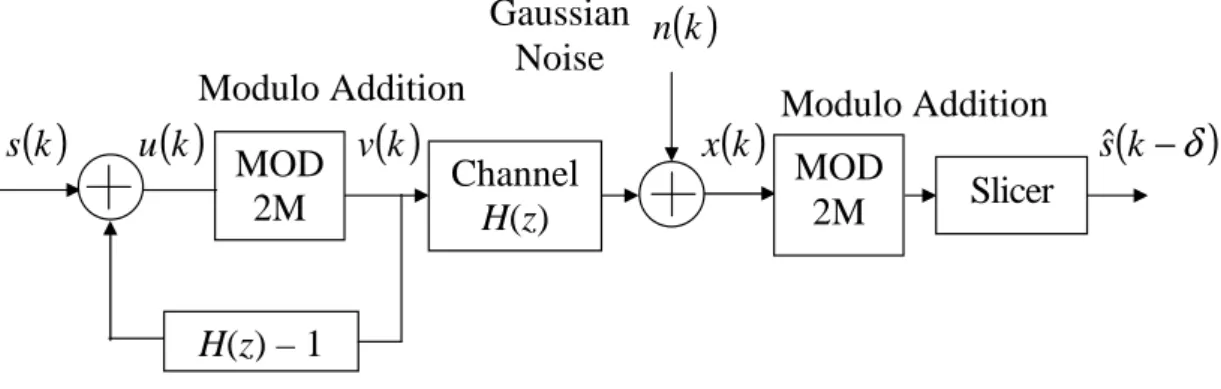
Figure 2.6 is a general representation of a SISO THP system. The modulo adder
basically wraps around the signal constellation so that the signal does not expand
infinitely, increasing the transmit power. If the data signal is drawn from anM-point
one-dimensional PAM signal set A = {±1,±3, . . . ,±(M −1)}, for even M, then the
18 CHAPTER 2 BACKGROUND
( )
k
n
s
( )
k
u
( )
k
v
( )
k
x
( )
k
sˆ
(
k
−
δ
)
Channel
H(z)
H(z) – 1
Modulo Addition
Slicer
MOD
2M
Gaussian
Noise
MOD
2M
Modulo Addition
Figure 2.6 SISO Tomlinson-Harashima Precoder
Figure 2.7 shows an example plot of the function employed by the modulo adder for
M = 4. Hence, the modulo adder over a fixed interval of, say, [-M, +M) implements
−5
0
5
−4
−2
0
2
4
Input, u(k)
Output, v(k)
Figure 2.7 Output vs. input for the modulo adder
the following algorithm:
1. If the result of the summation, u(k) is greater than M, 2M is deducted from it
until it is less than M.
2. If the result of the summation, u(k) is less than -M, 2M is added to it until it is
2.4 TOMLINSON-HARASHIMA PRECODING 19
If the data symbols are drawn from anM-ary square QAM signal setA={a+j b|a, b∈
±1,±3,· · ±(√M−1)}, then the modulo adder makes sure that the real and imaginary
parts of the precoded symbols lie in the interval [-√M, +√M). Due to the modulo
operation, all the points spaced by integer multiples of 2√M in real or imaginary part
represent the same data.
The concept of Tomlinson-Harashima precoding (THP) for SISO channels can be
easily extended to MIMO channels. Figure 2.8 shows a generalized MIMO THP system
for a zero-forcing (ZF) system. Similar to the SISO case, the direct realization of THP
n
(k
)
v
(k
)
x
(k
)
y
(k
)
s
ˆ
(
k
−
δ
)
)
(k
s
MOD
2M
Channel
H(z)
H(z) - I
+ –
+ –
Decision
MOD
2M
Figure 2.8 MIMO Tomlinson-Harashima Precoder
requires advanced knowledge of the Channel State Information (CSI) matrixH(z).
One result of implementing SISO or MIMO THP is the input data is scrambled
into a pseudorandom sequence [16]. This scrambling spreads the frequency spectrum
of the data, and so reduces the intermodulation effects, but it colors the data unlike a
conventional scrambler which has a whitening effect.
As the input data sequence is modified because of the modulo addition, the receiver
needs to apply the same modulo operation to the received data to retrieve the original
transmitted symbol. Hence, the received sequence is passed through the modulo adder
20 CHAPTER 2 BACKGROUND
2.5 BLIND EQUALIZATION
Normally, for the equalizer to “learn” the channel characteristics the transmitter sends
a training sequence to the receiver, interrupting the normal transmission mode
peri-odically as the channel changes or new users join a point-to-multipoint system. But,
in a broadcast network or point-to-multipoint network a periodic training sequence
wastes valuable bandwidth for all of the users. Bandwidth is very costly, so its efficient
utilization is one of the prime factors in designing modern transmission systems.
A trained equalizer is adapted to align the output of the equalizer due to a particular
transmitted symbol with the symbol itself, and the final equalizer taps attempt to
produce the closest matching (i.e., when the difference between the equalizer output
and the desired symbol is minimum). Various kinds of algorithms such as the Least
Mean Square (LMS), Normalized Least Mean Square (NLMS) and Recursive Least
Squares (RLS) algorithms are available to minimize the mean squared error or the
least squares fit of the data to provide the best equalizer output [7].
By eliminating the need for a periodic training sequence, blind equalization
re-duces bandwidth wastage. A blind equalizer is “blind” because it does not require
any training sequence of predetermined symbols; all it utilizes are the statistical
char-acteristics of the transmitted signal. Based on these statistics, the equalizer recovers
the transmitted signal. By matching certain properties of the transmitted signal
de-rived from its higher-order statistics, many cost function-based algorithms have been
developed including the Sato algorithm, Godard-Constant Modulus Algorithm (CMA),
Multi Modulus Algorithm (MMA) and Reduced Constellation Algorithm (RCA) [8].
Each algorithm opens the “eye” of the blind equalizer, mitigating the channel distortion
of the transmitted signal.
The CMA cost function is of the form [26]:
CFCMA = E{[|y(k)|2−R2c]2}, where R2c=
E{|s(k)|4}
E{|s(k)|2}. (2.19)
Here,y(k) is the output of the equalizer, ands(k) is the data symbol. This cost function
2.5 BLIND EQUALIZATION 21
of radius Rc, shown in Fig. 2.9.
Figure 2.9 Graphical representation of CMA from [1]
Similarly, the MMA cost function is:
CFMMA= E{[yr2(k)−R2m]2−[yi2(k)−R2m]2}, where R2m =
E{a4(k)} E{a2(k)} =
E{b4(k)} E{b2(k)}.
(2.20)
Here subscriptsr andiindicate the real and imaginary parts of of the equalizer output
y(k), anda(k) and b(k) are the real and imaginary parts of the data symbol s(k). We
assume that E{an(k)}= E{bn(k)}. The cost function can be interpreted as fitting the
output data constellation of the equalizer to a square with side lengths 2Rm. Fig. 2.10
shows its graphical representation.
Figure 2.10 Graphical representation of MMA from [1]
Finally, the RCA cost function is defined as:
CFRCA= E{|y(k)−Rrcsgn[y(k)]|2}, where R2r =
E{a2(k)}
22 CHAPTER 2 BACKGROUND
Figure 2.11 Graphical representation of RCA from [1]
with csgn(y) = csgn(yr+jyi) = sgn(yr) +jsgn(yi), corresponding to fitting the output data constellation of the equalizer to a reduced four-point square constellation. Its
graphical representation is presented in Fig. 2.11. The equalizer tap weights can be
updated using a stochastic gradient-type recursion [1]. Note that these Bussgang-type
algorithms produce a sign ambiguity in the decoded signal. Thus, to mitigate this
problem, we assume that the transmitted signal is differentially modulated.
2.6 BLIND EQUALIZATION FOR MIMO SYSTEMS
The same algorithms can be used for MIMO systems. But, MIMO channel separation is
crucial for successful reception of the transmitted signals. The condition of
distortion-less reception for a SISO system requires that the z-transform of the system impulse
response has no zeros on the unit circle [8]. The same condition can be extended to
find necessary and sufficient conditions for the identifiability of MIMO channels [3],
[47]. We review these conditions in the following sections.
2.6.1 Condition for MIMO Channel Identification
Figure 2.12 shows an NT ×NR MIMO system with a linear equalizer at the receiver.
Setting the channel noise to zero, the linear equalizer satisfies the condition of
distor-tionless reception when
2.6 BLIND EQUALIZATION FOR MIMO SYSTEMS 23 Blind Algorithm ) ( 1 k s ) (k
sNT
11 h T N 1 h 1 R N h T RN N h ) ( 1 k n ) ( 1k x ) (k n R N ) (k
xNR
11 f R N 1 f 1 T N f R TN N f ) (k
yNT
) (
1 k
y
Figure 2.12 MIMO system with linear equalizer
where F(z) and H(z) represent thez-transforms of the equalizer and channel matrix
respectively, andINT is anNT×NT identity matrix. This condition yields a
bounded-input bounded-output (BIBO) stable equalizer at the receiver. Mathematically, this
BIBO zero-forcing receiver has the form [3]
F(ejω) = [HH(ejω)H(ejω)]−1HH(ejω), for NR≥NT. (2.23)
Therefore, HH(ejω)H(ejω) has to be nonsingular for all ω ∈ [−π, π]. In other
words, a MIMO channel is identifiable if H(ejω) is of full (column) rank for all ω ∈
[−π, π]. This implies that the number of system outputs is no less than the number of
24 CHAPTER 2 BACKGROUND
2.6.2 Initial Convergence Condition for MIMO Blind Equalizer
In this thesis, we consider Bussgang-type algorithms in particular to update the MIMO
equalizer. As already mentioned, these algorithm use the higher-order moments for the
recovery of the source data. For the linear equalizer of Fig. 2.12 the equalizer output
can be expressed as
yj(k) = NT
X
i=1
∞
X
ℓ=−∞
si(ℓ)cij(k−ℓ), j= 1, . . . , NT, (2.24)
wherecij is the combined channel-equalizer system response, corresponding to thei-th
transmitted signal and j-th output of the equalizer. The combined response is related
tohji and fij by
cij(k) = NR
X
m=1
fjm(k)⋆ hmi(k), (2.25)
where ⋆ denotes the convolution. This combined response can be used in expressing
the Bussgang-type cost functions. For the MIMO channel model, we only consider the
CMA algorithm. Analogous expressions can be derived both for MMA and RCA cost
functions.
The CMA cost function for the MIMO system can be expressed as
CFMIMOCMA = E
NT X j=1
[|yj(k)|2−R2c]2
, where R
2 c =
E{|si(k)|4} E{|si(k)|2} =
m4s
m2s
, (2.26)
andm4sandm2srepresent the fourth and second absolute moments of the transmitted
signal. From (2.24) and (2.26) the CMA cost function for the equalizer outputyj can
be written as a function ofcij leading to
CFMIMOCMA = NT
X
j=1
"
−(κGm22s−m4s)
X
i,k
|cij(k)|4+κGm22s
X
i,k
|cij(k)|2
2
−κGm4s
X
i,k
|cij(k)|2+
m2 4s m2 2s # . (2.27)
2.6 BLIND EQUALIZATION FOR MIMO SYSTEMS 25
to the square of the second moment of the input signal, written as:
κ×= E{| ×(k)|
4}
[E{| ×(k)|2}]2. (2.28)
In (2.27) the kurtosis is specifically for a Gaussian signal withκG= 3 for real Gaussian
signals and κG = 2 for complex Gaussian signals.1
So, if the MIMO system satisfies the distortionless reception condition (2.22) and
the length of the equalizer is double-infinite, then using Foschini’s argument [5], in [3]
it is shown that the minimum points of cost function (2.27) are
|cij[k]|2=δ[k−kd, i−i0, j−j0], for some integers kd, i0 and j0. (2.29)
The Dirac delta δ[k, i, j] is defined as
δ[k, i, j] =
1, ifk=i= j = 0
0, otherwise.
(2.30)
In [3] a condition for satisfactory equalizer convergence is derived, requiring the
following definitions:
• The Attainable Setfor a given equalizer is:
Ca={c:cij(k) = NR
X
m=1
X
ℓ
hmi(k−ℓ)fim(ℓ),
X
ℓ
|fij(ℓ)|<∞}, j= 1, . . . , NT. (2.31)
• The Unique Global Minimum Set Coneis:
Ci,j,k ={c:|cij(k)|>|ci′j′(k′)| for all i6=i′ or j6=j′ or k6=k′
andX
i,j,k
|cij(k)|<∞}. (2.32)
26 CHAPTER 2 BACKGROUND
• The Boundary of Ci,j,k is:
Bi,j,k ={c:|cij(k)|=|ci′j′(k′)| for some i6=i′ or j6=j′ or k6=k′
andX
i,j,k
|cij(k)|<∞}. (2.33)
Using these definitions, Li and Liu prove the following theorem:
Theorem 1 If the initial equalizer parameter weights are such that the initial system response vector co ∈ Ca ∩ Ci,j,k and its output satisfies the kurtosis condition
γy
γs
>0.5, (2.34)
where
γ×=
m4×
m2 2×
−κG (2.35)
is the excess kurtosis, then for a sufficiently small step size, the equalizer will cause c
to converge to a minimum point inside Ca∩Ci,j,k. (For the case of a complex random
variable (2.35) holds if E{×2}= 0.)
Hence, the initial response vector co has a crucial role in the initial performance
of the blind equalizer. Note that condition (2.34) is related to our previous statement
that Bussgang-type blind algorithms only work well for non-Gaussian signals. Also,
under the stated convergence conditions CMA cost function (2.27) will converge to a
setting such that each equalizer outputyj(k), j= 1, . . .,NT, is possibly a shifted and
rotated version of the transmitted symbolsi(k), i= 1,. . .,NT.
2.6.3 Modified Bussgang Algorithms for MIMO Systems
Whether an equalizer based on cost function (2.27) can recover all of the transmitted
signals depends on the channel parameters. In a SISO system, the transmitted symbol
is corrupted by the noise and its own postcursors and precursors. But, in MIMO
systems each transmitted symbol is also corrupted by the other transmitted symbols.
2.6 BLIND EQUALIZATION FOR MIMO SYSTEMS 27
cross-correlation of the individual channel impulse responses. In [39], Papadias and
Paulraj have modified the CMA cost function for a MIMO system operating over
highly correlated frequency selective channels. They introduce the following modified
CMA cost function:
CFMIMOCMA-PP= E
NT X j=1
[|yj(k)|2−R2c]2
+ 2
NT
X
i,i′=1;i6=i′ d2
X
d=d1
|rii′(d)|2, (2.36)
whererii′(d) = E[yi(k)y∗i′(k−d)] is the cross-correlation between usersiand i′.
The second term of the new cost function penalizes the correlations between the
users and pushes the cross-correlation term towards zero. The parameters d1 and d2
accommodate all possible delays between theNT user signals. Using this cost function
the equalizer matrix can be updated as [39]:
F(k+ 1) =F(k)−µ[∆b1(k)· · ·∆bNT(k)], (2.37)
where
∆j(k) = E[{|yj(k)|2−R2c}yj(k)x∗(k)] + NT
X
i′=1;i′6=i d2
X
d=d1
rii′(d)E[yi′(k−d)x∗(k)] (2.38)
and ∆bj is an estimate of ∆j. The estimation can be based on instantaneous values or
sample averaging. But, the estimation slows the blind equalization convergence, and
hence this algorithm is suitable for MIMO systems where the receivers are very closely
spaced, yielding very high cross-correlations.
In [3], Li and Liu have also used a cross-correlation penalty function to get rid of
the co-channel interference. Their modified CMA cost function is:
CFMIMOCMA-LL = E
NT X j=1
[|yj(k)|2−R2c]2
−bo
NT
X
i,i′=1;i6=i′
28 CHAPTER 2 BACKGROUND
wherebo≥m4s/(2m22s−m4s) andK(yi, yi′) for the case of two users can be defined as
K(y1, y2) = 1 2
−1
X
k′=−∞
Cum[y1(k), y∗1(k), y2(k+k′), y∗2(k+k′)]
+ 1
2
∞
X
k′=0
Cum[y1(k−k′), y∗1(k−k′), y2(k), y∗2(k)], for all k′ ≤k. (2.40)
The cumulant is defined as
Cum(y1, y∗1, y2, y2∗) = E[|y1|2|y2|2]−E[|y1|2] E[|y2|2]− |E[y1y2∗]|2 (2.41)
for complex random variablesyj satisfying the condition:
E[yj] = E[y2j] = 0, for j= 1,2. (2.42)
The equalizer update algorithm can be implemented for any number of users, but
here we consider only two users (i= 1,2). The algorithm for two users is [3]:
fijn(k) =fijn−1(k)−µ{[|yi(n)|2−R2c]yi(n)−bozi(n)}x∗j(n−k), (2.43)
where j = 1, . . . , NR, µ is a small step size, fijn(k) is the k-th tap weight of the ij-th filter after then-th iteration and the zi(n)’s are given by
z1(n) =
∞
X
d=0
{|y2(n−d)|2y1(n)−E[|y2(n−d)|2]y1(n)−E[y1(n)y2∗(n−d)]y2(n−d)}
z2(n) =
∞
X
d=0
{|y1(n−d)|2y2(n)−E[|y1(n−d)|2]y2(n)−E[y2(n)y1∗(n−d)]y1(n−d)} (2.44)
In practicez1(n) andz2(n) are replaced by their empirical averages. These averages
can be easily implemented using single-pole smoothing filters, at the cost of slower
equalizer convergence speed. But, as mentioned in [3], this reduction in speed often
enables convergence even when the initial condition of (2.34) is not met.
2.6 BLIND EQUALIZATION FOR MIMO SYSTEMS 29
condition (2.34) is satisfied. Then the conventional MIMO CMA algorithm without a
penalty function should be used to minimize (2.27). The purpose of the new algorithm
is to adjust the equalizer tap weights so that the excess kurtosis condition (2.34) is
satisfied. If the initial excess kurtosis ratio satisfies the condition, then there is no need
to use the modified CMA algorithm. We now consider the union of THP and blind
Chapter 3
IMPLEMENTATION AND ANALYSIS OF THP-BLIND
EQUALIZATION
In this chapter we derive SISO and MIMO system models for the combination of THP
and blind equalization techniques. As shown in Section 2.2, the DFE is a non-linear
device with a structure which can be used both for equalization and precoding. In the
following sections we study these two operation modes. As an equalizer in the receiver,
the feedback filter of the DFE is prone to error propagation, whereas as a precoder in
the transmitter, the feedback filter does not suffer from this problem, but it increases
the signal power.
After describing the system model we study the effect of THP on the statistical
properties of the transmitted data signal. We then derive bounds on the higher-order
moments of the THP-encoded signal.
3.1 DFE-BASED PRECODING OPERATION
Figures 2.2 and 2.6 show block diagrams of the DFE and the THP, with the feedback
filter in the receiver and transmitter, respectively. If the z-transform of the channel
transfer function can be represented as H(z), then ideally the THP feedback filter in
the precoder has the form H(z)−1 as shown in Fig. 2.6. But, for most practical
scenarios the channel transfer function is not known at the transmitter, and the tap
weights of the precoder filter cannot be derived. Fortunately, a DFE can be used to
determine practical tap weights for the precoder filter. After equalizing the channel,
the tap weights of the feedback filter of the DFE are sent back to the transmitter via
32 CHAPTER 3 IMPLEMENTATION AND ANALYSIS OF THP-BLIND EQUALIZATION
the feedback filter in the DFE is no longer needed, eliminating error propagation in the
system. Only the linear feedforward part of the equalizer is retained in the receiver.
Figure 3.1 shows the training sequence mode of a DFE. In this mode, the equalizer
can apply an adaptive algorithm or Wiener filter theory (ifH(z) is perfectly known) to
determine good tap weights. At the end of the training sequence the feedback filter tap
n
( )
k
( )
k
s
x
( )
k
y
( )
k
sˆ
(
k
−
δ
)
Training Symbol
Channel
H(z)
Feedforward
Equalizer
Slicer
Feedback
Equalizer
Error
Adaptive Algorithm
+ –
Gaussian
Noise
Figure 3.1 Training sequence mode for DFE
weights are transferred to the precoder, yielding only a linear equalizer at the receiver
as shown in Fig. 3.2. At this point the communication system will be in steady-state
n
( )
k
( )
k
s
u
( )
k
v
( )
k
x
( )
k
y
( )
k
(
k
−
δ
)
sˆ
Slicer
Error
Blind Algorithm
Channel
H(z)
+ –Gaussian
Noise
Higher Order Statistics
Modulo Addition
MOD
2M
Modulo Addition
MOD
2M
Feedforward
Equalizer
Feedback
Equalizer
3.1 DFE-BASED PRECODING OPERATION 33 Error Slicer ) ( 1 k s ) ( 2 k s 11 h 21 h 12 h 22 h 32
h h31
) ( 1 k n ) ( 2 k n 13 f ) ( 3 k n 11 f 21 f 12 f 22 f 23 f 11 b 12 b 22 b 21 b ) ( 1 k y ) ( 2 k y Slicer ) ( ˆ1 k−δ
s
) ( ˆ2 k−δ
s
Feedforward Equalizer
Feedback Equalizer
Figure 3.3 Training sequence mode for MIMO DFE
mode. If, however, another user wants to join the broadcast or point-to-multipoint
system, either the initialization process has to start again or the additional user can
use an adaptive blind algorithm to deduce the tap weights of the linear equalizer while
the precoder tap weights remain fixed at the values derived from the initial training
sequence mode.
For a MIMO system, the CSI between each of the transmitter and receiver antennas
is not known beforehand in the transmitter. So, good DFE tap weights can be
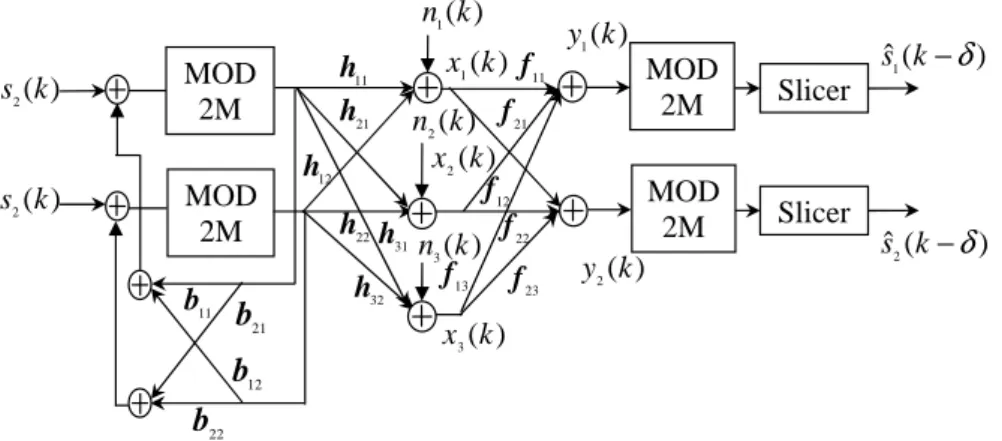
deter-mined using training. Figure 3.3 shows the training sequence mode for a 2×3 MIMO
system. Similar to a SISO system, the feedback filter tap weights can be transferred
to the transmitter via a reverse channel, and the steady state system model for the
corresponding MIMO system is shown in Fig. 3.4.
So, the operational steps for both SISO and MIMO systems can be summarized as:
1. Train the DFE to get the optimum tap weights for the feedback filter.
2. Switch from the DFE to THP, yielding only a linear equalizer in the receiver.
The feedback filter then performs the precoding operation in the transmitter.
3. Now the precoded data is passed through the channel. If another user joins the
system, a blind algorithm is used to open the “eye”.
34 CHAPTER 3 IMPLEMENTATION AND ANALYSIS OF THP-BLIND EQUALIZATION MOD 2M Slicer MOD 2M MOD 2M Slicer MOD 2M ) ( 2 k s ) ( 2 k s 11 b 11 h 21 h 12 h 22 h 32 h 31 h ) ( 1 k n ) ( 2 k n ) ( 3 k n 11 f 21 f 12 f 22 f 13 f 23 f ) ( 1 k y ) ( 2 k y ) ( ˆ1 k−δ
s
) ( ˆ2 k−δ
s ) ( 1 k x ) ( 2 k x ) ( 3 k x 12 b 21 b 22 b
Figure 3.4 Use of feedback filter of MIMO DFE in precoder
We now investigate the relationship of the feedback filter tap weights of the DFE to
the optimal THP feedback filter tap weights introduced in Section 2.4. To do this, we
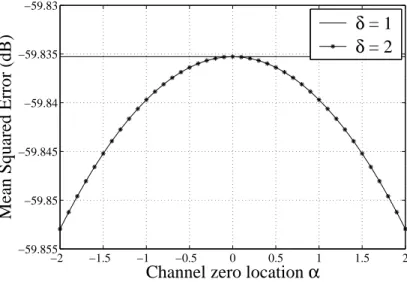
consider a simple zero channel using a DFE with Nf = 2 andNb = 1. As the channel
consists of a single zero, its length is L = 2. The z-transform of the channel impulse
response can be written as H(z) = 1 +α z−1, where α represents the single complex
zero in the channel. Thus, the transfer function of the precoder feedback filter has the
simple form α z−1. So, the THP filter in the transmitter is a one-tap finite impulse
response (FIR) filter with a single complex tap weight α.
Because we know the channel impulse response, using Wiener filter theory we can
determine the optimum tap weights of the DFE. As we will show, in the case of a
zero forcing (ZF) equalizer, the optimal tap weights of the feedback filter match the
theoretical THP tap weights. But, given channel noise, the Wiener tap weights differ
from the theoretical THP tap weights. Note that the use of THP removes the noise
enhancement problem of the ZF equalizer.
Using vector notation, the channel impulse response of the single zero channel can
be expressed ash= [1 α]. Now, the channel convolution matrixH is a 2 by 3 matrix
of the form
H =
1 α 0
0 1 α
3.1 DFE-BASED PRECODING OPERATION 35
For this channel, we find that
E{x xH}=σs2
1 +|α|
2 α
α∗ 1 +|α|2
+σn2I2
E{x sHB}=σs2
1 α 0
0 1 α
0δ×1 1
0(2−δ)×1
,
where (·)∗ denotes the complex conjugate. Similarly, the cross-correlation vector pδ
has the form
pδ =σs2
H(:, δ)
0
. (3.2)
For specific delayδ= 1, we have
E{x sHB}=σ2s
1 α 0
0 1 α
0 1 0
=σ2s
α
1
.
From (2.7) and (2.11) the corresponding autocorrelation matrix and cross-correlation
vector are
Rδ=1=
σs2(1 +|α|2) +σ2n σ2sα −σ2sα σ2sα∗ σ2s(1 +|α|2) +σn2 −σs2
−σs2α∗ −σ2s σs2
(3.3)
pδ=1=σs2[1 0 0]H. (3.4)
36 CHAPTER 3 IMPLEMENTATION AND ANALYSIS OF THP-BLIND EQUALIZATION
have the form
wδ=1=
1 0 α
0 |α1|2 |α1|2
α∗ |α1|2
1+|α|2+|α|4
|α|2
1 0 0 = 1 0 α (3.5) and
fδ=1= [1 0]H bδ=1=α. (3.6)
Similarly, for δ= 2 we find
E{x sHB}=σs2
0
α
Rδ=2=
σs2(1 +|α|2) +σ2n σs2α 0
σ2
sα∗ σ2s(1 +|α|2) +σn2 −σs2α
0 −σs2α∗ σ2s