Exploring organisational
knowledge creation
What is the practical value of Nonaka’s Hypertext model
and how can it be applied?
Master Thesis
Business Administration
Human Resource Management
School of Management and Governance
University of Twente
Author
J.M. Constandse
Supervisors
Prof. Dr. J.C. Looise
Ir. A.A.R. Veenendaal
Date and place of publication
January 2013
i
Abstract
Knowledge creation models frequently suffer from a narrow scope, or a too broad approach. The
objective of this paper is to take one of these models, namely the Hypertext organisation (Nonaka,
1994) and bring it closer to practice by increasing its fit with a practical situation. The ultimate aim of
this study is to provide a conclusion about the value and applicability of this model for knowledge
creation in knowledge intensive companies.
An extensive review of Nonaka’s contribution to knowledge management literature and adjacent
publications has led to a comprehensive reconstruction of the Hypertext model and its potential
shortcomings. Subsequently, a case study of a knowledge intensive company was conducted using
semi-structured group interviews among 16 respondents who were selected using a combination of
quota sampling and self-selection. The respondents were asked to discuss the current method of
knowledge creation at the company, the individual elements of the reconstructed Hypertext model
in relation to knowledge creation at the company and their perceptions of value and applicability of
the model for knowledge creation at the company. The interview outcomes have led to eight
suggested changes which are aimed to improve the practical relevance of the model.
The main conclusions in this paper are that the Hypertext model is an abstract and idealised
representation of organisational knowledge creation which relies on poorly supported and partially
unproven constructs and relations, but nevertheless holds considerable merit for managing
organisational knowledge creation. Several constructs and relations appear to be influenced by
Japanese culture, while others are expected to more accurately portray reality when configured to
follow a different order. Despite this criticism, the reception of the model among the respondents in
the case study was largely positive as many elements and relations were familiar or perceived to be
valuable. Several respondents have expressed their intention to immediately apply some of the
lessons learned from the interviews in practice.
The overall judgment of the respondents was that the applicability and value of the model is
relatively high. However, the universality of the model and the assessment of theoretical
shortcomings potentially negatively affect the applicability of the model. By implementing the
proposed changes, this paper presents an evolved Hypertext model which holds greater practical
iii
Acknowledgement
This thesis is the culmination of the research I have done as part of my graduation for the Master
Business Administration at the University of Twente. Having chosen the master track Human
Resource Management, the study I have conducted focuses on how to manage organisational
knowledge creation, which by extension is the management of human resources.
I would like to use this opportunity to thank my supervisors, Prof. Dr. Jan Kees Looise and Ir. André
Veenendaal, for their support and insightful comments. The way in which Prof. Looise has provided
guidance during the first month of this research has proven to be invaluable in establishing a working
relationship and coming to a successful conclusion. Furthermore, my thanks go out to Dr. Martijn van
Velzen for how he has coached me prior to Prof. Looise taking over the supervision. I am intensely
grateful for the patience he has showed and the way he has motivated me to become a better
student and researcher.
I also would like to thank my parents, family, friends and colleagues who have helped me out in more
than one occasion. You have all kept me on track and your feedback has proven to be very helpful in
completing my studies at the University of Twente.
I am grateful that my former employer has supplied me with the perfect working environment to
work on this thesis. Without expecting any type of compensation he has allowed me to use the
company’s resources and given me the opportunity to work in a distraction free environment.
Finally, I wish to express my gratitude to the participants in the case study who have allowed me to
obtain useful data to perform my analysis with.
v
Index
Abstract ... i
Acknowledgement ... iii
1. Introduction ... 1
1.1. Knowledge creation is necessary, but how? ... 1
1.2. Problem statement and research questions ... 2
1.3. Research design ... 3
1.4. Case selection ... 4
1.5. Relevance ... 5
1.6. Organisation of the thesis ... 5
2. The Hypertext organisation design ... 7
2.1. Introduction to the Hypertext organisation design ... 7
2.2. Underlying principles ... 9
2.2.1. The knowledge typology ... 9
2.2.2. Modes of knowledge creation ... 12
2.2.3. The knowledge creation spiral ... 17
2.2.4. Knowledge scaling ... 19
2.2.5. Self-organising teams ... 21
2.2.6. Managing organisational knowledge creation ... 23
2.2.7. Middle-up-down management ... 25
2.3. Returning to the Hypertext organisation ... 27
2.4. Potential shortcomings ... 32
2.5. Conclusion ... 35
3. Methodology ... 38
3.1. Introduction of the case company ... 38
3.2. Research methodology ... 40
vi
4. Results of the case study ... 50
4.1. The current method of knowledge creation ... 50
4.2. How the Hypertext model relates to the case company... 53
4.3. Applicability and value of the model for the case company ... 58
5. Assessing the case study outcomes ... 61
5.1. Differences between the case company and the Hypertext model ... 61
5.2. Similarities between the case company and the Hypertext model ... 62
5.3. Value and applicability for the case company ... 63
6. Conclusion and discussion ... 65
6.1. Research question outcomes ... 65
6.1.1. The main elements of the model and its contribution to knowledge creation ... 65
6.1.2. Operationalizing and implementing the model in practice... 66
6.1.3. Value and applicability for knowledge intensive companies ... 67
6.1.4. Conclusions regarding the applicability of the model ... 68
6.2. Increasing the model’s fit with the practical setting ... 70
6.2.1. Amending the model to bring it closer to practice ... 70
6.2.2. Suggestions to improve knowledge creation at the case company ... 76
6.3. Contributions ... 78
6.4. Limitations and suggestions for follow up research ... 79
References ... 82
Appendices ... 86
A.1. Interview protocol ... 86
1
1. Introduction
1.1. Knowledge creation is necessary, but how?
The importance of knowledge as an organisational resource has been emphasised by Grant (1996) in
his work on the knowledge-based theory of the firm. Knowledge should be seen as an intangible
asset which is unique, causally ambiguous and hard to imitate or substitute. The resource based view
attributes competitive advantage to the possession of these characteristics (Barney, 1991; Kogut &
Zander, 1992; Cabrera & Cabrera, 2002). Kogut and Zander (1992) argue that the sharing and transfer
of knowledge of individuals and groups within an organisation is the reason why firms exist.
Inter-organisational knowledge diffusion, however, can lead to erosion of competitive advantages (Teece,
2000; Coff, Coff & Eastvold, 2006). The sustainability of the competitive advantage from knowledge
resources must therefore be attributed to the ability to create new knowledge (Grant, 1996; Nonaka,
Toyama & Konno, 2000; Turner & Makhija, 2006). The outcomes of knowledge creation can be
threefold: (1) product and process innovations with an enhanced understanding or “justified true
belief”, (2) an enhanced capacity to act, and (3) the ability to act, define, and solve problems (Nonaka
& von Krogh, 2009).
The currently available models describing knowledge creation are often incomplete due to unevenly
distributed support for specific aspects of these models (e.g. Nonaka, 1991). Sometimes they are
based on misinterpretation of important premises (e.g. Coff, Coff & Eastvold, 2006), or inadequately
explain concepts with crucial importance (e.g. Argote & Ingram, 2000). If authors provide examples
of operationalization, they are frequently vague or appear to incompletely translate theory into
practice (e.g. Nonaka, 1994). Other publications contain methodological shortcomings (e.g. Song,
Almeida & Wu, 2003; Menon & Pfeffer, 2003), or confuse readers by using concept labels with
differing contextual meanings (e.g. Kogut & Zander, 1992 vs. Bhatt, 2001; Polanyi, 1966 vs. Coff, Coff
& Eastvold, 2006). Choi and Lee (2002) have stated that despite the voluminous discussion about
knowledge management strategies, there is relatively little empirical evidence available.
At the same time there is no denying that most of these models hold value in the field of knowledge
management research. Several articles (Nelson & Winter, 1982; Nonaka, 1991; Starbuck, 1992; Kogut
& Zander, 1992; Burt, 1995; Grant, 1996; Teece, Pisano & Shuen, 1997) can be considered to have
formed a foundation upon which other researchers have been able to build their own theories.
Judging by the number of times these articles have been referred to in other publications, one can
assume that they are held in high regard. Unfortunately, this does not implicitly lead to
2
The influence knowledge has on competitiveness, the distribution of competences and the
availability of tools that assist knowledge transfer have increased the importance of effective
knowledge transfer within firms (Teece, 2000). But without knowing what the practical value and
applicability is of models which stimulate knowledge creation effectiveness, how should knowledge
creation be shaped?
1.2. Problem statement and research questions
The practical applicability and by extension the value of knowledge management models remains
unclear and forms a hole in existing knowledge management theory. An assessment of a model’s
applicability can have implications for the perceived value of the model and lead to better informed
implementation decisions.
This paper takes one of the knowledge creation models, namely the Hypertext organisation (Nonaka,
1994) and brings it closer to practice by amending it to increase its fit with a practical situation. The
Hypertext model was chosen because it builds on elements of knowledge management that have
been widely adopted by other researchers, despite some of them suffering from vague explanations
and lack of empirical testing. With what appear to be shaky foundations, the Hypertext
organisational model presents an organisation design tailored for knowledge creation. At first glance
the model offers a solution for any organisation looking to optimise its knowledge creation activities,
but considering the aforementioned, what is the real value and applicability of the Hypertext model?
This study will provide a basis for operationalization and implementation in a practical setting. To
reach this goal, we will critically examine the model and provide a detailed description of its various
elements. An assessment of the model’s applicability will be easier to perform when an
understanding is created of how the model can be operationalized and implemented in practice.
Next, a conclusion will be drawn regarding the value and applicability of the model in a particular
practical setting (knowledge intensive companies, a choice which will be elaborated on in section
1.4.). Finally, through combining empirical data and the outcomes of the literature review, a
conclusion will be drawn about the applicability of the model for knowledge creation.
To sum up, the research questions in this paper are:
1. What are the main elements of Nonaka’s Hypertext organisation model and what does it
contribute to knowledge creation?
3 3. What is the value and applicability of the model for knowledge creation in knowledge
intensive companies?
4. Which conclusions can be drawn regarding the applicability of the model?
1.3. Research design
This study follows a research design in which an assessment of Nonaka’s contribution to knowledge
management literature forms the basis. This assessment includes adjacent publications from other
authors. The literature review culminates in the construction of a comprehensive explanation of the
Hypertext model which stays as close to Nonaka’s intentions as possible. Using this reconstructed
model, a list of its potential shortcomings is formulated.
The second phase of this research involves conducting a case study using semi-structured group
interviews. These interviews can be divided into three segments. The first segment covers the
current method of knowledge creation at the case company (see section 1.4.), in which the
respondents are asked to describe how knowledge is being created, if this method fits the knowledge
requirements of the company and how they would propose to improve knowledge creation
effectiveness.
Following the first segment is an in-depth explanation of the reconstructed Hypertext model and the
way its elements are conceptualised to work in unison. The second segment of the interview focuses
on the model and facilitates discussions about how the model’s elements are similar to how the
company currently works and how the respondents would see other elements operate in practice.
The third segment of the interviews involves the measuring of perceptions of value and applicability
of the model for knowledge creation at the case company. The respondents are asked to discuss
their expectations of fit between the company’s knowledge requirements and the Hypertext model,
and how they would envision bringing the model closer to practice.
Using the interview outcomes, suggestions are made to bring the model closer to practice. These
suggestions lead to the construction of an improved version of the Hypertext model. Furthermore,
based on the case study and the literature review a list is constructed of suggestions to improve the
knowledge creation processes at the case company. Finally, an overall verdict about value and
applicability of the reconstructed Hypertext model is formulated, using the literature review and the
4
1.4. Case selection
This study focuses on how knowledge creation is managed in knowledge intensive companies and
ascertains the value and applicability of the Hypertext model in this setting. The choice for
knowledge intensive companies is made because of the importance of effectively and efficiently
creating knowledge in this type of organisation. Swart and Kinnie (2003) state that knowledge
intensive firms gain competitive advantage with the human and social capital they possess. Human
capital includes individual tacit and explicit knowledge (Nelson & Winter, 1982). It is therefore likely
that knowledge creation models are highly relevant to knowledge intensive companies. Changing the
Hypertext model to bring it closer to practice will also have a larger impact on these companies than
others because of the important role knowledge creation plays for these companies.
The case company is a major Dutch internet agency employing around 90 people. Following the
criteria for knowledge intensive firms set out by Swart and Kinnie (2003), the case company can be
described as being knowledge intensive, because most of the work at the company is of an
intellectual nature and college-level educated workers form a major part of the workforce.
Furthermore, Starbuck (1992) describes knowledge intensive firms as companies in which knowledge
has more importance than other resources in maintaining the firm’s competitive position, which also
applies to the case company.
The company was selected based on how the researcher has perceived the company while being
employed at the company in the years prior to the study. The company’s affiliation with knowledge
creation and the perceived pragmatic approach to managing knowledge creation make this company
a suitable basis to compare the model with. Without being aware of how the Hypertext model is
constructed, several elements have been observed to be in place at the company prior to the study
taking place. The company relies heavily on dialogue and teamwork to share knowledge, similar to
how Nonaka has conceptualised the socialisation and externalisation modes of knowledge creation.
Furthermore, the company has adopted an organisational structure which shows strong similarities
with Nonaka’s project-system layer, in which self-organising teams enjoy high degrees of autonomy,
cross-fertilisation and self-transcendence. A final similarity between the model and the case
company’s pragmatic method of knowledge creation has been observed to be the role of top
management in determining a broad overall direction after which middle management works with
5
1.5. Relevance
This study is of value to the practice of knowledge management for four reasons. Firstly, the
proposed changes this study offers to bring the Hypertext model closer to practice amend the model
to be easier to apply in knowledge intensive companies. The improved model is a more accurate
representation of practical knowledge creation in the setting of knowledge intensive companies.
Secondly, in conducting the interviews, decision makers at the case company are sparked to look into
ways to manage the way knowledge creation takes place at the company. This new interest is
planned to result in the hosting of a workshop to present this study’s findings to a larger audience at
the case company and discuss ways to improve its knowledge creation process.
Thirdly, this study provides suggestions to improve knowledge creation at the case company. While
these suggestions were not part of the original goal of this study, an analysis of the interview
outcomes and constructing a list of suggestions to improve the model has led to a realisation that
there is an opportunity for quick gains at the company and companies which face similar conditions.
The fourth source for practical relevance is that this study will draw conclusions about the practical
applicability and value of the model in the setting of a knowledge intensive company, which enables
managers to take better informed implementation decisions.
1.6. Organisation of the thesis
This paper is structured to follow the order of the research questions. The second chapter will
explain the principles that underlie Nonaka’s Hypertext organisation model and how the model is
designed to affect the practice of knowledge creation. Chapter two will culminate in an
interpretation of how Nonaka has intended the individual elements of the Hypertext model to work
together. This interpretation is a reconstruction of the model using the original publication in which
the model was presented (Nonaka, 1994) and adjacent publications. Using the reconstructed model,
chapter two will end with an assessment of the merits and potential shortcomings of the model, and
will provide answers to the first two research questions.
Chapter three will introduce the case company, elaborate on the research methodology and the
operationalization of constructs.
The fourth chapter will present the research findings by discussing the most relevant quotes,
following the three stages of the interviews. Firstly, the current method of knowledge creation at the
case company will be discussed. Following this, the interview outcomes concerning the way the
Hypertext model relates to the case company are presented. Chapter four will conclude with the
6
company.
The fifth chapter will elaborate on the observed differences and similarities between the case
company’s knowledge creation method and the Hypertext model. The fifth chapter will cap off with a
statement about the value and applicability of the Hypertext model in the setting of the case
company, thus answering the third research question.
The sixth and final chapter will present the conclusions of this study. The four research questions are
answered and changes are made to the model in order to bring it closer to practice. Furthermore, the
sixth chapter will contain suggestions to improve the knowledge creation activities at the case
company, an examination of the contributions of this study to knowledge management theory and a
7
2.
The Hypertext organisation design
The Hypertext organisation is an organisational architecture that is expected to improve the
efficiency of the knowledge creation process. The design consists of a three-layered organisation, in
which employees cycle from a hierarchical top-down organisation into a flat team-based organisation
and a supporting knowledge base. How these layers fit together will be explained in section 2.1.
This chapter is structured in a fashion where the Hypertext model is briefly introduced, after which
the underlying principles are examined. It is concluded with an in-depth assessment of how the
model functions and what the potential shortcomings are.
2.1.
Introduction to the Hypertext organisation design
Nonaka (1994) has coined a new organisational architecture which combines the efficiency and
stability of a hierarchical bureaucratic organisation with the flexibility of the flat, cross-functional
task-force organisation. This new architecture is intended to combine the advantages these
structures have on knowledge creation effectiveness. The Hypertext organisation consists of three
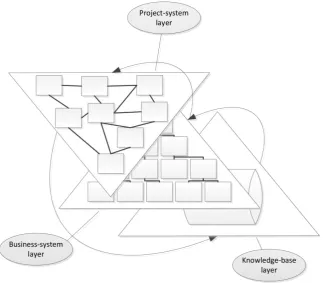
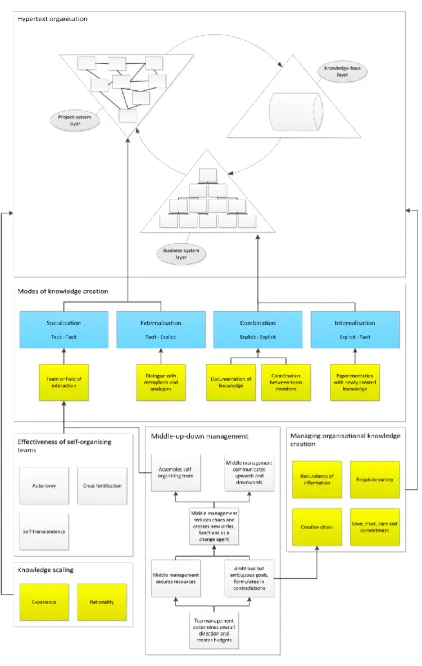
[image:15.595.74.400.437.720.2]layers (see figure 1).
Figure 1: Hypertext Organisation (Nonaka, 1994)
The bottom layer of the Hypertext organisation is known as the knowledge-base layer, in which tacit
8
culture and procedures, while the explicit knowledge has taken form in documents, filing systems, or
digital databases.
The layer on top of the knowledge-base is called the business-system layer. This is where routine
operations are carried out in a hierarchical, bureaucratic organisation. This layer has all the
characteristics of a top-down organisation.
The top layer is known as the project-system layer. Multiple knowledge creating self-organising
project teams make up this layer. The teams are loosely linked to facilitate an interconnectedness
that improves the knowledge creation process. They share the same corporate vision that underlies
the knowledge creation efforts.
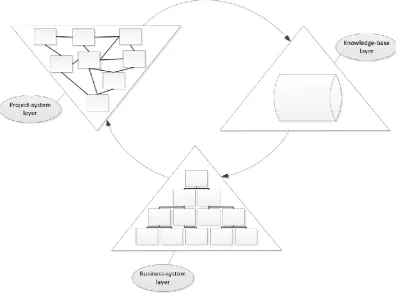
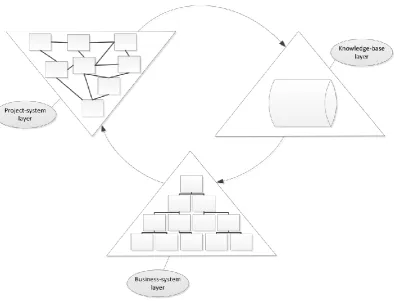
Organisational knowledge creation is conceptualised as a perpetual dynamic cycle of knowledge and
information flowing through the three layers (see figure 2). The project teams in the top layer are
comprised of members from diverse functions and departments from the business-system layer. The
teams cooperate in their efforts to work towards the knowledge goals set out by the company
management. When a team completes the task that has been set out for it, it is disassembled. The
project team members then move to the knowledge-base layer to create an inventory in which the
outcomes of their knowledge creation activities are stored. They move back to the business system
layer when they finish their documenting and resume their routine operations until they are called
[image:16.595.75.472.469.767.2]upon for another project.
9 The Hypertext organisation design relies on the notion that knowledge can be either tacit or explicit,
depending on the relative ease with which knowledge can be articulated or codified. This typology
forms the basis upon which the knowledge creation process is conceptualised as knowledge moving
through a sequence of conversions between tacit and explicit, where it gains magnitude and
momentum. This sequence of conversions forms a circle, or a spiral of ever growing knowledge
assets. The spiral is the result of implementing several triggers; knowledge creation enhancing
conditions and specific knowledge creation activities that together form an intricate network of
relations.
The complexity of this network and the assumptions that lie at the foundation of the Hypertext
organisation design, require the reader to understand the underlying principles, before explaining
how the building blocks are integrated to form a whole. Section 2.2. will discuss these elements by
diving into the deepest level of analysis and moving upwards toward a reconstruction of the model.
While presenting the underlying elements, each item will be critically examined and discussed while
introducing relevant alternative theories.
A visual representation of the conceptualised relations is provided in section 2.3. This chapter
concludes with an assessment of the potential shortcomings of the model based on the literature
review and answers to the first two research questions.
2.2.
Underlying principles
2.2.1.
The knowledge typology
Knowledge is defined using several classifications. Examples of such classifications are component
and architectural knowledge (Tallman et al., 2004), tacit and specific knowledge (Coff, Coff &
Eastvold, 2006), information and know-how (Kogut & Zander, 1992), and tacit and explicit knowledge
(Polanyi, 1966; Nonaka, 1991). These classifications are similar in that they assign a label to
knowledge types, based on the value of this knowledge. The distinction between tacit and explicit
knowledge has influenced the field of knowledge management considerably. It is a classification
which is based on the ease with which the knowledge can be disseminated. The assumption that
knowledge can be explicit or tacit has in recent years developed into a proposition that knowledge
should not be identified as either explicit or tacit, but can be placed on a scale that ranges from
explicit to tacit (Ambrosini & Bowman, 2001) to acknowledge the existence of knowledge which
10
In 1966 Polanyi explained that we know more than we can tell. From a Gestalt-psychology angle he
explains that we unawarely possess knowledge which as a result of our unawareness is difficult or
impossible to articulate. This type of knowledge is tacit knowledge.
To elaborate on what is tacit knowledge, Polanyi (1966) made an interesting reference to Plato’s
Meno: “we take for granted that solutions to great problems are great discoveries. But seeing a
solution to a problem is not being able to see something that is hidden, but to see something that
other people are not aware of seeing” … “[Plato] says that to search for the solution of a problem is
an absurdity; for either you know what you are looking for, and then there is no problem; or you do
not know what you are looking for, and then you cannot expect to find anything.” In Poe’s Purloined
Letter there is a momentous document in front of everybody and as a result of it being available it is
overlooked by everybody. In terms of Meno this means that if all knowledge is explicit (easily
articulated), we cannot know a problem or look for a solution to it. Therefore, if problems exist and
discoveries are made to solve them, there must be a knowing of something we cannot tell. This
assumption hints at a type of knowledge that we are unaware of knowing or unable to articulate.
Polanyi (1966) calls this type of knowledge tacit knowledge.
Nonaka (1991) describes tacit knowledge as being highly personal, hard to formalise and difficult to
communicate. It is deeply rooted in action and in an individual’s commitment to a specific context.
Tacit knowledge consists partly of technical skill and knowhow which has been developed over years
of practice. The cognitive dimension of tacit knowledge lies in its composition of mental models,
beliefs, and perspectives, which are difficult to explain because the holders of this knowledge take it
for granted. Ambrosini and Bowman (2001) attribute tacit knowledge with specificity, because this
type of knowledge is acquired in a particular setting. Additionally, Ambrosini and Bowman (2001)
explain that the personal trait of tacit knowledge is caused by the degree to which the knowledge has
become ingrained in people and organisations, which lead to the knowledge becoming implicit and
taken for granted. The specificity and the personal nature of tacit knowledge render it difficult for
outsiders to imitate or copy (Nonaka, 1991; Kogut & Zander, 1992; Nonaka, 1994; Ambrosini &
Bowman, 2001; Coff, Coff & Eastvold, 2006)
Kogut and Zander (1992) have influenced the current understanding of what is tacit knowledge.
Instead of using the construct label “tacit knowledge”, they use the term know-how. Know-how was
described by Von Hippel (1988) as “… the accumulated practical skill or expertise that allows one to
do something smoothly and efficiently”. Kogut and Zander use the term information for knowledge
that can be transmitted without loss of integrity once the syntactical rules required for deciphering it
are known. Information is placed on the opposite of know-how on the knowledge attribute scale.
11 implies knowing how to do something. The distinction between information and know-how is
comparable to that made between declarative knowledge (a statement that provides a description)
and procedural knowledge (a statement to describe a process).
If information (Kogut & Zander, 1992) is a type of knowledge that can be transmitted without loss of
integrity, it is essentially the same thing as Nonaka’s (1991) explicit knowledge. Nonaka describes
explicit knowledge as formal and systematic, which makes it relatively easy to communicate and
share, for example through product specifications or scientific formulae.
When comparing the typologies of Nonaka (1991, 1994), Kogut and Zander (1992) and Ambrosini and
Bowman (2001), it is apparent that Nonaka’s division of tacit and explicit knowledge is a valid one. It
is however cut short in its explanation and leaves the reader wondering what is truly meant. The
other authors are much more elaborate in explaining the difference between these constructs.
Ambrosini and Bowman (2001) for example offer several gradations of tacitness and explicitness, a
proposition which was later supported by Nonaka (Nonaka, von Krogh and Voelpel, 2006; Nonaka &
von Krogh, 2009). Furthermore, Nonaka (1991, 1994) rarely uses practical examples of the difference
between tacitness and explicitness, as opposed to Kogut and Zander (1992), Ambrosini and Bowman
(2001), Turner and Makhija (2006) and Coff, Coff and Eastvold (2006). Kogut and Zander’s
explanation (1991) of know-how and information, constructs which in many ways have the same
meaning as tacit and explicit knowledge, is much more easily understood than the typology Nonaka
uses.
If one were to exclusively use Nonaka’s explanation (1994) of tacit and explicit knowledge, the
comprehension of these constructs would be very limited. This drawback can be overcome by
including articles from other authors who have adopted and modified these constructs or using a
larger selection of Nonaka’s work. This raises the question if Nonaka’s distinction between tacit and
explicit knowledge forms a stable enough foundation for the knowledge creation model that will be
explained in the following sections.
In closing, the distinction between explicit and tacit knowledge lies in the way the knowledge was
created and the ease with which it can be articulated. The awareness of possessing knowledge plays
a role in labelling knowledge along a spectrum that ranges from explicit to tacit, with explicit
knowledge being a type of knowledge of which individuals are consciously aware of possessing it,
while this awareness does not apply to tacit knowledge. An understanding of the differences
between explicit and tacit knowledge is important before moving on to the knowledge creation
12
2.2.2.
Modes of knowledge creation
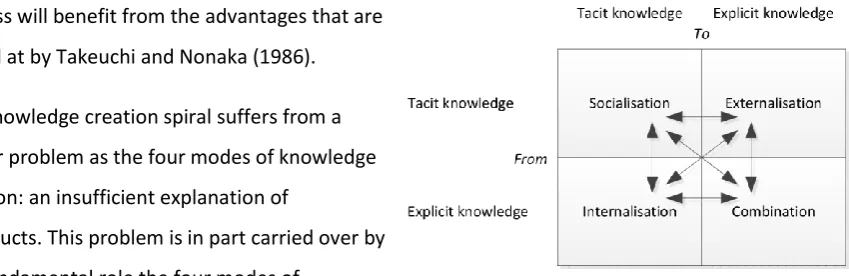
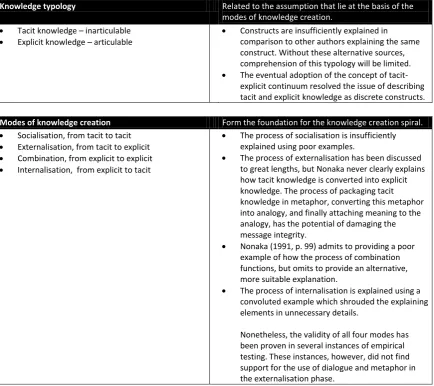
Nonaka (1991, 1994) describes four phases (figure 3) in organisational knowledge creation that exist
in dynamic interaction with each other:
1. From tacit to tacit; socialisation
2. From tacit to explicit; externalisation
3. From explicit to explicit; combination
4. From explicit to tacit; internalisation
Because tacit knowledge is acquired through experience and experimentation, it is difficult to share
this type of knowledge without common experiences. Transferring tacit knowledge therefore takes
place during a long process of observation, imitation, and practice. Creating tacit knowledge through
shared experience is called socialisation, while creating tacit knowledge through experimentation
with explicit knowledge is called internalisation.
Nonaka (1994) explains that new explicit knowledge can be created through social processes that
combine different bodies of explicit knowledge held by individuals and by using dialogue with
metaphors and analogies to articulate tacit knowledge. The reconfiguring, combining and
recontextualizing of several bodies of explicit knowledge will lead to new insights and solutions for
the problems we experience. This process of creating new explicit knowledge from several bodies of
existing explicit knowledge is called combination. Articulating tacit knowledge to make it explicit is
called externalisation.
Socialisation and combination don’t affect the tacit or explicit nature of the knowledge involved.
They are techniques of transferring and creating through reconfiguration of knowledge. There are
two types of knowledge conversion: from explicit to tacit (internalisation) and from tacit to explicit
(externalisation). Explicit knowledge and tacit knowledge are complementary and can expand over
time through a process of mutual interaction. Nonaka (1994) explains that metaphors play an
important role in externalisation and action is
deeply related to internalisation. Internalisation
is comparable to the traditional definition of
learning – acquiring tacit knowledge from
sources of explicit knowledge, or skills and
know-how from textbooks.
The processes of socialisation, internalisation
[image:20.595.299.525.637.772.2]and combination are part of the theories of
13 organisational culture, organisational learning and information processing respectively.
Externalisation however, is not coupled as easily with any organisational theories. Converting tacit
knowledge into explicit knowledge is a difficult process which has received some attention from
scholars, but the way this process can take shape remains largely a mystery. Nonaka (1991, 1994)
expresses that using metaphors can help in converting tacit knowledge into explicit knowledge, but
doesn’t provide any empirical evidence to support this claim. He is also vague in explaining how this
process would take shape. Ambrosini and Bowman (2001) support Nonaka’s assertion (1994) that
metaphors are useful in transmitting tacit knowledge. If something cannot easily be put into words,
then perhaps it can be explained through telling a story about an occurrence in which the subject
plays a role. The authors call this storytelling.
Using metaphors or storytelling when direct language is available is discouraged. One way to prevent
the overuse of metaphors is to ask to reformulate an explanation. If the second explanation is
another metaphor, instead of a “regular” expression, the original metaphor is appropriate for the
situation.
Metaphors can be used to explain something intuitive to people who are grounded in different
contexts and with different experiences, through the use of imagination and symbols without the
need for analysis or generalisation (Nonaka, 1991, 1994). The process of deciphering a metaphor by
the audience is the first step of converting tacit knowledge into explicit knowledge.
Analogies are more structured than metaphors because they aren’t driven by intuition and images
that are at first glance remotely linked to each other. Analogies form a more structured process of
reconciling contradictions and making distinctions, and they highlight the similarities between the
contradicting terms in metaphors. This reduces the ambiguity of the metaphors.
What is not explained is what the value is of using a metaphor before moving to an analogy. What is
the reason for forcing the expression of contradicting terms and connecting these terms in a later
phase? This may be where mental models come into play. Mental models that include schemata,
paradigms, beliefs, and perspectives are understood to help us perceive and define the world around
us (Nonaka, 1994 p.16). But this explanation is taken out of context, because the author originally
uses it to describe the cognitive element of tacit knowledge. Nonaka potentially attributes value to
the transition from metaphor to analogy in the role mental models play during the interpretation and
reconstruction of the contradicting terms in the metaphor. If this is true, there is a loss of integrity in
the message that is being conveyed. If the transition from tacit to explicit involves a two-step process
in which interpretation plays a key role, the message will change due to the influence mental models
have on the act of interpreting. Even though this line of thought is speculative and a considerable
14
he were more concise in his elaborate explanation of the role metaphors play in articulating tacit
knowledge, it may have been easier to understand. It appears that Ambrosini and Bowman’s (2001)
suggestion to use storytelling and cognitive (causal) mapping as techniques to articulate tacit
knowledge would be a better option, as these are less complex and not influenced by the
aforementioned threat to the message integrity.
A second point of criticism can be raised against the way the process of socialisation is explained
(Nonaka, 1991, p. 98-99). Socialisation, or the transfer of tacit knowledge without converting it into
explicit knowledge, is described using an example of an electrical appliance manufacturer’s quest of
designing a bread-making machine for home use. What follows is an anecdote of how the designers
were unable to deliver a machine that would produce high quality bread. In order to improve their
design, one staff member went into an apprenticeship with a master baker and over time has learnt
the craft of baking high quality bread. Because tacit knowledge is rooted in action (Kogut & Zander,
1992; Ambrosini & Bowman, 2001), Nonaka (1991, p. 98-99) chose to explain the transfer of tacit
knowledge by writing about the baker’s apprentice learning how the kneading technique influences
the quality of the bread. It was a twisting motion during the stretching of the dough that was missing
from the bread-making machine’s design.
This is a poor example of how tacit knowledge can be transferred. It actually describes how the
master baker performs his job differently from how a layman would do it, by performing an action
that could have easily been put into words. In this example the tacit knowledge is not transferred
through the accumulation of years of hands-on experience, but learning from a simple observation.
This reasoning is furthered by Ribeiro and Collins (2007). They argue that the notion of knowledge
conversion from tacit to explicit (externalisation) is conceptually flawed if based on the case of the
bread-making machine because tacit knowledge has not become embedded into the machine as a
result of the designer’s apprenticeship with a master baker (Ribeiro & Collins, 2007, p. 1418).
Gourlay (2006) shares the sentiment that Nonaka (1991, 1994) has insufficiently explained the
process of socialisation by using an improper example. Here however, the focus of the criticism is on
whether the taste or kneading was at issue in producing high quality bread. In reference to a bread
making handbook, Gourlay states that the taste of bread is affected by the raw ingredients, the
dough maturation process and the baking, but not by the kneading. He concludes that the example
used by Nonaka is faulty because of the assumption that the twisting of the dough is the secret to
baking high quality bread. Instead, the improvement to the bread-maker design is likely attributed to
incidental problem solving during the lengthy design process (Gourlay, 2006, p. 1417). The potential
for an incorrect attribution of success undermines Nonaka’s example, which leaves the conclusion
15 Nonaka’s explanation of the process of combination is also insufficient: “An individual can also
combine discrete pieces of explicit knowledge into a whole. For example, when a comptroller of a
company collects information from throughout the organisation and puts it together in a financial
report, the report is new knowledge in the sense that it synthesises information from many different
sources. But this combination does not really extend the company’s existing knowledge base either”
(Nonaka, 1991, p. 99). In theoretical terms combination is described as the creation of new
knowledge through merging and reconfiguring existing knowledge. Nonaka chose to use a weak
example of how several sources of existing knowledge are combined in a single document. This
document is seen as the new source of knowledge. He admits that this new source of knowledge
does not add to the company’s knowledge endowment, but instead of providing a better
explanation, he continues to explain the process of externalisation; omitting to provide a concise
elaboration of how combination works.
In his 1994 article, Nonaka explains that “The reconfiguring of existing information through the
sorting, adding, recategorizing, and recontextualizing of explicit knowledge can lead to new
knowledge.” This does not significantly alter the state with which this construct is explained in the
previous publication, leading to the conclusion that it is unclear how the process of combination
works. Nonaka (1991, 1994) has described the construct in theoretical terms and by using a single
example, but does not produce evidence of knowledge creation through the reconfiguration and
combination of existing knowledge.
Internalisation is explained using an example where the comptroller’s summary of data causes a
revision of the company’s financial control system (Nonaka, 1991, p. 99). The revised financial control
system becomes a part of the organisation’s internal environment: a new status-quo which, over
time, is taken for granted by the employees. The new financial control system will become a part of
the toolset and resources necessary for the employees to do their jobs.
The transition from explicit to tacit does not occur at the intersection between delivering the
comptroller’s dataset and the formulation of a new financial control system, but at the point where
the employees start subconsciously performing their jobs in accordance with the behaviour that is
stimulated by the new financial control system. The knowledge has changed from being entirely
explicit (the comptroller’s dataset) to being largely tacit (the subconscious awareness of the financial
control system, which leads to a change in employee behaviour). In essence this can be seen as a
good example of how explicit knowledge is converted into tacit knowledge. Unfortunately the
formulation of the example appears to put too much emphasis on the influence the comptroller’s
dataset has on the revision of the financial control system, because a relatively simple source of
16
what the author is really trying to bring across. If Nonaka had chosen to include an additional
example of how internalisation works, or abstained from mentioning the comptroller’s dataset, it
may have worked better in explaining the construct.
Choi and Lee (2002) have examined the link between knowledge management strategies and the
modes of knowledge creation, and found evidence for the way socialisation, externalisation,
combination and internalisation work. The authors have categorised knowledge management
strategies in human and system strategies, a typology which shows overlap with the distinction
between tacit and explicit knowledge. Empirical testing shows that knowledge management
strategies need to be adjusted to fit the knowledge creation process within the company to improve
corporate performance. The human strategy is found to be most suitable for socialisation and
internalisation. The system strategy is found to be most suitable for combination. Choi and Lee
(2002) state that Bloodgood and Salisbury (2001) and Riggins and Rhee (1999) have found the system
strategy to be suitable for externalisation as well, which completes the linking between the
knowledge creation modes and the two knowledge management strategies.
In a confirmatory factor analysis using survey data from 105 middle managers from firms in the
Tokyo area, Nonaka et al. (1994) have found empirical support for the existence of all four modes of
knowledge creation. An interesting outcome here is that Nonaka et al. (1994) did not find evidence
for the use of dialogue and metaphor in the externalisation phase. It is also noteworthy that there
are several threats to the study’s statistical conclusion validity and the external validity due to low
statistical power, homogeneity of the sampled units, and the potential for an interaction of the
causal relationship with the sampled units.
What can be drawn from this is that the conceptualisation of the four modes of knowledge creation
is sound, though the way they are explained raise more questions than they solve. Nonaka et al.
(1994) have proven that the constructs socialisation, externalisation, combination and integration are
valid. Choi and Lee (2002) have proven that there is a significant relation between the type of
behaviour observed and the knowledge creation mode which formed the context in which the
observation is made. This relation is as Nonaka has hypothesised in 1991.
In conclusion it can be noted that the four phases of organisational knowledge creation (Nonaka,
1991, 1994) are insufficiently explained, but empirically proven in several occasions. The validity of
the four modes has a great impact on the perceived value of the Hypertext organisational model, as
the constructs of tacit and explicit knowledge, and the four phases of organisational knowledge
creation function as the foundation upon which the model is built. What follows is an elaboration on
17
2.2.3.
The knowledge creation spiral
Knowledge creation can take place in each of the four aforementioned modes. However, the central
theme of the model is the dynamic interaction between the modes. The interaction between the
modes is necessary because without it, problems can arise. Nonaka (1994) provides an example by
explaining that pure combination leads to a superficial interpretation of existing knowledge which
has little to do with the here-and-now reality. Pure socialisation limits the “sharability” of the tacit
knowledge and keeps this knowledge bound to the context in which it was created.
Organisational knowledge creation takes place when the four modes are managed to form a
perpetual cycle. Knowledge creation in a sequence of knowledge creation modes can be seen as
knowledge shifting through the modes. These shifts are triggered by certain events. The triggering
conditions are:
Socialisation starts with the building of a team or a field of interaction in which experiences
and perspectives are shared
Externalisation starts after several rounds of meaningful dialogue in which a sophisticated
use of metaphors is used to enable the articulation of tacit knowledge.
Combination is triggered by coordination between team members and the rest of the
organisation, and documentation of existing knowledge.
Internalisation takes place when team members assimilate knowledge in a trial-and-error
fashion. This experimentation can trigger internalisation.
The cycle (see figure 4) can be seen as a spiral if
the outcomes of the knowledge creation process
are assumed to be a form of progress. Progress
resulting from knowledge creation causes the
starting point of the knowledge creation cycle to
move upwards. But since the knowledge
creation cycle does not have a clear beginning or
end, the starting point is continually shifting,
which transforms the cycle into a spiral. Because
the knowledge creation starts at the individual level and expands through interaction, it transcends
sectional, departmental, divisional and ultimately organisational boundaries (Nonaka, Toyama &
Konno, 2000). The incrementally increasing unit size of knowledge and the expansion across
[image:25.595.104.522.521.657.2]organisational units causes the cycle to become a spiral.
18
What is missing from Nonaka’s work is that the hypothesised causal relations between the triggering
conditions and the modes of knowledge creation are lacking empirical support. Nonaka (1994)
supports the propositions with the anecdotal evidence that he uses to describe the four modes of
knowledge creation (see subsection 2.2.1.) and fails to deliver more compelling evidence, such as the
work of Nonaka et al. (1994), Riggins and Rhee (1999), Bloodgood and Salisbury (2001) and Choi and
Lee (2002) in the context of the four modes of knowledge creation. Furthermore, in his elaboration
the author does not provide the evidence first hand. The hypothesised triggering conditions are in
effect the same as the actual behaviour that is being stimulated. It is easy to assume that behaviour
will be witnessed after introducing said behaviour to a setting. This leads to the conclusion that the
proposed triggering conditions are insufficiently supported. This shortcoming can be solved by an
inclusion of empirical data which points at a cause and effect relationship between the triggering
conditions and the modes of knowledge creation.
It is also unclear how Nonaka (1994) attributes power to the interaction between tacit and explicit
knowledge conversion modes. He provides examples of focusing on pure combination or pure
socialisation, which can prove problematic, but there is no mention of effects when focusing on
internalisation or externalisation.
The argument for the knowledge creation spiral (Nonaka, 1991, 1994) implicitly prescribes an order
in which the modes of knowledge creation should take place. Figure 4 displays the spiral as a
clockwise motion. Forcing a different order appears to be impossible because the outcome of the
socialisation phase is used as the input for the externalisation phase, which in turn supplies the input
for the combination phase, and so on. Nonaka (1991, 1994) attributes a sequential nature to the
process of knowledge creation by aligning the knowledge creation modes in this order. Just five years
earlier Nonaka made an argument for abandoning sequential development processes in the context
of product development (Takeuchi & Nonaka, 1986; Nonaka, 1988b). The context from which this
petition is taken differs slightly from the setting that is being discussed in this study, but the main
arguments can be carried over. Parallel development should be adopted over sequential
development to reduce the development cycle time, while increasing development efficiency and
preventing the “next bench” syndrome1.
Taking into account the expected benefits of adopting a parallel development process, perhaps the
spiral of knowledge creation can be optimised by not viewing it as a spiral and reconnecting the
knowledge creation modes in a chaotic or random fashion (figure 5). If knowledge creation can take
19 place in multiple knowledge creation modes
simultaneously, perhaps the outcome of this
process will benefit from the advantages that are
hinted at by Takeuchi and Nonaka (1986).
The knowledge creation spiral suffers from a
similar problem as the four modes of knowledge
creation: an insufficient explanation of
constructs. This problem is in part carried over by
the fundamental role the four modes of
knowledge creation have in the knowledge creation spiral, but the way the theory is presented, is not
improved. Furthermore, the order in which the modes of knowledge creation are suggested to take
place is an interesting topic for discussion, as an argument is made for switching from a spiral in
which the modes have sequential interdependence, to a chaos with parallel interdependence.
The knowledge creation spiral forms the core of the Hypertext organisation design. It is argued (e.g.
Nonaka, 1988a, 1988b, 1991, 1994; Nonaka, von Krogh & Voelpel, 2006; Nonaka, Toyama & Konno,
2000) that implementing the triggering conditions for the knowledge creation modes is necessary,
but not sufficient to optimise organisational knowledge creation activities. Subsections 2.2.4. through
2.2.7. will supplement the knowledge creation spiral with measures that are expected to improve
knowledge creation effectiveness.
2.2.4.
Knowledge scaling
Knowledge is created by individuals. An organisation cannot create knowledge without individuals
within this organisation. Kogut and Zander (1992) argue that the sharing and transfer of knowledge
of individuals and groups within an organisation is the reason why firms exist. Organisational
knowledge creation is a process of amplifying the creation of knowledge by the individuals within the
organisation and maintaining this knowledge within the knowledge network of the organisation
(Nonaka, 1994; Arikan, 2009). The enlargement of an individual’s knowledge plays a vital role in
coming to a model for knowledge creation which builds on the four modes of knowledge creation
and the spiral in which they function. The concept of enlarging an individual’s knowledge is
multidimensional because it can be explained from the different interpretations of the term
enlarging. This subsection will elaborate on the enlargement of an individual’s knowledge from the
perspectives of increasing the availability of a knowledge resource in the organisation (Coff, Coff &
[image:27.595.99.524.110.248.2]Eastvold, 2006) and enlargement of knowledge within the individual through an interaction between
20
experience and rationality (Nonaka, 1994). The first explanation of the enlargement of an individual’s
knowledge isn’t included in Nonaka’s argument for the Hypertext organisational design, but is used
in this study because it offers valuable insight into the potential drawbacks of externalisation, the
codification of tacit knowledge, and the dissemination of knowledge.
Knowledge transfer is a multiplication effort, because unlike in a basic transaction relationship, the
knowledge source does not lose the amount of knowledge the receiver gains. Disseminating
knowledge is therefore a way of enlarging an individual’s knowledge within an organisational
context. Every time knowledge is transferred from one actor to another, its volume grows. As a
result, an organisation is more capable of matching the knowledge resource availability with the
resource requirement.
Coff, Coff and Eastvold (2006) state that the value of tacit knowledge is derived from its inimitability.
Leveraging tacit knowledge means that the valuable resource can be used more widely throughout
the organisation. Because tacit knowledge is often firm-specific, which means that a market for tacit
knowledge is unfeasible. If knowledge is abundant, the resource isn’t scarce and as such not
expected to be a source of competitive advantage. Furthermore, the tacit nature is expected to make
it hard for the firm to find prospective employees who possess this resource (Coff, Coff & Eastvold,
2006). To overcome situations in which the demand for tacit knowledge surpasses the supply, tacit
knowledge has to be scaled up. If the competitive advantage originates from the possession of
particular tacit knowledge, scaled up tacit knowledge can strengthen the advantage. Coff, Coff and
Eastvold (2006) anticipate limitations to the scaling of tacit knowledge. They expect the strategic
value of tacit knowledge to diminish if the knowledge is scaled up to where it becomes available to
competitors. A factor adding to this effect is the requirement of partially codifying tacit knowledge to
lubricate the dissemination process. Codified knowledge is more easily accessible by competitors by
hiring people away from the originating firm. In conclusion, the enlarging an individual’s knowledge
can assist an organisation in fulfilling its knowledge resource requirements, while at the same time
opening up possibilities for the knowledge to spill over to competitors (Coff, Coff & Eastvold, 2006).
Nonaka (1994) sees the enlargement of individual knowledge as an interaction between experience
and rationality, after which it is crystallised into unique, personal perspectives. These personal
perspectives on knowledge are based on individual believes and value systems, and play a role in the
interpretation of shared experiences in the conceptualisation.
The way Nonaka (1994) explains the enlargement of individual knowledge focuses on improving the
quality of knowledge through increasing the variety of personal experiences and knowledge
experience. Having varied but related experiences enables the individual to connect and integrate
21 hand, are expected to inhibit creative thinking and the formation of new knowledge (Nonaka, 1994).
Knowledge experience is described as “an embodiment of knowledge through a deep personal
commitment into bodily experience” (Nonaka, 1994, p. 22). This notion is derived from oriental
culture and from Descartes. In reference to Varela et. al (1991), Nonaka explains embodiment as “a
reflection in which body and mind have been brought together”. Commitment to bodily experience is
described using Nishida (1960) as “an intentional self-involvement in the object and situation which
transcends the subject-object distinction, thereby providing access to ‘pure experience’” (Nonaka,
1994, p. 22). In this paper, knowledge experience is interpreted as the merging of the individual’s
perspectives with the knowledge, to become intuitive instead of rational. Knowledge experience
reflects a true commitment to knowledge.
Nonaka (1994) goes on to explain that improvements to knowledge quality through having varied
experiences and the knowledge experience have to be balanced by the ability to reflect on
experience. The author calls this knowledge of rationality. Knowledge of rationality has a place in the
combination phase of knowledge creation. Reflection is necessary to create discrete declarative
knowledge and ignores the importance of commitment by centring on reinterpreting existing explicit
knowledge.
Concluding from Nonaka’s assessment, it can be said that enlarging individual knowledge involves
improving the knowledge quality through having varied experiences in the creation process, having
high commitment to knowledge through unifying the individual with the knowledge (knowledge
experience), and being able to reflect on experience (knowledge of rationality) while combining
perspectives to form new knowledge.
2.2.5. Self-organising teams
Socialisation can be facilitated by the establishment of a knowledge creation field or self-organising
team in which collaboration leads to new concepts (Nonaka, 1994). This field can cross organisational
boundaries, as shown by examples from Japanese industry where suppliers are involved in various
stages of new product development, and customers in the case of new product planning (Dyer &
Nobeoka, 1998). The notion of a field or context in which knowledge creation takes place is
supported in several publications (e.g. von Krogh, 1998; Grant, 1996; Tanriverdi & Iacono, 1998;
Nonaka, Toyama & Konno, 2000; Alavi & Leidner, 2001; Nonaka, von Krogh & Voelpel, 2006).
Takeuchi and Nonaka (1986) describe organizing teams as project teams that take on a
self-organising character as they are driven to a state of zero-information. What they mean by this is that
22
fluctuation to the organisation. Over time, the uncertain situation will develop into a new dynamic
order and the project team will begin to operate like a start-up company by taking initiatives and
risks, and developing an independent agenda.
Project teams become self-organising when they enjoy autonomy, become self-transcendent and
exhibit cross-fertilisation (Takeuchi & Nonaka, 1986; Nonaka, 1988a; Nonaka, Toyama & Konno,
2000). Three examples of successful project teams are provided to support the argument for
autonomy (IBM’s Boca Raton operations, the Honda City project and NEC’s PC 8000 development –
Takeuchi & Nonaka, 1986, p. 139-140). In these cases the influence of top management on the daily
activities of the team members is limited to providing guidance, resources and moral support. The
teams are free to make their own decisions. Nonaka, Toyama and Konno (2000) link autonomy to
increases in the motivation of organisation members to create new knowledge, the commitment of
individuals to the knowledge creation process and the organisation, and it is expected that autonomy
improves the chances of accessing valuable information held by individuals.
Self-transcendence is explained as a process in which “one reaches out beyond the boundaries of
one’s own existence” (Nonaka, Toyama & Konno, 2000). Individuals can transcend themselves in
each of the four modes of knowledge creation through diminishing barriers between individuals
(promoting socialisation), integrating individual intentions and ideas into the group’s mental world
(promoting externalisation), recontextualising knowledge which transcends the group level
(promoting combination), and individuals accessing the knowledge realm of the group (promoting
internalisation) (Nonaka, Toyama & Konno, 2000). Self-transcendence can be achieved by setting
challenging targets in which contradictions have to be solved (Nonaka, 1988a).
Self-transcendence of project teams means that the teams devise ways to challenge prevailing ideas
and override the status quo from what appear to be contradictory goals, to make big discoveries. The
teams are enveloped in a relentless quest for elevating their own goals throughout the development
process (Takeuchi & Nonaka, 1986).
The third characteristic displayed by self-organising teams is cross-fertilisation, which describes the
interaction between team members coming from various functionally specialised backgrounds. The
process of cross-fertilisation is excellently illustrated by a quote from one of the FX-3500 project
team members at Fuji-Xerox: “When all the team members are located in one large room, someone’s
information becomes yours, without even trying. You then start thinking in terms of what’s best or
second best for that group at large and not only about where you stand. If everyone understands the
other person’s position, then each of us is more willing to give in, or at least to try to talk to each
23 Self-organising teams can trigger knowledge creation through building mutual trust among members.
This will accelerate the sharing of tacit knowledge among members. The sharing of experiences to
help build common perspectives is an operationalization of the socialisation phase of the knowledge
creation spiral.
Common perspective can also be built by conceptualising the shared tacit knowledge through
continuous dialogue. This is the externalisation phase of the knowledge creation spiral. An important
thing to note in the context of creating common perspective is that the dialogue should always leave
room for revision or useful negotiation; participants should be able to express ideas and opinions
freely.
Although the knowledge creation field construct is exhaustively discussed by Nonaka and several
authors with whom he has collaborated, the discussions do not contain references to empirical
testing of the causal relations. Nonaka, Toyama and Konno (2000) have conceptually developed the
knowledge creation field construct into a more detailed understanding of the social aspects of
knowledge development and relabelled the construct as Ba. Ba appears to be grounded in Japanese
culture, which may have led to the authors taking the construct’s validity for granted. It is plausible
that being embedded in a setting where the proposed causal relations are taken for granted has
caused the omission of providing empirical evidence to support the anecdotal claims made in this
context.
2.2.6. Managing organisational knowledge creation
To promote an organisation-wide climate for effective knowledge creation, Nonaka (1994) proposes
that organisations create conditions of creative chaos, redundancy of information, and requisite
variety. Nonaka, Toyama and Konno (2000) introduce the fourth condition of love, care, trust and
commitment to emphasise its role in the building of information redundancy.
Creative chaos can be generated out of environmental fluctuation (Nonaka, 1994) or by creating an
ambitious but ambiguous vision (Nonaka, 1988a). Environmental fluctuation or ambitious but
ambiguous tasks force the employees to adopt a new perspective on the challenges they face. They
will have to harmonise the contradictions in their task to give new meaning and “think outside of the
box”. The sense of crisis forces a breakdown of routines and habits, which prevents path-dependence
(Nonaka, Toyama & Konno, 2000). Top management has to instigate this process, by creating an
ambitious but ambiguous vision and allowing self-organising teams the freedom to reconsider
fundamental thinking and come up with novel ways of tackling problems.