ORIGINAL RESEARCH
Recanalization Rates Decrease with Increasing
Thrombectomy Attempts
Y. Loh R. Jahan D.L. McArthur Z.-S. Shi N.R. Gonzalez G.R. Duckwiler P.M. Vespa S. Starkman J.L. Saver S. Tateshima D.S. Liebeskind F. Vin˜uela
BACKGROUND AND PURPOSE: Use of the Merci retriever is increasing as a means to reopen large intracranial arterial occlusions. We sought to determine whether there is an optimum number of retrieval attempts that yields the highest recanalization rates and after which the probability of success decreases.
MATERIALS AND METHODS: All consecutive patients undergoing Merci retrieval for large cerebral artery occlusions were prospectively tracked at a comprehensive stroke center. We analyzed ICA, M1 segment of the MCA, and vertebrobasilar occlusions. We compared the revascularization of the primary AOL with the number of documented retrieval attempts used to achieve that AOL score. For tandem lesions, each target lesion was compared separately on the basis of where the device was deployed.
RESULTS: We identified a total of 97 patients with 115 arterial occlusions. The median number of attempts per target vessel was 3, while the median final AOL score was 2. Up to 3 retrieval attempts correlated with good revascularization (AOL 2 or 3). Whenⱖ4 attempts were performed, the end result was more often failed revascularization (AOL 0 or 1) and procedural complications (P⫽.006).
CONCLUSIONS:In our experience, 3 may be the optimum number of Merci retrieval attempts per target vessel occlusion. Four or more attempts may not improve the chances of recanalization, while increasing the risk of complications.
ABBREVIATIONS:AOL ⫽arterial occlusive lesion; CI⫽ confidence interval; HT⫽hemorrhagic transformation; ICA⫽internal carotid artery; IQR⫽interquartile range; MCA⫽middle cerebral artery; OR⫽odds ratio; UCLA⫽University of California, Los Angeles
T
he Merci retriever was the first device cleared by the US Food and Drug Administration for mechanical thrombec-tomy of intracranial occlusions,1,2with more use in clinicalpractice than any other mechanical approach. The Merci re-triever (Concentric Medical, Mountain View, California) is aimed at reopening large proximal intracranial arterial occlu-sions due to thromboembolism. Because the technique of me-chanical thrombectomy is still in its infancy, ways to optimize its use and technical variables leading to success continue to emerge. One of these aspects centers on whether there is an optimum number of retrieval attempts that yields the highest recanalization rates for the average thromboembolic occlu-sion. Not uncommonly, our stroke team experiences cases of
occlusions that are “resistant” to all recanalization attempts. Such an occlusion fails to recanalize regardless of the number of retrieval attempts. These instances may represent impacted and well-organized clot, underlying stenosis, or both. They may also signify iatrogenic uncorrectable injury to the vessel by the device. In such situations, mechanical thrombectomy alone tends to be unfruitful. In this article, we attempt to iden-tify the optimum number of passes that usually reopens the typical arterial occlusion in acute ischemic stroke, essentially dichotomizing such occlusions from “resistant” ones. Exceed-ing this number might thus indicate to the operator that the probability of recanalization will decrease with increasing attempts.
Materials and Methods
All consecutive patients undergoing Merci retrieval for large-vessel occlusions were prospectively entered into the data base of our insti-tution according to protocol approved by our local instiinsti-tutional re-view board. All patients or their proxies gave written informed con-sent. We included the intracranial ICA, the M1 segment of the MCA, and vertebrobasilar occlusions. Patients with tandem lesions were included if at least 1 of the occlusions involved the intracranial ICA, M1 segment of the MCA, or intracranial vertebral or basilar arteries. We recorded the final AOL score from the angiogram. This system assigns a score of 0 to represent no recanalization; 1, incomplete or partial recanalization with no distal flow; 2, incomplete or partial recanalization with any distal flow; and 3, complete recanalization with any distal flow.3The number of retrieval attempts was then
re-corded from the report. If the report did not reflect the total number of attempts, the number of passes was deduced from the angiogram itself. The case was excluded if the report did not document the total
Received July 23, 2009; accepted after revision September 15.
From the Division of Neurosurgery (Y.L., D.L.M., N.R.G., P.M.V.) and Department of Neurology (S.S., J.L.S., D.S.L.), David Geffen School of Medicine at UCLA, Los Angeles, California; Division of Interventional Neuroradiology (Y.L., R.J., Z.-S.S., N.R.G., G.R.D., S.T., F.V.), Division of Interventional Neuroradiology, Ronald Reagan UCLA Medical Center, Los Angeles, California; and Neurovascular Service (Y.L.), Department of Medicine, Madigan Army Medical Center, Tacoma, Washington.
All authors are or have been employees of the University of California, which holds several patents on retriever devices for stroke. Dr. Duckwiler is a Scientific Advisor for and shareholder in Concentric Medical, Inc. Dr. Liebeskind is a consultant for Concentric Medical. Dr. Starkman has received grant funding for clinical trials from Concentric Medical and Genentech, Inc. Dr. Saver is a scientific consultant for CoAxia, Concentric Medical, Talecris, Ferrer, AGA Medical, BrainsGate, PhotoThera, and Cygnis; has received lecture honoraria from Ferrer and Boehringer Ingelheim; received support for clinical trials from Concentric Medical; and is a site investigator in multicenter trials sponsored by AGA Medical and the National Institutes of Health, for which the University of California Regents received payments based on the number of subjects enrolled.
Please address correspondence to Yince Loh, MD, Neurovascular Service, Department of Medicine, Madigan Army Medical Center, Building 9040, Fitzsimmons Dr, Tacoma, WA 98431; e-mail: [email protected]
DOI 10.3174/ajnr.A1958
INTERVENTIONAL
ORIGINAL
number of passes and if the number of passes was unclear after re-viewing the angiogram.
If the final AOL score was the same as that achieved on a previous attempt, the sequential number of that previous interim pass was documented as the final outcome number of attempts and not the total documented number of passes. For instance, if an AOL score of 2 was achieved on the third recanalization attempt and 2 more interim passes were made to no avail, 3 was recorded as the final outcome number of attempts, not 5. If the interim AOL score achieved after each pass was not specified in the report, the angiogram was reviewed. If the interim score was unclear after angiogram review as well, the total number of passes was used.
In situations with tandem lesions, each target lesion was com-pared separately on the basis of where the retriever was deployed. For instance, if the retriever was deployed distal to an M1 occlusion when both an M1 and ICA thrombus were present and 3 passes were made in the same manner, 3 final outcome attempts were recorded for both the M1 and the ICA.
The patient’s age, sex, and time to first retrieval attempt were compared between the groups with similar final AOL scores (0 –1 versus 2–3), as well as rate of pre-Merci use of intravenous and com-comitant infusion of intra-arterial thrombolytics (for this cohort, solely recombinant tissue plasminogen activator). We also compared the groups with respect to the premorbid medical conditions of hy-pertension, diabetes mellitus, dyslipidemia, peripheral vascular dis-ease, and atrial fibrillation. Patients with tandem lesions were only included in these comparisons if both occlusions had similar final AOL scores.
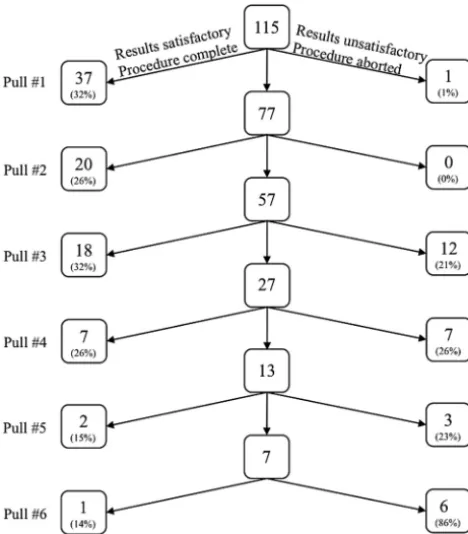
We constructed a decision tree separating 3 possible outcomes per retrieval attempt: successful result with completion of the procedure (or continuation without further success), unsuccessful attempt but the procedure continued, and unsuccessful attempt with termination of the procedure (Fig 1). From a decision-making perspective, we made 2 primary comparisons between the number of the pass and the
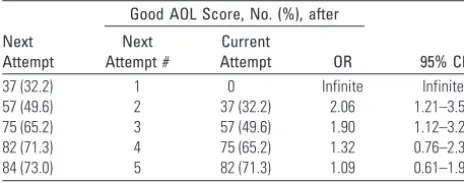
recorded final AOL score to determine if an optimum number of attempts yielded the highest rate of AOL scores of 2 or 3. Following any given number of previous attempts, we first determined whether the prospective decision to proceed with a subsequent attempt could result in an improved recanalization result. Second, we performed an analysis of proportions to determine the odds of a prospective pre-specified number of attempts resulting in a recanalization equivalent to that achieved by 6 attempts (the maximum number of attempts used in our cohort). In this comparison, the lowest number of at-tempts resulting in a rate of good recanalization that did not signifi-cantly differ from the rate followingⱖ1 attempt exceeding this num-ber was then designated the “optimal” numnum-ber.
We then separated the entire study group into 2 groups: those achieving good recanalization by the optimal number of attempts (optimal group) and those that did not recanalize or did so after more than the optimal number of attempts (suboptimal group). For tan-dem lesions, we included only those patients who were either optimal or suboptimal for both lesions. We compared the 2 groups with re-spect to demographic data, time to first retrieval attempt, and use of pre-Merci or concomitant thrombolytics. We compared the rate of procedural complications defined as blood or contrast extravasation into the subarachnoid space, intraventricular hemorrhage or air em-bolism on postretrieval CT, vessel rupture, dissection, and device fracture. The rate of parenchymal HT was compared between groups according to the previously established European Cooperative Acute Stroke Study definition.4
Statistical analyses for categoric variables included the2test, the
Fisher exact test when cell sizes were small, and ORs for selected com-parisons. Median values with IQR were calculated for the number of retrieval attempts and AOL scores. Unevenly distributed data were compared by using the Mann-WhitneyUtest. All analytic procedures were conducted in R, Version 2.8.0.5
Results
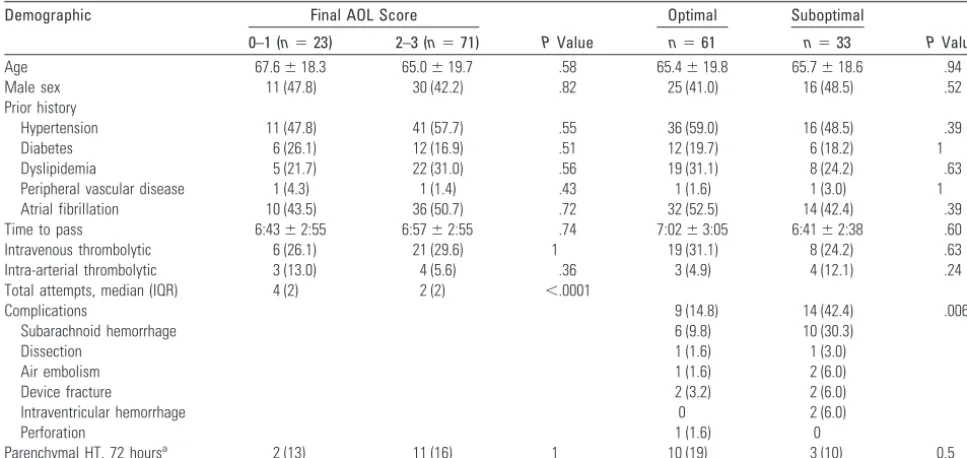
We identified a total of 97 patients with 115 proximal arterial occlusions. The median number of attempts per target vessel was 2.5 (IQR, 2), while the median final outcome AOL score was 2 (IQR, 2). There was no difference between the various final outcome AOL scores with respect to age, sex, premorbid medical history, time to first Merci pass, procedural compli-cations, or use of concomitant intravenous or intra-arterial thrombolytics (Table 1). The final outcome AOL scores are displayed with respect to each final outcome attempt number in Table 2. The distribution of each AOL score (0 –3) by each final outcome attempt number (1– 6) is displayed in Fig 2. Figure 3 shows the distribution of good (AOL 2 or 3) and bad (AOL 0 or 1) recanalization results with each aggregated at-tempt, while Fig 4 displays the absolute number of good and bad final outcomes distributed by each final outcome-attempt number.
[image:2.594.54.288.43.310.2]fied total ofⱕ2 pulls (Table 4; 73.9% versus 49.6%; OR, 2.88; 95% CI, 1.66 –5.02), but not a prespecified total ofⱕ3 pulls (73.9% versus 65.2%; OR, 1.51; 95% CI, 0.86 –2.66). Thus, the optimal number of attempts deduced by both primary com-parisons was 3.
After separating the cohort into 2 new groups, those achieving good recanalization by 3 attempts and all others, we found no difference in demographic data, premorbid medical conditions, time to first Merci pass, or use of concomitant
[image:3.594.52.536.58.287.2]thrombolytics. Procedural complications occurred more fre-quently whenⱖ4 passes were attempted (42.4% versus 14.8%, P⫽.006). Thirteen patients experienced parenchymal HT. This was evident on immediate postprocedural imaging in 3 cases, while the remainder experienced delayed parenchymal HT within the 72 hours following intervention. In most of Table 1: Comparison by final AOL score and optimal number of attempts
Demographic Final AOL Score
PValue
Optimal Suboptimal
PValue 0–1 (n⫽23) 2–3 (n⫽71) n⫽61 n⫽33
Age 67.6⫾18.3 65.0⫾19.7 .58 65.4⫾19.8 65.7⫾18.6 .94
Male sex 11 (47.8) 30 (42.2) .82 25 (41.0) 16 (48.5) .52
Prior history
Hypertension 11 (47.8) 41 (57.7) .55 36 (59.0) 16 (48.5) .39
Diabetes 6 (26.1) 12 (16.9) .51 12 (19.7) 6 (18.2) 1
Dyslipidemia 5 (21.7) 22 (31.0) .56 19 (31.1) 8 (24.2) .63
Peripheral vascular disease 1 (4.3) 1 (1.4) .43 1 (1.6) 1 (3.0) 1
Atrial fibrillation 10 (43.5) 36 (50.7) .72 32 (52.5) 14 (42.4) .39
Time to pass 6:43⫾2:55 6:57⫾2:55 .74 7:02⫾3:05 6:41⫾2:38 .60
Intravenous thrombolytic 6 (26.1) 21 (29.6) 1 19 (31.1) 8 (24.2) .63
Intra-arterial thrombolytic 3 (13.0) 4 (5.6) .36 3 (4.9) 4 (12.1) .24
Total attempts, median (IQR) 4 (2) 2 (2) ⬍.0001
Complications 9 (14.8) 14 (42.4) .006
Subarachnoid hemorrhage 6 (9.8) 10 (30.3)
Dissection 1 (1.6) 1 (3.0)
Air embolism 1 (1.6) 2 (6.0)
Device fracture 2 (3.2) 2 (6.0)
Intraventricular hemorrhage 0 2 (6.0)
Perforation 1 (1.6) 0
Parenchymal HT, 72 hoursa 2 (13) 11 (16) 1 10 (19) 3 (10) 0.5
aEleven patients were not included because they were not able to undergo imaging 72 hours after intervention; none of these patients had HT on post-Merci CT; 7 of these patients had
[image:3.594.303.535.317.451.2]a poor final-outcome AOL score, while 4 had good final-outcome AOL scores. Seven of these patients underwent the optimal number of attempts, while 4 did not.
Table 2: Distribution of final outcome AOL scores by number of attempts
Attempt
Final Outcome AOL Score, No. (%)
0 1 2 3
1 0 1 (3) 9 (24) 28 (74)
2 0 0 5 (25) 15 (75)
3 9 (30) 3 (10) 12 (40) 6 (20)
4 5 (36) 2 (14) 2 (14) 5 (36)
5 3 (50) 1 (17) 1 (17) 1 (17)
6 5 (71) 1 (14) 0 1 (14)
Total 22 (19) 8 (7) 29 (25) 56 (49)
Fig 2.Graph shows the number of attempts used to achieve final outcome AOL score.
Fig 3.Graph shows aggregate odds that a given attempt number will recanalize.
[image:3.594.54.286.338.601.2] [image:3.594.302.535.477.631.2]these cases, HT occurred between 24 and 48 hours after at-tempted thrombectomy. Parenchymal HT rates did not vary when groups were stratified according to final outcome AOL score or by the number of retrieval attempts.
Discussion
An optimal number of attempted retrievals with the Merci device has not yet been demonstrated. The initial Mechanical Embolus Removal in Cerebral Ischemia trial was limited to 8 attempts per case, which remains the limit at our institution. However, experience has shown that less than this number is often necessary. After the first several pulls, the operator often has an idea whether the target occlusion will ever be success-fully recanalized. Much of this is the sensation transmitted through the retriever as well as how and where the coils of the retriever unravel on repeated passes. Anecdotally, some cases of occlusions are suspected to be “resistant” when the trans-mitted sensation is “gritty” or when the retriever consistently unravels in the same location while stretching the entire vessel. These cases are likely responsible for most of those requiring more than the optimal number of passes and are ultimately unlikely to recanalize with mechanical thrombectomy alone. These instances may be ones involving impacted clot, under-lying stenosis, or both.
Alternatively, these “resistant” cases may represent iatro-genic injury. The device may cause dissection not detectable on angiography, or the endothelium may be injured and the natural anti-thrombogenic mechanism of the artery, dis-rupted, leading to ongoing in situ thrombosis. Because the optimal number of passes represents the ideal case of the typ-ical embolic occlusion, exceeding this number may indicate that the operator is dealing with such a “resistant” occlusion. Knowledge of such an optimum number might thus signal a point of diminishing returns and increasing complications.
We demonstrated that 3 Merci retrieval attempts tended to yield improved recanalization. After 3 attempts have been made, there is low probability that a subsequent attempt will improve the recanalization result obtained after 3 passes.
Sim-ilarly, attempting onlyⱕ3 attempts prespecified at the start of an intervention will likely result in an equivalent outcome to a procedure with no imposed limit. Nearly one-third (18/57) of patients proceeding to 3 attempts experienced successful re-canalization, contributing an additional 13% to the overall rate of success.
Examination of the rates of recanalization (Fig 3) with ag-gregated attempts corroborates our evidence that diminishing return appears to occur after 3 pulls. A good recanalization rate of 47.4% followed 2 attempts and 65.2% followed 3, while each subsequent attempt successfully produced only an addi-tional 7%, 2%, and 1% of successful outcomes, respectively.
We demonstrated that the rate of procedural complica-tions increased when the optimal number was exceeded, re-gardless of final recanalization. Thrombectomy with the Merci retriever can disrupt the endothelium, particularly when an impacted clot is in the M1 segment or beyond. In such a situ-ation, the absence of any points of dural fixation allows the vessel to stretch and likely disrupts the basement membrane in the subarachnoid space. Although the most common finding on postthrombectomy CT scans is subarachnoid extravasa-tion thought to be contrast material, this extravasaextravasa-tion is likely to have a hemorrhagic component as well, and thus no differ-ence was drawn between subarachnoid hemorrhage and con-trast extravasation. The clinical significance of this postthrom-bectomy CT finding is unclear at this time. Similarly, because clinical outcome was not a measure in this study, it is unclear whether the higher rate of the other procedural complications of dissection, device fracture, intraventricular hemorrhage, and perforation had a significant impact on morbidity and mortality.
The optimal number we describe should be considered for each target lesion. As is sometimes the case, more proximal larger lesions (such as an ICA or basilar occlusion) tend to be less impacted and can be completely recanalized,6,7yet they
produce distal embolism that subsequently requires follow-up mechanical retrieval. Similarly, tandem lesions may initially require a larger Merci retriever to clear the proximal thrombus to allow a smaller device to access the distal thrombus. We attempted to account for both of these situations in our ana-lytic design. By counting the attempts per each target lesion, we can more accurately describe the thrombectomy character-istics of the individual lesion rather than the overall difficulty of revascularizing the patient, much as we are addressing the AOL score and not the overall reperfusion. Thus, in the situa-tion in which a tandem ICA occlusion occurs proximal to an M1 stenosis with superimposed clot, analysis of the character-istically easier ICA recanalization would likely reveal a positive recanalization outcome and a corresponding lower number of attempts, while the more difficult, if not impossible, distal le-sion might demonstrate less favorable results.
One angiographic aspect that was not a planned analysis in our comparison is the specific thrombus location in the sub-group that had occlusions involving the M1 segment. Authors have shown that the more proximal the MCA occlusion, the less likely it is to recanalize.8This finding may have had an
[image:4.594.53.285.69.160.2]unforeseen impact on our results if there was an uneven dis-tribution of proximal M1 occlusions in the suboptimal group. Our study is intended to characterize recanalization and not overall reperfusion and thus compares only the AOL score Table 3: Probability next attempt will improve existing
recanalization result after a given number of attempts
Next Attempt
Good AOL Score, No. (%), after
95% CI Next
Attempt #
Current
Attempt OR
37 (32.2) 1 0 Infinite Infinite
57 (49.6) 2 37 (32.2) 2.06 1.21–3.55
75 (65.2) 3 57 (49.6) 1.90 1.12–3.25
82 (71.3) 4 75 (65.2) 1.32 0.76–2.32
[image:4.594.51.286.205.284.2]84 (73.0) 5 82 (71.3) 1.09 0.61–1.95
Table 4: Probability that the maximum number of attempts (6) will produce a final AOL result superior to a prospective prespecified number of attempts
Good AOL Score, No. (%), after Attempting Up to:
Six Attempts Pre-Specified Number OR 95% CI
6 85 (73.9) 1 37 (32.2) 5.97 3.37–10.58
6 85 (73.9) 2 57 (49.6) 2.88 1.66–5.02
6 85 (73.9) 3 75 (65.2) 1.51 0.86–2.66
6 85 (73.9) 4 82 (71.3) 1.14 0.64–2.04
and not the Thrombolysis in Cerebral Ischemia grade.9,10Even though they conceptually complement one another, we chose to assess only the AOL score because it more accurately de-scribes the success in retrieving or macerating thrombus at a given location. Although individual lesion characteristics are best described with the AOL score, its main weakness is the broad range of each score and poor correlation with overall reperfusion.10For instance, an AOL score of 2 can represent
anywhere from sluggish antegrade flow score through a sub-occlusive thrombus to rapid distal perfusion in the presence of minimal residual thrombus.
Another inherent weakness that we could not correct for is a volume effect. The increasing volume at our institution dur-ing the past several years reflects the development of an exten-sive stroke network in the surrounding communities, manda-tory diversion, and the rising public and Emergency Medical Service awareness of the availability of techniques such as mechanical thrombectomy. The annual number of strokes treated with the Merci device at our institution was 10 in 2003 and 25 in 2006. This potential volume effect may improve recanalization rates overall.
Although the same operators were involved for the entirety of the data-collection period, our study also does not account for improvements in thrombectomy technique and experi-ence with time. Currently, our numbers are not large enough to detect improvement in recanalization results with time. Our study also does not account for advances in device tech-nology such as those demonstrated in the Multi MERCI trial.11
Conclusions
We describe a dichotomy in the ease of recanalization of typ-ical occlusions and more resistant ones and define an opti-mum number that differentiates these 2 groups. Because time
is essential in acute stroke therapy, awareness of this difference may prompt the endovascular operator to consider switching to another means of revascularization such as intracranial an-gioplasty and/or stent placement when thrombectomy fails after the third pass.
References
1. Gobin YP, Starkman S, Duckwiler GR, et al.MERCI 1: a phase 1 study of Me-chanical Embolus Removal in Cerebral Ischemia.Stroke2004;35:2848 –54 2. Smith WS, Sung G, Starkman S, et al, for the MERCI Trial Investigators.Safety
and efficacy of mechanical embolectomy in acute ischemic stroke: results of the MERCI trial.Stroke2005;36:1432–38. Epub 2005 Jun 16
3. Khatri P, Neff J, Broderick JP, et al, for the IMS-I Investigators. Revasculariza-tion end points in stroke intervenRevasculariza-tional trials: recanalizaRevasculariza-tion versus reperfu-sion in IMS-I.Stroke2005;36:2400 – 03
4. Hacke W, Kaste M, Fieschi C, et al.Intravenous thrombolysis with recombi-nant tissue plasminogen activator for acute hemispheric stroke: the European Cooperative Acute Stroke Study (ECASS).JAMA1995;274:1017–25 5. The R Project for Statistical Computing. http://www.R-project.org. Accessed
November 13, 2009
6. Lutsep HL, Rymer MM, Nesbit GM.Vertebrobasilar revascularization rates and outcomes in the MERCI and multi-MERCI trials.J Stroke Cerebrovasc Dis
2008;17:55–57
7. Flint AC, Duckwiler GR, Budzik RF, et a, for the MERCI and Multi MERCI Writing Committee.Mechanical thrombectomy of intracranial internal ca-rotid occlusion: pooled results of the MERCI and Multi MERCI Part I trials.
Stroke2007;38:1274 – 80. Epub 2007 Mar 1
8. Schellinger PD, Fiebach JB, Jansen O, et al.Stroke magnetic resonance imaging within 6 hours after onset of hyperacute cerebral ischemia.Ann Neurol
2001;49:460 – 69
9. Higashida R, Furlan A, Roberts H, et al, for the Technology Assessment Com-mittees of the American Society of Interventional and Therapeutic Neuroradi-ology and the Society of Interventional RadiNeuroradi-ology.Trial design and reporting standards for intraarterial cerebral thrombolysis for acute ischemic stroke.J Vasc Interv Radiol2003;14(9 part 2):945– 46
10. Tomsick T.TIMI, TIBI, TICI: I came, I saw, I got confused.AJNR Am J Neuro-radiol2007;28:382– 84