1
PCAS 20 (2017/2018)
Syndicate Report
(ANTA604)
Antarctic sea ice and its implications
John Ahearn (17146234)
Olivia Grover-Johnson (61282869)
Tayele Kringen (75441759)
Anna Miller (13809938)
Chloe Power (95065028)
Word count: 7635 (excluding abstract and references)
Abstract
Global warming has caused a significant decrease in sea ice coverage in the Arctic. This is having far reaching implications for the ecosystems, as well as dramatically changing the way that humans interact with the Arctic environment. Climate models predicted that a similar decrease in sea ice would occur in the Antarctic. However, since regular observations began in 1979, the sea ice extent in the Antarctic has been increasing. We review current research that identifies numerous atmospheric and oceanic factors that are influencing sea ice trends. These factors have helped to explain some of the changes observed in sea ice extent at a regional level, but still do not accurately predict sea ice trends for the Southern Ocean as whole. A significant anomaly in sea ice extent that occurred in the austral spring of 2016-17 has confounded scientists, and highlights the limitations of current science and climate models to foresee the trend in sea ice in the Antarctic. Furthermore, we explore the potential implications for Antarctic ecosystems through a review of current literature. This emphasises the critical role of sea ice in the life history of a vast majority of Antarctic species, making them extremely vulnerable to changes in sea ice extent. Finally, we consider the implications for human activities in the Antarctic through a series of case studies. These identify the organisations and industries that will be affected by changes in sea ice, and who will rely on the development of accurate models and predictions to safely plan their future activities in the Antarctic.
2
Contents
1. Introduction - The importance of Antarctic sea ice 4
2. Factors influencing sea ice 7
2.1. Overview 7
2.2 Atmospheric factors 8
2.2.1. Southern Annular Mode (SAM) 8
2.2.2. El Nino Southern Oscillation (ENSO) 9
2.2.3. Amundsen Sea Low (ASL) 10
2.3. Oceanic factors 11
2.3.1 Overview 11
2.3.2. Ice shelf melting 12
2.3.3. Ekman Drift 14
2.3.4. Changes in precipitation 14
3. Ecological implications of sea ice variability 15
3.1. Overview 15
3.2. Antarctic krill 16
3.3. Antarctic silverfish 17
3.4. Adelie penguins 18
3.5. Emperor penguins 18
3.6. Marine mammals 18
4. Operational implications of changing sea ice extent 19
4.1. Overview 19
4.2. National Antarctic Programs (or research stations) 20
4.3. Search and Rescue (SAR) 20
3
4.5. Tourism 22
5. Conclusion 23
4
1. Introduction
The annual seasonal expansion and regression of sea ice around the Antarctic continent is a
remarkable event, with far reaching effects on the Antarctic and global climate. The ice edge
can advance at up to 4 km per day in the autumn months (Sinclair, 2015), reaching a maximal
winter extent in late September or early October. It can stretch for up to 1000 km from the
coastline, covers an area of approximately 20 million km2, and has the effect of doubling the
size of the continent (Sinclair, 2015). The depth of the ice also increases over the autumn and
winter months with accumulation of snow fall from above, and ongoing freezing of the ocean
from beneath (Sinclair, 2015), reaching around 3-4 m thick. In the summer months
(November to January), the ice rapidly retreats again to its smallest extent of approximately 3
million km2 (Sinclair, 2015).
Antarctic sea ice plays a crucial role in the global climate system, linking atmospheric and
oceanic circulation systems. In addition to sea ice, snow cover in the Southern Ocean
contributes to the global climate system via the strong albedo effect of ice and by affecting the
location of storm belts in mid-latitudes (Kidston, Taschetto, Thompson & England, 2011;
Raphael, Hobbs & Wainer, 2011). Furthermore, the Southern Ocean acts as a carbon sink,
trapping excess heat from anthropogenic carbon dioxide (Frolicher et al., 2015; Johnson,
2008; Marshall, Speer, Orsi, Johnson & Bullister, 2012; Orsi,1999). Models have also
indicated that changes in sea ice will affect the mass balance of ice sheets through altered ice
sheet dynamics and thus contribute to global sea level rise (Agosta, Fettheis & Datta, 2015;
Bracegirdle, Stephenson, Turner & Phillips, 2015).
In the Arctic, observations since the 1970s have shown the maximal sea ice extent has
decreased significantly (Comiso & Nishio, 2008; Meehl, Arblaster, Bitz, Chung & Teng,
2016; Parkinson & Cavalieri, 2012; Purich, England & Cowan, 2016; Simmonds, 2015;
Turner et al., 2017; Vaughn et al., 2013). A number of records have been broken, with
consecutively smaller maximal sea ice extents occurring during the Arctic Summer
(Parkinson & Cavalieri, 2012; Simmonds, 2015; Turner et al., 2009). This alarmingly rapid
change in ice coverage has been largely attributed to the warming effect of increasing levels
of atmospheric carbon dioxide (Stroeve et al., 2012).
To predict how the polar regions will be affected by a warming planet, numerous
5 sea ice coverage in the Antarctic will follow a similar pattern to the Artic, with the
assumption that global warming will be the driving factor (Meehl et al., 2016; Purich et al.,
2016; Turner, Phillips, Hosking, Marshall & Orr, 2013). However, in contrast to the Arctic,
the sea ice surrounding the Antarctic continent has been increasing. Regular satellite
observations began in 1979 (Meehl et al., 2016; Purich et al., 2016; Turner et al., 2017), and
have demonstrated a small but statistically significant increase in sea ice coverage (Cavaliera,
Parkinson, Gloersen & Zwally, 1997; Comiso & Nishio, 2008; Fan, Deser & Schneider, 2014;
Parkinson & Cavalieri, 2012; Zwally, Comiso, Parkinson, Cavalieri & Gloersen, 2002). This
includes several record maximum annual sea ice extents in September 2012 (Turner et al.,
2013) and new record maximums in the subsequent years of 2013 and 2014 (Reid,
Stammerjohn, Massom, Scabos & Lieser, 2015). A positive trend in Antarctic sea ice in
comparison to a negative trend in Arctic sea ice, relative to the mean annual extent for the
period of 1981-2010 can be illustrated by Fig.1. The changes in sea ice coverage in the
Antarctic are not uniform, with different regions experiencing different patterns. The Ross
Sea region has experienced the most dramatic increase in sea ice extent since records began in
the 1970s, and the growth here contributes most to the overall increase in sea ice extent across
the entire continent (Holland, 2014; Parkinson & Comiso, 2013).
6 Sea ice forms when the water temperature drops below its freezing point as a result of heat
exchange between the atmosphere and surface layers of the ocean (Liu, Curry & Martinson,
2004). The sea ice that forms around the Antarctic continent is not a single homogenous or
continuous body. Sections of ice of various sizes move in groups called ice floes. These floes
travel across the ocean surface, moved by wind and ocean currents (Sinclair,
2015). Understanding the integration of atmospheric and oceanic circulation is critical to
understanding how sea ice forms. Currently there are numerous atmospheric and oceanic
factors that have been identified that contribute to the formation of sea ice. These include, but
are not limited to: ocean currents, sea surface temperatures, ice drift (Uotila, Holland, Vihma,
Marsland & Kimura, 2014), surface winds (Purich et al., 2016; Turner et al., 2016), ocean
warming, melting of ice shelves and ice sheets (Hansen et al., 2016), and altered patterns of
precipitation. Each factor can vary significantly from year to year, and over decade long time
frames (e.g., Fan et al., 2014; Holland & Kwok, 2012; Renwick, Kohurt & Dean, 2012).
Understanding the interplay of these factors, their natural variability and response of sea ice
trends is highly complex. To date, none of these factors has been demonstrated to have an
overarching influence on sea ice trends. Such variability poses difficulties in concluding
whether the positive trend in sea ice extent is consistent, or whether it falls within the range of
normal variability (Polvani & Smith 2013; Zunz, Goose & Massonet, 2013). The projections
from climate models have so far been inadequate at predicting the sea ice trends occurring in
the Antarctic (Turner et al., 2013; Uotila et al., 2014). Hence there have been significant
differences between model simulations and actual observations (Gagné, Gillett & Fyfe, 2015).
The austral spring of 2016 took researchers by surprise with a significant decrease in
Antarctic sea ice (Stuecker, Bitz & Armor, 2017; Turner et al., 2017). Both the rate of
decrease (75 × 103 km2/day, or 46% faster than mean rate of decrease) and the total extent of
the decrease in sea ice were unprecedented (Turner et al., 2017). The extent of sea ice present
during this anomaly was −2.25 × 10⁶ km2 smaller than the mean observed at that time of year
(Turner et al., 2017), and the the lowest since records at just 2.07 × 10⁶ km2 on March 1, 2017
(Turner et al., 2017).
This change affected all regions of the Antarctic. However, Weddell and Ross Sea regions
7 explaining these dramatic changes have been attributed to changes in atmospheric pressures,
especially the Southern Annular Mode (SAM) (Turner et al., 2017).
The variability in sea ice coverage in the Antarctic has important implications both for the
rich but fragile ecosystems, as well as the range of anthropogenic activities that occur in the
Antarctic. Understanding what is happening to the sea is therefore crucial for the planning of
logistics for National Antarctic Programs, as well as Antarctic tourism and fishing. The extent
of sea ice will affect access to fisheries, tourism locations, and research stations (Lee et al.,
2017).
The structure and function of Antarctic ecosystems will also be affected. Changing sea ice
conditions are likely to influence the abundance and distribution of phytoplankton and krill
species ( Massom & Stammerjohn, 2010). Given these species’ critical position in the
Antarctic marine food webs, higher trophic species such as seals, penguins, and whales are
also likely to be affected (Constable et al., 2014; Ducklow, Schofield, Vernet, Stammerjohn
& Erickson, 2012; Massom & Stammerjohn, 2010; Saba et al., 2014).
This study aims to review the literature on the current understanding of factors driving sea ice
formation, and the potential implications sea ice variability has on Antarctic ecosystems and
human activities. However, the interplay of these factors on Antarctic sea ice remains
relatively unsolved, which requires further knowledge and research.
2. Factors influencing Antarctic sea ice
2.1. Overview
Since regular observations of Antarctic sea ice coverage began in 1979, the sea ice extent has
been increasing, yet the observations of atmospheric and ocean temperatures have shown that
both have increased (Liu et al., 2004; Zhang, 2007). Antarctic atmospheric temperatures have
is risen at up to 0.05oC per year in some regions (Stuecker et al., 2017), and ocean
temperatures have risen by 0.2 °C in the Antarctic Circumpolar Current (ACC)(Gille, 2002;
Liu & Curry, 2010). The paradoxical increase in sea ice can only be understood by
8 2.2. Atmospheric factors
2.2.1 Southern Annular Mode (SAM)
The Southern Annular Mode (SAM) is best defined as a ring of climate variability which
regulates the westerly winds encircling Antarctica (Gillett, Kell & Jones, 2006). The SAM
can exist in two phases, positive and negative, which lead to very different effects on sea ice
extent. When the SAM is in its positive phase the pressure around Antarctica is lower than
normal resulting in cold surface temperatures around most of the continent but with warming
occurring at the peninsula (Gillett et al., 2006). These cooler temperatures lead to sea ice
expansion through advection of cool surface waters northward, a process called Ekman drift
(Ferreira, Marshall, Bitz, Solomon & Plumb, 2015). A negative SAM results in the opposite
effect when pressure around Antarctica is higher than normal, resulting in warmer sea surface
temperatures and a reduction of sea ice (Doddridge & Marshall, 2017).
SAM phases are influenced by many factors including the concentration of greenhouse gases,
volcanic aerosols, and the Antarctic ozone layer (Arblaster & Meehl, 2006). The expansion of
sea ice in the Antarctic in recent decades has in part been driven by ozone depletion which
has led to a more positive SAM (Stuecker et al., 2017). Ozone in the stratosphere has the
ability to absorb sunlight which keeps the stratosphere relatively warm, but prevents sunlight
reaching the lower atmosphere - so a hole in the ozone makes the pole much colder (Renwick,
2012). Stratospheric ozone is expected to recover in the coming decades but ever increasing
greenhouse gas concentrations will continue to influence the SAM. The effect of the
greenhouse gases is predicted to cause a more negative SAM (Arblaster & Meehl, 2006) and
subsequently lead to decreases in sea ice extent (Arblaster, Meehl & Karoly, 2011). The effect
of rising greenhouse gases on the SAM is also expected to cause the westerly winds to shift
poleward and to intensify, leading to further surface warming and a decrease in sea ice cover
(Armour & Bitz, 2016).
Even though many models and studies use trends in SAM to determine sea ice extent it still
has its flaws. Observations have certainly shown that the increasingly positive SAM
correlates with an increase in sea ice extent. However, the observational record does not
always support the assumption that a positive SAM will lead to an increase in sea ice. There
9 been no apparent trend in SAM (Jones et al., 2016). This is further complicated by the fact
that several studies have shown no evidence of a correlation between long term trends in the
SAM and sea ice extent (Kohyama & Hartmann, 2016; Lefebvre, Goosse, Timmermann &
Fichefet, 2004; Simpkins, Ciastro, Thompson & England, 2012). A recent hypothesis may
explain this dichotomy. It is thought that a positive SAM leads to sea ice expansion in the
short term, but the opposite is true for long term time scales (Ferreira et al., 2015). Eventually
warmer subsurface water will be upwelled leading to sea ice decline (Ferreira et al., 2015).
2.2.2. El Niño and Southern Oscillation (ENSO)
The El Niño and Southern Oscillation (ENSO) is the largest source of climate variability
occurring from one year to the next (Diaz & Markgraf, 1992). The ENSO periodically
changes wind and sea surface temperatures in the tropical eastern Pacific Ocean, but its
effects can be observed throughout the world and can greatly impact Antarctic sea ice extent.
ENSO can exist in three different phases which are: neutral, La Niña, and El Niño. In a La
Niña event the subtropical jet is weakened and the polar front jet is strengthened leading to an
increase in storms, warmer weather, and less sea ice in the southern Bellingshausen Sea and
western Weddell Sea (Stammerjohn, Martinon, Smith, Yuan & Rind, 2008). A La Niña event
however does the opposite in the Ross and Amundsen Sea where conditions become colder
and more sea ice is observed (Stammerjohn et al., 2008). The reverse can be observed in an El
Niño event where the southern Bellingshausen Sea and western Weddell Sea become colder
and the Ross and Amundsen Seas become warmer (Yuan, 2004). This phenomena was
observed in which the largest ENSO anomalies occurred at the Antarctic dipole region (Yuan,
2004) (Fig.1). The Antarctic dipole (ADP) is part of the ENSO system and is the largest
ENSO temperature anomaly outside of the tropics. Antarctic dipole patterns are closely
10
Figure 2: Pattern between the El Niño Southern Oscillation and Antarctic Dipole (Yuan 2004).
The interaction of the ENSO and SAM together can also greatly alter Antarctic sea ice extent.
A La Niña event coinciding with a positive SAM is the most favourable condition for sea ice
growth around Antarctica except to the west of the peninsula due to the Antarctic dipole
effect (Pezza, Rashid & Simmonds, 2012). When an El Niño event occurs with the SAM in its
negative phase a decrease in sea ice is observed in the Ross sea region whereas an increase
occurs in the Bellingshausen Sea (Pope, Holland, Orr, Marshall & Phillips, 2017). The
relationship between ENSO and SAM was determined to be a key factor in the low sea ice
extent observed during the austral spring of 2016. In this occasion an extreme El Niño event
was followed by a weak La Niña and a negative SAM phase leading to warming in the
Southern Ocean and a decrease in sea ice extent (Stuecker et al., 2017). This event was
proven to be extremely rare based on models from CMIP5, which showed this combination
occurring only 121 times in roughly 13,000 model years (Stuecker et al., 2017).
2.2.3. Amundsen Sea Low (ASL)
The Amundsen Sea low (ASL) is a climatological low pressure centre off the coast of West
Antarctica. It has been hypothesised that the ASL exists due to the non symmetrical
11 location and depth of the ASL change through time with some seasonal patterns being
observed. The ASL displays seasonal movement and has been shown to be further east toward
the peninsula in the summer and more west in the winter near the Ross Sea (Fogt & Wovrosh,
2015). This east-west movement changes the location of meridional wind anomalies that
influence patterns in sea ice extent (Fogt & Wovrosh, 2015).
The location and depth of the ASL is influenced by a number of factors including ozone
depletion, SAM phases, and ENSO patterns (Turner et al., 2009). When SAM is in its
negative phase it causes the ASL to deepen and become even lower pressure, this is also the
case during La Niña events (Turner et al., 2013). The deepening of the ASL over the Weddell
Sea results in a reduction in sea ice in the Bellingshausen and Eastern Amundsen Sea due to
the increase in northerly winds (Clem, Renwick & Mcgregor, 2017). The deepening of the
ASL is consistent with the Antarctic dipole found between the peninsula and the Ross Sea. It
has been predicted that a loss of ozone has contributed to the deepening of the ASL. However,
not all models show this to be true (Turner, Hosking, Bracegridle, Marshall & Phillips, 2015).
2.3. Oceanic factors
2.3.1. Overview
The Southern Ocean is stratified into three distinct layers. The uppermost layer is driven by
prevailing winds, the middle is a body of warmer water which has originated in the equatorial
regions and has been transported poleward, and the deepest layer – Antarctic Bottom Water,
which is the cold polar water that sinks to the ocean floor before subsequently circulating
northwards toward the equator (Foldvik & Gammelsrød, 1988). It is the middle layer of water
in the Southern Ocean that has warmed by ~0.2oC in the last century. This temperature rise is
much greater than the average for all oceans, and is concentrated within the Antarctic
Circumpolar Current (ACC) (Gille, 2002; Liu & Curry, 2010). This thermal stratification of
the Southern Ocean is important to understand as it plays a key role in ocean dynamics and
thus influences sea ice formation. The formation of sea ice results in the expulsion of salt
from the ice and into the ocean (Goosse & Zunz, 2014). This salty water is transported
downward due to its high density. The vertical transport of salt results in a strong
stratification of the ocean and more deep heat storage from the reduced vertical heat flux.
12 efficiently cooled by the atmosphere (Bintanja, Van Oldenborgh, Drijfhout, Wouters &
Katsman, 2013). The observed warming that is occurring has been linked to increased melting
from the ice-shelves and changes in precipitation, both of which affect sea ice formation.
These factors are considered in detail below, along with the effect of the Ekman drift.
2.3.2. Ice shelf melting
Unlike the mid-depth waters which have been warming, surface waters in the Southern Ocean
have been cooling (Bintanja et al., 2013). There has also been an observed freshening of
surface waters (Bintanja et al., 2013). These observed changes in temperature and salinity
profiles are being attributed to an increasing accumulation of melt water from ice shelves
(Bintanja et al., 2013; Jacobs, Giulivi, & Mele, 2002). This is thought to be maintaining or
increasing sea ice extent despite the warming observed in mid-depth waters.
Ice shelves, which are the floating extension of grounded ice sheets and glaciers, can melt
from beneath through the process of thermal heat conduction. This process is occurring well
below the surface of the ocean, and is one of the most important melting processes occurring
in the Antarctic (Depoorter et al., 2013; Rignot, Jacobs, Mouginot & Scheuchl, 2013). The
melting ice sheets introduce cold, fresh water into the ocean, creating a layer that is called ice
shelf water.
Because of the pressures that occur at the depth beneath at the ice shelf base, this water can be
colder than the normal freezing point at the surface of the ocean (Foldvik & Kvinge, 1974;
Jacobs, Fairbanks & Horibe, 1985). Due to its lower density the freshwater rises towards the
surface, and in doing so the pressure decreases. The balance between the pressure and
temperature changes, allowing the super-cooled water to freeze as it reaches lower pressures
nearer the surface. Ice, being less dense than water will continue to rise (Jordan, Kimura,
Holand, Jenkins & Piggott, 2015), and the newly formed ice crystals collect together where
they may also be carried out from beneath the ice shelf to form new sea ice (Craven et al.,
2014; Robinson, Williams, Stevens, Langorne & Haskell, 2014). Since the ocean water has
high salinity, it is thus denser than the ice shelf meltwater, which is made up entirely of
freshwater. Consequently, the ice shelf water creates a low-density layer of freshwater that
stays at the surface (Liu & Curry, 2010). Freshwater freezes more readily than salt water, so
13 also promotes the vertical growth of sea ice, and possible the horizontal expansion of the ice
edge.
Numerous research teams have attempted model and predict the effects of ice shelf melt on
sea ice extent. Some have come up with models that generally support this theory (e.g. Aiken
& England, 2008; Beckmann & Goosse, 2003; Bintanja, Van Oldenborgh & Katsman, 2015;
Hellmer, 2004; Swingedouw et al., 2008). However, there have been other studies that
dispute the theory (Swart & Fyfe, 2013). Pauling et al (2016) noted that previously,
freshwater coming from ice sheets and ice shelves had not been included in important climate
models (e.g. CMIP5). This resulted in some large, otherwise unexplained, discrepancies in the
overall mass balance of the Antarctic ice sheet and shelves (Pauling, Bitz, Smith, &
Langhorne, 2016). When fresh meltwater forcing was included in these models, a consequent
cooling of sea surface waters and an increase in sea ice extent was simulated in the Southern
Ocean (Pauling et al., 2016). However, the findings from their models were not enough to
counteract the effects of anthropogenic forcing in the longer term (Pauling et al., 2016)
Overall, the inconsistency of modelled findings that include freshwater forcing suggest that
we do not really understand the interaction between meltwater and ocean water and how they
are involved in sea ice formation. The general conclusion that has been reached suggests that
while freshwater from ice shelf melt might possibly mitigate the effects of the warming
Southern Ocean, it certainly does not explain the full extent of sea ice increase (Hobbs et al.,
2016; Pauling et al., 2016). Langhorne et al (2015) established that the contribution of the ice
shelf water is certainly very important for the thickness and longevity of sea ice, but are less
certain about its influence on sea ice extent (Langhorne et al., 2015). Even harder to predict is
whether this effect might become stronger in the future as increasing volumes of fresh
meltwater from ice shelves and ice sheets is expected to occur (Golledge et al., 2015).
Importantly, it must be noted that the trends in sea ice extent have varied significantly on a
regional scale, and will almost certainly continue to vary in this manner. Despite the overall
expansion in sea ice extent, the Bellingshausen Sea is an area in Antarctica which has seen
notable sea ice decrease (Bintanja et al., 2013). This can be attributed to a warming of the sea
surface temperatures as opposed to cooling. It might be of greater value to use models to
14 rather than treating them as a whole. The regional variation indicates the significant influence
of the numerous other oceanic and atmospheric factors that influence sea ice formation.
2.3.3. Changes in precipitation
The effect of a warming ocean and warming atmosphere in the Antarctic is thought to explain
the increase in precipitation and snowfall events in Antarctica (Liu et al., 2004; Zhang, 2007).
Net precipitation is the amount of water (snow) accumulating on the surface after evaporation
is accounted for. In Antarctica the net precipitation has been increasing steadily since records
began (Bromwich, Nicolas & Monaghan, 2011; Donat, Lowry, Alexander, O’ Gorman &
Maher, 2016). A warmer atmosphere has the potential to retain more moisture than a cold one
(Donat et al., 2016; He, Soden & Kirtman, 2014). Therefore, the increase in net precipitation
can be attributed to a warming atmosphere from increased greenhouse gas emissions (Frieler
et al., 2015; Stocker, 2014). Furthermore, 15 model projections from the National Centre of
Environmental Projection show that Antarctic net precipitation will continue to increase at an
average rate of 0.42 ±0.01 mm/year (Uotila, Lynch, Cassano & Cullather, 2007). Precipitation
brings freshwater to the surface of the ocean, so the increases observed may have a similar
effect as the ice shelf water, contributing to an increase in sea ice extent.
2.3.4. Ekman Drift
Ekman drift is a phenomenon that can have profound effects on ocean circulation and hence
sea ice (Gordon, 1981). The combination of surface winds and the Coriolis effect cause the
surface layer of water to diverge from the surface wind direction. A body of water will be
transported at 90o to the prevailing surface winds. Ekman drift that occurs as a consequence of
a positive SAM has the greatest impact on sea ice expansion. When the SAM is in a positive
phase it induces strong westerly winds across Antarctica. Ekman drift will then push surface
waters in the Southern Ocean northwards (away from the continent). In the autumn and winter
months when sea ice is forming, this can have the effect of increasing sea ice extent. As a
body of water is transported north, sea ice floating on its surface goes with it. This pushes sea
ice away from the continent, creating openings in the ice called leads near to the coast. New
sea ice forms in these openings, where the cold continental temperatures and the influence of
ice shelf water encourage sea ice formation, until it is also pushed outwards. Thus some sea
15 During summer months, the areas of open water that are created near the coast because of
Ekman drift can have the opposite effect. These areas have low albedo meaning the relatively
dark colour of the ocean water can absorb a lot of solar radiation. This means that the water
heats up and can melt the surrounding sea ice (Gordon, 1981; Kostov et al., 2017; Purich et
al., 2016). The difference in responses to Ekman drift in summer and winter could help to
explain the seasonality of sea ice.
These are small effects of Ekman drift. However, the most complicated and influential effect
of Ekman drift lies in its effect on ocean circulation. As the sea ice and surface waters are
transported northwards, cold deep water upwells near the Antarctic coastline. This cool water
can prevent melting of sea ice in summer. (Kostov et al., 2016; Purich et al., 2016).
Observations and models suggest that the most important effect of the Ekman phenomenon is
that it minimizes the effects of factors that might decrease sea ice extent by continuously
bringing cold deep water to the surface at the coastline (Kostov et al., 2016; Purich et al.,
2016).
3. Environmental implications of sea ice variability
3.1. Overview
Changes in sea ice extent is likely to have implications at all trophic levels, particularly in
Antarctic marine ecosystems. The vast majority of species rely in some way on the presence,
seasonal rhythms and properties of sea ice (Massom & Stammerjohn, 2010). It provides
habitat, a source of shelter from predators, and serves as a platform for breeding and
reproduction (Massom & Stammerjohn, 2010). The variability, thickness and duration of the
ice are possibly more important than the total extent (Flores et al., 2012), and these factors
can directly and indirectly influence ecosystem dynamics and the distribution of species.
Different types of sea ice have different roles for different species. For example fast ice,
which forms around land and ice sheets, creates a relatively stationary platform in sheltered
bays (Massom & Stammerjohn, 2010) (Fig. 2). These areas are important due to their
recurrence and persistence in certain locations, and are used for breeding by Weddell seals
(Leptonychotes weddellii) and Emperor penguins (Aptenodytes forsteri) (Massom &
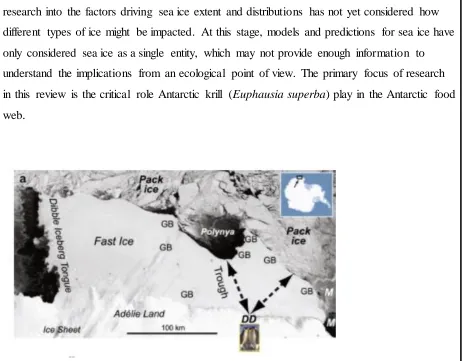
Stammerjohn, 2010). Pack ice, on the other hand, floats in the sea and is made up of
innumerable pieces of ice of variable size freezing together (Fig. 2). This a much more
16 ice free areas surrounded by ice (Fig. 2). This relatively low turbulent environment is an ideal
habitat for larval krill, a refuge for other species away predators in the open ocean, and a
place for air breathing species to surface (Massom & Stammerjohn, 2010). Although they
account for only 1.5% of the sea ice zone, they generate a positive ecological effect for all
trophic levels and are often regarded as “oases” (Massom & Stammerjohn, 2010). The
research into the factors driving sea ice extent and distributions has not yet considered how
different types of ice might be impacted. At this stage, models and predictions for sea ice have
only considered sea ice as a single entity, which may not provide enough information to
understand the implications from an ecological point of view. The primary focus of research
in this review is the critical role Antarctic krill (Euphausia superba) play in the Antarctic food
[image:16.595.69.537.172.533.2]web.
Figure 2: Satellite image showing fast ice surrounding the Emperor penguin colony at PointeGe´ologie near Dumont d’Urville, with pack ice and polynyas in distance (Massom and Stammerjohn 2010).
3.2. Antarctic krill
Sea ice is an ideal substrate for algal biomass which provides a vital food source for grazers
such as Antarctic krill during times of the year when food sources are scarce (Arrigo,
Dijken,& Bushinsky, 2008; Quetin & Ross, 2009). Moreover, Antarctic krill are crucial
components of essentially forming the base of the Antarctic food web (Flores et al., 2012).
They are a source of food for most Antarctic species either by direct consumption, or via food
17 whales, and fish all have krill as a key part of their diet. Hence the cascading effects of any
changes in the abundance and distribution of these low trophic level species will have
ecosystem wide effects. The structure of rafted ice floes and pressure ridges within the sea ice
provide an ideal habitat for retaining krill larvae and the transportation of developing
juveniles (Meyer et al., 2009). Thicker rafted ice is more favourable in terms of refuge for
juveniles than thin ice (Massom & Stammerjohn, 2010). Furthermore, ice algae found on the
underside of sea ice is an important food source for larval krill due to their reduced capacity
to store energy (Flores et al., 2012).
A change in sea ice hence has the potential to influence the abundance and distribution of
krill. It can change the availability of shelter, feeding grounds, and transportation for larvae
(Flores et al., 2012). Seasonal variations in the distribution and abundance of several top
predator species in South Georgia, the West Antarctic Peninsula and the Scotia Arc has
already been attributed to changes in krill availability and sea ice patterns (Flores et al., 2012).
This demonstrates how the complex Antarctic ecosystem dynamics (Flores et al., 2012) could
be impacted by changes in sea ice extent.
In the West Antarctic Peninsula (WAP) region average monthly sea ice extent declined at a
rate of approximately 7% per decade between 1979 and 2008 (Turner et al., 2009). This rapid
decline of sea ice has not only altered the physical environment and surrounding marine
habitats, but impacted the food web at multiple levels (Massom & Stammerjohn, 2010). The
shifts in the cycles of sea ice and their duration have caused spatial and temporal disparities
between algal blooms, the development of krill and recruitment, and the availability of krill to
higher order predators (Forcada & Trathan, 2009). A decline in sea ice extent can reduce
algae biomass that reside on the ice underside, leading to reduced food availability for krill
and krill dependent predators. These shifts in low trophic species of the food web have been
suggested to indirectly and directly influence the WAP biota, notably Antarctic krill,
Antarctic silverfish (Pleuragramma antarctica) and Adélie penguins (Pygoscelis adeliae)
(Ducklow et al., 2007; Massom & Stammerjohn, 2010).
3.3. Antarctic silverfish
Antarctic silverfish are also vulnerable to sea ice variability. This fish species relies on sea ice
for spawning, and it provides a nursery ground for juveniles to grow (Massom &
Stammerjohn, 2010). It is the most abundant fish found in Antarctic coastal pelagic waters
18 al., 2008). It thus represents a vital trophic link, but its presence in the diet of a number of
predators in the West Antarctic Peninsula has been decreasing (Moline et al., 2008). This is
consistent with the region’s decline of sea ice.
3.4. Adelie penguins
Adelie penguins are ice obligate species; they depend on the sea ice for survival, as does their
preferred prey (Ducklow et al., 2007). In the West Antarctic Peninsula, periodic warming
events have caused significant changes in sea ice over the past 25 years (Massom &
Stammerjohn, 2010). There has been a dramatic decline in Adelie penguins populations in
this region as a result of the decrease in sea ice (Ducklow et al., 2007).
3.5. Emperor penguins
Emperor penguins are found scattered throughout the sea ice zone when not closely
associated with fast ice during each breeding season (Massom & Stammerjohn, 2010).
Ideally, they require a stable, fast ice platform to breed, while still having relatively close
access to open water for food (Massom & Stammerjohn, 2010). Hence colonies are typically
found near polynyas for easy access to food (Massom & Stammerjohn, 2010). If the sea ice
extent is too large, this can cause negative effects on the breeding success of colonies due to
the increased forage distance from the open water to the colony and thus greater energy
expended (Massom & Stammerjohn, 2010).
3.6. Marine mammals
The sea ice is also a key habitat and refuge for a number of marine mammals. An increase in
sea ice extent can negatively affect the ability of other top predators such as whales and seals
to locate and access their prey and to traverse the sea ice zone. Energy expended on traversing
greater distances can lead to early adult mortality in seals (Massom & Stammerjohn, 2010).
Sea ice can act as a barrier to air breathing species (Ainley, Tynan & Stirling, 2010), and they
must be able to surface to access air to breath (Massom & Stammerjohn, 2010). Conversely, a
decrease in the extent of fast ice has been shown to negatively affect the breeding success of
Weddell seals (Massom & Stammerjohn, 2010). Recent decline of the Weddell seal
population in the West Antarctic Peninsula region is suggested to be due to a reduction in fast
ice during the breeding season, resulting in reduced platform areas for breeding (Massom &
19 resting platforms, and the reduction of polynyas which species depend on for foraging and
refuge.
4. Operational implications of changing sea ice extent
4.1. Overview
There are many operations and activities occurring on the Antarctic continent and in the
surrounding Southern Ocean on an annual basis. These include the resupply and servicing of
the 76 Antarctic research stations, licenced and illegal fishing vessels, whaling and
anti-whaling vessels, research vessels, tourist cruises, private vessels, adventure races, defence
force operations, and search and rescue operations. Almost all of these rely on being able to
safely navigate the Southern Ocean by ship for their primary activities (Hui et al., 2017).
In the Arctic, where sea ice extent has clearly been decreasing for several decades (Stroeve,
Holland, Meier, Scambos & Serreze, 2007) organisations have been able to plan for and adapt
to those changes. Given the uncertainty of the predictions for Antarctic sea ice, planning for
the maritime operations working in the Southern Ocean will be very challenging. From an
operational perspective, it will be important to understand the impact and make contingency
plans for both an increase and a decrease in Antarctic sea ice (Hui et al., 2017). Once a
pattern emerges and reliable climate modelling can predict the changes in sea ice, then a more
focused plan can be implemented.
During the austral summer, the break-up and retreat of sea ice allows ships to freely navigate
south of the Antarctic Circumpolar Current. The retreating ice also creates clear open waters
along the coastline that remain open for weeks or months (Lee et al., 2017). The timing and
extent of the break up varies and is a major factor affecting shipping and navigation in the
Southern Ocean. This was a problem that affected the early Antarctic explorers of the Heroic
Age - many of whom experienced variations in the sea ice that either prevented them from
sailing south, or from returning north (Edinburgh & Day, 2016). For example, Shackleton was
famously stuck in the sea ice for nearly 10 months and finally had to abandon his ship when it
sank as it succumbed to the pressure of the sea ice. Despite the enormous advances in
20 accidents today. The implications of changing sea ice extent is explored below through four
case studies.
4.2. National Antarctic Programs (or Research Stations)
The American base at McMurdo receives important supplies once a year by a container ship
and a fuel supply ship (West, 2017). These vessels require an icebreaking vessel to escort
them safely through the sea ice, by opening up and clearing a channel to the base (West,
2017). The number of icebreakers available to complete this work is limited (West, 2107). A
critical problem arose in 2006 when the escorting icebreaker Polar Star was damaged en route
to McMurdo Base (West, 2017). Without the icebreaker, the ship that was due to resupply
McMurdo with fuel could not reach the base. Fuel supplies reached critically low levels, and a
replacement icebreaking vessel had to be sent from Seattle to assist (West, 2017). By the time
the icebreaker could safely escort the fuel re-supply vessel to McMurdo, the base had only 5
days of fuel left (West, 2017). This would have had significant consequences for the health
and safety of the approximately 900 personnel at McMurdo station.
This case highlights the vulnerability of the numerous coastal research stations that rely
exclusively on shipping to support and supply their operations. Many bases have limited
support from aircraft, but the majority rely entirely on fuel supplied by ship (COMNAP,
2017). A scenario that saw an increase in sea ice extent would likely require an increase in the
number of already limited specialist icebreaker vessels. Without the dedicated support of
these vessels, the research stations could face the serious consequences of failed re-supply
operations. Alternatively, securing a larger fleet of dedicated icebreakers would be extremely
costly.
4.3. Search and Rescue (SAR)
In 2013, while chartered to the Australian Antarctic division, the MV Akademik Shokalskiy
became trapped in an outbreak of old glacial ice in the Southern Ocean (Doyle, 2014). The
21 the rescue operation (Doyle, 2014). The three rescue vessels were unable to get closer than 6
nautical miles after encountering significant ice. R/V Xue Long also became trapped. AMSA then directed the American heavy icebreaker Polar Star to assist. But, before reaching the trapped vessels a change in wind broke up the ice and the trapped vessels freed themselves.
The incident following the rescue attempt was criticised for disrupting “serious science” and
raised questions about the worth of re-enacting such expeditions (Revkin, 2013; Robinson,
2013). This case study shows how the unpredictability of sea ice has direct implications on
how search and rescue operations will be run – if at all.
4.4. Fishing
The Convention of Conservation of Antarctic Marine Living Resources (CCAMLR) issued
licences, permits, and authorisations to 46 vessels to fish within the Convention Area for the
2017 / 2018 season. They are fishing for Antarctic Toothfish, Patagonian Toothfish, Mackerel
Icefish, and Antarctic Kill (CCAMLR, 2017).
The majority of Antarctic fishing vessels operate near or in the sea ice (Baird, 2006). Most are
not ice strengthened, are small, and operate remotely from other vessels (Baird, 2006). The
area in which they fish is limited by the sea ice extent, as they cannot penetrate through sea
ice, and get in trouble when they do (Field, 2011). The length of the fishing season is also
limited by the timing of the retreat and growth of sea ice. Decreasing sea ice could potentially
open new fishing grounds to the south due to increasing accessibility. With the increasing
demand for seafood, combined with easier access, a decrease in mean summer sea ice might
see an increase in the number of fishing vessels. In New Zealand’s Exclusive Economic Zone
(EEZ), New Zealand Fisheries is responsible for the monitoring and compliance of fishing
vessels. The Royal New Zealand Navy (RNZN) sends one Offshore Patrol Vessel (OPV) to
the Southern Ocean in December for approximately six weeks to monitor fishing activities. If
there was an increase in the number of vessels operating within a larger ice-free zone, and
potentially over a longer time, then the demands on the monitoring program would be
significantly increased. This begs the question of whether New Zealand would be able to
adequately monitor and regulate fishing in this region without investing in a larger fleet. This
could lead to economically viable opportunities for more illegal and unauthorised fishing.
22 that the abundance of fish available for harvest may change which would ultimately dictate
where the fishing industry moves.
Antarctic Fisheries face a changing dynamic in which sea ice extent could affect not only the
availability of fish but also their accessibility. This is a valuable industry to New Zealand and
other nations, so its fate is of significant interest. The flow-on effects of a changing industry
would also have implications for the monitoring and compliance of fisheries.
4.5. Tourism
A review of cruise options shows the popularity of adventure tourism (Ewert & Jamieson,
2003). Every year the Arctic and Antarctic regions receive a significant and growing number
of visitors (Landau & Splettstoesser, 2007). There is speculation that the growth in tourists
will accelerate given the effects of changing sea ice opening up routes that were previously
inaccessible to cruise vessels (Johnston, 2006). A key concern is the increased cruise traffic
operating in new areas, possibly further south, and closer to variable sea ice hazards, with
limited support in the event of an incident.
A reduction is sea ice could open up areas to tourism that are not yet being visited. This may
mean more human activity in sensitive areas, which have remained largely unexplored to date
(Johnston, 2006). Wildlife which has been isolated from humans could be exposed to the
introduction of exotic flora and fauna, unintentionally brought in by visitors. The potential
change in accessibility may demand new regulations or changes to existing International
Association of Antarctic Tour Operators (IAATO) regulations on tourist activity in the
Antarctic.
Overall, a decrease in sea ice extent may open the possibility for increased commercial
activity and increased human presence in the Antarctic region, primarily through improved
accessibility. If the sea ice extent were to increase, access will likely become more
challenging or expensive and may hinder the rapidly increasing human presence in Antarctic
waters. Furthermore, it may complicate the supply and support to the research stations around
the Antarctic coastline. The unpredictability of sea ice means that logistical operations in the
23
5. Conclusion
Over the last four decades, there has been a general positive trend in sea ice extent in the
Antarctic. This has occurred despite increasing atmospheric and oceanic temperature, and has
defied the most sophisticated climate modelling systems available. This trend in sea ice extent
has been attributed to a number of atmospheric and oceanic factors. There has been a trend
towards a more positive SAM, which has been linked to greater sea ice extent through its
influence on the strength and locations of westerly winds around the continent. The ENSO
has also been identified as having important effects on the formation of sea ice, with La Niña
events leading to an increase in sea ice in the Ross Sea region, particularly when they
coincide with a positive SAM. The combination of SAM driven westerly winds with the
Coriolis effect results in the transport of water away from the coastline in a phenomenon
called Ekman drift. This affects sea ice differently in different seasons, tending to support the
expansion of sea ice in winter months. Although there might be a generalised warming of the
waters in the Southern Ocean, surface waters are actually becoming cooler and fresher. This
has been attributed to an increase in ice shelf melt and also to an increase in precipitation. It is
thought that this may at least mitigate the effect of warming conditions, if not directly
promoting the growth in sea ice extent. Despite being able to identify numerous driving
factors, the models are still unable to accurately predict trends in sea ice extent.
Scientists have established that changing sea ice extent will likely have a significant impact
on critical Antarctic species. Antarctic krill species are known to be affected by changes in
sea ice extent. Their relative importance in the food web makes the possibility of cascading
effects, implicating almost the entire food web, a frightening possibility. Apart from
impacting of food sources, sea ice has an important role to play for the majority of Antarctic
species, thus changes in sea ice extent will potentially have ecosystem wide effects.
Far less clear is how sea ice trends in the Antarctic will affect human activities. The
uncertainty in predictions poses a significant challenge to the growing number of vessels
travelling to the sea ice zone, be it for tourism, fishing, the support of science, or other
24 change, potentially causing major logistical and safety problems. Scenarios can be foreseen
that may demand increased support from ice-breaking vessels, though with such uncertainty
about the trend in sea ice, it will be economically risky at this stage to invest in this sort of
infrastructure. This emphasises the importance of a concerted and collaborative effort to
improve our understanding of the factors influencing sea ice formation, their complex
interactions and the likely trend of sea ice extent in the Antarctic. Improved models and
predictions will enable planning and management of operations in the Southern Ocean,
hopefully making these safer, and minimising our impact on the already fragile ecosystem.
6. References
Agosta, C., Fettweis, X., & Datta, R. (2015). Evaluation of the CMIP5 models in the aim of regional modelling of the Antarctic surface mass balance. Cryosphere (The), 9, 2311-2321.
Aiken, C. M., & England, M. H. (2008). Sensitivity of the present-day climate to freshwater forcing associated with Antarctic sea ice loss. Journal of Climate, 21(15), 3936-3946. Ainley, D. G., Tynan, C. T., & Stirling, I. (2003). Sea ice: a critical habitat for polar marine
mammals and birds. Sea Ice-An Introduction to its Physics, Chemistry, Biology and Geology.
Arblaster, J. M., & Meehl, G. A. (2006). Contributions of external forcings to southern annular mode trends. Journal of climate, 19(12), 2896-2905.
Arblaster, J. M., Meehl, G. A., & Karoly, D. J. (2011). Future climate change in the Southern Hemisphere: Competing effects of ozone and greenhouse gases. Geophysical
Research Letters, 38(2).
Armour, K. C., & Bitz, C. M. (2016). Observed and projected trends in Antarctic sea ice. US CLIVAR, 500, 12.
Arrigo, K. R., van Dijken, G. L., & Bushinsky, S. (2008). Primary production in the Southern Ocean, 1997–2006. Journal of Geophysical Research: Oceans, 113(C8).
Baird, D. (2007). Preparing for Emergency Response in the Remote Southern Ocean. Retrieved from http://www.mlaanz.org/Uploads/08_Baird_paper.pdf
Beckmann, A., & Goosse, H. (2003). A parameterization of ice shelf–ocean interaction for climate models. Ocean modelling, 5(2), 157-170.
Bintanja, R., Van Oldenborgh, G. J., Drijfhout, S. S., Wouters, B., & Katsman, C. A. (2013). Important role for ocean warming and increased ice-shelf melt in Antarctic sea-ice expansion. Nature Geoscience, 6(5), 376-379.
Bintanja, R., Van Oldenborgh, G. J., & Katsman, C. A. (2015). The effect of increased fresh water from Antarctic ice shelves on future trends in Antarctic sea ice. Annals of Glaciology, 56(69), 120-126
Bracegirdle, T. J., Stephenson, D. B., Turner, J., & Phillips, T. (2015). The importance of sea ice area biases in 21st century multimodel projections of Antarctic temperature and precipitation. Geophysical Research Letters, 42(24).
25 Burroughs, W. J. (2005). Climate change in prehistory: The end of the reign of chaos.
Cambridge University Press.
Cavalieri, D. J., Parkinson, C. L., Gloersen, P., Comiso, J. C., & Zwally, H. J. (1999). Deriving long‐term time series of sea ice cover from satellite passive‐microwave multisensor data sets. Journal of Geophysical Research: Oceans, 104(C7), 15803-15814.
Cavaliera, D., Parkinson, C., Gloersen, P., & Zwally, H. (1997). Arctic and
Antarctic Sea Ice Concentrations from Multichannel Passive- Microwave Satellite Data Sets: October 1978- September 1995: User's Guide.
CCAMLR. (2016). List of authorised vessels. [Data file]. Retrieved from https://www.ccamlr.org/en/compliance/list-authorised-vessels
Clem, K. R., Renwick, J. A., & McGregor, J. (2017). Large-Scale Forcing of the Amundsen Sea Low and Its Influence on Sea Ice and West Antarctic Temperature. Journal of Climate, 30(20), 8405-8424.
COMNAP. (2017). Antarctic station catalogue. [Data File]. Retrieved From
https://www.comnap.aq/Members/Shared%20Documents/COMNAP_Antarctic_ Station_Catalogue.pdf
Comiso, J. C., & Nishio, F. (2008). Trends in the sea ice cover using enhanced and compatible AMSR‐E, SSM/I, and SMMR data. Journal of Geophysical Research:
Oceans, 113(C2).
Constable, A. J., Melbourne‐Thomas, J., Corney, S. P., Arrigo, K. R., Barbraud, C., Barnes, D. K., ... & Davidson, A. T. (2014). Climate change and Southern Ocean ecosystems I: how changes in physical habitats directly affect marine biota. Global Change
Biology, 20(10), 3004-3025.
Craven, M., Warner, R. C., Galton-Fenzi, B. K., Herraiz-Borreguero, L., Vogel, S. W., & Allison, I. (2014). Platelet ice attachment to instrument strings beneath the Amery Ice Shelf, East Antarctica. Journal of Glaciology, 60(220), 383-393.
Depoorter, M. A., Bamber, J. L., Griggs, J. A., Lenaerts, J. T. M., Ligtenberg, S. R. M., Van den Broeke, M. R., & Moholdt, G. (2013). Calving fluxes and basal melt rates of Antarctic ice shelves. Nature, 502(7469), 89-92.
Diaz, H. F., & Markgraf, V. (Eds.). (1992). El Niño: historical and paleoclimatic aspects of the Southern Oscillation. Cambridge University Press.
Doddridge, E. W., & Marshall, J. (2017). Modulation of the Seasonal Cycle of Antarctic Sea Ice Extent Related to the Southern Annular Mode. Geophysical Research Letters, 44(19), 9761-9768.
Donat, M. G., Lowry, A. L., Alexander, L. V., O’Gorman, P. A., & Maher, N. (2016). More extreme precipitation in the world [rsquor] s dry and wet regions. Nature Climate Change, 6(5), 508-513.
Doyle, M. (2014). Ice bound. Aurora Journal, 33(3), 2.
Ducklow, H. W., Baker, K., Martinson, D. G., Quetin, L. B., Ross, R. M., Smith, R. C., ... & Fraser, W. (2007). Marine pelagic ecosystems: the west Antarctic
Peninsula. Philosophical Transactions of the Royal Society of London B: Biological Sciences, 362(1477), 67-94.
Ducklow, H. W., Schofield, O., Vernet, M., Stammerjohn, S., & Erickson, M. (2012). Multiscale control of bacterial production by phytoplankton dynamics and sea ice along the western Antarctic Peninsula: a regional and decadal investigation. Journal of
Marine Systems, 98, 26-39.
Edinburgh, T., & Day, J. J. (2016). Estimating the extent of Antarctic summer sea ice during the Heroic Age of Antarctic Exploration. The Cryosphere, 10(6), 2721-2730.
26 tourism industry. Managing tourist health and safety in the new millennium, 67-84 Fan, T., Deser, C., & Schneider, D. P. (2014). Recent Antarctic sea ice trends in the context of
Southern Ocean surface climate variations since 1950. Geophysical Research Letters,
41(7), 2419-2426.
Ferreira, D., Marshall, J., Bitz, C. M., Solomon, S., & Plumb, A. (2015). Antarctic ocean and sea ice response to ozone depletion: A two-time-scale problem. Journal of Climate, 28(3), 1206-1226.
Field, M. (2011, December 20). Troubled fishing boat 'not suitable for ice'. Stuff. Retrieved from: http://www.stuff.co.nz/national/6165535/Troubled- fishing-boat-not-suitable-for-ice Flores, H., Atkinson, A., Kawaguchi, S., Krafft, B. A., Milinevsky, G., Nicol, S., ... & Cirelli,
V. (2012). Impact of climate change on Antarctic krill. Marine Ecology Progress Series, 458, 1-19.
Fogt, R. L., & Wovrosh, A. J. (2015). The relative influence of tropical sea surface temperatures and radiative forcing on the Amundsen Sea Low. Journal of Climate, 28(21), 8540-8555.
Foldvik, A., & Gammelsrød, T. (1988). Notes on Southern Ocean hydrography, sea-ice and bottom water formation. Palaeogeography, Palaeoclimatology, Palaeoecology, 67(1-2), 3-17.
Foldvik, A., & Kvinge, T. (1974, March). Conditional instability of sea water at the freezing point. In Deep Sea Research and Oceanographic Abstracts (Vol. 21, No. 3, pp. 169-174). Elsevier.
Forcada, J., & Trathan, P. N. (2009). Penguin responses to climate change in the Southern Ocean. Global Change Biology, 15(7), 1618-1630.
Frieler, K., Clark, P. U., He, F., Buizert, C., Reese, R., Ligtenberg, S. R., ... & Levermann, A. (2015). Consistent evidence of increasing Antarctic accumulation with
warming. Nature Climate Change, 5(4), 348-352.
Frölicher, T. L., Sarmiento, J. L., Paynter, D. J., Dunne, J. P., Krasting, J. P., & Winton, M. (2015). Dominance of the Southern Ocean in anthropogenic carbon and heat uptake in CMIP5 models. Journal of Climate, 28(2), 862-886.
Gagné, M. È., Gillett, N. P., & Fyfe, J. C. (2015). Observed and simulated changes in Antarctic sea ice extent over the past 50 years. Geophysical Research Letters, 42(1), 90-95.
Gille, S. T. (2002). Warming of the Southern Ocean since the 1950s. Science, 295(5558), 1275-1277.
Gillett, N. P., Kell, T. D., & Jones, P. D. (2006). Regional climate impacts of the Southern Annular Mode. Geophysical Research Letters, 33(23).
Golledge, N. R., Kowalewski, D. E., Naish, T. R., Levy, R. H., Fogwill, C. J., & Gasson, E. G. (2015). The multi- millennial Antarctic commitment to future sea-level
rise. Nature, 526(7573), 421-425.
Goosse, H., & Zunz, V. (2014). Decadal trends in the Antarctic sea ice extent ultimately controlled by ice–ocean feedback. The Cryosphere, 8(2), 453-470.
Gordon, A. L. (1981). Seasonality of Southern Ocean sea ice. Journal of Geophysical Research: Oceans, 86(C5), 4193-4197.
Hansen, J., Sato, M., Hearty, P., Ruedy, R., Kelley, M., Masson-Delmotte, V., ... & Velicogna, I. (2016). Ice melt, sea level rise and superstorms: evidence from paleoclimate data, climate modeling, and modern observations that 2 C global
warming could be dangerous. Atmospheric Chemistry and Physics, 16(6), 3761-3812. He, J., Soden, B. J., & Kirtman, B. (2014). The robustness of the atmospheric circulation and
27 Hellmer, H. H. (2004). Impact of Antarctic ice shelf basal melting on sea ice and deep ocean
properties. Geophysical Research Letters, 31(10).
Hobbs, W. R., Massom, R., Stammerjohn, S., Reid, P., Williams, G., & Meier, W. (2016). A review of recent changes in Southern Ocean sea ice, their drivers and forcings. Global and Planetary Change, 143, 228-250.
Holland, P. R. (2014). The seasonality of Antarctic sea ice trends. Geophysical Research
Letters, 41(12), 4230-4237.
Holland, P. R., & Kwok, R. (2012). Wind-driven trends in Antarctic sea-ice drift. Nature
Geoscience, 5(12), 872-875.
Hui, F., Zhao, T., Li, X., Shokr, M., Heil, P., Zhao, J., ... & Cheng, X. (2017). Satellite-Based Sea Ice Navigation for Prydz Bay, East Antarctica. Remote Sensing, 9(6), 518
Jacobs, S. S., Fairbanks, R. G., & Horibe, Y. (1985). Origin and evolution of water masses near the Antarctic continental margin: evidence from H218O/H216O ratios in seawater. Oceanology of the Antarctic Continental Shelf, 59-85.
Jacobs, S. S., Giulivi, C. F., & Mele, P. A. (2002). Freshening of the Ross Sea during the late 20th century. Science, 297(5580), 386-389.
Jones, J. M., Gille, S. T., Goosse, H., Abram, N. J., Canziani, P. O., Charman, D. J., ... & England, M. H. (2016). Assessing recent trends in high-latitude Southern Hemisphere surface climate. Nature Climate Change, 6(10), 917-926.
Johnson, G. C. (2008). Quantifying Antarctic bottom water and North Atlantic deep water volumes. Journal of Geophysical Research: Oceans, 113(C5).
Johnston, M. E. (2006). Impacts of global environmental change on tourism in the polar regions. Tourism and global environment change. Channel View Publications, 37-53. Jordan, J. R., Kimura, S., Holland, P. R., Jenkins, A., & Piggott, M. D. (2015). On the
conditional frazil ice instability in seawater. Journal of Physical Oceanography, 45(4), 1121-1138.
Kidston, J., Taschetto, A. S., Thompson, D. W. J., & England, M. H. (2011). The influence of Southern Hemisphere sea‐ice extent on the latitude of the mid‐latitude jet stream.
Geophysical Research Letters, 38(15).
Kohyama, T., & Hartmann, D. L. (2016). Antarctic sea ice response to weather and climate modes of variability. Journal of Climate, 29(2), 721-741.
Kostov, Y., Marshall, J., Hausmann, U., Armour, K. C., Ferreira, D., & Holland, M. M. (2017). Fast and slow responses of Southern Ocean sea surface temperature to SAM in coupled climate models. Climate Dynamics, 48(5-6), 1595-1609.
Lachlan‐Cope, T. A., Connolley, W. M., & Turner, J. (2001). The role of the non‐
axisymmetric antarctic orography in forcing the observed pattern of variability of the Antarctic climate. Geophysical research letters, 28(21), 4111-4114.
Landau, D., & Splettstoesser, J. (2007). Antarctic tourism: what are the limits. Prospects for polar tourism, 197-209.
Langhorne, P. J., Hughes, K. G., Gough, A. J., Smith, I. J., Williams, M. J. M., Robinson, N. J., ... & Mahoney, A. R. (2015). Observed platelet ice distributions in Antarctic sea ice: An index for ocean‐ice shelf heat flux. Geophysical Research Letters, 42(13), 5442-5451.
Lee, J. R., Raymond, B., Bracegirdle, T. J., Chadès, I., Fuller, R. A., Shaw, J. D., & Terauds, A. (2017). Climate change drives expansion of Antarctic ice-free habitat. Nature, 547 (7661), 49.
Lee, S. K., Park, W., Baringer, M. O., Gordon, A. L., Huber, B., & Liu, Y. (2015). Pacific origin of the abrupt increase in Indian Ocean heat content during the warming hiatus.
Nature Geoscience, 8(6), 445-449.