Anxiolysis and recognition memory enhancement
with long-term supplemental ascorbic acid (vitamin
C) in normal rats: possible dose dependency and sex
differences
Robert N. Hughes*, Nicola J. Hancock and Rikki M. Thompson
Department of Psychology, University of Canterbury, Private Bag 4800, Christchurch 8140, New Zealand.
Introduction
A
scorbic acid (vitamin C) is a powerful antioxidant with a number of effects on the brain including protection against oxidative damage [1], involvement in catecholamine synthesis, and possible neuromodulation of neural transmission viaglutamine, dopamine, acetylcholine and GABA along with associated behavioral responses [2]. During the last 20 years, there has been increasing interest in the possible anxiolytic effects of ascorbic acid supplementation even when there is no evidence of a deficiency in its endogenous form, namely ascorbate. For example, it has been shown that 14 days of treatment of normal human volunteers with 3g of ascorbic acid reduced salivary cortisol, blood pressure and subjective anxiety in response to a psychological stressor [3]. Ascorbic acid’s anxiolytic potential has also been suggested by reports of it decreasing neophobia and measures of fear in poultry [4,5], reducing avoidance of an aversive environment in mice [6], alleviating behavioral and biochemical stress responses to electroshock in mice [7], attenuating anxiogenic effects of prolonged exposure to loud noise in mice [8], and decreasing several forms of anxiety-related behavior in rats [9]. As the rats in our earlier study [9] were provided with only one level of chronic ascorbic acid inAbstract
To investigate a possible dose-response relationship and sex differences for anxiolytic and memory-enhancing effects of ascorbic acid (vitamin C), an adult PVG /c hooded rats were individually treated for 8 weeks with approximately 61, 114 or 160 mg/kg/ day of ascorbic acid in their drinking water. After their treatment, over 3 consecutive days they experienced a 5-min trial in an open field (OF) followed by a 5-min trial in an elevated plus maze (EPM), and then finally a 5-min novel object recognition (NOR) test in the OF. Dose-related anxiolytic effects were observed that to some extent depended on the measure of anxiety. In other words, anxiolytic effects were evident in higher frequencies of walking with 114 mg/kg and 61 mg/kg, higher frequencies of rearing and lower frequencies of grooming in the OF as well as more frequent occupation of the EPM open arms. Rats treated with 160 mg/kg explored a novel versus familiar object in the NOR test to a significantly greater extent than control rats thereby suggesting enhancement of their recognition memory. Overall, it appeared that the anxiolytic effects of ascorbic acid were more typical of the lowest dose, whereas memory enhancement appeared to be confined to the highest dose. While there were a number of significant sex differences, there was no evidence of differences between females and males in the effects of ascorbic acid.
Keywords: Ascorbic acid, anxiolysis, rats, open field, elevated plus maze, novel object recognition
Received: 26 December 2014
Revised: 13 February 2015
Accepted: 02 March 2015
Published: 04 March 2015
*Corresponding author: Robert N. Hughes
© 2015 Hughes et al; licensee Vernon Innovative Publishers.
http://creativecommons.org/ licenses/by/4.0.
Editors approved: Vinay Parikh
Temple University, USA
How to cite this article:
their drinking water (approximately 80 mg/kg/day), one of the aims of the present study was to determine if doses lower and higher than this would have comparable anxiolytic effects. Some evidence of dose-related effectiveness of the vitamin has been reported by Choi et al [7]. Therefore, effects of treatment with three doses of ascorbic acid on anxiety-related behavior were recorded in an open field and an elevated plus maze. Both types of apparatus are commonly used for assessing anxiety levels in rats [10,11].
Improved impaired memory following intraperitoneal or intravenous ascorbic acid administration has been illustrated by several examples of reduced age-related and drug-induced memory deficits in rats [11] and mice [6,13,14]. Such findings support the suggestion that ascorbic acid can protect against the cognitive decline accompanying neurodegenerative disorders, such as Alzheimer’s Disease [2,15], which are characterized by ascorbate deficiencies [16,17]. However, there has been signifi-cantly less research into effects of ascorbic acid supplementation on unimpaired memory in healthy subjects. Of the few studies on record, one has shown that long-term oral administration (30 days) of both 60 and 120 mg/kg of the vitamin significantly enhanced passive avoidance learning and memory in rats [18]. More recently it was reported that acute intravenous ascorbic acid improved spatial memory in mice [19]. Therefore, a second aim of the present study was to assess the effects of ascorbic acid on recognition memory in normal rats as reflected in a novel object recognition task. This task involves evaluating preferences for a novel versus familiar object and has become a popular way of measuring recognition memory in rodents [20]. As previously [9], ascorbic acid was added to rats’ drinking water in quantities designed to achieve three daily doses. These were 60 and 120 mg/kg (as administered by Shahidi et al., [18]) plus an additional higher dose of 180 mg/kg.
Methods
The subjects were 40 female and 40 male hooded rats of the PVG/c strain bred on the Animal Facility of the Department of Psychol-ogy, University of Canterbury, Christchurch, New Zealand. They were weaned at 30 days of age and kept in groups of 4 same-sexed animals until the beginning of ascorbic acid exposure approxi-mately 140 days later. The rats were then randomly assigned to a control or one of 3 ascorbic acid groups in same-sexed pairs in 560x350x215-mm (lengthxwidthxheight) plastic cages. The two members of each pair were separated from each other by a 560x215-mm (lengthxheight) wire partitions that enabled visual, auditory and olfactory but not physical contact. This enabled individual measurements of volumes of water or ascorbic acid drunk (see below) without the rats being totally socially isolated. All cages were kept in 12 h light: 12 h dark illumination (lights on at 700 h) with an ambient temperature of 20±1°C. There were 10 females and 10 males in each of the 4 groups. All animals had ad libitum access to standard laboratory rat food pellets. All treatment and testing procedures complied with the re-quirements of Parts 5 (Codes of Welfare) and 6 (Use of Animals
in Research, Testing and Teaching) of the New Zealand Animal Welfare Act, 1999, and had been approved by the University of Canterbury’s Animal Ethics Committee (approval number 2013/14R).
Preparation of and treatment with ascorbic acid solutions
Ascorbic acid powder was dissolved in tap water in amounts designed to achieve target doses of approximately 60, 120 and 180 mg/kg/day on the basis of earlier established volumes of water drunk each day by individual PVG/c rats [9]. After taking into account differences between the two species in body surface area [21], these doses for rats were equivalent to 0.73, 1.45 and 2.28 g/day of ascorbic acid for an average 75.6 kg adult human (based on body weight data for Europe and North America [22]). Doses of this magnitude are well tolerated and without adverse effects [23,24]. Since females typically drink more than males, the quantities of ascorbic acid that were added to the rats’ drinking water were different for each sex to ensure that they both consumed equivalent daily doses. The resulting drinking fluids were provided ad libitum up to and including the 3-day testing period. Every second (and occasionally third) day for the duration of the study, each rat was weighed and, when its drink-ing bottle was topped up, its daily consumption of ascorbic acid (mg/kg) was calculated from the volume of fluid drunk since the last measurement. Once a week, all bottles were replaced with sterilized ones containing freshly prepared solutions.
Testing apparatus
Behavioral effects of treatment with ascorbic acid were measured in an open field (OF) and an elevated plus maze (EPM). The interior of the 900x900x300-mm high wooden OF was painted black, and the floor was divided into 16 numbered squares by means of a grid of intersecting white lines. A small 200x150x195 mm (lxwxh) wooden start box, with a hinged lid, was attached to the outside of one wall that enabled access to the interior of the apparatus through a slide-controlled 100x100-mm open-ing. The OF sat on a 700 mm-high table and was illuminated by overhead fluorescent room lighting.
The wooden EPM comprised four 500 mm-longx100-mm wide arms extending (at 90° to each other) from a central 150-mmx150-mm platform. Two of the arms facing each other had 245-mm-high side and end walls comprising clear Perspex (the open arms) while the same walls of the other two were constructed from black-painted wood (the closed arms). Although the presence of transparent walls on the open arms
is not conventional practice, they prevent a startled rat from leaping off the arm and do not appear to reduce its aversiveness [25] and thus anxiogenic properties [26]. The maze was evenly illuminated by overhead fluorescent room lighting and sat on a 1 m-high stand.
General procedure
trial in the OF, followed the next day by a trial in the EPM, and finally on the third day, a novel object recognition trial (NOR). The responses were recorded by means of a momentary time-sampling procedure whereby, every 3 s (indicated by an auditory signal and ear piece), each rat’s location in the apparatus was noted and, where relevant, what type of behavior it was engaged in. Such procedures have proved to be accurate and reliable for estimating frequencies and duration of events [27]. For example, time-sampling has been shown to produce test-retest reliability coefficients of between 0.93 and 0.98, and validity coefficients of 0.87 and 0.99 [28]. All observations were made via CCTV with the camera above the apparatus and the monitor and observer situated some distance away. Following a trial, the apparatus was thoroughly washed and dried before the next rat’s test.
OF testing
Each rat was placed in the start box and then allowed access to the interior of the OF by removal of the slide. The time taken for the rat to fully emerge was recorded, the slide was replaced and then, every 3 s for 5 min, it was noted which square the rat was occupying and if it was engaged in one of the following responses: walking within or between squares (walking), stand-ing up on its hind legs either unsupported or leanstand-ing against a wall (rearing), licking its body (grooming) or remaining totally motionless (immobile). At the same time, it was noted if the rat was occupying one of the four center squares (center occupancy) or corners (corner occupancy) of the apparatus. High frequencies of walking, rearing and center occupancy is regarded as indices of low anxiety, while high frequencies of grooming, immobility and corner occupancy are thought to reflect high anxiety [11,29]. From square occupancy data it was also possible to estimate distance travelled (ambulation) by counting the number of times the rat was in a different square from that occupied when the immediately preceding 3 s signal occurred [26,30,31]. At the completion of its trial, the rat was allowed to freely explore the OF for a further 5 min as additional familiarization with the apparatus in preparation for the NOR trial to be experienced on the third testing day (see below).
EPM testing
Each rat was placed on the central platform of the apparatus facing one of the closed arms and continuously observed for 5 min. Its entries (all four feet) into each arm were counted and every 3 s the arm being occupied by the rat was noted. It was subsequently possible to calculate the rat’s percentage of entries into the open arms and the percentage of 3 s observations when occupying these arms. These two measures are indicative of willingness to visit the anxiety-inducing unenclosed parts of the apparatus [10]. The total number of entries into the closed arms comprised a measure of locomotor activity that is relatively uncontaminated by anxiety [32].
NOR testing
For all rats, the familiar objects were two weighted 300-ml
empty drink cans, 115 mm high and with a diameter of 60 mm. The novel object was a stop clock 115 mm high, 115 mm wide
and 45 mm deep. In an earlier independent experiment, any preference for one object rather than the other (irrespective of their novelty values) had been assessed in 20 adult PVG/c hooded rats that were not part of the present study. The as-sessment involved placing the can and stop clock in diagonal quadrants of an open field and, via CCTV, recording every 3 s for 5 min, if the rat was in physical contact with and sniffing or manipulating either object. The position of each object was alternated for different rats. It was accordingly shown that the mean±SEM numbers of contacts made with the can and clock were 5.15±1.17 and 3.30±0.85 respectively. The difference between these values was not significant (F(1,36)=1.97, p>0.1), although female rats made significantly more contacts with both than males (females=6.20±1.12, males=2.25±0.73, F(1,36)=8.99, p<0.01). For a NOR trial,the two cans were placed in diagonal corners of the OF, 10 cm from the walls. Each rat was then placed in the center of the OF and allowed to explore the apparatus and cans for 5 min after which time it was removed and returned to a holding cage. One of the cans was replaced by the stop clock (the position of which differed for different rats) and then, 15 min later, the rat was put back into the center of the OF. Every 3 s for 5 min it was noted if it was sniffing or manipulating the novel or the familiar object. A NOR discrimination index was calculated as follows:
An index greater than zero indicates more exploration of the novel than the familiar object, whereas an index of less than zero indicates the opposite [33].
Statistical analysis
Unless stated otherwise, all data were subjected to separate 4 (treatment)x2 (sex) ANOVAs using the StatviewTM SE II statistics
package for Macintosh computers. Post hoc comparisons were made by means of Fisher PLSD tests (p<0.05).
Results
Doses, fluid drunk and body weights
Determination of the rats’ average ascorbic acid consumption for each of the three treatment conditions revealed approximate daily doses of 61, 114 and 160 mg/kg (to the nearest whole number). The mean±SEM volumes of average fluid drunk each day (ml/100 g body weight) for the control and three ascorbic acid groups (both sexes combined) were 9.34±1.05, 8.21±0.59, 7.71±0.67 and 7.23±0.59 respectively. The differences between the groups were not significant (F(3,72)=1.46, p>0.2). However, for all groups combined, female rats drank significantly more fluid each day than males (females=10.95±0.40, males=5.30±0.11, F(1,72)=232.58, p<0.0001).
Respective mean±SEM body weights (g) for the control and three treatment groups (both sexes combined) were 298.84±20.22,
NOR discrimination index =
novel object exploration – familiar object exploration
300.66±22.51, 291.37±20.77 and 290.20±19.54. While there were no significant group differences between these weights (F(3,72)=0.06, p>0.9), male rats were significantly heavier than females (F(1,72)=2180.91, p<0.0001).
Behavioral results
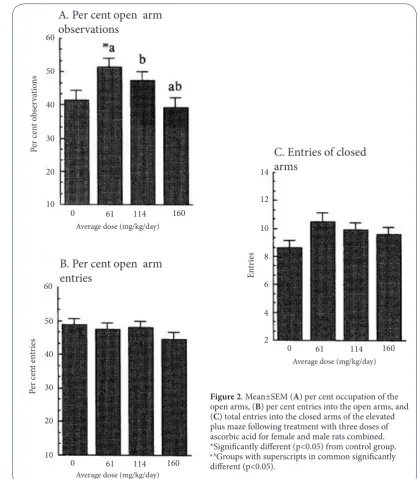
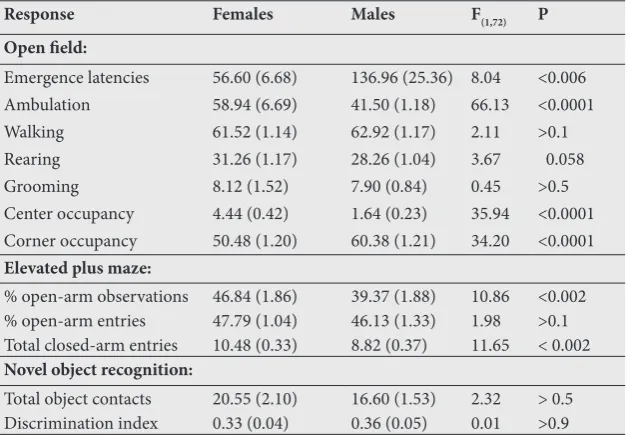
For ease of inspection, the effects on all responses of treatment with the different doses of ascorbic acid for both sexes combined are presented in Figures 1, 2 and 3 whereas sex differences for all treatment conditions combined (along with results of ANOVAs) are displayed in Table 1.
OF responses
Effects of treatment with ascorbic acid for both sexes combined on all OF responses except emergence latencies and immobil-ity are outlined in Figure 1. Although emergence latencies were not significantly affected by ascorbic acid ([control] mean±SEM=111.45±44.60 s, 61 mg/kg/day=99.35±20.34 s, 114 mg/kg/day=79.60±12.21 s, 160 mg/kg/day=82.45±19.25
s, F(3,72)=0.33, p>0.8), female rats emerged significantly faster than males (see Table 1).
[image:4.595.109.481.237.682.2]An ANOVA of immobility data was not appropriate as the response was observed too infrequently among ascorbic acid
Figure 1. Mean±SEM frequencies of (A) ambulation, (B) walking, (C) rearing, (D) grooming, (E) center occupancy, and (F) corner occupancy recorded in the open field following treatment with three doses of ascorbic acid for female and male rats combined.
*Significantly different (p<0.05) from control group.
a,bGroups with superscripts in common significantly different (p<0.05).
A. Ambulation
D. Grooming
B. Walking
E. Center occupancy
C. Rearing
F. Corner occupancy
*ab
7014 12 10 8 6 4 2 0
6 5 4 3 2 1 0
70 60 50 40 30 20 10 0 60
50 40 30 20 10
80
70
60
50
40
40
35
30
25
20
15
0 0 61 114 160 0 61 114 160
Diff
er
en
t s
qu
ar
es o
cc
up
ie
d
Fr
eq
uen
cy
F
re
quen
cy
Fr
eq
uen
cy
Fr
eq
uen
cy
Fr
eq
uen
cy
0 61 114 160
0 61 114 160
0 61 114 160
0 61 114 160
Average dose (mg/kg/day)
Average dose (mg/kg/day) Average dose (mg/kg/day)
Average dose (mg/kg/day) Average dose (mg/kg/day)
A. Per cent open arm
observations
C. Entries of closed
arms
B. Per cent open arm
entries
60
50
40
30
20
10 12
10
8
6
4
2 14
60
50
40
30
20
10
P
er cen
t o
bs
er
va
tio
ns
P
er cen
t en
tr
ies
En
tr
ies
0 61 114 160
Average dose (mg/kg/day)
0 61 114 160
Average dose (mg/kg/day)
0 61 114 160
[image:5.595.79.500.89.569.2]Average dose (mg/kg/day)
Figure 2. Mean±SEM (A) per cent occupation of the open arms, (B) per cent entries into the open arms, and (C) total entries into the closed arms of the elevated plus maze following treatment with three doses of ascorbic acid for female and male rats combined. *Significantly different (p<0.05) from control group.
a,bGroups with superscripts in common significantly
different (p<0.05).
treated rats. However, while 14 (70%) of the 20 control animals were seen to be immobile at least once during the test session, none of the rats in either the 61 or 114 mg/kg/day group, and only 2 (10%) in the 160 mg/kg/day group were immobile at least once. As shown by a chi-square test, the difference between all ascorbic acid-treated rats combined and control animals was significant (Χ(1)=41.66, p<0.001). Of the 40 females, 7 (18%) were immobile at least once compared with 9 (23%) of the 40 males. Clearly this difference was not significant (Χ(1)=0.31, p>0.5).
Neither ambulation (Figure 1A, F(3,72)=0.89, p>0.4) nor corner occupancy (Figure 1F, F(3,72)=0.31, p>0.8) were significantly
0.8
0.6
0.4
0.2
0.0
Di
scr
imin
at
io
n in
dex
0 61 114 160
[image:6.595.44.289.76.357.2]Average dose (mg/kg/day)
Figure 3. Mean±SEM discrimination indices for female and male rats combined following treatment with three doses of ascorbic acid obtained from exploration of novel and familiar objects in the novel object recognition task.
*Significantly different (p<0.05) from control group.
a,bGroups with superscripts in common significantly different
(p<0.05).
Response Females Males F(1,72) P Open field:
Emergence latencies 56.60 (6.68) 136.96 (25.36) 8.04 <0.006 Ambulation 58.94 (6.69) 41.50 (1.18) 66.13 <0.0001 Walking 61.52 (1.14) 62.92 (1.17) 2.11 >0.1 Rearing 31.26 (1.17) 28.26 (1.04) 3.67 0.058 Grooming 8.12 (1.52) 7.90 (0.84) 0.45 >0.5 Center occupancy 4.44 (0.42) 1.64 (0.23) 35.94 <0.0001 Corner occupancy 50.48 (1.20) 60.38 (1.21) 34.20 <0.0001 Elevated plus maze:
% open-arm observations 46.84 (1.86) 39.37 (1.88) 10.86 <0.002 % open-arm entries 47.79 (1.04) 46.13 (1.33) 1.98 >0.1 Total closed-arm entries 10.48 (0.33) 8.82 (0.37) 11.65 < 0.002 Novel object recognition:
Total object contacts 20.55 (2.10) 16.60 (1.53) 2.32 > 0.5 Discrimination index 0.33 (0.04) 0.36 (0.05) 0.01 >0.9 Table 1. Comparison of results in the open field, elevated plus maze, and novel object recognition test for female and male rats.
Mean±SEM values for all responses recorded in the open field and elevated plus maze, and novel object recognition test for female and male rats exposed to water or 61, 114 or 160 mg/kg/day of ascorbic acid (exposure conditions combined), plus results of ANOVAs for sex differences.
As shown in Table 1, female rats exhibited significantly higher frequencies of ambulation and center occupancy, and a sugges-tive (but not significant) higher frequency of rearing than males. They also occupied the corners of the apparatus significantly
less often than males.
EPM responses
Effects of treatment with the three doses of ascorbic acid on responses recorded in the EPM are shown in Figure 2.
While the effect was significant for per cent observations in the open arms (Figure 2A, F(3,72)=4.34, p<0.008), this was not so for either per cent entries into the open arms (Figure 2B, F(3,72)=0.90, p>0.4) or total entries into the closed arms (Figure 2C, F(3,72)=1.42, p>0.2). The significant effect for observations in the open arms was due to rats treated with 61 mg/kg/day occupying these arms significantly more often than rats in any other group. Female rats were seen significantly more often in the open arms and entered the closed arms more often than males (see Table 1).
NOR
The mean±SEM total number of contacts with both objects for each treatment group were: control=19.95±3.75, 61 mg/kg/ day=19.60±1.99, 114 mg/kg/day=19.35±2.29, and160 mg/kg/ day=15.40±1.89, F(3,72)=0.68, p>0.5. Clearly ascorbic acid treat-ment did not affect this measure. Effects of ascorbic acid on the NOR discrimination index can be seen in Figure 3.
[image:6.595.163.477.479.698.2]familiar object for the control and each ascorbic acid group (61, 114 and 160 mg/kg/day) respectively, were 60.15±3.85, 68.82±3.45, 63.11±3.98 and 79.47±3.07. As shown by one-sample t-tests (df=19), each of these percentages significantly exceeded the chance expectancy of 50%. However, the ascorbic acid ef-fect on the discrimination index was significant (F(3,72)=5.68, p<0.002) because of the index being significantly higher for the 160 mg/kg/day group than for any other group (outlined in Figure 3). As shown in Table 1, females and males did not differ significantly on either total contacts with both objects or the discrimination index.
Discussion
Although the approximate target dose of 60 mg/kg of ascorbic acid was nearly achieved for the lowest dose (i.e., 61 mg/kg/ day), the doses fell short of the goals by 5% for the 120 mg/ kg (i.e., 114 mg/kg/day) and 11% for the 180 mg/kg/day (i.e., 160 mg/kg/day) targets. However, these short-falls were trivial and still resulted in levels of ascorbic acid that were sufficient for possible dose-response relationships to be examined. They were equivalent to 0.59, 1.11 and 1.56 g/day, respectively for a human which are well within the safe range [23,24]. Although there was no statistically significant main effect of the treatment in the daily volumes of fluid drunk, the greater relative volume consumed by females than by male rats was consistent with previous findings [9,34] and was no doubt due to the females’ higher level of diuresis arising from their lower levels of anti-diuretic hormones [35,36].
Even though there was evidence of anxiolytic effects of ascorbic acid on behavior in the OF, the doses that were effective in this respect depended on the particular response recorded. For example, frequencies of walking within or between squares (but not ambulation or distance traveled) were increased by both higher doses, whereas rearing was increased only by the lowest dose. It was also notable that, irrespective of dose, all ascorbic acid-treated rats combined were seen to be significantly less immobile than control subjects. However, observations in the open arms of the EPM were increased only by the lowest dose. While all these results were indicative of reduced anxiety [10,11,29], they clearly did not reflect a linear dose-response relationship. Although center and corner occupancy in the OF were previously increased and decreased respectively by 80 mg/kg/day of ascorbic acid, thereby suggesting anxiolysis [9], neither response was affected in the present study apart from a significantly higher frequency of the former response with 160 mg/kg/day compared with 114 mg/kg/day (consistent with greater anxiolysis). Inspection of the results outlined for OF rearing and especially open-arm observations in the EPM suggest that, overall, 61 mg/kg/day of ascorbic acid probably exerted the greatest anxiolytic effect on the rats.
The shorter emergence latencies and higher frequencies of rearing and center occupancy, plus lower frequencies of corner occupancy in the OF shown by female than by male rats are con-sistent with the view that they are the less anxious or emotionally
reactive of the two sexes [37]. The same conclusion would apply to females’ higher frequencies of open-arm observations in the EPM. However, the higher frequencies of female OF ambulation and EPM closed-arm entries were probably more likely to have been due to their higher activity level [38].
The significantly highest NOR discrimination index with 160 mg/kg/day of ascorbic acid suggests that this dose had improved the rats’ recognition memory. This outcome is in line with the finding that 125 mg/kg of acute intravenous ascorbic acid improved spatial memory in mice [19], and that 120 mg/ kg of chronic oral ascorbic acid enhanced retention of a passive avoidance task [18]. To our knowledge, ascorbic acid-related enhanced recognition memory has not been previously reported. On balance, most of the results obtained in the OF and es-pecially the EPM (which is generally regarded as preferable for measuring rodent anxiety, [39]) were consistent with anxiolytic effects of ascorbic acid reported by a number of previous authors (described in the Introduction). These effects appeared to be most typical of 61 mg/kg/day, which is approximately within the range shown previously to be anxiolytic [9]. It is therefore possible that doses considerably in excess of 60-80 mg/kg/day (i.e., 0.73-0.98 g/day for an average human) may not reliably exert anxiety-reducing effects. However, a different conclusion seems appropriate for enhancement of recognition memory as this only occurred with a dose of 180 mg/kg/day. Although such a chronic intake that typified the present study is clearly not therapeutically realistic as treatment for human anxiety or memory disorders, the common practice for many people to consume vitamin C daily for other health-related reasons might also help protect anxiety-prone individuals from deleterious psychological effects of stress and/or provide some protection from disease- or age-related memory impairment.
While the mechanism for ascorbic acid’s anxiolytic action re-mains to be conclusively established, possibilities include NMDA antagonism [40], ascorbate-related reduction of brain oxidative stress (that has been implicated in anxiety, [41]) and serotonin regulation [42]. Alternatively, ascorbic acid-induced anxiolysis might merely be due to attenuation of the stress hormone, cortisol [3,5]. Although ascorbic acid’s memory-enhancing effects have also been related to its antioxidant properties [43], there is evi-dence that it functions as a modulator of brain neurotransmitters that are important for memory, such as acetylcholine, dopamine, glutamate and GABA [2]. Since, contrary to its anxiolytic action, ascorbic acid improved recognition of a novel object only with the highest dose, it is likely that different central mechanisms are involved in the vitamin’s effects on anxiety and memory. Clearly, further research is required to firmly establish critical doses for anxiolytic and memory-enhancing effects of ascorbic acid, as well as the central mechanisms responsible.
Conclusions
suggested in previous research. In this respect, the lowest dose of 61 mg/kg/day appeared to be the most effective. However, only the highest dose of 160 mg/kg/day improved recognition memory as measured by the NOR test. From observations of their anxiety-related behavior and consistent with previous findings, female rats were less anxious (or emotionally reactive) than males. Overall, it was clear from the results of the present study that more research is required to establish critical doses for both the anxiolytic and memory-enhancing effects of ascorbic acid, and determine associated central mechanisms.
Competing interests
The authors declare that they have no competing interests.
Authors’ contributions
The study was designed by RNH who also analyzed all result-ing data and drafted the manuscript. NJH treated the rats with ascorbic acid and conducted all behavioral testing and data collation. RMT was responsible for determining the lack of a significant preference for either object used in the NOR test.
Acknowledgement
This study was supported by an internal research grant from the Department of Psychology, University of Canterbury.
References
1. Fumeron, C., Nguyen-Khoa, T., Saltiel, C., Kebede, M., Buisson, C., Drueke, T. B., Lacour, B. and Massy, Z. A. (2005). Effects of oral vitamin C supplementation on oxidative stress and inflammation status in haemodialysis patients. Nephrol Dial Transplant, 20, 1874-9.
2. Harrison, F. E. and May, J. M. (2009). Vitamin C function in the brain: vital role of the ascorbate transporter SVCT2. Free Radic Biol Med, 46, 719-30.
3. Brody, S., Preut, R., Schommer, K. and Schurmeyer, T. H. (2002). A randomized controlled trial of high dose ascorbic acid for reduction of blood pressure, cortisol, and subjective responses to psychological stress. Psychopharmacology (Berl), 159, 319-24. 4. Jones, R. B., Satterlee, D. G., Moreau and Waddington, D. (1996).
Vitamin C supplementation and fear-reduction in Japanese quail: short-term cumulative effects. Br Poult Sci, 37, 33-42.
5. Satterlee, D. G., Jones, R. B. and Ryder, F. H. (1994). Effects of ascorbyl-2-polyphosphate on adrenocortical activation and fear-related behavior in broiler chickens. Poult Sci, 73, 194-201. 6. de Angelis, L. and Furlan, C. (1995). The effects of ascorbic acid
and oxiracetam on scopolamine-induced amnesia in a habituation test in aged mice. Neurobiol Learn Mem, 64, 119-24.
7. Choi, J.Y., Choi, Y.J, dela Peña, I.K., Yoon, S.Y., Lee, G.S. and Shin, C.Y. et al. (2010). Vitamin C supplementation alleviates electroshock stress but not restraint stress in ICR mice. Food SciBiotechnol 19, 137-44.
8. Angrini, M. A. and Leslie, J. C. (2012). Vitamin C attenuates the physiological and behavioural changes induced by long-term exposure to noise. Behav Pharmacol, 23, 119-25.
9. Hughes, R. N., Lowther, C. L. and van Nobelen, M. (2011). Prolonged treatment with vitamins C and E separately and together decreases anxiety-related open-field behavior and acoustic startle in hooded rats. Pharmacol Biochem Behav, 97, 494-9.
10. Pellow, S., Chopin, P., File, S. E. and Briley, M. (1985). Validation of open:closed arm entries in an elevated plus-maze as a measure of anxiety in the rat. J Neurosci Methods, 14, 149-67.
11. Prut, L. and Belzung, C. (2003). The open field as a paradigm to measure the effects of drugs on anxiety-like behaviors: a review. Eur J Pharmacol, 463, 3-33.
12. Pettenuzzo, L. F., Schuck, P. F., Fontella, F., Wannmacher, C. M., Wyse, A. T., Dutra-Filho, C. S., Netto, C. A. and Wajner, M. (2002). Ascorbic acid prevents cognitive deficits caused by chronic administration of propionic acid to rats in the water maze. Pharmacol Biochem Behav, 73, 623-9.
13. Harrison, F. E., Hosseini, A. H., Dawes, S. M., Weaver, S. and May, J. M. (2009). Ascorbic acid attenuates scopolamine-induced spatial learning deficits in the water maze. Behav Brain Res, 205, 550-8.
14. Harrison, F. E., Hosseini, A. H., McDonald, M. P. and May, J. M. (2009). Vitamin C reduces spatial learning deficits in middle-aged and very old APP/PSEN1 transgenic and wild-type mice. Pharmacol Biochem Behav, 93, 443-50.
15. Paleologos, M., Cumming, R. G. and Lazarus, R. (1998). Cohort study of vitamin C intake and cognitive impairment. Am J Epidemiol, 148, 45-50.
16. Charlton, K. E., Rabinowitz, T. L., Geffen, L. N. and Dhansay, M. A. (2004). Lowered plasma vitamin C, but not vitamin E, concentrations in dementia patients. J Nutr Health Aging, 8, 99-107.
17. Riviere, S., Birlouez-Aragon, I., Nourhashemi, F. and Vellas, B. (1998). Low plasma vitamin C in Alzheimer patients despite an adequate diet. Int J Geriatr Psychiatry, 13, 749-54.
18. Shahidi, S., Komaki, A., Mahmoodi, M., Atrvash, N. and Ghodrati, M. (2008). Ascorbic acid supplementation could affect passive avoidance learning and memory in rat. Brain Res Bull, 76, 109-13.
19. Kennard, J. A. and Harrison, F. E. (2014). Intravenous ascorbate improves spatial memory in middle-aged APP/PSEN1 and wild type mice. Behav Brain Res, 264, 34-42.
20. Bevins, R. A. and Besheer, J. (2006). Object recognition in rats and mice: a one-trial non-matching-to-sample learning task to study ‘recognition memory’. Nat Protoc, 1, 1306-11.
21. Reagan-Shaw, S., Nihal, M. and Ahmad, N. (2008). Dose translation from animal to human studies revisited. FASEB J, 22, 659-61.
22. Walpole, S. C., Prieto-Merino, D., Edwards, P., Cleland, J., Stevens, G. and Roberts, I. (2012). The weight of nations: an estimation of adult human biomass. BMC Public Health, 12, 439.
23. Hathcock, J. N., Azzi, A., Blumberg, J., Bray, T., Dickinson, A., Frei, B., Jialal, I., Johnston, C. S., Kelly, F. J., Kraemer, K., Packer, L., Parthasarathy, S., Sies, H. and Traber, M. G. (2005). Vitamins E and C are safe across a broad range of intakes. Am J Clin Nutr, 81, 736-45.
24. Johnston, C. S. (1999). Biomarkers for establishing a tolerable upper intake level for vitamin C. Nutr Rev, 57, 71-7.
25. Martinez, J. C., Cardenas, F., Lamprea, M. and Morato, S. (2002). The role of vision and proprioception in the aversion of rats to the open arms of an elevated plus-maze. Behav Processes, 60, 15-26. 26. Hughes, R. N., Hancock, N. J., Henwood, G. A. and Rapley, S. A.
(2014). Evidence for anxiolytic effects of acute caffeine on anxiety-related behavior in male and female rats tested with and without bright light. Behav Brain Res, 271, 7-15.
R. (1977). Taking a closer look: time sampling and measurement error. J Appl Behav Anal, 10, 325-32.
28. Detke, M. J., Rickels, M. and Lucki, I. (1995). Active behaviors in the rat forced swimming test differentially produced by serotonergic and noradrenergic antidepressants. Psychopharmacology (Berl), 121, 66-72.
29. Archer, J. (1973). Tests for emotionality in rats and mice: a review. Anim Behav, 21, 205-35.
30. Hughes, R. N. (2011). Adult anxiety-related behavior of rats following consumption during late adolescence of alcohol alone and in combination with caffeine. Alcohol, 45, 365-72.
31. Hughes, R. N. and Otto, M. T. (2013). Anxiolytic effects of environmental enrichment attenuate sex-related anxiogenic effects of scopolamine in rats. Prog Neuropsychopharmacol Biol Psychiatry, 40, 252-9.
32. Cruz, A. P., Frei, F. and Graeff, F. G. (1994). Ethopharmacological analysis of rat behavior on the elevated plus-maze. Pharmacol Biochem Behav, 49, 171-6.
33. Sutcliffe, J. S., Marshall, K. M. and Neill, J. C. (2007). Influence of gender on working and spatial memory in the novel object recognition task in the rat. Behav Brain Res, 177, 117-25. 34. Hughes, R. N. and Collins, M. A. (2010). Enhanced habituation
and decreased anxiety by environmental enrichment and possible attenuation of these effects by chronic alpha-tocopherol (vitamin E) in aging male and female rats. Pharmacol Biochem Behav, 94, 534-42.
35. McGivern, R. F., Henschel, D., Hutcheson, M. and Pangburn, T. (1996). Sex difference in daily water consumption of rats: effect of housing and hormones. Physiol Behav, 59, 653-8.
36. Wang, Y. X., Edwards, R. M., Nambi, P., Stack, E. J., Pullen, M., Share, L., Crofton, J. T. and Brooks, D. P. (1993). Sex difference in the antidiuretic activity of vasopressin in the rat. Am J Physiol, 265, R1284-90.
37. Gray, J. A. (1971). Sex differences in emotional behaviour in mammals including man: endocrine bases. Acta Psychol (Amst), 35, 29-46.
38. Archer, J. (1975). Rodent sex differences in emotional and related behavior. Behav Biol, 14, 451-79.
39. Bourin, M., Petit-Demouliere, B., Dhonnchadha, B. N. and Hascoet, M. (2007). Animal models of anxiety in mice. Fundam Clin Pharmacol, 21, 567-74.
40. Majewska, M. D., Bell, J. A. and London, E. D. (1990). Regulation of the NMDA receptor by redox phenomena: inhibitory role of ascorbate. Brain Res, 537, 328-32.
41. Bouayed, J., Rammal, H. and Soulimani, R. (2009). Oxidative stress and anxiety: relationship and cellular pathways. Oxid Med Cell Longev, 2, 63-7.
42. Lee, L., Kang, S. A., Lee, H. O., Lee, B. H., Jung, I. K., Lee, J. E. and Hoe, Y. S. (2001). Effect of supplementation of vitamin E and vitamin C on brain acetylcholinesterase activity and neurotransmitter levels in rats treated with scopolamine, an inducer of dementia. J Nutr Sci Vitaminol (Tokyo), 47, 323-8. 43. Castagne, V., Rougemont, M., Cuenod, M. and Do, K. Q.