Bayesian Markov Regime-Switching Models
for Cointegration
Kai Cui1, Wenshan Cui2
1Department of Statistical Science, Duke University, Durham, USA
2School of Science and Information, Qingdao Agricultural University, Qingdao, China
Email: [email protected], [email protected]
Received October 10, 2012; revised November 11, 2012; accepted November 18, 2012
ABSTRACT
This paper introduces a Bayesian Markov regime-switching model that allows the cointegration relationship between two time series to be switched on and off over time. Unlike classical approaches for testing and modeling cointegration, the Bayesian Markov switching method allows for estimation of the regime-specific model parameters via Markov Chain Monte Carlo and generates more reliable estimation. Inference of regime switching also provides important in- formation for further analysis and decision making.
Keywords: Cointegration; Regime-Switching; Bayesian; MCMC
1. Introduction
Since the development of the concept of cointegration [1], there has been a rich literature on testing cointegration and applying cointegration approaches to real data analy- sis. One of the most illustrative examples in practice is the pair trading strategy [2]. The basic idea is that: find two securities whose prices have been historically mov- ing together. So when the spread between them widens, we short the winner and buy the loser. And if we believe that the history would repeat itself, prices will converge again and the arbitrager will profit. This moving-together relationship between two nonstationary time series is called cointegration. Mathematically, if two nonstation- ary time series and Vt are cointegrated, then there
exists a number t U
called the cointegration ratio, such that Yt UtVt is stationary.
Although there have been many statistical studies to find cointegrated time series, there are still many un- solved problems. First of all, it is often hard simply to find cointegration given a specific period of time. There are several statistical explanations for failing to reject the null of no cointegration including the span of the data set, structural breaks [3] and the choice of test model [4]. Se- condly, there are few statistical decision-making rules after identifying candidate pairs. Taking pair trading as an exmple, typically, people simply use the decision rule that they open a long-short position when the pair prices have diverged by a certain amount (e.g. two standard de- viations from the historical mean) and close the position when the prices have reverted [5].
This paper proposes the Bayesian Markov regime- switching model that allows the cointegration relation- ship between two time series to be switched on or off over time via a discrete-time Markov process. This is an improvement to the traditional cointegration tests con- sidering that the model flexibly allows local non-cointe- gration rather than assuming global cointegration over the whole period of time. By using a fully Bayesian mo- dels, uncertainty about cointegration ratio is also incor- porated into the model and inferred simultaneously with all other unknown quantities. Furthermore, inference of the hidden regime-switching is also critical to decision making and further generic analysis.
2. Markov Regime-Switching Models for
Cointegration
Suppose we have two nonstationary time series t and
t with integration order 1, and t
U V
V Yt Ut ( is
known, typically people propose a and then test the stationary property of t). If t is stationary, then we
say time series t and Vt are cointegrated. To test for
stationarity, the Engle-Grange method [6] tests the
Y Y
U 0
null hypothesis using the ADF unit root test [5] based on the Error Correction Model (EVM) with lag order K (as compared to 0 in which case it is stationary):
1 1
K t t i t i
k
Y Y Y t
(1)cients and t N
0,
Y.
In comparison, the Markov regime-switching model we proposed allows t to switch between cointegrated
or non-cointegrated regimes in a Markovian manner, by introducing the regime indicator variable Xt, regime
specific parameters and the Markov transition matrix . For the simplicity of exposition, we assume that , with denoting that that Yt is
sta-tionary (i.e. t and Vt are cointegrated) at time t and
meaning non-cointegration. Then the model can be written as:
X P t X t X
0,1 1
Xt 0U 00 01 10 11 , 0 t t X X t t Y I N p p p p
1 0 1 , Xt t K t t k X X Y P k Yt i
Y U V
(2)
where t t t and thus Yt Ut Vt t
. is the Markov transition matrix of X
P X , with
1
Pr
ij
p X
0
t j Xt i
and initial value X .
Clearly, when the model reduces to model (1) with negative
0
t
X
, while specifies unit root process for t and thus no cointegration exists for time series t and . By obtaining inference of the under- lining regimes t1 t X Y t V U
X , regime-specific parameters and seg-
mentation of regime-specific data, the model provides much information for further generic analysis and deci- sion making.
3. Bayesian Computation
We propose to use Bayesian analysis for the inference of parameters and latent regimes Xt, where posterior sam-
ples of all unknown quantities are drawn using Markov Chain Monte Carlo (MCMC).
Under this model (2), the likelihood function is:
0 0 1 10 0 0
1 : 0 1 : 1 , t t
t t t t
t
t t t t
t X
t t t t
t X
L X Y P X P Y X
P Y X P X X
P X P Y X
P Y X P X X
P Y X P X X
0 Conjugate prior distributions are placed on model pa- rameters [7]. Specifically, conjugate Dirichlet priors are assigned to each row of the transition matrix PX and
0, 1
q q q , where qi Pr
X0 i
. Conjugate Nor-mal-Gamma priors are assigned for all the regression coefficients Xt and the corresponding precisions
k
Xt
1 2 0, ir N 1 2
0 0
, ; , ; , 0,1
; , 2 2 t t t i i ij X X X
p Dir i j
v SS k q D
To obtained the posterior marginal distributions of the unknown parameters and the hidden regimes Xt, Gibbs
sampler is constructed to iterate the following steps: 1) Sample and from full conditional distribu- tions:
q PX
1 ir 0 0 2 01 00 01
0 0
1 10, 0 2 10, 1
1 1
10 11
1 1
1 11, 0 2 11, 1
1 1 , ; , , , , X X
Xi Xi Xi Xi
t t
Xi Xi Xi Xi
t t
q D I I p p
Dir I I
p p
Dir I I
2) Sample the regression coefficients and variance from Normal-Inverse Gamma full conditional distribu- tions given the conjugacy of the priors.
3) Sample the whole path of Xt.
Since Xts are highly correlated, Gibbs sampler
con-structed via regular full conditional distribution would be extremely inefficient [7]. To overcome this, Forward Fil- tering and Backward Sampling algorithm is applied to draw block samples of Xt. To achieve this, define
Y0, , Yn, n i
n i P X
, then by recursion:
0 i q Pi Y X0 0 i ;
and
1
n n ji n n
j
i j p P Y X
i
With this, the results follow that:
1 ,
1
t t
t t t
P X i i
P X j X i j p
ji
By using this algorithm, a sample of XT is first
drawn from a bernoulli (multinomial if Xt takes more
than two values) distribution, and , sam- ples of t
0 t T 1
X are drawn sequentially and backward from
the conditional bernoulli distribution, with
1
t ji
t t
t j
j j p
P X j X i
j p
i ,4. Simulated Time Series Analysis
4.1. Model Assessment
To testify the performance of the proposed framework, we simulated a Markov regime-switching times series of length , which switches between one stationary AR(2) process (State 0) and one non-stationary AR(2) process (State 1). The two AR(2) models and the corre-sponding Error Correction Models (ECM) are shown as follows: (the (non-)stationary property can be easily tested by the Unit Root Test)
500
T
1 2
1 1
1 2
1
State 0 : 3 0.6 0.28 , : 3 0.68 0.28 ; State1: 4 0.7 0.3 ,
: 4 0.3 .
t t t
t t t
t t t t
t t t
y y y
ECM y y y
y y y
ECM y y
t
t
(3)
wheret N
0,1 andt
0,1
N . The transition ma-
trix is specified as
00 01 10 11
0.8 0.2 0.8 0.2
X
p p
P
p p
.
A simulated data was shown in Figure 1.
The proposed model was applied to the time series to find regime switching, with the priors specified as fol- lows:
00 01 10 11
1,1 , , 1,1 , , 1,1 ,
1 1 1
0, ; ,
2 2
t t
t
X X
k X
q Dir p p Dir p p Dir
N
15
10
5
0
Va
lu
e
[image:3.595.309.530.280.550.2]Time 0 50 100 150 200
Figure 1. Illutration of a time series stimulated by the mar- kov switching model.
To infer the value of Xt based on posterior samples,
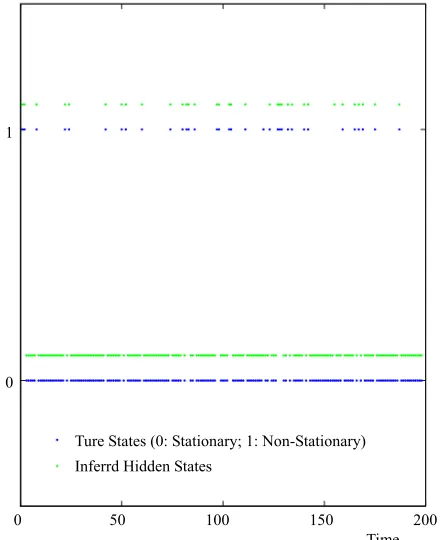
we use posterior probability as the cut-off point. Shown in Figure 2, the inferred regimes are compared
with the true values, which shows that our model gives good recovery of the latent regimes (with the first 200 time points shown). Other model parameters are also correctly inferred as shown in Table 1, where posterior
distributions cover the true values well. 0.5
4.2. Posterior Decision Making
The importance of inference of regimes when analyzing (non)stationary time series lies in the fact that com- monly-used stationarity and cointegration tests (e.g. ADF unit root test and Engle-Granger cointegration tes [1]) may well give misleading results when regime switching
1
0
Time 0 50 100 150 200
Ture States (0: Stationary; 1: Non-Stationary) Inferrd Hidden States
Figure 2. Inferred regimes Xt (in green) compared to the true values (in blue) show good inference.
Table 1. Posterior estimates of model parameters compared to the true values. The parameters are defined as in model 2 and specified in (3).
Parameter Mean STD Truth
−0.676 0.011 −0.68
0 1
0.287 0.013 −0.28
0
0.952 0.048 1
1 1
−0.323 0.041 −0.3
1
[image:3.595.66.280.401.704.2] [image:3.595.309.538.630.735.2]should be: we open a position when it is both in the sta- tionary state and has diverged from the historical station- ary mean. It is apparently risky either to open a position when currently we are in a non-stationary state or the historical mean calculation involves non-stationary data. exists in the process. For illustration, a quick ADF test of
the previously simulated data concludes that the null hy- pothesis with unit root is rejected at 99.9% confidence level, indicating the times series is stationary. If this time series were generated by the linear combination of two nonstationary time series, then the ADF test tells that these two are co-integrated, which is clearly wrong.
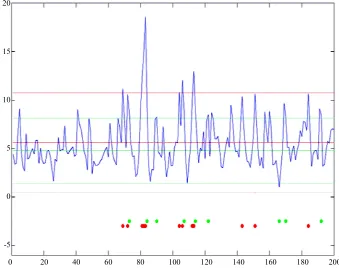
Since people care much about the time points where values are at least 2 standard deviations away from the historical mean, the figure shows that the we pick differ- ent time points using our model and decision making rules from those obtained using all historical data and traditional rules, which we believe are more reasonable choices. For example, many spikes in Figure 3 are actu-
ally not good time points to open the position based on our Markov regime-switching model simply because those spikes are in the non-stationary (non-cointegrated) regime. However in comparison, the traditional approach considers them open positions whenever the values are 2 standard deviations away from the mean, which is a very risky decision not considering the regimes.
In the following part, we will use the context of pair trading to illustrate how the Markov regime-switching model can potentially help improve decision making in practice. Basically people do pair trading based on the traditional rule that you open a long-short position when the pair prices have diverged by more than two historical standard deviations. And you unwind the position when it returns to historical mean.
First of all, the model clearly allows more reasonable estimation of the historical mean and standard deviation, based soly on data in the stationary (cointegrated) re- gimes, rather than including data in the nonstationary (non-cointegrated) regimes. This difference can be ob- served in Figure 3, where the historical mean using data
in the stationary regime is different from that using all data, and the standard deviation is also smaller.
5. Cointegrated Price Series Analysis
An possible example of a pair of cointegrated time series is the gold ETF, GLD versus the gold miners ETF, GDX. GLD reflects the spot price of gold, and GDX is a basket of gold-mining stocks. It makes intuitive sense that their Secondly, the identification of stationary (cointegrated)
and nonstationary (non-cointegrated) regimes also help establish more rational decision making rules, which
20
15
10
5
0
-5
[image:4.595.129.468.410.680.2]0 20 40 60 80 100 120 140 160 180 200
35
30
25
20
15
10
5
0
[image:5.595.115.476.83.327.2]0.4 0.42 0.44 0.46 0.48 0.5 0.52 0.54
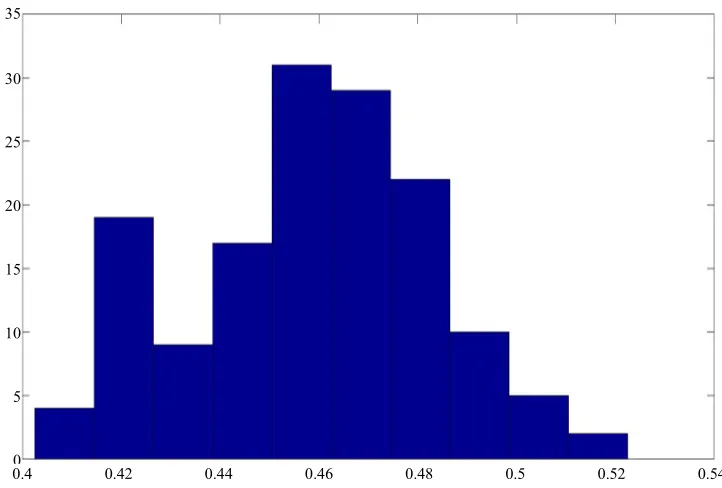
Figure 4. Distribution of the probability that Xt is in the cointegration regime (t = 1,···,T).
prices may move in tandem. Previous study via the two- step Engle-Granger method [1] identified that a portfolio with long 1 share of GLD and short 1.6766 share of GDX is likely a stationary time series, with lag 1 but the conclusion is later questioned by other studies [8]. To test the possible co-integration, the two-state Markov regime switching model is applied to the 05/23/06-11/30/07 GLD and GDX time series. A histogram shown the distribution of the probability of the time points being in the cointe- gration state is shown in Figure 4. According to the pre-
vious 0.5 cut-off point, the Markov regime switching model indicates that at most of the time, the two time series are not cointegrated with the 1.6766 cointegration ratio. This may serve as another counterexample (toge- ther with the simulation result) that the widely-used ADF test might provide misleading results when used to test co-integration regardless of possible regime switching.
6. Conclusions and Future Work
In this study, we proposed to use the Bayesian Markov regime-switching model as a flexible model for cointe- gration and stationarity analysis, where the latent regime- switching process is modeled via a Markov process. A strong message of this study is that, while identifying cointegration (or stationarity) is often hard globally, al- lowing local non-cointegration (or non-stationarity) and inferring the regime switching can provide much infor- mation for further analysis and decision making.
Several extensions of the study are still worth explor- ing, including relaxing the hidden Markov transition mo- dels and incorporating uncertainty about number of re-
gimes in the model. Hidden semi-Markov models are na- tural extensions of hidden Markov models. While the run- length distribution of the hidden Markov models implic- ity follows a geometric distribution, hidden semi-Markov models allow for more general runlength distributions, and thus are more flexible to describe the time spend in a given regime. As for the cases with the number of re- gimes unknown, Bayesian inference through reversible jump MCMC methods [9] could be a viable alternative that both explores models with different number of re- gimes and estimation of regime-specific parameters.
REFERENCES
[1] R. F. Engle and C. W. J. Granger, “Co-integration and Error Correction: Representation, Estimation, and Test-ing,” Econometrica, Vol. 55, No. 2, 1987, pp. 251-276.
doi:10.2307/1913236
[2] H. Puspaningrum, “Pairs Trading Using Cointegration Ap- proach,” Ph.D. Thesis, University of Wollongong, Wol- longong, 2012.
[3] J. Campos and N. R. Ericsson and D. F. Hendry, “Coin- tegration Tests in the Presence of Structural Breaks,” In- ternational Finance Discussion Papers 440, Board of Go- vernors of the Federal Reserve System (US), 1996. [4] E. G. Gatev and W. Goetzmann and K. G. Rouwenhorst,
“Pairs Trading: Performance of a Relative Value Arbi- trage Rule,” Boston College, Boston, 2006.
[5] A. W. Gregory and B. E. Hansen, “Residual-Based Tests for Cointegration in Models with Regime Shifts,” Journal of Econometrics, Vol. 70, No. 1, 1996, pp. 99-126. doi:10.1016/0304-4076(69)41685-7
mators for Autoregressive Time Series With a Unit Root,”
Journal of the American Statistical Association, Vol. 74, No. 366, 1979, pp. 427-431. doi:10.2307/2286348 [7] G. E. B. Archer and D. M. Titterington, “Parameter Esti-
mation for Hidden Markov Chains,” Journal of Statistical Planning and Inference, Vol. 108, No. 1, 2002, pp. 365-
390. doi:10.1016/S0378-3758(02)00318-X
[8] E. P. Chan,“Quantitative Trading,” John Wiley and Sons, Hoboken, 2008.
[9] C. P. Robert, T. Ryden and D. M. Titterington, “Bayesian Inference in Hidden Markov Models through the Reversi- ble Jump Markov Chain Monte Carlo Method,” Journal of The Royal Statistical Society Series B, Vol. 62, No. 1,