Proceedings of the 55th Annual Meeting of the Association for Computational Linguistics, pages 496–505 Vancouver, Canada, July 30 - August 4, 2017. c2017 Association for Computational Linguistics Proceedings of the 55th Annual Meeting of the Association for Computational Linguistics, pages 496–505
Vancouver, Canada, July 30 - August 4, 2017. c2017 Association for Computational Linguistics
Sequential Matching Network: A New Architecture for Multi-turn
Response Selection in Retrieval-Based Chatbots
Yu Wu†, Wei Wu‡, Chen Xing♦, Zhoujun Li†∗, Ming Zhou‡
†State Key Lab of Software Development Environment, Beihang University, Beijing, China
♦College of Computer and Control Engineering, Nankai University, Tianjin, China
‡ Microsoft Research, Beijing, China
{wuyu,lizj}@buaa.edu.cn{wuwei,v-chxing,mingzhou}@microsoft.com
Abstract
We study response selection for multi-turn conversation in retrieval-based chat-bots. Existing work either concatenates ut-terances in context or matches a response with a highly abstract context vector fi-nally, which may lose relationships among utterances or important contextual infor-mation. We propose a sequential match-ing network (SMN) to address both prob-lems. SMN first matches a response with each utterance in the context on multiple levels of granularity, and distills important matching information from each pair as a vector with convolution and pooling oper-ations. The vectors are then accumulated in a chronological order through a recur-rent neural network (RNN) which models relationships among utterances. The fi-nal matching score is calculated with the hidden states of the RNN. An empirical study on two public data sets shows that SMN can significantly outperform state-of-the-art methods for response selection in multi-turn conversation.
1 Introduction
Conversational agents include task-oriented dia-log systems and non-task-oriented chatbots. Dia-log systems focus on helping people complete spe-cific tasks in vertical domains (Young et al.,2010), while chatbots aim to naturally and meaningfully converse with humans on open domain topics (Ritter et al., 2011). Existing work on building chatbots includes generation -based methods and retrieval-based methods. Retrieval based chatbots enjoy the advantage of informative and fluent re-sponses, because they select a proper response for
∗Corresponding Author
Context
utterance 1 Human: How are you doing?
utterance 2 ChatBot: I am going tohold a drum classin Shanghai. Anyone wants to join? The location is near Lujiazui. utterance 3 Human: Interesting! Do you have coaches who
can help me practicedrum? utterance 4 ChatBot: Of course.
utterance 5 Human: Can I have a free first lesson?
Response Candidates
response 1 Sure. Have you ever played drum before?X
[image:1.595.306.522.221.317.2]response 2 What lessons do you want?7
Table 1: An example of multi-turn conversation
the current conversation from a repository with re-sponse selection algorithms. While most existing work on retrieval-based chatbots studies response selection for single-turn conversation (Wang et al., 2013) which only considers the last input message, we consider the problem in a multi-turn scenario. In a chatbot, multi-turn response selection takes a message and utterances in its previous turns as input and selects a response that is natural and rel-evant to the whole context.
The key to response selection lies in input-response matching. Different from single-turn conversation, multi-turn conversation requires matching between a response and a conversation context in which one needs to consider not only the matching between the response and the input message but also matching between responses and utterances in previous turns. The challenges of the task include (1) how to identify important infor-mation (words, phrases, and sentences) in context, which is crucial to selecting a proper response and leveraging relevant information in matching; and (2) how to model relationships among the utter-ances in the context. Table1illustrates the chal-lenges with an example. First, “hold a drum class” and “drum” in context are very important. With-out them, one may find responses relevant to the message (i.e., the fifth utterance of the context) but nonsense in the context (e.g., “what lessons do you want?”). Second, the message highly de-pends on the second utterance in the context, and
the order of the utterances matters in response se-lection: exchanging the third utterance and the fifth utterance may lead to different responses. Ex-isting work, however, either ignores relationships among utterances when concatenating them to-gether (Lowe et al.,2015), or loses important in-formation in context in the process of converting the whole context to a vector without enough su-pervision from responses (e.g., by a hierarchical RNN (Zhou et al.,2016)).
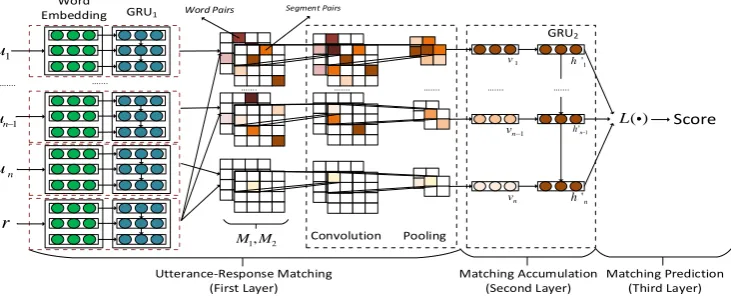
We propose a sequential matching network (SMN), a new context based matching model that can tackle both challenges in an end-to-end way. The reason that existing models lose important in-formation in the context is that they first represent the whole context as a vector and then match the context vector with a response vector. Thus, re-sponses in these models connect with the context until the final step in matching. To avoid informa-tion loss, SMN matches a response with each ut-terance in the context at the beginning and encodes important information in each pair into a matching vector. The matching vectors are then accumu-lated in the utterances’ temporal order to model their relationships. The final matching degree is computed with the accumulation of the matching vectors. Specifically, for each utterance-response pair, the model constructs a word-word similarity matrix and a sequence-sequence similarity matrix by the word embeddings and the hidden states of a recurrent neural network with gated recurrent units (GRU) (Chung et al.,2014) respectively. The two matrices capture important matching information in the pair on a word level and a segment (word subsequence) level respectively, and the informa-tion is distilled and fused as a matching vector through an alternation of convolution and pooling operations on the matrices. By this means, impor-tant information from multiple levels of granular-ity in context is recognized under sufficient super-vision from the response and carried into match-ing with minimal loss. The matchmatch-ing vectors are then uploaded to another GRU to form a match-ing score for the context and the response. The GRU accumulates the pair matching in its hidden states in the chronological order of the utterances in context. It models relationships and dependen-cies among the utterances in a matching fashion and has the utterance order supervise the accumu-lation of pair matching. The matching degree of the context and the response is computed by a logit
model with the hidden states of the GRU. SMN extends the powerful “2D” matching paradigm in text pair matching for single-turn conversation to context based matching for multi-turn conversa-tion, and enjoys the advantage of both important information in utterance-response pairs and rela-tionships among utterances being sufficiently pre-served and leveraged in matching.
We test our model on the Ubuntu dialogue corpus (Lowe et al.,2015) which is a large scale publicly available English data set for research in multi-turn conversation. The results show that our model can significantly outperform state-of-the-art methods, and improvement to the best baseline model on R10@1 is over6%. In addition
to the Ubuntu corpus, we create a human-labeled Chinese data set, namely the Douban Conversa-tion Corpus, and test our model on it. In contrast to the Ubuntu corpus in which data is collected from a specific domain and negative candidates are randomly sampled, conversations in this data come from the open domain, and response candidates in this data set are collected from a retrieval engine and labeled by three human judges. On this data, our model improves the best baseline model by3% on R10@1 and4% on P@1.
As far as we know, Douban Conversation Corpus is the first human-labeled data set for multi-turn response selection and could be a good comple-ment to the Ubuntu corpus. We have released Douban Conversation Corups and our source code at https://github.com/MarkWuNLP/ MultiTurnResponseSelection
Our contributions in this paper are three-folds: (1) the proposal of a new context based match-ing model for multi-turn response selection in retrieval-based chatbots; (2) the publication of a large human-labeled data set to research commu-nities; (3) empirical verification of the effective-ness of the model on public data sets.
2 Related Work
.... ....
....
Score
1, 2
M M Convolution Pooling
( )
L
.... .... ....
1
u
1 n
u
n
u
r
Word Embedding GRU1
GRU2
.... 1
v
1
n v
n v
1
'n h
Utterance-Response Matching (First Layer)
Matching Accumulation (Second Layer)
Segment Pairs Word Pairs
Matching Prediction (Third Layer)
1
' h
'n
[image:3.595.111.477.72.222.2]h
Figure 1: Architecture of SMN
2016;Serban et al.,2016). Our work is a retrieval-based method, in which we study context-retrieval-based response selection.
Early studies of retrieval-based chatbots focus on response selection for single-turn conversation (Wang et al., 2013; Ji et al., 2014; Wang et al., 2015; Wu et al., 2016b). Recently, researchers have begun to pay attention to multi-turn conver-sation. For example, Lowe et al. (2015) match a response with the literal concatenation of context utterances. Yan et al. (2016) concatenate context utterances with the input message as reformulated queries and perform matching with a deep neural network architecture. Zhou et al. (2016) improve multi-turn response selection with a multi-view model including an utterance view and a word view. Our model is different in that it matches a response with each utterance at first and accumu-lates matching information instead of sentences by a GRU, thus useful information for matching can be sufficiently retained.
3 Sequential Matching Network 3.1 Problem Formalization
Suppose that we have a data set D =
{(yi, si, ri)}Ni=1, wheresi={ui,1, . . . , ui,ni}
rep-resents a conversation context with {ui,k}nk=1i as
utterances. ri is a response candidate and yi ∈ {0,1}denotes a label.yi= 1meansriis a proper
response forsi, otherwiseyi = 0. Our goal is to
learn a matching model g(·,·) with D. For any context-response pair (s, r), g(s, r)measures the matching degree betweensandr.
3.2 Model Overview
We propose a sequential matching network (SMN) to modelg(·,·). Figure 1 gives the architecture.
SMN first decomposes context-response match-ing into several utterance-response pair matchmatch-ing and then all pairs matching are accumulated as a context based matching through a recurrent neu-ral network. SMN consists of three layers. The first layer matches a response candidate with each utterance in the context on a word level and a segment level, and important matching informa-tion from the two levels is distilled by convolu-tion, pooling and encoded in a matching vector. The matching vectors are then fed into the sec-ond layer where they are accumulated in the hid-den states of a recurrent neural network with GRU following the chronological order of the utterances in the context. The third layer calculates the final matching score with the hidden states of the sec-ond layer.
SMN enjoys several advantages over existing models. First, a response candidate can match each utterance in the context at the very beginning, thus matching information in every utterance-response pair can be sufficiently extracted and car-ried to the final matching score with minimal loss. Second, information extraction from each utter-ance is conducted on different levels of granular-ity and under sufficient supervision from the re-sponse, thus semantic structures that are useful for response selection in each utterance can be well identified and extracted. Third, matching and ut-terance relationships are coupled rather than sepa-rately modeled, thus utterance relationships (e.g., order), as a kind of knowledge, can supervise the formation of the matching score.
context based matching in response selection for multi-turn conversation. In the following sections, we will describe details of the three layers.
3.3 Utterance-Response Matching
Given an utterance u in a context s and a
re-sponse candidate r, the model looks up an
em-bedding table and represents u and r as U = [eu,1, . . . , eu,nu]andR= [er,1, . . . , er,nr]
respec-tively, where eu,i, er,i ∈ Rd are the embeddings
of the i-th word of u and r respectively. U ∈
Rd×nu andR∈Rd×nr are then used to construct
a word-word similarity matrix M1 ∈ Rnu×nr
and a sequence-sequence similarity matrix M2
∈Rnu×nr which are two input channels of a
con-volutional neural network (CNN). The CNN dis-tills important matching information from the ma-trices and encodes the information into a matching vectorv.
Specifically, ∀i, j, the (i, j)-th element ofM1
is defined by
e1,i,j =e>u,i·er,j. (1)
M1 models the matching between u and r on a
word level.
To construct M2, we first employ a GRU to
transform U and R to hidden vectors. Suppose
that Hu = [hu,1, . . . , hu,nu]are the hidden
vec-tors ofU, then∀i,hu,i∈Rmis defined by
zi=σ(Wzeu,i+Uzhu,i−1) ri=σ(Wreu,i+Urhu,i−1)
ehu,i=tanh(Wheu,i+Uh(rihu,i−1)) hu,i=ziehu,i+ (1−zi)hu,i−1, (2) wherehu,0 = 0,ziandriare an update gate and a
reset gate respectively,σ(·)is a sigmoid function, andWz, Wh, Wr, Uz, Ur,Uh are parameters.
Similarly, we haveHr = [hr,1, . . . , hr,nr]as the
hidden vectors ofR. Then,∀i, j, the(i, j)-th ele-ment ofM2 is defined by
e2,i,j=h>u,iAhr,j, (3)
whereA ∈ Rm×m is a linear transformation. ∀i,
GRU models the sequential relationship and the dependency among words up to positioniand
en-codes the text segment until thei-th word to a
hid-den vector. Therefore, M2 models the matching
betweenuandron a segment level.
M1 and M2 are then processed by a CNN
to form v. ∀f = 1,2, CNN regards Mf as
an input channel, and alternates convolution and max-pooling operations. Suppose that z(l,f) =
h
zi,j(l,f)i
I(l,f)×J(l,f) denotes the output of feature maps of type-f on layer-l, where z(0,f) = Mf, ∀f = 1,2. On the convolution layer, we employ a 2D convolution operation with a window size
rw(l,f)×rh(l,f), and definezi,j(l,f)as
zi,j(l,f)=σ(
FXl−1
f0=0
rX(wl,f)
s=0
rh(l,f)
X
t=0
Ws,t(l,f)·z(il+−s,j1,f+0t)+bl,k), (4)
whereσ(·)is a ReLU,W(l,f) ∈Rrw(l,f)×rh(l,f) and
bl,kare parameters, andFl−1is the number of
fea-ture maps on the(l−1)-th layer. A max pooling operation follows a convolution operation and can be formulated as
z(i,jl,f)= max
p(wl,f)>s≥0
max
p(hl,f)>t≥0
zi+s,j+t, (5)
wherep(wl,f)andp(hl,f)are the width and the height
of the 2D pooling respectively. The output of the final feature maps are concatenated and mapped to a low dimensional space with a linear transforma-tion as the matching vectorv∈Rq.
According to Equation (1), (3), (4), and (5), we can see that by learning word embedding and parameters of GRU from training data, words or segments in an utterance that are useful for rec-ognizing the appropriateness of a response may have high similarity with some words or segments in the response and result in high value areas in the similarity matrices. These areas will be trans-formed and selected by convolution and pooling operations and carry important information in the utterance to the matching vector. This is how our model identifies important information in context and leverage it in matching under the supervision of the response. We consider multiple channels because we want to capture important matching information on multiple levels of granularity of text.
3.4 Matching Accumulation
Suppose that[v1, . . . , vn]is the output of the first
layer (corresponding to n pairs), at the second
layer, a GRU takes[v1, . . . , vn]as an input and
en-codes the matching sequence into its hidden states
Hm = [h01, . . . , h0n] ∈ Rq×n with a detailed
context; (2) it leverages the temporal relationship to supervise the accumulation of the pair match-ing as a context based matchmatch-ing. Moreover, from Equation (2), we can see that the reset gate (i.e.,
ri) and the update gate (i.e.,zi) control how much
information from the previous hidden state and the current input flows to the current hidden state, thus important matching vectors (corresponding to important utterances) can be accumulated while noise in the vectors can be filtered out.
3.5 Matching Prediction and Learning With[h01, . . . , h0n], we defineg(s, r)as
g(s, r) =sof tmax(W2L[h01, . . . , h0n] +b2), (6)
where W2 and b2 are parameters. We
con-sider three parameterizations for L[h01, . . . , h0n]: (1) only the last hidden state is used. Then
L[h01, . . . , h0n] = h0n. (2) the hidden states
are linearly combined. Then, L[h01, . . . , h0n] =
Pn
i=1wih0i, wherewi ∈ R. (3) we follow (Yang
et al., 2016) and employ an attention mechanism to combine the hidden states. Then,L[h01, . . . , h0n] is defined as
ti=tanh(W1,1hui,nu+W1,2h0i+b1),
αi=
exp(t>
i ts)
P
i(exp(t>its))
,
L[h01, . . . , h0n] = n
X
i=1
αih0i, (7)
where W1,1 ∈ Rq×m,W1,2 ∈ Rq×q and b1 ∈
Rq are parameters. h0
i and hui,nu are the i-th
matching vector and the final hidden state of the
i-th utterance respectively. ts ∈ Rq is a virtual
context vector which is randomly initialized and jointly learned in training.
Both (2) and (3) aim to learn weights for
{h01, . . . , h0n}from training data and highlight the
effect of important matching vectors in the final matching. The difference is that weights in (2) are static, because the weights are totally determined by the positions of utterances, while weights in (3) are dynamically computed by the matching vec-tors and utterance vecvec-tors. We denote our model with the three parameterizations ofL[h01, . . . , h0n] as SMNlast, SMNstatic, and SMNdynamic, and
empirically compare them in experiments. We learn g(·,·) by minimizing cross entropy withD. LetΘdenote the parameters of SMN, then the objective functionL(D,Θ)of learning can be
formulated as
−
N
X
i=1
[yilog(g(si, ri)) + (1−yi)log(1−g(si, ri))]. (8)
4 Response Candidate Retrieval
In practice, a retrieval-based chatbot, to apply the matching approach to the response selection, one needs to retrieve a number of response didates from an index beforehand. While can-didate retrieval is not the focus of the paper, it is an important step in a real system. In this work, we exploit a heuristic method to obtain re-sponse candidates from the index. Given a mes-sageunwith{u1, . . . , un−1}utterances in its
pre-vious turns, we extract the top5 keywords from
{u1, . . . , un−1} based on their tf-idf scores1 and
expandun with the keywords. Then we send the
expanded message to the index and retrieve re-sponse candidates using the inline retrieval algo-rithm of the index. Finally, we use g(s, r) to rank the candidates and return the top one as a re-sponse to the context.
5 Experiments
We tested our model on a publicly available En-glish data set and a Chinese data set published with this paper.
5.1 Ubuntu Corpus
The English data set is the Ubuntu Corpus (Lowe et al., 2015) which contains multi-turn dialogues collected from chat logs of the Ubuntu Forum. The data set consists of1million context-response pairs for training, 0.5 million pairs for valida-tion, and0.5million pairs for testing. Positive re-sponses are true rere-sponses from humans, and neg-ative ones are randomly sampled. The ratio of the positive and the negative is 1:1 in training, and 1:9 in validation and testing. We used the copy shared by Xu et al. (2016)2in which numbers, urls, and
paths are replaced by special placeholders. We fol-lowed (Lowe et al.,2015) and employed recall at positionk inn candidates (Rn@k) as evaluation
metrics.
1Tf is word frequency in the context, while idf is calcu-lated using the entire index.
2https://www.dropbox.com/s/
5.2 Douban Conversation Corpus
The Ubuntu Corpus is a domain specific data set, and response candidates are obtained from nega-tive sampling without human judgment. To further verify the efficacy of our model, we created a new data set with open domain conversations, called the Douban Conversation Corpus. Response can-didates in the test set of the Douban Conversation Corpus are collected following the procedure of a retrieval-based chatbot and are labeled by human judges. It simulates the real scenario of a retrieval-based chatbot. We publish it to research communi-ties to facilitate the research of multi-turn response selection.
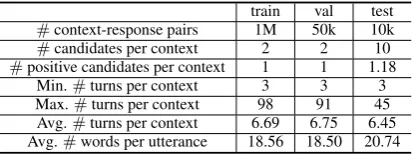
Specifically, we crawled1.1million dyadic dia-logues (conversation between two persons) longer than2turns from Douban group3which is a pop-ular social networking service in China. We ran-domly sampled0.5million dialogues for creating a training set,25thousand dialouges for creating a validation set, and1,000dialogues for creating a test set, and made sure that there is no overlap be-tween the three sets. For each dialogue in training and validation, we took the last turn as a positive response for the previous turns as a context and randomly sampled another response from the1.1 million data as a negative response. There are1 million context-response pairs in the training set and50thousand pairs in the validation set.
To create the test set, we first crawled 15 mil-lion post-reply pairs from Sina Weibo4 which is
the largest microblogging service in China and in-dexed the pairs with Lucene5. We took the last
turn of each Douban dyadic dialogue in the test set as a message, retrieved 10 response candi-dates from the index following the method in Sec-tion 4, and finally formed a test set with 10,000 context-response pairs. We recruited three label-ers to judge if a candidate is a proper response to the context. A proper response means the response can naturally reply to the message given the whole context. Each pair received three labels and the majority of the labels were taken as the final deci-sion. Table2gives the statistics of the three sets. Note that the Fleiss’ kappa (Fleiss, 1971) of the labeling is0.41, which indicates that the three la-belers reached a relatively high agreement.
Besides Rn@ks, we also followed the
conven-3https://www.douban.com/group
4http://weibo.com/
5https://lucenenet.apache.org/
train val test
#context-response pairs 1M 50k 10k
#candidates per context 2 2 10
#positive candidates per context 1 1 1.18 Min.#turns per context 3 3 3 Max.#turns per context 98 91 45
[image:6.595.310.518.62.139.2]Avg.#turns per context 6.69 6.75 6.45 Avg.#words per utterance 18.56 18.50 20.74
Table 2: Statistics of Douban Conversation Corpus
tion of information retrieval and employed mean average precision (MAP) (Baeza-Yates et al., 1999), mean reciprocal rank (MRR) (Voorhees et al.,1999), and precision at position 1 (P@1) as evaluation metrics. We did not calculate R2@1
because in Douban corpus one context could have more than one correct responses, and we have to randomly sample one for R2@1, which may bring
bias to evaluation. When using the labeled set, we removed conversations with all negative re-sponses or all positive rere-sponses, as models make no difference with them. There are6,670 context-response pairs left in the test set.
5.3 Baseline
We considered the following baselines:
Basic models: models in (Lowe et al., 2015) and (Kadlec et al.,2015) including TF-IDF, RNN, CNN, LSTM and BiLSTM.
Multi-view: the model proposed by Zhou et al. (2016) that utilizes a hierarchical recurrent neural network to model utterance relationships.
Deep learning to respond (DL2R): the model proposed by Yan et al. (2016) that reformulates the message with other utterances in the context.
Ubuntu Corpus Douban Conversation Corpus
R2@1 R10@1 R10@2 R10@5 MAP MRR P@1 R10@1 R10@2 R10@5 TF-IDF 0.659 0.410 0.545 0.708 0.331 0.359 0.180 0.096 0.172 0.405
RNN 0.768 0.403 0.547 0.819 0.390 0.422 0.208 0.118 0.223 0.589
CNN 0.848 0.549 0.684 0.896 0.417 0.440 0.226 0.121 0.252 0.647
LSTM 0.901 0.638 0.784 0.949 0.485 0.527 0.320 0.187 0.343 0.720 BiLSTM 0.895 0.630 0.780 0.944 0.479 0.514 0.313 0.184 0.330 0.716 Multi-View 0.908 0.662 0.801 0.951 0.505 0.543 0.342 0.202 0.350 0.729 DL2R 0.899 0.626 0.783 0.944 0.488 0.527 0.330 0.193 0.342 0.705 MV-LSTM 0.906 0.653 0.804 0.946 0.498 0.538 0.348 0.202 0.351 0.710 Match-LSTM 0.904 0.653 0.799 0.944 0.500 0.537 0.345 0.202 0.348 0.720 Attentive-LSTM 0.903 0.633 0.789 0.943 0.495 0.523 0.331 0.192 0.328 0.718 Multi-Channel 0.904 0.656 0.809 0.942 0.506 0.543 0.349 0.203 0.351 0.709 Multi-Channelexp 0.714 0.368 0.497 0.745 0.476 0.515 0.317 0.179 0.335 0.691
SMNlast 0.923 0.723 0.842 0.956 0.526 0.571 0.393 0.236 0.387 0.729
SMNstatic 0.927 0.725 0.838 0.962 0.523 0.572 0.387 0.228 0.387 0.734
[image:7.595.77.521.62.235.2]SMNdynamic 0.926 0.726 0.847 0.961 0.529 0.569 0.397 0.233 0.396 0.724
Table 3: Evaluation results on the two data sets. Numbers in bold mean that the improvement is statisti-cally significant compared with the best baseline.
5.4 Parameter Tuning
For baseline models, if their results are available in existing literature (e.g., those on the Ubuntu cor-pus), we just copied the numbers, otherwise we implemented the models following the settings in the literatures. All models were implemented us-ing Theano (Theano Development Team, 2016). Word embeddings were initialized by the results of word2vec (Mikolov et al., 2013) which ran on the training data, and the dimensionality of word vectors is200. For Multi-Channel and layer one of our model, we set the dimensionality of the hidden states of GRU as200. We tuned the window size of convolution and pooling in{(2,2),(3,3)(4,4)} and chose (3,3) finally. The number of feature maps is8. In layer two, we set the dimensionality of matching vectors and the hidden states of GRU as50. The parameters were updated by stochastic gradient descent with Adam algorithm (Kingma and Ba, 2014) on a single Tesla K80 GPU. The initial learning rate is 0.001, and the parameters of Adam, β1 and β2 are 0.9 and 0.999
respec-tively. We employed early-stopping as a regu-larization strategy. Models were trained in mini-batches with a batch size of200, and the maximum utterance length is50. We set the maximum con-text length (i.e., number of utterances) as 10, be-cause the performance of models does not improve on contexts longer than 10 (details are shown in the Section 5.6). We padded zeros if the number of utterances in a context is less than10, otherwise we kept the last10utterances.
5.5 Evaluation Results
Table 3 shows the evaluation results on the two data sets. Our models outperform baselines
greatly in terms of all metrics on both data sets, with the improvements being statistically signifi-cant (t-test withp-value≤0.01, exceptR10@5on
Douban Corpus). Even the state-of-the-art single-turn matching models perform much worse than our models. The results demonstrate that one cannot neglect utterance relationships and simply perform multi-turn response selection by concate-nating utterances together. Our models achieve significant improvements over Multi-View, which justified our “matching first” strategy. DL2R is worse than our models, indicating that utterance reformulation with heuristic rules is not a good method for utilizing context information. Rn@ks
are low on the Douban Corpus as there are multi-ple correct candidates for a context (e.g., if there are3correct responses, then the maximumR10@1
is0.33). SMNdynamic is only slightly better than
SMNstatic and SMNlast. The reason might be
that the GRU can select useful signals from the matching sequence and accumulate them in the fi-nal state with its gate mechanism, thus the efficacy of an attention mechanism is not obvious for the task at hand.
5.6 Further Analysis
Ubuntu Corpus Douban Conversation Corpus
R2@1 R10@1 R10@2 R10@5 MAP MRR P@1 R10@1 R10@2 R10@5 ReplaceM 0.905 0.661 0.799 0.950 0.503 0.541 0.343 0.201 0.364 0.729
ReplaceA 0.918 0.716 0.832 0.954 0.522 0.565 0.376 0.220 0.385 0.727
[image:8.595.89.508.57.130.2]OnlyM1 0.919 0.704 0.832 0.955 0.518 0.562 0.370 0.228 0.371 0.737 OnlyM2 0.921 0.715 0.836 0.956 0.521 0.565 0.382 0.232 0.380 0.734 SMNlast 0.923 0.723 0.842 0.956 0.526 0.571 0.393 0.236 0.387 0.729
Table 4: Evaluation results of model ablation.
then the commandglebihanshouldextractthem
all from/tothatdirectory
how can unzip many rar ( _number_ for example ) files at once
0.00 0.15 0.30 0.45 0.60 0.75 0.90 1.05 1.20 1.35 1.50
value
(a)M1ofu1andr
then the
commandglebihanshouldextractthem all
from/tothatdirectory
okay
how 0.000.15
0.30 0.45 0.60 0.75 0.90 1.05 1.20 1.35 1.50
value
(b) M1ofu3andr
0 10 20 30 40
u_1 u_2 u_3 u_4 u_5
0.0 0.1 0.2 0.3 0.4 0.5 0.6 0.7 0.8 0.9 1.0
value
[image:8.595.102.483.58.276.2](c) Update gate Figure 2: Model visualization. Darker areas mean larger value.
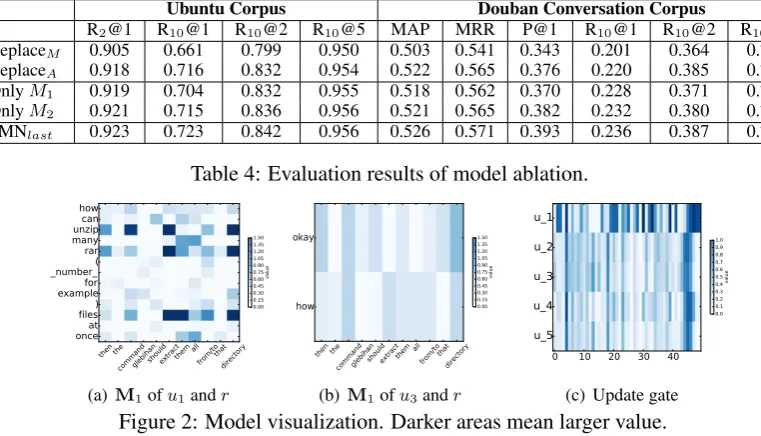
in the same directory? u5: yes they all are; r: then the command glebihan should extract them all from/to that directory}. It is from the test set and our model successfully ranked the correct re-sponse to the top position. Due to space limita-tion, we only visualizedM1, M2 and the update
gate (i.e. z) in Figure 2. We can see that in u1
important words including “unzip”, “rar”, “files” are recognized and carried to matching by “com-mand”, “extract”, and “directory” in r, while u3
is almost useless and thus little information is ex-tracted from it. u1 is crucial to response selection
and nearly all information fromu1andrflows to
the hidden state of GRU, while other utterances are less informative and the corresponding gates are almost “closed” to keep the information from
u1 andruntil the final state.
Model ablation: we investigate the effect of different parts of SMN by removing them one by one from SMNlast, shown in Table4. First,
replac-ing the multi-channel “2D” matchreplac-ing with a neural tensor network (NTN) (Socher et al., 2013) (de-noted as ReplaceM) makes the performance drop
dramatically. This is because NTN only matches a pair by an utterance vector and a response vector and loses important information in the pair. To-gether with the visualization, we can conclude that “2D” matching plays a key role in the “matching first” strategy as it captures the important match-ing information in each pair with minimal loss. Second, the performance drops slightly when re-placing the GRU for matching accumulation with a multi-layer perceptron (denoted as ReplaceA).
This indicates that utterance relationships are use-ful. Finally, we left only one channel in matching
and found thatM2 is a little more powerful than
M1 and we achieve the best results with both of
them (except onR10@5on the Douban Corpus).
Performance across context length: we study how our model (SMNlast) performs across the
length of contexts. Figure 3 shows the compar-ison on MAP in different length intervals on the Douban corpus. Our model consistently performs better than the baselines, and when contexts be-come longer, the gap bebe-comes larger. The re-sults demonstrate that our model can well capture the dependencies, especially long dependencies, among utterances in contexts.
(2,5] (5,10] (10,)
context length
40 45 50 55 60
MAP
[image:8.595.330.501.464.552.2]LSTM MV-LSTM Multi-View SMN
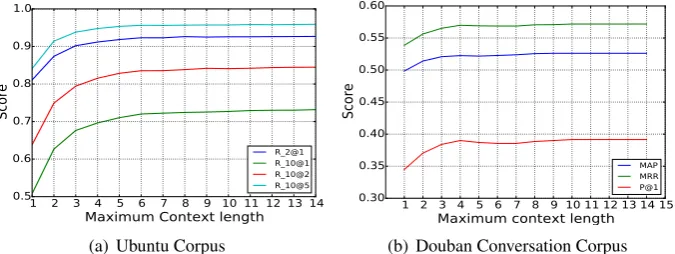
Figure 3: Comparison across context length Maximum context length: we investigate the influence of maximum context length for SMN. Figure 4 shows the performance of SMN on Ubuntu Corpus and Douban Corpus with respect to maximum context length. From Figure 4, we find that performance improves significantly when the maximum context length is lower than 5, and becomes stable after the context length reaches 10. This indicates that context information is impor-tant for multi-turn response selection, and we can set the maximum context length as 10 to balance effectiveness and efficiency.
1 2 3 4 5 6 7 8 9 10 11 12 13 14
Maximum Context length
0.5 0.6 0.7 0.8 0.9 1.0
Score
R_2@1 R_10@1 R_10@2 R_10@5
(a) Ubuntu Corpus
1 2 3 4 5 6 7 8 9 10 11 12 13 14 15
Maximum context length
0.30 0.35 0.40 0.45 0.50 0.55 0.60
Score
MAP MRR P@1
[image:9.595.131.469.69.196.2](b) Douban Conversation Corpus Figure 4: Performance of SMN across maximum context length
still several problems that cannot be handled per-fectly.
(1) Logical consistency. SMN models the con-text and response on the semantic level, but pays little attention to logical consistency. This leads to several DSATs in the Douban Corpus. For exam-ple, given a context{a: Does anyone know New-ton jogging shoes? b: 100 RMB on Taobao. a: I know that. I do not want to buy it because that is a fake which is made in Qingdao ,b: Is it the only reason you do not want to buy it? }, SMN gives a large score to the response {It is not a fake. I
just worry about the date of manufacture}. The response is inconsistent with the context on logic, as it claims that the jogging shoes are not fake. In the future, we shall explore the logic consistency problem in retrieval-based chatbots.
(2) No correct candidates after retrieval. In the experiment, we prepared 1000 contexts for test-ing, but only 667 contexts have correct candidates after candidate response retrieval. This indicates that there is still room for candidate retrieval com-ponents to improve, and only expanding the input message with several keywords in context may not be a perfect approach for candidate retrieval. In the future, we will consider advanced methods for retrieving candidates.
6 Conclusion and Future Work
We present a new context based model for multi-turn response selection in retrieval-based chatbots. Experiment results on open data sets show that the model can significantly outperform the state-of-the-art methods. Besides, we publish the first human-labeled multi-turn response selection data set to research communities. In the future, we shall study how to model logical consistency of responses and improve candidate retrieval.
7 Acknowledgment
We appreciate valuable comments provided by anonymous reviewers and our discussions with Zhao Yan. This work was supported by the National Natural Science Foundation of China (Grand Nos. 61672081, U1636211, 61370126), Beijing Advanced Innovation Center for Imag-ing Technology (No.BAICIT-2016001), National High Technology Research and Development Pro-gram of China (No.2015AA016004), and the Fund of the State Key Laboratory of Software Develop-ment EnvironDevelop-ment (No.SKLSDE-2015ZX-16).
References
Ricardo Baeza-Yates, Berthier Ribeiro-Neto, et al. 1999. Modern information retrieval, volume 463. ACM press New York.
Junyoung Chung, Caglar Gulcehre, KyungHyun Cho, and Yoshua Bengio. 2014. Empirical evaluation of gated recurrent neural networks on sequence model-ing.arXiv preprint arXiv:1412.3555.
Joseph L Fleiss. 1971. Measuring nominal scale agree-ment among many raters. Psychological bulletin 76(5):378.
Baotian Hu, Zhengdong Lu, Hang Li, and Qingcai Chen. 2014. Convolutional neural network archi-tectures for matching natural language sentences. InAdvances in Neural Information Processing Sys-tems. pages 2042–2050.
Zongcheng Ji, Zhengdong Lu, and Hang Li. 2014. An information retrieval approach to short text conver-sation. arXiv preprint arXiv:1408.6988.
Rudolf Kadlec, Martin Schmid, and Jan Kleindienst. 2015. Improved deep learning baselines for ubuntu corpus dialogs. arXiv preprint arXiv:1510.03753. Diederik Kingma and Jimmy Ba. 2014. Adam: A
Jiwei Li, Michel Galley, Chris Brockett, Jianfeng Gao, and Bill Dolan. 2015. A diversity-promoting objec-tive function for neural conversation models. arXiv preprint arXiv:1510.03055.
Jiwei Li, Michel Galley, Chris Brockett, Jianfeng Gao, and Bill Dolan. 2016. A persona-based neural con-versation model. arXiv preprint arXiv:1603.06155 .
Ryan Lowe, Nissan Pow, Iulian Serban, and Joelle Pineau. 2015. The ubuntu dialogue corpus: A large dataset for research in unstructured multi-turn dia-logue systems. arXiv preprint arXiv:1506.08909. Tomas Mikolov, Ilya Sutskever, Kai Chen, Greg S
Cor-rado, and Jeff Dean. 2013. Distributed representa-tions of words and phrases and their compositional-ity. InAdvances in neural information processing systems. pages 3111–3119.
Alan Ritter, Colin Cherry, and William B Dolan. 2011. Data-driven response generation in social media. In Proceedings of the Conference on Empirical Meth-ods in Natural Language Processing. Association for Computational Linguistics, pages 583–593.
Iulian V Serban, Alessandro Sordoni, Yoshua Bengio, Aaron Courville, and Joelle Pineau. 2015. Build-ing end-to-end dialogue systems usBuild-ing generative hi-erarchical neural network models. arXiv preprint arXiv:1507.04808.
Iulian Vlad Serban, Tim Klinger, Gerald Tesauro, Kartik Talamadupula, Bowen Zhou, Yoshua Ben-gio, and Aaron Courville. 2016. Multiresolu-tion recurrent neural networks: An applicaMultiresolu-tion to dialogue response generation. arXiv preprint arXiv:1606.00776.
Lifeng Shang, Zhengdong Lu, and Hang Li. 2015. Neural responding machine for short-text conversa-tion. InACL 2015, July 26-31, 2015, Beijing, China, Volume 1: Long Papers. pages 1577–1586.
Richard Socher, Danqi Chen, Christopher D Manning, and Andrew Ng. 2013. Reasoning with neural ten-sor networks for knowledge base completion. In Ad-vances in Neural Information Processing Systems. pages 926–934.
Ming Tan, Bing Xiang, and Bowen Zhou. 2015. Lstm-based deep learning models for non-factoid answer selection. arXiv preprint arXiv:1511.04108.
Theano Development Team. 2016. Theano: A Python framework for fast computation of
mathe-matical expressions.arXiv e-printsabs/1605.02688.
http://arxiv.org/abs/1605.02688.
Oriol Vinyals and Quoc Le. 2015. A neural conversa-tional model. arXiv preprint arXiv:1506.05869.
Ellen M Voorhees et al. 1999. The trec-8 question an-swering track report. InTrec. volume 99, pages 77– 82.
Shengxian Wan, Yanyan Lan, Jun Xu, Jiafeng Guo, Liang Pang, and Xueqi Cheng. 2016. Match-srnn: Modeling the recursive matching structure with spa-tial rnn. arXiv preprint arXiv:1604.04378.
Hao Wang, Zhengdong Lu, Hang Li, and Enhong Chen. 2013. A dataset for research on short-text conversations. InEMNLP. pages 935–945.
Mingxuan Wang, Zhengdong Lu, Hang Li, and Qun Liu. 2015. Syntax-based deep matching of short texts.arXiv preprint arXiv:1503.02427.
Shuohang Wang and Jing Jiang. 2015. Learning nat-ural language inference with lstm. arXiv preprint arXiv:1512.08849.
Bowen Wu, Baoxun Wang, and Hui Xue. 2016a. Rank-ing responses oriented to conversational relevance in chat-bots.COLING16.
Yu Wu, Wei Wu, Zhoujun Li, and Ming Zhou. 2016b. Topic augmented neural network for short text con-versation. CoRRabs/1605.00090.
Chen Xing, Wei Wu, Yu Wu, Jie Liu, Yalou Huang, Ming Zhou, and Wei-Ying Ma. 2016. Topic augmented neural response generation with a joint attention mechanism. arXiv preprint arXiv:1606.08340.
Zhen Xu, Bingquan Liu, Baoxun Wang, Chengjie Sun, and Xiaolong Wang. 2016. Incorporating loose-structured knowledge into lstm with recall gate for conversation modeling. arXiv preprint arXiv:1605.05110.
Rui Yan, Yiping Song, and Hua Wu. 2016. Learning to respond with deep neural networks for
retrieval-based human-computer conversation system. In
SI-GIR 2016, Pisa, Italy, July 17-21, 2016. pages 55–
64.https://doi.org/10.1145/2911451.2911542.
Zichao Yang, Diyi Yang, Chris Dyer, Xiaodong He, Alex Smola, and Eduard Hovy. 2016. Hierarchi-cal attention networks for document classification. InProceedings of the 2016 Conference of the North American Chapter of the Association for Computa-tional Linguistics: Human Language Technologies.
Steve Young, Milica Gaˇsi´c, Simon Keizer, Franc¸ois Mairesse, Jost Schatzmann, Blaise Thomson, and Kai Yu. 2010. The hidden information state model: A practical framework for pomdp-based spoken dia-logue management. Computer Speech & Language 24(2):150–174.