Proceedings of the 55th Annual Meeting of the Association for Computational Linguistics, pages 939–949 Vancouver, Canada, July 30 - August 4, 2017. c2017 Association for Computational Linguistics Proceedings of the 55th Annual Meeting of the Association for Computational Linguistics, pages 939–949
Vancouver, Canada, July 30 - August 4, 2017. c2017 Association for Computational Linguistics
Semantic Word Clusters Using Signed Spectral Clustering
Jo˜ao Sedoc, Jean Gallier, Lyle Ungar
Computer & Information Science University of Pennsylvania
joao, jean, [email protected]
Dean Foster
Amazon LLC [email protected]
Abstract
Vector space representations of words cap-ture many aspects of word similarity, but such methods tend to produce vector spaces in which antonyms (as well as syn-onyms) are close to each other. For spec-tral clustering using such word embed-dings, words are points in a vector space where synonyms are linked with posi-tive weights, while antonyms are linked with negative weights. We present a new signed spectral normalized graph cut al-gorithm, signed clustering, that overlays existing thesauri upon distributionally de-rived vector representations of words, so that antonym relationships between word pairs are represented by negative weights. Our signed clustering algorithm produces clusters of words that simultaneously cap-ture distributional and synonym relations. By using randomized spectral decomposi-tion (Halko et al.,2011) and sparse matri-ces, our method is both fast and scalable. We validate our clusters using datasets containing human judgments of word pair similarities and show the benefit of using our word clusters for sentiment prediction.
1 Introduction
In distributional vector representations, opposite relations are not fully captured. Take, for example, words such as “great” and “awful” that can appear with similar frequency in the same sentence struc-ture: “John had a great meeting” and “John had an awful day.” Word embeddings, which are success-ful in a wide array of NLP tasks (Turney et al., 2010; Dhillon et al., 2015), fail to capture this antonymy because they follow the distributional hypothesis that similar words are used in similar
contexts (Harris, 1954), thus assigning small co-sine or euclidean distances between the vector rep-resentations of “great” and “awful”.
While vector space models (Turney et al.,2010) such as word2vec (Mikolov et al., 2013), Global vectors (GloVe) (Pennington et al., 2014), or Eigenwords (Dhillon et al., 2015) capture relat-edness, they do not adequately encode synonymy and semantic similarity (Mohammad et al.,2013; Scheible et al.,2013). Our goal is to create clus-ters of synonyms or semantically equivalent words and linguistically motivated unified constructs. Signed graphs, which are graphs with negative edge weights, were first introduced byCartwright and Harary (1956). However, signed graph clus-tering for multiclass normalized cuts (K-clusters) has been largely unexplored until recently. We present a novel theory and method that extends multiclass normalized cuts (K-cluster) of Yu and Shi(2003) to signed graphs (Gallier, 2016)1 and
the work ofKunegis et al.(2010) to K-clustering. This extension allows the incorporation of knowl-edge base information, positive and negatively weighted links (see figure 2.1). Negative edges serve as repellent or opposite relationships be-tween nodes.
Our signed spectral normalized graph cut algo-rithm (henceforth, signed clustering) builds neg-ative edge relations into graph embeddings using similarity structure in vector spaces. It takes as input an initial set of vectors and edge relations, and hence is easy to combine with any word em-bedding method. This paper formally improves on the discrete optimization problem of Yu and Shi (2003).
Signed clustering gives better clusters than spectral clustering (Shi and Malik,2000) of word embeddings, and it has better coverage and is more robust than thesaurus look-up. This is because
the-1Gallier(2016) is a full theoretical exposition of our meth-ods with proofs on arXiv.
sauri erroneously give equal weight to rare senses of a word – for example, “rich” as a rarely used synonym of “absurd”. Also, the overlap between thesauri is small, due to their manual creation.Lin (1998) found 17.8397% overlap between synonym sets from Roget’s Thesaurus and WordNet 1.5. We find similarly small overlap between all three the-sauri tested.
We evaluate our clusters using SimLex-999 (Hill et al.,2014) and SimVerb-3500 (Gerz et al., 2016) as a ground truth for our cluster evaluation. Finally, we test our method on the sentiment anal-ysis task. Overall, signed spectral clustering can augment methods using signed information and has broad application for many fields.
Our main contributions are: the novel extension of signed clustering to the multiclass (K-cluster), and the application of this method to create seman-tic word clusters that are agnosseman-tic to vector space representations and thesauri.
1.1 Related Work
Semantic word cluster and distributional thesauri have been well studied in the NLP literature (Lin, 1998;Curran, 2004). Recently there has been a line of research on incorporating synonyms and antonyms into word embeddings. Our approach is very much in the line ofVlachos et al.(2009). However, they explicitly made verb clusters using Dirichlet Process Mixture Models and must-link / cannot-link clustering. Furthermore, they note that cannot-link clustering does not improve per-formance whereas our signed clustering antonyms are key.
Most recent models either attempt to make richer contexts, in order to find semantic similar-ity, or overlay thesaurus information in a super-vised or semi-supersuper-vised manner. One line of ac-tive research is post processing the word vector embedding by transforming the space using a sin-gle or multi-relational objective (Yih et al.,2012; Tang et al.,2014;Chang et al.,2013;Tang et al., 2014; Zhang et al., 2014; Faruqui et al., 2015; Mrkˇsi´c et al.,2016).
Alternatively, there are methods to modify the objective function for generating the word em-beddings (Ono et al., 2015; Pham et al., 2015; Schwartz et al.,2015).
Our approach differs from the aforementioned methods in that we created word clusters using the antonym relationships as negative links. Unlike
the previous approaches using semi-supervised methods, we incorporated the thesauri as a knowl-edge base. Similar to word vector retrofitting and counter-fitting methods described inFaruqui et al. (2015) and Mrkˇsi´c et al.(2016), our signed clus-tering method uses existing vector representations to create word clusters.
To our knowledge, this work is the first theo-retical foundation of multiclass signed normalized cuts.2 Zass and Shashua(2005) solved multiclass
cluster from another approach, by relaxing the or-thogonality assumption and focusing instead on the non-negativity constraint. This led to a doubly stochastic optimization problem. Negative edges are handled by a constrained hyperparameter.Hou (2005) used positive degrees of nodes in the de-gree matrix of a signed graph with weights (-1, 0, 1), which was advanced by Kolluri et al. (2004) andKunegis et al.(2010) using absolute values of weights in the degree matrix. Interestingly,Chiang et al.(2014) presented a theoretical foundation for edge sign prediction and a recursive clustering ap-proach.Mercado et al.(2016) found that using the geometric mean of the graph Laplacian improves performance.
Wang et al. (2016) used semi-supervised po-larity induction (Rao and Ravichandran, 2009) to create clusters of words with similar valence and arousal. Must-link and cannot-link soft spectral clustering (Rangapuram and Hein,2012) share similarities with our method, particularly in the limit where there are no must-link edges present. Both must-link and cannot-link clustering as well as polarity induction differ in optimization method. Our method is significantly faster due to the use of randomized SVD (Halko et al., 2011) and can thus be applied to large scale NLP prob-lems.
We developed a novel theory and algorithm that extends the clustering ofShi and Malik(2000) and Yu and Shi(2003) to the multiclass signed graph case.
2 Signed Graph Cluster Estimation 2.1 Signed Normalized Cut
Weighted graphs for which the weight matrix is a symmetric matrix in which negative and posi-tive entries are allowed are calledsigned graphs.
Such graphs (with weights (−1,0,+1)) were in-troduced as early as 1953 by (Harary, 1953), to model social relations involving disliking, indif-ference, and liking. The problem of cluster-ing the nodes of a signed graph arises naturally as a generalization of the clustering problem for weighted graphs. Figure 1 shows a signed graph of word similarities with a thesaurus overlay.Gallier
Figure 1: Signed graph of words using a distance metric from the word embedding. The red dashed edges represent the antonym relation while solid edges represent synonymy relations.
(2016) extends normalized cuts to signed graphs in order to incorporate antonym information into word clusters.
Definition 2.1. Aweighted graphis a pairG = (V, W), where V = {v1, . . . , vm} is a set of
nodes or vertices, and W is a symmetric matrix called theweight matrix, such thatwi j≥0for all
i, j ∈ {1, . . . , m}, andwi i = 0fori= 1, . . . , m.
We say that a set{vi, vj}is an edge iffwi j > 0.
The corresponding (undirected) graph(V, E)with
E ={{vi, vj} |wi j >0}, is called the
underly-ing graphofG.
Given a signed graph G = (V, W) (where
W is a symmetric matrix with zero diagonal en-tries), theunderlying graphofGis the graph with node set V and set of (undirected) edges E = {{vi, vj} |wij 6= 0}.
If (V, W) is a signed graph, where W is an m×msymmetric matrix with zero diagonal en-tries and with the other enen-trieswij ∈Rarbitrary,
for any node vi ∈ V, the signed degreeof vi is
defined as
di =d(vi) = m
X
j=1 |wij|,
and thesigned degree matrix Das
D= diag(d(v1), . . . , d(vm)).
For any subsetAof the set of nodesV, let
vol(A) = X
vi∈A
di =
X
vi∈A
m
X
j=1 |wij|.
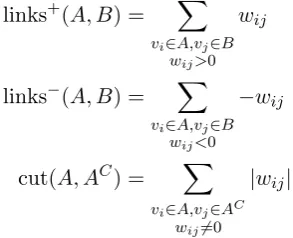
For any two subsetsAandB ofV andAC which is the complement of A, define links+(A, B), links−(A, B), andcut(A, AC)by
links+(A, B) = X
vi∈A,vj∈B
wij>0
wij
links−(A, B) = X
vi∈A,vj∈B
wij<0
−wij
cut(A, AC) = X
vi∈A,vj∈AC
wij6=0
|wij|.
Then, thesigned LaplacianLis defined by
L=D−W,
and its normalized versionLsymby
Lsym=D−1/2L D−1/2=I −D−1/2W D−1/2.
Kunegis et al. (2010) showed that L is positive semidefinite. For a graph without isolated vertices, we haved(vi) >0fori= 1, . . . , m, soD−1/2is
well defined.
Given a partition of V into K clusters
(A1, . . . , AK), if we represent thejth block of this
partition by a vectorXj such that
Xij = (
aj ifvi ∈Aj
0 ifvi ∈/ Aj,
for someaj 6= 0. For illustration, supposem= 5
andA1 ={v1, v3}then(X1)>= [a1,0, a1,0,0]. Definition 2.2. The signed normalized cut
sNcut(A1, . . . , AK)of the partition(A1, ..., AK)
is defined as
sNcut(A1, . . . ,AK) = K
X
j=1
cut(Aj, ACj ) + 2links−(Aj, Aj)
vol(Aj)
It should be noted that this formulation differs significantly fromKunegis et al.(2010) and even more so from must-link / cannot-link clustering.
Observe that minimizing sNcut(A1, . . . , AK)
minimizes the number of positive and negative edges between clusters and also the number of negative edges within clusters. Removing the term
links−(Aj, Aj)reducessNcutto normalized cuts.
A linear algebraic formulation is
sNcut(A1, . . . , AK) = K
X
j=1
(Xj)>LXj
(Xj)>DXj.
whereXis theN ×K matrix whosejth column isXj.
2.2 Optimization Problem
We now formulate K-way clustering of a graph using normalized cuts.
If we let
X =n[X1 . . . XK]|Xj =aj(xj1, . . . , xjN),
xji ∈ {1,0}, aj ∈R, Xj 6= 0
o
our solution set is
K=nX ∈ X |(Xi)>DXj = 0,
1≤i, j≤K, i6=jo.
The resulting optimization problem is
minimize
K
X
j=1
(Xj)>LXj
(Xj)>DXj
subject to (Xi)>DXj = 0,
1≤i, j≤K, i6=j, X∈ X.
The problem can be reformulated to an equiva-lent optimization problem:
minimize tr(X>LX)
subject to X>DX =I, X∈ X.
We then form a relaxation of the above problem, dropping the condition thatX∈ X, giving
Relaxed Problem
minimize tr(Y>D−1/2LD−1/2Y)
subject to Y>Y =I.
The minimum of the relaxed problem is achieved by the K unit eigenvectors associated with the smallest eigenvalues ofLsym.
2.3 Finding an Approximate Discrete Solution
Given a solution Z of the relaxed problem, we look for pairs(X, Q)withX ∈ X and whereQis aK×Kmatrix with nonzero and pairwise orthog-onal columns, withkXkF =kZkF, that minimize
ϕ(X, Q) =kX−ZQkF.
Here,kAkF is the Frobenius norm ofA.
This nonlinear optimization problem involves two unknown matricesXandQ. To solve the re-laxed problem, we proceed by alternating between minimizingϕ(X, Q) =kX−ZQkF with respect toX holdingQfixed (step 5 in algorithm 1), and minimizingϕ(X, Q)with respect toQholdingX fixed (steps 6 and 7 in algorithm 1).
This second stage in whichX is held fixed has been studied, but it is still a hard problem for which no closed-form solution is known. Hence we divide the problem into steps 6 and 7 for which the solution is known. Since Q is of the form Q=RΛwhereR∈O(K)andΛis a diagonal
in-vertible matrix, we minimizekX−ZRΛkF. The
matrixRΛis not a minimizer ofkX−ZRΛkF in
general, but it is an improvement onRalone, and both stages can be solved quite easily. In step 6 the problem reduces to minimizing −2tr(Q>Z>X);
that is, maximizingtr(Q>Z>X).
Algorithm 1Signed Clustering
1: Input: W the weight matrix (without isolated nodes), K the number of clusters, and termination threshold. 2: Using theDthe degree matrix, and the signed Laplacian
L, compute Lsym the signed normalized Laplacian.
3: InitializeΛ =I,X=D−12UwhereUis the matrix of
the eigenvectors corresponding to the K smallest eigen-values ofLsym.3
4: whilekX−ZRΛkF > do
5: MinimizekX−ZRΛkF with respect toXholding Qfixed.
6: FixX, Z, andΛ, findR ∈ O(K)that minimizes kX−ZRΛkF.
7: FixX,Z, andR, find a diagonal invertible matrixΛ that minimizeskX−ZRΛkF.
8: end while
9: Find the discrete solutionX∗by choosing the largest entryxij on rowisetxij = 1and all
otherxij = 0for rowi.
10: Output:X∗.
removing the solution requirement that Xj 6= 0,
the algorithm can findk≤Kclusters.
3 Similarity Calculation
The main input to the spectral signed clustering al-gorithm is the similarity matrixW, which overlays both the distributional properties and thesaurus in-formation. FollowingBelkin and Niyogi (2003), we chose the heat kernel based on the Euclidean distance between word vector representations as our similarity metric, such that
Wij =
0 ife−kwi−wjk
2
σ <
e−kwi−wjk
2
σ otherwise
.
whereσandare hyperparameters found using grid search (see Supplemental material for more detail).
We represented the thesaurus as two matrices where
Tijsyn = (
1 if wordsiandjare synonyms
0 otherwise .
and
Tijant= (
−1 if wordsiandjare antonyms
0 otherwise .
Tsyn is the synonym graph and Tant is the antonym graph. The signed graph can then be written in matrix form asWˆ =γW+βantTant
W+βsynTsynW, wherecomputes Hadamard product (element-wise multiplication).
The parameters γ, βsyn, and βant are tuned to
the data target dataset using cross validation. The reader should note thatσ andare not found us-ing a target dataset, but instead usus-ing cross vali-dation and grid search to minimize the number of negative edges within clusters and the number of disconnected components in the cluster.
4 Evaluation Metrics
We evaluated the clusters using both intrinsic and extrinsic methods. For intrinsic evaluation, we used thesaurus information for two novel metrics: 1) the number of negative edges (NNE) within the clusters, which in our semantic clusters is the num-ber of antonyms in the same cluster, and 2) the number of disconnected components (NDC) in the synonym graph, so the number of groups of words
that are not connected by a synonym relation in the thesaurus. The NDC thus has the disadvantage that it is a function of the thesaurus coverage. Our third intrinsic measure uses a gold standard de-signed to measure how well we capture word sim-ilarity: Semantically similar words should be in the same cluster and semantically dissimilar words should not. For extrinsic evaluation, as descibed below, we measure how much our clusters help to identify text polarity. We also compare multiple word embeddings and thesauri to demonstrate the stability of our method.
5 Experiments with Synthetic Data
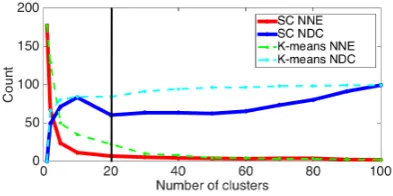
[image:5.595.314.511.391.489.2]In order to evaluate our signed graph clustering method, we first focused on intrinsic measures of cluster quality in synthetic data. To do so, we cre-ated random signed graphs with the same propor-tion of positive and negative edges as in our real dataset. Figure2demonstrates that the number of
Figure 2: The relation between disconnected com-ponent (NDC) and negative edge (NNE) using simulated signed graphs with 100 vertices.
6 Experimental Setup 6.1 Word Embeddings
We used four different word embedding meth-ods for evaluation: Skip-gram vectors (word2vec) (Mikolov et al., 2013), Global vectors (GloVe) (Pennington et al., 2014), Eigenwords (Dhillon et al., 2015), and Global Context (GloCon) (Huang et al.,2012); however, we only report the results for word2vec, which is the most popular word embedding (see the supplemental material for other embeddings). We used word2vec 300 dimensional embeddings which were trained on several billion words of English: the Gigaword and the English discussion forum data gathered as part of BOLT. Tokenization was performed using CMU’s Twokenize.4
6.2 Thesauri
Several thesauri were used in order to test the robustness including Roget’s Thesaurus (Roget, 1852), the Microsoft Word English (MS Word) thesaurus from Samsonovic et al. (2010) and WordNet 3.0 (Miller,1995).
We chose a subset of 5108 words for the training dataset, which had high overlap between various sources. Changes to the training dataset had mini-mal effects on the optimini-mal parameters. Within the training dataset, each of the thesauri had roughly 3700 antonym pairs; combined they had 6680. However, the number of distinct connected com-ponents varied, with Roget’s Thesaurus having the fewest (629), and MS Word Thesaurus (1162) and WordNet (2449) having the most. These ratios were consistent across the full dataset.
6.3 Gold Standard SimLex-999 And SimVerb-3500
Following the analysis ofVlachos et al.(2009), we threshold the semantically similar datasets to find word pairs which should or should not belong to the same cluster. As ground truth, we extracted 120 semantically similar words from SimLex-999 with a similarity score greater than 8 out of 10. SimLex-999 is a gold standard resource for se-mantic similarity, not relatedness, based on ratings by human annotators.
Our 120 pair subset of SimLex-999 has multiple parts-of-speech including Noun-Noun pairs, Verb-Verb pairs and Adjective-Adjective pairs. Within
4https://github.com/brendano/
ark-tweet-nlp
SimVerb-3500, we used a subset of 318 semanti-cally similar verb pairs.
The community is attempting to define better gold standards; however, currently these are the best datasets that we are aware of. We tried to use WordNet, Roget, and the Paraphrase Database (PPDB) (Ganitkevitch et al.,2013) as a gold stan-dard, but manual inspection as well as empiri-cal results showed that none of the automatiempiri-cally generated datasets were a sufficient gold standard. Possibly the symmetric pattern of (Schwartz et al., 2015) would have been sufficient; we did not have time to validate this.
6.4 Stanford Sentiment Treebank
We also evaluated our clusters by using them as features for predicting sentiment, using senti-ment treebank5(Socher et al.,2013) with
coarse-grained labels on phrases and sentences from movie review excerpts. This dataset is widely used for the evaluation of sentiment analysis. We used the standard partition of the treebank into training (6920), development (872), and test (1821) sets.
7 Cluster Evaluation
Table1shows the four most-associated words with “accept” using different methods.
We now turn to quantitative measures of word similarity and synonym cluster quality.
7.1 Comparison with K-means and Normalized Cuts
In order to assess the model we tested (1) K-means, (2) normalized cuts without thesaurus, and (3) signed normalized cuts. As a baseline, we created clusters using K-means on the original word2vec vector representations where the num-ber of K clusters was set to 750.
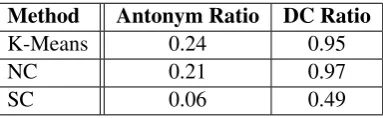
Table2shows the relative ratios of the different clustering methods of with respect to antonym pair inclusion and the number of disconnected compo-nents within the clusters. For both methods, over twenty percent of the clusters contain antonym pairs even though the median cluster size is six. Signed clustering radically reduced the number of antonyms within clusters compared to the other methods.
5http://nlp.stanford.edu/sentiment/
Ref word Roget WordNet MS Word W2V SC W2V
accept adopt agree take accepts grant
[image:7.595.115.480.62.133.2]accept your fate get swallow reject permit be fooled by fancy consent agree let acquiesce hold assume accepting okay
Table 1: Qualitative comparison of clusters.
Method Antonym Ratio DC Ratio
K-Means 0.24 0.95
NC 0.21 0.97
[image:7.595.312.519.168.314.2]SC 0.06 0.49
Table 2: Clustering evaluation of K-means, nor-malized cuts, and signed nornor-malized cuts with 750 clusters. Ratio of clusters with containing one or more antonym pair and ratio of clusters with dis-connected components.
8 Empirical Results
Tables 3 and 5 present our main result. When using our signed clustering method with similar words, as labeled by SimLex-999 and SimVerb-3500, our clustering accuracy increased by 5% on both SimLex-999 and SimVerb-3000. Fur-thermore, by combining the thesauri lookup with our clustering, we achieved almost perfect accu-racy (96%). Table 5 shows the sentiment analy-sis task performance. Our method outperforms all methods with similar complexity; however, we did not reach state-of-the-art results when compared to much more complex models which also use a richer dataset.
8.1 Evaluation Using Word Similarity Datasets
In a perfect setting, all word pairs rated highly similar by human annotators would be in the same cluster, and all words which were rated dissimilar would be in different clusters. Since our cluster-ing algorithm produced sets of words, we used this evaluation instead of the more commonly reported correlations.
In table 3 we show the results of the eval-uation with SimLex-999. Combining thesaurus lookup and word2vec+CombThes clusters, la-beled as Lookup + SC(W2V), yielded an accu-racy of 0.96 (5 errors). Note that clusters using word2vec with normalized cuts does not improve accuracy. The MSW thesaurus has much lower coverage, but 100 % accuracy, which is why when
Method Acc SimLex Err
MSW Lookup 0.70 0
Roget Lookup 0.63 0
WordNet Lookup 0.43 0
Combined Lookup 0.90 0
NC(W2V) 0.36 0.05
SC(W2V) 0.67 0
Lookup + NC(W2V) 0.91 0.05 Lookup +SC(W2V) 0.96 0
[image:7.595.85.277.171.230.2]MSW +SC(W2V) 0.95 0
Table 3: Clustering evaluation using SimLex-999 with 120 word pairs having similarity score over 8. SC stands for our signed clustering and NC is standard normalized cuts. SC(W2V) are the word clusters from signed clustering using word2vec and the combined thesauri. Erris the proportion of dissimilar words (with score<2) present in the same cluster.
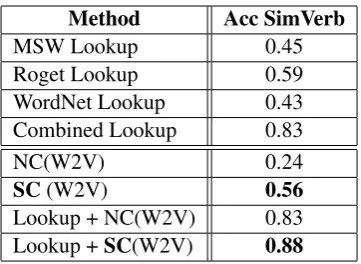
combined with the signed clustering the perfor-mance is 0.95. In table3 we state the proportion of clusters containing dissimilar words as a sanity check for cluster size. (See supplemental mate-rial for full cluster size optimization information.) Another important result is that the verb accuracy yielded the largest accuracy gains, consistent with the results ofSchwartz et al.(2015).
Table 4 clearly shows that the overall perfor-mance of all methods is lower for verb similarity. However, the improvement using both signed clus-tering as well as thesaurus look is also larger.
8.2 Sentiment Analysis
We trained anl2-norm regularized logistic
regres-sion (Friedman et al.,2001) and simultaneouslyγ, βsyn, and βant using our word clusters in order
Method Acc SimVerb
MSW Lookup 0.45
Roget Lookup 0.59
WordNet Lookup 0.43 Combined Lookup 0.83
NC(W2V) 0.24
SC(W2V) 0.56
[image:8.595.90.271.60.192.2]Lookup + NC(W2V) 0.83 Lookup +SC(W2V) 0.88
Table 4: Clustering evaluation using SimVerb-3500 with 317 word pairs having similarity score over 8. SC stands for our signed clustering and NC is standard normalized cuts. SC(W2V) are the word clusters from signed clustering using word2vec and the combined thesauri.
K were optimized minimizing error using grid search. We compared our model against exist-ing models: Naive Bayes with bag of words (NB) (Socher et al., 2013), sentence word embedding averages (VecAvg), retrofitted sentence word em-beddings (RVecAvg) (Faruqui et al., 2015) that incorporate thesaurus information, simple recur-rent neural networks (RNN), and two baselines of normalized cuts and signed normalized cuts using only thesaurus information.
While the state-of-the art Convolutional Neu-ral Network (CNN) (Kim, 2014) is at 0.881, our model performs quite well with much less infor-mation and complexity. Table5shows that signed clustering outperforms the baselines of Naive Bayes, normalized cuts, and signed cuts using just thesaurus information. Furthermore, we outper-form comparable models, including retrofitting, which has thesaurus information, and the recur-rent neural network, which has access to domain specific context information.
Signed clustering using only thesaurus infor-mation (SC(Thes)) performed significantly worse than all other methods. This was largely due to low coverage; rare words such as “WOW” and “???” are not covered. As expected, because nor-malized cut clusters include antonyms, the method performs worse than others. Nonetheless the im-provement from 0.79 to 0.836 is quite drastic.
9 Conclusion
We developed a novel theory for signed normal-ized cuts and an algorithm for finding their dis-crete solution. We showed that we can find
su-Model Accuracy
NB (Socher et al.,2013) 0.818
VecAvg (W2V) 0.812
(Faruqui et al.,2015)
RVecAvg (W2V) 0.821
(Faruqui et al.,2015)
RNN(Socher et al.,2013) 0.824
NC(W2V) 0.79
SC(Thes) 0.752
[image:8.595.323.507.60.203.2]SC(W2V) 0.836
Table 5: Sentiment analysis accuracy for binary predictions of signed clustering algorithm (SC) versus other models. SC(W2V) are the signed clusters using word2vec word representations.
perior semantically similar clusters which do not require new word embeddings but simply overlay thesaurus information on preexisting ones. The clusters are general and can be used with many out-of-the-box word embeddings. By accounting for antonym relationships, our algorithm greatly outperforms simple normalized cuts. Finally, we examined our clustering method on the sentiment analysis task fromSocher et al. (2013) sentiment treebank dataset and showed that it improved per-formance versus comparable models.
Our automatically generated clusters give bet-ter coverage than manually constructed thesauri. Our signed spectral clustering method allows us to incorporate the knowledge contained in these thesauri without modifying the word embeddings themselves. We further showed that use of the the-sauri can be tuned to the task at hand.
References
Mikhail Belkin and Partha Niyogi. 2003. Laplacian eigenmaps for dimensionality reduction and data representation. Neural computation 15(6):1373– 1396.
Dorwin Cartwright and Frank Harary. 1956. Structural balance: a generalization of heider’s theory. Psy-chological review63(5):277.
Kai-Wei Chang, Wen-tau Yih, and Christopher Meek. 2013. Multi-relational latent semantic analysis. In
Proceedings of the 2013 Conference on Empirical
Methods in Natural Language Processing.
Associ-ation for ComputAssoci-ational Linguistics, pages 1602– 1612.http://aclweb.org/anthology/D13-1167.
Kai-Yang Chiang, Cho-Jui Hsieh, Nagarajan Natara-jan, Inderjit S. Dhillon, and Ambuj Tewari. 2014. Prediction and clustering in signed net-works: A local to global perspective.
Jour-nal of Machine Learning Research 15:1177–1213.
http://jmlr.org/papers/v15/chiang14a.html.
James Richard Curran. 2004. From distributional to semantic similarity .
Paramveer S. Dhillon, Dean P. Foster, and Lyle H. Un-gar. 2015. Eigenwords: Spectral word embeddings.
Journal of Machine Learning Research 16:3035–
3078.http://jmlr.org/papers/v16/dhillon15a.html.
Manaal Faruqui, Jesse Dodge, Kumar Sujay Jauhar, Chris Dyer, Eduard Hovy, and A. Noah Smith. 2015.
Retrofitting word vectors to semantic lexicons. In
Proceedings of the 2015 Conference of the North American Chapter of the Association for
Computa-tional Linguistics: Human Language Technologies.
Association for Computational Linguistics, pages 1606–1615. https://doi.org/10.3115/v1/N15-1184.
Jerome Friedman, Trevor Hastie, and Robert Tibshi-rani. 2001. The elements of statistical learning, vol-ume 1. Springer series in statistics Springer, Berlin.
Jean Gallier. 2016. Spectral theory of unsigned and signed graphs applications to graph clustering: a
sur-vey. arXiv preprint arXiv:1601.04692.
Juri Ganitkevitch, Benjamin Van Durme, and Chris Callison-Burch. 2013. Ppdb: The paraphrase database. In Proceedings of the 2013 Con-ference of the North American Chapter of the Association for Computational Linguistics:
Hu-man Language Technologies. Association for
Computational Linguistics, pages 758–764.
http://aclweb.org/anthology/N13-1092.
Daniela Gerz, Ivan Vuli´c, Felix Hill, Roi Reichart, and Anna Korhonen. 2016. Simverb-3500: A large-scale evaluation set of verb similarity. arXiv preprint
arXiv:1608.00869.
Nathan Halko, Per-Gunnar Martinsson, and Joel A Tropp. 2011. Finding structure with random-ness: Probabilistic algorithms for constructing ap-proximate matrix decompositions. SIAM review
53(2):217–288.
Frank Harary. 1953. On the notion of balance of a signed graph. The Michigan Mathematical Journal
2(2):143–146.
Zellig S Harris. 1954. Distributional structure.Word.
Felix Hill, Roi Reichart, and Anna Korhonen. 2014. Simlex-999: Evaluating semantic models with (genuine) similarity estimation. arXiv preprint
arXiv:1408.3456.
Yao Ping Hou. 2005. Bounds for the least laplacian eigenvalue of a signed graph. Acta Mathematica
Sinica21(4):955–960.
Eric Huang, Richard Socher, Christopher Manning, and Andrew Ng. 2012. Improving word repre-sentations via global context and multiple word prototypes. In Proceedings of the 50th An-nual Meeting of the Association for Computational
Linguistics (Volume 1: Long Papers).
Associa-tion for ComputaAssocia-tional Linguistics, pages 873–882.
http://aclweb.org/anthology/P12-1092.
Yoon Kim. 2014. Convolutional neural networks for sentence classification. In Proceedings of the 2014 Conference on Empirical Methods in
Nat-ural Language Processing (EMNLP). Association
for Computational Linguistics, pages 1746–1751.
https://doi.org/10.3115/v1/D14-1181.
Ravikrishna Kolluri, Jonathan Richard Shewchuk, and James F O’Brien. 2004. Spectral surface recon-struction from noisy point clouds. InProceedings of the 2004 Eurographics/ACM SIGGRAPH
sympo-sium on Geometry processing. ACM, pages 11–21.
J´erˆome Kunegis, Stephan Schmidt, Andreas Lom-matzsch, J¨urgen Lerner, Ernesto William De Luca, and Sahin Albayrak. 2010. Spectral analysis of signed graphs for clustering, prediction and visual-ization. InSDM. SIAM, volume 10, pages 559–559.
Dekang Lin. 1998. Automatic retrieval and clustering of similar words. In36th Annual Meeting of the As-sociation for Computational Linguistics and 17th In-ternational Conference on Computational
Linguis-tics, Volume 2.
http://aclweb.org/anthology/P98-2127.
Pedro Mercado, Francesco Tudisco, and Matthias Hein. 2016. Clustering signed networks with the geometric mean of laplacians. In D. D. Lee, M. Sugiyama, U. V. Luxburg, I. Guyon, and R. Garnett, editors,Advances in Neural Information
Processing Systems 29. Curran Associates, Inc.,
Tomas Mikolov, Kai Chen, Greg Corrado, and Jef-frey Dean. 2013. Efficient estimation of word representations in vector space. arXiv preprint
arXiv:1301.3781.
George A Miller. 1995. Wordnet: a lexical database for english. Communications of the ACM 38(11):39– 41.
M. Saif Mohammad, J. Bonnie Dorr, Graeme Hirst, and D. Peter Turney. 2013. Computing lexi-cal contrast. Computational Linguistics 39(3).
https://doi.org/10.1162/COLI a 00143.
Nikola Mrkˇsi´c, Diarmuid ´O S´eaghdha, Blaise Thom-son, Milica Gaˇsi´c, M. Lina Rojas-Barahona, Pei-Hao Su, David Vandyke, Tsung-Hsien Wen, and Steve Young. 2016. Counter-fitting word vec-tors to linguistic constraints. In Proceedings of the 2016 Conference of the North American Chap-ter of the Association for Computational
Linguis-tics: Human Language Technologies.
Associa-tion for ComputaAssocia-tional Linguistics, pages 142–148.
https://doi.org/10.18653/v1/N16-1018.
Masataka Ono, Makoto Miwa, and Yutaka Sasaki. 2015. Word embedding-based antonym detection using thesauri and distributional information. In
Proceedings of the 2015 Conference of the North American Chapter of the Association for
Computa-tional Linguistics: Human Language Technologies.
Association for Computational Linguistics, pages 984–989. https://doi.org/10.3115/v1/N15-1100. Jeffrey Pennington, Richard Socher, and
Christo-pher Manning. 2014. Glove: Global vectors for word representation. In Proceedings of the 2014 Conference on Empirical Methods in
Nat-ural Language Processing (EMNLP). Association
for Computational Linguistics, pages 1532–1543.
https://doi.org/10.3115/v1/D14-1162.
The Nghia Pham, Angeliki Lazaridou, and Marco Ba-roni. 2015. A multitask objective to inject lexi-cal contrast into distributional semantics. In Pro-ceedings of the 53rd Annual Meeting of the As-sociation for Computational Linguistics and the 7th International Joint Conference on Natural
Lan-guage Processing (Volume 2: Short Papers).
Asso-ciation for Computational Linguistics, pages 21–26.
https://doi.org/10.3115/v1/P15-2004.
Syama Sundar Rangapuram and Matthias Hein. 2012. Constrained 1-spectral clustering. International conference on Artificial Intelligence and Statistics
(AISTATS)22:1143—1151.
Delip Rao and Deepak Ravichandran. 2009. Semi-supervised polarity lexicon induction. In Pro-ceedings of the 12th Conference of the
Euro-pean Chapter of the ACL (EACL 2009).
Associa-tion for ComputaAssocia-tional Linguistics, pages 675–682.
http://aclweb.org/anthology/E09-1077.
Peter Mark Roget. 1852.Roget’s Thesaurus of English
Words and Phrases.... Longman Group Ltd.
Alexei V Samsonovic, Giorgio A Ascoli, and Jeffrey Krichmar. 2010. Principal semantic components of language and the measurement of meaning. PloS one5(6):e10921.
Silke Scheible, Sabine Schulte im Walde, and Sylvia Springorum. 2013. Uncovering distribu-tional differences between synonyms and antonyms in a word space model. In Proceedings of the Sixth International Joint Conference on
Nat-ural Language Processing. Asian Federation of
Natural Language Processing, pages 489–497.
http://aclweb.org/anthology/I13-1056.
Roy Schwartz, Roi Reichart, and Ari Rappoport. 2015. Symmetric pattern based word embeddings for improved word similarity prediction. In Pro-ceedings of the Nineteenth Conference on
Com-putational Natural Language Learning.
Associa-tion for ComputaAssocia-tional Linguistics, pages 258–267.
https://doi.org/10.18653/v1/K15-1026.
Jianbo Shi and Jitendra Malik. 2000. Normalized cuts and image segmentation. Pattern Analysis and Machine Intelligence, IEEE Transactions on
22(8):888–905.
Richard Socher, Alex Perelygin, Jean Wu, Ja-son Chuang, D. Christopher Manning, Andrew Ng, and Christopher Potts. 2013. Recur-sive deep models for semantic compositional-ity over a sentiment treebank. In Proceed-ings of the 2013 Conference on Empirical
Meth-ods in Natural Language Processing. Association
for Computational Linguistics, pages 1631–1642.
http://aclweb.org/anthology/D13-1170.
Duyu Tang, Furu Wei, Nan Yang, Ming Zhou, Ting Liu, and Bing Qin. 2014. Learning sentiment-specific word embedding for twitter sentiment clas-sification. In Proceedings of the 52nd Annual Meeting of the Association for Computational
Lin-guistics (Volume 1: Long Papers). Association
for Computational Linguistics, pages 1555–1565.
https://doi.org/10.3115/v1/P14-1146.
Peter D Turney, Patrick Pantel, et al. 2010. From frequency to meaning: Vector space models of se-mantics. Journal of artificial intelligence research
37(1):141–188.
Andreas Vlachos, Anna Korhonen, and Zoubin Ghahramani. 2009. Proceedings of the Workshop on Geometrical Models of Natural Language Se-mantics, Association for Computational Linguistics, chapter Unsupervised and Constrained Dirichlet Process Mixture Models for Verb Clustering, pages 74–82. http://aclweb.org/anthology/W09-0210.
Jin Wang, Liang-Chih Yu, K Robert Lai, and Xuejie Zhang. 2016. Community-based weighted graph model for valence-arousal prediction of affective words. IEEE/ACM Transactions on Audio, Speech,
Wen-tau Yih, Geoffrey Zweig, and John Platt. 2012.
Polarity inducing latent semantic analysis. In Pro-ceedings of the 2012 Joint Conference on Empiri-cal Methods in Natural Language Processing and
Computational Natural Language Learning.
Asso-ciation for Computational Linguistics, pages 1212– 1222.http://aclweb.org/anthology/D12-1111.
Stella X Yu and Jianbo Shi. 2003. Multiclass spec-tral clustering. In Computer Vision, 2003.
Pro-ceedings. Ninth IEEE International Conference on.
IEEE, pages 313–319.
Ron Zass and Amnon Shashua. 2005. A unifying ap-proach to hard and probabilistic clustering. In Com-puter Vision, 2005. ICCV 2005. Tenth IEEE
Interna-tional Conference on. IEEE, volume 1, pages 294–
301.
Jingwei Zhang, Jeremy Salwen, Michael Glass, and Alfio Gliozzo. 2014. Word semantic rep-resentations using bayesian probabilistic ten-sor factorization. In Proceedings of the 2014 Conference on Empirical Methods in Natural
Language Processing (EMNLP). Association for
Computational Linguistics, pages 1522–1531.