30
A Tutorial Markov Analysis of Effective Human Tutorial Sessions
Nabin Maharjan and Vasile Rus
Department of Computer Science / Institute for Intelligent Systems The University of Memphis
Memphis, TN, USA
{nmharjan,vrus}@memphis.edu
Abstract
This paper investigates what differentiates effective tutorial sessions from less effec-tive sessions. Towards this end, we charac-terize and explore human tutors’ actions in tutorial dialogue sessions by mapping the tutor-tutee interactions, which are streams of dialogue utterances, into streams of ac-tions, based on the language-as-action the-ory. Next, we use human expert judgment measures, evidence of learning (EL) and
evidence of soundness(ES), to identify ef-fective and inefef-fective sessions. We per-form sub-sequence pattern mining to iden-tify sub-sequences of dialogue modes that discriminate good sessions from bad ses-sions. We finally use the results of sub-sequence analysis method to generate a tu-torial Markov process for effective tutu-torial sessions.
1 Introduction
Identifying effective instructional strategies, i.e., strategies that induce learning gains, has been a key research question in the Intelligent Tutor-ing Systems (ITSs) community. There are two common approaches used to address this research question: (1) hypothesize and validate through experimentation strategies guided by sound ped-agogical theory (Aleven et al., 2001; Rus et al.,
2017a) and (2) discover strategies employed by expert tutors (Boyer et al.,2011;Rus et al.,2015;
Ohlsson et al.,2007). In our work, we adopt the latter approach which typically consists of mining patterns associated with successful tutorial ses-sions in large collections of recorded human tu-toring sessions. (Boyer et al., 2011;Cade et al.,
2008;Rus et al.,2015;Ohlsson et al.,2007). It is important to note that discovering effective
tutoring strategies by studying the strategies used by expert tutors is challenging because what char-acterizes tutoring expertise is still an open ques-tion to some degree (Rus et al.,2015). A tutor who employs sound strategies may appear less expert when working with students having low abilities or lacking in motivation. On the other hand, an average tutor may seem expert if s/he only works with high ability and highly motivated students. We lack student ability and prior knowledge infor-mation in our data and therefore focus oneffective tutoringrather thanexpert tutoring. Effective tu-toringrefers to tutoring that yields learning gains. In sum, we study in this paper strategies of effec-tive tutors as reflected in effeceffec-tive tutorial sessions. In this paper, we worked with an annotated cor-pus of human tutoring sessions from which we identified effective sessions based on human ex-pert judgments (see Section 5). We mapped tu-torial sessions onto sequences of dialogue acts and dialogue modes (Cade et al.,2008), explained later, using a predefined coding taxonomy (see Section3). We then conducted sub-sequence pat-tern mining to identify sub-sequences of dialogue modes that occur in effective tutoring sessions but not in ineffective tutoring sessions. We used these distinctive sub-sequences of modes to build a Markov process for effective tutorial sessions. Fi-nally, using the tutorial Markov process, we ana-lyzed and searched for dialogue mode patterns as-sociated with effective tutoring sessions.
2 Related Work
ITSs. Graesser et al.(1995) proposed a five-step general structure of collaborative problem solv-ing dursolv-ing tutorsolv-ing. Cade et al.(2008) examined likely sequences of dialogue modes in expert tu-toring. Boyer and colleagues (2009;2010) applied hidden Markov models to discover effective dia-logue modes inherent in the tutoring sessions.Rus et al.(2017b) used a supervised machine learning method to automatically map tutorial sessions into dialogue acts, sub-acts and modes and then ana-lyzed human tutoring sessions using profile com-parison and sequence logos to discover effective tutorial strategies in terms of dialogue acts and modes. Our work further contributes to this area of research by characterizing effective tutorial ses-sions in terms of dialogue mode sequential pat-terns and tutorial Markov processes.
3 Coding Taxonomy
The role of the coding taxonomy is to help us map tutors and tutees’ utterances in tutorial di-alogues onto actions, i.e., dialogue acts, based on the language-as-action theory (Austin, 1975;
Searle, 1969) according to which when we say something we do something. For example, the ut-terance:“There is an useful idea called ‘conserva-tion of energy”’is categorized as anAssertion dia-logue act, i.e., the utterance is making an assertion. Because the assertion is about “conservation of energy”, aConcept, we consider this as a special-ized assertion about a concept, i.e., an Assertion-Concept dialogue act-subact combination.
We group sequences of dialogue acts and sub acts into higher level constructs, i.e., dialogue modes. Dialogue modes represent contiguous sequences of dialogue acts-subacts that together serve particular pedagogical purposes, e.g., a se-quence of hints in the form of questions may re-flect a scaffolding instructional strategy in which the tutee works mostly by herself on the current instructional task while the tutor offers help, when needed, through such hints.
The dialogue act and mode taxonomies are adapted to our context from a set of earlier tax-onomies which were created to analyze a large corpus of online tutoring sessions conducted by human tutors in the domains of Algebra and Physics (Morrison et al., 2014). There are 17 top level expert-defined dialogue act categories. Each dialogue act category may have 4 to 22 subcategories or sub-acts. For example, we
dis-Annotation Agreement (%) Kappa
Act 77 0.72
Act-subact 62 0.60
Mode 44 0.37
Mode∗ 53.8 0.48
[image:2.595.319.513.62.148.2]Mode∗∗ 64.3 0.60
Table 1: Average Inter Annotator Agreement Be-tween Two Independent Annotators. Mode∗ and Mode∗∗ represent dialogue mode agreement be-tween verifier and first annotator and, verifier and second annotator respectively.
tinguish Assertions that reference aspects of the tutorial process itself (Assertion:Process); do-main concepts (Assertion:Concept), or the the use of lower-level mathematical calculations ( As-sertion:Calculation). Further, we have a set of 17 dialogue modes: Assessment, Closing, Fad-ing, ITSupport, Metacognition, MethodID, Mod-eling,OffTopic,Opening,ProblemID, ProcessNe-gotiation,RapportBuilding,RoadMap, SenseMak-ing,Scaffolding, SessionSummaryandTelling. A detailed description of the dialogue modes is de-scribed by Morrison and colleagues (Morrison et al.,2014).
4 Data
Mode sub-sequences (p-value in bracket)
Fading-Closing (0.0002)
Scaffolding-Scaffolding (0.0008) Fading (0.0009)
Scaffolding-Fading (0.0055) Fading-Fading (0.01) ProblemID-Fading (0.02)
ProblemID-Scaffolding-Scaffolding(0.0362) Closing (0.05)
Fading-RapportBuilding (0.05) Fading-ProcessNegotiation (0.06) Fading-Scaffolding (0.07)
Fading-ProcessNegotiation-Closing (0.07) Fading-Fading-Scaffolding (0.08)
ProblemID-Fading-Scaffolding (0.10) Fading-Scaffolding-Fading (0.14) Scaffolding-Closing (0.15)
Opening-ProblemID-Fading (0.18) RapportBuilding (0.18)
Fading-Scaffolding-Closing (0.18) Scaffolding-Fading-Scaffolding (0.20) Scaffolding-RapportBuilding (0.23)
Fading-Scaffolding-ProcessNegotiation (0.26) RapportBuilding-Closing(0.37)
Table 2: Discriminant mode sub-sequences.
5 Markov Analysis of Tutorial Sessions
In order to identify effective sessions, the SMEs also rated each tutorial session using a 1-5 scale (5 being best score) along two dimensions: evidence of learning (EL) and evidence of soundness (ES). The ES score is supposed to measure the degree to which the tutor applied pedagogically sound tac-tics. On the other hand, the EL score indicates whether there is strong evidence that the student learned from the tutoring session. The ES and EL distinction was designed in order to separate con-founding factors such as learners’ engagement in the session. For instance, a tutor may apply sound pedagogy but the student may not learn as all they might be interested is to find a quick answer to their (homework) problem. It should be noted that most of the sessions we had access to were in the context of homework help. That is, students start a session by asking for help with a particular prob-lem. While EL and ES were supposed to cap-ture different things, the EL and ES scores were found to be highly correlated (Pearson co-efficient of 0.7).
We used both EL and ES to capture overall
qual-ity of tutoring sessions. We categorized all ses-sions having ES and EL scores≤2 as ineffective, and all sessions rated with ES = 5 and EL≥4 as effective.
We conducted discriminant mode sub-sequence analysis using Traminer package in R. It should be noted that a sub-sequence is not necessarily a contiguous sequence of observations, however, the order of the observations is preserved. For ex-ample, (Fading)-(Closing) is a valid sub-sequence of dialogue modes formed from the (Fading )-(ProcessNegotiation)-(Closing) contiguous ses-sion fragment. We generated sub-sequences up to length 7 from all annotated tutorial sessions.
The Traminer algorithm first finds the most frequent sub-sequences by counting their distinct occurrences and then applies a Chi-squared test (Bonferroni-adjusted) to identify sub-sequences that are statistically more (or less) frequent in each group. We used a p-value<0.4 to generate a suf-ficient number of likely distinctive sub-sequences of modes (Table 2). Once the significant sub-sequences were identified, we generated a state transition matrix, explained next.
5.1 State Transition Matrix
We created a state transition matrix with modes as the states. We ignored sub-sequences of unit length as they don’t indicate an observed transition. For sub-sequences spanning more than two states, we split them into multiple bi-gram sub-sequences. For example, we obtained bigram sub-sequences Opening-ProblemID and
ProblemID-Fadingfrom the Opening-ProblemID-Fadingsub-sequence. We discarded self-transition paths since modes are actually mode switches in our case. Therefore, we discarded transition pathScaffolding-Scaffoldingfrom the ProblemID-Scaffolding-Scaffoldingsub-sequence.
We used confident scores of discriminant sub-sequences to compute transition probabilities. The confidence score of a discriminant sub-sequence is the probability that the sub-sequence is com-ing from an effective session, i.e., 1 - p-value. We computed a confidence score of a path as the confidence score of the discriminant sub-sequence the path belongs to. For example, for Opening-ProblemID-Fading (0.18), the con-fidence score of paths Opening-ProblemID and
confi-Figure 1: Tutorial Markov Process for effective tutorial sessions.
dence scores from all the sub-sequences where the path is present. For example, path ProblemID-Fading is present in sub-sequences ProblemID-Fading (0.02) and Opening-ProblemID-Fading
(0.18). So, the weight of the path ProblemID-Fading is: 0.98 + 0.82 = 1.8. Finally, we nor-malized the weight of each path A-B to represent transition probability by dividing it by the sum of the weights of all possible transitions from A. For example, the weight of the path ProblemID-Fading is normalized by dividing it by the sum total of weights of all the transitions from Prob-lemIDstate.
5.2 Tutorial Markov Interpretation
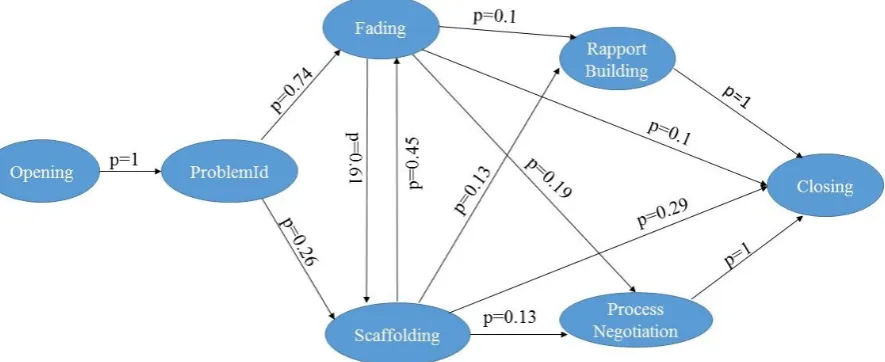
Figure 1 shows the state transition graph of the underlying Markov process corresponding to the above state transition matrix. In the figure, the states are dialogue modes whereas transitions are generated using only the discriminant sub-sequences of modes. Each path has been labeled with the corresponding transition probabilities.
The Markov process reveals that any sequence of modes it can generate starts with an Open-ing and ends with a Closing state and is likely to have a large number of Scaffolding - Fad-ing switches/transitions. This result partly sup-ports theoretical expert tutoring models based on themodeling-scaffolding-fadingparadigm ( Ro-goff and Lave, 1984). The high occurrences of these modes provide evidence that effective tu-tors monitor and engage students more and pro-vide help only when needed. Cade et al. (2008) also found that Scaffolding was a highly
occur-ring mode in expert tutooccur-ring. They found a rela-tively low occurrence of theFadingmode, which they suggested might be explained by time con-straints, i.e. the tutoring session prevented tutors from spending too much time in theFadingmode. The Markov process also resembles to some degree Graesser’s (Graesser et al., 1995) 5-step dialogue framework, which captures the tutorial phases prevalent in collaborative problem-solving tutoring: i) Tutor asks question, ii) Student an-swers question, iii) Tutor gives short feedback, iv)Tutor and student collaboratively improve the quality of the answer, v) Tutor assesses student’s understanding. One probable effective tutorial path from the Markov process, which might be comparable to Graesser’s framework, isOpening ProblemId Fading Scaffolding Fading -ProcessNegotiation - Closing. Indeed, the sub-path ProblemId - Fading - Scaffolding - Fading - ProcessNegotiationresembles Graesser’s 5-step framework.
[image:4.595.81.524.69.250.2]between Scaffolding and Fading to provide help (Scaffolding), only when needed. In this sense, the last two elements in Graesser’s framework can be considered to be aligned with theScaffolding -Fadingpattern.
The additional benefit of this Markov process representation is that it suggests multiple possible paths or meta-strategies that can lead to learning gains.
6 Conclusion
We used human expert judgment scores to iden-tify effective and ineffective tutoring sessions. We conducted discriminant mode sub-sequence anal-ysis based on which we generated a Markov pro-cess for effective tutorial sessions. We found that sequences of dialogue modes derived from the Markov process are most likely to have many Scaf-folding and Fading modes. Furthermore, the in-ferred Markov process suggests a new model for tutoring when students ask for help as opposed to tutor-driven sessions, which was modeled in the past. Our future work is to expand our understand-ing of the effective strategies in effective tutorial sessions while accounting for other factors such as students’ prior knowledge.
Acknowledgments
This work was partially supported by The Univer-sity of Memphis and a contract from the Advanced Distributed Learning Initiative of the United States Department of Defense.
References
Vincent Aleven, Octav Popescu, and Kenneth R Koedinger. 2001. Towards tutorial dialog to sup-port self-explanation: Adding natural language un-derstanding to a cognitive tutor. InProceedings of Artificial Intelligence in Education, pages 246–255.
John Langshaw Austin. 1975. How to do things with words. Oxford university press.
Kristy Elizabeth Boyer, Eunyoung Ha, Michael D Wal-lis, Robert Phillips, Mladen A Vouk, and James C Lester. 2009. Discovering tutorial dialogue strate-gies with hidden markov models. In AIED, pages 141–148.
Kristy Elizabeth Boyer, Robert Phillips, Amy Ingram, Eun Young Ha, Michael Wallis, Mladen Vouk, and James Lester. 2010. Characterizing the effective-ness of tutorial dialogue with hidden markov mod-els. In International Conference on Intelligent Tu-toring Systems, pages 55–64. Springer.
Kristy Elizabeth Boyer, Robert Phillips, Amy Ingram, Eun Young Ha, Michael Wallis, Mladen Vouk, and James Lester. 2011. Investigating the relationship between dialogue structure and tutoring effective-ness: a hidden markov modeling approach. Interna-tional Journal of Artificial Intelligence in Education, 21(1-2):65–81.
Whitney Cade, Jessica Copeland, Natalie Person, and Sidney DMello. 2008. Dialogue modes in expert tu-toring. InIntelligent tutoring systems, pages 470– 479. Springer.
Arthur C Graesser, Natalie K Person, and Joseph P Magliano. 1995. Collaborative dialogue patterns in naturalistic one-to-one tutoring. Applied cognitive psychology, 9(6):495–522.
Donald Morrison, Benjamin Nye, Borhan Samei, Vivek Varma Datla, Craig Kelly, and Vasile Rus. 2014. Building an intelligent pal from the tutor. com session database phase 1: Data mining. In Educa-tional Data Mining 2014.
Stellan Ohlsson, Barbara Di Eugenio, Bettina Chow, Davide Fossati, Xin Lu, and Trina C Kershaw. 2007. Beyond the code-and-count analysis of tutoring dia-logues. Artificial intelligence in education: Build-ing technology rich learnBuild-ing contexts that work, 158:349.
Barbara Ed Rogoff and Jean Ed Lave. 1984. Everyday cognition: Its development in social context. Har-vard University Press.
Vasile Rus, Rajendra Banjade, Nobal Niraula, Eliz-abeth Gire, and Donald Franceschetti. 2017a. A study on two hint-level policies in conversational in-telligent tutoring systems. InInnovations in Smart Learning, pages 171–181. Springer.
Vasile Rus, Nabin Maharjan, and Rajendra Banjade. 2015. Unsupervised discovery of tutorial dialogue modes in human-to-human tutorial data. In Pro-ceedings of the Third Annual GIFT Users Sympo-sium, pages 63–80.
Vasile Rus, Nabin Maharjan, Tamang Lasang, Michael Yudelson, Susan Berman, Fancsali Stephen, and Steve Ritter. 2017b. An analysis of human tutors actions in tutorial dialogues. In Proceedings of the Thirtieth International Florida Artificial Intelli-gence Research Society Conference.