Proceedings of the 55th Annual Meeting of the Association for Computational Linguistics, pages 1308–1319 Vancouver, Canada, July 30 - August 4, 2017. c2017 Association for Computational Linguistics Proceedings of the 55th Annual Meeting of the Association for Computational Linguistics, pages 1308–1319
Vancouver, Canada, July 30 - August 4, 2017. c2017 Association for Computational Linguistics
Chat Detection in an Intelligent Assistant: Combining Task-oriented and
Non-task-oriented Spoken Dialogue Systems
Satoshi Akasaki∗ The University of Tokyo
Nobuhiro Kaji Yahoo Japan Corporation [email protected]
Abstract
Recently emerged intelligent assistants on smartphones and home electronics (e.g., Siri and Alexa) can be seen as novel hybrids of domain-specific task-oriented spoken dialogue systems and open-domain non-task-oriented ones. To realize such hybrid dialogue systems, this paper investigates determining whether or not a user is going to have a chat with the system. To address the lack of bench-mark datasets for this task, we construct a new dataset consisting of15,160 utter-ances collected from the real log data of a commercial intelligent assistant (and will release the dataset to facilitate future re-search activity). In addition, we investi-gate using tweets and Web search queries for handling open-domain user utterances, which characterize the task of chat de-tection. Experiments demonstrated that, while simple supervised methods are ef-fective, the use of the tweets and search queries further improves the F1-score from 86.21to87.53.
1 Introduction
1.1 Chat detection
Conventional studies on spoken dialogue systems (SDS) have investigated either domain-specific task-oriented SDS1 (Williams and Young, 2007)
or open-domain non-task-oriented SDS (a.k.a., chatbots or chat-oriented SDS) (Wallace, 2009). The former offers convenience by helping users complete tasks in specific domains, while the latter ∗Work done during internship at Yahoo Japan
Corpora-tion.
1They can be classified as single-domain or multi-domain
task-oriented SDS.
offers entertainment through open-ended chatting (or smalltalk) with users. Although the function-alities offered by the two types of SDS are com-plementary to each other, little practical effort has been made to combine them. This unfortunately has limited the potential of SDS.
This situation is now being changed by the emergence of voice-activated intelligent assistants on smartphones and home electronics (e.g., Siri2
and Alexa3). These intelligent assistants typically
perform various tasks (e.g., Web search, weather checking, and alarm setting) while being able to have chats with users. They can be seen as a novel hybrid of multi-domain task-oriented SDS and open-domain non-task-oriented SDS.
To realize such hybrid SDS, we have to deter-mine whether or not a user is going to have a chat with the system. For example, if a user says “What is your hobby?” it is considered that she is going to have a chat with the system. On the other hand, if she says “Set an alarm at 8 o’clock,” she is prob-ably trying to operate her smartphone. We refer to this task aschat detectionand treat it as a binary classification problem.
Chat detection has not been explored enough in past studies. This is primarily because little attempts have been made to develop hybrids of task-oriented and non-task-oriented SDS (see Sec-tion 2 for related work). Although task-oriented and non-task-oriented SDS have long research his-tories, both of them do not require chat detec-tion. Typically, users of task-oriented SDS do not have chats with the systems and users of non-task-oriented SDS always have chats with the systems.
1.2 Summary of this paper
In this work, we construct a new dataset for chat detection. As we already discussed, chat detection
2http://www.apple.com/ios/siri 3https://developer.amazon.com/alexa
has not been explored enough, and thus there ex-ist no benchmark datasets available. To address this situation, we collected15,160user utterances from real log data of a commercial intelligent as-sistant, and recruited crowd workers to annotate those utterances with whether or not the users are going to have chats with the intelligent assistant. The resulting dataset will be released to facilitate future studies.
The technical challenge in chat detection is that we have to handle open-ended utterances of in-telligent assistant users. Commercial inin-telligent assistants have a vast amount of users and they talk about a wide variety of topics especially when chatting with the assistants. It consequently be-comes labor-intensive to collect a sufficiently large amount of annotated data for training accurate chat detectors.
We develop supervised binary classifiers to per-form chat detection. We address the open-ended user utterances, which characterize chat detection, by using unlabeled external resources. We specif-ically utilize tweets (i.e., Twitter posts) and Web search queries to enhance the supervised classi-fiers.
Experimental results demonstrated that, while simple supervised methods are effective, the ex-ternal resources are able to further improve them. The results demonstrated that the use of the ex-ternal resources increases over1point of F1-score (from86.21to87.53).
2 Related Work
2.1 Previous studies on combining
task-oriented and non-task-oriented SDS Task-oriented and non-task-oriented SDS have long been investigated independently, and little at-tempts have been made to develop hybrids of the two types of SDS. As a consequence, previous studies have not investigated chat detection with-out only a few exceptions.4
Niculescu and Banchs (2015) explored using non-task-oriented SDS as a back-off mechanism for task-oriented SDS. They, however, did not pro-pose any concrete methods of automatically deter-mining when to switch to non-task-oriented SDS.
4Unfortunately, we cannot discuss little about chat
detec-tion in existing commercial intelligent assistants since most of their technical details have not been disclosed. We make the best effort to compensate for it by comparing the pro-posed methods with our in-house intelligent assistant in the experiment.
Lee et al. (2007) proposed an example-based di-alogue manager to combine task-oriented and non-task-oriented SDS. In such a framework, however, it is difficult to flexibly utilize state-of-the-art su-pervised classifiers as a component.
Other studies proposed machine-learning-based frameworks for combining multi-domain task-oriented SDS and non-task-task-oriented SDS (Wang et al., 2014; Sarikaya, 2017). These assume that several components including a chat detector are already available, and explore integrating those components. They discuss little on how to develop each of the components. On the other hand, the fo-cus of this work is to develop one of those compo-nents, a chat detector. Although it lies outside the scope of this paper to explore how to exploit chat detection method in a full dialogue system, the chat detection method is considered to serve, for example, as one component within those frame-works.
2.2 Intent and domain determination
Chat detection is related to, but different from, intent and domain determination that have been studied in the field of SDS (Guo et al., 2014; Xu and Sarikaya, 2014; Ravuri and Stolcke, 2015; Kim et al., 2016; Zhang and Wang, 2016).
Both intent and domain determination have been investigated in domain-specific task-oriented SDS. Intent determination aims to determine the type of information a user is seeking in single-domain task-oriented SDS. For example, in the ATIS dataset, which is collected from an airline travel information service system, the information type includes flight, city, and so on (Tur et al., 2010). On the other hand, domain determination aims to determine which domain is relevant to a given user utterance in multi-domain task-oriented SDS (Xu and Sarikaya, 2014). Note that it is pos-sible that domain determination is followed by in-tent determination.
Unlike intent and domain determination, chat detection targets hybrid systems of multi-domain task-oriented SDS and open-domain non-task-oriented SDS, and aims to determine whether the non-task-oriented component is responsible to a given user utterance or not (i.e., the user is going to have a chat or not). Therefore, the objective of chat detection is different from intent and domain determination.
spe-cific problem of domain determination (Sarikaya, 2017). We, nevertheless, discuss it as a different problem because of the uniqueness of the “chat domain.” It greatly differs from ordinary domains in that it plays a role of combining the two differ-ent types of SDS that have long been studied in-dependently, rather than combining multiple SDS of the same types. In addition, we discuss the use of external resources, especially tweets, for chat detection. This approach is unique to chat detec-tion and is not considered effective for ordinary domain determination.
It is interesting to note that chat detection is not followed by slot-filling unlike intent and domain determination, as far as we use a popular response generator such as seq2seq model (Sutskever et al., 2014) or an information retrieval based approach (Yan et al., 2016). Although joint intent (or domain) determination and slot-filling has been widely studied to improve accuracy (Guo et al., 2014; Zhang and Wang, 2016), the same approach is not feasible in chat detection.
2.3 Intelligent assistant
Previous studies on intelligent assistants have not investigated chat detection. Their research top-ics are centered around those on user behaviors including the prediction of user satisfaction and engagement (Jiang et al., 2015; Kobayashi et al., 2015; Sano et al., 2016; Kiseleva et al., 2016a,b) and gamification (Otani et al., 2016). For example, Jiang et al. (2015) investigated predicting whether users are satisfied with the responses of intelligent assistants by combining diverse features including clicks and utterances. Sano et al. (2016) explored predicting whether users will keep using the intel-ligent assistants in the future by using long-term usage histories.
Some earlier works used the Cortana dataset as a benchmark of domain determination (Guo et al., 2014; Xu and Sarikaya, 2014; Kim et al., 2016) or proposed a development framework for Cortana (Crook et al., 2016). Those studies, however, re-garded the intelligent assistant as merely one ex-ample of multi-domain task-oriented SDS and did not explore chat detection.
2.4 Non-task-oriented SDS
Non-task-oriented SDS have long been studied in the research community. While early studies adopted rule-based methods (Weizenbaum, 1966; Wallace, 2009), statistical approaches have
re-cently gained much popularity (Ritter et al., 2011; Vinyals and Le, 2015). This research direction was pioneered by Ritter et al. (2011), who applied a phrase-based SMT model to the response gen-eration. Later, Vinyals and Le (2015) used the seq2seq model (Sutskever et al., 2014). To date, a number follow-up studies have been made to im-prove on the response quality (Hasegawa et al., 2013; Shang et al., 2015; Sordoni et al., 2015; Li et al., 2016a,b; Gu et al., 2016; Yan et al., 2016). Those studies assume that users always want to have chats with systems and investigate only methods of generating appropriate responses to given utterances. Chat detection is required for integrating those response generators into intelli-gent assistants.
2.5 Use of conversational data
The recent explosion of conversational data on the Web, especially tweets, have triggered a va-riety of dialogue studies. Those typically used tweets either for training response generators (c.f., Section 2.4) or for discovering dialogue acts in an unsupervised fashion (Ritter et al., 2010; Hi-gashinaka et al., 2011). This treatment of tweets differs from that in our work.
3 Chat Detection Dataset
In this section we explain how we constructed the new benchmark dataset for chat detection. We then analyze the data to provide insights into the actual user behavior.
3.1 Construction procedure
We sampled 15,160 unique utterances5 (i.e., au-tomatic speech recognition results) from the real log data of a commercial intelligent assistant, Ya-hoo! Voice Assist.6 The log data were collected
between Jan. and Aug. 2016. In the log data, some utterances such as “Hello” appear frequently. To construct a dataset containing both high and low frequency utterances, we set frequency thresh-olds7 to divide the utterances into three groups
(high, middle, and low frequency) and then ran-domly sampled the same number of utterances
5The utterances are all in Japanese. Example utterances
given in this paper are English translations.
6https://v-assist.yahoo.co.jp
7We cannot disclose the exact threshold values so as to
Label Example No. of votes
CHAT Let’s talk about something. 5
What is your hobby? 7
I don’t have any holidays this month. 5
I’m walking around now. 6
Do you like cats? 5
You are a serious geek. 7
NONCHAT Show me a picture of Mt. Fuji. 6
What’s the highest building in the world? 5
A nice restaurant near here. 7
Wake me up at 9:10. 7
Brighten the screen. 6
[image:4.595.139.460.60.243.2]Turn off the alarm. 7
Table 1: Example utterances and the numbers of votes. NONCHAT utterances are further divided into information seeking (top) and device control (bottom) to facilitate readers’ understanding.
#Votes No. of utterances
4 1701
5 2670
6 4978
7 5811
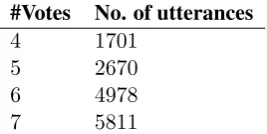
Table 2: Distribution of the numbers of votes.
from each of the three groups. During the data col-lection, we ensured privacy by manually removing utterances that included the full name of a person or detailed address information.
Next, we recruited crowd workers to annotate the15,160utterances with two labels, CHAT and NONCHAT. The workers annotated the CHAT la-bel when users were going to have chats with the intelligent assistant and annotated the NONCHAT label when users were seeking some information (e.g., searching the Web or checking the weather) or were trying to operate the smartphones (e.g., setting alarms or controlling volume). Note that our intelligent assistant works primarily on smart-phones and thus the NONCHATutterances include many operational instructions such as alarm set-ting. Example utterances are given in Table 1.
Seven workers were assigned to each utterance, and the final labels were obtained by majority vote to address the quality issue inherent in crowd-sourcing. The last column in Table 1 shows the number of votes that the majority label obtained. For example, five workers provided the CHAT la-bel (and the other two provided the NONCHAT la-bel) to the first utterance “Let’s talk about some-thing.”
3.2 Data analysis
The construction process described above yielded a dataset made up of 4,833 CHAT and 10,327 NONCHATutterances.
We investigated the annotation agreement among the crowd workers. Table 2 shows the distribution of the numbers of votes that the ma-jority labels obtained. The annotation given by the seven workers agreed perfectly in 5,811 of the 15,160 utterances (38%). Also, at least six workers agreed in the majority of cases, 10,789 (= 4,978 + 5,811)utterances (71%). This indi-cates high agreement among the workers and the reliability of the annotation results.
[image:4.595.115.249.296.363.2]Dialogue act (No. of Utter.) Example GREETING(206) Hello.
Merry Christmas. SELFDISCLOSURE(1164) I am free today.
I have a sore throat. ORDER(716) Please cheer me up.
Give me a song! QUESTION(1551) Do you have emotions?
Are you angry? INVITATION(130) Let’s play with me!
Let’s go to karaoke next time. INFORMATION(214) My cat is acting strange.
It snowed a lot. THANKS(126) Thank you.
You are cool! CURSE(172) You’re an idiot.
You are useless. APOLOGY(9) I’m sorry.
I mistook, sorry. INTERJECTION(151) Whoof.
Yeah, yeah.
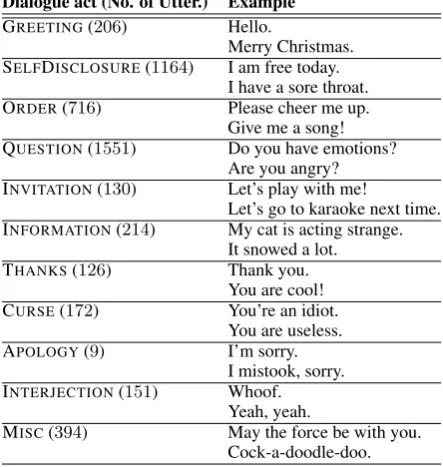
[image:5.595.71.293.66.300.2]MISC(394) May the force be with you. Cock-a-doodle-doo. Table 3: Distribution over dialogue acts and exam-ple utterances.
a wide variety of topics including private issues (e.g., “I am free today”) and questions to the assis-tant (e.g., “Are you angry?”). Also, we even see a movie quote (“May the force be with you”) and a rooster crow (“Cock-a-doodle-doo”) in the MISC act. These clearly represent the open-domain na-ture of the user utterances in intelligent assistants. Interestingly, some users curse at the intelligent assistant probably because it failed to make appro-priate responses (see the CURSE act). Although such user behavior would not be observed from paid research participants, we observe a certain amount of curse utterances in the real data.
4 Detection Method
We formulate chat detection as a binary classifi-cation problem to train supervised classifiers. In this section, we first explain the two types of clas-sifiers explored in this paper, and then investigate the use of external resources for enhancing those classifiers.
4.1 Base classifiers
The first classifier utilizes SVM for its popular-ity and efficiency. It uses character and wordn
[image:5.595.308.523.83.198.2]-gram (n = 1 and2) features. It also uses word embedding features (Turian et al., 2010). A skip-gram model (Mikolov et al., 2013) is trained on
Figure 1: Feature vector representation of the ex-ample utterance “Today’s weather.” The upper three parts of the vector represent the features de-scribed in Section 4.1 (charactern-gram, wordn
-gram, and average of the word embeddings). The three additional features explained in Section 4.2 are added as two real-valued features (Tweet GRU and Query GRU) and one binary feature (Query binary).
the entire intelligent assistant log8 to learn word
embeddings. The embeddings of the words in the utterance are then averaged to produce additional features.
The second classifier uses a convolutional neu-ral network (CNN) because it has recently proven to perform well on text classification problems (Kim, 2014; Johnson and Zhang, 2015a,b). We follow (Kim, 2014) to develop a simple CNN that has a single convolution and max-pooling layer followed by the soft-max layer. We use a recti-fied linear unit (ReLU) as the non-linear activation function. The same word embeddings as SVM are used for the pre-training.
4.2 Using external resources
We next investigate using external resources for enhancing the base classifiers. Thanks to the rapid evolution of the Web in the past decade, a variety of textual data including not only conversational (i.e., chat-like) but also non-conversational ones are abundantly available nowadays. These data of-fer an effective way of enhancing the base classi-fiers. We specifically use tweets and Web search queries as conversational and non-conversational text data, respectively.
We train character-based9 language models on
8We used the same log data used in Section 3. The
de-tailed statistics is confidential.
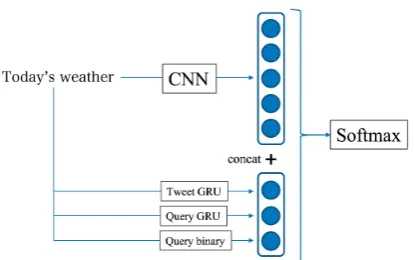
prelim-Figure 2: Architecture of our CNN-based classi-fier when the input utterance is “Today’s weather.” The output layer of CNN and the three additional features explained in Section 4.2 are concatenated. The resulting vector is fed to the soft-max func-tion.
tweets and Web search queries, and use their scores (i.e., the normalized log probabilities of the utterance) as two additional features. Let
u = c1, c2, . . . , cm be an utterance made up of
m characters. Then, the score scorer(u) of the language model trained on the external resource
r∈ {tweet,query}is defined as
scorer(u) = 1
m
m ∑
t=1
logpr(ct|c1, . . . , ct−1).
The GRU language model is adopted for its su-perior performance (Cho et al., 2014; Chung et al., 2014). Letxtbe the embedding oft-th character andhtbe thet-th hidden state. GRU computes the hidden state as
ht= (1−zt)⊙ht−1+zt⊙h˜t
zt=σ(W(z)zt+U(z)ht−1) ˜
ht= tanh(W(h)xt+U(h)(rt⊙ht−1))
rt=σ(W(r)xt+U(r)ht−1)
where ⊙is the element-wise multiplication, σ is
the sigmoid and tanh is the hyperbolic tangent.
W(z), U(z), W(h), U(h), W(r), and U(r) are weight matrices. The hidden states are fed to the soft-max to predict the next word.
We also use a binary feature indicating whether the utterance appears in the Web search query log inary experiments and found that character-based ones per-form consistently better.
or not. We observe that some NONCHAT utter-ances are made up of single entities such as loca-tion and product names. Such utterances are con-sidered to be seeking information on those entities. We therefore use the query log as an entity dic-tionary to derive a feature indicating whether the utterance is likely to be a single entity.
[image:6.595.72.280.88.218.2]The resulting three features are incorporated into the SVM-based classifier straightforwardly (Figure 1). For the CNN-based classifier, they are provided as additional inputs to the soft-max layer (Figure 2).
5 Experimental Results
We empirically evaluate the proposed methods on the chat detection dataset.
5.1 Experimental settings
We performed10-fold cross validation on the chat detection dataset to train and evaluate the proposed classifiers. In each fold, we used80%,10%, and 10% of the data for the training, development, and evaluation, respectively.
We used word2vec10 to learn 300 dimen-sional word embeddings. They were used to in-duce the additional 300features for SVM. They were also used as the pre-trained word embed-dings for CNN.
We used thefaster-rnntoolkit11to train the
GRU language models. The size of the embedding and hidden layer was set to256. Noise contrastive estimation (Gutmann and Hyv¨arinen, 2010) was used to train the soft-max function and the num-ber of noise samples was set to50. Maximum en-tropy 4-gram models were also trained to yield a combined model (Mikolov et al., 2011).
The language models were trained on100 mil-lions tweets collected between Apr. and July 2016 and 100 million Web search queries issued be-tween Mar. and Jun. 2016. The tweets were sam-pled from those received replies to collect only conversational tweets (Ritter et al., 2011). The same Web search queries were used to derive the binary feature. Although it is difficult to release those data, we plan to make the feature values available together with the benchmark dataset.
We usedliblinear12to trainL2-regularized
L2-loss SVM. The hyperparameter c was tuned
Model Acc. P R F1
Majority 68.12 N/A N/A N/A
Tweet GRU 72.07 54.54 74.40 62.94
In-house IA 78.31 62.57 79.51 70.03
SVM 90.51 86.42 83.45 84.91
SVM+embed. 91.35 87.62 84.88 86.21
SVM+embed.+tweet-query 92.15 88.61 86.50 87.53
CNN 85.16 83.40 68.12 74.41
CNN+pre-train. 90.84 87.03 83.80 85.36
[image:7.595.153.445.62.201.2]CNN+pre-train.+tweet-query 91.48 87.78 85.18 86.56
Table 4: Chat detection results.
over{2−10,2−9, . . . ,210}.
The CNN was implemented with chainer.13
We tuned the number of feature maps over
{100,150}, and filter region sizes over
{{2},{3},{1,2},{2,3},{3,4},{1,2,3},{2,3,4}}. The mini-batch size was set to 32. The dropout rate was set to0.5. We used Adam (α = 0.001, β1 = 0.9,β2 = 0.999, andϵ= 10−8) to perform stochastic gradient descent (Kingma and Ba, 2015).
5.2 Baselines
The following baseline methods were imple-mented for comparison:
Majority Utterances are always classified as the majority class, NONCHAT.
Tweet GRU Utterances are classified as CHATif the score of the GRU language model trained on the tweets exceeds a threshold. We used exactly the same GRU language model as the one that was used for deriving the feature. The threshold was calibrated on the develop-ment data by maximizing the F1-score of the CHATclass.
In-house IA Our in-house intelligent assistant system, which adopts a hybrid of rule-based and example-based approaches. Since we cannot disclose its technical details, the result is presented just for reference.
5.3 Result
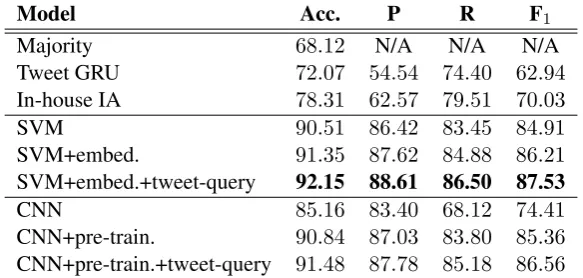
Table 4 gives the precision, recall, F1-score (for the CHAT class), and overall classification accu-racy results. We report only accuaccu-racy for Ma-jority baseline. +embed.and+pre-train. repre-sent using the word embedding features for SVM
13http://chainer.org
and the pre-trained word embeddings for CNN, respectively. +tweet-query represents using the three features derived from the tweets and Web search query.
Table 4 represents that both of the classi-fiers, SVM and CNN, perform accurately. We see that both +embed. and +pre-train. im-prove the results. The best performing method, SVM+embed.+tweet-query, achieves92% accu-racy and 87% F1-score, outperforming all of the baselines. CNN performed worse than SVM con-trary to results reported by recent studies (Kim, 2014). We think this is because the architecture of our CNN is rather simplistic. It might be possi-ble to improve the CNN-based classifier by adopt-ing more complex network, although it is likely to come at the cost of extra training time. Another reason would be that our SVM classifier uses care-fully designed features beyond word1-grams.
Table 4 also represents that the external re-sources are effective, improving F1-scores almost 1 points in both SVM and CNN. Table 5 il-lustrates example utterances and their language model scores. We see that the language mod-els trained on the tweets and queries success-fully provide the CHAT utterances with high and low scores, respectively. Table 6 shows chat de-tection results when each of the three features derived from the external resources is added to SVM+embed. The results represent that they are all worse than SVM+embed.+tweet-query and thus it is crucial to combine all of them for achiev-ing the best performance.
Table 7 shows examples of feature weights of SVM+embed.+tweet-query. Tweet GRU and query GRU denote the language model score fea-tures. The others are wordn-gram features. We
Score (tweet/query) Label Utterance
−0.964 −1.427 CHAT Halloween has already finished. −0.957 −1.610 CHAT Let’s sleep.
[image:8.595.143.456.62.134.2]−1.233 −0.562 NONCHAT Pokemon Go install. −1.837 −0.682 NONCHAT Weekly weather forecast.
Table 5: Examples of the language model scores. The first two columns represent the scores provided by the GRU language models trained on the tweets and Web search queries, respectively. The third and fourth columns represent the label and utterance.
Feature Acc. P R F1
[image:8.595.306.528.201.269.2]tweet GRU 91.53 87.62 85.49 86.53 query GRU 91.38 87.55 85.06 86.28 query binary 91.42 87.56 85.21 86.36
Table 6: Effect of the three features derived from the tweets and Web search queries.
Feature Weight Feature Weight tweet GRU 1.128 query GRU −0.771
I 0.215 call to −0.217
Sing 0.195 volume −0.196
Table 7: Examples feature weights of
SVM+embed+tweet-query.
positive and negative weights, respectively. This indicates that effectiveness of the language mod-els. We also see that the first person has a large positive weight, while terms related to device con-trolling (“call to” and “volume”) have large nega-tive weights.
Table 8 represents chat detection results of SVM+embd.+tweet-queryacross the numbers of votes that the majority label obtained. As ex-pected, we see that all metrics get higher as the number of agreement among the crowd workers becomes larger. In fact, we see as much as98% accuracy when all seven workers agree. This im-plies that utterances easy for humans to classify are also easy for the classifiers.
5.4 Training data size
We next investigate the effect of the training data size on the classification accuracy.
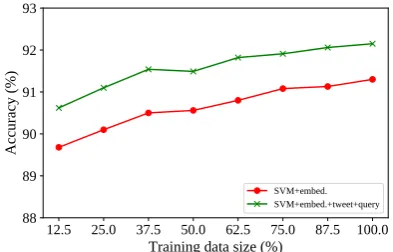
Figure 3 illustrates the learning curve. It rep-resents that the classification accuracy improves almost monotonically as the training data size in-creases. Although our training data is by no means small, the shape of the learning curve neverthe-less suggests that further improvement would be achieved by adding more training data. This
[image:8.595.317.514.321.447.2]im-#Votes #Utter. Acc. P R F1 4 1701 66.67 55.41 59.81 57.53 5 2670 87.72 80.46 83.01 81.72 6 4978 96.02 92.73 93.87 93.30 7 5811 98.33 96.73 97.68 97.20
Table 8: Chat detection results across the numbers of votes that the majority label obtained.
12.5 25.0 37.5 50.0 62.5 75.0 87.5 100.0
Training data size (%)
88 89 90 91 92 93
Accuracy (%)
SVM+embed. SVM+embed.+tweet+query
Figure 3: Learning curve of the proposed meth-ods. The horizontal axis represents what percent-age of the training portion is used in each fold of the cross validation. The vertical axis represents the classification accuracy.
plies that a very large amount of training data are required for covering open-domain utterances in intelligent assistants.
The figure at the same time represents the usefulness of the external resources. We see thatSVM+embed.+tweet-querytrained on about 25% of the training data is able to achieve compa-rable accuracy withSVM+embed. trained on the entire training data. This result suggests that the external resources are able to compensate for the scarcity of annotated data.
5.5 Utterance length
Fig-5 6 7 8 9 10 11 12 13 14 15
Utterance Length
86 88 90 92 94
Accuracy (%)
[image:9.595.84.280.66.196.2]SVM+embed. SVM+embed.+tweet-query
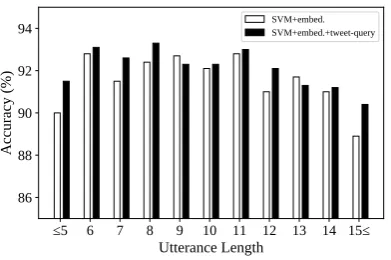
Figure 4: Classification accuracy across utterance lengths in the number of characters.
ure 4 illustrates the classification accuracies of SVM+embed. and SVM+embed.+tweet-query for each utterance length in the number of char-acters.
Figure 4 reveals that the difference between the two proposed methods is evident in short utter-ances (i.e.,≤5). This is because those utterances
are too short to contain sufficient information re-quired for classification, and the additional fea-tures are helpful. We note that Japanese writing system uses ideograms and thus even five charac-ters is enough to represent a simple sentence.
We also see a clear difference in longer utter-ances (i.e.,15 ≤) as well. We consider those long utterances are difficult to classify because some words in the utterances are irrelevant for the clas-sification and then-gram and embedding features
include those irrelevant ones. On the other hand, we consider that the language model scores are good at capturing stylistic information irrespective of the utterance length.
6 Future Work
As discussed in Section 3.2, some user utterances such as “I am hungry” are ambiguous in nature and thus are difficult to handle in the current frame-work. An important future work is to develop a so-phisticated dialogue manager to handle such utter-ances, for example, by making clarification ques-tions (Schl¨oder and Fernandez, 2015).
We manually investigated the dialogue acts in the chat detection dataset (c.f., Section 3.2). It is interesting to automatically determine the dia-logue acts to help producing appropriate system responses. Some related studies exist in such a re-search direction (Meguro et al., 2010).
Although we used only text data to perform
chat detection, we can also utilize contextual in-formation such as the previous utterances (Xu and Sarikaya, 2014), the acoustic information (Jiang et al., 2015), and the user profile (Sano et al., 2016). It is an interesting research topic to use such contextual information beyond text. It is con-sidered promising to make use of a neural network for integrating such heterogeneous information.
An automatic speech recognition (ASR) error is a popular problem in SDS, and previous studies have proposed sophisticated techniques, includ-ing re-rankinclud-ing (Morbini et al., 2012) and POMDP (Williams and Young, 2007), for addressing the ASR errors. Incorporating these techniques into our methods is also an important future work.
Although the studies on non-task-oriented SDS have made substantial progress in the past few years, it unfortunately remains difficult for the systems to fluently chat with users (Higashinaka et al., 2015). Further efforts on improving non-task-oriented dialogue systems is an important fu-ture work.
7 Conclusion
This paper investigated chat detection for combin-ing domain-specific task-oriented SDS and open-domain non-task-oriented SDS. To address the scarcity of benchmark datasets for this task, we constructed a new benchmark dataset from the real log data of a commercial intelligent assis-tant. In addition, we investigated using the exter-nal resources, tweets and Web search queries, to handle open-domain user utterances, which char-acterize the task of chat detection. The empiri-cal experiment demonstrated that the off-the-shelf supervised methods augmented with the external resources perform accurately, outperforming the baseline approaches. We hope that this study con-tributes to remove the long-standing boundary be-tween task-oriented and non-task-oriented SDS.
To facilitate future research, we are going to re-lease the dataset together with the feature values derived from the tweets and Web search queries.14
Acknowledgments
We thank Manabu Sassano, Chikara Hashimoto, Naoki Yoshinaga, and Masashi Toyoda for fruit-ful discussions and comments. We also thank the anonymous reviewers.
References
Kyunghyun Cho, Bart van Merrienboer, Caglar Gulcehre, Dzmitry Bahdanau, Fethi Bougares, Holger Schwenk, and Yoshua Bengio. 2014. Learning phrase representations using rnn encoder– decoder for statistical machine translation. In
Proceedings of EMNLP. pages 1724–1734.
http://www.aclweb.org/anthology/D14-1179.
Junyoung Chung, Caglar Gulcehre, KyungHyun Cho, and Yoshua Bengio. 2014. Empirical evaluation of gated recurrent neural networks on sequence model-ing. arXiv:1412.3555.
Paul Crook, Alex Marin, Vipul Agarwal, Khushboo Aggarwal, Tasos Anastasakos, Ravi Bikkula, Daniel Boies, Asli Celikyilmaz, Senthilkumar Chandramo-han, Zhaleh Feizollahi, Roman Holenstein, Min-woo Jeong, Omar Khan, Young-Bum Kim, Eliza-beth Krawczyk, Xiaohu Liu, Danko Panic, Vasiliy Radostev, Nikhil Ramesh, Jean-Phillipe Robichaud, Alexandre Rochette, Logan Stromberg, and Ruhi Sarikaya. 2016. Task completion platform: A self-serve multi-domain goal oriented dialogue platform. In Proceedings of NAACL (Demonstrations). pages 47–51. http://www.aclweb.org/anthology/N16-3010.
Jiatao Gu, Zhengdong Lu, Hang Li, and Vic-tor O.K. Li. 2016. Incorporating copying mechanism in sequence-to-sequence learning.
In Proceedings of ACL. pages 1631–1640.
http://www.aclweb.org/anthology/P16-1154.
Daniel (Zhaohan) Guo, Gokhan Tur, Scott Wen tau Yih, and Geoffrey Zweig. 2014. Joint semantic utterance classification and slot filling with recursive neural networks. InProceedings of IEEE SLT Workshop. Michael Gutmann and Aapo Hyv¨arinen. 2010.
Noise-contrastive estimation: A new estimation principle for unnormalized statistical models. InProceedings of AISTATS. pages 297–304.
Takayuki Hasegawa, Nobuhiro Kaji, Naoki Yoshi-naga, and Masashi Toyoda. 2013. Predicting and eliciting addressee’s emotion in online dia-logue. In Proceedings of ACL. pages 964–972. http://www.aclweb.org/anthology/P13-1095.
Ryuichiro Higashinaka, Kotaro Funakoshi, Masahiro Araki, Hiroshi Tsukahara, Yuka Kobayashi, and Masahiro Mizukami. 2015. Towards taxon-omy of errors in chat-oriented dialogue sys-tems. In Proceedings of SIGDIAL. pages 87–95. http://aclweb.org/anthology/W15-4611.
Ryuichiro Higashinaka, Noriaki Kawamae, Kugatsu Sadamitsu, Yasuhiro Minami, Toyomi Meguro, Ko-hji Dohsaka, and Hirohito Inagaki. 2011. Building a conversational model from two-tweets. In Proceed-ings of ASRU. pages 330–335.
Jiepu Jiang, Ahmed Hassan Awadallah, Rosie Jones, Umut Ozertem, Imed Zitouni, Ranjitha Gurunath
Kulkarni, and Omar Zia Khan. 2015. Automatic on-line evaluation of intelligent assistants. In Proceed-ings of WWW. pages 506–516.
Rie Johnson and Tong Zhang. 2015a. Effec-tive use of word order for text categoriza-tion with convolutional neural networks.
In Proceedings of NAACL. pages 103–112.
http://www.aclweb.org/anthology/N15-1011.
Rie Johnson and Tong Zhang. 2015b. Semi-supervised convolutional neural networks for text categoriza-tion via region embedding. In Advances in NIPS, pages 919–927.
Joo-Kyung Kim, Gokhan Tur, Asli Celikyilmaz, Bin Cao, and Ye-Yi Wang. 2016. Intent detection using semantically enriched word embeddings. In Pro-ceedings of IEEE SLT Workshop.
Yoon Kim. 2014. Convolutional neural net-works for sentence classification. In
Pro-ceedings of EMNLP. pages 1746–1751.
http://www.aclweb.org/anthology/D14-1181.
Diederik P. Kingma and Jimmy Ba. 2015. Adam: A method for stochastic optimization. InProceedings of ICLR.
Julia Kiseleva, Kyle Williams, Ahmed Hassan Awadal-lah, Aidan Crook, Imed Zitouni, and Tasos Anas-tasakos. 2016a. Predicting user satisfaction with in-telligent assistants. InProceedings of SIGIR. pages 45–54.
Julia Kiseleva, Kyle Williams, Ahmed Hassan Awadal-lah, Aidan C. Crook, Imed Zitouni, and Tasos Anastasakos. 2016b. Understanding user satisfac-tion with intelligent assistants. In Proceedings of SIGCHIIR. pages 121–130.
Hayato Kobayashi, Kaori Tanio, and Manabu Sassano. 2015. Effects of game on user engagement with spo-ken dialogue system. InProceedings of SIGDIAL. pages 422–426. http://aclweb.org/anthology/W15-4656.
Cheongjae Lee, Sangkeun Jung, Seokhwan Kim, and Gary Geunbae Lee. 2007. Example-based dialog modeling for practical multi-domain dialog system.
Speech Communication51(5):466–484.
Jiwei Li, Michel Galley, Chris Brockett, Jianfeng Gao, and Bill Dolan. 2016a. A diversity-promoting objective function for neural conversation mod-els. In Proceedings of NAACL. pages 110–119. http://www.aclweb.org/anthology/N16-1014.
Toyomi Meguro, Ryuichiro Higashinaka, Yasuhiro Minami, and Kohji Dohsaka. 2010. Control-ling listening-oriented dialogue using par-tially observable markov decision processes. In Proceedings of Coling. pages 761–769. http://www.aclweb.org/anthology/C10-1086.
Tomas Mikolov, Anoop Deoras, Daniel Povey, Lukas Burget, and Jan Cernocky. 2011. Strategies for training large scale neural network language mod-els. InProceedings of ASRU. pages 196–201.
Tomas Mikolov, Ilya Sutskever, Kai Chen, Greg Cor-rado, and Jeffrey Dean. 2013. Distributed represen-tations of words and phrases and their composition-ality. InAdvances in NIPS. pages 3111–3119.
Fabrizio Morbini, Kartik Audhkhasi, Ron Artstein, Maarten Van Segbroeck, Kenji Sagae, Panayiotis Georgiou, David R. Traum, and Shri Narayanan. 2012. A reranking approach for recognition and classification of speech input in conversational dia-logue systems. InProceedings of SLT. pages 49–54.
Andreea I. Niculescu and Rafael E. Banchs. 2015. Strategies to cope with errors in human-machine speech interactions: using chatbots as back-off mechanism for task-oriented dialogues. In Proceed-ings of ERRARE.
Naoki Otani, Daisuke Kawahara, Sadao Kuro-hashi, Nobuhiro Kaji, and Manabu Sassano. 2016. Large-scale acquisition of commonsense knowledge via a quiz game on a dialogue sys-tem. In Proceedings of OKBQA. pages 11–20. http://aclweb.org/anthology/W16-4402.
Suman Ravuri and Andreas Stolcke. 2015. A compara-tive study of neural network models for lexical intent classification. In In Proceedings of ASRU. pages 368–374.
Alan Ritter, Colin Cherry, and Bill Dolan. 2010. Unsupervised modeling of twitter conversations. In In Proceedings of NAACL. pages 172–180. http://www.aclweb.org/anthology/N10-1020.
Alan Ritter, Colin Cherry, and William B. Dolan. 2011. Data-driven response generation in social me-dia. In Proceedings of EMNLP. pages 583–593. http://www.aclweb.org/anthology/D11-1054.
Shumpei Sano, Nobuhiro Kaji, and Manabu Sassano. 2016. Prediction of prospective user engagement with intelligent assistants.
In Proceedings of ACL. pages 1203–1212.
http://www.aclweb.org/anthology/P16-1114.
Ruhi Sarikaya. 2017. The technology behind personal digital assistants: An overview of the system archi-tecture and key components. IEEE Signal Process-ing Magazine34(1):67–81.
Julian J. Schl¨oder and Raquel Fernandez. 2015. Clar-ifying intentions in dialogue: A corpus study.
In Proceedings of the 11th International Confer-ence on Computational Semantics. pages 46–51. http://www.aclweb.org/anthology/W15-0106.
Lifeng Shang, Zhengdong Lu, and Hang Li. 2015. Neural responding machine for short-text conver-sation. InProceedings of ACL. pages 1577–1586. http://www.aclweb.org/anthology/P15-1152.
Alessandro Sordoni, Michel Galley, Michael Auli, Chris Brockett, Yangfeng Ji, Margaret Mitchell, Jian-Yun Nie, Jianfeng Gao, and Bill Dolan. 2015. A neural network approach to context-sensitive generation of conversational responses.
In Proceedings of NAACL. pages 196–205.
http://www.aclweb.org/anthology/N15-1020.
Ilya Sutskever, Oriol Vinyals, and Quoc V Le. 2014. Sequence to sequence learning with neural net-works. InAdvances in NIPS, pages 3104–3112.
Gokhan Tur, Dilek Hakkani-T¨ur, and Larry Heck. 2010. What is left to be understood in atis? In
Proceedings of IEEE SLT Workshop. pages 19–24.
Joseph Turian, Lev-Arie Ratinov, and Yoshua Ben-gio. 2010. Word representations: A simple and general method for semi-supervised learn-ing. In Proceedings of ACL. pages 384–394. http://www.aclweb.org/anthology/P10-1040.
Oriol Vinyals and Quoc Le. 2015. A neural conver-sational model. In Proceedings of Deep Learning Workshop.
Richard S. Wallace. 2009. The Anatomy of A.L.I.C.E., Springer, pages 181–210.
Zhuoran Wang, Hongliang Chen, Guanchun Wang, Hao Tian, Hua Wu, and Haifeng Wang. 2014. Policy learning for domain selection in an extensible multi-domain spoken dialogue sys-tem. In Proceedings of EMNLP. pages 57–67. http://www.aclweb.org/anthology/D14-1007.
Joseph Weizenbaum. 1966. Eliza–a computer program for the study of natural language communication be-tween man and machine. Communications of the ACM9(1):36–45.
Jason D. Williams and Steve Young. 2007. Partially observable markov decision processes for spoken dialog systems. Computer Speech & Language
21(2):393–422.
Puyang Xu and Ruhi Sarikaya. 2014. Contextual do-main classification in spoken language understand-ing systems usunderstand-ing recurrent neural network. In Pro-ceedings of ICASSP. pages 136–140.