12
Multiple Admissibility in Language Learning:
Judging Grammaticality Using Unlabeled Data
Anisia Katinskaia,Sardana Ivanova,Roman Yangarber University of Helsinki, Department of Computer Science, Finland
Abstract
We present our work on the problem of detec-tion Multiple Admissibility (MA) in language learning. Multiple Admissibility occurs when more than one grammatical form of a word fits syntactically and semantically in a given con-text. In second-language education—in partic-ular, in intelligent tutoring systems/computer-aided language learning (ITS/CALL), systems generate exercises automatically. MA implies that multiple alternative answers are possi-ble. We treat the problem as a grammatical-ity judgement task. We train a neural network with an objective to label sentences as gram-matical or ungramgram-matical, using a “simulated learner corpus”: a dataset with correct text and with artificial errors, generated automat-ically. While MA occurs commonly in many languages, this paper focuses on learning Rus-sian. We present a detailed classification of the types of constructions in Russian, in which MA is possible, and evaluate the model using a test set built from answers provided by users of the Revita language learning system.
1 Introduction
The problem of Multiple Admissibility(MA) oc-curs in the context of language learning. In “cloze” exercises (fill-in-the-blank), the learner re-ceives a text with some word removed, and a base form1of the removed word as a hint. The task is to produce the correct grammatical form of the miss-ing word, given the context. The answer given by the user is checked automatically by the language learning system. Therefore, the system should be able to accept more than one answer, if there are grammatically and semantically valid alterna-tives in the given context. Otherwise, the language learning system returns negative (actually incor-rect) feedback to the learner. This is a problem,
1The base or “dictionary” form will be referred to as
lemmain this paper.
because negative feedback for an acceptable an-swer misleads and discourages the learner.
We examine MA in the context of our language learning system, Revita (Katinskaia et al.,2018). Revita is available online2 for second language (L2) learning beyond the beginner level. It is in use in official university-level curricula at several major universities. It covers several languages, many of which are highly inflectional, with rich morphology. Revita creates a variety of exercises based on input text materials, which are selected by the users. It generates exercises and assesses the users’ answers automatically.
For example, consider the sentence in Finnish: “Ilmoitus vaaleista tulee kotiin postissa.” (“Notice about elections comes to the house in the mail.”)
In practice mode, Revita presents the text to the learner in small pieces—“snippets” (about 1 para-graph each)—with all generated exercises. This is important, because grammatical forms in exer-cises usually depend on a wider context.
For the given example, Revita can generate cloze exercises hiding several tokens (surface forms) and providing their lemmas as hints:
“Ilmoitus vaali tulla koti posti.” (“Notice election come house mail .”).
For the verb ”tulla” (”come”) and nouns ”vaali” (“election”), ”koti” (“home”) and ”posti” (”mail”) the learner should insert the correct grammatical forms. Revita expects them to be the same as the forms in the original text, and will return negative feedback otherwise. However, in this example,
postitse(“via email”) is also acceptable, although it is not in the original text.
The MA problem is also relevant in the context of exercises that require a free-form answer, such as an answer to a question or an essay. The learner
can produce “unexpected” but nevertheless valid grammatical forms.
In the current work, we restrict our focus to MA of multiple surface forms of the same lemma, given the context; we do not consider synonyms, which can also fit the same context. The latter topic is part of the future work.
The structure of the paper is as follows: In sec-tion2we formulate the problem and provide a de-tailed classification of the types of MA found in the learner data. In section3we describe our ap-proach, in particular, the procedure for generating artificial grammatical errors and creating test sets. Section 4presents previous work on artificial er-ror generation. Section5describes our model and experimental setup. In section6we discuss the re-sults and error analysis, and conclude in section7.
2 Multiple Admissibility: Problem Overview
We use data from several hundred registered stu-dents learning Russian (and other languages), practicing with exercises based on texts, or an-swering questions in test sessions. Currently, Re-vita does not provide a mode for written essays, because it does not check free-form answers.
Except for cloze exercises, Revita also gener-ates exercises where the users are asked to se-lect among various surface forms based on a given lemma—a correct surface form and a set of auto-matically generated distractors; or to type the word they hear. This allows us to collect a wide range of errors, though not all kinds of possible errors; e.g., currently we do not track punctuation errors, word order errors, insertion errors, errors resulting from choosing an incorrect lemma, etc.
We annotated 2884 answers from the Revita database, which were automatically marked as “not matching the original text.” This work was done by two annotators (90% agreement) both with native-level competency in Russian, and background in linguistics and teaching Russian. Among all annotated answers, 7.5% were actu-ally correct, but differed from the original text. Also, we checked answers given by three students with C1 CEFR proficiency level in Russian (es-tablished independently by their teachers); 15.8% of these answers were grammatically and seman-tically valid in the context. Thus, for advanced users, the problem of MA is twice as relevant as on average; we plan to investigate these results with a
larger base of Revita users.
2.1 Types of Multiple Admissibility
In analyzing the answers given by our users, we discovered several types of the most frequent con-texts where MA appears.
Present/Past tense: The most clear case of MA in Russian (as in many other languages) is the case of interchangeable forms of present and past tense of verbs. Russian has three tenses (present, past, future), of which past and future tenses can have perfective or imperfective aspect.
In the next example, if both verbs are chosen for as exercises3 and the learner sees two lem-mas (”задержаться” and ”вернуться”), she has a possibility to produce verb forms in any tense de-pending on the contextbeyond the given sentence. It may be narrative past tense or present tense, or the text may be a message where the communica-tive goal of the speaker is to inform the reader about future events, so future tense is expected.
“Мы задержались(PST)4 у друзей и вернулись(PST) домой поздно.”
“We were delayed with friends and returned home late.”
The following option may be acceptable:
“Мы задержались(PST) у друзей и вернемся(FUT) домой поздно.”
“We were delayed with friends and
will return home late.”
The future cannot precede the past in this sen-tence, so the next variant answer is grammatically incorrect:
* “Мы задержимся(FUT) у друзей и вернулись(PST) домой поздно.”
“We will be delayed with friends and returned home late.”5
Some cases are more difficult because the choice of tense can depend on knowledge beyond the text:
“Ученым удалось установить, что у минойцев существовало (PST) несколько видов письма.”
3
If one of the verbs is chosen as an exercise, the user may get a hint from the surface form of the other verb, that they should be coordinated.
4
We use standard abbreviations from the Leipzig Glossing Rules.
“Scientists were able to establish that the Mi-noans had several types of writing systems.”
In a non-fictional narrative, only the past tense can be used, since the Minoans do not exist in the present. These examples show that deciding which tenses are acceptable in the context is difficult.
Singular/Plural: Singular and plural nouns can be grammatically valid in the same context, if there is no dependency on words beyond the sen-tence boundaries. For instance:
“Из последних разработок—скафандр для работы (SG.) в открытом космосе.”
“Из последних разработок—скафандр для работ (Pl.) в открытом космосе.” “From the latest developments—the space-suit for work in open space.”
Short/Full adjective:6 in many constructions, short and full forms of adjectives can be used as a part of a compound predicate (Vinogradov,1972). The difference between these is that the short form typically expressestemporal meaning and that it is a phenomenon ofliterary language, whereas its full alternative form sounds more colloquial.
“Вы ужасно болтливы (short) и непоседливы “ (short)(from I. Bunin) “You are being terribly talkative (PRED) and restless (PRED).”
“Вы ужасно болтливые и непоседливые”.
“You are terribly talkative (DESCR) and restless (DESCR)”.
We treat these examples as MA, because even for native Russian speakers in many cases the choice can be unclear. So it would be too strict to treat one of the variants as incorrect.
Nominative/Instrumental case: nouns as part of compound named predicates can be in the nom-inative or instrumental case. The difference in meaning is similar to that of short/full adjectives (Rosenthal et al., 1994): nominative indicates a
constant feature of a subject, whereas instrumen-tal indicates atemporaryfeature of a subject. We consider the following examples as MA, because of a subtle difference in meaning:
“Она была загадочная (NOM) и непонятная (NOM) для меня”. (from I. Bunin)
6So-called full/short forms of adjectives correspond to
de-scriptive/predicative adjectives in other languages: compare “the hungry(DESCR) dog” vs. “the dog is hungry(PRED)”.
“Она была загадочной (INS) и непонятной (INS) для меня”.
“She was mysterious and incomprehensible to me”.
Genitive/Accusative case: usage of genitive vs. accusative is a complex topic, beyond the scope of this paper. We mention a few examples briefly, where MA can appear—denotation of a part of the wholeandnegation. Usually the gen-itive is used to denote a part of the whole. In the following example, usage of the accusative is in-correct:
“Пожалуйста, отрежь хлеба” (GEN) * “Пожалуйста, отрежь хлеб” (ACC) “Please, cut some bread.”
In some contexts both meanings are possible— of a part and of the whole—resulting in MA:
“Нам оставили хлеба и вина” (GEN) “We were left with some bread and wine.”
“Нам оставили хлеб и вино” (ACC) “We were left with bread and wine.”
If both words appear in exercises, Revita should accept genitive or accusative (if the context speci-fies the expected meaning nowhere else).
The next case is negation constructions. The genitive is usually used where negation is stressed, whereas the accusative weakens the negation, (Rosenthal et al., 1994). However, it is worth noticing that the difference can be difficult to un-derstand even for native Russian speakers.
“До вас никто еще этого браслета (GEN) не надевал.” (from Kuprin.)
“No onehas worn this bracelet before you.”
Compare with a similar example in the accusative:
“Он не отвергнул тогда с презрением эти сто (ACC) рублей.” (Dostoevsky)
“Hedid notreject those one hundred rubles with contempt.”
It is not always possible for the learner to know which case expected in the sentence, because it implies that she should know which type of nega-tion was mennega-tioned. always possible, and both op-tions fit semantically.
2019). Without going into detail, we show ex-amples from (Rakhilina et al.,2014)—a heritage learner corpus.7 Both sentences can be interpreted as correct, with a subtle difference in meaning:
“Он пишет ей, чтобы она не перестала (PFV) любить его.”
“He writes to her that she should not stop lov-ing him.”
“Он пишет ей, чтобы она не переставала (IPFV) любить его.”
“He writes to her that she continue to love him.”
Gerund/Other verb forms: MA occurs in some contexts where gerunds are used. In the fol-lowing example, both sentences can express the meaning of two actions happening at the same time. The only argument against using a past tense verb form is that it sounds somewhat unnatural without a conjunction ”and” between verbs (”was saying and thinking”):
“... говорил я себе, думая (GERUND) об Охотном ряде” (from Bunin)
“... I was saying to myself, thinking about Okhotny Ryad”
“... говорил я себе, думал (PST) об Охотном ряде”
“... I was saying to myself, was thinking about Okhotny Ryad”
Prepositions with multiple cases: some prepo-sitions can govern two different cases of the fol-lowing noun, with no change in meaning:
“Она спряталась под одеялом.” (INS) “Она спряталась под одеяло.” (ACC) “She hid under a blanket.”
Second Genitive (Partitive): and other forms common in spoken language can be valid alterna-tives, often unfamiliar to L2 learners.
“Я привозил ей коробки шоколаду (2GEN), новые книги...”
“Я привозил ей коробки шоколада (GEN), новые книги...”
“I was bringing her boxes of chocolate, new books...”
7Heritage learners are persons with a cultural
con-nection to or proficiency in the language through fam-ily, community, or country of origin. (Definition from http://www.cal.org/heritage/research/)
Other cases: some examples of MA contexts are exceptionally interesting and rare.
“На этой почве хорошо росла трава, что обеспечивало (Neu) пастбищами овец.” “На этой почве хорошо росла трава, что обеспечивала (Fem) пастбищами овец.”
“The grass grew well on this soil, what provided sheep with pasture.”
These sentences expresses similar meaning, al-though the verb “обеспечивать” (“to provide”) appears in the neuter gender in the first and fem-inine in the second. This happens because in the first sentence the subordinative pronoun “что” (“which”) refers to the entire preceding clause, whereas in the second it refers only to the word “трава” (“grass”), which is feminine.
We observe many other types of constructions with MA. This is not an exhaustive list, but covers only some of the types actually found among the answers given by the learners of Russian in Revita. The list should give us some intuitions about the problem of MA, and how difficult it is to identify automatically.
3 Overview of the Approach
How can we identify instances of Multiple Admis-sibility? One approach to this problem is to train a model with a language modeling objective— referred to as “LM-trained” in the literature. In such a scenario, the task of the model is to pre-dict the next word at every point in the sentence, e.g., for the sentence ”The keys to the cabinet [is/are] here”8 the task of the model is to pre-dict that P(are|C) > P(is|C), where C is the context. Linzen (2016) experimented with this kind of language modeling in three setups: with-out any grammatically relevant supervision, with supervision on grammaticality (predicting which of two sentences9is grammatical/ungrammatical), and number prediction—predicting between two classes, ”singular” or ”plural”. The last two setups are strongly supervised. The poorest results were obtained using a LM-trained model, despite using a large-scale language model (Jozefowicz et al., 2016).
Later, Gulordava (2018) reevaluated these re-sults for the task of predicting long-distance agree-ment: for several languages, including Russian,
8
The example is from (Linzen et al.,2016).
9”The keys to the cabinet are here” vs. ”The keys to the
an LM-trained RNN approached the accuracy of the supervised models described in (Linzen et al., 2016). Marvin (2018) performed a targeted evalu-ation of several LMs—N-gram, LM-trained RNN, and Multitask RNN10—on the task of detecting er-rors in several grammatical constructions for En-glish.11 The results of even the strongest LM var-ied considerably depending on the syntactic com-plexity of the construction: 100% accuracy in the case of simple subject-verb agreement, and 0.52% accuracy for subject-verb agreement across an ob-ject relative clause (without “that”).
In light of these results from prior research, we decided to approach the problem as a supervised grammaticality judgement task—a two-class clas-sification task, (Linzen et al.,2016)).
Since MA answers are correct answers, sen-tences with alternative grammatical forms of the same lemma would be grammatically correct. One of the problems with this approach is the lack of annotated training data. The Revita database had only 7156 answers labeled “incorrect” for Rus-sian, at the time when these experiments began. Therefore we generated a training dataset by sim-ulatinggrammatical errors. We describe the sim-ulation procedure in the following subsection, and briefly review prior approaches to generating ar-tificial errors for grammatical error detection and correction tasks (GED/GEC). Every instance in the simulated dataset is labeled as correct or in-correct. The network reads the entire sequence in a bidirectional fashion and receives a supervised signal at the end. We describe the model and the experiments in the following sections.
3.1 Generating Artificial Errors
First, we describe the process of generating train-ing data: the source of data, preprocesstrain-ing steps and a brief analysis of what types of errors we ob-tain in the simulated data. In the following sub-section, we proceed to describe the test sets which were build from real users’ data containing “natu-ral” errors.
Generating training datasets with artificial er-rors is a common approach, because obtaining large error-annotated learner corpora is extremely difficult and costly, (Granger, 2003): difficulties
10Language modeling objective, combined with a
super-vised task of sequence tagging with CCG supertags.
11The authors expected that a LM would assign a higher
probability to a grammatical sentence than to an ungrammat-ical one.
relate to collecting data from language learners and very expensive annotation procedures.
Revita at present creates exercises only for words which do not exhibitlemma ambiguity (ho-mography).12 Lemma ambiguity occurs when a surface form has more than one lemma. An example of this type of ambiguity is the token “стекло”, which has two morphological analyses:
стечь(“to flow down”) Verb+Past+Sing+Neut,
стекло(“glass”) Noun+Sing+Nom/Acc.13 In this setting, we do not need to generate errors for surface forms with lemma ambiguity.
Training instances are generated by sliding a window of radius r over the list of input tokens, with the target token in the middle. The target is everyn-th token (nis the stride). If the target to-ken is unambiguous, is above a frequency thresh-old,14 and has a morphological analysis, it is re-placed by a random grammatical form from the paradigm to which the token belongs.15
We use r = 10, which results in a window wider than an average sentence in Russian, and we are interested in including wide context in training instances. All generated windows are labeled as negative/ungrammatical. The training dataset con-sists of a balanced number of grammatical and un-grammatical instances. Part of the generated data was removed from training dataset and used as a
validation setfor training the model.
Of the automatically generated errors that we checked, some appear very natural, while others may be less likely to be made by real students.
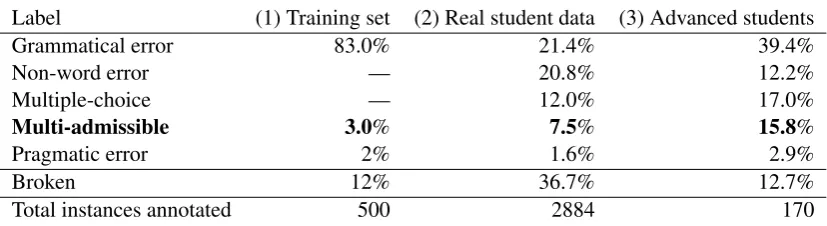
As Linzen (2016) notes, some of the gener-ated instances willnot in fact be ungrammatical. We analysed 500 randomly chosen generated win-dows; 3% of them happened to be grammatical (in Table1we refer to them as Multi-admissible). We provide the interpretation for all labels in Table1 in the following subsection.
3.2 Test Data Analysis
To create test sets, we took 2884 answers from Re-vita’s database, which were automatically marked as “incorrect,” and manually annotated them using the labels below:
12
Because it currently does not attempt to perform disam-biguation, and only one lemma can be shown as the hint.
13
This is an example not only of lemma ambiguity, but also of word sense and morphological ambiguity.
14
We count frequencies from the entire corpus used for building the training set, to exclude words appearing once.
15We generate paradigms of inflected words using the
Label (1) Training set (2) Real student data (3) Advanced students
Grammatical error 83.0% 21.4% 39.4%
Non-word error — 20.8% 12.2%
Multiple-choice — 12.0% 17.0%
Multi-admissible 3.0% 7.5% 15.8%
Pragmatic error 2% 1.6% 2.9%
Broken 12% 36.7% 12.7%
[image:6.595.92.506.60.173.2]Total instances annotated 500 2884 170
Table 1: Data we annotated for verification and testing: (1) subset of the set of errorsautomatically generatedfor training (randomly sampled and manually annotated), (2) learners’ answers (randomly sampled), marked by the System asincorrect, (3) subset of learner’ incorrect answers—foradvancedlearners only (CEFR level C1/C2). “Broken”: discarded instances (technical problems, too many unknown words, numbers, punctuation marks, etc.)
•Grammatical error: answer was a valid gram-matical form of the word (exists in paradigm), but incorrect in the given context. This group includes only errors made in cloze exercises.
•Non-word error: spelling error—the word was rejected by the morphological analyzer.
•Multiple-choice: error in a choice of word from a list of options.
•Multi-admissible: as mentioned above, we con-sider these to becorrectanswers.
•Pragmatic error: a separate type of error where the given answer can fit grammatically, but is se-mantically/pragmatically unnatural in the context. We provide one example of the last kind of er-ror; it requires further investigation:
“У меня машина сломалась, и мне пришлось звонить в автосервис (ACC)”. “My car broke down and I had to call (to) the auto repair”.
* “У меня машина сломалась, и мне пришлось звонить в автосервисe (LOC)”.
* “My car broke down and I had to call (while being) in a car-service station”.
Preposition “в” (“in”) governs two cases— Nominative and Locative—but the second sen-tence does not make sense pragmatically. We have begun a more detailed annotation of all learner an-swers (i.e., the types of grammatical errors). This topic is beyond the scope of this paper.
• Broken: discarded instances (technical prob-lems, words not in our training vocabulary, too many numbers, punctuation marks, answers given in languages different from expected, etc).
Table1represents the number of all mentioned data types in the real learners’ answers (the second column) and in the subset of these real answers
which were given only by advanced learners (the third column).
We separate the real, manually annotated data into four test sets (see Table2).
A. The first test set contains only sentences ex-hibiting MA.
B. The second test set is randomly chosen cor-rect sentences from a separate corpus (for a total of 500 instances) which was not used for generating training data.
C. The third test set is made to test the ability of our model to distinguish between grammatical and ungrammatical sentences (as it was trained to do)—thus it contains:
C1. sentences with grammatical errors made by Revita users;
C2. correct sentences from Revita’s database. D. The fourth test set contains sentences only with pragmatic errors.
In the next section, we shortly review prior work related to artificial error generation (AEG) for the grammaticality judgement task.
4 Related Work
Felice(2016) divides methods of AEG into deter-ministic vs. probabilistic. Thedeterministic ap-proachconsists of methods that generate errors in systematic ways, which do not make use of learner error distributions. Izumi et al.(2003) introduced a system for correction of article errors made by English learners, native in Japanese. The system was trained on artificial data where a, an, the or the zero article were replaced with a different op-tion chosen randomly.
speak-ers: split compounds and word order errors. Brockett et al.(2006) describe a statistical ma-chine translation (SMT) system for correcting a set of 14 countable and uncountable nouns which are often confused by learners of English. They used rules to change quantifiers (e.g. much–many), to generate plural forms, and to insert unnecessary determiners. Lee and Seneff(2008) created an ar-tificial corpus of verb form errors. They changed verbs in the original text to different forms, such as to-infinitive, 3rd person singular present, past, or -ing participle. Ehsan and Faili (2013) used SMT for AEG to correct grammatical errors and context-sensitive spelling mistakes in English and Farsi. Training corpora were obtained by inject-ing artificial errors into well-formed treebank sen-tences using predefined error templates.
Probabilistic approach:Rozovskaya and Roth describe several methods for AEG which include creation of article (Rozovskaya and Roth,2010b) and preposition errors (Rozovskaya and Roth, 2010a, 2011) based on statistics from an English as a Second Language (ESL) corpora. They in-ject errors into Wikipedia sentences using differ-ent strategies (e.g., distribution before and after correction, L1-specific error distributions).
Rozovskaya et al. (2012) proposed an inflation method, which preserves the ability of the model to take into account learner error patterns. While also increasing the model’s recall, this method reduced the confidence that the system has in the source word. Improvement in F-scores was achieved by this method when correcting deter-miners and prepositions. Further, this method was used by other researchers (Felice and Yuan,2014; Putra and Szab´o, 2013;Rozovskaya et al., 2013, 2014,2017).
Dickinson(2010) introduce an approach to gen-erate artificial syntactic errors and morphologi-cal errors for Russian. Imamura et al. (2012) adapt the method ofRozovskaya and Roth(2010b) for particle correction in Japanese. Cahill et al. (2013) examine automatically-compiled sentences from Wikipedia revisions for correcting errors in prepositions. Kasewa et al.(2018) use an off-the-shelf attentive sequence-to-sequence NN (Bah-danau et al.,2014) to learn to introduce errors.
5 Model and Experiment
Data: For generating the training/validation datasets, we use the open-source “Taiga” Russian
corpus,16 which is arranged by genre into sev-eral segments. We used all news segments, and part of the literary text segment, for a total of 809M words. We exclude social media, film subti-tles, and poems, because their language has more deviations from the literary standard. All docu-ments were lowercased, tokenized, and morpho-logically analyzed using Crosslator (Klyshinsky et al.,2011).17 We replace all punctuation marks with a special token, to preserve information about sentence/clause boundaries. The size of the train-ing vocabulary was around 1.2M words (after re-moving words with frequency less than 2). For validation, we randomly chose 5% of all generated data.
Model architecture: our baseline neural net-work (NN) is implemented in TensorFlow. Its ar-chitecture is a one-layer bidirectional LSTM with dropout (0.2), which has 512 hidden units. The hidden state of the BiLSTM is then fed to an Multi-layer Perceptron (MLP). The MLP uses one hidden layer with 1024 neurons, and Leaky ReLU activation function. The size of the output layer is 1, since we have only two classes to predict. The output of the MLP is then fed to a sigmoid activa-tion funcactiva-tion to obtain a predicactiva-tion for the entire input sequence. To encode words, we use the Fast-Text 300-dimensional pre-trained embeddings.18
The network and the word embeddings were trained in an end-to-end fashion. Optimization was done using Adam, dropout, and early stopping based on the loss on the validation set. We trained the network over only half of an epoch, since it was showing signs of overfitting—because we use a sliding window, the number of training instances was over 90M. The averaged accuracy on the val-idation set was 95 %. Table2reports the accuracy on the test sets, averaged across 5 runs.
6 Results
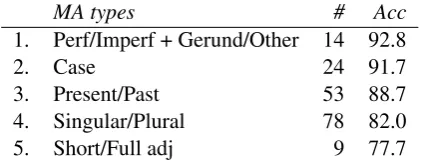
Table 2 shows the results of our experiments in terms of accuracy. 85.9% accuracy was achieved across all types of MA. However, we should stress that in the test set marked Multi-admissible (MA), the majority of the instances belong to the MA types of Present/Past tense and Singular/Plural.
Since the test set has a small number of in-stances of MA contexts with gerund/other verb
16
https://tatianashavrina.github.io
17
This analyzer was chosen because it is a part of Revita’s text processing pipeline.
Test set # Acc
A. Multi-admissible 178 85.9
B. Random correct 500 92.3
C. Correct & incorrect 1290 81.0
C1. Grammatically correct 650 73.3
C2. Grammatically incorrect 640 88.6
[image:8.595.76.287.61.158.2]D. Pragmatic errors 46 54.3
Table 2: Percent accuracyof our NN model. Random correct: test set built from sentences which were not in-cluded in the training and validation sets and did not ap-pear in Revita’s database, randomly selected sentences from normal texts. Grammatically incorrect: test set with real grammatical errors from students’ data. Prag-matic errors: test set with real pragPrag-matic errors from students’ data.
MA types # Acc
1. Perf/Imperf + Gerund/Other 14 92.8
2. Case 24 91.7
3. Present/Past 53 88.7
4. Singular/Plural 78 82.0
5. Short/Full adj 9 77.7
Table 3: Percent accuracy of our NN model for dif-ferent MA contexts. Case combines all types of MA contexts listed in the Subsection 2.1which differ by case (Nominative/Instrumental, Genitive/Accusative and others).
forms and MA contexts which differ by perfec-tive/imperfective aspect, we grouped them to-gether for testing the model. On these two types of MA the model achieved the highest accu-racy, 92.8% (see Table 3). For the same rea-sons we grouped together MA contexts which differ by case (Nominative/Instrumental, Geni-tive/Accusative, Second Genitive and other). The overall accuracy for these contexts is 91.7%.
We plan to test all combined MA types sepa-rately as soon as we have more annotated data. The accuracy for Present/Past tense is 88.7%. The accuracy for Number agreement (including subject-verb agreement on number) is 81.0%. The lowest accuracy was achieved for Short/Full adjectives—77.7%. Some discussion of errors is in the following subsection.
We use additional test sets to assess other as-pects of the trained NN model. The “Random cor-rect” test set (B.) contains 500 randomly sampled sentenceswithout errors, to compare with the MA test set. These sentences were sampled from a corpus which was not used for generating
train-ing/validation data, and are not present in the Re-vita database. On random correct sentences, the model achieved substantially better results than for MA instances (92.3%). It is interesting that the model has more difficulty with the syntactic struc-ture of contexts with known MA than with some random correct contexts.
Another test set (C.) is made up of correct sen-tences from the Revita database, and sensen-tences with grammatical errors made by the learners. We evaluate the model on this test set to gain insight into how well it can differentiate between various incorrect vs. correct sentences. The discussion of results for different grammatical error types is be-yond the scope of this paper, and is left for the further work.
The pragmatic error test set (D.) was used to find out how difficult it is to predict labels for sentences which are correct grammatically but in-correct semantically/pragmatically. Clearly these instances pose the greatest challenge to the cur-rent model; (it was not explicitly trained to detect them).
Of the nearly 3000 manually annotated in-stances, the number of instances found to be prag-matic errors and MA was not large.
6.1 Error Analysis
We analysed some of the errors the model made on the MA test dataset. For all types of MA, we found some similar patterns: the model assigns very low scores to short sequences (which are padded), con-texts with too many punctuation marks or names, and context with non-Russian words which are un-known to the model. For example, for construc-tions with Present/Past tense, the network made wrong predictions if the subject was a name or a number, which in most cases corresponds to the token “UNK” in our model’s vocabulary. The same happens if the subject is outside the window. Sometimes the model confuses certain nouns or pronouns next to the verb with its subject, for ex-ample:
“Поезда (SUBJ) метро задерживаются (PRED).
“Trains of the metro are delayed.”
[image:8.595.76.288.278.360.2]subject is the plural noun “поезда” (“trains”)— but the genitive is closer to the predicate. As a re-sult, the model will identify the sentence as gram-matically incorrect, believing that the subject and predicate conflict in number.
We also should note that some instances marked by the model as incorrect are actually incorrect, but marked as MA by annotators, which means that MA instances need to be double-checked and that the model is able to identify ungrammatical contexts.
It is difficult to compare our results directly with prior work, because we have not yet found in the previous work a problem similar to Multiple Admissibility for Russian. A similar problem— grammatical acceptability judgment—is presented in (Warstadt et al., 2018), for English only. The best results they achieved in terms of percent ac-curacy is 77.2%. The average human acac-curacy is 85%.
For the task of grammatical error detection, the results obtained for Russian are much lower than for English. For example, the highest precision in (Rozovskaya and Roth,2019) for errors in number agreement is 56.7.
Concerning the grammaticality judgement task, Marvin (2018) reported accuracies for subject-verb agreement from 50% to 99% depending on the syntactic complexity of the sentence (e.g., re-lations across relative clause). This is similar to Present/Past tense construction in our setup.
Linzen et al. (2016) also concludes that the grammaticality judgment objective is more diffi-cult than, for example, the number prediction ob-jective. The LSTM model can have up to 23% error on this task, as sentence complexity grows. This work studied only number agreement and subject-verb dependencies in English.
7 Conclusions and Future Work
We address the problem ofMultiple admissibility
in automatically generated exercises, by approach-ing it as a grammaticality judgment task. We of-fer a detailed study of examples, where our lan-guage learning system mistakenly assesses admis-sible answers as incorrect. We classify these con-texts into 10 types, where only some of these types have been in the focus of prior research, especially for Russian. We train a NN model with the gram-maticality objective, independent of the type of test set we use for evaluation. The problem of
lacking labeled training data was approached by generating a dataset with artificial errors. We also observed that the MA problem is more relevant for advanced language learners. Another observa-tion is that for a trained model it is more difficult to make prediction about MA contexts than about random correct sentences.
We plan to extend and improve our training data by marking numbers with special tokens, or by mapping them into words. We also plan to mark names with a name tag by using some of the exist-ing NER models, and mark rare words with their part of speech. We also believe that providing the model with syntactic information (parsing) can help, so that we can train a model in a multitask fashion: predict tags of words, as well as their cor-rectness. Also, it is worth trying to use new large-scale language models, which proved to be more effective on a variety of tasks.
Additional annotation of student data collected in Revita’s database is needed; in the current work, the annotation was done by two experts, and all disagreements were resolved. We plan to ex-tend our experiments to other languages available in Revita. Each has its own language-specific types of MA. Generating all paradigms of a word could be problematic for some highly inflected languages (e.g., Finnish, etc.).
The goal of this paper is to introduce the prob-lem of Multiple Admissibility and to attract more attention to experimenting with morphologically rich languages and languages other than English in this context.
References
Dzmitry Bahdanau, Kyunghyun Cho, and Yoshua Ben-gio. 2014. Neural machine translation by jointly learning to align and translate. arXiv preprint arXiv:1409.0473.
Chris Brockett, William B Dolan, and Michael Gamon. 2006. Correcting ESL errors using phrasal SMT techniques. InProceedings of the 21st International Conference on Computational Linguistics and the 44th annual meeting of the Association for Compu-tational Linguistics, pages 249–256. Association for Computational Linguistics.
Markus Dickinson. 2010. Generating learner-like mor-phological errors in russian. In Proceedings of the 23rd International Conference on Computational Linguistics (Coling 2010), pages 259–267.
Nava Ehsan and Heshaam Faili. 2013. Grammatical and context-sensitive error correction using a sta-tistical machine translation framework. Software: Practice and Experience, 43(2):187–206.
Mariano Felice. 2016. Artificial error generation for translation-based grammatical error correction. Technical report, University of Cambridge, Com-puter Laboratory.
Mariano Felice and Zheng Yuan. 2014. Generating ar-tificial errors for grammatical error correction. In
Proceedings of the Student Research Workshop at the 14th Conference of the European Chapter of the Association for Computational Linguistics, pages 116–126.
Sylviane Granger. 2003. Error-tagged learner corpora and CALL: A promising synergy. CALICO journal, 20(3):465–480.
Kristina Gulordava, Piotr Bojanowski, Edouard Grave, Tal Linzen, and Marco Baroni. 2018. Color-less green recurrent networks dream hierarchically.
arXiv preprint arXiv:1803.11138.
Kenji Imamura, Kuniko Saito, Kugatsu Sadamitsu, and Hitoshi Nishikawa. 2012. Grammar error correc-tion using pseudo-error sentences and domain adap-tation. InProceedings of the 50th Annual Meeting of the Association for Computational Linguistics: Short Papers-Volume 2, pages 388–392. Association for Computational Linguistics.
Emi Izumi, Kiyotaka Uchimoto, Toyomi Saiga, Thep-chai Supnithi, and Hitoshi Isahara. 2003. Automatic error detection in the Japanese learners’ English spo-ken data. InThe Companion Volume to the Proceed-ings of 41st Annual Meeting of the Association for Computational Linguistics.
Rafal Jozefowicz, Oriol Vinyals, Mike Schuster, Noam Shazeer, and Yonghui Wu. 2016. Exploring the limits of language modeling. arXiv preprint arXiv:1602.02410.
Sudhanshu Kasewa, Pontus Stenetorp, and Sebastian Riedel. 2018. Wronging a right: Generating better errors to improve grammatical error detection. arXiv preprint arXiv:1810.00668.
Anisia Katinskaia, Javad Nouri, and Roman Yangarber. 2018. Revita: a language-learning platform at the intersection of ITS and CALL. In Proceedings of LREC: 11th International Conference on Language Resources and Evaluation, Miyazaki, Japan.
E.S. Klyshinsky, N.A. Kochetkova, M.I. Litvinov, and V.Yu. Maximov. 2011. Method of POS-disambiguation using information about words co-occurrence (for Russian). Proceedings of GSCL, pages 191–195.
Mikhail Korobov. 2015. Morphological analyzer and generator for Russian and Ukrainian languages. In
International Conference on Analysis of Images, So-cial Networks and Texts, pages 320–332. Springer.
John Lee and Stephanie Seneff. 2008. Correcting mis-use of verb forms. Proceedings of ACL-08: HLT, pages 174–182.
Tal Linzen, Emmanuel Dupoux, and Yoav Goldberg. 2016. Assessing the ability of lstms to learn syntax-sensitive dependencies. Transactions of the Associ-ation for ComputAssoci-ational Linguistics, 4:521–535.
Rebecca Marvin and Tal Linzen. 2018. Targeted syn-tactic evaluation of language models.arXiv preprint arXiv:1808.09031.
Desmond Darma Putra and Lili Szab´o. 2013. UdS at CoNLL 2013 Shared Task. In Proceedings of the Seventeenth Conference on Computational Natural Language Learning: Shared Task, pages 88–95.
E.V. Rakhilina, A.S. Vyrenkova, and M.S. Polinskaya. 2014. Grammar of errors and grammar of construc-tions: ”Heritage” (”inherited”) Russian language.
Questions of linguistics, 3(2014):3–19.
Ditmar Elyashevich Rosenthal, E.V. Dzhandzhakova, and N.P. Kabanova. 1994. Reference on Spelling, Pronunciation, and Literary Editing. Moscow Inter-national School of Translators.
Alla Rozovskaya, Kai-Wei Chang, Mark Sammons, and Dan Roth. 2013. The University of Illinois system in the CoNLL-2013 shared task. In Pro-ceedings of the Seventeenth Conference on Compu-tational Natural Language Learning: Shared Task, pages 13–19.
Alla Rozovskaya, Kai-Wei Chang, Mark Sammons, Dan Roth, and Nizar Habash. 2014. The Illinois-Columbia system in the CoNLL-2014 shared task. In Proceedings of the Eighteenth Conference on Computational Natural Language Learning: Shared Task, pages 34–42.
Alla Rozovskaya and Dan Roth. 2010a. Generating confusion sets for context-sensitive error correction. In Proceedings of the 2010 Conference on Empiri-cal Methods in Natural Language Processing, pages 961–970. Association for Computational Linguis-tics.
Alla Rozovskaya and Dan Roth. 2010b. Training paradigms for correcting errors in grammar and us-age. In Human language technologies: The 2010 annual conference of the north american chapter of the association for computational linguistics, pages 154–162. Association for Computational Linguis-tics.
the Association for Computational Linguistics: Hu-man Language Technologies-Volume 1, pages 924– 933. Association for Computational Linguistics.
Alla Rozovskaya and Dan Roth. 2019. Grammar error correction in morphologically rich languages: The case of Russian.Transactions of the Association for Computational Linguistics, 7:1–17.
Alla Rozovskaya, Dan Roth, and Mark Sammons. 2017. Adapting to learner errors with minimal su-pervision. Computational Linguistics, 43(4):723– 760.
Alla Rozovskaya, Mark Sammons, and Dan Roth. 2012. The UI system in the HOO 2012 shared task on error correction. InProceedings of the Seventh Workshop on Building Educational Applications Us-ing NLP, pages 272–280. Association for Computa-tional Linguistics.
Jonas Sj¨obergh and Ola Knutsson. 2005. Faking er-rors to avoid making erer-rors: Very weakly super-vised learning for error detection in writing. InProc. RANLP, volume 2005.
Viktor Vladimirovich Vinogradov. 1972. Russian lan-guage: The grammatical doctrine of the word, vol-ume 21. High School.