481
Divide, Conquer and Combine: Hierarchical Feature Fusion Network
with Local and Global Perspectives for Multimodal Affective Computing
Sijie Mai School of Electronics and Information Technology,
Sun Yat-sen University
{maisj,xingslong}@mail2.sysu.edu.cn Haifeng Hu School of Electronics and Information Technology,
Sun Yat-sen University
Songlong Xing School of Electronics and Information Technology,
Sun Yat-sen University
Abstract
We propose a general strategy named ‘divide, conquer and combine’ for multimodal fusion. Instead of directly fusing features at holis-tic level, we conduct fusion hierarchically so that both local and global interactions are con-sidered for a comprehensive interpretation of multimodal embeddings. In the ‘divide’ and ‘conquer’ stages, we conduct local fusion by exploring the interaction of a portion of the aligned feature vectors across various modal-ities lying within a sliding window, which en-sures that each part of multimodal embeddings are explored sufficiently. On its basis, global fusion is conducted in the ‘combine’ stage to explore the interconnection across local inter-actions, via an Attentive Bi-directional Skip-connected LSTM that directly connects distant local interactions and integrates two levels of attention mechanism. In this way, local inter-actions can exchange information sufficiently and thus obtain an overall view of multimodal information. Our method achieves state-of-the-art performance on multimodal affective computing with higher efficiency.
1 Introduction
Multimodal machine learning, as prior research shows (Baltruˇsaitis et al., 2019), always yields higher performance in multimodal tasks compared to the situation where only one modality is in-volved. In this paper, we aim at the multimodal machine learning problem, with an emphasis on multimodal affective computing where the task is to infer human’s opinion from given language, vi-sual and acoustic modalities (Poria et al.,2017a).
[image:1.595.317.515.222.348.2]Finding a feasible and effective solution to learning inter-modality dynamics has been an in-triguing and important problem in multimodal learning (Baltruˇsaitis et al., 2019), where inter-modality dynamics represent complementary in-formation contained in more than one involved
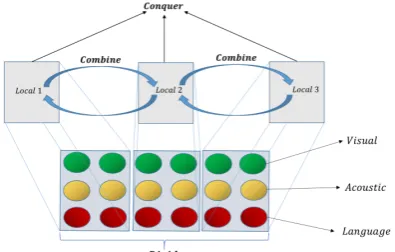
Figure 1: Schematic Diagram of our fusion strategy. Here the window size and stride are both set to 2.
modality to be detected and analyzed for a more accurate comprehension. For this purpose, a large body of prior work mostly treats the feature vec-tors of the modalities as the smallest units and fuse them at holistic level (Barezi et al., 2018; Poria et al., 2016a, 2017b; Liu et al., 2018). Typical-ly,Zadeh et al.(2017) propose a tensor-based fu-sion method which fuses feature vectors of three modalities using Cartesian product. Despite the effectiveness this type of methods have achieved, they give little consideration to acknowledging the variations across different portions of a feature vector which may contain disparate aspects of in-formation and thus fail to render the fusion proce-dure more specialized. Additionally, they conduct fusion within one step, which can be intractable in some scenarios where the fusion method is sus-ceptible to high computational complexity.
Recently, Convolution Neural Networks (CN-N) have achieved compelling successes in com-puter vision (Krizhevsky et al.,2012;Mehta et al.,
strate-gy towards multimodal fusion with multiple con-crete fusion methods to choose from. Specifical-ly, as shown in Fig. 1, we align feature vectors of three modalities to obtain multimodal embed-dings and apply a sliding window to slide through them. The parallel portions of feature vectors within each window are then fused by a specific fusion method. By considering local interaction-s we achieve three advantageinteraction-s: 1) render fuinteraction-sion procedure more specialized since each portion of modality embeddings contains specific aspect of information intuitively; 2) assign proper weight-s to different portionweight-s; 3) reduce computational complexity and parameters substantially by divid-ing holistic fusion into multiple local ones. Many approaches can be adapted into our strategy for lo-cal fusion, and we empirilo-cally apply outer product, following (Zadeh et al.,2017). While using out-er product (bilinear pooling) always brings heavy time and space complexity (Lin et al.,2015; Zade-h et al.,2017;Wu et al.,2017), we show that our method can achieve much higher efficiency.
Nonetheless, local fusion alone is not adequate for a comprehensive analysis of opinion. In fact, local interactions may contain complementary in-formation to each other, which should be drawn upon for overall comprehension. Moreover, a small-sized sliding window may not be able to cover a complete interaction. Thus, we propose global fusion to explore interconnections of lo-cal interactions to mitigate these problems. In practice, RNN variants (Goudreau et al., 1994), especially LSTM (Hochreiter and Schmidhuber,
1997), are suitable for global fusion for their im-pressive power in modeling interrelations. How-ever, in vanilla RNN architecture, only consecu-tive time steps are linked through hidden states, which may not be adequate for conveying infor-mation to local interactions that are far apart. Re-cently, some works have focused upon introducing residual learning into RNNs (Tao and Liu,2018;
Wang and Wang,2018;Wang and Tian,2016;He et al.,2016). Motivated by these efforts, we pro-pose an Attentive Bi-directional Skip-connected LSTM (ABS-LSTM) that introduces bidirection-al skip connection of memory cells and hidden states into LSTM, which is effective in ensuring sufficient flow of information in multi-way and handling long-term dependency problem (Bengio et al.,1994). In the transmission process of ABS-LSTM, the previous interactions are not equally
correlated to the current local interaction, i.e., they vary in the amount of complementary information to be delivered. In addition, given that the local in-teractions, which do not contain equally valuable information, are used as input into ABS-LSTM across time steps, it is understandable that the pro-duced states do not contribute equally to recog-nizing emotion. Thus, we incorporate two levels of attention mechanism into ABS-LSTM, i.e., Re-gional Interdependence Attention and Global In-teraction Attention. The former takes effect in the process of delivering complementary information between local interactions, identifying the various correlation of previous tlocal interactions to the current one. The latter serves the purpose of allo-cating more attention to states that are more infor-mative so as to aid a more accurate prediction.
To sum up, we propose a Hierarchical Feature Fusion Network (HFFN) for multimodal affective analysis. The main contributions are as follows:
• We propose a generic hierarchical fusion s-trategy, termed ‘divide, conquer and com-bine’, to explore both local and global inter-actions in multiple stages each focusing on different dynamics.
• Instead of conducting fusion on a holistic lev-el, we innovate to leverage a sliding window to explore inter-modality dynamics locally. In this way, our model can take into account the variations across portions in a feature vec-tor. Such setting also brings about an impres-sive bonus, i.e., significant drop in computa-tional complexity compared to other tensor-based methods, which is proven empirically.
• We propose global fusion to obtain an over-all view of multimodal embeddings via a specifically designed ABS-LSTM, in which we integrate two levels of attention mech-anism: Regional Interdependence Attention and Global Interaction Attention.
2 Related Work
Previous research on affective analysis focuses on text modality(Liu and Zhang,2012;Cambria and Hussain,2015), which is a hot research topic in the NLP community. However, recent research sug-gests that information from text is not sufficient for mining opinion of humans (Poria et al.,2017a;
espe-cially under the situation where sarcasm or ambi-guity occurs. Nevertheless, if the accompanying information such as speaker’s facial expressions and tones are presented, it would be much easier to figure out the real sentiment (Pham et al.,2019,
2018). Therefore, multimodal affective analy-sis has attracted increasing attention, whose ma-jor challenge is how to fuse features from vari-ous modalities. Earlier feature fusion strategies can be roughly categorized into feature-level and decision-level fusion. The former seeks to ex-tract features of various modalities and conduc-t fusion aconduc-t inpuconduc-t level, by mapping conduc-them inconduc-to conduc-the same embedding space simply using concatena-tion (Wollmer et al., 2013; Rozgic et al., 2012;
Morency et al., 2011;Poria et al.,2016a, 2017b;
Gu et al., 2017). The latter, by contrast, draws tentative decisions based on involved modalities separately and weighted-average the decisions, re-alizing cross-modal fusion (Wu and Liang,2010;
Nojavanasghari et al., 2016;Zadeh et al., 2016a;
Wang et al., 2016). These two lines of work do not effectively model cross-modal or modality-specific dynamics (Zadeh et al.,2017).
Recently, word-level fusion methods have re-ceived substantial research attention and been widely acknowledged for effective exploration of time-dependent interactions (Wang et al., 2019;
Zadeh et al., 2018a,b,c; Gu et al., 2018a; Ra-jagopalan et al.,2016). For example, Chen et al.
(2017) andGu et al. (2018b) leverage word-level alignment between modalities and explore time-restricted cross-modal dynamics. Liang et al.
(2018a) propose Recurrent Multistage Fusion Net-work (RMFN) which decomposes multimodal fu-sion into three stages and uses LSTM to perform local fusion. RMFN adopts the strategy of ‘di-vide and conquer’, while our method extends it by adding ‘combine’ part to learn the relations be-tween local interactions.Liang et al.(2018b) con-ducts emotion recognition using local-global emo-tion intensity rankings and Bayesian ranking algo-rithms. However, the ‘local’ and ‘global’ here is totally different from ours, with its ‘local’ refer-ring to an utterance of a video while our ‘local’ represents a feature chunk of an utterance.
Tensor fusion has also become increasingly popular. Tensor Fusion Network (TFN) (Zadeh et al., 2017) adopts outer product to conduct fu-sion at holistic level, which is later extended by
Liu et al.(2018) andBarezi et al.(2018) that try to
improve efficiency and reduce redundant informa-tion by decomposing weights of high-dimensional fused tensors. HFFN mainly applies outer product as local fusion methods, and it improves efficien-cy by dividing modality embeddings into multiple local chunks before fusion which prevents high-dimensional fused tensor from being created. Ac-tually, HFFN can adopt any fusion strategy in local fusion stage other than only outer product, show-ing high flexibility and applicability.
3 Algorithm
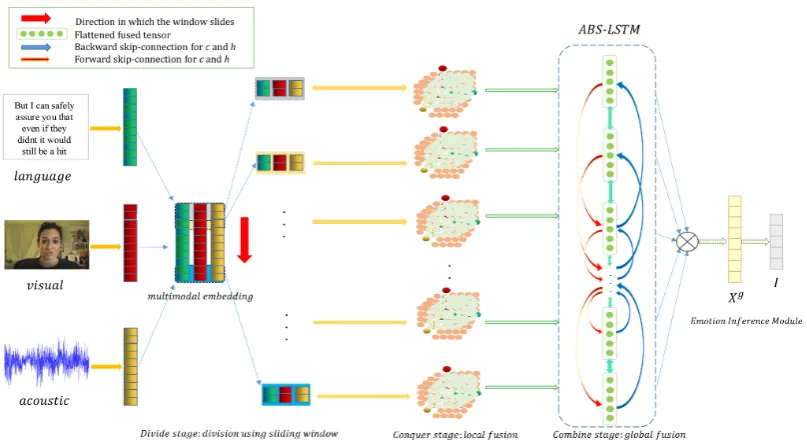
As shown in Fig.2, HFFN consists of: 1) Local Fusion Module (LFM) for fusing features of dif-ferent modalities at every local chunk; 2) Global Fusion Module (GFM) for exploring global inter-modality dynamics; 3) Emotion Inference Module (EIM) for obtaining the predicted emotion.
3.1 Divide and Conquer: Local Fusion
At the local fusion stage, we apply a sliding win-dow that slides through the aligned feature vec-tors synchronously. At each step of operation, lo-cal fusion is conducted for the portions of feature vectors within the window. In this way, features across all modalities at the same window are able to fully interact with one another to obtain locally confined interactions in a more specialized way.
Assume that we have three modalities’ feature vectors as input, namely languagel∈ Rk, visual
v ∈ Rk and acoustica ∈ Rk (we only consider
the situation where all modalities share the same feature lengthksince they can be easily mapped into the same embedding space via some transfor-mations). In ‘divide’ stage, we align these feature vectors to form the multimodal embedding M∈
R3×kand leverage a sliding window of size3×d
to explore inter-modality dynamics. Through the sliding window, each feature vector can be seen as segmented into multiple portions, each termed as a local portion. The segmentation procedure for feature vector of one modality is equivalent to:
mi=[ms·(i−1)+1, ms·(i−1)+2, ..., ms·(i−1)+d] (1)
where m ∈ {l, v, a} is the modality m, d is the window size,sis the stride andmidenotes theith
local portion of modality m (i ∈ [1, n], n is the number of local portions for each modality). Ob-viously, for each modality, we haven= k−sd+ 1
Figure 2: The Detailed Structure of HFFN.
have n = k−sd+ 2local portions. In practice, bothdandscan be set freely (see Section4.3.5). For descriptive convenience we also term the par-allel local portions corresponding to all modalities within the sliding window as a local chunk.
Many fusion methods can be chosen for fusing features within each local chunk to explore inter-modality dynamics in ‘conquer’ stage. In practice, we apply outer product for it provides the best re-sults in our experiments. Firstly, each local portion is padded with1sto retain interactions of any sub-set of modalities as in (Zadeh et al.,2017):
mi0 = [mi, 1], 1≤i≤n, m∈ {l, v, a} (2)
Then we perform outer product from feature vec-tors padded with1s, defined as (Liu et al.,2018):
Xif =O m
mi0, mi0 ∈Rd+1 (3)
whereN
denotes tensor outer product of a set of vectors. The final local fused tensor forith local chunk isXif ∈ R(d+1)3
which represents theith
local interaction. We group allnlocal fused ten-sors to obtain the overall fused tensor sequence:
Xf = [X1f; X2f; ... ; Xnf] ∈ Rn×(d+1)
3
. A tensor fusion diagram is shown in LFM module of Fig. 2. Compared with other models adopt-ing outer product (Zadeh et al., 2017), our mod-el achieves a marked improvement in efficiency by dividing holistic tensor fusion into multiple lo-cal ones, which is shown in Section4.3.3. Actu-ally, we can apply other fusion methods that are suitable for local information extraction, which demonstrates the broad applicability of our strat-egy and is left for future work.
3.2 Combine: Global Fusion
In the ‘combine’ stage, we model global interac-tions by exploring interconnecinterac-tions (complemen-tary information) and context-dependency across local fused tensors to obtain an overall interpre-tation of interactions comprehensively. In addi-tion, the limited and fixed size of sliding window may lead to division of the complete process of ex-pressing emotion into different local portions, in which case sufficient flow of information between local chunks is warranted to compensate for this problem. Therefore, we design ABS-LSTM, an RNN variant, to make sense of the cross-modality dynamics from an integral perspective. In ABS-LSTM, we introduce bidirectional residual con-nection of memory cells and hidden states as well as integrate attention mechanisms to transmit in-formation and learn overall representations more effectively, as shown in Fig.2. Now that we ob-tain the local fused tensor sequenceXf in LFM,
global interaction learning can be expressed as:
Xg =ABS-LSTM(Xf) (4) whereABS-LSTMis activated by tanh nonlinear function,Xg = [X1g; X2g;...; Xng] ∈ Rn×2o is
the global fused tensor sequence, and2ois the di-mensionality of ABS-LSTM’s output. A detailed illustration of ABS-LSTM is shown below.
3.2.1 ABS-LSTM
in-teractions within a certain distance range are mu-tually correlated, it is necessary for ABS-LSTM to operate in a bidirectional way. As opposed to conventional bidirectional RNNs, ABS-LSTM has a set of identical parameters for both for-ward/backward passes which ensures a smaller number of parameters. Further, ABS-LSTM di-rectly connects the current interaction with its sev-eral neighbors so that information can be suffi-ciently exchanged. Given its ability to bidirection-ally transmit information in multiple connections, it is powerful in modeling long-term dependency, which is crucial for long sequences.
Firstly we illustrate the pipeline of ABS-LSTM in forward pass stage. Assume thattprevious lo-cal interactions are directly connected to the cur-rent one (t is set to 3 in our experiment), it is beneficial to identify the various correlation be-tween previous t interactions and the current in-teraction. To this end, we integrate Regional In-terdependence Attention (RIA) into ABS-LSTM, so that previous local interactions containing more complementary information to the current one are given more importance in the information trans-mission process. The equations for previous infor-mation fusion of cells and states forlthinteraction
in forward pass are as follows:
scl−i=tanh(Wc(
− →c
l−i⊕Xlf) ),1≤i≤t
shl−i=tanh(Wh(
− →
hl−i⊕Xlf) ),1≤i≤t
(5)
sc= [kscl−tk2,kscl−t+1k2, ...,kscl−1k2],
sh= [kshl−tk2,kshl−t+1k2, ...,kshl−1k2]
(6)
γc=sof tmax(sc),γh =sof tmax(sh) (7)
˜ cl=a(
t
X
i=1
γcl−i
− →c
l−i),h˜l=a( t
X
i=1
γhl−i
− →
hl−i)
(8) where L
denotes vector concatenation and
Wh,Wc ∈ Ro×(o+(d+1)
3)
are parameter matri-ces that determine the importance of previous cells
− →c
l−i and states −→cl−i, respectively. Eq. 5
map-s the cell and map-state at the (l −i)th time step
in-to twoo-dimensional vectors respectively. Instead of merely using−→cl−i or
− →
hl−i to obtain their
im-portance towards local interaction at current time step, we also utilize current time step’s inputXlf
to reflect the correlation between the cell and s-tates of (l−i)th interaction and current lth time
step’s input, which provides a better measuremen-t of ameasuremen-tmeasuremen-tenmeasuremen-tion score by learning inmeasuremen-ter-dependency
correlation between interactions. We take the 2-norm of each vector in Eq. 6 as the importance score of each previous cell and state and then for-m at-dimensional importance score vector for al-l states and ceal-lal-ls, respectiveal-ly. In Eq. 7 we use
sof tmaxlayer to normalize both vectors and ob-tain the final attention scores, which, according to Eq.8, are used as weights for the combination of previoustlocal interactions. The functionain E-q.8is a nonlinear activation function that helps to improve expressive power of ABS-LSTM, which we empirically chooseReLU. Overall, Eq.5to E-q.8realize transmission of information from pre-vious multiple local interactions to the current one, using the first level of attention mechanism, i.e., RIA, which is able to properly distribute attention across the previoustlocal interactions to focus on the ones that contain information most relevant to the current local interaction.
After the combination of previous information, we further define:
fl =σ(Wf1X
f
l +Wf2hel) (9) il=σ(Wi1X
f
l +Wi2ehl) (10) −
→c
l=flcel+iltanh(Wm1X
f
l+Wm2ehl) (11) −
→
hl=σ(Wo1X
f
l +Wo2ehl)tanh( − →
cl) (12)
where σ denotes sigmoid function. Eq.9 - 12
denote the routine procedure of LSTM except that
− →
hl−1 and−→cl−1 are replaced withehl andcel,
re-spectively. The output oflthtime step in forward pass stage is −→hl (1 ≤ l ≤ n). To make
ABS-LSTM bidirectional, in backward pass stage, we reverse inputXfso that the last interaction arrives in first place and again feed it into Eq. 5 - 12, whose output becomes ←h−l. The output of
ABS-LSTM atlthtime step is:hl=
←− hlL
− →
over others since they have just synthesized an in-formative interaction and not yet been ‘diluted’. Hence, it is justifiable to employ a specifically de-signed attention mechanism, termed Global Inter-action Attention (GIA), to properly assign impor-tance across states. GIA is formulated as follows:
ωh=ReLU(Wh0hl+bh0) (13)
ωx =ReLU(WxXlf +bx) (14)
hal =tanh((Wh2ωh)·hl+Wx2ωx) (15)
whereWh0 ∈Ro×2oandWx ∈Ro×(d+1)
3
are t-wo parameter matrices andbh0,bx ∈ Ro are two
bias vectors to be learned.Wh2,Wx2 ∈R
1×oare
two parameter matrices that determine final im-portance scores. Through affine transforms and nonlinearities in Eq. 13 and Eq.14, the lth state
hl and the corresponding input Xlf are
embed-ded into twoo-dimensional vectorsωhandωxthat
contain information regarding importance oflth s-tate and local interaction, respectively. In Eq.15,
Wh2 andωh first form a scalar via matrix
multi-plication, which reflects the importance of thelth
hidden state to be used as its weight. Meanwhile, we pre-multiplyωxbyWx2 and obtain a scalar to
be added to each entry of weighted state, which functions as a bias containing input information. By this means, the attended state at current time step is able to focus more on the information from current interaction instead of the previous ones. Considering thatXlf andhl are two intrinsically
disparate sources of information, we only formu-late the impact of Xlf as a scalar that biases the state, rather than as a vector which has much more complex influence to the state and empirically de-grades performance. In this way, ifXlf is more important, the lth attended state hal will receive a more significant shift towards a higher position with respect to all high-dimensional coordinates, and thus hal is more attended. In a sense, every element of the original state undergoes a transfor-mation, with a specifically determined weight and a fixed bias across all entries. GIA enables ABS-LSTM to enhance the states of greater importance, aiding a more accurate classification. The final output of ABS-LSTM is the concatenation of at-tended states:Xg =Ln
l=1hal ∈Rn×2o.
3.3 Emotion Inference Module
After obtaining the global interactions, the final e-motion is obtained by:
E=f(We1Xg+be1) (16)
I =sof tmax(We2E) (17)
wheref contains a tanhactivation function and a dropout layer of dropout rate 0.5, We1 ∈ R50×n·2o, be1 ∈ R50and We2 ∈ RN×50 are the
learnable parameters, and I ∈ RN is the final
e-motion inference (N is the number of categories).
4 Experiments
4.1 datasets
CMU-MOSI (Zadeh et al., 2016b) includes 93 videos with each video padded to 62 utterances. We consider positive and negative sentiments in our paper. We use 49 videos for training, 13 for validation and 31 for testing. CMU-MOSEI
(Zadeh et al., 2018c) has 2928 videos, and each video is padded to 98 utterances. Each utterance has been scored on two perspectives: sentiment in-tensity (ranges between [-3, 3]) and emotion (six classes). We consider positive, negative and neu-tral sentiments in the paper. We utilize 1800, 450 and 678 videos respectively for training, validation and testing. IEMOCAP(Busso et al.,2008) con-tains 151 videos and each video has at most 110 utterances. IEMOCAP contains following label-s: anger, happiness, sadness, neutral, excitement, frustration, fear, surprise and other. We take the first four emotions so as to compare with previous models. The training, validation and testing sets contain 96, 24 and 31 videos respectively.
4.2 Experimental details
HFFN is implemented using the framework of Keras, with tensorflow as backend. The in-put dimensionalityk for MOSI and CMU-MOSEI datasets is 50, while for IEMOCAP,kis set to 100. We use RMSprop for optimizing the network, with cosine proximity as objective func-tion. The output dimension 2oof ABS-LSTM is set to 6 for CMU-MOSI and CMU-MOSEI but 2 for IEMOCAP. Note that ABS-LSTM is activated bytanhand followed by a dropout layer.
For feature pre-extraction, our setting on CMU-MOSI and IEMOCAP datasets are identical to that in (Poria et al., 2017b)1. The features are extracted from each utterances separately. For language feature, a text-CNN is applied. Each word is first embedded into a vector us-ing word2vec tool (Mikolov et al., 2013). Then
1
the vectorized representations for all words in an utterance are concatenated, which afterward-s iafterward-s proceafterward-safterward-sed by CNNafterward-s (Karpathy et al., 2014). Foracoustic feature, an open-source tool openS-MILE (Eyben, 2010) is utilized to generate high dimensional vectors comprised of low-level de-scriptors (LLD). 3D-CNN (Ji et al., 2013) is ap-plied for visual feature pre-extraction. It learn-s relevant featurelearn-s from each frame and the al-terations across consecutive frames. By contrast, on CMU-MOSEI dataset we follow the setting as in (Zadeh et al., 2017;Liu et al., 2018)2. GloVe (Pennington et al.,2014), Facet (iMotions,2017) and COVAREP (Degottex et al.,2014) are applied for extracting language, visual and acoustic fea-tures respectively. Word-level alignment is per-formed using P2FA (Yuan and Liberman, 2008) across modalities. Eventually the unimodal fea-tures are generated as the average of their feature values over word time interval (Chen et al.,2017). Subsequent to pre-extraction, similar to BC-LSTM (Poria et al.,2017b), we devise a Unimodal Feature Extraction Network (UFEN): Ru×dj → Ru×k, which consists of a bidirectional LSTM
lay-er followed by a fully connected (FC) laylay-er, for each separate modality. Here,udenotes the num-ber of utterances that constitute a video anddj is
the dimensionality of raw feature vector for jth
modality. Through UFEN, feature vectors of al-l modaal-lities are mapped into the same embedding space (have the same dimensionality k). UFEN for each modality, is individually trained followed by a FC layer: Rk → RN using Adadelta (
Zeil-er,2012) as optimizer and with categorical cross-entropy as loss function. The precessed feature vectors of each utterance will be sent into HFFN.
4.3 Results and Discussions
4.3.1 Comparison with Baselines
We compare HFFN with following multimodal algorithms: RMFN (Liang et al., 2018a), MFN (Zadeh et al.,2018a), MCTN (Pham et al.,2019), BC-LSTM (Poria et al.,2017b), TFN (Zadeh et al.,
2017), MARN (Zadeh et al., 2018b), LMF ( Li-u et al., 2018), MFM (Tsai et al., 2019), MR-RF (Barezi et al.,2018), FAF (Gu et al., 2018b), RAVEN (Wang et al.,2019), GMFN (Zadeh et al.,
2018c), Memn2n (Sukhbaatar et al.,2015), MM-B2 (Liang et al., 2019), CHFusion (Majumder et al., 2018), SVM Trees (Rozgic et al., 2012),
2https://github.com/A2Zadeh/CMU-MultimodalSDK
Methods Acc F1 Score
BC-LSTM 77.9 78.1
CAT-LSTM 76.6 76.2
MFN 77.4 77.3
FAF 76.5 76.8
RAVEN 78.0
-CHFusion 80.0
-MMB2 75.2 75.1
MFM 77.4 77.3
RMFN 78.4 78.0
MCTN 79.3 79.1
GMFN 77.7 77.7
TFN 74.6 74.5
LMF 76.4 75.7
MRRF 73.0 73.1
HFFN(d, s= 2,2) 80.19 80.34
Table 1: Performance on CMU-MOSI dataset.
Models Acc F1 score
TFN 59.40 57.33
LMF 60.27 53.87
CHFusion 58.45 56.90 BC-LSTM 60.77 59.04 CAT-LSTM 60.72 58.83 HFFN(d, s= 2,2) 60.37 59.07
Table 3: Performance on CMU-MOSEI dataset.
CMN (Hazarika et al.,2018), C-MKL (Poria et al.,
2016b) and CAT-LSTM (Poria et al.,2017c). As presented in Table1, HFFN shows improve-ment over typical approaches, setting new state-of-the-art record. Compared with the tensor fu-sion approaches TFN (Zadeh et al., 2017), M-RRF (Barezi et al., 2018) and LMF (Liu et al.,
s-IEMOCAP (Individual) IEMOCAP (4-way) Models F1-Angry F1-Happy F1-Sad F1-Neutral Models Acc F1
MFM 86.7 85.8 86.1 68.1 C-MKL 74.1
-MARN 84.2 83.6 81.2 66.7 CHFusion 76.5 76.8
MFN 83.7 84.0 82.1 69.2 SVM Trees 67.4
-RMFN 84.6 85.8 82.9 69.1 BC-LSTM 77.57 77.80
TFN 84.2 83.6 82.8 65.4 CAT-LSTM 80.47 80.27
MRRF 86.0 85.6 85.8 67.9 Memn2n 75.08
-GMFN 85.5 84.2 83.0 68.9 CMN 77.62
-RAVEN 86.7 85.8 83.1 69.3 TFN 75.83 75.99
LMF 89.0 85.8 85.9 71.7 LMF 76.32 76.49
HFFN(d, s= 2,2) 94.31 88.65 86.24 76.24 HFFN(d, s= 2,2) 82.37 82.42
Table 2: Performance of HFFN on IEMOCAP dataset. Here F1- means F1 score.
CMU-MOSI IEMOCAP
Methods Acc F1 Acc F1
[image:8.595.93.514.59.288.2]L 78.59 78.52 81.46 81.54 A 48.14 48.30 38.08 38.17 V 56.97 57.48 34.52 29.15 L+A 78.06 78.29 80.38 80.60 L+V 79.39 79.38 80.05 80.26 A+V 55.17 55.76 55.17 55.79 L+A+V 80.19 80.34 82.37 82.42
Table 4: Unimodal, Bimodal and Trimodal Results of HFFN. Here, L, A and V denotes language, acoustic and visual modalities, respectively.
core with slight margin. HFFN still achieves state-of-the-art performance on these two datasets.
4.3.2 Discussion on Modality Importance
To explore the underlying information of each modality, we carry out an experiment to compare the performance among unimodal, bimodal and t-rimodal models. For unimodal models, we can infer from Table 4 that language modality is the most predictive for emotion prediction, outper-forming acoustic and visual modalities with sig-nificant margin. When coupled with acoustic and visual modalities, the trimodal HFFN perform-s beperform-st, whoperform-se reperform-sult iperform-s 1% ∼2% better than the language-HFFN, indicting that acoustic and visu-al modvisu-alities actuvisu-ally play auxiliary roles while language is dominant. However, in our model, when conducting outer product, all three modal-ities are treated equally, which is probably not the optimal choice. In the future, we aim to devel-op a fusion technique paying more attention to the language modality, while the other two modalities only serve as accessory sources of information.
Interestingly, the bimodal HFFNs do not nec-essarily outperform the language-HFFN. Contrar-ily, sometimes it even lowers the performance when language is combining with acoustic or vi-sual modality. Nevertheless, when three modali-ties are available, the performance is undoubtedly the best. It indicates that a great deal of informa-tion hidden in a single modality can be interpreted
Methods FLOPs Number of Parameters BC-LSTM 1,322,024 1,383,902
TFN 8,491,845 4,245,986
HFFN 16,665 8,301
Table 5: Comparison of Efficiency.
only by combining all the three modalities.
4.3.3 Comparative Analysis on Efficiency
Contrast experiments are conducted to analyze the efficiency of TFN (Zadeh et al.,2017), BC-LSTM (Poria et al.,2017b)3and HFFN. We compare the number of parameters and FLOPs after fusion (the FLOPs index is used to measure time complexi-ty), and the inputs for all methods are the same to make a fair comparison. The trainable layers in TFN include two FC layers of 32 ReLU acti-vation units and a decision layer: R32→R2. We
adopt this setting to match the code released by the authors4. BC-LSTM’s trainable layers contain a bidirectional LSTM with input and output dimen-sion being3·50and600respectively, and two FC layers of 500 and 2 units respectively.
Table5shows that in terms of the number of pa-rameters, TFN is around 511 times larger than our HFFN, even under the situation where we adopt a more complex module after tensor fusion, demon-strating the high efficiency of HFFN. Note that if TFN adopts the original setting as stated in (Zadeh et al.,2017) where the FC layers have 128 units, it would even have more parameters than our ver-sion of TFN. Compared to BC-LSTM, HFFN has about 166 times fewer parameters and the FLOPs of HFFN is over 79 times fewer than that of BC-LSTM. Moreover, BC-LSTM is over 6 times faster than TFN in time complexity measured by FLOPs and the number of parameters is over 3 times s-maller. These results demonstrate that outer prod-uct applied in TFN results in heavy computation-al complexity and a substanticomputation-al number of
param-3
https://github.com/soujanyaporia/multimodal-sentiment-analysis
Acc F1 score Bidirectional LSTM 79.65 79.77
LSTM 78.86 78.97
ABS-LSTM(no attention) 79.12 79.22 ABS-LSTM(RIA) 79.39 79.54 ABS-LSTM(GIA) 79.39 79.47 ABS-LSTM(RIA+GIA) 80.19 80.34
Table 6: Discussion on LSTM Variants.
eters compared with other methods such as BC-LSTM, while HFFN can avoid these two problems and is even more efficient than other approaches adopting low-complexity fusion methods.
4.3.4 Discussion on Global Fusion
To demonstrate the superiority of ABS-LSTM on learning global interactions and the impact of the proposed attention mechanism, we conduct an ex-periment to compare the performance of mod-el under different settings of global fusion. We can infer from Table 6 that ABS-LSTM reaches best results among all tested LSTM variants. Be-sides, vanilla LSTM achieves lowest performance, showing the necessity of delivering information bidirectionally. Bidirectional LSTM slightly out-performs no-attention variant of ABS-LSTM, pos-sibly due to the use of two sets of independen-t learnable parameindependen-ters for forward and backward passes, respectively, which allows more flexibili-ty. However, as ABS-LSTM with attention out-performs bidirectional LSTM, it demonstrates the efficacy of ABS-LSTM.
In terms of the effectiveness of attention mech-anisms, interestingly, both RIA and GIA, when used alone, only bring about slight improvement (0.2%∼0.3%) compared to the no-attention ver-sion of ABS-LSTM. However, it further boost-s the performance when RIA and GIA are con-currently used, achieving more improvement than that caused by RIA and GIA alone added together. This shows some potential positive link between the two levels of attention mechanism. Specifi-cally, RIA can provide more refined information during transmission between local interactions, so that the output states to be processed by GIA are more focused on useful information and freer of noise, maximizing the effect of GIA.
4.3.5 Discussion on Sliding Window
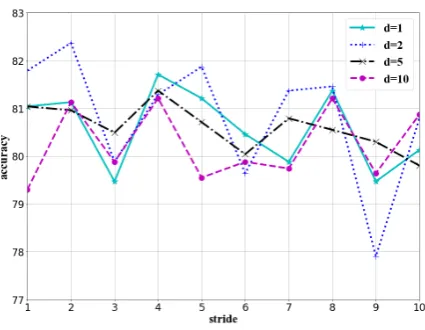
To investigate the influence of the sizedand the stride s of sliding window on learning local in-teractions, we conduct experiments on IEMOCAP whereschanges incrementally from 1 to 10 andd
[image:9.595.310.523.60.225.2]takes on four values, namely 1, 2, 5 and 10. The
Figure 3: Influence of window sizedand strides.
results are shown in Fig.3. It can be observed that for all values ofd, the accuracy fluctuates within a limited range as the strideschanges incremental-ly, showing robustness with respect to the stride. Overall, the model fares best when dis set to 2, demonstrating that a moderate size of sliding win-dow is important for ensuring high performance. We conjecture that the reason behind the decline in performance whendis assigned an overly large value (greater than 2), is that the effect of local fusion is lessened, leading to less specialized ex-ploration of feature portions. This in turn veri-fies the central importance of local fusion in our strategy. In addition, an unreasonably smalldmay lead to disintegration of the feature correlation that could be capitalized on and scatter complete in-formation, thus hurting overall performance. Fur-thermore, it is surprising that when the stridesis greater thand(some dimensions of feature vectors are left out in local fusion), the accuracy does not significantly suffer. This shows that there may be a deal of redundant information in the feature vec-tors, implying that more advanced extraction tech-niques are needed for more refined representation-s, which we will explore as part of future work.
5 Conclusion
References
Tadas Baltruˇsaitis, Chaitanya Ahuja, and Louis-Philippe Morency. 2019. Multimodal machine learning: A survey and taxonomy. IEEE Transac-tions on Pattern Analysis and Machine Intelligence, 41(2):423–443.
Elham J. Barezi, Peyman Momeni, Ian Wood, and Pas-cale Fung. 2018. Modality-based factorization for multimodal fusion.CoRR, abs/1811.12624.
Y Bengio, P Simard, and P Frasconi. 1994. Learn-ing long-term dependencies with gradient descent is difficult. IEEE Transactions on Neural Networks, 5(2):157–166.
Carlos Busso, Murtaza Bulut, Chi Chun Lee, Abe Kazemzadeh, Emily Mower, Samuel Kim, Jean-nette N. Chang, Sungbok Lee, and Shrikanth S. Narayanan. 2008. Iemocap: interactive emotion-al dyadic motion capture database. Language Re-sources and Evaluation, 42(4):335–359.
E. Cambria. 2016. Affective computing and sentiment analysis.IEEE Intelligent Systems, 31(02):102–107.
Erik Cambria and Amir Hussain. 2015. Senticnet. Sen-tic Computing, pages 23–71.
Minghai Chen, Sen Wang, Paul Pu Liang, Tadas Baltrusˇaitis, Amir Zadeh, and Louis Philippe Morency. 2017. Multimodal sentiment analysis with word-level fusion and reinforcement learning. 19th ACM International Conference on Multimodal Inter-action (ICMI’17).
Gilles Degottex, John Kane, Thomas Drugman, Tuomo Raitio, and Stefan Scherer. 2014. Covarep: A col-laborative voice analysis repository for speech tech-nologies. InICASSP.
Sidney K. D’Mello and Jacqueline Kory. 2015. A re-view and meta-analysis of multimodal affect detec-tion systems. Acm Computing Surveys, 47(3):1–36.
Florian Eyben. 2010. Opensmile:the munich versa-tile and fast open-source audio feature extractor. In ACM International Conference on Multimedia, pages 1459–1462.
M W Goudreau, C L Giles, S T Chakradhar, and . Chen, D. 1994. First-order versus second-order single-layer recurrent neural networks. IEEE Transactions on Neural Networks, 5(3):511–513.
Yue Gu, Xinyu Li, Shuhong Chen, Jianyu Zhang, and Ivan Marsic. 2017. Speech intention classification with multimodal deep learning. Proceedings of Canadian Conference on Artificial Intelligence.
Yue Gu, Xinyu Li, Kaixiang Huang, Shiyu Fu, Kangn-ing Yang, Shuhong Chen, Moliang Zhou, and Ivan Marsic. 2018a. Human conversation analysis us-ing attentive multimodal networks with hierarchical encoder-decoder. InACM Multimedia.
Yue Gu, Kangning Yang, Shiyu Fu, Shuhong Chen, Xinyu Li, and Ivan Marsic. 2018b. Multimodal af-fective analysis using hierarchical attention strategy with word-level alignment.ACL.
Devamanyu Hazarika, Soujanya Poria, Amir Zadeh, Erik Cambria, Louis-Philippe Morency, and Roger Zimmermann. 2018. Conversational memory net-work for emotion recognition in dyadic dialogue videos. pages 2122–2132.
Kaiming He, Xiangyu Zhang, Shaoqing Ren, and Jian Sun. 2016. Deep residual learning for image recog-nition. InIEEE Conference on Computer Vision and Pattern Recognition, pages 770–778.
Sepp Hochreiter and Jrgen Schmidhuber. 1997. Long short-term memory. Neural Computation, 9(8):1735–1780.
iMotions. 2017. Facial expression analysis.
S. Ji, M. Yang, and K. Yu. 2013. 3d convolutional neu-ral networks for human action recognition. IEEE Transactions on Pattern Analysis and Machine In-telligence, 35(1):221–231.
Andrej Karpathy, George Toderici, Sanketh Shetty, Thomas Leung, Rahul Sukthankar, and Fei Fei Li. 2014. Large-scale video classification with convo-lutional neural networks. In Computer Vision and Pattern Recognition, pages 1725–1732.
Alex Krizhevsky, Ilya Sutskever, and Geoffrey E. Hin-ton. 2012. Imagenet classification with deep convo-lutional neural networks. In International Confer-ence on Neural Information Processing Systems.
Paul Pu Liang, Yao Chong Lim, Y. H. Tsai, Ruslan R. Salakhutdinov, and Louis-Philippe Morency. 2019. Strong and simple baselines for multimodal utter-ance embeddings. InNAACL.
Paul Pu Liang, Ziyin Liu, Amir Zadeh, and Louis Philippe Morency. 2018a. Multimodal lan-guage analysis with recurrent multistage fusion. EMNLP.
Paul Pu Liang, Amir Zadeh, and Louis Philippe Moren-cy. 2018b. Multimodal local-global ranking fusion for emotion recognition. 2018 International Con-ference on Multimodal Interaction (ICMI’18), pages 472–476.
Tsung Yu Lin, Aruni Roychowdhury, and Subhransu Maji. 2015. Bilinear cnn models for fine-grained vi-sual recognition.ICCV, pages 1449–1457.
Bing Liu and Lei Zhang. 2012. A Survey of Opin-ion Mining and Sentiment Analysis, pages 415–463. Springer US, Boston, MA.
N Majumder, D Hazarika, Alexander Gelbukh, Erik Cambria, and Soujanya Poria. 2018. Multimodal sentiment analysis using hierarchical fusion with context modeling.Knowledge-based systems.
Sachin Mehta, Mohammad Rastegari, Linda Shapiro, and Hannaneh Hajishirzi. 2019. Espnetv2: A light-weight, power efficient, and general purpose con-volutional neural network. InIEEE Conference on Computer Vision and Pattern Recognition(CVPR).
Tomas Mikolov, Kai Chen, Greg Corrado, and Jeffrey Dean. 2013. Efficient estimation of word represen-tations in vector space.Computer Science.
Louis Philippe Morency, Rada Mihalcea, and Payal Doshi. 2011. Towards multimodal sentiment anal-ysis: harvesting opinions from the web. In Interna-tional Conference on Multimodal Interfaces, pages 169–176.
Behnaz Nojavanasghari, Deepak Gopinath, Jayanth K-oushik, and Louis Philippe Morency. 2016. Deep multimodal fusion for persuasiveness prediction. In Proceedings of ACM International Conference on Multimodal Interaction, pages 284–288.
Jeffrey Pennington, Richard Socher, and Christo-pher D. Manning. 2014. Glove: Global vectors for word representation. InEmpirical Methods in Nat-ural Language Processing (EMNLP), pages 1532– 1543.
Hai Pham, Paul Pu Liang, Thomas Manzini, Louis Philippe Morency, and Poczˇos Barnabˇas. 2019. Found in translation: Learning robust join-t represenjoin-tajoin-tions by cyclic join-translajoin-tions bejoin-tween modalities. AAAI.
Hai Pham, Manzini Thomos, Liang Paul Pu, and Poczˇos Barnabˇas. 2018. Seq2seq2sentiment: Mul-timodal sequence to sequence models for sentiment analysis. InACL 2018 Grand Challenge and Work-shop on Human Multimodal Language.
Soujanya Poria, Erik Cambria, Rajiv Bajpai, and Amir Hussain. 2017a. A review of affective computing: From unimodal analysis to multimodal fusion. In-formation Fusion, 37:98–125.
Soujanya Poria, Erik Cambria, Devamanyu Hazarika, Navonil Majumder, Amir Zadeh, and Louis Philippe Morency. 2017b. Context-dependent sentimen-t analysis in user-generasentimen-ted videos. In ACL, pages 873–883.
Soujanya Poria, Erik Cambria, Devamanyu Hazarika, Navonil Mazumder, Amir Zadeh, and Louis Philippe Morency. 2017c. Multi-level multiple attentions for contextual multimodal sentiment analysis. In Pro-ceedings of IEEE International Conference on Data Mining (ICDM), pages 1033–1038.
Soujanya Poria, Iti Chaturvedi, Erik Cambria, and Amir Hussain. 2016a. Convolutional mkl based
multimodal emotion recognition and sentiment anal-ysis. InProceedings of IEEE International Confer-ence on Data Mining (ICDM), pages 439–448.
Soujanya Poria, Iti Chaturvedi, Erik Cambria, and Amir Hussain. 2016b. Convolutional mkl based multimodal emotion recognition and sentiment anal-ysis. In IEEE International Conference on Data Mining, pages 439–448.
Shyam Sundar Rajagopalan, Louis Philippe Moren-cy, Tadas BaltrusAˇitis, and Roland Goecke. 2016. Extending long short-term memory for multi-view structured learning. ECCV, pages 338–353.
V. Rozgic, S. Ananthakrishnan, S. Saleem, R. Kumar, and R. Prasad. 2012. Ensemble of svm trees for mul-timodal emotion recognition. In Signal and Infor-mation Processing Association Summit and Confer-ence, pages 1–4.
Sainbayar Sukhbaatar, Arthur Szlam, Jason Weston, and Rob Fergus. 2015. End-to-end memory net-works. InAdvances in neural information process-ing systems, pages 2440–2448.
Fei Tao and Gang Liu. 2018. Advanced lstm: A study about better time dependency modeling in emotion recognition. Proceedings of Acoustics, Speech and Signal Processing (ICASSP).
Yao Hung Hubert Tsai, Paul Pu Liang, Amir Zadeh, Louis Philippe Morency, and Ruslan Salakhutdinov. 2019. Learning factorized multimodal representa-tions.ICLR.
Cheng Wang and Cheng Wang. 2018. Rra: Recurrent residual attention for sequence learning. AAAI.
Haohan Wang, Aaksha Meghawat, Louis Philippe Morency, and Eric P Xing. 2016. Select-additive learning: Improving generalization in multimodal sentiment analysis. pages 949–954.
Yansen Wang, Ying Shen, Zhun Liu, Paul Pu Liang, and Amir Zadeh. 2019. Words can shift: Dynami-cally adjusting word representations using nonverbal behaviors.AAAI.
Yiren Wang and Fei Tian. 2016. Recurrent residu-al learning for sequence classification. InEMNLP, pages 938–943.
Martin Wollmer, Felix Weninger, Tobias Knaup, B-jorn Schuller, Congkai Sun, Kenji Sagae, and Louis Philippe Morency. 2013. Youtube movie re-views: Sentiment analysis in an audio-visual con-text. IEEE Intelligent Systems, 28(3):46–53.
Lin Wu, Yang Wang, Lin Wu, Yang Wang, Lin Wu, and Yang Wang. 2017. Where to focus: Deep attention-based spatially recurrent bilinear networks for fine-grained visual recognition. arXiv Preprint: 1709.05769.
Jiahong Yuan and Mark Liberman. 2008. Speaker i-dentification on the SCOTUS corpus. Acoustical So-ciety of America Journal, 123:3878.
Amir Zadeh, Minghai Chen, Soujanya Poria, Erik Cambria, and Louis Philippe Morency. 2017. Ten-sor fusion network for multimodal sentiment analy-sis.EMNLP, pages 1114–1125.
Amir Zadeh, Paul Pu Liang, Navonil Mazumder, Sou-janya Poria, Erik Cambria, and Louis Philippe Morency. 2018a. Memory fusion network for multi-view sequential learning. AAAI.
Amir Zadeh, Paul Pu Liang, Soujanya Poria, Prateek Vij, Erik Cambria, and Louis Philippe Morency. 2018b. Multi-attention recurrent network for human communication comprehension. AAAI.
Amir Zadeh, Paul Pu Liang, Jonathan Vanbriesen, Sou-janya Poria, Edmund Tong, Erik Cambria, Minghai Chen, and Louis Philippe Morency. 2018c. Mul-timodal language analysis in the wild: Cmu-mosei dataset and interpretable dynamic fusion graph. A-CL, pages 2236–2246.
Amir Zadeh, Rowan Zellers, Eli Pincus, and Louis Philippe Morency. 2016a. Mosi: Multimodal corpus of sentiment intensity and subjectivity anal-ysis in online opinion videos. IEEE Intelligent Sys-tems, 31(6):82–88.
Amir Zadeh, Rowan Zellers, Eli Pincus, and Louis Philippe Morency. 2016b. Multimodal sen-timent intensity analysis in videos: Facial gestures and verbal messages. IEEE Intelligent Systems, 31(6):82–88.