204
Effective Adversarial Regularization for Neural Machine Translation
Motoki Sato1, Jun Suzuki2,3, Shun Kiyono3,2 1Preferred Networks, Inc.,2Tohoku University, 3RIKEN Center for Advanced Intelligence Project
[email protected], [email protected], [email protected]
Abstract
A regularization technique based on adversar-ial perturbation, which was initadversar-ially developed in the field of image processing, has been suc-cessfully applied to text classification tasks and has yielded attractive improvements. We aim to further leverage this promising method-ology into more sophisticated and critical neu-ral models in the natuneu-ral language processing field, i.e., neural machine translation (NMT) models. However, it is not trivial to apply this methodology to such models. Thus, this paper investigates the effectiveness of several pos-sible configurations of applying the ial perturbation and reveals that the adversar-ial regularization technique can significantly and consistently improve the performance of widely used NMT models, such as LSTM-based and Transformer-LSTM-based models.1 1 Introduction
The existence of (small) perturbations that in-duce a critical prediction error in machine learn-ing models was first discovered and discussed in the field of image processing (Szegedy et al., 2014). Such perturbed inputs are often referred to asadversarial examplesin the literature. Sub-sequently, Goodfellow et al. (2015) proposed a learning framework that simultaneously leverages adversarial examples as additional training data for reducing the prediction errors. This learning framework is referred to asadversarial training.
In the field of natural language processing (NLP), the input is a sequence of discrete symbols, such as words or sentences. Since it is unreason-able to add a small perturbation to the symbols, ap-plying the idea of adversarial training to NLP tasks has been recognized as a challenging problem. Re-cently,Miyato et al.(2017) overcame this problem 1Our code for replicating the experiments in this paper is
available at the following URL:https://github.com/ pfnet-research/vat_nmt
Encoder Decoder
!"
#$"
!%
#$%
!&
#$&
'(
#$()
'"
#$")
'*
#$+)
[image:1.595.309.528.220.272.2]," ,% ,+-"
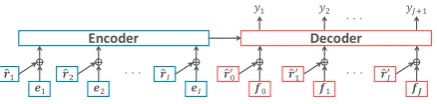
Figure 1: An intuitive sketch that explains how we add adversarial perturbations to a typical NMT model structure for adversarial regularization. The definitions ofeiandfjcan be found in Eq.2. Moreover, those of
ˆ
riandrˆ0jare in Eq.8and13, respectively.
and reported excellent performance improvements on multiple benchmark datasets of text classifica-tion task. The key idea of their success is to apply adversarial perturbations into the input embedding layer instead of the inputs themselves as used in image processing tasks. An important implication of their study is that their method can be inter-preted as a regularization method, and thus, they do not focus on generating adversarial examples. We refer to this regularization technique as adver-sarial regularization.
re-veal the effectiveness of the adversarial regu-larization in NMT models and encourage re-searchers/developers to apply the adversarial reg-ularization as a common technique for further improving the performance of their NMT mod-els. We investigate the effectiveness of several possible configurations that can significantly and consistently improve the performance of typical baseline NMT models, such as LSTM-based and Transformer-based models,
2 Related Work
Several studies have recently applied adversarial training to NLP tasks, e.g., (Jia and Liang,2017; Belinkov and Bisk, 2018; Hosseini et al., 2017; Samanta and Mehta, 2017; Miyato et al., 2017; Sato et al.,2018). For example,Belinkov and Bisk (2018); Hosseini et al. (2017) proposed methods that generate input sentences with random char-acter swaps. They utilized the generated (input) sentences as additional training data. However, the main focus of these methods is the incorpora-tion ofadversarial examplesin the training phase, which is orthogonal to our attention, adversarial regularization, as described in Section1.
Clark et al.(2018) used virtual adversarial train-ing (VAT), which is a semi-supervised extension of the adversarial regularization technique origi-nally proposed in Miyato et al. (2016), in their experiments to compare the results with those of their proposed method. Therefore, the focus of the neural models differs from this paper. Namely, they focused on sequential labeling, whereas we discuss NMT models.
In parallel to our work,Wang et al.(2019) also investigated the effectiveness of the adversarial regularization technique in neural language mod-eling and NMT. They also demonstrated the im-pacts of the adversarial regularization technique in NMT models. We investigate the effectiveness of the several practical configurations that have not been examined in their paper, such as the combi-nations with VAT and back-translation.
3 Neural Machine Translation Model
Model Definition In general, an NMT model receives a sentence as input and returns a cor-responding (translated) sentence as output. Let Vs andVt represent the vocabularies of the input and output sentences, respectively. xi andyj de-note the one-hot vectors of the i-th and j-th
to-kens in input and output sentences, respectively, i.e. xi 2{0,1}|Vs|andyj 2{0,1}|Vt|. Here, we introduce a short notation xi:j for representing a sequence of vectors (xi, . . . ,xj). To explain the NMT model concisely, we assume that its input and output are both sequences of one-hot vectors
x1:I andy1:J that correspond to input and output sentences whose lengths areI andJ, respectively.
Thus, the NMT model approximates the following conditional probability:
p(Y|X) =YJ+1
j=1p(yj|y0:j 1,X), (1)
where y0 andyJ+1 represent one-hot vectors of
special beginning-of-sentence (BOS) and end-of-sentence (EOS) tokens, respectively, and X = x1:I andY =y1:J+1.
Let E 2 RD⇥|Vs| and F 2 RD⇥|Vt| be the
encoder and decoder embedding matrices, respec-tively, whereDis the dimension of the embedding
vectors. Thus, p(yj|y0:j 1,X) in Eq.1 is
calcu-lated as follows:
p(yj|y0:j 1,X) =AttDec fj,h1:I ,
h1:I =Enc(e1:I),
fj =F yj 1, ei =Exi, (2)
whereEnc(·)andAttDec(·)represent functions
that abstract the entire encoder and decoder (with an attention mechanism) procedures, respectively.
Training Phase LetDbe the training data con-sisting of a set of pairs of Xn and Yn, namely, D = {(Xn,Yn)}Nn=1, where N represents the
amount of training data. For training, we generally seek the optimal parameters⇥ˆ that can minimize
the following optimization problem:
ˆ
⇥= argmin
⇥ J
(D,⇥) , (3)
J(D,⇥) = 1
|D| X
(X,Y)2D
`(X,Y,⇥), (4)
`(X,Y,⇥) = log p(Y|X,⇥) , (5)
where⇥represents a set of trainable parameters
in the NMT model.
Generation Phase We generally use a K-best
beam search to generate an output sentence with the (approximated) K-highest probability given
input sentence X in the generation (test) phase.
4 Adversarial Regularization
This section briefly describes the adversarial reg-ularization technique applied to the text classifica-tion tasks proposed in Miyato et al.(2017). Let
ˆ
ri 2RD be an adversarial perturbation vector for thei-th word in inputX. The perturbed input
em-bedding e0i 2 RD is computed for each encoder time-stepias follows:
e0i=Exi+ ˆri. (6)
4.1 Adversarial Training (AdvT)
To obtain the worst case perturbations as an ad-versarial perturbation in terms of minimizing the log-likelihood of givenX, we seek the optimal so-lutionrˆby maximizing the following equation:
ˆ
r= argmax r,||r||✏
n
`(X,r,Y,⇥)o, (7)
where ✏ is a scalar hyper-parameter that
con-trols the norm of the perturbation, and r
repre-sents a concatenated vector ofri for all i. Here,
`(X,r,Y,⇥) represents an extension of Eq. 5,
where the perturbationriinris applied to the po-sition ofrˆias described in Eq.6.
However, it is generally infeasible to exactly es-timate rˆin Eq. 7 for deep neural models. As a
solution, an approximation method was proposed byGoodfellow et al.(2015), where`(X,Y,r,⇥)
is linearized around X. This approximation
method induces the following non-iterative solu-tion for calculatingrˆifor all encoder time-stepi:
ˆ ri=✏
ai ||a||2
, ai =rei`(X,Y,⇥). (8)
Thus, based on adversarial perturbationrˆ, the loss
function can be defined as:
A(D,⇥) = 1
|D| X
(X,Y)2D
`(X,r,ˆ Y,⇥). (9)
Finally, we jointly minimize the objective func-tionsJ(D,⇥)andA(D,⇥):
ˆ
⇥= argmin
⇥ n
J(D,⇥) + A(D,⇥)o, (10)
where is a scalar hyper-parameter that controls the balance of the two loss functions.
4.2 Virtual Adversarial Training (VAT)
Miyato et al. (2016) proposed virtual adversar-ial training, which is mainly used for the semi-supervised extension of the adversarial regulariza-tion technique. The difference appears in the loss function ` in Eq. 7 and 9. Specifically, we can
use perturbations calculated based on the virtual adversarial training by substituting`with the
fol-lowing loss function:
`KL(X,r,ˆ ·,⇥) =KL p(· |X,⇥)||p(· |X,r,ˆ ⇥) ,
(11) whereKL(·||·)denotes the KL divergence.
It is worth noting here that, in our experiments, we never applied the semi-supervised learning, but used the above equation for calculating pertur-bation as the replacement of standard adversarial regularization. This means that the training data is identical in both settings.
5 Adversarial Regularization in NMT As strictly following the original definition of the conventional adversarial training, the straightfor-ward approach to applying the adversarial pertur-bation is to add the perturpertur-bation into the encoder-side embeddingsei as described in Eq.6. How-ever, NMT models generally have another embed-ding layer in the decoder-side, as we explained in Eq.2. This fact immediately offers us also to con-sider applying the adversarial perturbation into the decoder-side embeddingsfj.
For example, letrˆj0 2RDbe an adversarial per-turbation vector for thej-th word in outputY. The
perturbed embedding fj0 2 RD is computed for each decoder time-stepjas follows:
fj0 =F yj 1+ ˆrj0. (12)
Then similar to Eq.8, we can calculaterˆ0as:
ˆ
r0j =✏ bj
||b||2
, bj =rfj`(X,Y,⇥), (13)
wherebis a concatenated vector ofbjfor allj. In addition, we need to slightly modify the definition ofr, which is originally the concatenation vector
of allrifor alli, to the concatenation vector of all
riandrj0 for alliandj.
DE$EN FR$EN
training 189,318 208,323
[image:4.595.105.259.62.113.2]test2012 (dev) 1,700 1,124 test2013 (test) 993 1,024 test2014 (test) 1,305 1,305
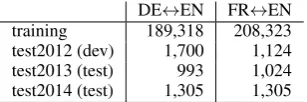
Table 1: Number of sentences in our datasets (Datasets are cleaned from the original dataset).
Perturbation EN!DE Model position test2013 test2014
LSTM (None) 27.73 23.98
+AdvT enc-emb 28.73 24.90 dec-emb 27.44 23.71 enc-dec-emb 28.47 24.78
+VAT enc-emb 29.03 24.75
dec-emb 27.49 23.20 enc-dec-emb 29.47 24.92 Transformer (None) 29.15 25.19 +AdvT enc-emb 29.04 25.16 dec-emb 28.95 25.75 enc-dec-emb 29.61 25.78
+VAT enc-emb 29.95 26.00
dec-emb 29.62 25.88 enc-dec-emb 30.13 26.06
Table 2: BLEU scores averaged over five models in var-ious configurations of perturbation positions (enc-emb, dec-emb, or enc-dec-emb) and adversarial regulariza-tion techniques (AdvTorVAT).
6 Experiments
6.1 Datasets
We conducted experiments on the IWSLT evalua-tion campaign dataset (Cettolo et al., 2012). We used the IWSLT 2016 training set for training models, 2012 test set (test2012) as the develop-ment set, and 2013 and 2014 test sets (test2013 and test2014) as our test sets. Table1 shows the statistics of datasets used in our experiments.
For preprocessing of our experimental datasets, we used the Moses tokenizer2 and the truecaser3.
We removed sentences over 50 words from the training set. We also applied the byte-pair en-coding (BPE) based subword splitting script4with
16,000 merge operations (Sennrich et al.,2016b).
6.2 Model Configurations
We selected two widely used model archi-tectures, namely, LSTM-based encoder-decoder
2https://github.com/moses-smt/ mosesdecoder/blob/master/scripts/ tokenizer/tokenizer.perl
3https://github.com/moses-smt/ mosesdecoder/blob/master/scripts/ recaser/truecase.perl
4https://github.com/rsennrich/ subword-nmt
used in Luong et al. (2015) and self-attention-based encoder-decoder, the so-called Trans-former (Vaswani et al., 2017). We adapted the hyper-parameters based on the several recent pre-vious papers5.
Hereafter, we refer to the model trained with the adversarial regularization (`in Eq.7) asAdvT, and similarly, with the virtual adversarial training (`KL in Eq.11) asVAT. We set = 1and✏ = 1
for allAdvTandVATexperiments.
6.3 Results
Investigation of effective configuration Ta-ble2shows the experimental results with config-urations of perturbation positions (enc-emb, dec-emb, or enc-dec-emb) and adversarial regulariza-tion techniques (AdvT or VAT). As evaluation metrics, we used BLEU scores (Papineni et al., 2002)6. Note that all reported BLEU scores are
averaged over five models.
Firstly, in terms of the effective perturbation position, enc-dec-emb configurations, which add perturbations to both encoder and decoder embed-dings, consistently outperformed other configura-tions, which used either encoder or decoder only. Moreover, we achieved better performance when we added perturbation to the encoder-side (enc-emb) rather than the decoder-side (dec-(enc-emb).
Furthermore, the results of VAT was consis-tently better than those of AdvT. This tendency was also observed in the results reported by Miy-ato et al. (2016). As discussed in Kurakin et al. (2017), AdvT generates the adversarial exam-ples from correct examexam-ples, and thus, the models trained by AdvT tend to overfit to training data rather than those trained byVAT. They referred to this phenomenon of AdvT aslabel leaking.
Results on four language pairs Table3shows the BLEU scores of averaged over five models on four different language pairs (directions), namely German!English, French!English, English!German, and English!French. Fur-thermore, the row(b)shows the results obtained when we incorporated pseudo-parallel corpora generated using the back-translation method (Sen-nrich et al.,2016a) as additional training data. For
5The detailed hyper-parameters are listed in AppendixA. 6We used the multi-bleu.perl script in the
Moses toolkit: https://github.com/moses-smt/ mosesdecoder/blob/master/scripts/
Perturbation
Model position
(a)
LSTM (None)
Transformer (None)
+VAT enc-dec-emb
+VAT+AdvT enc-dec-emb
(b)w/ BT Transformer+VAT enc-dec-embenc-dec-emb +VAT+AdvT enc-dec-emb
DE!EN test2013 test2014
32.71 28.53 34.22 30.19 35.06 31.10 35.50 30.88 35.44 31.08 36.43 32.53 36.49 32.39
FR!EN test2013 test2014
39.09 36.25 38.87 37.20 40.09 37.89 40.26 38.44 40.44 38.42 41.29 39.76 41.56 39.64
EN!DE test2013 test2014
27.73 23.98 29.15 25.19 30.13 26.06 30.04 26.33 30.73 26.02 31.99 27.20 31.29 27.05
EN!FR test2013 test2014
[image:5.595.78.522.61.158.2]38.89 36.18 40.43 37.90 41.13 38.64 41.67 38.72 41.74 39.03 43.41 40.15 42.61 39.95
Table 3: BLEU scores averaged over five models in four different language pairs (directions). (b)Results with using training data increased by back-translation method (BT).
Input meine gebildete Mutter aber wurde Lehrerin .
Reference but my educated mother became a teacher .
Baseline (Transformer) my educated mother , though , became a teacher
.
Proposed (Transformer+VAT w/ BT) but my educated mother became a teacher .
Input aber man kann sehen , wie die Menschen
miteinander kommunizieren , zu welchen Zeiten sie einander anrufen , wann sie zu Bett gehen .
Reference but you can see how your people are
communicating with each other , what times they call each other , when they go to bed .
Baseline (Transformer) but you can see how people talk to each other
about what time they call each other when they go to bed .
Proposed (Transformer+VAT w/ BT) but you can see how people communicate with each other , at which time they call each other , when they go to bed .
Input wer im Saal hat ein Handy dabei ?
Reference who in the room has a mobile phone with you ?
Baseline (Transformer) who in the room has a cell phone in it ?
Proposed (Transformer+VAT w/ BT) who in the room has a cell phone with me ?
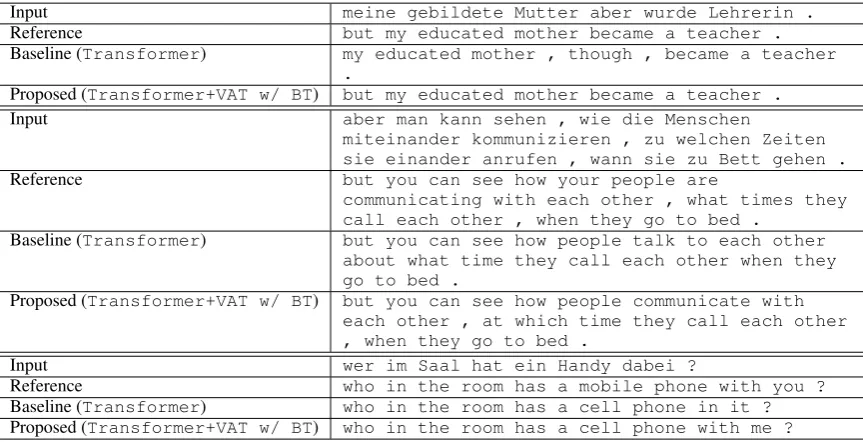
Table 4: Example translation from German!English (test2013).
generating the pseudo-parallel corpora, we used the WMT14 news translation corpus.
We observe that Transformer+VAT consis-tently outperformed the baselineTransformer results in both standard(a) and back-translation (b)settings. We report thatVAT did not require us to perform additional heavy hyper-parameter search (excluding the hyper-parameter search in base models). Therefore, we can expect that VAT can improve the translation performance on other datasets and settings with relatively high-confidence.
In addition, the rows +VAT+AdvT show the performance obtained by applying bothAdvTand VATsimultaneously. We can further improve the performance in some cases, but the improvement is not consistent among the datasets.
Actual Translation Examples Table 4 shows actual translation examples generated by the mod-els compared in our German!English translation setting. We observe that Transformer+VAT with using training data increased by the back-translation method seems to generate higher
qual-ity translations compared with those of the base-lineTransformer.
7 Conclusion
This paper discussed the practical usage and ben-efit of adversarial regularization based on adver-sarial perturbation in the current NMT models. Our experimental results demonstrated that ap-plying VAT to both encoder and decoder embed-dings consistently outperformed other configura-tions. Additionally, we confirmed that adversarial regularization techniques effectively worked even if we performed them with the training data in-creased by a back-translation method. We believe that adversarial regularization can be one of the common and fundamental technologies to further improve the translation quality, such as model en-semble, byte-pair encoding, and back-translation.
Acknowledgments
[image:5.595.83.515.194.415.2]References
Yonatan Belinkov and Yonatan Bisk. 2018. Syn-thetic and Natural Noise Both Break Neural Ma-chine Translation. InProceedings of the 6th Inter-national Conference on Learning Representations (ICLR).
Mauro Cettolo, Christian Girardi, and Marcello Fed-erico. 2012. WIT3: Web Inventory of Transcribed and Translated Talks. In Proceedings of the 16th Annual Conference of the European Association for Machine Translation (EAMT), pages 261–268.
Sumit Chopra, Michael Auli, and Alexander M. Rush. 2016. Abstractive Sentence Summarization with At-tentive Recurrent Neural Networks. In Proceed-ings of the 2016 Conference of the North American Chapter of the Association for Computational Lin-guistics (NAACL), pages 93–98.
Kevin Clark, Minh-Thang Luong, Christopher D. Man-ning, and Quoc Le. 2018. Semi-Supervised Se-quence Modeling with Cross-View Training. In Pro-ceedings of the 2018 Conference on Empirical Meth-ods in Natural Language Processing (EMNLP), pages 1914–1925.
Ian J. Goodfellow, Jonathon Shlens, and Christian Szegedy. 2015. Explaining and Harnessing Adver-sarial Examples. In Proceedings of the 3rd Inter-national Conference on Learning Representations (ICLR).
Hossein Hosseini, Sreeram Kannan, Baosen Zhang, and Radha Poovendran. 2017. Deceiving Google’s Perspective API Built for Detecting Toxic Com-ments. arXiv preprint arXiv:1702.08138.
Jianshu Ji, Qinlong Wang, Kristina Toutanova, Yongen Gong, Steven Truong, and Jianfeng Gao. 2017. A Nested Attention Neural Hybrid Model for Gram-matical Error Correction. In Proceedings of the 55th Annual Meeting of the Association for Compu-tational Linguistics (ACL), pages 753–762.
Robin Jia and Percy Liang. 2017. Adversarial Exam-ples for Evaluating Reading Comprehension Sys-tems. In Proceedings of the 2017 Conference on Empirical Methods in Natural Language Processing (EMNLP).
Alexey Kurakin, Ian J Goodfellow, and Samy Bengio. 2017. Adversarial Machine Learning at Scale. In
Proceedings of the 5th International Conference on Learning Representations (ICLR).
Minh-Thang Luong, Hieu Pham, and Christopher D. Manning. 2015. Effective Approaches to Attention-based Neural Machine Translation. In Proceed-ings of the 2015 Conference on Empirical Methods in Natural Language Processing (EMNLP), pages 1412–1421.
Takeru Miyato, Andrew M Dai, and Ian Goodfellow. 2017. Adversarial Training Methods for Semi-Supervised Text Classification. In Proceedings of the 5th International Conference on Learning Rep-resentations (ICLR).
Takeru Miyato, Shin ichi Maeda, Masanori Koyama, Ken Nakae, and Shin Ishii. 2016. Distributional Smoothing with Virtual Adversarial Training. In
Proceedings of the 4th International Conference on Learning Representations (ICLR).
Kishore Papineni, Salim Roukos, Todd Ward, and Wei-Jing Zhu. 2002. BLEU: a Method for Automatic Evaluation of Machine Translation. InProceedings of the 40th Annual Meeting of the Association for Computational Linguistics (ACL), pages 311–318. Alexander M. Rush, Sumit Chopra, and Jason
We-ston. 2015. A Neural Attention Model for Abstrac-tive Sentence Summarization. InProceedings of the 2015 Conference on Empirical Methods in Natural Language Processing (EMNLP), pages 379–389. Suranjana Samanta and Sameep Mehta. 2017. Towards
Crafting Text Adversarial Samples. arXiv preprint arXiv:1707.02812.
Motoki Sato, Jun Suzuki, Hiroyuki Shindo, and Yuji Matsumoto. 2018. Interpretable Adversarial Pertur-bation in Input Embedding Space for Text. In Pro-ceedings of the Twenty-Seventh International Joint Conference on Artificial Intelligence (IJCAI), pages 4323–4330.
Rico Sennrich, Barry Haddow, and Alexandra Birch. 2016a. Improving Neural Machine Translation Models with Monolingual Data. InProceedings of 54th Annual Meeting of the Association for Compu-tational Linguistics (ACL), pages 86–96.
Rico Sennrich, Barry Haddow, and Alexandra Birch. 2016b. Neural Machine Translation of Rare Words with Subword Units. InProceedings of 54th Annual Meeting of the Association for Computational Lin-guistics (ACL), pages 1715–1725.
Lifeng Shang, Zhengdong Lu, and Hang Li. 2015. Neural Responding Machine for Short-Text Conver-sation. In Proceedings of the 53rd Annual Meet-ing of the Association for Computational LMeet-inguistics and the 7th International Joint Conference on Nat-ural Language Processing (ACL & IJCNLP), pages 1577–1586.
Jun Suzuki, Sho Takase, Hidetaka Kamigaito, Makoto Morishita, and Masaaki Nagata. 2018. An Empir-ical Study of Building a Strong Baseline for Con-stituency Parsing. In Proceedings of the 56th An-nual Meeting of the Association for Computational Linguistics (ACL), pages 612–618.
Ashish Vaswani, Noam Shazeer, Niki Parmar, Jakob Uszkoreit, Llion Jones, Aidan N. Gomez, Lukasz Kaiser, and Illia Polosukhin. 2017. Attention is All you Need. InProceedings of the 31st Annual Con-ference on Neural Information Processing Systems (NIPS), pages 6000–6010.
Oriol Vinyals,Łukasz Kaiser, Terry Koo, Slav Petrov, Ilya Sutskever, and Geoffrey Hinton. 2015. Gram-mar as a Foreign Language. In Proceedings of the 29th Annual Conference on Neural Information Pro-cessing Systems (NIPS), pages 2773–2781.