41
Affordances in Grounded Language Learning
Stephen McGregor KyungTae Lim
LATTICE - CNRS & École normale supérieure / PSL Université Sorbonne nouvelle Paris 3 / USPC 1, rue Maurice Arnoux, 92120 Montrouge, France
[email protected] [email protected]
Abstract
We present a novel methodology involv-ing mappinvolv-ings between different modes of semantic representations. We propose dis-tributional semantic models as a mecha-nism for representing the kind of world knowledge inherent in the system of ab-stract symbols characteristic of a sophisti-cated community of language users. Then, motivated by insight from ecological psy-chology, we describe a model approximat-ing affordances, by which we mean a lan-guage learner’s direct perception of op-portunities for action in an environment. We present a preliminary experiment in-volving mapping between these two rep-resentational modalities, and propose that our methodology can become the basis for a cognitively inspired model of grounded language learning.
1 Introduction
Computational approaches to grounded language learning have typically involved mapping from perceptual to linguistic modalities through the ap-plication of complex information processing oper-ations. Yu and Siskind(2013), for instance, use hidden Markov models to translate from object tracks to natural language descriptions of event observed in video clips. Likewise the ImageNet database has provided a platform for the produc-tive application of deep neural network architec-tures for mapping between images and natural lan-guage labels (Krizhevsky et al., 2012). Signifi-cantly with regard to the ideas outlined here,Oh et al. (2017) describe a methodology for training an agent to construct novel sequences of actions based on analogies with previously learned strate-gies; the mechanism for learning a vocabulary of
basic actions consists of a combination of convo-lutional and LSTM layers within a neural network. Work of this nature highlights the state of the art in modelling technologies, and as an information engineering approach to meaningful tasks such as question answering and image labelling a signifi-cant contribution is made. This is arguably done, however, at the expense of presenting interpretable or indeed plausible models of the way that envi-ronmentally embedded agents use relatively scant exposure to a language speaking community in or-der to develop a lexicon that is rich and produc-tive. In this regard, the conventional computa-tional stance on grounded language learning em-braces a view of the relationship between language and the world as asymbol grounding problem, by which abstract symbols susceptible to formal op-erations are somehow associated with perceptions and propositions: the hard work is done by a com-plex and philosophically opaque process of trans-forming signals into symbols, with the sense that computation by way of deep nets in some sense stands in for an inscrutable mind-brain gestalt.
As an alternative to this approach, R ˛ aczaszek-Leonardi et al.(2018) propose asymbol unground-ing problem: by this account, language begins as a semiotic structure with the representational scheme of a nascent language learner iconically and indexically aligned to embodied and embed-ded experiences of the world. This alignment is understood in terms ofGibson’s (1979) notion of
con-straints on the way that a cognitive agent behaves in an environment (R ˛aczaszek-Leonardi,2012).
The strength of thinking of perception in gen-eral and language in particular in terms of affor-dances is that this moves away from the prob-lem of the computational load associated with the spontaneous construction of contextually produc-tive representational structures. ForClark(1997), affordances play a role in the an action-oriented
model of cognition revolving around light-weight, environmentally situated representations, while
Chemero(2009) proposes affordances as a mecha-nism for resolving the issue of themental gymnas-ticsinherent in a computational cognitive model. These approaches, which seek to place mind in the context of environmental embodiment and em-beddedness, prefigure recent attempts to intro-duce affordances as a component of a cognitively oriented theory of language in which words can be mapped to denotations oriented towards ac-tion on objects in situaac-tions, and utterances them-selves become opportunities for communication (R ˛aczaszek-Leonardi and Nomikou,2015).
Despite these valuable theoretical contributions, affordances have proved resistant to empirical modelling, not least because it is difficult to come up with a tractable scheme for representing a cog-nitive feature that is specifically conceived as an antidote to representational approaches to cogni-tion. Our present objective is to begin to map a way towards the computational simulation of the role of affordances in language acquisition through interaction with an established linguis-tic community. In order to do this, we’ll extract both statistical and syntactic information from a large-scale corpus to model two different modes of semantic representation, one geared towards the kind of world-knowledge inherent in the evolu-tion of language on the time-scale of a commu-nity of language users, the other designed to reflect the way that an agent might encounter language grounded in the affordances of denoted objects.
In as much as we will be combining established distributional semantic techniques with likewise established syntactic analysis, this work can be broadly positioned in the context of other recent models. Cheng and Kartsaklis (2015), for in-stance, compound co-occurrence and syntactical information in order to generate word-embeddings enhanced for compositional tasks. Vuli´c (2017) likewise uses information about dependency
re-lationships to map word embeddings from multi-ple languages into a shared vector space, achiev-ing impressive results on cross-lachiev-ingual versions of word similarity tasks. An important caveat re-garding our own research, however, is that we are using syntactical information as a kind of stand-in for a simulation of the way that an agent might encounter words aligned with events involv-ing objects: in the end, we would actually like to see the methodology outlined here as ground-work towards a model of language acquisition which specifically does not fall back on the kind of rich linguistic knowledge inherent in either vector space models or dependency parsers.
2 Modelling Affordances
On the one hand, as a model for the type of lexical semantic representation imbued with the produc-tive world knowledge of an experienced language user, we propose distributional semantic vector space models (Clark, 2015), in which words are represented as points in high dimensional spaces where properties such as proximity and direction can relate to semantic phenomena such as related-ness and intension. On the other hand, as a model of the perception of objects mapped to linguistic units and at the same time perceived in terms of their potential for being acted upon, we suggest a rudimentary framework for associating denota-tions with events and related objects.
Distributional semantic word-vectors have the advantage of incorporating both world knowledge (Mikolov et al., 2013; Pennington et al., 2014) and at least the potential for compositionality (Mitchell and Lapata,2010;Coecke et al.,2011) into a computationally tractable structure. They can also, importantly, be extrapolated in an es-sentially unsupervised way from large-scale tex-tual data, allowing for the construction of an open ended lexicon characterised by the representa-tion of semantic properties through geometric fea-tures. In terms of our framework for modelling a language-learning agent, we propose that this type of representation can stand in for interaction be-tween the agent and a tutor acting as a conduit to the knowledge embedded in a language as de-veloped by a community of language users (Smith et al.,2003).
2013), applied across iterative observations of a cleaned-up version of Wikipedia.1 We detect sen-tence boundaries, remove punctuation, render all characters lower-case, and, ignoring sentences of less than five words in length, apply theskip-gram
methodology for learning to predict a 5-by-5 win-dow of co-occurrence words around a given tar-get word. The cleaned version of our corpus con-tains about 9.08 million word types representing roughly 1.87 billion word tokens spread across 87.2 million sentences.
As a model of the way that language is en-countered in the environment by a novice language learner, we propose a representational scheme for affordances designed to reflect the actions and in-teractions that might be associated with an agent’s early encounters with new objects. For present purposes, we will once again turn to a corpus-based technique for building representations: we traverse the same rendition of Wikipedia, seek-ing instances where words in our vocabulary are used as direct objects. We parse each sentence in the corpus using the Spacy parser; in instances of multi-word phrases, we treat the head as a candi-date target word. For word types tagged as direct objects, we build up counts of corresponding pred-icates and associated subjects and indirect objects and then calculate probability distributions over the word types observed in each of these roles, so that affordances can be represented as a matrix of probability distributions over word types for each of these three grammatical classes for every word in a target vocabulary:
p(X|w) = |x
w,1|
|Xw|
,|xw,2|
|Xw|
...
(1)
w= (p(P|w), p(S|w), p(I|w)) (2)
Here, a distributionp(X|w)represents the discrete probabilities of words (x1, x2...) being observed
in a dependency relationshipXwith wordw, cal-culated for predicates, subjects, and indirect ob-jects (P, S, I) respectively. We take these gram-matical features to correspond, at least in a rough sense, to the kind of thing that can be done with the corresponding target object, the things that do these things, and the things that can be affected by actions involving this object.
With these probability spaces established, we can compute the top words in terms of
probabil-1Implemented using the Gensim library for Python.
ity of observation in a particular grammatical role across all vocabulary words up to some arbitrary count. So, for instance, an affordance matrix for the wordtaxibuilt with three-element probability distributions would look like this (wherePROand YEARare generic representations for personal pro-nouns and years respectively):
predicate subject ind. object
take= 0.587 PRO = 0.809 YEAR = 0.385
drive= 0.279 who= 0.112 airport= 0.365
hail= 0.134 von= 0.079 station= 0.250
3 A Small Experiment
Beginning with the framework described above, we first examine the degree to which our represen-tations capture properties associated with the de-notations of some basic nouns. In order to estab-lish a small-scale vocabulary of objects, we turn to the tables of words exemplifying types of objects described byRosch(1975) in her seminal work on conceptual prototypes. We choose the five words that were reported as most prototypical of five con-ceptual categories, as determined by a survey of a large number of respondents. The categories are VEHICLES,CLOTHING,TOOLS,FURNITURE, and FRUIT. Our objective for this preliminary work will be to establish representations of these ob-ject types in both a distributional semantic vector space and a probabilistic affordance space.
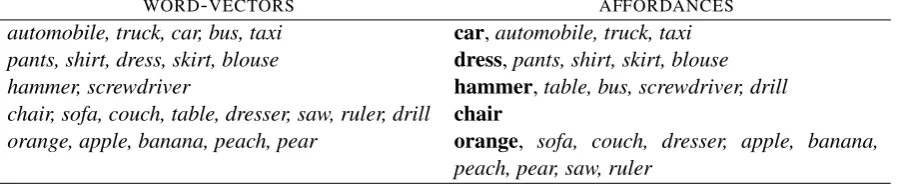
In order to explore the effectiveness of the conceptual spaces generated by the representa-tional techniques described above, we first ex-tract the word-vectors corresponding to our vocab-ulary from theword2vecdistributional semantic model and perform k-means clustering on these, specifying a total of five target classes.2 Results are reported in theWORD-VECTORScolumn in Ta-ble1. While these clusters do not correspond ex-actly with human judgement, they do align some-what with the expected delineations between ob-ject classes. The large cluster containing a mix of furniture and tools is characterised by words like
sawandrulerwhich are presumably affected by a high degree of word sense ambiguity.
Next we explore the space of affordances. The representations in this space are, as described above, construed as matrices of probabilities. Specifically, we take the top 20 most likely words
2Clustering is implemented using theKMeansalgorithm
WORD-VECTORS AFFORDANCES
automobile, truck, car, bus, taxi car,automobile, truck, taxi pants, shirt, dress, skirt, blouse dress,pants, shirt, skirt, blouse
hammer, screwdriver hammer,table, bus, screwdriver, drill
chair, sofa, couch, table, dresser, saw, ruler, drill chair
[image:4.595.77.526.67.160.2]orange, apple, banana, peach, pear orange, sofa, couch, dresser, apple, banana, peach, pear, saw, ruler
Table 1: Clusters of word representations in distributional semantic and probabilistic affordance spaces. Word-vectors are clustered based on k-means clustering, and affordance representations are clustered based on a k-medoid algorithm, with the most cost-effective medoids indicated in bold.
for each grammatical class and generate probabil-ities for each word in each of these classes for each of our 25 object-words. In order to calculate the distance between two affordance representa-tions, we take the Hellinger distance between two aligned probability distributions. This operation, which we take as a good quantification of the re-lationship between two distributions, results in a matrix of three dimensional vectors, each element corresponding to a grammatical class. So, for two vocabulary wordsaandband a grammatical class
c, the element of a vector representing the relation-ship between those two words can be described as follows, wherehis the label for one of the top 20 words occurring in that grammatical class:
Mc(a, b) = √1 2×
v u u t
20
X
h=1
q
p(ah)−qp(bh) 2
(3) We treat the set of three values corresponding to each target-to-target relationship as a distance vec-tor, and so consider the distance between those two words to be simply the norm of that vector. With a distance matrix thus established, we use a k-medoids algorithm of our own design to clus-ter the affordance representations. We apply this measure because we are working from a matrix of distances, rather than from an explicit vector space; we might also consider, for instance, multi-dimensional scaling to project these representa-tions into a vector space, but we consider the k-medoid approach to be appropriate for our present purposes. Results are reported in the right column of Table1, with optimal medoids highlighted.
As with the clustering of word-vectors, the re-sults here do not correspond perfectly with human judgements. We don’t see this as necessarily be-ing a problem, though: it would be strange, in fact, to expect a developing cognitive agent to
categor-ically classify each object based on affordance-oriented interactions with an environment. So, for instance, fruits are compounded with some furni-ture and some tools in a single category orbiting the highly ambiguous termorange.
The crucial question is how we can effectively map between word-vectors, which we take to rep-resent a kind of encyclopaedic knowledge of the world, and the affordances which are proposed as at least a rough model of the way that words are encountered by an early language learner. In or-der to explore this issue further, we construct a rudimentary neural network, mapping the 200 el-ements of each of our word-vectors onto the sets of probability distributions corresponding to affor-dances by way of a single dense softmax layer. This operation is in effect quite similar to a multi-class logistic regression, except that here we are attempting to learn to approximate an actual prob-ability distribution rather than to simply reward the assignment of the highest score to a particu-lar class. Formally, we map from a word-vector −→
vwto a probability distributionp(xn|w)associated with a wordxnobserved participating with vocab-ulary wordwas a member of grammatical classX
by learning a weight matrixM, expressed here in terms of dot products with each row −−→mxk
associ-ated with members(x1...x|X|)of classX:
p(xn|w) =
e−v→wT·−−→mxn
Pk=|X|
k=1 e
−→
vwT·−−→mxk
(4)
A separate weight matrix is learned for each of the three grammatical classes associate with the ob-jects that we seek to model.
word-TOTAL VEHICLES CLOTHING TOOLS FURNITURE FRUIT
word 0.12 0.0 0.2 0.2 0.2 0.0
class 0.64 0.8 0.6 0.6 0.2 1.0
Table 2: Accuracy rates for mapping from distributional semantic word-vectors to affordance matrices, from a word to the same word and from a word to another word of the same class.
vector is considered to map to the point in the space of affordance matrices that is closest based on Hellinger as technique described above. This experiment is designed to test the ability of this simple model to map between two different modes of semantic representation, one based on a large-scale analysis of the way that words occur in the context of a complex, developed vocabulary, the other utilising syntax to simulate the small-scale encounter of words as mapping to opportunities for action on corresponding denotations.
While the network generally fails to make exact word-to-word mappings, it is notable that it does, more often than not, manage to map a word-vector to an affordance representation corresponding to another word of at least the correct class. We sug-gest that this indicates there is some basic cate-gorical information in word-vector representations that can be aligned with data about the way that objects are predictably encountered in the world.
4 What Next?
The development of a mapping between ency-clopaedic and empirical lexical semantic represen-tations described here is, in the end, not particu-lar remarkable. We have in effect mapped from one statistical interpretation of a corpus to another. There is a large space of parameters to toggle: the parameters of the word2vec methodology for generating word-vectors, the number and choice of grammatical classes for our affordance space, the actual selection of target vocabulary words, and the network architecture for mapping between representational frameworks are just some of the factors inviting further experimentation.
Moreover, the experiments we carry out involve a small set of words distributed over a likewise small set of classes. This is in contrast to some of the more ambitious approaches to multi-modal tasks such as image labelling that have recently emerged, which can involve thousands of labels (Frome et al., 2013). What we are aiming at, though, is not so much an approach to informa-tion engineering as a first step towards modelling
the way grounded language learning might happen for an environmentally situated agent.
To this end, there is ample room to reconsider the way in which we model affordances in the first place. The corpus-based technique described here is amenable to a computational approach, but ulti-mately it will be important to develop a more sit-uated methodology. To this end, experiments on human-robot interaction conducted by (Gross and Krenn, 2016) have illustrated the way in which factors such as gaze and gesture are crucial fea-tures of early-stage linguistic interactions, and we suggest that a mechanism for representing these elements of communication is an important con-sideration in modelling grounded language learn-ing. Likewise with a focus on robotic applications,
Spranger and Steels(2014) have explored the way that the ontogentic ritualisation inherent in the phenotype of a community of language users plays an important role in human language learning.
Returning to more traditionally computational tasks, we finally propose that an affordance based model can play a useful role in mapping between low-level input from, for instance, the visual do-main and more abstract linguistic representations. What we have described here might be conceived as one wing of the type of autoencoder network that has been successful in tasks involving image processing (Krizhevsky et al.,2012) and machine translation (Hill et al., 2016). Rather than treat-ing the encodtreat-ing at the locus of these networks as an arbitrarily abstract semantic representation, we propose that an effective system might involve en-coding to and deen-coding from affordance type rep-resentations. The next step in exploring this hy-pothesis will be to experiment with mapping from images to affordances. We have no illusions that this will be an easy task, but we do think that we have established sufficient groundwork for carry-ing ahead with this line of research.
Acknowledgements
References
Anthony Chemero. 2009.Radical Embodied Cognitive
Science. The MIT Press, Cambridge, MA.
Jianpeng Cheng and Dimitri Kartsaklis. 2015. Syntax-aware multi-sense word embeddings for deep com-positional models of meaning. InProceedings of the 2015 Conference on Empirical Methods in Natural
Language Processing, pages 1531–1542.
Associa-tion for ComputaAssocia-tional Linguistics.
Andy Clark. 1997. Being There: Putting Brain, Body,
and World Together Again. MIT Press, Cambridge,
MA.
Stephen Clark. 2015. Vector space models of lexical meaning. In Shalom Lappin and Chris Fox, editors,
The Handbook of Contemporary Semantic Theory,
pages 493–522. Wiley-Blackwell.
Bob Coecke, Mehrnoosh Sadrzadeh, and Stephen Clark. 2011. Mathematical foundations for a com-positional distributed model of meaning. Linguistic Analysis, 36(1-4):345–384.
Andrea Frome, Greg S Corrado, Jon Shlens, Samy Bengio, Jeff Dean, Marc Aurelio Ranzato, and Tomas Mikolov. 2013. DeViSE: A deep visual-semantic embedding model. In C. J. C. Burges, L. Bottou, M. Welling, Z. Ghahramani, and K. Q. Weinberger, editors, Advances in Neural Informa-tion Processing Systems 26, pages 2121–2129.
James J. Gibson. 1979. The Ecological Approach to Visual Perception. Houghton Miffline, Boston.
Stephanie Gross and Brigitte Krenn. 2016. The ofai multi-modal task description corpus. In Proceed-ings of the Tenth International Conference on
Lan-guage Resources and Evaluation (LREC).
Felix Hill, Kyunghyun Cho, and Anna Korhonen. 2016. Learning distributed representations of sentences from unlabelled data. In Proceedings of the 2016 Conference of the North American Chapter of the Association for Computational Linguistics: Human
Language Technologies, pages 1367–1377.
Associ-ation for ComputAssoci-ational Linguistics.
Alex Krizhevsky, Ilya Sutskever, and Geoffrey E. Hin-ton. 2012. Imagenet classification with deep con-volutional neural networks. InProceedings of the 25th International Conference on Neural
Informa-tion Processing Systems - Volume 1, pages 1097–
1105.
Tomas Mikolov, Kai Chen, Greg Corrado, and Jeffrey Dean. 2013. Efficient estimation of word represen-tations in vector space. In Proceedings of ICLR
Workshop.
Jeff Mitchell and Mirella Lapata. 2010. Composition in distributional models of semantics. Cognitive Sci-ence, 34(8):1388–1439.
Junhyuk Oh, Satinder P. Singh, Honglak Lee, and Pushmeet Kohli. 2017. Zero-shot task generaliza-tion with multi-task deep reinforcement learning. In
Proceedings of the 34th International Conference on
Machine Learning, pages 2661–2670.
Jeffrey Pennington, Richard Socher, and Christo-pher D. Manning. 2014. GloVe: Global vectors for word representation. In Conference on Empirical
Methods in Natural Language Processing.
Joanna R ˛aczaszek-Leonardi. 2012. Language as a sys-tem of replicable constraints. In Howar Hunt Pat-tee and Joanna R ˛aczaszek-Leonardi, editors, Laws, Lanuage and Life, pages 295–333. Springer.
Joanna R ˛aczaszek-Leonardi and Iris Nomikou. 2015. Beyond mechanistic interaction: Value-based con-straints on meaning in language. Frontiers in Psy-chology, 6(1579).
Joanna R ˛aczaszek-Leonardi, Iris Nomikou, Katha-rina J. Rohlfing, and Terrence W. Deacon. 2018. Language development from an ecological perspec-tive: Ecologically valid ways to abstract symbols.
Ecological Psychology, 30(1):39–73.
Eleanor Rosch. 1975. Cognitive representations of se-mantic categories. Journal of Experimental
Psy-chology: General, 104:192–233.
Kenny Smith, Henry Brighton, and Simon Kirby. 2003. Complex systems in language evolution: The cul-tural emergence of compositional structure.
Ad-vances in Complex Systems, 6(4):537–558.
Michael Spranger and Luc Steels. 2014. Discover-ing communication through ontogenetic
ritualisa-tion. In 4th International Conference on
Devel-opment and Learning and on Epigenetic Robotics
(ICDL-EPIROB), pages 14–19.
Ivan Vuli´c. 2017. Cross-lingual syntactically informed distributed word representations. InProceedings of the 15th Conference of the European Chapter of the Association for Computational Linguistics, EACL 2017, Valencia, Spain, April 3-7, 2017, Volume 2: Short Papers, pages 408–414.