2450
SemAxis: A Lightweight Framework to Characterize Domain-Specific
Word Semantics Beyond Sentiment
Jisun An† Haewoon Kwak† Yong-Yeol Ahn§
†Qatar Computing Research Institute, Hamad Bin Khalifa University, Doha, Qatar §Indiana University, Bloomington, IN, USA
[email protected] [email protected] [email protected]
Abstract
Because word semantics can substantially change across communities and contexts, capturing domain-specific word semantics is an important challenge. Here, we pro-pose SEMAXIS, a simple yet powerful framework to characterize word seman-tics using many semantic axes in word-vector spaces beyond sentiment. We demonstrate that SEMAXIS can capture nuanced semantic representations in mul-tiple online communities. We also show that, when the sentiment axis is examined, SEMAXIS outperforms the state-of-the-art approaches in building domain-specific sentiment lexicons.
1 Introduction
In lexicon-based text analysis, a common, tacit as-sumption is that the meaning of each word does not change significantly across contexts. This ap-proximation, however, falls short because context can strongly alter the meaning of words (Fischer, 1958;Eckert and McConnell-Ginet, 2013;Hovy, 2015;Hamilton et al., 2016b). For instance, the wordkillmay be used much more positively in the context of video games than it would be in a news story; the wordsoftmay be used much more nega-tively in the context of sports than it is in the con-text of toy animals (Hamilton et al.,2016a). Thus, lexicon-based analysis exhibits a clear limitation when two groups with strongly dissimilar lexical contexts are compared.
Recent breakthroughs in vector-space repre-sentation, such as word2vec (Mikolov et al., 2013b), provide new opportunities to tackle this challenge of context-dependence, because in these approaches, the representation of each word is learned from its context. For instance, a
re-cent study shows that a propagation method on the vector space embedding can infer context-dependent sentiment values of words (Hamilton et al.,2016a). Yet, it remains to be seen whether it is possible to generalize this idea to general word semantics other than sentiment.
In this work, we propose SEMAXIS, a lightweight framework to characterize domain-specific word semantics beyond sentiment. SE
-MAXIS characterizes word semantics with re-spect to many semantic perre-spectives in a domain-specific word-vector space. To systematically dis-cover the manifold of word semantics, we induce 732 semantic axes based on the antonym pairs from ConceptNet (Speer et al.,2017). We would like to emphasize that, although some of the in-duced axes can be considered as an extended ver-sion of sentiment analysis, such as an axis of ‘re-spectful’ (positive) and ‘disre‘re-spectful’ (negative), some cannot be mapped to a positive and negative relationship, such as ‘exogeneous’ and ‘endoge-neous,’ and ‘loose’ and ‘monogamous.’ Based on this rich set of semantic axes, SEMAXIScaptures nuanced semantic representations across corpora. The key contributions of this paper are:
• We propose a general framework to charac-terize the manifold of domain-specific word semantics.
• We systematically identify semantic axes based on the antonym pairs in ConceptNet.
• We demonstrate that SEMAXIS can capture semantic differences between two corpora.
• We provide a systematic evaluation in comparison to the state-of-the-art, domain-specific sentiment lexicon construction methodologies.
in-duce context-aware semantic lexicons. All of the inferred lexicons along with code for SEMAXIS
and all methods evaluated are made available in the SEMAXISpackage released with this paper1.
2 Related Work
For decades, researchers have been developing computational techniques for text analysis, includ-ing: sentiment analysis (Pang and Lee, 2004), stance detection (Biber and Finegan,1988), point of view (Wiebe,1994), and opinion mining (Pang and Lee,2004). The practice of creating and shar-ing large-scale annotated lexicons also accelerated the research (Stone et al.,1966;Bradley and Lang, 1999;Pennebaker et al.,2001;Dodds et al.,2011; Mohammad et al.,2016,2017).
These approaches can be roughly grouped into two major categories: lexicon-based ap-proach (Turney, 2002;Taboada et al., 2011) and classification-based approach (Pang et al., 2002; Kim, 2014; Socher et al., 2013). Although the recent advancement of neural networks in-creases the potential of the latter approach, the former has been widely used for its simplicity and transparency. ANEW (Bradley and Lang, 1999), LIWC (Pennebaker et al., 2001), SO-CAL (Taboada et al.,2011), SentiWordNet (Esuli and Sebastiani,2006), and LabMT (Dodds et al., 2011) are well-known lexicons.
A clear limitation of the lexicon-based approach is that it overlooks the context-dependent seman-tic changes. Scholars reported that the meaning of a word can be altered by context, such as com-munities (Yang and Eisenstein, 2015; Hamilton et al.,2016a), diachronic changes (Hamilton et al., 2016b) or demographic (Rosenthal and McKe-own, 2011; Eckert and McConnell-Ginet, 2013; Green, 2002; Hovy, 2015), geography ( Trudg-ill,1974), political and cultural attitudes (Fischer, 1958) and personal variations (Yang and Eisen-stein,2017). Recently, a few studies have shown the importance of taking such context into ac-counts. For example, Hovy et al. (2015) showed that, by including author demographics such as age and gender, the accuracy of sentiment anal-ysis and topic classification can be improved. It was also shown that, without domain-specific lex-icons, the performance of sentiment analysis can be significantly degraded (Hamilton et al.,2016a). Building domain-specific sentiment lexicons
1https://github.com/ghdi6758/SemAxis
through human input (crowdsourcing or experts) requires not only significant resources but also careful control of biases (Dodds et al.,2011; Mo-hammad and Turney, 2010). The challenge is exacerbated because ‘context’ is difficult to con-cretely operationalize and there can be numer-ous contexts of interest. For resource-scarce lan-guages, such problems become even more crit-ical (Hong et al., 2013). Automatically build-ing lexicons from web-scale resources (Velikovich et al., 2010; Tang et al., 2014) may solve this problem but poses a severe risk of unintended bi-ases (Loughran and McDonald,2011).
Inducing domain-specific lexicons from the un-labeled corpora reduces the cost of dictionary building (Hatzivassiloglou and McKeown, 1997; Rothe et al., 2016). Although earlier research utilize syntactic (grammatical) structures ( Hatzi-vassiloglou and McKeown, 1997; Widdows and Dorow, 2002), the approach of learning word-vector representations has gained a lot of momen-tum (Rothe et al., 2016;Hamilton et al., 2016a; Velikovich et al.,2010;Fast et al.,2016).
The most relevant work is SENTPROP ( Hamil-ton et al., 2016a), which constructs domain-specific sentiment lexicons using graph propaga-tion techniques (Velikovich et al.,2010;Rao and Ravichandran,2009). In contrast to SENTPROP’s
sentiment-focused approach, we provide a frame-work to understand the semantics of words with respect to 732 semantic axes based on Concept-Net (Speer et al.,2017).
3 SEMAXISFramework
Our framework, SEMAXIS, involves three steps:
constructing a word embedding, defining a se-mantic axis, and mapping words onto the seman-tic axis. Although they seem straightforward, the complexities and challenges in each step can add up. In particular, we tackle the issues of treating small corpora and selecting pole words.
3.1 The Basics of SEMAXIS
3.1.1 Building word embeddings
competing methods (Levy et al.,2015).
3.1.2 Defining a semantic axis and computing the semantic axis vector
A semantic axis is defined by the vector between two sets of ‘pole’ words that are antonymous to each other. For instance, a sentiment axis can be defined by a set of the most positive words on one end and the most negative words on the other end. Similarly, any antonymous word pair can be used to define a semantic axis (e.g., ‘clean’ vs. ‘dirty’ or ‘respectful’ vs. ‘disrespectful’).
Once two sets of pole words for the correspond-ing axis are chosen, we compute the average tor for each pole. Then, by subtracting one vec-tor from the other, we obtain the semantic axis vector that encodes the antonymous relationship between two sets of words. More formally, let
S+={v+
1, v2+, ..., v+n} and S−={v − 1 , v
−
2, ..., vm−} be two sets of pole word vectors that have an antonym relationship. Then, the average vectors for each set are computed as V+=1
n
Pn
1 vi+ and V−=m1 Pm
1 v −
j . From the two average vectors, the semantic axis vector,Vaxis(fromS− toS+), can be defined as:
Vaxis=V+−V− (1)
3.1.3 Projecting words onto a semantic axis
Once the semantic axis vector is obtained, we can compute the cosine similarity between the axis vector and a word vector. The resulting cosine similarity captures how closely the word is aligned to the semantic axis. Given a word vectorvw for a wordw, the score of the wordwalong with the given semantic axis,Vaxis, is computed as:
score(w)Vaxis = cos(vw,Vaxis)
= vw·Vaxis kvwkkVaxisk
(2)
A higher score means that the wordw is more closely aligned to S+ than S−. When Vaxis is a sentiment axis, a higher score is corresponds to more positive sentiment.
3.2 SEMAXISfor Comparative Text Analysis
Although aforementioned steps are conceptually simple, there are two practical challenges: 1) deal-ing with small corpus and 2) finddeal-ing good pole words for building a semantic axis.
3.2.1 Semantic relations encoded in word embeddings
Since semantic relations are particularly impor-tant in our method, we need to ensure that our word embedding maintains general semantic re-lations. This can be evaluated by analogy tasks. In particular, we use the Google analogy test dataset (Mikolov et al., 2013a), which contains 19,544 questions — 8,869 semantic and 10,675 syntactic questions — in 14 relation types, such as capital-world pairs and opposite relationships.
3.2.2 Dealing with small corpus
As in other machine learning tasks, the amount of data critically influences the performance of word embedding methods. However, the corpora of our interest are often too small to facilitate the learning of rich semantic relationships therein. To mitigate this issue, we propose to pre-train a word embed-ding using a background corpus and update with the target corpora. In doing so, we capture the se-mantic changes while maintaining general seman-tic relations offered by the large reference model.
The vector-space embedding drifts from the ref-erence model as we train with the target corpus. If trained too much with the smaller target corpus, it will lose the ‘good’ initial embedding from the huge reference corpus. If trained too little, it will not be able to capture context-dependent semantic changes. Our goal is thus to minimize the loss in general semantic relations while maximizing the characteristic semantic relations in the new texts.
Consider a corpus of our interest C and a ref-erence corpusR. The modelM is pre-trained on
R, and then we start training it onC. We use the superscripteto represent thee-th epoch of train-ing. That is,MCe is the model after thee-th epoch trained onC. Then, we evaluate the model regard-ing two aspects: general semantic relations and context-dependent semantic relations. The former is measured by the overall accuracy of the anal-ogy test (Mikolov et al., 2013a). The latter is measured by tracking the semantic changes of the topkwords in the given corpusC. The semantic changes of the words are measured by the changes in their scores,∆, on a certain axis; for instance, a sentiment axis, between consecutive epochs. We stop learning when two conditions are satisfied: (1) When the accuracy of the analogy test drops by
to control the epochs. When∆is low, the gain by updating the model becomes negligible compared to the cost and thus we can stop updating.
3.3 Identifying rich semantic axes for SEMAXIS
The primary advantage of SEMAXISis that it can be easily extended to examine diverse perspectives of texts as it is lightweight. Although the axis can be defined by any pair of words in principle, we propose a systematic way to define the axes.
3.3.1 732 Pre-defined Semantic Axes
We begin with a pair of antonyms, called initial pole words. For instance, a sentiment axis, which is a basis of sentiment analyses, can be defined by a pair of sentiment antonyms, such as ‘good’ and ‘bad.’
To build a comprehensive set of initial pole words, we compile a list of antonyms from Con-ceptNet 5.5, which is the latest release of a knowl-edge graph among concepts (Speer et al., 2017). We extract all the antonym concepts marked as ‘/r/Antonym’ edges. Then, we filter out non-English concepts and multi-word concepts. In ad-dition, we eliminate duplicated antonyms that in-volve synonyms. For instance, only one of the (empower, prohibit) and (empower, forbid) needs to be kept because ‘prohibit’ and ‘forbid’ are syn-onyms, marked as ‘/r/Synonym’ in ConceptNet.
To further refine the antonym pairs, we cre-ate a crowdsourcing task on Figure Eight, for-merly known as CrowdFlower. Specifically, we ask crowdworkers: Do these two words have op-posite meanings?We include those word pairs that a majority of crowdworkers agree to have an op-posite meaning. The word pairs that the majority of crowdsource workers disagree were mostly er-roneous antonym pairs, such as ‘5’ and ‘3’, and ‘have’ and ‘has.’ We then filter out the antonyms that are highly similar to each other. For example, (‘advisedly’ and ‘accidentally’) and (‘purposely’ and ‘accidentally’) show the cosine similarity of 0.5148, while ‘advisedly’ and ‘purposely’ are not marked as synonyms in ConceptNet. Although we use the threshold of 0.4 in this work, a differ-ent threshold can be chosen depending on the pur-pose. Finally, we eliminate concepts that do not appear in the pre-trained Google News 100B word embeddings. As a result, we obtain 732 pairs of antonyms. Each pair of antonyms becomes initial pole words to define one of the diverse axes for
SEMAXIS.
We assess the semantic diversity of the axes by computing cosine similarity between every possi-ble pair of the axes. The absolute mean value of the cosine similarity is 0.062, and the standard de-viation is 0.050. These low cosine similarity and standard deviation values indicate that the chosen axes have a variety of directions, covering diverse and distinct semantics.
3.3.2 Augmenting pole words
We then expand the two initial pole words to larger sets of pole words, calledexpanded pole words, to obtain more robust results. If we use only two ini-tial pole words to define the corresponding axis, the result will be sensitive to the choice of those words. Since the initial pole words are not nec-essarily the best combinations possible, we would like to augment it so that it is more robust to the choice of the initial pole words.
To address this issue, we find thelclosest words of each initial pole word in the word embedding. We then compute the geometric center (average vector) of l+1 words (including the initial pole word) and regard it as the vector representation of that pole of the axis. For instance, refining an axis representing a ‘good’ and ‘bad’ relation, we first find the l closest words for each of ‘good’ and ‘bad’ and then compute the geometric center of them. The newly computed geometric centers then become both ends of the axis representing a ‘good’ and ‘bad’ relation. We demonstrate how this approach improves the explanatory power of an axis describing a corresponding antonym rela-tion in Secrela-tion4.3.
4 SEMAXISValidation
In this section, we quantitatively evaluate our ap-proach using the ground-truth data and by com-paring our method against the standard baselines and state-of-the-art approaches. We reproduce the evaluation task introduced by Hamiltonet al. (2016a), recreating Standard English and Twitter sentiment lexicons for evaluation. We then com-pare the accuracy of sentiment classification with three other methods that generate domain-specific sentiment lexicons.
It is worth noting that we validate SEMAXIS
specifically or manually designed but established based on the corresponding pole words, the vali-dation based on the sentiment axis can be gener-alized to other axes that are similarly established based on other corresponding pole words.
Standard English: We use well-known General Inquirer lexicon (Stone et al., 1966) and contin-uous valence scores collected by Warriner et al. (2013) to evaluate the performance of SEMAXIS
compared to other state-of-the-art methods. We test all of the methods by using the off-the-shelf Google news embedding constructed from 1011
tokens (Google,2013).
Twitter: We evaluate our approach with the test dataset from the 2015 SemEval task 10E competi-tion (Rosenthal et al.,2015) using the embedding constructed by Rotheet al. (2016).
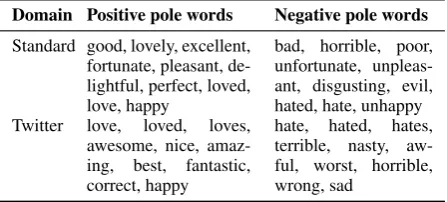
Domain Positive pole words Negative pole words
Standard good, lovely, excellent, fortunate, pleasant, de-lightful, perfect, loved, love, happy
bad, horrible, poor, unfortunate, unpleas-ant, disgusting, evil, hated, hate, unhappy Twitter love, loved, loves,
awesome, nice, amaz-ing, best, fantastic, correct, happy
hate, hated, hates, terrible, nasty, aw-ful, worst, horrible, wrong, sad
Table 1: Manually selected pole words used for the evaluation task in (Hamilton et al., 2016a). These pole words are called seed words in ( Hamil-ton et al.,2016a)
4.1 Evaluation Setup
We compare our method against state-of-the-art approaches that generate domain-specific senti-ment lexicons.
State-of-the-art approaches: Our baseline for the standard English is a WordNet-based method, which performs label propagation over a WordNet-derived graph (San Vicente et al.,2014). For Twitter, we use Sentiment140, a distantly su-pervised approach that uses signals from emoti-cons (Mohammad and Turney,2010). Moreover, on both datasets, we compare against two state-of-the-art sentiment induction methods: DENSIFIER,
a method that learns orthogonal transformations of word vectors (Rothe et al.,2016), and SENTPROP, a method with a label propagation approach on word embeddings (Hamilton et al., 2016a). Seed words, which are called pole words in our work, are listed in Table1.
Evaluation metrics: We evaluate the aforemen-tioned approaches according to (i) their binary classification accuracy (positive and negative), (ii) ternary classification performance (positive, neu-tral, and negative), and (iii) Kendall τ rank-correlation with continuous human-annotated po-larity scores. Since all methods result in senti-ment scores of words rather than assigning a class of sentiment, we label words as positive, neu-tral, or negative using the class-mass normaliza-tion method (Zhu et al., 2003). This normaliza-tion uses knowledge of the label distribunormaliza-tion of a test dataset and simply assigns labels to best match this distribution. For the implementation of other methods, we directly use the source code with-out any modification or tuning (SocialSent,2016) used in (Hamilton et al.,2016a).
4.2 Evaluation Results
Table 2 summarizes the performance. Surpris-ingly, SEMAXIS— the simplest approach — out-performs others on both Standard English and Twitter datasets across all measures.
Standard English
Method AUC Ternary F1 Tau
SEMAXIS 92.2 61.0 0.48
DENSIFIER 91.0 58.2 0.46
SENTPROP 88.4 56.1 0.41
WordNet 89.5 58.7 0.34
Method AUC Ternary F1 Tau
SEMAXIS 90.0 59.2 0.57
DENSIFIER 88.5 58.8 0.55
[image:5.595.72.296.312.413.2]SENTPROP 85.0 58.2 0.50 Sentiment140 86.2 57.7 0.51
Table 2: Evaluation results. Our method performs best on both Standard English and Twitter.
4.3 Sensitivity to Pole Words
As discussed in Section3.3.2, because the axes are derived from pole words, the choice of the pole words can significantly affect the performance. We compare the robustness of three methods for selecting pole words: 1) using sentiment lexicons; 2) using two pole words only (initial pole words); and 3) using l closest words on the word2vec
[image:5.595.327.503.382.537.2]lexicons, ANEW (Bradley and Lang, 1999) and LabMT (Dodds et al., 2011). Then, for the two pole words, we match 1-of-10 positive pole words and 1-of-10 negative pole words in Table1, result-ing in 100 pairs of pole words. For these 100 pairs, in addition to the two initial pole words, we then use thelclosest words (l= 10) of each of them to evaluate the third method.
We compare these three methods by quantifying how well SEMAXIS performs for the evaluation
task. The average AUC for the two pole words method is 78.2. We find that one of the 100 pairs — ‘good’ and ‘bad’ — shows the highest AUC (92.4). However, another random pair (‘happy’ and ‘evil’) results in the worst performance with the AUC of 67.2. In other words, an axis de-fined by only two pole words is highly sensitive to the choice of the word pair. By contrast, when an axis is defined by aggregatinglclosest words, the average AUC increases to 80.6 (the minimum performance is above 71.2). Finally, using pre-established sentiment lexicons results in the worst performance (the AUC of 77.8 for ANEW and 67.5 for LabMT). These results show that identify-ing an axis is a crucial step in SEMAXIS, and using lclosest words in addition to initial pole words is a more robust method to define the axis.
5 SEMAXISin the Wild
We now demonstrate how SEMAXIScan be used in comparative text analysis to capture nuanced linguistic representations beyond the sentiment. As an example, we use Reddit (Reddit,2005), one of the most popular online communities. Reddit is known to serve diverse sub-communities with different linguistic styles (Zhang et al.,2017). We focus on a few pairs of subreddits that are known to express different views. We also choose them to capture a wide range of topics from politics to reli-gion, entertainment, and daily life to demonstrate the broad applicability of SEMAXIS.
5.1 Dataset, Pre-processing, Reference model, and Hyper-parameters
We use Reddit 2016 comment datasets that are publicly available (/u/Dewarim, 2017). We build a corpus from each subreddit by extracting all the comments posted on that subreddit. When the size of two corpora used for comparison is consider-ably different, we undersample the bigger corpus for a fair comparison. Every corpus then
under-goes the same pprocessing, where we first re-move punctuation and stop words, then replace URLs with its domain name.
Reference model for Reddit data As we discussed earlier, many datasets of our in-terest are likely too small to obtain good vector representations. For example, two popular subreddits, /r/The Donald and
/r/SandersForPresident2, show only
59.8% and 42.1% in analogy test, respectively.3 Therefore, as we proposed, we first create a pre-trained word embedding with a larger background corpus and perform additional training with target subreddits. We sample 1 million comments from each of the top 200 subreddits, resulting in 20 million comments. Using this sample, we build a word embedding, denoted as Reddit20M, using the CBOW model with a window size of five, a minimum word count of 10, the negative sampling, and down-sampling of frequent terms as suggested in (Levy et al., 2015). For the subsequent training with the target corpora, we train the model with a small starting learning rate, 0.005; Using different rates, such as 0.01 and 0.001, did not make much difference. We further tune the model with the dimension size of 300 and the number of the epoch of 100 using the analogy test results.
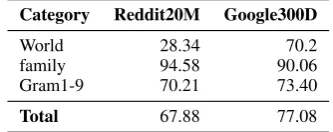
Category Reddit20M Google300D
World 28.34 70.2
family 94.58 90.06
Gram1-9 70.21 73.40
[image:6.595.332.499.457.523.2]Total 67.88 77.08
Table 3: Results of analogy tests, comparing 20M sample texts from Reddit vs. Google 100B News.
Table 3 shows the results of the analogy test using our Reddit20M in comparison with Google300D, which is the Google News em-bedding used in previous sections. As one can expect, Reddit20M shows worse perfor-mance than Google300D. However, the four cat-egories (capital-common-countries, capital-world, currency, and city-in-state denoted by World), which require some general knowledge on the world, drive the 10% decrease in overall
accu-2
/r/is a common notation for indicating subreddits.
3For both corpora, continuous bag-of-words (CBOW)
racy. Other categories show comparable or even better accuracy. For example, Reddit20M outper-forms Google300D by 4.52% in the family cate-gory. Since Reddit is a US-based online commu-nity, the Reddit model may not be able to properly capture semantic relationships inWorldcategory. By contrast, for the categories for testing grammar (denoted byGram1-9), Reddit20M shows compa-rable performances with Google300D (70.21 vs. 73.4). In this study, we use Reddit20M as a refer-ence model and update it with new target corpora.
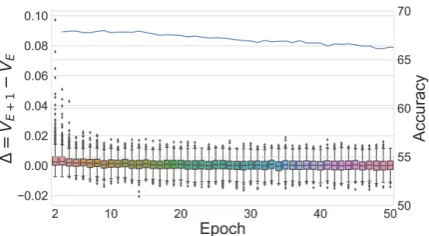
Figure 1: Changes of word semantics (box plot) and accuracy (line graph) over epoch for the model
for/r/SandersForPresident
Updating the reference modelAs we explained in Section 3.2.2, we stop updating the reference model depending on the accuracy of the analogy test and semantic changes of the top 1000 words of the given corpus. In our experiments, we setα = 0.3andβ = 0.001. Figure1shows the accuracy of the analogy test over epoch as a line plot and the semantic changes of words as a box plot for the model for /r/SandersForPresident. The model gradually loses general semantic rela-tion over epochs, and the characteristic semantic changes stabilize after about 10 epochs. Given the
α and β, we use the embedding after 10 epochs of training with the target subreddit data. We note that the results are consistent when epoch is greater than 10. We choose the number of epoch for other corpora based on the same tactic.
5.2 Confirming well-known language representations
Once we have word embeddings for given sub-reddits by updating the pre-trained model, we can compare the languages of two subreddits. As a case study, we compare supporters of Donald Trump (/r/The Donald) and Bernie Sanders
(/r/SandersForPresident)4, and examine the semantic differences in diverse issues, such as gun and minority, based on different axes. This can be easily compared with our educated guess learned from the 2016 U.S. Election.
Starting from a topic word (e.g., ‘gun’) and its closest word (e.g., ‘guns’), we compute the aver-age vector of the two words. We then find the clos-est word from the computed average vector and repeat this process to collect 30 topical terms in each word embedding. Then, we remove words that have appeared less thanntimes in both cor-pora. The highernleads to less coverage of top-ical terms but eliminate noise. We set n = 100
in the following experiments. We consider the re-maining words as topic words.
Figure 2 compares how the minority-related terms are depicted in the two subreddits. Fig-ure 2(a) and 2(b) show how minority issues are perceived in two communities with respect to ‘Sentiment’ and ‘Respect’ . The x-axis is the value for each word on the Sentiment axis for Trump supporters, and the y-axis is the difference be-tween the value for Trump and Sanders supporters. If the y-value is greater than 0, then it means the word is more ‘positive’ among Trump supporters compared to that among Sanders supporters.
Some terms perceived more positively (e.g., ‘immigration’ and ‘minorities’) while other terms were perceived more negatively (‘black’, ‘latino’, ‘hispanic’) among Trump supporters (Figure2(a)). As this positive perception on immigration and minorities is unexpected, we examine the actual comments. Through the manual inspection of rel-evant comments, we find that Trump supporters often mention that they ‘agree’ with or ‘support’ the idea of banning immigration, resulting in hav-ing a term ‘immigration’ as more positive than Sanders supporters. However, when examining those words on the ‘Disrespect’ vs. ‘Respect’ axis (Figure2(b)), most of the minority groups are con-sidered disrespectful by Trump supporters com-pared to Sanders supporters, demonstrating a ben-efit of examining multiple semantic axes that can reflect rich semantics beyond basic sentiments.
Then, one would expect that ‘Gun’ would be more positively perceived for Trump supporters compared to for Sanders supporters. Beyond the sentiment, we examine how ‘gun’ is perceived in
4Both subreddits have a policy of banning users who post
(a) Minority (Hate vs Amazing) (b) Minority (Disrespect vs Respect)
Figure 2: Trump supporters vs Sanders supporters on Minority issue
two communities for ‘Arousal’ and ‘Safety’ axes. We find that Trump supporters are generally posi-tive about gun-related issues, and Sanders support-ers associate ‘gun’ with more arousal and danger.
We also examine two other subreddits:
/r/atheism and /r/Christianity. As
their names indicate, the former is the subreddit for atheists and the latter is the subreddit for Christians. We expect that the two groups would have different perspectives regarding ‘god’ and ‘evolution.’ When examining the four words ‘god,’ ‘pray,’ ‘evolution,’ and ‘science’ on the ‘Unholy’ vs. ‘Holy’ axis, ‘god’ and ‘pray’ appear to be more ‘holy’ in/r/Christianitywhile ‘evolution’ and ‘science’ appear more ‘unholy’ than in/r/Atheism, which fits in our intuition. As another example, we examine the/r/PS4
and /r/NintendoSwitchsubreddits. PS4 is a video game console released by Sony and Nin-tendo Switch is released by NinNin-tendo. Although both video game consoles originated from Japan, Nintendo Switch targets more family (children) and casual gamers with more playful and eas-ier games while the games for PS4 target adult and thus tend to be more violent and more diffi-cult to play. We examine three terms (‘Nintendo,’ ‘Mario,’ and ‘Zelda’) from Nintendo Switch and three terms (‘Sony,’ ‘Uncharted,’ and ‘Killzone’) from Sony on the ‘Casual’ vs. ‘Hardcore’ axis.5 We find that ‘Mario’ and ‘Zelda’ are perceived more casual in /r/PS4, and ‘Uncharted’ and ‘Killzone’ are more hardcore in /r/PS4 than
/r/NintendoSwitch. Although both tendo’ and ‘Sony’ have negative values,
‘Nin-5Mario and Zelda are popular Nintendo Switch games,
and Uncharted and Killzone are popular PS4 games.
tendo’ was considered more casual than ‘Sony’ in/r/PS4. Overall, our method effectively cap-tures context-dependent semantic changes beyond the basic sentiments.
5.3 Comparative Text Analysis with Diverse Axes
Let us show how SEMAXIS can find, for a given word, a set of the best axes that describe its seman-tic. We map the word on our predefined 732 axes, which are explained in Section3.3.1, and rank the axes based on the projection values on the axes. In other words, the top axes describe the word with the highest strength.
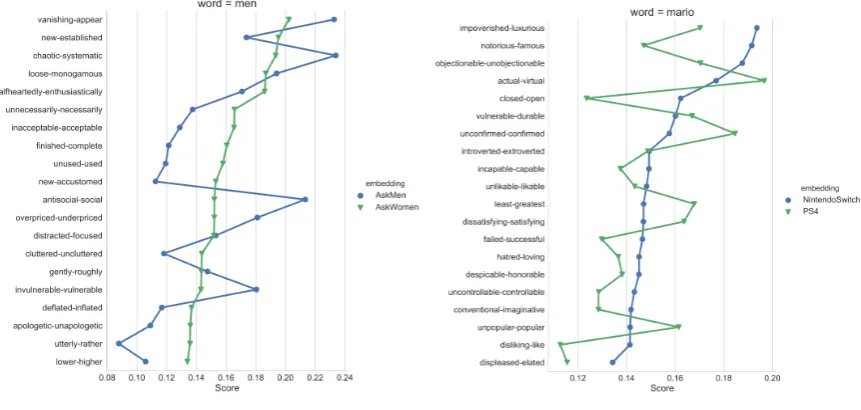
Figure 3(a) shows the top 20 axes with the largest projection values for ‘Men’ in
/r/AskWomen and /r/AskMen, which are
the subreddits where people expect replies from each gender. In /r/AskWomen, compared with
/r/AskMen, ‘Men’ seems to be perceived as more vanishing, more established, less systematic, less monogamous, more enthusiastic, less social, more uncluttered, less vulnerable, and more un-apologetic. This observed perception of men from women’s perspective seems to concur with the common gender stereotype, demonstrating strong potential of SEMAXIS.
Likewise, in Figure 3(b), we examine how a word ‘Mario’ is perceived in two subred-dits /r/NintendoSwitch and /r/PS4. In
(a) Men in /r/AskWomen and /r/AskMen (b) Mario in /r/NintendoSwitch and /r/PS4
Figure 3: An example of comparative text analysis using SEMAXIS: (a) ‘Men’ in/r/AskWomenand
/r/AskMenand (b) ‘Mario’ in/r/NintendoSwitchand/r/PS4
satisfying, popular, undetectable, and unstop-pable. ‘Mario’ is perceived more positively in
/r/NintendoSwitchthan in/r/PS4, as ex-pected. Furthermore, SEMAXIS reveals detailed and nuanced perceptions of different communities.
6 Discussion and Conclusion
We have proposed SEMAXIS to examine a nu-anced representation of words based on diverse semantic axes. We have shown that SEMAXIS
can construct good domain-specific sentiment lex-icons by projecting words on the sentiment axis. We have also demonstrated that our approach can reveal nuanced context-dependence of words through the lens of numerous semantic axes.
There are two major limitations. First, we per-formed the quantitative evaluation only with the sentiment axis, even though we supplemented it with more qualitative examples. We used the sen-timent axis because it is better studied and more methods exist, but ideally it would be better to perform evaluation across many semantic axes. We hope that SEMAXIScan facilitate research on other semantic axes so that we will have labeled datasets for other axes as well. Secondly, Gaffney and Matias (2018) recently reported the Reddit data used in this study is incomplete. The authors suggest using the data with caution, particularly when analyzing user interactions. Although our work examine communities in Reddit, we focus on the difference of the word semantics. Thus,
we believe the effect of deleted comment would be marginal in our analyses.
Despite these limitations, we identify the fol-lowing key implications. First, SEMAXIS
of-fers a framework to examine texts on diverse se-mantic axes beyond the sentiment axis, through the 732 systematically induced semantic axes that capture common antonyms. Our study may facil-itate further investigations on context-dependent text analysis techniques and applications. Sec-ond, the unsupervised nature of SEMAXIS pro-vides a powerful way to build lexicons of any semantic axis, including the sentiment axis, for non-English languages, particularly the resource-scarce languages.
7 Acknowledgements
References
Douglas Biber and Edward Finegan. 1988. Adver-bial stance types in english. Discourse processes, 11(1):1–34.
Margaret M Bradley and Peter J Lang. 1999. Affective norms for english words (ANEW): Instruction man-ual and affective ratings. Technical report, Technical report C-1, the center for research in psychophysiol-ogy, University of Florida.
Peter Sheridan Dodds, Kameron Decker Harris, Is-abel M Kloumann, Catherine A Bliss, and Christo-pher M Danforth. 2011. Temporal patterns of happiness and information in a global social net-work: Hedonometrics and Twitter. PLOS ONE, 6(12):e26752.
Penelope Eckert and Sally McConnell-Ginet. 2013.
Language and gender. Cambridge University Press.
A. Esuli and F. Sebastiani. 2006. Sentiwordnet: A publicly available lexical resource for opinion min-ing. In Proceedings of the Fifth International Conference on Language Resources and Evaluation (LREC’06). European Language Resources Associ-ation (ELRA).
Ethan Fast, Binbin Chen, and Michael S Bernstein. 2016. Empath: Understanding topic signals in large-scale text. In Proceedings of the 2016 CHI Con-ference on Human Factors in Computing Systems, pages 4647–4657. ACM.
John L. Fischer. 1958. Social influences on the choice of a linguistic variant. WORD, 14(1):47–56.
Devin Gaffney and J Nathan Matias. 2018. Caveat emptor, computational social science: Large-scale missing data in a widely-published reddit corpus.
arXiv preprint arXiv:1803.05046.
Google. 2013. Google word2vec. https://code. google.com/archive/p/word2vec/. [On-line; accessed February 23, 2018].
Lisa J Green. 2002. African American English: a lin-guistic introduction. Cambridge University Press.
William L. Hamilton, Kevin Clark, Jure Leskovec, and Dan Jurafsky. 2016a. Inducing domain-specific sen-timent lexicons from unlabeled corpora. In Proceed-ings of the 2016 Conference on Empirical Methods in Natural Language Processing, pages 595–605. Association for Computational Linguistics.
William L. Hamilton, Jure Leskovec, and Dan Jurafsky. 2016b. Diachronic word embeddings reveal statisti-cal laws of semantic change. InProceedings of the 54th Annual Meeting of the Association for Compu-tational Linguistics (Volume 1: Long Papers), pages 1489–1501. Association for Computational Linguis-tics.
Vasileios Hatzivassiloglou and Kathleen R. McKeown. 1997. Predicting the semantic orientation of adjec-tives. In8th Conference of the European Chapter of the Association for Computational Linguistics.
Yoonsung Hong, Haewoon Kwak, Youngmin Baek, and Sue Moon. 2013. Tower of babel: A crowdsourcing game building sentiment lexicons for resource-scarce languages. In Proceedings of the 22nd International Conference on World Wide Web, WWW ’13 Companion, pages 549–556, New York, NY, USA. ACM.
Dirk Hovy. 2015. Demographic factors improve clas-sification performance. InProceedings of the 53rd Annual Meeting of the Association for Computa-tional Linguistics and the 7th InternaComputa-tional Joint Conference on Natural Language Processing (Vol-ume 1: Long Papers), pages 752–762. Association for Computational Linguistics.
Yoon Kim. 2014. Convolutional neural networks for sentence classification. In Proceedings of the 2014 Conference on Empirical Methods in Natural Lan-guage Processing (EMNLP), pages 1746–1751. As-sociation for Computational Linguistics.
Omer Levy, Yoav Goldberg, and Ido Dagan. 2015. Im-proving distributional similarity with lessons learned from word embeddings.Transactions of the Associ-ation for ComputAssoci-ational Linguistics, 3:211–225.
Tim Loughran and Bill McDonald. 2011. When is a liability not a liability? textual analysis, dictionaries, and 10-ks.The Journal of Finance, 66(1):35–65.
Tomas Mikolov, Kai Chen, Greg Corrado, and Jef-frey Dean. 2013a. Efficient estimation of word representations in vector space. arXiv preprint arXiv:1301.3781.
Tomas Mikolov, Ilya Sutskever, Kai Chen, Greg S Cor-rado, and Jeff Dean. 2013b. Distributed representa-tions of words and phrases and their compositional-ity. InAdvances in Neural Information Processing Systems, pages 3111–3119.
Saif Mohammad, Svetlana Kiritchenko, Parinaz Sob-hani, Xiaodan Zhu, and Colin Cherry. 2016. Semeval-2016 task 6: Detecting stance in tweets. In
Proceedings of the 10th International Workshop on Semantic Evaluation (SemEval-2016), pages 31–41. Association for Computational Linguistics.
Saif Mohammad and Peter Turney. 2010. Emotions evoked by common words and phrases: Using me-chanical turk to create an emotion lexicon. In Pro-ceedings of the NAACL HLT 2010 Workshop on Computational Approaches to Analysis and Gener-ation of Emotion in Text, pages 26–34. Association for Computational Linguistics.
Saif M. Mohammad, Parinaz Sobhani, and Svetlana Kiritchenko. 2017. Stance and sentiment in tweets.
Bo Pang and Lillian Lee. 2004. A sentimental edu-cation: Sentiment analysis using subjectivity sum-marization based on minimum cuts. InProceedings of the 42nd Annual Meeting of the Association for Computational Linguistics (ACL-04).
Bo Pang, Lillian Lee, and Shivakumar Vaithyanathan. 2002. Thumbs up? sentiment classification using machine learning techniques. InProceedings of the 2002 Conference on Empirical Methods in Natural Language Processing (EMNLP 2002).
James W Pennebaker, Martha E Francis, and Roger J Booth. 2001. Linguistic inquiry and word count: LIWC 2001. Mahway: Lawrence Erlbaum Asso-ciates, 71.
Delip Rao and Deepak Ravichandran. 2009. Semi-supervised polarity lexicon induction. In Proceed-ings of the 12th Conference of the European Chapter of the ACL (EACL 2009), pages 675–682. Associa-tion for ComputaAssocia-tional Linguistics.
Reddit. 2005. Reddit: the front page of the
inter-net. https://www.reddit.com/. [Online;
accessed February 23, 2018].
Sara Rosenthal and Kathleen McKeown. 2011. Age prediction in blogs: A study of style, content, and online behavior in pre- and post-social media gen-erations. InProceedings of the 49th Annual Meet-ing of the Association for Computational LMeet-inguis- Linguis-tics: Human Language Technologies, pages 763– 772. Association for Computational Linguistics.
Sara Rosenthal, Preslav Nakov, Svetlana Kiritchenko, Saif Mohammad, Alan Ritter, and Veselin Stoyanov. 2015. Semeval-2015 task 10: Sentiment analysis in twitter. InProceedings of the 9th International Workshop on Semantic Evaluation (SemEval 2015), pages 451–463. Association for Computational Lin-guistics.
Sascha Rothe, Sebastian Ebert, and Hinrich Sch¨utze. 2016. Ultradense word embeddings by orthogonal transformation. InProceedings of the 2016 Confer-ence of the North American Chapter of the Associ-ation for ComputAssoci-ational Linguistics: Human Lan-guage Technologies, pages 767–777. Association for Computational Linguistics.
I˜naki San Vicente, Rodrigo Agerri, and German Rigau. 2014. Simple, robust and (almost) unsupervised generation of polarity lexicons for multiple lan-guages. InProceedings of the 14th Conference of the European Chapter of the Association for Com-putational Linguistics, pages 88–97. Association for Computational Linguistics.
Richard Socher, Alex Perelygin, Jean Wu, Jason Chuang, Christopher D. Manning, Andrew Ng, and Christopher Potts. 2013. Recursive deep models for semantic compositionality over a sentiment tree-bank. In Proceedings of the 2013 Conference on
Empirical Methods in Natural Language Process-ing, pages 1631–1642. Association for Computa-tional Linguistics.
SocialSent. 2016. Code and data for inducing domain-specific sentiment lexicons. https://github.
com/williamleif/socialsent. [Online;
accessed February 23, 2018].
Robert Speer, Joshua Chin, and Catherine Havasi. 2017. Conceptnet 5.5: An open multilingual graph of general knowledge. InAAAI, pages 4444–4451.
Philip J Stone, Dexter C Dunphy, and Marshall S Smith. 1966. The general inquirer: A computer ap-proach to content analysis. MIT press.
Maite Taboada, Julian Brooke, Milan Tofiloski, Kim-berly Voll, and Manfred Stede. 2011. Lexicon-based methods for sentiment analysis.Computational Lin-guistics, 37(2).
Duyu Tang, Furu Wei, Bing Qin, Ming Zhou, and Ting Liu. 2014. Building large-scale twitter-specific sen-timent lexicon : A representation learning approach. In Proceedings of COLING 2014, the 25th Inter-national Conference on Computational Linguistics: Technical Papers, pages 172–182. Dublin City Uni-versity and Association for Computational Linguis-tics.
Peter Trudgill. 1974. Linguistic change and diffu-sion: Description and explanation in sociolinguistic dialect geography. Language in society, 3(2):215– 246.
Peter Turney. 2002. Thumbs up or thumbs down? se-mantic orientation applied to unsupervised classifi-cation of reviews. InProceedings of the 40th An-nual Meeting of the Association for Computational Linguistics.
/u/Dewarim. 2017. Reddit comment dataset. https:
//files.pushshift.io/. [Online;
down-loaded July 23, 2017].
Leonid Velikovich, Sasha Blair-Goldensohn, Kerry Hannan, and Ryan McDonald. 2010. The viability of web-derived polarity lexicons. InHuman Lan-guage Technologies: The 2010 Annual Conference of the North American Chapter of the Association for Computational Linguistics, pages 777–785. As-sociation for Computational Linguistics.
Amy Beth Warriner, Victor Kuperman, and Marc Brys-baert. 2013. Norms of valence, arousal, and dom-inance for 13,915 english lemmas. Behavior re-search methods, 45(4):1191–1207.
Dominic Widdows and Beate Dorow. 2002. A graph model for unsupervised lexical acquisition. In COL-ING 2002: The 19th International Conference on Computational Linguistics.
Yi Yang and Jacob Eisenstein. 2015. Putting things in context: Community-specific embed-ding projections for sentiment analysis. CoRR, abs/1511.06052.
Yi Yang and Jacob Eisenstein. 2017. Overcoming lan-guage variation in sentiment analysis with social at-tention.Transactions of the Association for Compu-tational Linguistics, 5:295–307.
Justine Zhang, William L Hamilton, Cristian Danescu-Niculescu-Mizil, Dan Jurafsky, and Jure Leskovec. 2017. Community identity and user engagement in a multi-community landscape. InProceedings of The International Conference on Web and Social Media.