
1098
Unsupervised Discrete Sentence Representation Learning for
Interpretable Neural Dialog Generation
Tiancheng Zhao, Kyusong Lee and Maxine Eskenazi Language Technologies Institute
Carnegie Mellon University Pittsburgh, Pennsylvania, USA
{tianchez, kyusongl, max+}@cs.cmu.edu
Abstract
The encoder-decoder dialog model is one of the most prominent methods used to build dialog systems in complex do-mains. Yet it is limited because it can-not output interpretable actions as in tra-ditional systems, which hinders humans from understanding its generation process. We present an unsupervised discrete sen-tence representation learning method that can integrate with any existing encoder-decoder dialog models for interpretable re-sponse generation. Building upon vari-ational autoencoders (VAEs), we present two novel models, DI-VAE and DI-VST that improve VAEs and can discover inter-pretable semantics via either auto encod-ing or context predictencod-ing. Our methods have been validated on real-world dialog datasets to discover semantic representa-tions and enhance encoder-decoder mod-els with interpretable generation.1
1 Introduction
Classic dialog systems rely on developing a mean-ing representation to represent the utterances from both the machine and human users (Larsson and Traum, 2000; Bohus et al., 2007). The dialog manager of a conventional dialog system outputs the system’s next action in a semantic frame that usually contains hand-crafted dialog acts and slot values (Williams and Young,2007). Then a natu-ral language generation module is used to gener-ate the system’s output in natural language based on the given semantic frame. This approach suf-fers from generalization to more complex do-mains because it soon become intractable to
man-1Data and code are available at https://github. com/snakeztc/NeuralDialog-LAED.
ually design a frame representation that covers all of the fine-grained system actions. The re-cently developed neural dialog system is one of the most prominent frameworks for developing di-alog agents in complex domains. The basic model is based on encoder-decoder networks (Cho et al.,
[image:1.595.314.521.357.408.2]2014) and can learn to generate system responses without the need for hand-crafted meaning repre-sentations and other annotations.
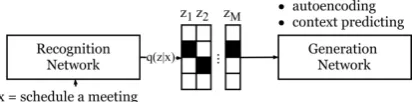
Figure 1: Our proposed models learn a set of dis-crete variables to represent sentences by either au-toencoding or context prediction.
Although generative dialog models have ad-vanced rapidly (Serban et al., 2016; Li et al.,
all the merit of neural dialog systems.
We focus on learning discrete latent represen-tations instead of dense continuous ones because discrete variables are easier to interpret (van den Oord et al.,2017) and can naturally correspond to categories in natural languages, e.g. topics, dia-log acts and etc. Despite the difficulty of learn-ing discrete latent variables in neural networks, the recently proposed Gumbel-Softmax offers a reli-able way to back-propagate through discrete vari-ables (Maddison et al., 2016; Jang et al., 2016). However, we found a simple combination of sen-tence variational autoencoders (VAEs) (Bowman et al., 2015) and Gumbel-Softmax fails to learn meaningful discrete representations. We then highlight the anti-information limitation of the ev-idence lowerbound objective (ELBO) in VAEs and improve it by proposing Discrete Information VAE (DI-VAE) that maximizes the mutual infor-mation between data and latent actions. We further enrich the learning signals beyond auto encoding by extending Skip Thought (Kiros et al., 2015) to Discrete Information Variational Skip Thought (DI-VST) that learns sentence-level distributional semantics. Finally, an integration mechanism is presented that combines the learned latent actions with encoder decoder models.
The proposed systems are tested on several real-world dialog datasets. Experiments show that the proposed methods significantly outperform the standard VAEs and can discover meaningful latent actions from these datasets. Also, experiments confirm the effectiveness of the proposed integra-tion mechanism and show that the learned latent actions can control the sentence-level attributes of the generated responses and provide human-interpretable meaning representations.
2 Related Work
Our work is closely related to research in latent variable dialog models. The majority of mod-els are based on Conditional Variational Autoen-coders (CVAEs) (Serban et al., 2016; Cao and Clark, 2017) with continuous latent variables to better model the response distribution and encour-age diverse responses. Zhao et al., (2017) fur-ther introduced dialog acts to guide the learning of the CVAEs. Discrete latent variables have also been used for task-oriented dialog systems (Wen et al.,2017), where the latent space is used to rep-resent intention. The second line of related work
is enriching the dialog context encoder with more fine-grained information than the dialog history. Li et al., (2016) captured speakers’ characteristics by encoding background information and speak-ing style into the distributed embeddspeak-ings. Xspeak-ing et al., (2016) maintain topic encoding based on La-tent Dirichlet Allocation (LDA) (Blei et al.,2003) of the conversation to encourage the model to out-put more topic coherent responses.
The proposed method also relates to sentence representation learning using neural networks. Most work learns continuous distributed repre-sentations of sentences from various learning sig-nals (Hill et al., 2016), e.g. the Skip Thought learns representations by predicting the previous and next sentences (Kiros et al., 2015). An-other area of work focused on learning regular-ized continuous sentence representation, which enables sentence generation by sampling the la-tent space (Bowman et al.,2015;Kim et al.,2017). There is less work on discrete sentence repre-sentations due to the difficulty of passing gradi-ents through discrete outputs. The recently devel-oped Gumbel Softmax (Jang et al.,2016; Maddi-son et al.,2016) and vector quantization (van den Oord et al.,2017) enable us to train discrete vari-ables. Notably, discrete variable models have been proposed to discover document topics (Miao et al.,2016) and semi-supervised sequence trans-action (Zhou and Neubig,2017)
Our work differs from these as follows: (1) we focus on learning interpretable variables; in prior research the semantics of latent variables are mostly ignored in the dialog generation setting. (2) we improve the learning objective for discrete VAEs and overcome the well-known posterior col-lapsing issue (Bowman et al., 2015; Chen et al.,
2016). (3) we focus on unsupervised learning of salient features in dialog responses instead of hand-crafted features.
3 Proposed Methods
or-der forzto beinterpretable:
1. z should capture salient sentence-level fea-tures about the responsex.
2. The meaning of latent symbols z should be independent of the contextc.
The first property is self-evident. The second can be explained: assumezcontains a single discrete variable withK classes. Since the context c can be any dialog history, if the meaning of each class changes given a different context, then it is diffi-cult to extract an intuitive interpretation by only looking at all responses with class k ∈ [1, K]. Therefore, the second property looks for latent ac-tions that have context-independent semantics so that each assignment ofzconveys the same mean-ing in all dialog contexts.
With the above definition of interpretable latent actions, we first introduce a recognition network
R : qR(z|x) and a generation network G. The role ofRis to map an sentence to the latent vari-able z and the generator G defines the learning signals that will be used to train z’s representa-tion. Notably, our recognition network R does not depend on the context cas has been the case in prior work (Serban et al.,2016). The motiva-tion of this design is to encourage z to capture context-independent semantics, which are further elaborated in Section 3.4. With thez learned by
R andG, we then introduce an encoder decoder network F : pF(x|z,c) and and a policy net-work π : pπ(z|c). At test time, given a context c, the policy network and encoder decoder will work together to generate the next response via
˜
x=pF(x|z ∼pπ(z|c),c). In short,R,G,F and
π are the four components that comprise our pro-posed framework. The next section will first focus on developing RandG for learning interpretable zand then will move on to integratingRwithF
andπin Section3.3.
3.1 Learning Sentence Representations from Auto-Encoding
Our baseline model is a sentence VAE with dis-crete latent space. We use an RNN as the recog-nition network to encode the responsex. Its last hidden state hR|x| is used to represent x. We de-finez to be a set of K-way categorical variables z = {z1...zm...zM}, whereM is the number of variables. For each zm, its posterior distribution is defined asqR(zm|x) =Softmax(WqhR|x|+bq).
During training, we use the Gumbel-Softmax trick to sample from this distribution and obtain low-variance gradients. To map the latent samples to the initial state of the decoder RNN, we define
{e1...em...eM}whereem ∈ RK×D andDis the generator cell size. Thus the initial state of the generator is: hG0 = PM
m=1em(zm). Finally, the generator RNN is used to reconstruct the response givenhG0. VAEs is trained to maxmimize the evi-dence lowerbound objective (ELBO) (Kingma and Welling, 2013). For simplicity, later discussion drops the subscript m in zm and assumes a sin-gle latentz. Since eachzmis independent, we can easily extend the results below to multiple vari-ables.
3.1.1 Anti-Information Limitation of ELBO
It is well-known that sentence VAEs are hard to train because of the posterior collapse issue. Many empirical solutions have been proposed: weaken-ing the decoder, addweaken-ing auxiliary loss etc. ( Bow-man et al., 2015; Chen et al., 2016; Zhao et al.,
2017). We argue that the posterior collapse issue lies in ELBO and we offer a novel decomposition to understand its behavior. First, instead of writ-ing ELBO for a swrit-ingle data point, we write it as an expectation over a dataset:
LVAE=Ex[EqR(z|x)[logpG(x|z)]
−KL(qR(z|x)kp(z))]
(1)
We can expand the KL term as Eq.2(derivations in Appendix A.1) and rewrite ELBO as:
Ex[KL(qR(z|x)kp(z))] = (2)
I(Z, X)+KL(q(z)kp(z))
LVAE=Eq(z|x)p(x)[logp(x|z)]
−I(Z, X)−KL(q(z)kp(z)) (3)
whereq(z) =Ex[qR(z|x)]andI(Z, X)is the mu-tual information between Z andX. This expan-sion shows that the KL term in ELBO is trying to reduce the mutual information between latent variables and the input data, which explains why VAEs often ignore the latent variable, especially when equipped with powerful decoders.
3.1.2 VAE with Information Maximization and Batch Prior Regularization
likeli-hood lowerbound and the mutual information be-tweenzand the input data:
LVAE+I(Z, X) =
EqR(z|x)p(x)[logpG(x|z)]−KL(q(z)kp(z)) (4)
Therefore, jointly optimizing ELBO and mutual information simply cancels out the information-discouraging term. Also, we can still sample from the prior distribution for generation because of KL(q(z)kp(z)). Eq. 4 is similar to the objec-tives used in adversarial autoencoders (Makhzani et al.,2015;Kim et al.,2017). Our derivation pro-vides a theoretical justification to their superior performance. Notably, Eq. 4 arrives at the same loss function proposed in infoVAE (Zhao S et al.,
2017). However, our derivation is different, offer-ing a new way to understand ELBO behavior.
The remaining challenge is how to minimize KL(q(z)kp(z)), sinceq(z) is an expectation over
q(z|x). When z is continuous, prior work has used adversarial training (Makhzani et al., 2015;
Kim et al.,2017) or Maximum Mean Discrepancy (MMD) (Zhao S et al.,2017) to regularizeq(z). It turns out that minimizing KL(q(z)kp(z))for dis-cretezis much simpler than its continuous coun-terparts. Let xn be a sample from a batch ofN data points. Then we have:
q(z)≈ 1 N
N
X
n=1
q(z|xn) =q0(z) (5)
whereq0(z)is a mixture of softmax from the pos-teriorsq(z|xn) of eachxn. We can approximate KL(q(z)kp(z))by:
KL(q0(z)kp(z)) =
K
X
k=1
q0(z=k) logq
0(z=k)
p(z=k)
(6)
We refer to Eq. 6 as Batch Prior Regularization (BPR). When N approaches infinity, q0(z) ap-proaches the true marginal distribution of q(z). In practice, we only need to use the data from each mini-batch assuming that the mini batches are randomized. Last, BPR is fundamentally dif-ferent from multiplying a coefficient < 1 to an-neal the KL term in VAE (Bowman et al.,2015). This is because BPR is a non-linear operation
log sum exp. For later discussion, we denote our discrete infoVAE with BPR as DI-VAE.
3.2 Learning Sentence Representations from the Context
DI-VAE infers sentence representations by recon-struction of the input sentence. Past research in distributional semantics has suggested the mean-ing of language can be inferred from the adjacent context (Harris,1954;Hill et al.,2016). The dis-tributional hypothesis is especially applicable to dialog since the utterance meaning is highly con-textual. For example, the dialog act is a well-known utterance feature and depends on dialog state (Austin, 1975;Stolcke et al., 2000). Thus, we introduce a second type of latent action based on sentence-level distributional semantics.
Skip thought (ST) is a powerful sentence representation that captures contextual informa-tion (Kiros et al., 2015). ST uses an RNN to en-code a sentence, and then uses the resulting sen-tence representation to predict the previous and next sentences. Inspired by ST’s robust perfor-mance across multiple tasks (Hill et al.,2016), we adapt our DI-VAE to Discrete Information Varia-tional Skip Thought (DI-VST) to learn discrete la-tent actions that model distributional semantics of sentences. We use the same recognition network from DI-VAE to outputz’s posterior distribution
qR(z|x). Given the samples from qR(z|x), two RNN generators are used to predict the previous sentence xp and the next sentencesxn. Finally, the learning objective is to maximize:
LDI-VST=EqR(z|x)p(x))[log(p n
G(xn|z)p p
G(xp|z))]
−KL(q(z)kp(z))
(7)
3.3 Integration with Encoder Decoders
We now describe how to integrate a givenqR(z|x) with an encoder decoder and a policy network. Let the dialog contextc be a sequence of utterances. Then a dialog context encoder network can en-code the dialog context into a distributed represen-tationhe =Fe(c). The decoderFdcan generate the responsesx˜ = Fd(he,z) using samples from
qR(z|x). Meanwhile, we train π to predict the aggregated posteriorEp(x|c)[qR(z|x)] from c via maximum likelihood training. This model is re-ferred as Latent Action Encoder Decoder (LAED) with the following objective.
LLAED(θF, θπ) =
Also simply augmenting the inputs of the decoders with latent action does not guarantee that the gen-erated response exhibits the attributes of the give action. Thus we use the controllable text gener-ation framework (Hu et al.,2017) by introducing
LAttr, which reuses the same recognition network
qR(z|x)as a fixed discriminator to penalize the de-coder if its generated responses do not reflect the attributes inz.
LAttr(θF) =EqR(z|x)p(c,x)[logqR(z|F(c,z))] (9) Since it is not possible to propagate gradients through the discrete outputs at Fd at each word step, we use a deterministic continuous relax-ation (Hu et al.,2017) by replacing output ofFd with the probability of each word. Let ot be the normalized probability at step t ∈ [1,|x|], the inputs to qR at time t are then the sum of word embeddings weighted by ot, i.e. hRt =
RNN(hRt−1,Eot) and E is the word embedding matrix. Finally this loss is combined withLLAED
and a hyperparameterλto have Attribute Forcing LAED.
LattrLAED=LLAED+λLAttr (10)
3.4 Relationship with Conditional VAEs
It is not hard to seeLLAEDis closely related to the objective of CVAEs for dialog generation (Serban et al.,2016;Zhao et al.,2017), which is:
LCVAE =Eq[logp(x|z,c)]−KL(q(z|x,c)kp(z|c)) (11) Despite their similarities, we highlight the key dif-ferences that prohibit CVAE from achieving inter-pretable dialog generation. First LCVAE encour-agesI(x,z|c)(Agakov,2005), which learnszthat capture context-dependent semantics. More in-tuitively, z in CVAE is trained to generate xvia
p(x|z,c)so the meaning of learnedzcan only be interpreted along with its contextc. Therefore this violates our goal of learning context-independent semantics. Our methods learnqR(z|x) that only depends on x and trains qR separately to ensure the semantics ofzare interpretable standalone.
4 Experiments and Results
The proposed methods are evaluated on four datasets. The first corpus is Penn Treebank (PTB) (Marcus et al.,1993) used to evaluate sen-tence VAEs (Bowman et al., 2015). We used
the version pre-processed by Mikolov (Mikolov et al., 2010). The second dataset is the Stanford Multi-Domain Dialog (SMD) dataset that contains 3,031 human-Woz, task-oriented dialogs collected from 3 different domains (navigation, weather and scheduling) (Eric and Manning,2017). The other two datasets are chat-oriented data: Daily Dialog (DD) and Switchboard (SW) (Godfrey and Hol-liman, 1997), which are used to test whether our methods can generalize beyond task-oriented di-alogs but also to to open-domain chatting. DD contains 13,118 multi-turn human-human dialogs annotated with dialog acts and emotions. (Li et al.,
2017). SW has 2,400 human-human telephone conversations that are annotated with topics and dialog acts. SW is a more challenging dataset be-cause it is transcribed from speech which contains complex spoken language phenomenon, e.g. hesi-tation, self-repair etc.
4.1 Comparing Discrete Sentence Representation Models
The first experiment used PTB and DD to eval-uate the performance of the proposed methods in learning discrete sentence representations. We implemented DI-VAE and DI-VST using GRU-RNN (Chung et al.,2014) and trained them using Adam (Kingma and Ba,2014). Besides the pro-posed methods, the following baselines are com-pared. Unregularized models: removing the KL(q|p) term from DI-VAE and DI-VST leads to a simple discrete autoencoder (DAE) and dis-crete skip thought (DST) with stochastic disdis-crete hidden units. ELBO models: the basic discrete sentence VAE (DVAE) or variational skip thought (DVST) that optimizes ELBO with regularization term KL(q(z|x)kp(z)). We found that standard training failed to learn informative latent actions for either DVAE or DVST because of the poste-rior collapse. Therefore, KL-annealing (Bowman et al., 2015) and bag-of-word loss (Zhao et al.,
2017) are used to force these two models learn meaningful representations. We also include the results for VAE with continuous latent variables reported on the same PTB (Zhao et al.,2017). Ad-ditionally, we report the perplexity from a stan-dard GRU-RNN language model (Zaremba et al.,
2014).
vari-ables I(x,z). Intuitively a good model should achieve low perplexity and KL distance, and si-multaneously achieve high I(x,z). The discrete latent space for all models areM=20 and K=10. Mini-batch size is 30.
Dom Model PPL KL(qkp) I(x,z)
PTB RNNLM 116.22 -
-VAE 73.49 15.94* -DAE 66.49 2.20 0.349 DVAE 70.84 0.315 0.286 DI-VAE 52.53 0.133 1.18
DD RNNLM 31.15 -
-DST xp:28.23 xn:28.16
0.588 1.359
DVST xp:30.36 xn:30.71
0.007 0.081
DI-VST xp:28.04
xn:27.94
[image:6.595.311.519.131.252.2]0.088 1.028
Table 1: Results for various discrete sentence rep-resentations. The KL for VAE is KL(q(z|x)kp(z))
instead of KL(q(z)kp(z))(Zhao et al.,2017)
Table1shows that all models achieve better per-plexity than an RNNLM, which shows they man-age to learn meaningful q(z|x). First, for auto-encoding models, DI-VAE is able to achieve the best results in all metrics compared other meth-ods. We found DAEs quickly learn to reconstruct the input but they are prone to overfitting dur-ing traindur-ing, which leads to lower performance on the test data compared to DI-VAE. Also, since there is no regularization term in the latent space,
q(z) is very different from the p(z) which pro-hibits us from generating sentences from the la-tent space. In fact, DI-VAE enjoys the same lin-ear interpolation properties reported in (Bowman et al.,2015) (See Appendix A.2). As for DVAEs, it achieves zeroI(x,z)in standard training and only manages to learn some information when train-ing with KL-annealtrain-ing and bag-of-word loss. On the other hand, our methods achieve robust per-formance without the need for additional process-ing. Similarly, the proposed DI-VST is able to achieve the lowest PPL and similar KL compared to the strongly regularized DVST. Interestingly, al-though DST is able to achieve the highestI(x,z), but PPL is not further improved. These results confirm the effectiveness of the proposed BPR in terms of regularizing q(z) while learning mean-ingful posteriorq(z|x).
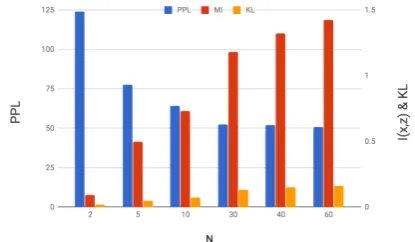
In order to understand BPR’s sensitivity to batch size N, a follow-up experiment varied the batch size from 2 to 60 (IfN=1, DI-VAE is equiv-alent to DVAE). Figure2show that asNincreases,
Figure 2: Perplexity andI(x,z)on PTB by vary-ing batch sizeN. BPR works better for largerN.
perplexity,I(x,z)monotonically improves, while KL(qkp) only increases from 0 to 0.159. After
N > 30, the performance plateaus. Therefore, using mini-batch is an efficient trade-off between
q(z)estimation and computation speed.
The last experiment in this section investigates the relation between representation learning and the dimension of the latent space. We set a fixed budget by restricting the maximum number of modes to be about 1000, i.e. KM ≈ 1000. We then vary the latent space size and report the same evaluation metrics. Table 2 shows that models with multiple small latent variables perform sig-nificantly better than those with large and few la-tent variables.
K, M KM PPL KL(qkp) I(x,z) 1000, 1 1000 75.61 0.032 0.335 10, 3 1000 71.42 0.071 0.607 4, 5 1024 68.43 0.088 0.809
Table 2: DI-VAE on PTB with different latent di-mensions under the same budget.
4.2 Interpreting Latent Actions
[image:6.595.72.292.138.322.2](e.g. dialog acts), it is unfair to use classic clus-ter measures (Vinh et al., 2010) to evaluate the clusters from latent actions. This is because the uniform priorp(z)evenly distribute the data to all possible latent actions, so that it is expected that frequent classes will be assigned to several latent actions. Thus we utilize the homogeneity met-ric (Rosenberg and Hirschberg, 2007) that mea-sures if each latent action contains only members of a single class. We tested this on the SW and DD, which contain human annotated features and we report the latent actions’ homogeneity w.r.t these features in Table3. On DD, results show DI-VST
SW DD
[image:7.595.307.527.220.404.2]Act Topic Act Emotion DI-VAE 0.48 0.08 0.18 0.09 DI-VST 0.33 0.13 0.34 0.12
Table 3: Homogeneity results (bounded [0, 1]).
works better than DI-VAE in terms of creating ac-tions that are more coherent for emotion and dia-log acts. The results are interesting on SW since VST performs worse on dialog acts than DI-VAE. One reason is that the dialog acts in SW are more fine-grained (42 acts) than the ones in DD (5 acts) so that distinguishing utterances based on words inxis more important than the information in the neighbouring utterances.
We then apply the proposed methods to SMD which has no manual annotation and contains task-oriented dialogs. Two experts are shown 5 ran-domly selected utterances from each latent action and are asked to give an action name that can de-scribe as many of the utterances as possible. Then an Amazon Mechanical Turk study is conducted to evaluate whether other utterances from the same latent action match these titles. 5 workers see the action name and a different group of 5 utterances from that latent action. They are asked to select all utterances that belong to the given actions, which tests the homogeneity of the utterances falling in the same cluster. Negative samples are included to prevent random selection. Table4shows that both methods work well and DI-VST achieved better homogeneity than DI-VAE.
Since DI-VAE is trained to reconstruct its input and DI-VST is trained to model the context, they group utterances in different ways. For example, DI-VST would group “Can I get a restaurant”, “I am looking for a restaurant” into one action where
Model Exp Agree Workerκ Match Rate DI-VAE 85.6% 0.52 71.3% DI-VST 93.3% 0.48 74.9%
Table 4: Human evaluation results on judging the homogeneity of latent actions in SMD.
DI-VAE may denote two actions for them. Finally, Table4.2shows sample annotation results, which show cases of the different types of latent actions discovered by our models.
Model Action Sample utterance
DI-VAE scheduling - sys: okay, scheduling a yoga activity with Tom for the 8th at 2pm.
- sys: okay, scheduling a meet-ing for 6 pm on Tuesday with your boss to go over the quar-terly report.
requests - usr: find out if it ’s supposed to rain
- usr: find nearest coffee shop DI-VST ask
sched-ule info
- usr: when is my football ac-tivity and who is going with me?
- usr: tell me when my dentist appointment is?
requests - usr: how about other coffee? - usr: 11 am please
Table 5: Example latent actions discovered in SMD using our methods.
4.3 Dialog Response Generation with Latent Actions
Finally we implement an LAED as follows. The encoder is a hierarchical recurrent encoder ( Ser-ban et al., 2016) with bi-directional GRU-RNNs as the utterance encoder and a second GRU-RNN as the discourse encoder. The discourse encoder output its last hidden state he|x|. The decoder is another GRU-RNN and its initial state of the de-coder is obtained byhd0 =he|x|+PM
m=1em(zm), where z comes from the recognition network of the proposed methods. The policy networkπis a 2-layer multi-layer perceptron (MLP) that models
pπ(z|he|x|). We use up to the previous 10 utter-ances as the dialog context and denote the LAED using DI-VAE latent actions as AE-ED and the one uses DI-VST as ST-ED.
[image:7.595.82.281.252.308.2]the given action. We generate dialog responses on a test dataset via ˜x = F(z ∼ π(c),c)
with greedy RNN decoding. The generated re-sponses are passed into theRand we measure at-tribute accuracy by countingx˜ as correct ifz = argmaxkqR(k|x˜). Table4.3shows our generated
Domain AE-ED +Lattr ST-ED +Lattr
SMD 93.5% 94.8% 91.9% 93.8% DD 88.4% 93.6% 78.5% 86.1% SW 84.7% 94.6% 57.3% 61.3%
Table 6: Results for attribute accuracy with and without attribute loss.
responses are highly consistent with the given la-tent actions. Also, lala-tent actions from DI-VAE achieve higher attribute accuracy than the ones from DI-VST, becausezfrom auto-encoding is ex-plicitly trained forxreconstruction. AddingLattr is effective in forcing the decoder to takezinto ac-count during its generation, which helps the most in more challenging open-domain chatting data, e.g. SW and DD. The accuracy of ST-ED on SW is worse than the other two datasets. The reason is that SW contains many short utterances that can be either a continuation of the same speaker or a new turn from the other speaker, whereas the re-sponses in the other two domains are always fol-lowed by a different speaker. The more complex context pattern in SW may require special treat-ment. We leave it for future work.
The second experiment checks if the policy net-work π is able to predict the right latent action given just the dialog context. We report both accu-racy, i.e. argmaxkqR(k|x) = argmaxk0pπ(k0|c) and perplexity of pπ(z|c). The perplexity mea-sure is more useful for open domain dialogs be-cause decision-making in complex dialogs is often one-to-many given a similar context (Zhao et al.,
2017). Table 7 shows the prediction scores on
SMD
AE-ED 3.045 (51.5% sys 52.4% usr 50.5%) ST-ED 1.695 (75.5% sys 82.1% usr 69.2%)
DD SW
AE-ED 4.47 (35.8%) 4.46 (31.68%) ST-ED 3.89 (47.5%) 3.68 (33.2%)
Table 7: Performance of policy network. Lattris included in training.
the three dialog datasets. These scores provide
useful insights to understand the complexity of a dialog dataset. For example, accuracy on open-domain chatting is harder than the task-oriented SMD data. Also, it is intuitive that predicting sys-tem actions is easier than predicting user actions on SMD. Also, in general the prediction scores for ST-ED are higher the ones for AE-ED. The rea-son is related to our previous discussion about the granularity of the latent actions. Since latent ac-tions from DI-VST mainly model the the type of utterances used in certain types of context, it is easier for the policy network to predict latent ac-tions from DI-VST. Therefore, choosing the type of latent actions is a design choice and depends on the type of interpretability that is needed. We fin-ish with an example generated from the two vari-ants of LAED on SMD as shown in Table8. Given a dialog context, our systems are able to output a probability distribution over different latent ac-tions that have interpretable meaning along with their natural language realizations.
c usr: Where does my friend live? Model Action Generated Responses
AE-ED
give loc info - Tom is at 753 University Ave, and a road block.
p(z|c)=0.34 - Comfort Inn is at 7 miles away.
give user info - Your home address is 5671 barringer street.
p(z|c)=0.22 - Your home is at 10 ames street.
ST-ED
give loc info - Jill’s house is 8 miles away at 347 Alta Mesa Ave.
p(z|c)=0.93 - Jill lives at 347 Alta Mesa Ave.
Table 8: Interpretable dialog generation on SMD with top probable latent actions. AE-ED predicts more fine-grained but more error-prone actions.
5 Conclusion and Future Work
reinforce-ment learning to adapt policy networks. We be-lieve that this work is an important step forward towards creating generative dialog models that can not only generalize to large unlabelled datasets in complex domains but also be explainable to hu-man users.
References
Felix Vsevolodovich Agakov. 2005. Variational In-formation Maximization in Stochastic Environments. Ph.D. thesis, University of Edinburgh.
John Langshaw Austin. 1975. How to do things with words. Oxford university press.
David M Blei, Andrew Y Ng, and Michael I Jordan. 2003. Latent dirichlet allocation. Journal of ma-chine Learning research3(Jan):993–1022.
Dan Bohus, Antoine Raux, Thomas K Harris, Maxine Eskenazi, and Alexander I Rudnicky. 2007. Olym-pus: an open-source framework for conversational spoken language interface research. InProceedings of the workshop on bridging the gap: Academic and industrial research in dialog technologies. Associa-tion for ComputaAssocia-tional Linguistics, pages 32–39.
Samuel R Bowman, Luke Vilnis, Oriol Vinyals, An-drew M Dai, Rafal Jozefowicz, and Samy Ben-gio. 2015. Generating sentences from a continuous space. arXiv preprint arXiv:1511.06349.
Kris Cao and Stephen Clark. 2017. Latent variable di-alogue models and their diversity. arXiv preprint arXiv:1702.05962.
Xi Chen, Diederik P Kingma, Tim Salimans, Yan Duan, Prafulla Dhariwal, John Schul-man, Ilya Sutskever, and Pieter Abbeel. 2016. Variational lossy autoencoder. arXiv preprint arXiv:1611.02731.
Kyunghyun Cho, Bart Van Merri¨enboer, Caglar Gul-cehre, Dzmitry Bahdanau, Fethi Bougares, Holger Schwenk, and Yoshua Bengio. 2014. Learning phrase representations using rnn encoder-decoder for statistical machine translation. arXiv preprint arXiv:1406.1078.
Junyoung Chung, Caglar Gulcehre, KyungHyun Cho, and Yoshua Bengio. 2014. Empirical evaluation of gated recurrent neural networks on sequence model-ing. arXiv preprint arXiv:1412.3555.
Mihail Eric and Christopher D Manning. 2017. Key-value retrieval networks for task-oriented dialogue. arXiv preprint arXiv:1705.05414.
Milica Gaˇsi´c, Filip Jurˇc´ıˇcek, Simon Keizer, Franc¸ois Mairesse, Blaise Thomson, Kai Yu, and Steve Young. 2010. Gaussian processes for fast policy op-timisation of pomdp-based dialogue managers. In
Proceedings of the 11th Annual Meeting of the Spe-cial Interest Group on Discourse and Dialogue. As-sociation for Computational Linguistics, pages 201– 204.
John J Godfrey and Edward Holliman. 1997. Switchboard-1 release 2. Linguistic Data Consor-tium, Philadelphia.
Zellig S Harris. 1954. Distributional structure. Word 10(2-3):146–162.
Felix Hill, Kyunghyun Cho, and Anna Korhonen. 2016. Learning distributed representations of sentences from unlabelled data. arXiv preprint arXiv:1602.03483.
Zhiting Hu, Zichao Yang, Xiaodan Liang, Ruslan Salakhutdinov, and Eric P Xing. 2017. Toward con-trolled generation of text. InInternational Confer-ence on Machine Learning. pages 1587–1596.
Eric Jang, Shixiang Gu, and Ben Poole. 2016. Categor-ical reparameterization with gumbel-softmax. arXiv preprint arXiv:1611.01144.
Yoon Kim, Kelly Zhang, Alexander M Rush, Yann LeCun, et al. 2017. Adversarially regularized au-toencoders for generating discrete structures. arXiv preprint arXiv:1706.04223.
Diederik Kingma and Jimmy Ba. 2014. Adam: A method for stochastic optimization. arXiv preprint arXiv:1412.6980.
Diederik P Kingma and Max Welling. 2013. Auto-encoding variational bayes. arXiv preprint arXiv:1312.6114.
Ryan Kiros, Yukun Zhu, Ruslan R Salakhutdinov, Richard Zemel, Raquel Urtasun, Antonio Torralba, and Sanja Fidler. 2015. Skip-thought vectors. In Advances in neural information processing systems. pages 3294–3302.
Staffan Larsson and David R Traum. 2000. Informa-tion state and dialogue management in the trindi di-alogue move engine toolkit. Natural language engi-neering6(3-4):323–340.
Jiwei Li, Michel Galley, Chris Brockett, Jianfeng Gao, and Bill Dolan. 2016. A persona-based neural con-versation model. arXiv preprint arXiv:1603.06155 .
Yanran Li, Hui Su, Xiaoyu Shen, Wenjie Li, Ziqiang Cao, and Shuzi Niu. 2017. Dailydialog: A manually labelled multi-turn dialogue dataset. arXiv preprint arXiv:1710.03957.
Alireza Makhzani, Jonathon Shlens, Navdeep Jaitly, Ian Goodfellow, and Brendan Frey. 2015. Adversar-ial autoencoders. arXiv preprint arXiv:1511.05644 .
Mitchell P Marcus, Mary Ann Marcinkiewicz, and Beatrice Santorini. 1993. Building a large annotated corpus of english: The penn treebank. Computa-tional linguistics19(2):313–330.
Yishu Miao, Lei Yu, and Phil Blunsom. 2016. Neu-ral variational inference for text processing. In In-ternational Conference on Machine Learning. pages 1727–1736.
Tomas Mikolov, Martin Karafi´at, Lukas Burget, Jan Cernock`y, and Sanjeev Khudanpur. 2010. Recur-rent neural network based language model. In Inter-speech. volume 2, page 3.
Andrew Rosenberg and Julia Hirschberg. 2007. V-measure: A conditional entropy-based external clus-ter evaluation measure. InProceedings of the 2007 joint conference on empirical methods in natural language processing and computational natural lan-guage learning (EMNLP-CoNLL).
Iulian Vlad Serban, Alessandro Sordoni, Ryan Lowe, Laurent Charlin, Joelle Pineau, Aaron Courville, and Yoshua Bengio. 2016. A hierarchical latent variable encoder-decoder model for generating di-alogues. arXiv preprint arXiv:1605.06069.
Andreas Stolcke, Noah Coccaro, Rebecca Bates, Paul Taylor, Carol Van Ess-Dykema, Klaus Ries, Eliza-beth Shriberg, Daniel Jurafsky, Rachel Martin, and Marie Meteer. 2000. Dialogue act modeling for au-tomatic tagging and recognition of conversational speech. Computational linguistics26(3):339–373.
Aaron van den Oord, Oriol Vinyals, et al. 2017. Neu-ral discrete representation learning. In Advances in Neural Information Processing Systems. pages 6309–6318.
Nguyen Xuan Vinh, Julien Epps, and James Bailey. 2010. Information theoretic measures for cluster-ings comparison: Variants, properties, normaliza-tion and correcnormaliza-tion for chance. Journal of Machine Learning Research11(Oct):2837–2854.
Tsung-Hsien Wen, Yishu Miao, Phil Blunsom, and Steve Young. 2017. Latent intention dialogue mod-els. arXiv preprint arXiv:1705.10229.
Jason D Williams and Steve Young. 2007. Partially observable markov decision processes for spoken dialog systems. Computer Speech & Language 21(2):393–422.
Chen Xing, Wei Wu, Yu Wu, Jie Liu, Yalou Huang, Ming Zhou, and Wei-Ying Ma. 2016. Topic augmented neural response generation with a joint attention mechanism. arXiv preprint arXiv:1606.08340.
Wojciech Zaremba, Ilya Sutskever, and Oriol Vinyals. 2014. Recurrent neural network regularization. arXiv preprint arXiv:1409.2329.
Tiancheng Zhao, Ran Zhao, and Maxine Eskenazi. 2017. Learning discourse-level diversity for neural dialog models using conditional variational autoen-coders.arXiv preprint arXiv:1703.10960.
Shengjia Zhao S, Jiaming Song, and Stefano Ermon. 2017. Infovae: Information maximizing variational autoencoders.arXiv preprint arXiv:1706.02262.
![Table 3: Homogeneity results (bounded [0, 1]).](https://thumb-us.123doks.com/thumbv2/123dok_us/181309.515525/7.595.82.281.252.308/table-homogeneity-results-bounded.webp)