5962
Barack’s Wife Hillary:
Using Knowledge Graphs for Fact-Aware Language Modeling
Robert L. Logan IV∗ Nelson F. Liu†§ Matthew E. Peters§ Matt Gardner§ Sameer Singh∗
∗University of California, Irvine, CA, USA
†University of Washington, Seattle, WA, USA
§Allen Institute for Artificial Intelligence, Seattle, WA, USA
{rlogan, sameer}@uci.edu,{mattg, matthewp}@allenai.org,[email protected]
Abstract
Modeling human language requires the ability to not only generate fluent text but also en-code factual knowledge. However, traditional language models are only capable of remem-bering facts seen at training time, and often have difficulty recalling them. To address this, we introduce the knowledge graph language model (KGLM), a neural language model with mechanisms for selecting and copying facts from a knowledge graph that are relevant to the context. These mechanisms enable the model to render information it has never seen before, as well as generate out-of-vocabulary tokens. We also introduce theLinked WikiText-2dataset,1a corpus of annotated text aligned to
the Wikidata knowledge graph whose contents (roughly) match the popularWikiText-2
bench-mark (Merity et al.,2017). In experiments, we demonstrate that the KGLM achieves signifi-cantly better performance than a strong base-line language model. We additionally pare different language models’ ability to com-plete sentences requiring factual knowledge, and show that the KGLM outperforms even very large language models in generating facts.
1 Introduction
For language models to generate plausible sen-tences, they must be both syntactically coherent as well as consistent with the world they describe. Al-though language models are quite skilled at generat-ing grammatical sentences, and previous work has shown that language models also possess some de-gree of common-sense reasoning and basic knowl-edge (Vinyals and Le,2015;Serban et al.,2016;
Trinh and Le,2019), their ability to generate
fac-tually correct text is quite limited. The clearest
limitation of existing language models is that they, at best, can only memorize facts observed during
1https://rloganiv.github.io/linked-wikitext-2
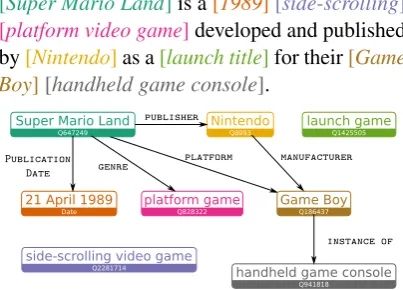
[Super Mario Land]is a[1989][side-scrolling] [platform video game]developed and published
by[Nintendo]as a[launch title]for their[Game Boy][handheld game console].
Date 21 April 1989
Q828322
platform game
Q8093 Nintendo Q647249
Super Mario Land
Q186437
Game Boy
Q941818
handheld game console
Q2281714 side-scrolling video game
Q1425505 launch game
Publication Date
genre
publisher
platform manufacturer
[image:1.595.315.517.225.370.2]instance of
Figure 1: Linked WikiText-2Example. A localized
knowledge graph containing facts that are (possibly) conveyed in the sentence above. The graph is built by it-eratively linking each detected entity to Wikidata, then adding any relations to previously mentioned entities. Note that not all entities are connected, potentially due to missing relations in Wikidata.
training. For instance, when conditioned on the text at the top of Figure1, an AWD-LSTM language model (Merity et al.,2018) trained onWikitext-2
assigns higher probability to the word “ PlaySta-tion” than “Game Boy”, even though this sentence
appears verbatim in the training data. This is not surprising—existing models represent the distribu-tion over the entire vocabulary directly, whether they are common words, references to real world entities, or factual information like dates and num-bers. As a result, language models are unable to generate factually correct sentences, do not gen-eralize to rare/unseen entities, and often omit rare tokens from the vocabulary (instead generating
UN-KNOWN tokens).
We introduce the knowledge graph language
model (KGLM), a neural language model with
graph, a subset of the knowledge graph that
con-tains entities that have already been mentioned in the text, and their related entities. When generating entity tokens, the model either decides to render a new entity that is absent from the local graph, thereby growing the local knowledge graph, or to render a fact from the local graph. When render-ing, the model combines the standard vocabulary with tokens available in the knowledge graph, thus supporting numbers, dates, and other rare tokens.
Figure1illustrates how the KGLM works. Ini-tially, the graph is empty and the model uses the entitySuper Mario Landto render the first three tokens, thus adding it and its relations to the local knowledge graph. After generating the next two to-kens (“is”, “a”) using the standard language model,
the model selectsSuper Mario Landas the parent entity,Publication Dateas the relation to render, and copies one of the tokens of the date entity as the token (“1989” in this case).
To facilitate research on knowledge graph-based language modeling, we collect the distantly su-pervisedLinked WikiText-2dataset. The
underly-ing text closely matchesWikiText-2(Merity et al.,
2017), a popular benchmark for language model-ing, allowing comparisons against existing mod-els. The tokens in the text are linked to entities in Wikidata (Vrandeˇci´c and Krötzsch,2014) using a combination of human-provided links and off-the-shelf linking and coreference models. We also use relations between these entities in Wikidata to con-struct plausible reasons for why an entity may have been mentioned: it could either be related to an entity that is already mentioned (including itself) or a brand new, unrelated entity for the document. We train and evaluate the KGLM on Linked
WikiText-2. When compared against AWD-LSTM,
a recent and performant language model, KGLM obtains not only a lower overall perplexity, but also a substantially lowerunknown-penalized
perplex-ity (Ueberla,1994;Ahn et al.,2016), a metric that allows fair comparisons between models that accu-rately model rare tokens and ones that predict them to be unknown. We also compare factual
com-pletion capabilities of these models, where they
predict the next word after a factual sentence (e.g.,
“Barack is married to ”) and show that KGLM
is significantly more accurate. Lastly, we show that the model is able to generate accurate facts for rare entities, and can becontrolled via modifications
the knowledge graph.
2 Knowledge Graph Language Model
In this section we introduce a language model that is conditioned on an external, structured knowledge source, which it uses to generate factual text.
2.1 Problem Setup and Notation
Alanguage modeldefines a probability distribution
over each token within a sequence, conditioned on the sequence of tokens observed so far. We denote the random variable representing the next token as
xtand the sequence of the tokens beforetasx<t, i.e. language models computep(xt|x<t). RNN
lan-guage models (Mikolov et al.,2010) parameterize this distribution using a recurrent structure:
p(xt|x<t) =softmax(Whht+b),
ht=RNN(ht−1,xt−1). (1)
We use LSTMs (Hochreiter and Schmidhuber,
1997) as the recurrent module in this paper.
Aknowledge graph(KG) is a directed, labeled
graph consisting of entitiesEas nodes, with edges defined over a set of relations R, i.e. KG =
{(p, r, e)|p∈ E, r∈ R, e∈ E}, wherepis a
par-ent par-entity with relationrto another entitye. Prac-tical KGs have other aspects that make this for-mulation somewhat inexact: some relations are to
literal values, such as numbers and dates, facts
may be expressed aspropertieson relations, and
entities havealiases as the set of strings that can
refer to the entity. We also define alocal
knowl-edge graphfor a subset of entitiesE<t asKG<t =
{(p, r, e)|p∈ E<t, r∈ R, e∈ E}, i.e. contains entitiesE<tand all facts they participate in.
2.2 Generative KG Language Model
The primary goal of the knowledge graph guage model (KGLM) is to enable a neural lan-guage model to generate entities and facts from a knowledge graph. To encourage the model to generate facts that have appeared in the context already, KGLM will maintain a local knowledge graph containing all facts involving entities that have appeared in the context. As the model decides to refer to entities that have not been referred to yet, it will grow the local knowledge graph with additional entities and facts to reflect the new entity. Formally, we will compute p(xt,Et|x<t,E<t)
wherex<t is the sequence of observed tokens,E<t
is the set of entities mentioned inx<t, andKG<tis
the local knowledge graph determined byE<t, as
Super Mario Land is a 1989 side-scrolling platform video game developed and published by
AAA I nc .
Sony I nc . . . . . . .
Zz y z x , CA pl at f or m game
Super Mar i o Land
. . . s i de- s c r ol l i ng game
Super
Mar i o Land Ni nt endo
Game Boy
pl at f or m game
1989 PUBLI SHER
GENR E
PLATFO RM P
UB .D
AT E
a the
dog ... company
Kabushiki Koppai Nintendo
...
Relation to Existing Entity
Mention of a New Entity
Not an Entity Mention
Distribution over standard
vocabulary and aliases of et
Distribution over standard vocabulary
standard vocabulary
aliases of et SELF
Nintendo
[image:3.595.83.510.90.291.2]pick from all entities parent from local entities
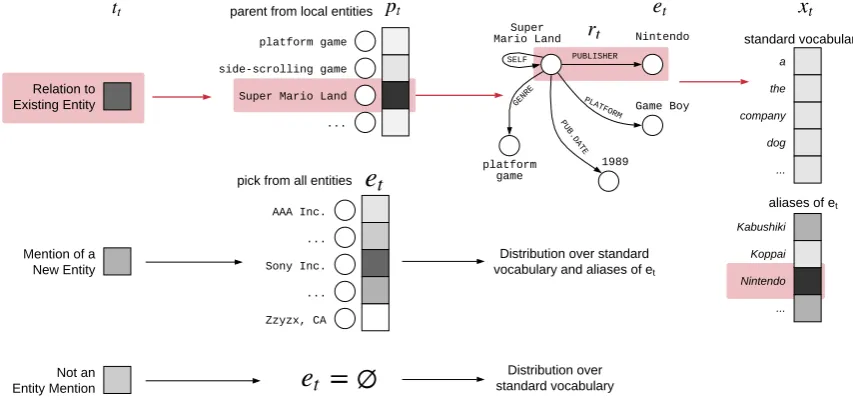
Figure 2:KGLM Illustration.When trying to generate the token following “published by”, the model first decides
the type of the mention (tt) to be a related entity (darker indicates higher probability), followed by identifying the
parent (pt), relation (rt), and entity to render (et) from the local knowledge graph as (Super Mario Land,Publisher,
Nintendo). The final distribution over the words includes the standard vocabulary along with aliases ofNintendo, and the model selects “Nintendo” as the tokenxt. Facts related toNintendowill be added to the local graph.
• Decide the type of xt, which we denote by tt: whether it is a reference to an entity in KG<t(related), a reference to an entity not in KG<t(new), or not an entity mention (∅). • Iftt=newthen choose the upcoming entityet
from the set of all entitiesE.
• Iftt=relatedthen:
– Choose a parent entityptfromE<t.
– Choose a factual relationrtto render,
rt∈ {(p, r, e)∈ KG<t|p=pt}.
– Chooseetas one of the tail entities, et∈ {e|(pt, rt, e)∈ KG<t}. • Iftt=∅thenet=∅.
• Generatextconditioned onet, potentially
copy-ing one ofet’s aliases.
• Ifet∈ E/ <t, thenE<(t+1)← E<t∪ {et},
elseE<(t+1)← E<t.
For the model to refer to an entity it has already mentioned, we introduce aReflexiverelation that self-relates, i.e.p=efor(p,Reflexive, e).
An illustration of this process and the variables is provided in Figure2, for generating a token in the middle of the same sentence as in Figure 1. Amongst the three mention types (tt), the model chooses a reference to existing entity, which re-quires picking a fact to render. As the parent entity of this fact (pt), the model picksSuper Mario Land, and then follows thePublisherrelation (rt) to
se-lectNintendoas the entity to render (et). When
renderingNintendoas a tokenxt, the model has an
expandedvocabulary available to it, containing the
standard vocabulary along with all word types in any of the aliases ofet.
Marginalizing out the KG There is a mismatch
between our initial task requirement, p(xt|x<t), and the model we describe so far, which computes
p(xt,Et|x<t,E<t). We will essentially marginal-izeout the local knowledge graph to compute the
probability of the tokens, i.e.p(x) =P
Ep(x,E). We will clarify this, along with describing the train-ing and the inference/decodtrain-ing algorithms for this model and other details of the setup, in Section4.
2.3 Parameterizing the Distributions
The parametric distributions used in the generative process above are defined as follows. We begin by computing the hidden state ht using the
for-mula in Eqn (1). We then split the vector into three components: ht = [ht,x;ht,p;ht,r], which
are respectively used to predict words, parents, and relations. The type of the token,tt, is computed
using a single-layer softmax overht,x to predict
one of{new,related,∅}.
Picking an Entity We also introduce pretrained
knowledge graph, denoted byvefor entityeand vr for relationr. To selectetfrom all entities in
casett=new, we use:
p(et) =softmax(ve·(ht,p+ht,r))
over alle∈ E. The reason we addht,pandht,ris
to mimic the structure of TransE, which we use to obtain entity and relation embeddings. Details on TransE will be provided in Section4. For mention of a related entity,tt =related, we pick a parent
entityptusing
p(pt) =softmax(vp·ht,p)
over allp∈ Et, then pick the relationrtusing
p(rt) =softmax(vr·ht,r)
over allr ∈ {r|(pt, r, e) ∈ KGt}. The
combina-tion of pt and rt determine the entityet (which must satisfy(pt, rt, et) ∈ KGt; if there are
multi-ple options one is chosen at random).
Rendering the Entity If et = ∅, i.e. there is
no entity to render, we use the same distribution over the vocabulary as in Eqn (1) - a softmax using
ht,x. If there is an entity to render, we construct
the distribution over the original vocabularyand
a vocabulary containing all the tokens that appear in aliases of et. This distribution is conditioned
on et in addition to xt. To compute the scores
over the original vocabulary, ht,x is replaced by h′
t,x = Wproj[ht,x;vet]whereWproj is a learned
weight matrix that projects the concatenated vector into the same vector space asht,x.
To obtain probabilities for words in the alias vocabulary, we use a copy mechanism Gu et al.
(2016). The token sequences comprising each alias {aj}are embedded then encoded using an LSTM
to form vectorsaj. Copy scores are computed as:
p(xt=aj)∝exphσ h′ t,x
T
Wcopy
aj
i
3 Linked WikiText-2
Modeling aside, one of the primary barriers to in-corporating factual knowledge into language mod-els is that training data is hard to obtain. Standard language modeling corpora consist only of text, and thus are unable to describe which entities or facts each token is referring to. In contrast, while relation extraction datasets link text to a knowledge
graph, the text is made up of disjoint sentences that do not provide sufficient context to train a pow-erful language model. Our goals are much more aligned to thedata-to-texttask (Ahn et al.,2016;
Lebret et al., 2016;Wiseman et al., 2017; Yang et al.,2017;Gardent et al., 2017;Ferreira et al.,
2018), where a small table-sized KB is provided to generate a short piece of text; we are interested in language models that dynamically decide the facts to incorporate from the knowledge graph, guided by the discourse.
For these reasons we introduce the Linked
WikiText-2dataset, consisting of (approximately)
the same articles appearing in theWikiText-2
lan-guage modeling corpus, but linked to the Wiki-data (Vrandeˇci´c and Krötzsch, 2014) knowledge graph. Because the text closely matches, mod-els trained onLinked WikiText-2can be compared
to models trained on WikiText-2. Furthermore,
because many of the facts in Wikidata are de-rived from Wikipedia articles, the knowledge graph has a good coverage of facts expressed in the text. The dataset is available for download at:
https://rloganiv.github.io/linked-wikitext-2. Our
system annotates one document at a time, and con-sists of entity linking, relation annotations, and post-processing. The following paragraphs de-scribe each step in detail.
Initial entity annotations We begin by
identify-ing an initial set of entity mentions within the text. The primary source of these mentions is the human-provided links between Wikipedia articles. When-ever a span of text is linked to another Wikipedia article, we associate its corresponding Wikidata entity with the span. While article links provide a large number of gold entity annotations, they are in-sufficient for capturing all of the mentions in the ar-ticle since entities are only linked the first time they occur. Accordingly, we use the neural-el (Gupta et al.,2017) entity linker to identify additional links to Wikidata, and identify coreferences using Stan-ford CoreNLP2to cover pronouns, nominals, and other tokens missed by the linker.
Local knowledge graph The next step iteratively
creates a generative story for the entities using rela-tions in the knowledge graph as well as identifies new entities. To do this, we process the text token by token. Each time an entity is encountered, we add all of the related entities in Wikidata as
Tokens xt Super Mario Land is a 1989 side - scrolling platform video game developed
Mention type tt new ∅ ∅ related new related ∅
Entity Mentioned et SML ∅ ∅ 04-21-1989 SIDE_SCROLL PVG ∅
Relation rt ∅ ∅ ∅ pub date ∅ genre ∅
Parent Entity pt ∅ ∅ ∅ SML ∅ SML ∅
xt and published by Nintendo as a launch title for their Game Boy handheld game console .
tt ∅ ∅ ∅ related ∅ ∅ new ∅ ∅ related related ∅
et ∅ ∅ ∅ NIN ∅ ∅ LT ∅ ∅ GAME_BOY HGC ∅
rt ∅ ∅ ∅ pub ∅ ∅ ∅ ∅ ∅ R:manu / platform instance of ∅
[image:5.595.81.516.64.202.2]pt ∅ ∅ ∅ SML ∅ ∅ ∅ ∅ ∅ NIN / SML GAME_BOY ∅
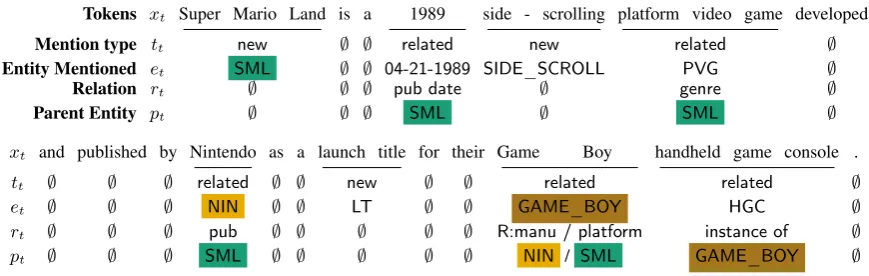
Table 1: Example Annotationof the sentence from Figure1, including corresponding variables from Figure2.
Note thatGame Boyhas multiple parent and relation annotations, as the platform forSuper Mario Landand as manufactured byNintendo. Wikidata identifiers are made human-readable (e.g.,SMLis Q647249) for clarity.
dates for matching. If one of these related entities is seen later in the document, we identify the entity as a parent for the later entity. Since multiple re-lations may appear asexplanationsfor each token,
we allow a token to have multiple facts.
Expanding the annotations Since there may be
entities that were missed in the initial set, as well as non-entity tokens of interest such as dates and quantities we further expand the entity annotations using string matching. For entities, we match the set of aliases provided in Wikidata. For dates, we create an exhaustive list of all of the possible ways of expressing the date (e.g. "December 7, 1941",
"7-12-1941", "1941", ...). We perform a similar
approach for quantities, using thepint library in
Python to handle the different ways of expressing units (e.g. "g", "gram", ...). Since there are many
ways to express a numerical quantity, we only ren-der the quantity at the level of precision supplied by Wikidata, and do not perform unit conversions.
Example Annotation An example annotation is
provided in Table1corresponding to the instance in Figure1, along with the variables that correspond to the generative process of the knowledge graph language model (KGLM). The entity mentioned for most tokens here are human-provided links, apart from “1989” that is linked to04-21-1989by the string matching process. The annotations indicate which of the entities arenewandrelatedbased on
whether they are reachable by entities linked so far, clearly making a mistake forside-scrolling game
andplatform video gamedue to missing links in
Wikidata. Finally, multiple plausible reasons for
Game Boyare included: it’s the platform forSuper
Mario Landand it is manufactured by Nintendo,
even though only the former is more relevant here.
Train Dev Test
Documents 600 60 60
Tokens 2,019,195 207,982 236,062
Vocab. Size 33,558 -
-Mention Tokens 207,803 21,226 24,441
Mention Spans 122,983 12,214 15,007
Unique Entities 41,058 5,415 5,625
Unique Relations 1,291 484 504
Table 2:Linked WikiText-2Corpus Statistics.
Even with these omissions and mistakes, it is clear that the annotations are rich and detailed, with a high coverage, and thus should prove beneficial for training knowledge graph language models.
Dataset Statistics Statistics forLinked WikiText-2
are provided in Table2. In this corpus, more than
10%of the tokens are considered entity tokens, i.e. they are generated as factual references to informa-tion in the knowledge graph. Each entity is only mentioned a few times (less than5on average, with
a long tail), and with more than thousand different relations. Thus it is clear that regular language models would not be able to generate factual text, and there is a need for language models to be able to refer to external sources of information.
Differences from WikiText-2 Although our
dataset is designed to closely replicateWikiText-2,
there are some differences that prevent direct com-parison. Firstly, there are minor variations in text across articles due to edits between download dates. Secondly, according to correspondence withMerity et al.(2017),WikiText-2was collected by querying
the Wikipedia Text API. Because this API discards useful annotation information (e.g. article links),
Linked WikiText-2instead was created by directly
4 Training and Inference for KGLM
In this section, we describe the training and infer-ence algorithm for KGLM.
Pretrained KG Embeddings During evaluation,
we may need to make predictions on entities and relations that have not been seen during training. Accordingly, we use fixed entity and relations em-beddings pre-trained using TransE (Bordes et al.,
2013) on Wikidata. Given(p, r, e), we learn em-beddingsvp,vrandveto minimize the distance:
δ(vp,vr,ve) =kvp+vr−vek2.
We use a max-margin loss to learn the embeddings:
L=max 0, γ+δ(vp,vr,ve)−δ v′
p,vr,ve′
whereγis the margin, and eitherp′ ore′ is a
ran-domly chosen entity embedding.
Training with Linked WikiText-2 Although the
generative process in KGLM involves many steps, training the model onLinked WikiText-2is
straight-forward. Our loss objective is the negative log-likelihood of the training data:
ℓ(Θ) =X
t
logp(xt,Et|x<t,E<t; Θ),
whereΘis the set of model parameters. Note that if an annotation has multiple viable parents such as
Game Boyin1, then we marginalize over all of the
parents. Since all random variables are observed, training can performed using off-the-shelf gradient-based optimizers.
Inference While observing annotations makes the
model easy to train, we do not assume that the model has access to annotations during evaluation. Furthermore, as discussed in Section2.2, the goal in language modelling is to measure the marginal probabilityp(x) =P
Ep(x,E)not the joint proba-bility. However, this sum is intractable to compute due to the large combinatorial space of possible annotations. We address this problem by approxi-mating the marginal distribution using importance sampling. Given samples from a proposal distribu-tionq(E|x)the marginal distribution is:
p(x) =X
E
p(x,E) =X
E
p(x,E)
q(E|x)q(E| x)
≈ 1
N X
E∼q
p(x,E)
q(E|x)
This approach is used to evaluate models inJi et al.
(2017) andDyer et al.(2016). FollowingJi et al.
(2017), we computeq(E|x)using a discriminative
version of our model that predicts annotations for the current token instead of for the next token.
5 Experiments
To evaluate the proposed language model, we first introduce the baselines, followed by an evalua-tion using perplexity of held-out corpus, accuracy on fact completion, and an illustration of how the model uses the knowledge graph.
5.1 Evaluation Setup
Baseline Models We compare KGLM to the
fol-lowing baseline models:
• AWD-LSTM (Merity et al., 2018): strong
LSTM-based model used as the foundation of most state-of-the-art models onWikiText-2.
• ENTITYNLM(Ji et al.,2017): an LSTM-based
language model with the ability to track entity mentions. Embeddings for entities are created dy-namically, and are not informed by any external sources of information.
• EntityCopyNet:a variant of the KGLM where
tt = new for all mentions, i.e. entities are selected fromEand entity aliases are copied, but relations in the knowledge graph are unused.
Hyperparameters We pre-train 256 dimensional
entity and relation embeddings for all entities within two hops of the set of entities that occur in
Linked WikiText-2using TransE with marginγ = 1.
Weights are tied between all date embeddings and between all quantity embeddings to save memory. FollowingMerity et al.(2018) we use 400 dimen-sional word embeddings and a 3 layer LSTM with hidden dimension 1150 to encode tokens. We also employ the same regularization strategy (DropCon-nect (Wan et al.,2013) + Dropout(Srivastava et al.,
2014)) and weight tying approach. However, we perform optimization using Adam (Kingma and Ba,
2015) with learning rate 1e-3 instead of NT-ASGD, having found that it is more stable.
5.2 Results
Perplexity We evaluate our model using the
stan-dardperplexity metric: expT1 PT
t=1logp(xt)
PPL UPP
ENTITYNLM*(Ji et al.,2017) 85.4 189.2
EntityCopyNet* 76.1 144.0
AWD-LSTM (Merity et al.,2018) 74.8 165.8
[image:7.595.84.283.64.127.2]KGLM* 44.1 88.5
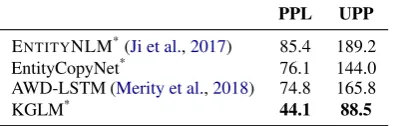
Table 3:Perplexity ResultsonLinked WikiText-2.
Re-sults for models marked with * are obtained using im-portance sampling.
overestimates the probability of out-of-vocabulary tokens when they are mapped to a single UNK token. This is problematic for comparing the per-formance of the KGLM to traditional language models onLinked WikiText-2since there are a large
number of rare entities whose alias tokens are out-of-vocabulary. That is, even if the KGLM identifies the correct entity and copies the correct alias token with high probability, other models can attain bet-ter perplexity by assigning a higher probability to UNK. Accordingly, we also measureunknown
pe-nalized perplexity(UPP) (a.k.aadjusted perplexity)
introduced byUeberla(1994), and used recently byAhn et al.(2016) andSpithourakis and Riedel
(2018). This metric penalizes the probability of UNK tokens by evenly dividing their probability mass over U, the set of tokens that get mapped to UNK . We can be compute UPP by replacing
p(UNK) in the perplexity above by 1
|U |p(UNK),
where|U|is estimated from the data.
We present the model perplexities in Table3. To marginalize over annotations, perplexities for the ENTITYNLM, EntityCopyNet, and KGLM are es-timated using the importance sampling approach described in Section4. We observe that the KGLM attains substantially lower perplexity than the other entity-based language models (44.1 vs. 76.1/85.4), providing strong evidence that leveraging knowl-edge graphs is crucial for accurate language mod-eling. Furthermore, KGLM significantly outper-forms all models in unknown penalized perplexity, demonstrating its ability to generate rare tokens.
Fact Completion Since factual text generation
is our primary objective, we evaluate the ability of language models to complete sentences with factual information. We additionally compare with
thesmallGPT-2 (Radford et al.,2019), a language
model trained on a much larger corpus of text. We select6popular relations from Freebase, and write
a simplecompletiontemplate for each, such as “X
was born in ” for thebirthplace relation. We
AWD-LSTM GPT-2
KGLM
Oracle NEL
nation-capital 0 / 0 6/7 0 / 0 0 / 4
birthloc 0 / 9 14 / 14 94/95 85 / 92
birthdate 0 / 25 8 / 9 65/68 61 / 67
spouse 0 / 0 2/ 3 2/ 2 1 /19
city-state 0 / 13 62/62 9 / 59 4 / 59
book-author 0 / 2 0 / 0 61/62 25 / 28
Average 0.0/8.2 15.3/15.8 38.5/47.7 29.3/44.8
Table 4: Fact Completion. Top-k accuracy
(@1/@5,%) for predicting the next token for an incom-plete factual sentence. See examples in Table5.
generate sentences for these templates for a number of(X, Y)pairs for which the relation holds, and
manually examine the first token generated by each language model to determine whether it is correct. Table4presents performance of each language model on the relations. TheoracleKGLM is given
the correct entity annotation forX, while theNEL
KGLM uses the discriminative model used for im-portance sampling combined with the NEL entity linker to produce an entity annotation forX.
Amongst models trained on the same data, both KGLM variants significantly outperform LSTM; they produce accurate facts, while AWD-LSTM produced generic, common words. KGLMs are also competitive with models trained on orders of magnitude more data, producing factual com-pletions that require specific knowledge, such as birthplaces, dates, and authors. However, they do not capture facts or relations that frequently appear in large corpora, like the cities within states.3 It is encouraging to see that the KGLM with automatic linking performs comparably to oracle linking.
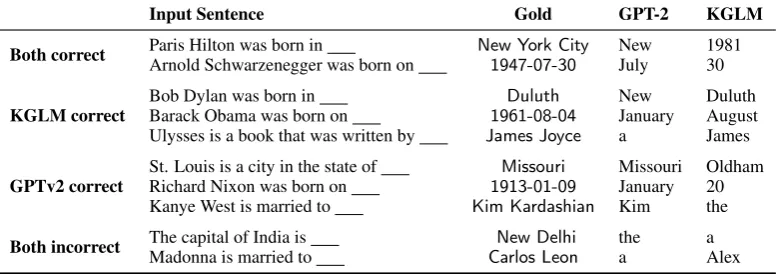
We provide examples in Table 5 to highlight qualitative differences between KGLM, trained on
600documents, and the recent state-of-the-art lan-guage model, GPT-2, trained on the WebText cor-pus with over8million documents (Radford et al., 2019). For examples that both models get factu-ally correct or incorrect, the generated tokens by KGLM are often much more specific, as opposed to selection of more popular/generic tokens (GPT-2 often predicts “New York” as the birthplace, even for popular entities). KGLM, in particular, gets factual statements correct when the head or tail en-tities are rare, while GPT-2 can only complete facts for more-popular entities while using more-generic tokens (such as “January” instead of “20”).
Input Sentence Gold GPT-2 KGLM
Both correct Paris Hilton was born inArnold Schwarzenegger was born on New York City New 1981
1947-07-30 July 30
KGLM correct
Bob Dylan was born in Duluth New Duluth
Barack Obama was born on 1961-08-04 January August
Ulysses is a book that was written by James Joyce a James
GPTv2 correct
St. Louis is a city in the state of Missouri Missouri Oldham
Richard Nixon was born on 1913-01-09 January 20
Kanye West is married to Kim Kardashian Kim the
Both incorrect The capital of India isMadonna is married to New Delhi the a
[image:8.595.104.494.61.198.2]Carlos Leon a Alex
Table 5:Completion Examples. Examples of fact completion by KGLM and GPT-2, which has been trained on
a much larger corpus. GPT-2 tends to produce very common and general tokens, such as one of a few popular cities to follow “born in”. KGLM sometimes makes mistakes in linking to the appropriate fact in the KG, however,
the generated facts are more specific and contain rare tokens. We omit AWD-LSTM from this figure as it rarely produced tokens apart from the generic “the” or “a”, or “hUNKi”.
Effect of changing the KG For most language
models, it is difficult to control their generation sincefactualknowledge is entangled with
gener-ation capabilities of the model. For KGLM, an additional benefit of its use of an external source of knowledge is that KGLM is directly control-lable via modifications to the KG. To illustrate this capability with a simple example, we create com-pletion of “Barack Obama was born on ” with
the original fact (Barack Obama,birthDate,
1961-08-04), resulting in the top three decoded tokens
as “August”, “4”, “1961”. After changing the birth
date to2013-03-21, the top three decoded tokens
become “March”, “21”, “2013”. Thus, changing
the fact in the knowledge graph directly leads to a corresponding change in the model’s prediction.
6 Related Work
Knowledge-based language models Our work
draws inspiration from two existing knowledge-based language models:
(i) ENTITYNLM (Ji et al., 2017) which
im-proves a language model’s ability to track entities by jointly modeling named entity recognition and coreference. Our model similarly tracks entities through a document, improving its ability to gener-ate factual information by modeling entity linking and relation extraction.
(ii) The neural knowledge language model (NKLM) (Ahn et al.,2016) which established the idea of leveraging knowledge graphs in neural lan-guage models. The main differentiating factor be-tween the KGLM and NKLM is that the KGLM operates on an entire knowledge graph and can be
evaluated on text without additional conditioning information, whereas the NKLM operates on a rel-atively smaller set of predefined edges emanating from a single entity, and requires that entity be pro-vided as conditioning information ahead of time. This requirement precludes direct comparison be-tween NKLM and the baselines in Section5.
Data-to-text generation Our work is also related
to the task of neural data-to-text generation. For a survey of early non-neural text generation meth-ods we refer the reader toReiter and Dale(1997). Recent neural methods have been applied to gener-ating text from tables of sports statistics (Wiseman et al.,2017), lists and tables (Yang et al.,2017), and Wikipedia info-boxes (Lebret et al.,2016). The pri-mary difference between these works and ours is our motivation. These works focus on generating coherent text within a narrow domain (e.g. sports, recipes, introductory sentences), and optimize met-rics such as BLEU and METEOR score. Our focus instead is to use a large source of structured knowl-edge to improve language model’s ability to handle rare tokens and facts on a broad domain of topics, and our emphasis is on improving perplexity.
General language modeling Also related are the
recent papers proposing modifications to the AWD-LSTM that improve performance on Wikitext-2 (Gong et al., 2018; Yang et al., 2018; Krause
7 Conclusions and Future Work
By relying on memorization, existing language models are unable to generate factually correct text about real-world entities. In particular, they are unable to capture the long tail of rare entities and word types like numbers and dates. In this work, we proposed theknowledge graph language model
(KGLM), a neural language model that can access an external source of facts, encoded as a knowledge graph, in order to generate text. Our implementa-tion is available at:https://github.com/rloganiv/ kglm-model. We also introducedLinked WikiText-2containing text that has been aligned to facts in
the knowledge graph, allowing efficient training of the model. Linked WikiText-2 is freely
avail-able for download at:https://rloganiv.github.io/ linked-wikitext-2. In our evaluation, we showed
that by utilizing this graph, the proposed KGLM is able to generate higher-quality, factually correct text that includes mentions of rare entities and spe-cific tokens like numbers and dates.
This work lays the groundwork for future re-search into knowledge-aware language modeling. The limitations of the KGLM model, such as the need for marginalization during inference and re-liance on annotated tokens, raise new research prob-lems for advancing neural NLP models. Our dis-tantly supervised approach to dataset creation can be used with other knowledge graphs and other kinds of text as well, providing opportunities for accurate language modeling in new domains.
Acknowledgements
First and foremost, we would like to thank Stephen Merity for sharing the materials used to collect the
WikiText-2dataset, and Nitish Gupta for
modify-ing his entity linker to assist our work. We would also like to thank Dheeru Dua and Anthony Chen for their thoughtful feedback. This work was sup-ported in part by Allen Institute of Artificial In-telligence (AI2), and in part by NSF award #IIS-1817183. The views expressed are those of the authors and do not reflect the official policy or po-sition of the funding agencies.
References
Sungjin Ahn, Heeyoul Choi, Tanel Pärnamaa, and Yoshua Bengio. 2016. A neural knowledge language model. ArXiv:1608.00318.
Antoine Bordes, Nicolas Usunier, Alberto Garcia-Duran, Jason Weston, and Oksana Yakhnenko. 2013. Translating embeddings for modeling multi-relational data. InProc. of NeurIPS.
Chris Dyer, Adhiguna Kuncoro, Miguel Ballesteros, and Noah A. Smith. 2016. Recurrent neural network grammars. InProc. of NAACL.
Thiago Castro Ferreira, Diego Moussallem, Emiel Krahmer, and Sander Wubben. 2018. Enriching the WebNLG corpus. InProc. of INLG.
Claire Gardent, Anastasia Shimorina, Shashi Narayan, and Laura Perez-Beltrachini. 2017. The WebNLG challenge: Generating text from RDF data. InProc. of INLG.
Chengyue Gong, Di He, Xu Tan, Tao Qin, Liwei Wang, and Tie-Yan Liu. 2018. Frage: frequency-agnostic word representation. InProc. of NeurIPS.
Jiatao Gu, Zhengdong Lu, Hang Li, and Victor O.K.
Li. 2016. Incorporating copying mechanism in
sequence-to-sequence learning. InProc. of ACL.
Nitish Gupta, Sameer Singh, and Dan Roth. 2017. En-tity linking via joint encoding of types, descriptions, and context. InProc. of EMNLP.
Sepp Hochreiter and Jürgen Schmidhuber. 1997.
Long short-term memory. Neural computation,
9(8):1735–1780.
Yangfeng Ji, Chenhao Tan, Sebastian Martschat, Yejin Choi, and Noah A. Smith. 2017. Dynamic entity representations in neural language models. InProc. of EMNLP.
Diederik P. Kingma and Jimmy Ba. 2015. Adam:
A method for stochastic optimization. InProc. of ICLR.
Ben Krause, Emmanuel Kahembwe, Iain Murray, and Steve Renals. 2018. Dynamic evaluation of neural sequence models. InProc. of ICML.
Rémi Lebret, David Grangier, and Michael Auli. 2016. Neural text generation from structured data with application to the biography domain. In Proc. of EMNLP.
Stephen Merity, Nitish Shirish Keskar, and Richard Socher. 2018. Regularizing and optimizing LSTM language models. InProc. of ICLR.
Tomáš Mikolov, Martin Karafiát, Lukáš Burget, Jan ˇCernock`y, and Sanjeev Khudanpur. 2010. Recurrent neural network based language model. In Proc. of INTERSPEECH.
Alec Radford, Jeff Wu, Rewon Child, David Luan, Dario Amodei, and Ilya Sutskever. 2019. Language models are unsupervised multitask learners. Techni-cal report, OpenAI.
Ehud Reiter and Robert Dale. 1997. Building applied natural language generation systems. Natural Lan-guage Engineering, 3(1):57–87.
Iulian V. Serban, Alessandro Sordoni, Yoshua Bengio, Aaron Courville, and Joelle Pineau. 2016. Building end-to-end dialogue systems using generative hierar-chical neural network models. InProc. of AAAI.
Georgios P. Spithourakis and Sebastian Riedel. 2018. Numeracy for language models: Evaluating and im-proving their ability to predict numbers. InProc. of ACL.
Nitish Srivastava, Geoffrey Hinton, Alex Krizhevsky, Ilya Sutskever, and Ruslan Salakhutdinov. 2014. Dropout: a simple way to prevent neural networks from overfitting. The Journal of Machine Learning Research, 15(1):1929–1958.
Trieu H. Trinh and Quoc V. Le. 2019. Do language models have common sense? InProc. of ICLR.
Joerg Ueberla. 1994. Analysing a simple language
model·some general conclusions for language models for speech recognition. Computer Speech & Language, 8(2):153 – 176.
Oriol Vinyals and Quoc V. Le. 2015. A neural
con-versational model. Proc. of ICML Deep Learning
Workshop.
Denny Vrandeˇci´c and Markus Krötzsch. 2014. Wiki-data: A free collaborative knowledgebase. Commu-nications of the ACM, 57(10):78–85.
Li Wan, Matthew Zeiler, Sixin Zhang, Yann LeCun, and Rob Fergus. 2013. Regularization of neural net-works using dropconnect. InProc. of ICML.
Sam Wiseman, Stuart M. Shieber, and Alexander M. Rush. 2017. Challenges in data-to-document gener-ation. InProc. of EMNLP.
Zhilin Yang, Zihang Dai, Ruslan Salakhutdinov, and William W Cohen. 2018. Breaking the softmax bot-tleneck: A high-rank RNN language model. InProc. of ICLR.
Zichao Yang, Phil Blunsom, Chris Dyer, and Wang Ling. 2017. Reference-aware language models. In