Online Information Retrieval for Language Learning
Maria Chinkina Madeeswaran Kannan Detmar Meurers
Universit¨at T¨ubingen LEAD Graduate School Department of Linguistics
{mchnkina,mkannan,dm}@sfs.uni-tuebingen.de
Abstract
The reading material used in a language learning classroom should ideally be rich in terms of the grammatical constructions and vocabulary to be taught and in line with the learner’s interests. We devel-oped an online Information Retrieval sys-tem that helps teachers search for texts appropriate in form, content, and read-ing level. It identifies the 87 grammati-cal constructions spelled out in the official English language curriculum of schools in Baden-W¨urttemberg, Germany. The tool incorporates a classical efficient al-gorithm for reranking the results by as-signing weights to selected constructions and prioritizing the documents containing them. Supplemented by an interactive vi-sualization module, it allows for a multi-faceted presentation and analysis of the re-trieved documents.
1 Introduction
The learner’s exposure to a language influences their acquisition of it. The importance ofinputin second language (L2) learning has been repeatedly emphasized by the proponents of major Second Language Acquisition theories (Krashen, 1977; Gass and Varonis, 1994; Swain, 1985), with psy-cholinguists highlighting the significance of fre-quency and perceptual salience of target construc-tions (e.g., Slobin, 1985).
In line with this research, a pedagogical ap-proach of input flood (Trahey and White, 1993) is extensively used by L2 teachers. However, manu-ally searching for linguisticmanu-ally rich reading ma-terial takes a lot of time and effort. As a re-sult, teachers often make use of easily accessible schoolbook texts. However, this limits the choice
of texts, and they are typically less up-to-date and less in line with students’ interests than authentic texts. In the same vein, a survey conducted by Pur-cell et al. (2012) revealed that teachers expect their students to use online search engines in a typical research assignment with a very high probability of 94%, compared to the 18% usage of printed or electronic textbooks.
With this in mind, we developed an online In-formation Retrieval (IR) system that uses efficient algorithms to retrieve, annotate and rerank web documents based on the grammatical construc-tions they contain. The paper presents FLAIR1
(Form-Focused Linguistically Aware Information Retrieval), a tool that provides a balance of con-tent and form in the search for appropriate reading material.
2 Overview and Architecture
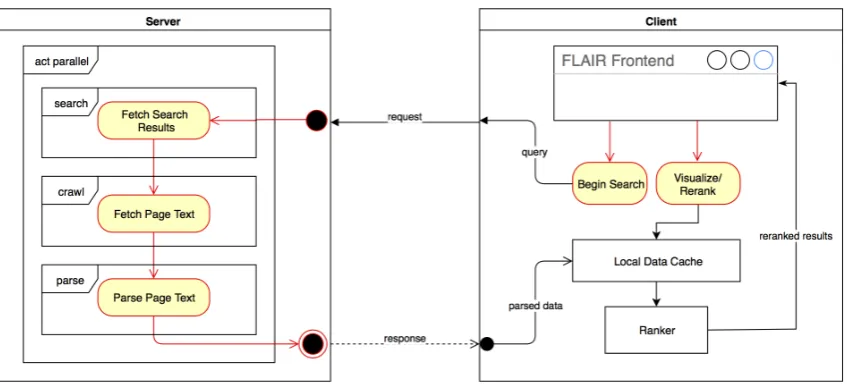
The FLAIR pipeline can be broadly reduced to four primary operations – Web Search, Text Crawling, Parsing and Ranking. As demonstrated by the diagram in Figure 1, the first three opera-tions are delegated to the server as they require the most resources. Ranking, however, is performed locally on the client endpoint to reduce latency.
Web Crawling
We chose to use Microsoft Bing2 as our primary
search engine given its readily available Java bind-ings. By default, the top 20 results are fetched for any given search query. A basic filter is applied to exclude web documents with low text content. The search is conducted repeatedly until the result-ing list of documents contains at least 20 items.
1The online tool is accessible at:http://purl.org/ icall/flair
2http://bing.com
Figure 1: FLAIR architecture.
Text Extraction
The Text Extractor makes use of the Boilerpipe library3 extracting plain text with the help of its
DefaultExtractor. The choice is motivated by the high performance of the library as compared to other text extraction techniques (Kohlsch¨utter et al., 2010).
Parsing
Text parsing is facilitated by the Stanford CoreNLP library4 (Manning et al., 2014), which
was chosen for its robust, performant and open-source implementation. Our initial prototype used the standard PCFG parser for constituent parsing, but its cubic time complexity was a significant is-sue when parsing texts with long sentences. We therefore switched to a shift-reduce implementa-tion5 that scales linearly with sentence and parse
length. While it resulted in a higher memory over-head due to its large language models, it allowed us to substantially improve the performance of our code.
Ranking
The final stage of the pipeline involves ranking the results according to a number of grammati-cal constructions and syntactic properties. Each parameter can be assigned a specific weight that then affects its ranking relative to the other pa-rameters. The parsed data is cached locally on
3https://code.google.com/p/boilerpipe/ 4http://nlp.stanford.edu/software/ corenlp.shtml
5http://nlp.stanford.edu/software/ srparser.shtml
the client side for each session. This allows us to perform the ranking calculations on the local computer, thereby avoid a server request-response roundtrip for each re-ranking operation.
We chose the classical IR algorithm BM25 (Robertson and Walker, 1994) as the basis for our ranking model. It helps to avoid the dominance of one single grammatical construction over the others and is independent of the normalization unit as it uses a ratio of the document length to the average document length in the collection. The final score of each document determines its place in the ranking and is calculated as:
G(q, d) =Pt∈q∩d (k+1)×tft,d
tft,d+k×(1−b+b×avdl|d| )×log
N+1 dft
where q is a FLAIR query containing one or more linguistic forms, tis a linguistic form,dis a document, tft,d is the number of occurrences of t in d, |d| is document length, avdl is the average document length in the collection, dft is the number of documents containing t, and k is a free parameter set to 1.7. The free parameterb
specifies the importance of the document length. The functionality of the tool allows the user to adjust the importance of the document length with a slider that assigns a value from 0 to 1 to the parameterb.
2.1 Technical Implementation
uses WebSocket (Fette and Melnikov, 2011) and Ajax (Garrett and others, 2005) technologies for full-duplex, responsive communication. All server operations are performed in parallel, and each op-eration is divided into subtasks that are executed asynchronously. Operations initiated by the client are dispatched as asynchronous messages to the server. The client then waits for a response from the latter, which are relayed as rudimentary push messages encoded in JSON.6By using
WebSock-ets to implement the server endpoint, we were able to reduce most of the overhead associated with HTTP responses.
The sequence of operations performed within theclientboundary is described as follows:
1. Send search query to server and initiate web search
2. Wait for completion signal from server
3. Initiate text parsing
4. Wait for completion signal from server
5. Request parsed data from server
6. Cache parsed data
7. Re-rank results according to parameters
The sequence of operations performed within the
serverboundary is described as follows:
1. Receive search query from client
2. Begin web search operation:
(a) Fetch top N valid search results (b) For each search result, fetch page text (c) Signal completion
3. Wait for request from client
4. Begin text parsing operation:
(a) For each valid search result, parse text and collate data
(b) Signal completion
5. Wait for request from client
6. Send parsed data to client
6http://json.org
3 FLAIR Interface
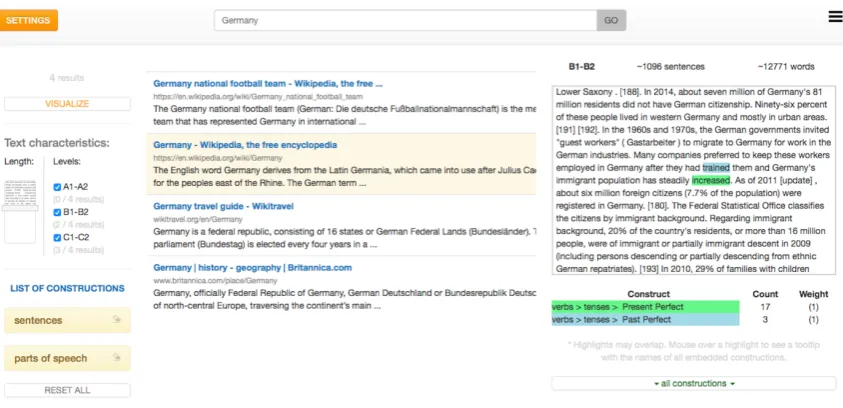
The main layout consists of four elements – a set-tings panel, a search field, a list of results, and a reading interface, where the identified target con-structions are highlighted. The interactive visual-ization incorporates the technique of parallel coor-dinates used for visualizing multivariate data (In-selberg and Dimsdale, 1991).
The visualization provides an overview of the distribution of the selected linguistic characteris-tics in the set of retrieved documents. Vertical axes represent parameters – linguistic forms, num-ber of sentences, numnum-ber of words and the read-ability score, and each polyline stands for a doc-ument having certain linguistic characteristics and thus, going through different points on the param-eter axes. The interactive design allows for more control over a user-selected set of linguistic char-acteristics. Users can select a range of values for one or more constructions to precisely identify and retrieve documents.
Figures 2 and 3 demonstrateFLAIRin use: The user has entered the queryGermanyand selected
Past Perfect and Present Perfect as target con-structions. After reranking the 20 retrieved docu-ments, the interactive visualization was used to se-lect only the documents with a non-zero frequency of both constructions.
4 Detection of Linguistic Forms
We based our choice of the 87 linguistic forms on the official school curriculum for English in the state of Baden-W¨urttemberg, Germany.7 As most
of the linguistic structures listed there do not have a one-to-one mapping to the standard output of NLP tools, we used a rule-based approach to ap-proximate them.
For closed word classes, string matching (e.g.,
articles) or look-up lists (e.g,prepositions) can be used to differentiate between their forms. How-ever, detection of some grammatical constructions and syntactic structures requires a deeper syntactic analysis. Identification of the degrees of compar-ison of long adjectives requires keeping track of two consequent tokens and their POS tags, as is the case with the constructionused tothat cannot be simply matched (cf. the passive”It is used to build rockets”). More challenging structures, such
7The curricula for grades 2, 4, 6, 8, 10 are accessible on
Figure 2:FLAIRinterface: the settings panel, the list of results and the reading interface.
Figure 3: The visualization component ofFLAIR. Vertical axes correspond to text characteristics and the lines going through the axes represent documents.
asrealandunreal conditionalsand different gram-maticaltenses, are identified by means of complex patterns and additional constraints. For a more elaborate discussion of the detection of linguistic forms, the pilot evaluation and the use cases, see Chinkina and Meurers (2016).
5 Performance Evaluation
Parallelization of the tool allowed us to reduce the overall processing time by at least a factor of 25 (e.g., 35 seconds compared to 15 minutes for top 20 results). However, due to the highly parallel nature of the system, its performance is largely dependent on the hardware on which it is deployed. Amongst the different operations per-formed by the pipeline, web crawling and text an-notation prove to be the most time-consuming and resource-intensive tasks. Web crawling is an I/O
task that is contingent on external factors such as remote network resources and bandwidth, thereby making it a potential bottleneck and also an unre-liable target for profiling. We conducted several searches and calculated the relative time each op-eration took. It took around 50-65% of the total time (from entering the query till displaying a list of results) to fetch the results and extract the docu-ments and around 20-30% of the total time to parse them.
The Stanford parser is responsible for text anno-tation operations, and its shift-reduce constituent parser offers best-in-class performance and accu-racy.8 We analyzed the performance of the parser
on the constructions that our tool depends on for the detection of linguistic patterns. Among the
[image:4.595.95.511.301.458.2]biggest challenges were gerunds that got anno-tated as either nouns (NN) or gerunds/present par-ticiples (VBG). Phrasal verbs, such as settle in, also appeared to be problematic for the parser and were sometimes not presented as a single entity in the list of dependencies.
TheFLAIRlight-weight algorithm for detecting linguistic forms builds upon the results of the Stan-ford parser while adding negligible overhead. To evaluate it, we collected nine news articles with the average length of 39 sentences by submitting three search queries and saving the top three re-sults for each of them. We then annotated all sen-tences for the 87 grammatical constructions and compared the results to the system output. Table 1 provides the precision, recall, and F-measure for selected linguistic forms identified byFLAIR9.
Linguistic target Prec. Rec. F1
Yes/no questions 1.00 1.00 1.00 Irregular verbs 1.00 0.96 0.98 used to 0.83 1.00 0.91 Phrasal verbs 1.00 0.61 0.76 Tenses (Present Simple, ...) 0.95 0.84 0.88 Conditionals (real, unreal) 0.65 0.83 0.73
Mean(81 targets) 0.94 0.90 0.91
Median(81 targets) 1.00 0.97 0.95
Table 1: Evaluating the FLAIR algorithm
As the numbers show, some constructions are eas-ily detectable (plural irregular noun forms, e.g.,
children) while others cannot be reliably identi-fied by the parser (conditionals). The reasons for a low performance are many-fold: the ambiguity of a construction (real conditionals), the unreliable output of the text extractor module (simple sen-tences) or the Stanford Parser (-ing verb forms), and the FLAIR parser module itself (unreal con-ditionals). Given the decent F-scores and our goal of covering the whole curriculum, we include all constructions into the final system – indepen-dent of their F-score. As for the effectiveness of the tool ina real-life setting, full user studies with language teachers and learners are necessary for a proper evaluation of distinctive components of
FLAIR(see Section 7).
9The mean and the median are given for 81 targets
be-cause six grammatical constructions did not occur in the test set.
6 Related Work
While most of the state-of-the-art IR systems de-signed for language teachers and learners imple-ment a text complexity module, they differ in how they treat vocabulary and grammar. Vocabulary models are built using either word lists (LAWSE
by Ott and Meurers, 2011) or the data from learner models (REAP by Brown and Eskenazi, 2004). Grammar is given little to no attention: Benn¨ohr (2005) takes into account the complexity of differ-ent conjunctions in herTextFinderalgorithm.
Distinguishing features ofFLAIRaimed at mak-ing it usable in a real-life settmak-ing are that (i) it cov-ers the full range of grammatical forms and cate-gories specified in the official English curriculum for German schools, and (ii) its parallel processing model allows to efficiently retrieve, annotate and rerank 20 web documents in a matter of seconds. 7 Conclusion and Outlook
The paper presentedFLAIR– an Information Re-trieval system that uses state-of-the-art NLP tools and algorithms to maximize the number of spe-cific linguistic forms in the top retrieved texts. It supports language teachers in their search for ap-propriate reading material in the following way:
• A parsing algorithm detects the 87 linguistic constructions spelled out in the official cur-riculum for the English language.
• Parallel processing allows to fetch and parse several documents at the same time, making the system efficient for real-life use.
• The responsive design of FLAIR ensures a seamless interaction with the system.
The tool offers input enrichment of online materi-als. In a broader context of computer-assisted lan-guage learning, it can be used to support input en-hancement (e.g.,WERTi by Meurers et al., 2010) and exercise generation (e.g.,Language MuseSM by Burstein et al., 2012).
support for i) search restricted to specific web do-mains and data sets, such as Project Gutenberg10
or news pages, and ii) search through one’s own data set. We also plan to implement and test more sophisticated text readability formulas (Va-jjala and Meurers, 2014) and extend our informa-tion retrieval algorithm. Finally, a pilot online user study targeting language teachers is the first step we are taking to empirically evaluate the efficacy of the tool.
On the technical side, FLAIR was built from the ground up to be easily scalable and extensible. Our implementation taps the parallelizability of text parsing and distributes the task homogenously over any given hardware. WhileFLAIRpresently supports the English language exclusively, its ar-chitecture enables us to add support for more lan-guages and grammatical constructions with a min-imal amount of work.
Acknowledgments
This research was funded by the LEAD Gradu-ate School [GSC1028], a project of the Excellence Initiative of the German federal and state govern-ments. Maria Chinkina is a doctoral student at the LEAD Graduate School.
We would also like to thank the language teach-ers at Fachsprachzentrum T¨ubingen for trying out the tool and providing valuable feedback.
References
Jasmine Benn¨ohr. 2005. A web-based personalised textfinder for language learners. Master’s thesis, University of Edinburgh.
Jonathan Brown and Maxine Eskenazi. 2004. Re-trieval of authentic documents for reader-specific lexical practice. InInSTIL/ICALL Symposium 2004. Maria Chinkina and Detmar Meurers. 2016. Linguistically-aware information retrieval: Provid-ing input enrichment for second language learners. InProceedings of the 11th Workshop on Innovative Use of NLP for Building Educational Applications, San Diego, CA.
Averil Coxhead. 2000. A new academic word list. TESOL quarterly, 34(2):213–238.
Ian Fette and Alexey Melnikov. 2011. The websocket protocol.
Jesse James Garrett et al. 2005. Ajax: A new approach to web applications.
10http://gutenberg.org
Susan M Gass and Evangeline Marlos Varonis. 1994. Input, interaction, and second language production. Studies in second language acquisition, 16(03):283– 302.
Alfred Inselberg and Bernard Dimsdale. 1991. Paral-lel coordinates. InHuman-Machine Interactive Sys-tems, pages 199–233. Springer.
Christian Kohlsch¨utter, Peter Fankhauser, and Wolf-gang Nejdl. 2010. Boilerplate detection using shal-low text features. InProceedings of the third ACM international conference on Web search and data mining, pages 441–450. ACM.
Stephen Krashen. 1977. Some issues relating to the monitor model. On Tesol, 77(144-158).
Christopher D. Manning, Mihai Surdeanu, John Bauer, Jenny Finkel, Steven J. Bethard, and David Mc-Closky. 2014. The Stanford CoreNLP natural lan-guage processing toolkit. In Proceedings of 52nd Annual Meeting of the Association for Computa-tional Linguistics: System Demonstrations, pages 55–60.
Niels Ott and Detmar Meurers. 2011. Information re-trieval for education: Making search engines lan-guage aware. Themes in Science and Technology Education, 3(1-2):pp–9.
Kristen Purcell, Lee Rainie, Alan Heaps, Judy Buchanan, Linda Friedrich, Amanda Jacklin, Clara Chen, and Kathryn Zickuhr. 2012. How teens do research in the digital world. Pew Internet & Amer-ican Life Project.
Stephen E Robertson and Steve Walker. 1994. Some simple effective approximations to the 2-poisson model for probabilistic weighted retrieval. In Pro-ceedings of the 17th annual international ACM SI-GIR conference on Research and development in in-formation retrieval, pages 232–241.
Dan I Slobin. 1985. Crosslinguistic evidence for the language-making capacity. The crosslinguistic study of language acquisition, 2:1157–1256.
Merrill Swain. 1985. Communicative competence: Some roles of comprehensible input and comprehen-sible output in its development. Input in second lan-guage acquisition, 15:165–179.
Martha Trahey and Lydia White. 1993. Positive evidence and preemption in the second language classroom. Studies in second language acquisition, 15(02):181–204.