Content Models for Survey Generation: A Factoid-Based Evaluation
Rahul Jha?,Catherine Finegan-Dollak?,Reed Coke?,Ben King?,Dragomir Radev?†
? Department of EECS, University of Michigan, USA †School of Information, University of Michigan, USA
{rahuljha,cfdollak,reedcoke,benking,radev}@umich.edu
Abstract
We present a new factoid-annotated dataset for evaluating content models for scientific survey article generation containing 3,425 sentences from 7 topics innatural language processing. We also introduce a novel HITS-based content model for automated survey article gen-eration called HITSUM that exploits the
lexical network structure between sen-tences from citing and cited papers. Using the factoid-annotated data, we conduct a pyramid evaluation and compare HITSUM
with two previous state-of-the-art content models: C-Lexrank, a network based con-tent model, and TOPICSUM, a Bayesian
content model. Our experiments show that our new content model captures useful survey-worthy information and outper-forms C-Lexrank by 4% and TOPICSUM
by 7% in pyramid evaluation.
1 Introduction
Survey article generation is the task of automat-ically building informative surveys for scientific topics. Given the rapid growth of publications in scientific fields, the development of such systems is crucial as human-written surveys exist for a lim-ited number of topics and get outdated quickly. In this paper, we investigate content models for extracting survey-worthy information from scien-tific papers. Such models are an essential com-ponent of any system for automatic survey arti-cle generation. Earlier work in the area of survey article generation has investigated content mod-els based on lexical networks (Mohammad et al., 2009; Qazvinian and Radev, 2008). These mod-els take as input citing sentences that describe important papers on the topic and assign them a salience score based on centrality in a lexical net-work formed by the input citing sentences. In this
Factoid Weight
Question Answering
answer extraction 6
question classification 6
definition of question answering 5
TREC QA track 5
information retrieval 5
Dependency Parsing
non-projective dependency structures /
trees 6
projectivity / projective dependency trees 6 deterministic parsing approaches: Nivre’s
algorithm 5
terminology: head - dependent 4 grammar driven approaches for
[image:1.595.310.520.202.372.2]dependency parsing 4
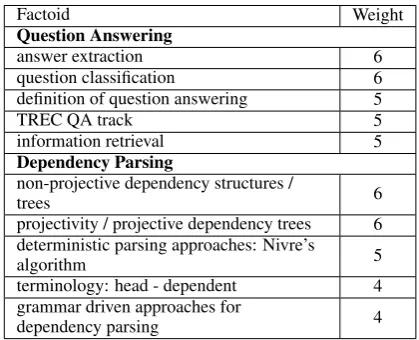
Table 1: Sample factoids from the topics of ques-tion answering and dependency parsing along with their factoid weights.
paper, we propose a new content model based on network structure previously unexplored for this task that exploits the lexical relationship between citing sentences and the sentences from the origi-nal papers that they cite. Our new formulation of the lexical network structure fits nicely with the hubs and authorities model for identifying impor-tant nodes in a network (Kleinberg, 1999), leading to a new content model called HITSUM. In
addi-tion to this new content model, we also describe how Bayesian content models previously explored in the news domain can be adapted for the content modeling task for survey generation.
For the task of evaluating various content mod-els discussed in this paper, we have annotated a total of 3,425 sentences across 7 topics in the field ofnatural language processingwith factoids from each of the topics. The factoids we use were ex-tracted from existing survey articles and tutorials on each topic (Jha et al., 2013), and thus repre-sent information that must be captured by a survey article on the corresponding topic. Each of the fac-toids is assigned a weight based on its frequency in the surveys/tutorials, which allows us to do
Topic # Sentences
dependency parsing 487 named entity recognition 383 question answering 452 semantic role labeling 466 sentiment analysis 613
summarization 507
[image:2.595.82.282.61.175.2]word sense disambiguation 425
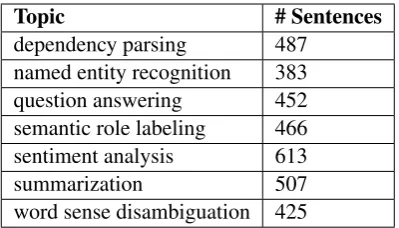
Table 2: List of seven NLP topics used in our ex-periments along with input size.
mid evaluation of our content models. Some sam-ple factoids are shown in Table 1. Evaluation using factoids extracted from existing survey articles can help us understand the limits of automated survey article generation and how well these systems can be expected to perform. For example, if certain kinds of factoids are missing consistently from our input sentences, improvements in content models are unlikely to get us closer to the goal of generat-ing survey articles that match those generated by humans, and effort must be directed to extracting text from other sources that will contain the miss-ing information. On the other hand, if most of the factoids exist in the input sentences but important factoids are not found by the content models, we can think of strategies for improving these models by doing error analysis.
The main contributions of this paper are:
• HITSUM, a new HITS-based content model
for automatic survey generation for scientific topics.
• A new dataset of 3,425 factoid-annotated sentences for scientific articles in 7 topics.
• Experimental results for pyramid evalua-tion comparing three existing content models (Lexrank, C-Lexrank, TOPICSUM) with HIT
-SUM.
The rest of this paper is organized as follows. Section 2 describes the dataset used in our exper-iment and the factoid annotation process. Sec-tion 3 describes each of the content models used in our experiments including HITSUM. Section 4
describes our experiments and Section 5 summa-rizes the results. We summarize the related work in Section 6 and conclude in Section 7.
2 Data
Prior research in automatic survey generation has explored using text from different parts of scien-tific papers. Some of the recent work has treated survey generation as a direct extension of sin-gle paper summarization (Qazvinian and Radev, 2008) and used citing sentences to a set of relevant papers as the input for the summarizer (Moham-mad et al., 2009; Qazvinian et al., 2013). How-ever, in our prior work, we have observed that it’s difficult to generate coherent and readable sum-maries using just citing sentences and have pro-posed the use of sentences from introductory texts of papers that cite a number of important papers on a topic (Jha et al., 2015). The use of full text allows for the use of discourse structure of these documents in framing coherent and readable sur-veys. Since the content models we explore are meant to be part of a larger system that should be able to generate coherent and readable survey ar-ticles, we use the introduction sentences for our experiments as well.
The corpus we used for extracting our experi-mental data was the ACL Anthology Network, a comprehensive bibliographic dataset that contains full text and citations for papers in most of the important venues in natural language processing (Radev et al., 2013). An oracle method is used for selecting the initial set of papers for each topic. For each topic, the bibliographies of at least three human-written surveys were extracted, and any papers that appeared in more than one survey were added to the target document set for the topic.
The text for summarization is extracted from in-troductory sections of papers that cite papers in the target document set. The intuition behind this is that the introductory sections of papers that cite these target document summarize the research in papers from the target document set as well as the relationships between these papers. Thus, these introductions can be thought of as mini-surveys for specific aspects of the topic; combining text from these introductory sections should allow us to generate good comprehensive survey articles for the topic1. For our experiments, we sort the cit-ing papers based on the number of papers they cite
1Other sections of papers might have such information,
Input sentence Factoids According to [1] , the corpus based supervised machine learning methods are
the most successful approaches to WSD where contextual features have been used mainly to distinguish ambiguous words in these methods.
supervised wsd, corpus based wsd
Compared with supervised methods, unsupervised methods do not require tagged corpus, but the precision is usually lower than that of the supervised methods.
supervised wsd, unsupervised wsd
Word sense disambiguation (WSD) has been a hot topic in natural language processing, which is to determine the sense of an ambiguous word in a specific context.
definition of word sense disambiguation
Improvement in the accuracy of identifying the correct word sense will result in
better machine translation systems, information retrieval systems, etc. wsd for machine translation, wsd for in-formation retrieval The SENSEVAL evaluation framework ( Kilgarriff 1998 ) was a DARPA-style
competition designed to bring some conformity to the field of WSD, although it has yet to achieve that aim completely.
[image:3.595.75.526.60.217.2]senseval
Table 3: Sample input sentences from the topic ofword sense disambiguationannotated with factoids.
in the target document set, pick the top 20 papers, and extract sentences from their introductions to form the input text for the summarizer. The seven topics used in our experiments and input size for each topic are shown in Table 2.
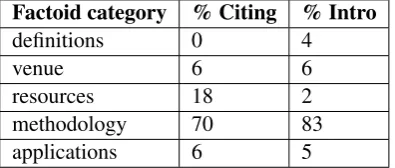
Once the input text for each topic has been ex-tracted, we annotate the sentences in the input text with factoids for that topic. Some annotated sentences in the topic ofword sense disambigua-tion are shown in Table 3. Given this new an-notated data, we can compare how the factoids are distributed across different citing sentences (as annotated by Jha et al. (2013)) and introduction sentences that we have annotated. For this, we divide the factoids into five categories: defini-tions, venue, resources, methodology, and appli-cations. The fractional distribution of factoids in these categories is shown in Table 4. We can see that the distribution of factoids relating to venues, methodology and applications is similar for the two datasets. However, factoids related to defini-tional sentences are almost completely missing in the citing sentences data. This lack of background information in citing sentences is one of the moti-vations for using introduction sentences for survey article generation as opposed to previous work.
The complete set of factoids as well as annotated sentences for all the top-ics is available for download at http: //clair.si.umich.edu/corpora/ Surveyor_CM_Data.tar.gz.
3 Content Models
We now describe each of the content models used in our experiments.
Factoid category % Citing % Intro
definitions 0 4
venue 6 6
resources 18 2
methodology 70 83
applications 6 5
Table 4: Fractional distribution of factoids across various categories in citing sentences vs introduc-tion sentences.
3.1 Lexrank
Lexrank is a network-based content selection al-gorithm that serves as a baseline for our experi-ments. Given an input set of sentences, it first cre-ates a network using these sentences where each node represents a sentence and each edge repre-sents the tf-idf cosine similarity between the sen-tences. Two methods for creating the network are possible. First, we can remove all edges that are lower than a certain threshold of similarity (gener-ally set to 0.1). The Lexrank value for a nodep(u)
in this case is calculated as:
1−d N +d
X
v∈adj[u]
p(v) deg(v)
[image:3.595.319.517.256.340.2]A dictionary such as the LDOCE has broad coverage of word senses, useful for WSD .
This paper describes a program that disambiguates English word senses in unrestricted text using statistical models of the major Roget’s Thesaurus categories.
Our technique offers benefits both for online semantic processing and for the challenging task of mapping word senses across multiple MRDs in creating a merged lexical database.
The words in the sentences may be any of the 28,000 headwords in Longman’s Dictionary of Contemporary English (LDOCE) and are disambiguated relative to the senses given in LDOCE. This paper describes a heuristic approach to automatically identifying which senses of a machine-readable dictionary (MRD) headword are semantically related versus those which correspond to fundamentally different senses of the word.
Figure 1: A sentence fromPciting with a high hub score (bolded) and some of sentences fromPcited
that it links to (italicised). The sentence fromPciting obtain a high hub score by being connected to the
sentences with high authority scores.
1−d N +d
X
v∈adj[u]
cos(u, v) T otalCosvp(v)
Wherecos(u, v)gives the tf-idf cosine similar-ity between sentence u andv andT otalCosv =
P
z∈adj[v]cos(z, v). In our experiments, we
em-ploy this second formulation. The above equation can be solved efficiently using the power method (Newman, 2010) to obtain p(u) for each node, which is then used as the score for ordering the sentences. The final Lexrank values p(u) for a node represent the stationary distribution of the Markov chain represented by the transition matrix. Lexrank has been shown to perform well in sum-marization experiments (Erkan and Radev, 2004).
3.2 C-Lexrank
C-Lexrank is a clustering-based summarization system that was proposed by Qazvinian and Radev (2008) to summarize different perspectives in cit-ing sentences that reference a paper or a topic. To create summaries, C-LexRank constructs a fully connected network in which vertices are sen-tences, and edges are cosine similarities calculated using the tf-idf vectors of citation sentences. It then employs a hierarchical agglomeration clus-tering algorithm proposed by Clauset et al. (2004) to find communities of sentences that discuss the same scientific contributions. Once the graph is clustered and communities are formed, the method extracts sentences from different clusters to build a summary. It iterates through the clusters from largest to smallest, choosing the most salient sen-tence of each cluster, until the summary length limit is reached. The salience of a sentence in its
cluster is defined as its Lexrank value in the lexical network formed by sentences in the cluster.
3.3 HITSUM
The input set of sentences in our data come from introductory sections of papers that cite important papers on a topic. We’ll refer to the set of cit-ing papers that provide the input text for the sum-marizer asPciting and the set of important papers
that represent the research we are trying to sum-marize as Pcited. Both Lexrank and C-Lexrank
work by finding central sentences in a network formed by the input sentences and thus, only use the lexical information present inPciting, while
ig-noring additional lexical information from the pa-pers inPcited. We now present a formulation that
uses the network structure that exists between the sentences in the two sets of papers to incorporate additional lexical information into the summariza-tion system. This system is based on the hubs and authorities or the HITS model (Kleinberg, 1999) and hence is called HITSUM.
HITSUM, in addition to the sentences from the
introductory sections of papers in Pciting, also
uses sentences from the abstracts ofPcited. It starts
by computing the tf-idf cosine similarity between the sentences of each paperpi ∈ Pciting with the
sentences in the abstracts of each paperpj ∈Pcited
that is directly cited bypi. A directed edge is
cre-ated between every sentencesi inpi andsj inpj
ifsim(si, sj) > smin, wheresmin is a similarity
threshold (set to 0.1 for our experiments). Once this process has been completed for all papers in
Pciting, we end up with a bipartite graph between
sentences fromPciting andPcited.
φB φC/QA φD/J07−1005 φC/NER φD/I08−1071
the 0.066 question 0.044 metathesaurus 0.00032 ne 0.028 wikipedia 0.0087 of 0.040 questions 0.038 umls 0.00032 entity 0.022 pages 0.0053 and 0.034 answer 0.028 biomedical 0.00024 named 0.022 million 0.0018 a 0.029 answering 0.022 relevance 0.00024 entities 0.017 extracting 0.0018
in 0.027 qa 0.021 citation 0.00024 ner 0.014 articles 0.0018
[image:5.595.86.514.61.179.2]to 0.027 answers 0.017 wykoff 0.00024 names 0.009 contributors 0.0018 is 0.017 2001 0.016 bringing 0.00016 location 0.008 version 0.0009 for 0.014 system 0.011 appropriately 0.00016 tagging 0.007 dakka 0.0009 that 0.012 trec 0.008 organized 0.00016 recognition 0.007 service 0.0009 we 0.011 factoid 0.008 foundation 0.00016 classes 0.007 academic 0.0009
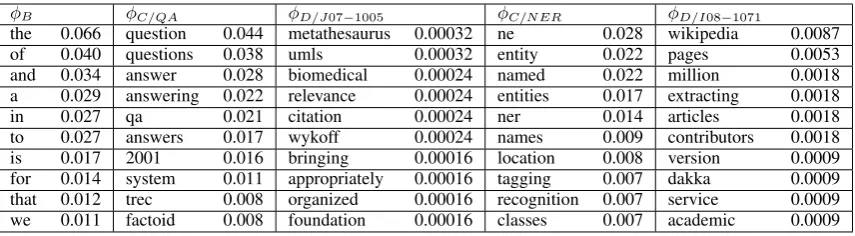
Figure 2: Top words from different word distributions learned by TOPICSUMon our input document set
of 15 topics. φBis the background word distribution that captures stop words. φC/QAandφC/NERare
the word distributions for the topics of question answeringandnamed entity recognition respectively.
φD/J07−1005 is the document-specific word distribution for a single paper in question answering that
focuses on clinical question answering. φD/I08−1071 is the document-specific word distribution for a single paper innamed entity recognitionthat focuses on named entity recognition in Wikipedia articles.
have a lot of incoming edges represent sentences that presented important contributions in the field. Similarly, sentences in Pciting that have a lot of
outgoing edges represent sentences that summa-rize a number of important contributions in the field. This suggests using the HITS algorithm, which, given a network, assigns hubs and author-ities scores to each node in the network in a mu-tually reinforcing way. Thus, nodes with high au-thority scores are those that are pointed to by a number of good hubs, and nodes with high hub scores are those that point to a number of good authorities. This can be formalized with the fol-lowing equation for the hub score of a node:
h(v) = X
u∈successors(v)
a(u)
Where h(v) is the hub score for node v,
successors(v)is the set of all nodes thatvhas an edge to, anda(u)is the authority score for node
u. Similarly, the authority score for each node is computed as:
a(v) = X
u∈predecessors(v)
h(u)
Wherepredecessors(v) is the set of all nodes that have an edge tov. The hub and authority score for each node can be computed using the power method that starts with an initial value and itera-tively updates the scores for each node based on the above equations until the hub and authority scores for each node converge to within a toler-ance value (set to 1E-08 for our experiments).
In our bipartite lexical network, we expect sen-tences inPcitedreceiving high authority scores to
be the ones reporting important contributions and sentences in Pciting that receive high hub scores
to be sentences summarizing important contribu-tions. Figure 1 shows an example of a sentence with a high hub score from the topic ofword sense disambiguation, along with some of the sentences that it points to. HITSUMcomputes the hub and
authority score for each sentence in the lexical net-work and then uses the hub scores for sentences in
Pciting as their relevance score. Sentences from
Pcited are part of the lexical network, but are not
used in the output summary.
3.4 TOPICSUM
TOPICSUM is a probabilistic content model
pre-sented in Haghighi and Vanderwende (2009) and is very similar to an earlier model called BayesSum proposed by Daum´e and Marcu (2006). It is a hierarchical, LDA (Latent Dirichlet Alloca-tion) style model that is based on the following generative story:2 words in any sentence in the corpus can come from one of three word distri-butions: a background word distributionφB that
flexibly models stop words, a content word dis-tribution φC for each document set that models
content relevant to the entire document set, and a document-specific word distribution φD. The
word distributions are learned using Gibbs sam-pling. Given n document sets each with k
doc-2To avoid confusion in use of the term “topic,” in this
Topic Lexrank C-Lexrank TOPICSUM HITSUM
dependency parsing 0.47 0.76 0.62 1.00∗
named entity recognition 0.80 0.89 0.90∗ 0.80
question answering 0.65 0.67 0.65 0.76∗
sentiment analysis 0.64 0.62 0.75∗ 0.63
semantic role labeling 0.75∗ 0.67 0.65 0.69
summarization 0.52 0.75∗ 0.57 0.68
word sense disambiguation 0.78 0.66 0.67 0.79∗
[image:6.595.115.486.61.190.2]Average 0.66 0.72 0.69 0.76∗
Table 5: Pyramid scores obtained by different content models for each topic along with average scores for each model across all topics. For each topic as well as the average, the best performing method has been highlighted with a∗.
uments, we get n content word distributions and
n∗kdocument-specific distributions leading to a total of1 +n+n∗kword distributions.
To illustrate the kind of distributions TOPIC
-SUM learns in our dataset, Figure 2 shows the
top words along with their probabilities from the background word distribution, two content distri-butions and two document-specific word distribu-tions. We see that the model effectively captures general content words for each topic.φC/QAis the word distribution for the topic ofquestion answer-ing, while φD/J07−1005 is the document-specific
word distribution for a specific paper in the docu-ment set forquestion answering3 that focuses on clinical question answering. The word distribu-tionφD/J07−1005contains words that are relevant to the specific subtopic in the paper, whileφC/QA
contains content words relevant to the general topic of question answering. Similar results can be seen in the word distributions fornamed entity recognition φC/NER and the document-specific
word distribution for a specific paper in the topic
φD/I08−10714 that focuses on comparable entity mining.
These topics, learned using Gibbs sampling, can be used to select sentences for a summary in the following way. To summarize a document set, we greedily select sentences that minimize the KL-divergence of our summary to the document-set-specific topic. Thus, the score for each sentences
isKL(φC||Ps)wherePsis the sentence word
dis-tribution with add-one smoothing applied to both distributions. Using this objective, sentences that
3Dina Demner-Fushman and Jimmy Lin. 2007.
Answer-ing Clinical Questions with Knowledge-Based and Statistical Techniques.Computational Linguistics.
4Wisam Dakka and Silviu Cucerzan. 2008. Augmenting
wikipedia with named entity tags.In Proceedings of IJCNLP.
contain words from the content word distribution with high probability are more likely to be selected in the generated summary.
We implemented TOPICSUM in Python
using Numpy and then optimized it using Scipy Weave. This code is available for use at https://github.com/rahuljha/ content-models. The repository also contains Python code for HITSUM.
4 Experiments
For evaluating our content models, we gener-ated 2,000-character-long summaries using each of the systems (Lexrank, C-Lexrank, HITSUM,
and TOPICSUM) for each of the topics. The
sum-maries are generated by ranking the input sen-tences using each content model and picking the top sentences till the budget of 2,000 characters is reached. Each of these summaries is then given a pyramid score (Nenkova and Passonneau, 2004) computed using the factoids assigned to each sen-tence.
Question classification is a crucial component of modern question answering system.
A what-type question is defined as the one whose question word is ‘what’, ‘which’, ‘name’ or ‘list’. This metaclassifier beats all published numbers on standard question classification benchmarks [4.4].
Due to its challenge, this paper focuses on what-type question classification. In this paper, we focus on fine-category classification.
The promise of a machine learning approach is that the QA system builder can now focus on de-signing features and providing labeled data, rather than coding and maintaining complex heuristic rule bases.
Figure 3: Part of the summary generated by HITSUMfor the topic ofquestion answering.
each content model.
5 Results and Discussion
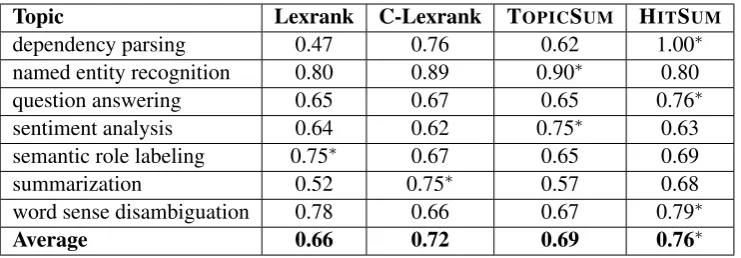
The results of pyramid evaluation are summarized in Table 5. It shows the pyramid score obtained by each system on each of the topics as well as the erage score. The highest performing system on av-erage is HITSUMwith an average performance of
76%. HITSUMdoes especially well for the topics
of dependency parsing, question answering, and word sense disambiguation. The second best per-forming system is C-Lexrank, which is not sur-prising because it was developed specifically for the task of scientific paper summarization. How-ever, HITSUMoutperforms C-Lexrank on several
topics and by 4% on average.
Figure 3 shows part of the summary generated by HITSUM for the topic of question answering.
The summary contains mostly informative sen-tences about different aspects of question answer-ing. One obvious drawback of this summary is that it’s not very coherent and readable. How-ever, previous work has shown how network based content models can be combined with discourse models to generate informative yet readable sum-maries (Jha et al., 2015). We looked at some of the network statistics of the lexical networks used by HITSUM. One of the things we noticed is that the
lexical networks for topics where HITSUM
per-forms well seem to have higher degree assorta-tivity compared to the topics for which it doesn’t perform well. High degree assortativity in lexical networks means sentences with high degree tend to be linked to other sentences with high degree. This suggests that HITS performs well for topics where a set of important factoids are mentioned in many citing and source sentences. A larger evalua-tion dataset is needed for a more thorough analysis of how the network properties of these lexical
net-works correlate with the performance of various content models.
TOPICSUM does well on the topics of named entity recognitionandsentiment analysis, but does not do well on average. This can be attributed to the fact that it was developed as a content model for the domain of news summarization and does not translate well to our domain. All systems out-perform Lexrank, which achieves the lowest aver-age score. This result is also intuitive, because ev-ery other system in our evaluation uses additional information not used by Lexrank: C-Lexrank ex-ploits the community structure in the input set of sentences, HITSUM exploits the lexical
informa-tion from cited sentences, and TOPICSUMexploits
information about global word distribution across all topics.
The different systems we tried in our evaluation depend on using different lexical information and seem to perform well for different topics. This suggests that further gains can be made by com-bining these systems. For example, C-Lexrank and HITSUM can be combined by utilizing both
the network formed by citing sentences and the network between the citing sentences and the cited sentences into a larger lexical network. TOPIC
-SUMscores can be combined with these
network-based system by using the TOPICSUMscores as a
prior for each node, and then running either Pager-ank or HITS on top of it. We leave exploration of such hybrid systems to future work.
6 Related Work
probabilis-tic methods. We summarize related work for each of these classes of content models, followed by a short summary of the related work in the domain of scientific summarization.
Network-based content models: Network-based content models (Erkan and Radev, 2004; Mihalcea and Tarau, 2004) work by converting the input sentences into a network. Each sentence is represented by a node in the network, and the edges between sentences are given weight based on the similarities of sentences. They then run Pagerank on this network, and sentences are selected based on their Pagerank score in the network. For computing Pagerank, the network can either be pruned by removing edges that have weights less than a certain threshold, or a weighted version of Pagerank can be run on the network. The method can also be modified for query-focused summarization (Otterbacher et al., 2009). C-Lexrank (Qazvinian and Radev, 2008) modifies Lexrank by first running a clus-tering algorithm on the network to partition the network into different communities and then selecting sentences from each community by running Lexrank on the sub-network within each community. C-Lexrank was also used in the task of automated survey generation with encouraging results (Mohammad et al., 2009).
Probabilistic content models: One of the first probabilistic content models seems to be BAYESSUM(Daum´e and Marcu, 2006), designed
for query-focused summarization. BAYESSUM
models a set of document collections using a hi-erarchical LDA style model. Each word in a sen-tence can be generated using one of three language models: 1) a general English language model that captures English filler or background knowledge, 2) a document-specific language model, and 3) a query language model. These language models are inferred using expectation propagation, and then sentences are ranked based on their likelihood of being generated from the query language model. A similar model for general multidocument sum-marization called TOPICSUM was proposed by
Haghighi and Vanderwende (2009), where the query language model is replaced by a document-collection-specific language model; thus sentences are selected based on how likely they are to con-tain information that summarizes the entire doc-ument collection instead of information
pertain-ing to individual documents or background knowl-edge.
Barzilay and Lee (2004) present a Hidden Markov Model (HMM) based content model where the hidden states of the HMM represent the topics in the text. The transition probabili-ties are learned through Viterbi decoding. They show that the HMM model can be used for both re-ordering of sentences for coherence and discrimi-native scoring of sentences for extractive summa-rization. Fung and Ngai (2006) present a simi-lar HMM-based model for multi-document sum-marization. Jiang and Zhai (2005) proposed an HMM-based model for the problem of extract-ing coherent passages relevant to a query from a relevant document. They learn an HMM with two background states (B1 andB2) and a
query-relevant state (R), each associated with a language model. The HMM starts in background stateB1,
switches to relevant stateR and then switches to the next background stateB2. The sentences that
the HMM emits while inR constitute the query-relevant passage from the document.
Scientific summarization: Early work in scien-tific summarization used abstracts of scienscien-tific ar-ticles to produce summaries of specific scientific papers (Kupiec et al., 1995). However, later work (Elkiss et al., 2008) showed that citation sentences are as important in understanding the main contri-butions of a paper.
Nanba and Okumura (1999) explored using ref-erence information to build a system for support-ing writsupport-ing survey articles. Their system extracts citing sentences that describe a referred paper and identify the type of reference relationships. The type of references can be one of the three: 1) type B that base on other researcher’s theory, 2) type C that compare with related works, or 3) type O representing relationships other than B or C. They posit that type C sentences are the most important for survey generation and can help show the simi-larities and differences among cited papers.
basis (agreement with or continuation of other work), and other (neutral description of other’s work). They describe classifiers for tagging the rhetorical status of sentences automatically and present a method for using this to assign relevance score to sentences.
In other work, Kan et al. (2002) use a corpus of 2000 annotated bibliographies for scientific papers as a first step towards a supervised summariza-tion system. They found that summaries in their corpus were mostly single-document abstractive summaries that were both indicative and informa-tive and were organized around a “theme,” making them ideal for query-based summarization. Mei and Zhai (2008) presented an impact-based sum-marization method for single-paper summariza-tion that assigns relevance scores to sentences in a paper based on their similarity to the set of cit-ing sentences that reference the paper.
More recently, Hoang and Kan (2010) present a method for automated related work generation. Their system takes as input a set of keywords ar-ranged in a hierarchical fashion that describes a target paper’s topic. They hypothesize that sen-tences in a related work provide either background information or specific contributions. They use two different models to extract these two kinds of sentences using the input tree and combines them to create the final output summary. Zhang et al. (2013) explore methods for biomedical sum-marization by identifying cliques in a network of semantic predications extracted from citations. These cliques are then clustered and labeled to identify different points of view represented in the summary.
7 Conclusion and Future Work
We have presented a new factoid-annotated dataset for evaluating content models for scientific survey article generation by annotating sentences from seven topics innatural language processing. We also introduce a new HITS-based content model called HITSUM for survey article generation that
exploits the lexical information from cited papers along with citing papers to rank input sentences for survey-worthiness. We conduct pyramid evaluation using our factoid dataset to compare HITSUM with existing network-based methods
(Lexrank, C-Lexrank) as well as methods based on Bayesian content modeling (TOPICSUM). On
average, HITSUM outperforms C-Lexrank by 4%
and TOPICSUM by 7%. Since the different
con-tent models use different kinds of lexical informa-tion, further gains might be obtained by combining some of these models into a joint model. We plan to explore this in future work.
References
Regina Barzilay and Lillian Lee. 2004. Catching the drift: Probabilistic content models, with applications to generation and summarization. In Daniel Marcu Susan Dumais and Salim Roukos, editors, HLT-NAACL 2004: Main Proceedings, pages 113–120, Boston, Massachusetts, USA, May 2 - May 7. Asso-ciation for Computational Linguistics.
Aaron Clauset, Mark E. J. Newman, and Cristopher Moore. 2004. Finding community structure in very large networks.Phys. Rev. E, 70(6):066111, Dec. Hal Daum´e, III and Daniel Marcu. 2006. Bayesian
query-focused summarization. In Proceedings of the 21st International Conference on Computational Linguistics and the 44th Annual Meeting of the As-sociation for Computational Linguistics, ACL-44, pages 305–312, Stroudsburg, PA, USA. Association for Computational Linguistics.
Aaron Elkiss, Siwei Shen, Anthony Fader, G¨unes¸ Erkan, David States, and Dragomir R. Radev. 2008. Blind men and elephants: What do citation sum-maries tell us about a research article? Journal of the American Society for Information Science and Technology, 59(1):51–62.
G¨unes¸ Erkan and Dragomir R. Radev. 2004. Lexrank: Graph-based centrality as salience in text summa-rization. Journal of Artificial Intelligence Research (JAIR).
Pascale Fung and Grace Ngai. 2006. One story, one flow: Hidden markov story models for multilingual multidocument summarization. ACM Trans. Speech Lang. Process., 3(2):1–16, July.
Aria Haghighi and Lucy Vanderwende. 2009. Ex-ploring content models for multi-document summa-rization. InProceedings of Human Language Tech-nologies: The 2009 Annual Conference of the North American Chapter of the Association for Compu-tational Linguistics, NAACL ’09, pages 362–370, Stroudsburg, PA, USA. Association for Computa-tional Linguistics.
Cong Duy Vu Hoang and Min-Yen Kan. 2010. To-wards automated related work summarization. In
Proceedings of the 23rd International Conference on Computational Linguistics: Posters, COLING ’10, pages 427–435, Stroudsburg, PA, USA. Association for Computational Linguistics.
starting from keywords. InProceedings of The As-sociation for Computational Linguistics (short pa-per).
Rahul Jha, Reed Coke, and Dragomir R. Radev. 2015. Surveyor: A system for generating coherent survey articles for scientific topics. InProceedings of the Twenty-Ninth AAAI Conference.
Jing Jiang and ChengXiang Zhai. 2005. Accurately extracting coherent relevant passages using hidden Markov models. pages 289–290.
Min-Yen Kan, Judith L. Klavans, and Kathleen R. McKeown. 2002. Using the Annotated Bibliog-raphy as a Resource for Indicative Summarization. In The International Conference on Language Re-sources and Evaluation (LREC), Las Palmas, Spain. Jon M. Kleinberg. 1999. Authoritative sources in a hyperlinked environment. J. ACM, 46:604–632, September.
Julian Kupiec, Jan Pedersen, and Francine Chen. 1995. A trainable document summarizer. InProceedings of the 18th Annual International ACM SIGIR Con-ference on Research and Development in Informa-tion Retrieval (SIGIR-95), pages 68–73.
Qiaozhu Mei and ChengXiang Zhai. 2008. Gener-ating impact-based summaries for scientific litera-ture. In Proceedings of the 46th Annual Confer-ence of the Association for Computational Linguis-tics (ACL-08), pages 816–824.
Rada Mihalcea and Paul Tarau. 2004. TextRank: Bringing order into texts. In Proceedings of the Conference on Empirical Methods in Natural Lan-guage Processing (EMNLP-04), July.
Saif Mohammad, Bonnie Dorr, Melissa Egan, Ahmed Hassan, Pradeep Muthukrishan, Vahed Qazvinian, Dragomir Radev, and David Zajic. 2009. Using ci-tations to generate surveys of scientific paradigms. In Proceedings of Human Language Technologies: The 2009 Annual Conference of the North American Chapter of the Association for Computational Lin-guistics, NAACL ’09, pages 584–592, Stroudsburg, PA, USA. Association for Computational Linguis-tics.
Hidetsugu Nanba and Manabu Okumura. 1999. To-wards multi-paper summarization using reference information. In Proceedings of the 16th Interna-tional Joint Conference on Artificial Intelligence (IJCAI-99), pages 926–931.
Ani Nenkova and Rebecca Passonneau. 2004. Evalu-ating content selection in summarization: The pyra-mid method. In Proceedings of the North Ameri-can Chapter of the Association for Computational Linguistics - Human Language Technologies (HLT-NAACL ’04).
Mark E. J. Newman. 2010. Networks: An Introduc-tion. Oxford University Press.
Jahna Otterbacher, Gunes Erkan, and Dragomir R. Radev. 2009. Biased lexrank: Passage retrieval us-ing random walks with question-based priors. Inf. Process. Manage., 45(1):42–54, January.
Vahed Qazvinian and Dragomir R. Radev. 2008. Scientific paper summarization using citation sum-mary networks. In Proceedings of the 22nd Inter-national Conference on Computational Linguistics (COLING-08), Manchester, UK.
Vahed Qazvinian, Dragomir R. Radev, Saif M. Mo-hammad, Bonnie Dorr, David Zajic, Michael Whidby, and Taesun Moon. 2013. Generating ex-tractive summaries of scientific paradigms. J. Artif. Int. Res., 46(1):165–201, January.
Dragomir R. Radev, Pradeep Muthukrishnan, Vahed Qazvinian, and Amjad Abu-Jbara. 2013. The acl anthology network corpus. Language Resources and Evaluation, pages 1–26.
Simone Teufel and Marc Moens. 2002. Summariz-ing scientific articles: experiments with relevance and rhetorical status. Computational Linguistics, 28(4):409–445.