Munich Personal RePEc Archive
Fast Security Constraint Unit
Commitment by Utilizing Chaotic Crow
Search Algorithm
Patel, Abhishek and Anand, Rajesh
Bhagwant University
1 May 2019
Online at
https://mpra.ub.uni-muenchen.de/93971/
Fast Security Constraint Unit Commitment by
Utilizing Chaotic Crow Search Algorithm
Abhishek Patel, Rajesh Anand
Bhagwant University, Faculty of Engineering & Technology
Abstract— This paper investigates the optimal operation of security constraint unit commitment (SCUC) as one of the most important concern in power system operation. SCUC is a mixed integer nonlinear problem (MINLP) which is hard to solve and also the optimal solution is not guarantee. To overcome this drawback, a new evolutionary method known as the chaotic crow search algorithm is developed. The proposed problem includes some significant constraints such as spinning reserve, generators ramp rate, load balance, and power limits. Finally, the proposed method is examined on a 10-unit distribution network. The results show the effectiveness and merit of the proposed technique.
Index Terms— Control and Optimization, Evolutionary Algorithm, Power systems, Reliability, Unit Commitment
I.INTRODUCTION
Unit commit is an optimization problem which tries to find a solution to determine which units should be working or shut down during the operation time. Based on the assumptions, three types of problems will be defining: 1) Security Constrained Unit Commitment (SCUC) 2) Profit Based Unit Commitment (PBUC) 3) Cost Based Unit Commitment (CBUC).
In this research studies, cost based unit commitment is analyzed and tries to minimize the cost function. As a result, solving this problem required to consider two sub problems at the same time: a) the economic dispatch b) determine the on and off status of every unit at every horizon intervals time. In the recent years, many papers have been released to satisfy the first and second points [1] such as dynamic programming (DP) [2], [3], particle swarm optimization (PSO) [4-5-6-7], genetic algorithm (GA) [8-9-10], etc. These papers tried to minimize the cost function or maximized the profit of the unit commitment [11-21]. On the other hand, the availability of the electricity is the main goal of the unit commitment. It should be mention that; the availability should be equal to the demand because there is no way to storage the electricity [22-29]. Therefore, the unit commitment should be design so that the generating units provide enough electricity for every interval schedule time with a minimum cost [30-37].
In this research study, minimizing the cost function of the unit commitment with high preference is improved by Teaching Learning Based Optimization (TLBO) method as a new evolutionary algorithm. All of the constraints problems associated with unit commitment is considered for this research study. Moreover, the generating cost of the unit commitment by TLBO has been compared with other methods
in the same conditions. The results proved the better performance of the TLBO.
II.CONSTRAINTS OF UNIT COMMITMENT
A.Objective Function
The total cost function of the unit commitment is the total summation of fuel cost and start-up cost which is defined as following:
1 1
M N
t t
i i
t i
min TC FC SDU
(1)Where,
TC
is the total cost,N
represents the unit number,FC
is the fuel cost of theith
unit at timet
andSU
is the start-up cost of theith
unit at timet
. This total cost can be effected by some constraints in unit commitment problem. The constraints are explained by the next sub sections [38-40].Table 1: Prediction of load demand for 24 hours
Hour[h] 1 2 3 4 5 6 7 8
Demand [MW]
700 750 850 950 1000 1100 1150 1200
Hour[h] 9 10 11 12 13 14 15 16
Demand [MW]
1300 1400 1450 1500 1400 1300 1200 1050
Hour[h] 17 18 19 20 21 22 23 24
Demand [MW]
1000 1100 1200 1400 1300 1100 900 800
B.Constraints
Load Demand
There is no way to storage the electrical energy. As a result, the generation’s power should be equal to the load demand [42-45]:
t t i N
i t
i
U
H
P
.
1
(2)
its related power at time
t
. Therefore, the summation of all the power generations should be equal toH
t.It should be noted that the number of units in this case of study are 10 units and the load prediction is defined for 24 hours (or a day) schedule time. Table 1 shows the Prediction of load demand for 24 hours [46-47].
Power Bounded
Every unit has a limitation in power generation based on its design. Indeed, every unit has a maximum and minimum potential for power generation and it is impossible to generate the power more than its capability. On the other hand, it is not affordable to generate the power less than its minimum power. This limitation can be taken into account by equation (3): max , min , i t i
i
P
P
P
(3)Where
P
i,minrepresents the minimum power ofith
unit andP
i,maxrepresents the maximum power ofith
unit.2.1 Increase and decrease the power
Every unit has a limitation in increasing or decreasing its power rapidly. In fact, every unit can change its power according to a specific rate which is defined based on its design. This limitation can be taken into account by equation (4):
2.2 Start-up Constrains
According to the equation (1), start-up cost has a significant influence in the total cost. In the unit commitment two types of start-up cost is defined: 1) Hot Start-up: when the unit is not cool down completely and needs to start-up again. 2) Cold Start-up: when the unit is cool down completely.
This limitation can be taken into account by equation:
1.
t T T t k t i k i i cold i off i
SU
U
St
(5)Where,
SU U U ifSt o
o St if U SU t i t i t i t i hot i t i t i hot i
SU
. .(1 ) .
1
(6)2.3 Spinning Reservation
Sometimes load demand for the electricity increase rapidly because of some reasons (for example it is a game and many people want to turn on their TV at the same time or any problem in a unit or units) which is not predicted. In this situation, the unit commitment should be able to responsible for more load demand by a reservation. On the other hand, some times the generation load is higher than the prediction. In this situation, unit commitment should be able to decrease its power generation rapidly to minimize
)
(
)
(
1 1i t i t i i t
i
RD
P
P
RU
P
(4) WhereRD
iandRU
i are hourly rate reduction and increase forith
unit respectively.The most important part in the ensure voltage availability analysis of the unit commitment is spinning reservation. In many cases this constraint is not consider to solve the unit commitment easily. Although, this constrain plays a very significant role in the reliability of the system. In this research study, spinning reservation is applied in order to increase the reliability of the system and also warrantee the availability of the voltage with a very high probability. This constraint is given in equation (7) and (8):
N i t i i t i i tup
P
P
M
r
U
SR
1
max
,
,
).
min(
(7)
N i t i i i t i tdn
P
P
M
r
U
SR
1
min
,
,
).
min(
(8)Where
SR
uprepresents spinning reservation when the load demand increase andSR
dn represents spinning reservation [image:3.595.308.554.406.546.2]when the load demand is decrease. Moreover,
r
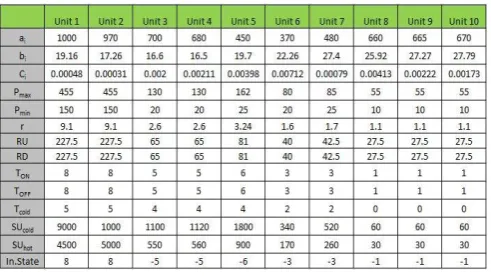
is the coefficient of the ramp rate which is considered equal to 10 in this study. It means that ramp rate can change within 10 minutes. The assumption of the unit commitment problem shows in table 2.Table 2. Unit commitment assumptions
III.CHAOTIC CROW SEARCH ALGORITHM
Fig. 1. Flowchart of the proposed method [11].
IV.SIMULATION AND RESULTS
A system including ten generation units has been considered as a test system. The load demand prediction has been considered for the day-ahead (next 24 hours). Table 2 depicts the performance of the proposed method and particle swarm optimization (PSO) algorithm. Based on the table, the performance of the proposed method is more acceptable of the well-known PSO method. Indeed, the proposed method performance is higher than PSO from both computational time and cost.
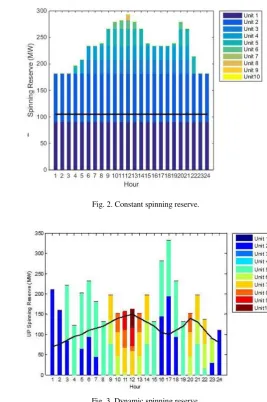
[image:4.595.282.550.51.454.2]One of the most important aspect of the SCUC is considering the spinning reserve for the emergency conditions such as load fluctuation or generator outages. Fig. 2 shows the constant spinning reserve. Considering a constant spinning reserve can potentially lead to higher cost. Hence, in this paper, a dynamic spinning reserve has been considered as shown in Fig. 3. As far as it can be seen, the spinning reserve has a dynamic behavior; that means the spinning reserve values change in any interval based on the requested demand. As mentioned considering the dynamic spinning reserve can contribute to lower cost. The total operation cost of this scenario is $563827.7.
[image:4.595.60.280.55.467.2]Fig. 2. Constant spinning reserve.
Fig. 3. Dynamic spinning reserve.
Table 2: Comparison of applied methods
Difference Between Methods Methods Start-up
Cost
Fuel Cost Final Cost Time
PSO 4090 559852.3 563942.2 85 Proposed
method
4090 559847.7 563937.7 35
V.CONCLUSION
In this study, TLBO is applied for 10 unit commitment problem. The results proved the better performance of TLBO compare to other evolutionary algorithms from both economic and time perspectives. Moreover, the spinning reservation of the system is analyzed which confirmed the high reliability of TLBO which contribute to high probability and availability of the electricity. TLBO is a new algorithm with a less mathematical calculation and fluent concept which can be used in the future in many optimization problems such as smart grids, renewable energy and cyber-physical systems.
REFERENCES
[2] C. K. Pang, G. B. Sheble, and F. Albuyeh, “Evaluation of dynamic programming based methods and multiple area representation for
thermal unit commitment,” IEEE Trans. Power App. Syst., vol. PAS -100, pp. 1212–1218, Mar. 1981.
[3] W. L. Snyder, Jr., H. D. Powell, Jr., and J. C. Rayburn, “Dynamic
Programming approach to unit commitment,” IEEE Trans. Power
Syst., vol. 2, no. 2, pp. 339–347, May 1987.
[4] T. O. Ting, M. V. C. Rao, and C. K. Loo, “A novel approach for unit commitment problem via an effective hybrid particle swarm
optimization.” IEEE Trans. Power Syst., vol. 21, no. 1, pp. 411–418, Feb. 2006.
[5] Z. L. Gaing, “Discrete particle swarm optimization algorithm for unit
commitment,” in Proc. IEEE Power Eng. Soc. General Meeting, Jul.
2003, vol. 1, pp. 13–17.
[6] W. Xiong, M. J. Li, and Y. Cheng, “An improved particle swarm
optimization algorithm for unit commitment,” in Proc. ICICTA 2008.
[7] P. Bajpai and S. N. Singh, “Fuzzy adaptive particle swarm optimization
for bidding strategy in uniform price spot market,” IEEE Trans. Power
Syst., vol. 22, no. 4, pp. 2152–2160, Nov. 2007.
[8] I. G. Damousis, A. G. Bakirtzis, and P. S. Dokopoulos, “A solution to the unit commitment problem using integer-coded genetic algorithm,” IEEE Trans. Power Syst., vol. 19, no. 2, pp. 1165–1172, May 2004. [9] H. Yang, P. Yang, and C. Huang, “A parallel genetic algorithm
approach to solving the unit commitment problem: Implementation on
the transputer networks,” IEEE Trans. Power Syst., vol. 12, no. 2, pp.
661–668, May 1997.
[10] J. M. Arroyo and A. J. Conejo, “A parallel repair genetic algorithm to
solve the unit commitment problem,” IEEE Trans. Power Syst., vol.
17, no. 4, pp. 1216–1224, Nov. 2002.
[11] Sayed, Gehad Ismail, Aboul Ella Hassanien, and Ahmad Taher Azar. "Feature selection via a novel chaotic crow search algorithm." Neural Computing and Applications 31, no. 1 (2019): 171-188.
[12] R. Sahba, "A Brief Study of Software Defined Networking for Cloud Computing," 2018 World Automation Congress, Stevenson, WA, June 2018.
[13] Dabbaghjamanesh, M., A. Moeini, M. Ashkaboosi, P. Khazaei,
and K. Mirzapalangi. "High Performance Control of Grid Connected Cascaded H-Bridge Active Rectifier Based on Type II-Fuzzy Logic Controller with Low Frequency Modulation
Technique." International Journal of Electrical & Computer
Engineering (2088-8708) 6, no. 2 (2016).
[14] Ashkaboosi, Maryam, Seyed Mehdi Nourani, Peyman
Khazaei, Morteza Dabbaghjamanesh, and Amirhossein Moeini. "An optimization technique based on profit of
investment and market clearing in wind power
systems." American Journal of Electrical and Electronic
Engineering 4, no. 3 (2016): 85-91.
[15] Khazaei, Peyman, Morteza Dabbaghjamanesh, Ali
Kalantarzadeh, and Hasan Mousavi. "Applying the modified TLBO algorithm to solve the unit commitment problem." In 2016 World Automation Congress (WAC), pp. 1-6. IEEE, 2016.
[16] Rakhshan, Mohsen, Navid Vafamand, Mokhtar Shasadeghi,
Morteza Dabbaghjamanesh, and Amirhossein Moeini. "Design of networked polynomial control systems with random delays:
sum of squares approach." International Journal of Automation
and Control 10, no. 1 (2016): 73-86.
[17] Haghshenas, S. Abbas, Sarmad Ghader, Daniel Yazgi, Edris
Delkhosh, Nabiallah Rashedi Birgani, Azadeh Razavi Arab, Zohreh Hajisalimi, Mohammad Hossein Nemati, Mohsen Soltanpour, and Morteza Jedari Attari. "Iranian Seas Waters Forecast-Part I: An Improved Model for The Persian
Gulf." Journal of Coastal Research 85, no. sp1 (2018):
1216-1220.
[18] Jedari Attari, Morteza, S. Abbas Haghshenas, Mohsen
Soltanpour, Mohammad Reza Allahyar, Sarmad Ghader, Daniel Yazji, Azadeh Razavi Arab, Zohreh Hajisalimi, S. Jaafar Ahmadi, and Arash Bakhtiari. "Developing the Persian
Gulf Wave Forecasting System." Journal of Coastal and
Marine Engineering 1, no. 1 (2018): 13-18.
[19] Dabbaghjamanesh, Morteza, Abdollah Kavousi-Fard, and
Shahab Mehraeen. "Effective scheduling of reconfigurable
microgrids with dynamic thermal line rating." IEEE
Transactions on Industrial Electronics 66, no. 2 (2019): 1552-1564.
[20] Ghaffari, Saeed, and Maryam Ashkaboosi. "Applying Hidden
Markov Model Baby Cry Signal Recognition Based on
Cybernetic Theory." IJEIR 5: 243-247.
[21] Ashkaboosi, Maryam, Farnoosh Ashkaboosi, and Seyed Mehdi
Nourani. "The Interaction of Cybernetics and Contemporary Economic Graphic Art as" Interactive Graphics"." (2016).
[22] Ghaffari, Saeed, and M. Ashkaboosi. "Applying Hidden
Markov M Recognition Based on C." (2016).
[23] Dabbaghjamanesh, Morteza, Shahab Mehraeen, Abdollah
Kavousifard, and Mosayeb Afshari Igder. "Effective scheduling operation of coordinated and uncoordinated wind-hydro and pumped-storage in generation units with modified
JAYA algorithm." In 2017 IEEE Industry Applications Society
Annual Meeting, pp. 1-8. IEEE, 2017.
[24] Dabbaghjamanesh, Morteza, Shahab Mehraeen, Abdollah
Kavousi-Fard, and Farzad Ferdowsi. "A New Efficient Stochastic Energy Management Technique for Interconnected
AC Microgrids." In 2018 IEEE Power & Energy Society
General Meeting (PESGM), pp. 1-5. IEEE, 2018.
[25] Razavi Arab, Azadeh, S. Abbas Haghshenas, and Farzin
Samsami. "Sediment transport and morphodynamic changes in Ziarat Estuary and Mond River Delta, the Persian Gulf." In EGU General Assembly Conference Abstracts, vol. 16. 2014.
[26] HAGHSHENAS, SEYED ABBAS, and ARAB AZADEH
RAZAVI. "APPLICATION OF SEDIMENT CONSTITUENT ANALYSIS FOR CHARACTERIZING LONGSHORE SEDIMENT TRANSPORT, CASE STUDY OF RAMIN PORT-IRANIAN COASTLINE OF THE OMAN SEA." (2014).
[27] Arab, Azadeh Razavi, Afshin Danehkar, S. Abbas Haghshenas,
and Gita B. Ebrahimi. "ASSESSMENT OF COASTAL DEVELOPMENT IMPACTS ON CORAL ECOSYSTEMS
IN NAIBAND BAY, THE PERSIAN GULF." Coastal
Engineering Proceedings 1, no. 33 (2012): 31.
[28] Haghshenas, S. Abbas, Azadeh Razavi Arab, Arash Bakhtiari,
Morteza Jedari Attari, and Michael John Risk. "Decadal
Evolution of Mond River Delta, the Persian Gulf." Journal of
Coastal Research 75, no. sp1 (2016): 805-810.
[29] Taherzadeh, Erfan, Morteza Dabbaghjamanesh, Mohsen
Gitizadeh, and Akbar Rahideh. "A new efficient fuel optimization in blended charge depletion/charge sustenance
control strategy for plug-in hybrid electric vehicles." IEEE
Transactions on Intelligent Vehicles 3, no. 3 (2018): 374-383.
[30] Tajalli, Seyede Zahra, Seyed Ali Mohammad Tajalli, Abdollah
Kavousi-Fard, Taher Niknam, Morteza Dabbaghjamanesh, and Shahab Mehraeen. "A Secure Distributed Cloud-Fog Based
Framework for Economic Operation of Microgrids." In 2019
IEEE Texas Power and Energy Conference (TPEC), pp. 1-6. IEEE, 2019.
[31] Taherzadeh, Erfan, Shahram Javadi, and Morteza
Dabbaghjamanesh. "New Optimal Power Management
Strategy for Series Plug-In Hybrid Electric
Vehicles." International Journal of Automotive
Technology 19, no. 6 (2018): 1061-1069.
[32] Dabbaghjamanesh, Morteza. "Stochastic Energy Management
[33] F. Sahba, A. Sahba, R. Sahba, "Helping Blind People in Their Meeting Locations to Find Each Other Using RFID Technology", International Journal of Computer Science and Information Security, Vol. 16, pp. 123-127, 2018
[34] A. Sahba, R. Sahba, and W.-M. Lin, "Improving IPC in
Simultaneous Multi-Threading (SMT) Processors by Capping IQ Utilization According to Dispatched Memory Instructions," 2014 World Automation Congress, Kona, HI, August 2014.
[35] A. Azarang, H. E. Manoochehri, and N. Kehtarnavaz,
"Convolutional autoencoder-based multispectral image
fusion," in IEEE Access, vol. 7, pp.35673-35683, Apr. 2019.
[36] A. Azarang, S. Kamaei, M. Miri, and M.H. Asemani, "A new
fractional-order chaotic system and its synchronization via Lyapunov and improved Laplacian-based method," in Optik, vol. 127, no. 24, pp.11717-11731, Dec. 2016.
[37] A. Azarang, M. Miri, S. Kamaei, and M.H. Asemani,
"Nonfragile fuzzy output feedback synchronization of a new chaotic system: design and implementation," in Journal of Computational and Nonlinear Dynamics, vol. 13, no. 1, p.011008, Jan. 2018.
[38] A. Azarang, J. Ranjbar, H. Mohseni, and M.A. Andy, "Output
feedback synchronization of a novel chaotic system and its application in secure communication," in International Journal of Computer Science and Network Security, vol. 17, pp.72-77, Apr. 2017.
[39] M. Bagheri, M. Madani, R. Sahba, and A. Sahba, "Real time
object detection using a novel adaptive color thresholding method", International ACM workshop on Ubiquitous meta user interfaces (Ubi-MUI'11), Scottsdale, AZ, November 2011
[40] R. Sahba, N. Ebadi, M. Jamshidi, P. Rad, "Automatic Text
Summarization Using Customizable Fuzzy Features and Attention on The Context and Vocabulary," 2018 World Automation Congress, Stevenson, WA, June 2018.
[41] R. Sahba, "A Brief Study of Software Defined Networking for
Cloud Computing," 2018 World Automation Congress, Stevenson, WA, June 2018.
[42] A. Sahba, Y. Zhang, M. Hays and W.-M. Lin, "A Real-Time
Per-Thread IQ-Capping Technique for Simultaneous
MultiThreading (SMT) Processors", In the Proceedings of the 11th International Conference on Information Technology New Generation (lTNG 2014), April 2014.
[43] Azadeh, Razavi Arab, S. Abbas Haghshenas, Farzin Samsami,
and Michael John Risk. "Traces of sediment origin in rheological behaviour of mud samples taken from the
North-Western Persian Gulf." In BOOK OF ABSTRACTS. 2015.
[44] Razavi Arab, Azadeh, S. Abbas Haghshenas, and Homayoun
Zaker. "Deep water current velocity data in the Persian Gulf." In EGU General Assembly Conference Abstracts, vol. 17. 2015.
[45] A. Azarang and H. Ghassemian, ‘‘A new pansharpening
method using multi resolution analysis framework and deep neural networks,’’ in Proc. IEEE 3rd Int. Conf. Pattern Recog. Image Anal. (IPRIA), Apr. 2017, pp. 1–6.
[46] A. Azarang and H. Ghassemian, ‘‘Application of
fractional-order differentiation in multispectral image fusion,’’ Remote Sens. Lett., vol. 9, no. 1, pp. 91–100, Jan. 2018.
[47] A. Azarang and H. Ghassemian, ‘‘An adaptive multispectral