Proceedings of the 53rd Annual Meeting of the Association for Computational Linguistics
Coupled Sequence Labeling on Heterogeneous Annotations: POS Tagging
as a Case Study
Zhenghua Li, Jiayuan Chao, Min Zhang∗, Wenliang Chen
(1) Soochow University
(2) Collaborative Innovation Center of Novel Software Technology and Industrialization
Jiangsu Province, China
{zhli13,minzhang,wlchen}@suda.edu.cn; china [email protected]
Abstract
In order to effectively utilize multiple datasets with heterogeneous annotations, this paper proposes a coupled sequence labeling model that can directly learn and infer two heterogeneous annotations simultaneously, and to facilitate discussion we use Chinese part-of-speech (POS) tagging as our case study. The key idea is to bundle two sets of POS tags together (e.g. “[NN,n]”), and build a conditional random field (CRF) based tagging model in the enlarged space of bundled tags with the help of
ambiguous labelings. To train our model
on two non-overlapping datasets that each has only one-side tags, we transform a one-side tag into a set of bundled tags by considering all possible mappings at the missing side and derive an objective function based on ambiguous labelings. The key advantage of our coupled model is to provide us with the flexibility of 1) incorporating joint features on the bundled tags to implicitly learn the loose mapping between heterogeneous annotations, and 2) exploring separate features on one-side tags to overcome the data sparseness problem of using only bundled tags. Experiments on benchmark datasets show that our coupled model significantly outperforms the state-of-the-art baselines on both one-side POS tagging and annotation conversion tasks. The codes and newly annotated data are released for non-commercial usage.1
∗Correspondence author. 1
http://hlt.suda.edu.cn/˜zhli
1 Introduction
The scale of available labeled data significantly affects the performance of statistical data-driven models. As a widely-used structural classification problem, sequence labeling is prone to suffer from the data sparseness issue. However, the heavy cost of manual annotation typically limits one labeled resource in both scale and genre. As a promising research line, semi-supervised learning for sequence labeling has been exten-sively studied. Huang et al. (2009) show that standard self-training can boost the performance of a simple hidden Markov model (HMM) based part-of-speech (POS) tagger. Søgaard (2011) ap-ply tri-training to English POS tagging, boost-ing accuracy from 97.27% to 97.50%. Sun and Uszkoreit (2012) derive word clusters from large-scale unlabeled data as extra features for Chi-nese POS tagging. Recently, the use of natural annotation has becomes a hot topic in Chinese word segmentation (Jiang et al., 2013; Liu et al., 2014; Yang and Vozila, 2014). The idea is to derive segmentation boundaries from implicit information encoded in web texts, such as anchor texts and punctuation marks, and use them as partially labeled training data in sequence labeling models.
The existence of multiple annotated resources opens another door for alleviating data sparse-ness. For example, Penn Chinese Treebank (CTB) contains about 20 thousand sentences annotated with word boundaries, POS tags, and syntactic structures (Xue et al., 2005), which is widely used for research on Chinese word segmentation and POS tagging. People’s Daily corpus (PD)2 is a large-scale corpus annotated with word segments and POS tags, containing about 300 thousand sentences from the first half of 1998 of People’s
2http://icl.pku.edu.cn/icl_groups/
corpustagging.asp
1 2 4 China focuses on economic development
1 2 3 4
Our nation strongly develops education [VV,v] [VE,v]
[VC,v] [VA,v]
Bundled tags [NN,n][NN,Ng]
[NN,vn] 3
Figure 1: An example to illustrate the annotation differences betweenCTB (above) and PD (below), and how to transform a one-side tag into a set of bundled tags. “NN” and “n” represent nouns; “VV”and “v” represent verbs.
Daily newspaper (see Table 2). The two resources were independently built for different purposes. CTB was designed to serve syntactic analysis, whereasPD was developed to support information extraction systems. However, the key challenge of exploiting the two resources is that they adopt different sets of POS tags which are impossible to be precisely converted from one to another based on heuristic rules. Figure 1 shows two example sentences fromCTB and PD. Please refer to Table B.3 in Xia (2000) for detailed comparison of the two guidelines.
Previous work on exploiting heterogeneous data (CTB and PD) mainly focuses on indirect guide-feature based methods. The basic idea is to use one resource to generate extra guide features on another resource (Jiang et al., 2009; Sun and Wan, 2012), which is similar to stacked learning (Nivre and McDonald, 2008). First, PD is used as source data to train a source model TaggerPD. Then, TaggerPD generates automatic POS tags on the target data CTB, called source
annota-tions. Finally, a target model TaggerCTB-guided is trained on CTB, using source annotations as extra guide features. Although the guide-feature based method is effective in boosting performance of the target model, we argue that it may have two potential drawbacks. First, the target model TaggerCTB-guided does not directly usePD as train-ing data, and therefore fails to make full use of rich language phenomena in PD. Second, the method is more complicated in real applications since it needs to parse a test sentence twice to get the final results.
This paper proposes a coupled sequence
label-ing model that can directly learn and infer two heterogeneous annotations simultaneously. We use Chinese part-of-speech (POS) tagging as our case study.3 The key idea is to bundle two sets of POS tags together (e.g. “[NN,n]”), and build a conditional random field (CRF) based tagging model in the enlarged space of bundled tags. To make use of two non-overlapping datasets that each has only side tags, we transform a one-side tag into a set of bundled tags by conone-sidering all possible mappings at the missing side and derive an objective function based on ambiguous
labelings. During training, the CRF-based
cou-pled model is supervised by such ambiguous label-ings. The advantages of our coupled model are to provide us the flexibility of 1) incorporating joint features on the bundled tags to implicitly learn the loose mapping between two sets of annotations, and 2) exploring separate features on one-side tags to overcome the data sparseness problem of using bundled tags. In summary, this work makes two major contributions:
1. We propose a coupled model which can more effectively make use of multiple resources with heterogeneous annotations, compared with both the baseline and guide-feature based method. Experiments show our approach can significantly improve POS tagging accuracy from94.10%to95.00%on CTB.
2. We have manually annotated CTB tags for
1,000PD sentences, which is the first dataset with two-side annotations and can be used for annotation-conversion evaluation. Exper-iments on the newly annotated data show that our coupled model also works effectively on the annotation conversion task, improving conversion accuracy from90.59%to93.90% (+3.31%).
2 Traditional POS Tagging (
Tagger
CTB)Given an input sentence of nwords, denoted by x=w1...wn, POS tagging aims to find an optimal
tag sequencet = t1...tn, whereti ∈ T (1 ≤i ≤
n) and T is a predefined tag set. As a log-linear probabilistic model (Lafferty et al., 2001), CRF
3There are some slight differences in the word
01:ti◦ti−1 02:ti◦wi
03:ti◦wi−1 04:ti◦wi+1 05:ti◦wi◦ci−1,−1 06:ti◦wi◦ci+1,0 07:ti◦ci,0 08:ti◦ci,−1 09:ti◦ci,k,0< k <#ci−1
10:ti◦ci,0◦ci,k,0< k <#ci−1
11:ti◦ci,−1◦ci,k,0< k <#ci−1
12: if#ci= 1then ti◦wi◦ci−1,−1◦ci+1,0 13: ifci,k=ci,k+1then ti◦ci,k◦“consecutive”
14:ti◦prefix(wi, k),1≤k≤4, k≤#ci
[image:3.595.316.519.61.137.2]15:ti◦suffix(wi, k),1≤k≤4, k≤#ci
Table 1: POS tagging features f(x, i, ti−1, ti). ◦ means string concatenation; ci,k denotes the kth Chinese character of wi; ci,0 is the first Chinese character; ci,−1 is the last Chinese character;
#ci is the total number of Chinese characters contained inwi;prefix/suffix(wi, k)denote thek -Character prefix/suffix ofwi.
defines the probability of a tag sequence as:
P(t|x;θ) = Pexp(Score(x,t;θ))
t′exp(Score(x,t′;θ)) Score(x,t;θ) = X
1≤i≤n
θ·f(x, i, ti−1, ti)
(1)
where f(x, i, ti−1, ti) is the feature vector at the
ithword andθis the weight vector. We adopt the
state-of-the-art tagging features in Table 1 (Zhang and Clark, 2008).
3 Coupled POS Tagging (
Tagger
CTB&PD)In this section, we introduce our coupled model, which is able to learn and predict two heteroge-neous annotations simultaheteroge-neously. The idea is to bundle two sets of POS tags together and let the CRF-based model work in the enlarged tag space. For example, a CTB tag “NN” and a PD tag “n” would be bundled into “[NN,n]”. Figure 2 shows the graphical structure of our model.
Different from the traditional model in Eq. (1), our coupled model defines the score of a bundled tag sequence as follows:
Score(x,[ta,tb];θ) =
X
1≤i≤n θ·
f(x, i,[tai−1, tib−1],[tai, tbi])
f(x, i, tai−1, tai)
f(x, i, tbi−1, tbi)
(2)
where the first item of the enlarged feature vector is called joint features, which can be obtained by
[image:3.595.86.281.63.206.2]w1 ... wi-1 wi ... wn
Figure 2: Graphical structure of our coupled CRF model.
instantiating Table 1 by replacing tiwith bundled tags [tai, tbi]; the second and third items are called
separate features, which are based on single-side
tags. The advantages of our coupled model over the traditional model are to provide us with the flexibility of using both kinds of features, which significantly contributes to the accuracy improve-ment as shown in the following experiimprove-ments.
3.1 Mapping Functions
The key challenge of our idea is that bothCTB and PD are non-overlapping and each contains only one-side POS tags. Therefore, the problem is how to construct training data for our coupled model. We denote the tag set of CTB asTa, and that of PD asTb, and the bundled tag set asTa&b. Since the full Cartetian Ta× Tb would lead to a very large number of bundled tags, making the model very slow, we would like to come up with a much smaller Ta&b ⊆ Ta × Tb, based on linguistic insights of the annotation guidelines of the two datasets.
To obtain a properTa&b, we introduce a map-ping function between the two sets of tags asm:
Ta× Tb → {0,1}, which only allow specific tag
pairs to be bundled together.
m(ta, tb) =
(
1 if the two tags can be bundled
0 otherwise
(3) where one mapping function m corresponds to one Ta&b. When the mapping function becomes looser, the tag set size|Ta&b|becomes larger.
Then, based on the mapping function, we can map a single-side POS tag into a set of bundled tags by considering all possible tags at the missing side, as illustrated in Figure 1. The word “Ñ U4”
“[NN, vn]” as its gold-standard references during training. It is known as ambiguous labelings when a training instance has multiple gold-standard la-bels. Similarly, we can obtain bundled tags for all other words in sentences of CTB and PD. After such transformation, the two datasets are now in the same tag space.
At the beginning of this work, our intuition is that the coupled model would achieve the best performance if we build a tight and linguistical-ly motivated mapping function. However, our preliminary experiments show that our intuitive assumption is actually incorrect. Therefore, we experiment with the following four mapping func-tions to manage to figure out the reasons behind and to better understand our coupled model.
• The tight mapping function produces 145 tags, and is constructed by strictly following linguistic principles and our careful study of the two guidelines and datasets.
• The relaxed mapping function results in179 tags, which is an looser version of the tight mapping function by including extra34weak mapping relationships.
• The automatic mapping function generates
346 tags. We use the baseline TaggerCTB to parsePD, and collect all automatic mapping relationships.
• The complete mapping function obtains
1,254tags (|Ta| × |Tb|= 33×38).
3.2 Training Objective with Ambiguous
Labelings
So far, we have formally defined a coupled model and prepared both CTB and PD in the same bundled tag space. The next problem is how to learn the model parametersθ. Note that after our transformation, a sentence in CTB or PD have many tag sequences as gold-standard references due to the loose mapping function, known as
ambiguous labelings. Here, we derive a training
objective based on ambiguous labelings. For simplicity, we illustrate the idea based on the notations of the baseline CRF model in Eq. (1).
Given a sentencex, we denote a set of ambigu-ous tag sequences as V. Then, the probability of
V is the sum of probabilities of all tag sequences contained inV:
p(V|x;θ) =X t∈V
p(t|x;θ) (4)
Algorithm 1 SGD training with two labeled
datasets.
1: Input: Two labeled datasets: D(1) =
{(x(1)i ,Vi(1)}N
i=1, D(2) = {(xi(2),Vi(2))}Mi=1; Parameters:I,N′,M′,b
2: Output:θ
3: Initialization: θ0 =0,k= 0; 4: fori= 1toI do{iterations}
5: Randomly select N′ instances from D(1) and M′ instances fromD(2) to compose a new datasetDi, and shuffle it.
6: Traverse Di, and use a small batch Dkb ⊆
Diat one step.
7: θk+1=θk+ηk1b∇L(Dkb;θk) 8: k=k+ 1
9: end for
Suppose the training data is D = {(xi,Vi)}Ni=1. Then the log likelihood is:
L(D;θ) =XN
i=1
logp(Vi|xi;θ) (5)
After derivation, the gradient is:
∂L(D;θ)
∂θ =
N
X
i=1
(Et∈Vi[f(xi,t)]−Et[f(xi,t)])
(6) wheref(xi,t)is an aggregated feature vector for taggingxiast;Et∈Vi[.]means model expectation of the features in the constrained space of Vi;
Et[.] is model expectation with no constraint.
This function can be efficiently solved by the forward-backward algorithm. Please note that the training objective of a traditional CRF model can be understood as a special case whereVicontains one sequence.
3.3 SGD Training with Two Datasets
The sampled data is then used for one-iteration training. Later experiments will investigate the effect of the weighting proportion. In this work, we use b= 30, and follow the implementation in CRFsuite4to decideηk.
4 Manually Annotating
PD
Sentences withCTB
TagsTo evaluate different methods on annotation con-version, we build the first dataset that contains
1,000 sentences with POS tags on both sides of CTB and PD. The sentences are randomly sam-pled fromPD. To save annotation effort, we only select20%most difficult tokens to manually anno-tate. The difficulty of a wordwiis measured based on marginal probabilities produced by the baseline TaggerCTB. p(ti|x, wi;θ) denotes the marginal probability of taggingwiasti. The basic assump-tion is that wi is more difficult to annotate if its most likely tag candidate (arg maxtp(t|x, wi;θ)) gets lower marginal probability.
We build a visualized online annotation system to facilitate manual labeling. The annotation task is designed in such way that at a time an annotator is provided with a sentence and one focus word, and is required to decide theCTB POS tag of the word. To further simplify annotation, we provide two or three most likely tag candidates as well, so that annotators can choose one either among the candidates or from a full list. We employ 8 undergraduate students as our annotators. Anno-tators are trained on simulated tasks from CTB data for several hours, and and start real annotation once reaching certain accuracy. To guarantee annotation quality, we adopt multiple annotation. Initially, one task is randomly assigned to two annotators. Later, if the two annotators submit different results, the system will assign the task to two more annotators. To aggregate annotation results, we only retain annotation tasks that the first two annotators agree (91.0%) or three anno-tators among four agree (5.6%), and discard other tasks (3.4%). Finally, we obtain 5,769 words with bothCTB and PD tags, with each annotator’s detailed submissions, and could be used as a non-synthesized dataset for studying aggregating submissions from non-expert annotators in crowd-sourcing platforms (Qing et al., 2014). The data is also fully released for non-commercial usage.
4http://www.chokkan.org/software/
crfsuite/
5 Experiments
In this section, we conduct experiments to verify the effectiveness of our approach. We adoptCTB (version 5.1) with the standard data split, and randomly split PD into four sets, among which one set is20%partially annotated withCTB tags. The data statistics is shown in Table 2. The main concern of this work is to improve accuracy on CTB by exploring large-scale PD, since CTB is relatively small, but is widely-used benchmark data in the research community.
We use the standard token-wise tagging accu-racy as the evaluation metric. For significance test, we adopt Dan Bikel’s randomized parsing evaluation comparator (Noreen, 1989).5.
The baseline CRF is trained on either CTB training data with 33 tags, or PD training data with 38 tags. The coupled CRF is trained on both two separate training datasets with bundled tags (179 tags for the relaxed mapping function). During evaluation, the coupled CRF is not directly evaluated on bundled tags, since bundled tags are unavailable in eitherCTB or PD test data. Instead, the coupled and baseline CRFs are both evaluated on one-side tags.
5.1 Model Development
Our coupled model has two major parameters to be decided. The first parameter is to determine the mapping function between CTB and PD an-notations, and the second parameter is the relative weights of the two datasets during training (N′vs.
M′: number of sentences in each dataset used for training at one iteration).
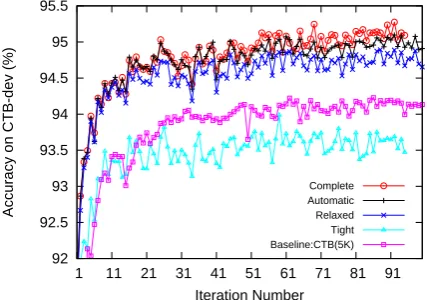
Effect of mapping functions (described
in Subsection 3.1) is illustrated in Figure 3. Empirically, we adopt N′ = 5K vs. M′ = 20K to merge the two training datasets at each iteration. Our intuition is that using this proportion, CTB should not be overwhelmed by PD, and both training data can be used up in relatively similar speed. Specifically, all training data ofCTB can be consumed in about 3 iterations, whereas PD can be consumed in about 14iterations. We also present the results of the baseline model trained using 5K sentences in one iteration for better comparison.
Contrary to our intuitive assumption, it actually leads to very bad performance when using the
5
#sentences #tokens withCTB tags #tokens withPD tags
CTB
train 16,091 437,991 –
dev 803 20,454 –
test 1,910 50,319 –
PD
train 273,883 – 6,488,208
dev 1,000 – 23,427
test 2,500 – 58,301
[image:6.595.141.458.60.169.2]newly labeled 1,000 5,769 27,942
Table 2: Data statistics. Please kindly note that the1,000sentences originally fromPD are only partially annotated withCTB tags (about20%most ambiguous tokens).
92 92.5 93 93.5 94 94.5 95 95.5
1 11 21 31 41 51 61 71 81 91
Accuracy on CTB-dev (%)
Iteration Number
Complete Automatic Relaxed Tight Baseline:CTB(5K)
Figure 3: Accuracy on CTB-dev regarding to mapping functions.
tight mapping function that is carefully created based on linguistic insights, which is even inferior to the baseline model. The relaxed mapping function outperforms the tight function by large margin. The automatic function works slightly better than the relaxed one. The complete function achieves similar accuracy with the automatic one. In summary, we can conclude that our coupled model achieves much better performance when the mapping function becomes looser. In other words, this suggests that our coupled model can
effectively learn the implicit mapping between heterogeneous annotations, and does not rely on a carefully designed mapping function.
Since a looser mapping function leads to a larger number of bundled tags and makes the model slower, we implement a paralleled training procedure based on Algorithm 1, and run each experiment with five threads. However, it still takes about20hours for one iteration when using the complete mapping function; whereas the other three mapping functions need about 6, 2, and 1 hours respectively. Therefore, as a compromise,
we adopt the relaxed mapping function in the
92 92.5 93 93.5 94 94.5 95
1 31 61 91 121 151 181 211 241 271
Accuracy on CTB-dev (%)
Iteration Number
[image:6.595.74.288.233.383.2]CTB(5K)+PD(100K) CTB(5K)+PD(20K) CTB(5K)+PD(5K) CTB(5K)+PD(1K) Baseline:CTB(5K)
Figure 4: Accuracy on CTB-dev with different weighting settings.
lowing experiments, which achieves slightly lower
accuracy than the complete mapping function, but is much faster.
Effect of weighting CTB and PD is
investi-gated in Figure 4 and 5. Since the scale of PD is much larger than CTB, we adopt Algorithm 1 to merge the training data in a certain proportion (N′ CTB sentences and M′ PD sentences) at each iteration. We use N′ = 5K, and vary
M′ = 1K/5K/20K/100K. Figure 4 shows the accuracy curves on CTB development data. We find that whenM′ = 100K, our coupled model achieve very low accuracy, which is even worse than the baseline model. The reason should be that the training instances inCTB are overwhelmed by those in PD whenM′ is large. In contrast, when
M′ = 1K, the accuracy is also inferior to the case of M′ = 5K, which indicates that PD is not effectively utilized in this setting. Our model works best when M′ = 5K, which is slightly better than the case ofM′ = 1K/20K.
[image:6.595.310.522.233.384.2]93.5 94 94.5 95 95.5 96 96.5 97 97.5
1 31 61 91 121 151 181 211 241 271
Accuracy on PD-dev (%)
Iteration Number
CTB(5K)+PD(100K) CTB(5K)+PD(20K) CTB(5K)+PD(5K) CTB(5K)+PD(1K) Baseline:PD(100K)
Figure 5: Accuracy on PD-dev with different weighting settings.
that when M′ = 100K, our coupled model achieves similar accuracy with the baseline model. When M′ becomes smaller, our coupled model becomes inferior to the baseline model. Particu-larly, whenM′ = 1K, the model converges very slowly. However, from the trend of the curves, we expect that the accuracy gap between our coupled model with M′ = 5K/20K and the baseline model should be much smaller when reaching convergence. Based on the above observation,
we adopt N′ = 5K and M′ = 5K in the following experiments. Moreover, we select the
best iteration on the development data, and use the corresponding model to parse the test data.
[image:7.595.321.515.60.128.2]5.2 Final Results
Table 3 shows the final results on the CTB test data. We re-implement the guide-feature based method of Jiang et al. (2009), referred to as two-stage CRF. Li et al. (2012) jointly models Chinese POS tagging and dependency parsing, and report the best tagging accuracy on CTB. The results show that our coupled model outperforms the
baseline model by large margin, and also achieves slightly higher accuracy than the guide-feature based method.
5.3 Feature Study
We conduct more experiments to measure individ-ual contribution of each feature set, namely the joint features based on bundled tags and separate features based on single-side tags, as defined in Eq. (2). Table 4 shows the results. We can see that when only using separate features, our coupled model achieves only slightly better accuracy than the baseline model. This is because there is
Accuracy Baseline CRF 94.10
Two-stage CRF (guide-feature) 94.81 (+0.71)† Coupled CRF 95.00 (+0.90)†‡
[image:7.595.74.288.66.221.2]Best result (Li et al., 2012) 94.60
Table 3: Final results on CTB test data. † means the corresponding approach significantly outperforms the baseline at confidence level of
p < 10−5; whereas ‡ means the accuracy difference between the two-stage CRF and the coupled CRF is significant at confidence level of
p <10−2.
dev test Baseline CRF 94.28 94.10 Coupled CRF (w/ separate feat) 94.36 94.43 (+0.33) Coupled CRF (w/ joint feat) 92.92 92.90 (-1.20) Coupled CRF (full) 95.10 95.00 (+0.90)
Table 4: Accuracy onCTB: feature study.
little connection and help between the two sets annotations. When only using joint features, our coupled model becomes largely inferior to the baseline, which is due to the data sparseness problem for the joint features. However, when the two sets of features are combined, the coupled model largely outperforms the baseline model. These results indicate that both joint features and
separate features are indispensable components and complementary to each other for the success of our coupled model.
5.4 Results on Annotation Conversion
In this subsection, we evaluate different methods on the annotation conversion task using our newly annotated 1,000 sentences. The gold-standard
PD-to-CTB conversion Baseline CRF 90.59
Two-stage CRF (guide-feature) 93.22 (+2.63)† Coupled CRF 93.90 (+3.31)†‡
Table 5: Conversion accuracy on our annotated data. † means the corresponding approach sig-nificantly outperforms the baseline at confidence level ofp < 10−5; whereas‡means the accuracy difference between the two-stage CRF and the coupled CRF is significant at confidence level of
dev test Baseline CRF 94.28 94.10
Coupled CRF 95.10 95.00 (+0.90)†
[image:8.595.78.288.60.115.2]Baseline CRF + convertedPD 95.01 94.81 (+0.71)†‡
Table 6: Accuracy onCTB: using converted PD.
†means the corresponding approach significantly outperforms the baseline at confidence level of
p < 10−5; whereas ‡ means the accuracy difference between the coupled CRF and the baseline CRF with converted PD is significant at confidence level ofp <10−2.
PD-side tags are provided, and the goal is to obtain theCTB-side tags via annotation conversion. We evaluate accuracy on the 5,769 words having manually annotatedCTB-side tags.
Our coupled model can be naturally used for annotation conversion. The idea is to perform constrained decoding on the test data, using the PD-side tags as hard constraints. The guide-feature based method can also perform annotation conversion by using the gold-standard PD-side tags to compose guide features. Table 5 shows the results. The accuracy is much lower than those in Table 3, because the 5,769 words used for evaluation are20%most ambiguous tokens in the1,000test sentence (partial annotation to save annotation effort). From Table 5, we can see that
our coupled model outperforms both the baseline and guide-feature based methods by large margin.
5.5 Results of Training with Converted Data
One weakness of our coupled model is the in-efficiency problem due to the large bundled tag set. In practice, we usually only need results following one annotation style. Therefore, we employ our coupled model to convertPD into the style of CTB, and train our baseline model with two training data with homogeneous annotations. Again, Algorithm 1 is used to merge the two data with N′ = 5K and M′ = 5K. The results are shown in the bottom row in Table 6. We can see that with the extra converted data,
the baseline model can achieve slightly lower accuracy with the coupled model and avoid the inefficiency problem at the meantime.
6 Related Work
This work is partially inspired by Qiu et al. (2013), who propose a model that performs heterogeneous
Chinese word segmentation and POS tagging and produces two sets of results following CTB and PD styles respectively. Different from our CRF-based coupled model, their approach adopts a lin-ear model, which directly combines two separate sets of features based on single-side tags, without considering the interacting joint features between the two annotations. They adopt an approximate decoding algorithm which tries to find the best single-side tag sequence with reference to tags at the other side. In contrast, our approach is a direct extension of traditional CRF, and is more theoretically simple from the perspective of mod-elling. The use of both joint and separate features is proven to be crucial for the success of our coupled model. In addition, their work indicates that their model relies on a hand-crafted loose mapping between annotations, which is opposite to our findings. The naming of the “coupled” CRF is borrowed from the work of Qiu et al. (2012), which treats the joint task of Chinese word segmentation and POS tagging as two coupled sequence labeling problems.
Zhang et al. (2014) propose a shift-reduce de-pendency parsing model which can simultaneous-ly learn and produce two heterogeneous parse trees. However, their approach assumes the ex-istence of data with annotations at both sides, which is obtained by converting phrase-structure trees into dependency trees with different heuristic rules.
This work is also closely related with multi-task learning, which aims to jointly learn multiple related tasks with the benefit of using interac-tive features under a share representation (Ben-David and Schuller, 2003; Ando and Zhang, 2005; Parameswaran and Weinberger, 2010). However, according to our knowledge, multi-task learning typically assumes the existence of data with labels for multiple tasks at the same time, which is unavailable in our situation.
learn from incomplete annotations where one sen-tence only contains one-side labels. The reviewer also suggests that our objective can be optimized with the latent variable structured perceptron of Sun et al. (2009), which we leave as future work.
Learning with ambiguous labelings are previ-ously explored for classification (Jin and Ghahra-mani, 2002), sequence labeling (Dredze et al., 2009), parsing (Riezler et al., 2002; T¨ackstr¨om et al., 2013; Li et al., 2014a; Li et al., 2014b). Recently, researchers derive natural annotations from web data, transform them into ambiguous labelings to supervise Chinese word segmentation models (Jiang et al., 2013; Liu et al., 2014; Yang and Vozila, 2014).
7 Conclusions
This paper proposes an effective coupled sequence labeling model for exploiting multiple non-overlapping datasets with heterogeneous annotations. Please note that our model can also be naturally trained on datasets with both-side annotations if such data exists. Experimental results demonstrate that our model work better than the baseline and guide-feature based methods on both one-side POS tagging and annotation conversion. Specifically, detailed analysis shows several interesting findings. First, both the separate features and joint features are indispensable components for the success of our coupled model. Second, our coupled model does not rely on a carefully hand-crafted mapping function. Our linguistically motivated mapping function is only used to reduce the size of the bundled tag set for the sake of efficiency. Finally, using the extra training data converted with our coupled model, the baseline tagging model achieves similar accuracy improvement. In this way, we can avoid the inefficiency problem of our coupled model in real application.
For future, our immediate plan is to annotate more data with both CTB and PD tags (a few t-housand sentences), and to investigate our coupled model with small amount of such annotation as extra training data. Meanwhile, Algorithm 1 is empirically effective in merging two training data, but still needs manual tuning of the weighting factor on held-out data. Thus, we would like to find a more principled and theoretically sound method to merge multiple training data.
Acknowledgments
The authors would like to thank the undergraduate students Fangli Lu and Xiaojing Wang for building our annotation system, and Le Lu, Die Hu, Yue Zhang, Jian Zhang, Qiuyi Yan, Xinzhou Jiang for data annotation. We are also grateful that Yu Ding kindly shared her earlier codes on which our annotation system was built. We also thank the helpful comments from our anonymous reviewers. This work was supported by National Natural Sci-ence Foundation of China (Grant No. 61432013, 61203314) and Jiangsu Planned Projects for Post-doctoral Research Funds (No. 1401075B), and was also partially supported by Collaborative In-novation Center of Novel Software Technology and Industrialization of Jiangsu Province.
References
Rie Kubota Ando and Tong Zhang. 2005. A
framework for learning predictive structures from
multiple tasks and unlabeled data. Journal of
Machine Learn Research, 6:1817–1853.
Shai Ben-David and Reba Schuller. 2003. Exploiting task relatedness for multiple task learning. In COLT.
Mark Dredze, Partha Pratim Talukdar, and Koby
Crammer. 2009. Sequence learning from data
with multiple labels. In ECML/PKDD Workshop on
Learning from Multi-Label Data.
Zhongqiang Huang, Vladimir Eidelman, and Mary Harper. 2009. Improving a simple bigram hmm part-of-speech tagger by latent annotation and self-training. In Proceedings of NAACL, pages 213–216.
Wenbin Jiang, Liang Huang, and Qun Liu. 2009. Au-tomatic adaptation of annotation standards: Chinese word segmentation and POS tagging – a case study. In Proceedings of ACL, pages 522–530.
Wenbin Jiang, Meng Sun, Yajuan L¨u, Yating Yang, and Qun Liu. 2013. Discriminative learning with natural annotations: Word segmentation as a case study. In Proceedings of ACL, pages 761–769.
Rong Jin and Zoubin Ghahramani. 2002. Learning with multiple labels. In Proceedings of NIPS.
John Lafferty, Andrew McCallum, and Fernando
Pereira. 2001. Conditional random fields:
Probabilistic models for segmenting and labeling sequence data. In Proceedings of ICML 2001, pages 282–289.
Zhenghua Li, Min Zhang, and Wenliang Chen.
2014a. Ambiguity-aware ensemble training for
semi-supervised dependency parsing. In ACL, pages 457–467.
Zhenghua Li, Min Zhang, and Wenliang Chen. 2014b. Soft cross-lingual syntax projection for dependency parsing. In COLING, pages 783–793.
Yijia Liu, Yue Zhang, Wanxiang Che, Ting Liu, and Fan Wu. 2014. Domain adaptation for CRF-based Chinese word segmentation using free annotations. In Proceedings of EMNLP, pages 864–874.
Joakim Nivre and Ryan McDonald. 2008. Integrat-ing graph-based and transition-based dependency parsers. In Proceedings of ACL, pages 950–958.
Eric W. Noreen. 1989. Computer-intensive methods
for testing hypotheses: An introduction. John Wiley
& Sons, Inc., New York.
S. Parameswaran and K.Q. Weinberger. 2010. Large margin multi-task metric learning. In J. Lafferty, C. K. I. Williams, J. Shawe-Taylor, R.S. Zemel, and A. Culotta, editors, Advances in Neural Information
Processing Systems 23, pages 1867–1875.
Ciyang Qing, Ulle Endriss, Raquel Fernandez, and
Justin Kruger. 2014. Empirical analysis of
aggregation methods for collective annotation. In
COLING, pages 1533–1542.
Xipeng Qiu, Feng Ji, Jiayi Zhao, and Xuanjing Huang. 2012. Joint segmentation and tagging with coupled
sequences labeling. In Proceedings of COLING
2012: Posters, pages 951–964, Mumbai, India.
Xipeng Qiu, Jiayi Zhao, and Xuanjing Huang. 2013. Joint Chinese word segmentation and POS tagging on heterogeneous annotated corpora with multiple
task learning. In Proceedings of EMNLP, pages
658–668.
Stefan Riezler, Tracy H. King, Ronald M. Kaplan, Richard Crouch, John T. III Maxwell, and Mark Johnson. 2002. Parsing the wall street journal using a lexical-functional grammar and discriminative
estimation techniques. In Proceedings of ACL,
pages 271–278.
Anders Søgaard. 2011. Semi-supervised condensed
nearest neighbor for part-of-speech tagging. In
Proceedings of ACL, pages 48–52.
Weiwei Sun and Hans Uszkoreit. 2012. Capturing paradigmatic and syntagmatic lexical relations: Towards accurate Chinese part-of-speech tagging. In Proceedings of ACL, pages 242–252.
Weiwei Sun and Xiaojun Wan. 2012. Reducing
approximation and estimation errors for Chinese lexical processing with heterogeneous annotations. In Proceedings of ACL, pages 232–241.
Xu Sun, Takuya Matsuzaki, Daisuke Okanohara,
and Jun’ichi Tsujii. 2009. Latent variable
perceptron algorithm for structured classification. In Proceedings of the 21st International Joint
Conference on Artificial Intelligence (IJCAI 2009),
pages 1236–1242.
Charles Sutton, Khashayar Rohanimanesh, and
An-drew McCallum. 2004. Dynamic conditional
random fields: Factorized probabilistic models
for labeling and segmenting sequence data. In
International Conference on Machine Learning (ICML).
Oscar T¨ackstr¨om, Ryan McDonald, and Joakim Nivre. 2013. Target language adaptation of discriminative transfer parsers. In Proceedings of NAACL, pages 1061–1071.
Fei Xia. 2000. The part-of-speech tagging guidelines
for the penn Chinese treebank 3.0. In Technical
Report, Linguistic Data Consortium.
Nianwen Xue, Fei Xia, Fu-Dong Chiou, and Martha Palmer. 2005. The Penn Chinese Treebank: Phrase structure annotation of a large corpus. In Natural
Language Engineering, volume 11, pages 207–238.
Fan Yang and Paul Vozila. 2014. Semi-supervised Chinese word segmentation using partial-label
learning with conditional random fields. In
Proceedings of EMNLP, pages 90–98.
Yue Zhang and Stephen Clark. 2008. Joint word
segmentation and POS tagging using a single perceptron. In Proceedings of ACL-08: HLT, pages 888–896.
Meishan Zhang, Wanxiang Che, Yanqiu Shao, and Ting Liu. 2014. Jointly or separately: Which is better for parsing heterogeneous dependencies? In