A Linear-Time Bottom-Up Discourse Parser
with Constraints and Post-Editing
Vanessa Wei FengDepartment of Computer Science University of Toronto Toronto, ON, Canada
Graeme Hirst
Department of Computer Science University of Toronto Toronto, ON, Canada
Abstract
Text-level discourse parsing remains a challenge. The current state-of-the-art overall accuracy in relation assignment is 55.73%, achieved by Joty et al. (2013). However, their model has a high order of time complexity, and thus cannot be ap-plied in practice. In this work, we develop a much faster model whose time complex-ity is linear in the number of sentences. Our model adopts a greedy bottom-up proach, with two linear-chain CRFs ap-plied in cascade as local classifiers. To en-hance the accuracy of the pipeline, we add additional constraints in the Viterbi decod-ing of the first CRF. In addition to effi-ciency, our parser also significantly out-performs the state of the art. Moreover, our novel approach of post-editing, which modifies a fully-built tree by considering information from constituents on upper levels, can further improve the accuracy.
1 Introduction
Discourse parsing is the task of identifying the presence and the type of the discourse relations between discourse units. While research in dis-course parsing can be partitioned into several di-rections according to different theories and frame-works, Rhetorical Structure Theory (RST) (Mann and Thompson, 1988) is probably the most am-bitious one, because it aims to identify not only the discourse relations in a small local context, but also the hierarchical tree structure for thefull text: from the relations relating the smallest discourse units (called elementary discourse units, EDUs), to the ones connecting paragraphs.
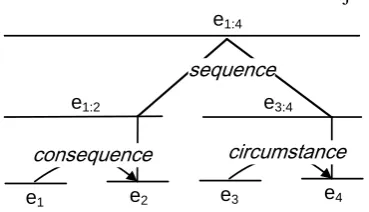
For example, Figure 1 shows a text fragment consisting of two sentences with four EDUs in total (e1-e4). Its discourse tree representation is
shown below the text, following the notation con-vention of RST: the two EDUs e1 and e2 are
re-lated by a mononuclear relation CONSEQUENCE,
wheree2is the more salient span (callednucleus,
ande1 is calledsatellite);e3 ande4are related by
another mononuclear relation CIRCUMSTANCE,
withe4as the nucleus; the two spanse1:2 ande3:4
are further related by a multi-nuclear relation SE -QUENCE, with both spans as the nucleus.
Conventionally, there are two major sub-tasks related to text-level discourse parsing: (1) EDU segmentation: to segment the raw text into EDUs, and (2) tree-building: to build a discourse tree from EDUs, representing the discourse relations in the text. Since the first sub-task is considered rela-tively easy, with the state-of-art accuracy at above 90% (Joty et al., 2012), the recent research focus is on the second sub-task, and often uses manual EDU segmentation.
The current state-of-the-art overall accuracy of the tree-building sub-task, evaluated on the RST Discourse Treebank (RST-DT, to be introduced in Section 8), is 55.73% by Joty et al. (2013). How-ever, as an optimal discourse parser, Joty et al.’s model is highly inefficient in practice, with re-spect to both their DCRF-based local classifiers, and their CKY-like bottom-up parsing algorithm. DCRF (Dynamic Conditional Random Fields) is a generalization of linear-chain CRFs, in which each time slice contains a set of state variables and edges (Sutton et al., 2007). CKY parsing is a bottom-up parsing algorithm which searches all possible parsing paths by dynamic programming. Therefore, despite its superior performance, their model is infeasible in most realistic situations.
The main objective of this work is to develop a more efficient discourse parser, with similar or even better performance with respect to Joty et al.’s optimal parser, but able to produce parsing re-sults in real time.
Our contribution is three-fold. First, with a
[On Aug. 1, the state tore up its controls,]e1
[and food prices leaped]e2 [Without buffer
stocks,]e3[inflation exploded.]e4
wsj 1146
e1 e2
consequence
e1:4
e3 e4
circumstance sequence
[image:2.595.89.274.115.221.2]e1:2 e3:4
Figure 1: An example text fragment composed of two sentences and four EDUs, with its RST dis-course tree representation shown below.
greedy bottom-up strategy, we develop a discourse parser with a time complexity linear in the total number of sentences in the document. As a re-sult of successfully avoiding the expensive non-greedy parsing algorithms, our discourse parser is very efficient in practice. Second, by using two linear-chain CRFs to label a sequence of discourse constituents, we can incorporate contextual infor-mation in a more natural way, compared to us-ing traditional discriminative classifiers, such as SVMs. Specifically, in the Viterbi decoding of the first CRF, we include additional constraints elicited from common sense, to make more ef-fective local decisions. Third, after a discourse (sub)tree is fully built from bottom up, we perform a novel post-editing process by considering infor-mation from the constituents on upper levels. We show that this post-editing can further improve the overall parsing performance.
2 Related work
2.1 HILDA discourse parser
The HILDA discourse parser by Hernault et al. (2010) is the first attempt at RST-style text-level discourse parsing. It adopts a pipeline framework, and greedily builds the discourse tree from the bot-tom up. In particular, starting from EDUs, at each step of the tree-building, a binary SVM classifier is first applied to determine which pair of adjacent discourse constituents should be merged to form a larger span, and another multi-class SVM classi-fier is then applied to assign the type of discourse relation that holds between the chosen pair.
The strength of HILDA’s greedy tree-building
strategy is its efficiency in practice. Also, the em-ployment of SVM classifiers allows the incorpora-tion of rich features for better data representaincorpora-tion (Feng and Hirst, 2012). However, HILDA’s ap-proach also has obvious weakness: the greedy al-gorithm may lead to poor performance due to local optima, and more importantly, the SVM classifiers are not well-suited for solving structural problems due to the difficulty of taking context into account.
2.2 Joty et al.’s joint model
Joty et al. (2013) approach the problem of text-level discourse parsing using a model trained by Conditional Random Fields (CRF). Their model has two distinct features.
First, they decomposed the problem of text-level discourse parsing into two stages: intra-sentential parsing to produce a discourse tree for each sentence, followed by multi-sentential pars-ing to combine the sentence-level discourse trees and produce the text-level discourse tree. Specif-ically, they employed two separate models for intra- and multi-sentential parsing. Their choice of two-stage parsing is well motivated for two rea-sons: (1) it has been shown that sentence aries correlate very well with discourse bound-aries, and (2) the scalability issue of their CRF-based models can be overcome by this decompo-sition.
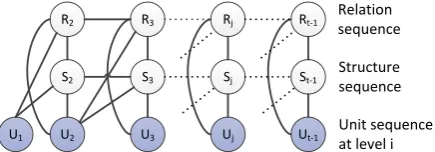
Second, they jointly modeled the structure and the relation for a given pair of discourse units. For example, Figure 2 shows their intra-sentential model, in which they use the bottom layer to rep-resent discourse units; the middle layer of binary nodes to predict the connection of adjacent dis-course units; and the top layer of multi-class nodes to predict the type of the relation between two units. Their model assigns a probability to each possible constituent, and a CKY-like parsing al-gorithm finds the globally optimal discourse tree, given the computed probabilities.
R2
S2
U2
U1
R3
S3
U3
Rj
Sj
Uj
Rt-1
St-1
Ut-1
Relation sequence
Structure sequence
[image:3.595.73.291.62.138.2]Unit sequence at level i
Figure 2: Joty et al. (2013)’s intra-sentential Con-dition Random Fields.
of input discourse units, for large documents, the parsing simply takes too long1.
3 Overall work flow
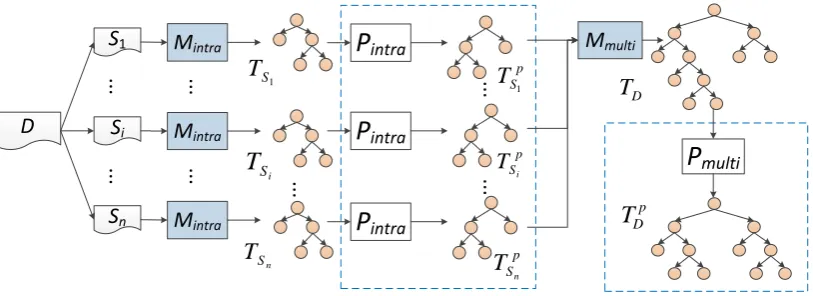
Figure 3 demonstrates the overall work flow of our discourse parser. The general idea is that, similar to Joty et al. (2013), we perform a sentence-level parsing for each sentence first, followed by a text-level parsing to generate a full discourse tree for the whole document. However, in addition to effi-ciency (to be shown in Section 6), our discourse parser has a distinct feature, which is the post-editing component (to be introduced in Section 5), as outlined in dashes.
Our discourse parser works as follows. A doc-ument D is first segmented into a list of sen-tences. Each sentence Si, after being segmented
into EDUs (not shown in the figure), goes through an intra-sentential bottom-up tree-building model
Mintra, to form a sentence-level discourse treeTSi,
with the EDUs as leaf nodes. After that, we ap-ply the intra-sentential post-editing modelPintrato
modify the generated treeTSitoTSpi, by considering
upper-level information.
We then combine all sentence-level discourse tree TSpi’s using our multi-sentential bottom-up tree-building model Mmulti to generate the
text-level discourse treeTD. Similar to sentence-level
parsing, we also post-edit TD using Pmulti to
pro-duce the final discourse treeTDp.
1The largest document in the RST-DT contains over 180
sentences, i.e.,n>180 for their multi-sentential CKY pars-ing. Intuitively, suppose the average time to compute the probability of each constituent is 0.01 second, then in total, the CKY-like parsing takes over 16 hours. It is possible to op-timize Joty et al.’s CKY-like parsing by replacing their CRF-based computation for upper-level constituents with some lo-cal computation based on the probabilities of lower-level con-stituents. However, such optimization is beyond the scope of this paper.
4 Bottom-up tree-building
For both intra- and multi-sentential parsing, our bottom-up tree-building process adopts a similar greedy pipeline framework like the HILDA dis-course parser (discussed in Section 2.1), to guar-antee efficiency for large documents. In partic-ular, starting from the constituents on the bot-tom level (EDUs for intra-sentential parsing and sentence-level discourse trees for multi-sentential parsing), at each step of the tree-building, we greedily merge a pair of adjacent discourse con-stituents such that the merged constituent has the highest probability as predicted by our structure
model. Therelation model is then applied to as-sign the relation to the new constituent.
4.1 Linear-chain CRFs as Local models Now we describe the local models we use to make decisions for a given pair of adjacent discourse constituents in the bottom-up tree-building. There are two dimensions for our local models: (1) scope of the model: intra- or multi-sentential, and (2) purpose of the model: for determining structures or relations. So we have four local models,Mstruct
intra ,
Mrel
intra,Mmultistruct, andMmultirel .
While our bottom-up tree-building shares the greedy framework with HILDA, unlike HILDA, our local models are implemented using CRFs. In this way, we are able to take into account the sequential information from contextual discourse constituents, which cannot be naturally repre-sented in HILDA with SVMs as local classifiers. Therefore, our model incorporates the strengths of both HILDA and Joty et al.’s model, i.e., the efficiency of a greedy parsing algorithm, and the ability to incorporate sequential information with CRFs.
As shown by Feng and Hirst (2012), for a pair of discourse constituents of interest, the sequential information from contextual constituents is cru-cial for determining structures. Therefore, it is well motivated to use Conditional Random Fields (CRFs) (Lafferty et al., 2001), which is a discrimi-native probabilistic graphical model, to make pre-dictions for a sequence of constituents surround-ing the pair of interest.
linear-D
S1
Si
Sn
...
...
Mintra
Mintra
Mintra
Mintra
P
intra...
... ...
P
intraP
intraP
multiMmulti
...
...
1 S
T
i S
T
n
S
T p
Sn T
p Si
T
p S T
1
D T
[image:4.595.98.505.61.209.2]p D
T
Figure 3: The work flow of our proposed discourse parser. In the figure,MintraandMmulti stand for the
intra- and multi-sentential bottom-up tree-building models, andPintra andPmultistand for the intra- and
multi-sentential post-editing models.
chain CRFs to model the structure and the relation separately. Although joint modeling has shown to be effective in various NLP and computer vision applications (Sutton et al., 2007; Yang et al., 2009; Wojek and Schiele, 2008), our choice of using two separate models is for the following reasons:
First, it is not entirely appropriate to model the structure and the relation at the same time. For example, with respect to Figure 2, it is unclear how the relation nodeRjis represented for a
train-ing instance whose structure nodeSj =0, i.e., the
unitsUj−1 andUj are disjoint. Assume a special
relation NO-REL is assigned forRj. Then, in the
tree-building process, we will have to deal with the situations where the joint model yields conflicting predictions: it is possible that the model predicts
Sj=1 andRj=NO-REL, or vice versa, and we
will have to decide which node to trust (and thus in some sense, the structure and the relation is no longer jointly modeled).
Secondly, as a joint model, it is mandatory to use a dynamic CRF, for which exact inference is usually intractable or slow. In contrast, for linear-chain CRFs, efficient algorithms and implementa-tions for exact inference exist.
4.2 Structure models
4.2.1 Intra-sentential structure model
Figure 4a shows our intra-sentential structure model Mstruct
intra in the form of a linear-chain CRF.
Similar to Joty et al.’s intra-sentential model, the first layer of the chain is composed of discourse constituents Uj’s, and the second layer is
com-posed of binary nodesSj’s to indicate the
proba-bility of merging adjacent discourse constituents.
S2
U2
U1
S3
U3
Sj
Uj
St
Ut
Structure sequence
All units in sentence at level i (a) Intra-sentential structure modelMintrastruct.
Sj-1
Uj-1
Uj-2
Sj
Uj
Structure sequence
Adjacent units at level i Uj+1
Sj+1
Sj-1
Uj-3
Sj+2
Uj+2
C1 C
2
C3
(b) Multi-sentential structure modelMstruct
multi.C1,C2, andC3
[image:4.595.307.527.276.436.2]denote the three chains for predictingUjandUj+1.
Figure 4: Local structure models.
At each step in the bottom-up tree-building pro-cess, we generate a single sequenceE, consisting ofU1,U2,...,Uj,...,Ut, which are all the current
discourse constituents in the sentence that need to be processed. For instance, initially, we have the sequenceE1={e1,e2,...,em}, which are the
EDUs of the sentence; after merginge1ande2on
the second level, we haveE2={e1:2,e3,...,em};
after merginge4ande5on the third level, we have E3={e1:2,e3,e4:5,...,em}, and so on.
pair must be merged).
Since the computation of Ei does not depend
on a particular pair of constituents, we can use the same sequenceEito compute structural
probabili-ties foralladjacent constituents. In contrast, Joty et al.’s computation of intra-sentential sequences depends on the particular pair of constituents: the sequence is composed of the pair in question, with other EDUs in the sentence, even if those EDUs have already been merged. Thus, different CRF chains have to be formed for different pairs of con-stituents. In addition to efficiency, our use of a single CRF chain for all constituents can better capture the sequential dependencies among con-text, by taking into account the information from partially built discourse constituents, rather than bottom-level EDUs only.
4.2.2 Multi-sentential structure model
For multi-sentential parsing, where the smallest discourse units are single sentences, as argued by Joty et al. (2013), it is not feasible to use a long chain to represent all constituents, due to the fact that it takesO(TM2)time to perform the
forward-backward exact inference on a chain withT units and an output vocabulary size ofM, thus the over-all complexity for over-all possible sequences in their model isO(M2n3)2.
Instead, we choose to take a sliding-window approach to form CRF chains for a particular pair of constituents, as shown in Figure 4b. For exam-ple, suppose we wish to compute the structural probability for the pairUj−1andUj, we form three
chains, each of which contains two contextual constituents: C1 = {Uj−3,Uj−2,Uj−1,Uj}, C2 = {Uj−2,Uj−1,Uj,Uj+1}, and C3 = {Uj−1,Uj,Uj+1,Uj+2}. We then find the chain Ct,1 ≤t ≤3, with the highest joint probability
over the entire sequence, and assign its marginal probabilityP(St
j=1)toP(Sj=1).
Similar to Mstruct
intra , forMmultistruct, we also include
additional constraints in the Viterbi decoding, by disallowing transitions between two ones, and dis-allowing the sequence to be all zeros if it contains all the remaining constituents in the document. 4.3 Relation models
4.3.1 Intra-sentential relation model The intra-sentential relation model Mrel
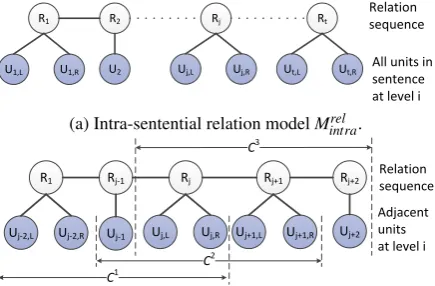
intra, shown
in Figure 5a, works in a similar way toMstruct
intra , as
2The time complexity will be reduced toO(M2n2), if we
use the same chain for all constituents as in ourMstruct intra.
described in Section 4.2.1. The linear-chain CRF contains a first layer of all discourse constituents
Uj’s in the sentence on leveli, and a second layer
of relation nodesRj’s to represent the relation
be-tween a pair of discourse constituents.
However, unlike the structure model, adjacent relation nodes do not share discourse constituents on the first layer. Rather, each relation node Rj
attempts to model the relation of one single con-stituentUj, by takingUj’s left and right subtrees
Uj,LandUj,Ras its first-layer nodes; ifUjis a
sin-gle EDU, then the first-layer node ofRj is simply
Uj, and Rj is a special relation symbol LEAF3.
Since we know, a priori, that the constituents in the chains are either leaf nodes or the ones that have been merged by our structure model, we never need to worry about the NO-REL issue as out-lined in Section 4.1.
In the bottom-up tree-building process, after merging a pair of adjacent constituents using
Mstruct
intra into a new constituent, sayUj, we form a
chain consisting of all current constituents in the sentence to decide the relation label forUj, i.e.,
the Rj node in the chain. In fact, by
perform-ing inference on this chain, we produce predic-tions not only forRj, but also for all otherRnodes
in the chain, which correspond to all other stituents in the sentence. Since those non-leaf con-stituents are already labeled in previous steps in the tree-building, we can nowre-assigntheir rela-tions if the model predicts differently in this step. Therefore, this re-labeling procedure can compen-sate for the loss of accuracy caused by our greedy bottom-up strategy to some extent.
4.3.2 Multi-sentential relation model
Figure 5b shows our multi-sentential relation model. LikeMrel
intra, the first layer consists of
adja-cent discourse units, and the relation nodes on the second layer model the relation of each constituent separately.
Similar to Mstruct
multi introduced in Section 4.2.2,
Mrel
multi also takes a sliding-window approach to
predict labels for constituents in a local context. For a constituentUjto be predicted, we form three
chains, and use the chain with the highest joint probability to assign or re-assign relations to con-stituents in that chain.
3These leaf constituents are represented using a special
Relation sequence
All units in sentence at level i
R1
U1,R
U1,L
R2
U2
Rj
Uj,R
Uj,L
Rt
Ut,R
Ut,L
(a) Intra-sentential relation modelMrel intra.
Relation sequence Adjacent units at level i R1
Uj-2,R
Uj-2,L
Rj-1
Uj-1
Rj
Uj,R
Uj,L
Rj+1
Uj+1,R
Uj+1,L
Rj+2
Uj+2
C1 C 2
C3
(b) Multi-sentential relation modelMrel
multi. C1,C2, andC3
[image:6.595.73.291.62.205.2]denote the three sliding windows for predictingUj,LandUj,R.
Figure 5: Local relation models.
5 Post-editing
After an intra- or multi-sentential discourse tree is fully built, we perform a post-editing to con-sider possible modifications to the current tree, by considering useful information from the discourse constituents on upper levels, which is unavailable in the bottom-up tree-building process.
The motivation for post-editing is that, some particular discourse relations, such as TEXTUAL
-ORGANIZATION, tend to occur on the top levels
of the discourse tree; thus, information such as the depth of the discourse constituent can be quite in-dicative. However, the exact depth of a discourse constituent is usually unknown in the bottom-up tree-building process; therefore, it might be ben-eficial to modify the tree by including top-down information after the tree is fully built.
The process of post-editing is shown in Algo-rithm 1. For each input discourse tree T, which is already fully built by bottom-up tree-building models, we do the following:
Lines 3 – 9: Identify the lowest level of T on which the constituents can be modified according to the post-editing structure component,Pstruct. To
do so, we maintain a list Lto store the discourse constituents that need to be examined. Initially,L
consists of all the bottom-level constituents inT. At each step of the loop, we consider merging the pair of adjacent units inLwith the highest proba-bility predicted byPstruct. If the predicted pair is
not merged in the original treeT, then a possible modification is located; otherwise, we merge the pair, and proceed to the next iteration.
Lines 10 – 12: If modifications have been pro-posed in the previous step, we build a new tree
Algorithm 1Post-editing algorithm. Input: A fully built discourse treeT.
1: if|T|=1then
2: returnT .Do nothing if it is a single
EDU.
3: L←[U1,U2,...,Ut] .The bottom-level
constituents inT.
4: while|L|>2do
5: i←PREDICTMERGING(L,Pstruct) 6: p←PARENT(L[i],L[i+1],T) 7: if p= NULLthen
8: break
9: ReplaceL[i]andL[i+1]withp 10: if|L|=2then
11: L←[U1,U2,...,Ut]
12: Tp←BUILDTREE(L,Pstruct,Prel,T)
Output: Tp
Tp using Pstruct as the structure model, and Prel
as the relation model, from the constituents on which modifications are proposed. Otherwise,Tp
is built from the bottom-level constituents of T. The upper-level information, such as the depth of a discourse constituent, is derived from the initial treeT.
5.1 Local models
The local models, P{{intrastruct|multi|rel}}, for post-editing is almost identical to their counterparts of the bottom-up tree-building, except that the linear-chain CRFs in post-editing includes additional features to represent information from constituents on higher levels (to be introduced in Section 7).
6 Linear time complexity
Here we analyze the time complexity of each com-ponent in our discourse parser, to quantitatively demonstrate the time efficiency of our model. The following analysis is focused on the bottom-up tree-building process, but a similar analysis can be carried out for the post-editing process. Since the number of operations in the post-editing process is roughly the same (1.5 times in the worst case) as in the bottom-up tree-building, post-editing shares the same complexity as the tree-building.
6.1 Intra-sentential parsing
Suppose the input document is segmented into
n sentences, and each sentence Sk contains mk
overall time complexity to perform intra-sentential parsing isO(m2
k). The reason is the following. On
leveliof the bottom-up tree-building, we generate a single chain to represent the structure or relation for all themk−iconstituents that are currently in
the sentence. The time complexity for performing forward-backward inference on the single chain is
O((mk−i)×M2) =O(mk−i), where the constant
M is the size of the output vocabulary. Starting from the EDUs on the bottom level, we need to perform inference for one chain on each level dur-ing the bottom-up tree-builddur-ing, and thus the total time complexity isΣmk
i=1O(mk−i) =O(m2k).
The total time to generate sentence-level dis-course trees for n sentences is Σn
k=1O(m2k). It is
fairly safe to assume that each mk is a constant,
in the sense that mk is independent of the total
number of sentences in the document. There-fore, the total time complexityΣn
k=1O(m2k)≤n×
O(max1≤j≤n(m2j)) =n×O(1) =O(n), i.e., linear
in the total number of sentences.
6.2 Multi-sentential parsing For multi-sentential models,Mstruct
multi andMmultirel , as
shown in Figures 4b and 5b, for a pair of con-stituents of interest, we generate multiple chains to predict the structure or the relation.
By including a constant numberk of discourse units in each chain, and considering a constant number l of such chains for computing each ad-jacent pair of discourse constituents (k = 4 for
Mstruct
multi andk=3 for Mmultirel ; l=3), we have an
overall time complexity of O(n). The reason is that it takesl×O(kM2) =O(1)time, wherel,k,M
are all constants, to perform exact inference for a given pair of adjacent constituents, and we need to perform such computation for alln−1 pairs of adjacent sentences on the first level of the tree-building. Adopting a greedy approach, on an ar-bitrary level during the tree-building, once we de-cide to merge a certain pair of constituents, say
Uj andUj+1, we only need to recompute a small
number of chains, i.e., the chains which originally includeUj orUj+1, and inference on each chain
takes O(1). Therefore, the total time complexity is(n−1)×O(1) + (n−1)×O(1) =O(n), where the first term in the summation is the complexity of computing all chains on the bottom level, and the second term is the complexity of computing the constant number of chains on higher levels.
We have thus showed that the time complexity
islinearinn, which is the number of sentences in the document. In fact, under the assumption that the number of EDUs in each sentence is indepen-dent ofn, it can be shown that the time complexity is also linear in the total number of EDUs4.
7 Features
In our local models, to encode two adjacent units,
Uj andUj+1, within a CRF chain, we use the
fol-lowing 10 sets of features, some of which are mod-ified from Joty et al.’s model.
Organization features: WhetherUj(orUj+1) is
the first (or last) constituent in the sentence (for intra-sentential models) or in the document (for multi-sentential models); whetherUj (orUj+1) is
a bottom-level constituent.
Textual structure features: Whether Uj
con-tains more sentences (or paragraphs) thanUj+1.
N-gram features: The beginning (or end) lexi-cal n-grams in each unit; the beginning (or end) POSn-grams in each unit, wheren∈ {1,2,3}. Dominance features: The PoS tags of the head node and the attachment node; the lexical heads of the head node and the attachment node; the domi-nance relationship between the two units.
Contextual features: The feature vector of the previous and the next constituent in the chain. Substructure features: The root node of the left and right discourse subtrees of each unit.
Syntactic features: whether each unit corre-sponds to a single syntactic subtree, and if so, the top PoS tag of the subtree; the distance of each unit to their lowest common ancestor in the syntax tree (intra-sentential only).
Entity transition features: The type and the number of entity transitions across the two units. We adopt Barzilay and Lapata (2008)’s entity-based local coherence model to represent a doc-ument by an entity grid, and extract local transi-tions among entities in continuous discourse con-stituents. We use bigram and trigram transitions with syntactic roles attached to each entity.
4We implicitly made an assumption that the parsing time
Cue phrase features: Whether a cue phrase oc-curs in the first or last EDU of each unit. The cue phrase list is based on the connectives collected by Knott and Dale (1994)
Post-editing features: The depth of each unit in the initial tree.
8 Experiments
For pre-processing, we use the Stanford CoreNLP (Klein and Manning, 2003; de Marneffe et al., 2006; Recasens et al., 2013) to syntactically parse the texts and extract coreference relations, and we use Penn2Malt5to lexicalize syntactic trees to
ex-tract dominance features.
For local models, our structure models are trained using MALLET (McCallum, 2002) to in-clude constraints over transitions between adja-cent labels, and our relation models are trained using CRFSuite (Okazaki, 2007), which is a fast implementation of linear-chain CRFs.
The data that we use to develop and evaluate our discourse parser is the RST Discourse Tree-bank (RST-DT) (Carlson et al., 2001), which is a large corpus annotated in the framework of RST. The RST-DT consists of 385 documents (347 for training and 38 for testing) from the Wall Street Journal. Following previous work on the RST-DT (Hernault et al., 2010; Feng and Hirst, 2012; Joty et al., 2012; Joty et al., 2013), we use 18 coarse-grained relation classes, and with nuclearity at-tached, we have a total set of 41 distinct relations. Non-binary relations are converted into a cascade of right-branching binary relations.
9 Results and Discussion 9.1 Parsing accuracy
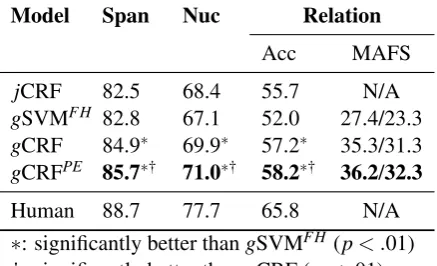
We compare four different models using manual EDU segmentation. In Table 1, the jCRF model in the first row is the optimal CRF model proposed by Joty et al. (2013). gSVMFH in the second row
is our implementation of HILDA’s greedy parsing algorithm using Feng and Hirst (2012)’s enhanced feature set. The third model,gCRF, represents our greedy CRF-based discourse parser, and the last row,gCRFPE, represents our parser with the
post-editing component included.
In order to conduct a direct comparison with Joty et al.’s model, we use the same set of
eval-5http://stp.lingfil.uu.se/˜nivre/ research/Penn2Malt.html.
Model Span Nuc Relation Acc MAFS
jCRF 82.5 68.4 55.7 N/A
gSVMFH 82.8 67.1 52.0 27.4/23.3
gCRF 84.9∗ 69.9∗ 57.2∗ 35.3/31.3
gCRFPE 85.7∗† 71.0∗† 58.2∗† 36.2/32.3
Human 88.7 77.7 65.8 N/A
∗: significantly better thangSVMFH (p< .01)
[image:8.595.308.527.65.198.2]†: significantly better thangCRF (p< .01)
Table 1: Performance of different models using gold-standard EDU segmentation, evaluated us-ing the constituent accuracy (%) for span, nucle-arity, and relation. For relation, we also report the macro-averaged F1-score (MAFS) for correctly retrieved constituents (before the slash) and for all constituents (after the slash). Statistical sig-nificance is verified using Wilcoxon’s signed-rank test.
uation metrics, i.e., the unlabeled and labeled pre-cision, recall, and F-score6 as defined by Marcu
(2000). For evaluating relations, since there is a skewed distribution of different relation types in the corpus, we also include the macro-averaged F1-score (MAFS)7 as another metric, to
empha-size the performance of infrequent relation types. We report the MAFS separately for the correctly retrieved constituents (i.e., the span boundary is correct) and all constituents in the reference tree.
As demonstrated by Table 1, our greedy CRF models perform significantly better than the other two models. Since we do not have the actual out-put of Joty et al.’s model, we are unable to con-duct significance testing between our models and theirs. But in terms of overall accuracy, ourgCRF model outperforms their model by 1.5%. More-over, with post-editing enabled, gCRFPE
signif-icantly (p< .01) outperforms our initial model
gCRF by another 1% in relation assignment, and this overall accuracy of 58.2% is close to 90% of human performance. With respect to the macro-averaged F1-scores, adding the post-editing com-ponent also obtains about 1% improvement.
However, the overall MAFS is still at the lower
6For manual segmentation, precision, recall, and F-score
are the same.
7MAFS is the F1-score averaged among all relation
Avg Min Max
# of EDUs 61.74 4 304
[image:9.595.331.506.65.145.2]# of Sentences 26.11 2 187 # of EDUs per sentence 2.36 1 10
Table 2: Characteristics of the 38 documents in the test data.
end of 30% for all constituents. Our error anal-ysis shows that, for two relation classes, TOPIC
-CHANGE and TEXTUAL-ORGANIZATION, our
model fails to retrieve any instance, and for TOPIC-COMMENT and EVALUATION, our model
scores a class-wiseF1score lower than 5%. These
four relation classes, apart from their infrequency in the corpus, are more abstractly defined, and thus are particularly challenging.
9.2 Parsing efficiency
We further illustrate the efficiency of our parser by demonstrating the time consumption of different models.
First, as shown in Table 2, the average number of sentences in a document is 26.11, which is al-ready too large for optimal parsing models, e.g., the CKY-like parsing algorithm in jCRF, let alone the fact that the largest document contains sev-eral hundred of EDUs and sentences. Therefore, it should be seen that non-optimal models are re-quired in most cases.
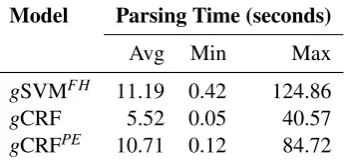
In Table 3, we report the parsing time8 for the
last three models, since we do not know the time of
jCRF. Note that the parsing time excludes the time cost for any necessary pre-processing. As can be seen, ourgCRF model is considerably faster than
gSVMFH, because, on one hand, feature
compu-tation is expensive in gSVMFH, since gSVMFH
utilizes a rich set of features; on the other hand, in gCRF, we are able to accelerate decoding by multi-threading MALLET (we use four threads). Even for the largest document with 187 sentences,
gCRF is able to produce the final tree after about 40 seconds, while jCRF would take over 16 hours assuming each DCRF decoding takes only 0.01 second. Although enabling post-editing doubles the time consumption, the overall time is still ac-ceptable in practice, and the loss of efficiency can be compensated by the improvement in accuracy.
8Tested on a Linux system with four duo-core 3.0GHz
processors and 16G memory.
Model Parsing Time (seconds)
Avg Min Max
gSVMFH 11.19 0.42 124.86
gCRF 5.52 0.05 40.57
gCRFPE 10.71 0.12 84.72
Table 3: The parsing time (in seconds) for the 38 documents in the test set of RST-DT. Time cost of any pre-processing is excluded from the analysis.
10 Conclusions
In this paper, we presented an efficient text-level discourse parser with time complexity linear in the total number of sentences in the document. Our approach was to adopt a greedy bottom-up tree-building, with two linear-chain CRFs as local probabilistic models, and enforce reason-able constraints in the first CRF’s Viterbi decod-ing. While significantly outperforming the state-of-the-art model by Joty et al. (2013), our parser is much faster in practice. In addition, we pro-pose a novel idea of post-editing, which modifies a fully-built discourse tree by considering informa-tion from upper-level constituents. We show that, although doubling the time consumption, post-editing can further boost the parsing performance to close to 90% of human performance.
In future work, we wish to further explore the idea of post-editing, since currently we use only the depth of the subtrees as upper-level informa-tion. Moreover, we wish to study whether we can incorporate constraints into the relation models, as we do to the structure models. For example, it might be helpful to train the relation models us-ing additional criteria, such as Generalized Ex-pectation (Mann and McCallum, 2008), to better take into account some prior knowledge about the relations. Last but not least, as reflected by the low MAFS in our experiments, some particularly difficult relation types might need specifically de-signed features for better recognition.
Acknowledgments
[image:9.595.77.289.66.128.2]References
Jason Baldridge and Alex Lascarides. 2005. Proba-bilistic head-driven parsing for discourse structure. InProceedings of the Ninth Conference on Compu-tational Natural Language Learning (CoNLL-2005), pages 96–103, Ann Arbor, Michigan, June. Associ-ation for ComputAssoci-ational Linguistics.
Regina Barzilay and Mirella Lapata. 2008. Modeling local coherence: an entity-based approach. Compu-tational Linguistics, 34(1):1–34.
Lynn Carlson, Daniel Marcu, and Mary Ellen Okurowski. 2001. Building a discourse-tagged cor-pus in the framework of Rhetorical Structure The-ory. In Proceedings of Second SIGDial Workshop on Discourse and Dialogue (SIGDial 2001), pages 1–10.
Marie-Catherine de Marneffe, Bill MacCartney, and Christopher D. Manning. 2006. Generating typed dependency parses from phrase structure parses. In Proceedings of the 5th International Conference on Language Resources and Evaluation (LREC 2006).
Vanessa Wei Feng and Graeme Hirst. 2012. Text-level discourse parsing with rich linguistic features. In Proceedings of the 50th Annual Meeting of the Asso-ciation for Computational Linguistics: Human Lan-guage Technologies (ACL 2012), pages 60–68, Jeju, Korea.
Hugo Hernault, Helmut Prendinger, David A. duVerle, and Mitsuru Ishizuka. 2010. HILDA: A discourse parser using support vector machine classification. Dialogue and Discourse, 1(3):1–33.
Shafiq Joty, Giuseppe Carenini, and Raymond T. Ng. 2012. A novel discriminative framework for sentence-level discourse analysis. In Proceed-ings of the 2012 Joint Conference on Empirical Methods in Natural Language Processing and Com-putational Natural Language Learning, EMNLP-CoNLL 2012, pages 904–915.
Shafiq Joty, Giuseppe Carenini, Raymond Ng, and Yashar Mehdad. 2013. Combining intra- and multi-sentential rhetorical parsing for document-level dis-course analysis. InProceedings of the 51st Annual Meeting of the Association for Computational Lin-guistics (ACL 2013), pages 486–496, Sofia, Bul-garia, August.
Dan Klein and Christopher D. Manning. 2003. Ac-curate unlexicalized parsing. InProceedings of the 41st Annual Meeting on Association for Computa-tional Linguistics (ACL 2003), ACL 2003, pages 423–430, Stroudsburg, PA, USA. Association for Computational Linguistics.
Alistair Knott and Robert Dale. 1994. Using linguistic phenomena to motivate a set of coherence relations. Discourse Processes, 18(1):35–64.
John D. Lafferty, Andrew McCallum, and Fernando C. N. Pereira. 2001. Conditional random fields: Probabilistic models for segmenting and labeling se-quence data. InProceedings of the Eighteenth Inter-national Conference on Machine Learning, ICML 2001, pages 282–289, San Francisco, CA, USA. Morgan Kaufmann Publishers Inc.
Gideon S. Mann and Andrew McCallum. 2008. Gen-eralized Expectation Criteria for semi-supervised learning of Conditional Random Fields. In Proceed-ings of the 46th Annual Meeting of the Association for Computational Linguistics: Human Language Technologies (ACL 2008), pages 870–878, Colum-bus, Ohio, June. Association for Computational Lin-guistics.
William Mann and Sandra Thompson. 1988. Rhetor-ical structure theory: Toward a functional theory of text organization. Text, 8(3):243–281.
Daniel Marcu. 2000. The Theory and Practice of Dis-course Parsing and Summarization. The MIT Press. Andrew Kachites McCallum. 2002. MAL-LET: A machine learning for language toolkit. http://mallet.cs.umass.edu.
Philippe Muller, Stergos Afantenos, Pascal Denis, and Nicholas Asher. 2012. Constrained decoding for text-level discourse parsing. In Proceedings of COLING 2012, pages 1883–1900, Mumbai, India, December. The COLING 2012 Organizing Commit-tee.
Naoaki Okazaki. 2007. CRFsuite: a fast im-plementation of conditional random fields (CRFs). http://www.chokkan.org/software/crfsuite/.
Marta Recasens, Marie-Catherine de Marneffe, and Christopher Potts. 2013. The life and death of dis-course entities: Identifying singleton mentions. In Proceedings of the 2013 Conference of the North American Chapter of the Association for Computa-tional Linguistics: Human Language Technologies, pages 627–633, Atlanta, Georgia, June. Association for Computational Linguistics.
Rajen Subba and Barbara Di Eugenio. 2009. An effec-tive discourse parser that uses rich linguistic infor-mation. InProceedings of Human Language Tech-nologies: The 2009 Annual Conference of the North American Chapter of the Association for Compu-tational Linguistics, pages 566–574, Boulder, Col-orado, June. Association for Computational Linguis-tics.
Charles Sutton, Andrew McCallum, and Khashayar Rohanimanesh. 2007. Dynamic conditional random fields: Factorized probabilistic models for labeling and segmenting sequence data. The Journal of Ma-chine Learning Research, 8:693–723, May.
on Computer Vision (ECCV 2008), pages 733–747, Marseille, France.