Using Personality Questionnaires in
Experiments – Limits and Potentials
Müller, Julia and Schwieren, Christiane
University of Münster, University of Heidelberg
5 April 2017
Online at
https://mpra.ub.uni-muenchen.de/78132/
JULIA M ¨ULLER
University of M¨unster
CHRISTIANE SCHWIEREN
University of Heidelberg
Abstract. Growing interest in using personality variables in economic research has led to the question whether personality as measured by psychology is useful to predict economic behavior. It is undoubted that personality can influence large-scale economic outcomes. Whether personality variables can also be used to understand micro-behavior in economic games is, however, less clear. We discuss the reasons for and against this assumption. In the framework of our own experiment, we test whether and which personality factors are useful in predicting behavior in the Trust Game. We can also use the Trust Game to understand how personality measures fare relatively in predicting behavior when situational constraints are strong or weak. This approach can help economists to better understand what to expect from the inclusion of personality variables in their models and experiments, and where further research might be useful and needed.
Keywords: Personality, Big Five, Five Factor Model, Incentives, Experiment, Trust Game.
JEL-Classifications: C72, C91, D03.
E-mail addresses: [email protected].
Date: April 5, 2017.
Corresponding author: Julia M¨uller, University of M¨unster, Institute for Organisational Eco-nomics, Scharnhorststr. 100, 48151 M¨unster, Germany.
Acknowledgments: We would like to thank Ulrike Basten, Christian Fiebach, and Christine Stelzel for helpful comments and suggestions. Financial support from the START-Professorship of the University of Heidelberg of the DFG Initiative of Excellence is gratefully acknowledged.
1. Introduction
Recently, a growing interest among (behavioral) economists in personality variables can be observed (e.g. Rustichini, DeYoung, Anderson, and Burks, 2012; M¨uller and Schwieren, 2012; Almlund, Duckworth, Heckman, and Kautz, 2011; Dohmen, Falk, Huffman, and Sunde, 2010; Borghans, Duckworth, Heckman, and ter Weel, 2008). Very frequently, the Big Five personality factors are used. Usually, correlations of the personality measures with some real-world aspects of economic behavior are reported and interpreted, for example with earnings or performance on the job.1
Research in experimental economics has started to include personality mea-sures in experiments, hoping to be able to explain part of the behavioral hetero-geneity found. Many studies relate some kind of Big Five personality variable, although measured by different instruments, to behavior in games like the Pris-oner’s Dilemma, Dictator Game, or the Ultimatum game (e.g. Brandst¨atter and G¨uth, 2002; Ben-Ner, Putterman, Kong, and Magan, 2004; Ben-Ner, Kong, and Putterman, 2004; Swope, Cadigan, Schmitt, and Shupp, 2008). Another example is Zhao and Smillie (2015), which examines the impact of personality in two spe-cific economic games (a social dilemma and a bargaining game) by using the Big Five and the HEXACO personality framework.2
Other studies use more specific scales, such as the Locus of Control, Self-Monitoring, and Sensation Seeking (Boone, De Brabander, and Van Witteloost-uijn, 1999), or the Myers–Briggs Type Indicator (Schmitt, Realo, Voracek, and Allik, 2008). The results of these exercises so far are not very conclusive.
One reason for this might lie in a methodological concern: is it reasonable to expect scores on personality scales to be predictive of micro-behavior in economic games? It is undoubted that personality can influence economic outcomes in the large (Ozer and Benet-Mart´ınez, 2006), such as occupational attainment (Filer, 1985) or occupational performance and success (Barrick and Mount, 1991; Seibert and Kraimer, 2001). Whether personality variables can also be used to understand “micro”-behavior in economic games is however less clear.
In this paper, we discuss reasons for and against the assumption that person-ality variables can help to explain “micro”-behavior in economic games. Therefore, in our own experiment, we test whether personality factors are useful in predict-ing behavior in the Trust Game (Berg, Dickhaut, and McCabe, 1995). We can
1See for example Barrick and Mount (1991); Mueller and Plug (2006).
2The HEXACO model of personality belongs to the group of general measures as defined in
Section 2. The acronym HEXACO stands for Honesty-Humility, Emotionality, eXtraversion,
also use the Trust Game to understand how personality measures fare relatively in predicting behavior when situational constraints vary in strength.
There are other studies relating the Trust Game or trust in general to per-sonality. Two studies relate the Machiavellian personality test to the Trust Game: Gunnthorsdottir, McCabe, and Smith (2002) use a modified trust game and Burks, Carpenter, and Verhoogen (2003) the standard trust game. Having hypotheses about both trust and trustworthiness, related to scoring high on Machiavellism, Gunnthorsdottir, McCabe, and Smith (2002) find that subjects who score high on Machiavellism are less trustworthy, where Burks, Carpenter, and Verhoogen (2003) find that a high score on Machiavellism predicts a lack of trust, but not trustworthiness.Thielmann and Hilbig (2015) find evidence that participants in an online trust game who score high on Honesty-Humility in the HEXACO model of personality act in a way that is more trustworthy. Fahr and Irlenbusch (2008) use the Big Five personality model, measured by Catell’s 16 PF-R, in an analysis of trust between representatives of organizations, using a modified trust game. To implement their organizational setting, the subjects played in groups of four and had to decide on a representative of their own group. They found a link be-tween anxiety and trustor behavior and anxiety and cooperative behavior on the side of the trustee. The research focus of Ben-Ner and Halldorsson (2010) is on understanding trusting and trustworthiness. They use many different measures, and among others the Big Five factors (measured by the NEO-FFI). Regarding the definition of trust and trustworthiness, they use not only survey questions but also a modified trust game (a repeated variant).
To preview our experimental results, we can show that the behavior of Player 1 is more strongly determined by personality than the behavior of Player 2. We dis-cuss this result on the background of our aims, to get an idea of when personality matters and whether and how using personality as an additional explanatory vari-able is recommendvari-able for (experimental) economists.
2. The Measurement of Personality
Personality psychology provides a large set of specific measures of potential interest for economists. On the one hand, there are general models of personality, usually having between four and seven general factors of personality (e.g. Goldberg, 1981; Cloninger, Svrakic, and Przybeck, 1993; Cattell and Schuerger, 2003). These are measured with different scales, varying in the content of the factors and the sub-factors measured. The most famous example is the NEO-PI-R, which measures the so called Big Five Personality Factors (Costa and McCrae, 1992). On the other hand, there are more specific measures, capturing certain aspects of personality, such as anxiousness or aggressiveness. Here, we focus on the general measures and use the NEO-PI-R (Costa and McCrae, 1992), German version (Ostendorf and Angleitner, 2004) to measure the Big Five personality factors.
Researchers in personality psychology have discussed whether personality fac-tors can be expected to correlate strongly with real life outcomes and behavior, and whether it would be problematic if this was not the case. After Mischel (1968), many personality psychologists have argued that there is a ceiling of a correlation of 0.3 between personality variables and real life outcomes, the so called 0.3 bar-rier (Mischel (1968); see also McCrae (1982) for exceptions). Researchers that adhere to this ceiling argument put forward the idea that the situation is at least as important as personality, or even more important, in determining behavior and important life outcomes.
Others (e.g. Ozer, 1985), however, argue that 0.3-correlations are not that small and can have important practical effects and that most social, psychological (and even medical) variables, such as socioeconomic status or cognitive ability, do not, on average, correlate any more strongly with important life outcomes. It is noteworthy that usually the outcomes studied are larger-life outcomes, such as divorce, occupational or educational attainment, and not “micro”-behaviors, such as trust-game behavior. An exception to this is research in organizational behavior that links, for example, the locus of control or conscientiousness to individual performance, turnover decisions, etc. (e.g. Judge and Bono, 2001; Allen, Weeks, and Moffitt, 2005; Dudley, Orvis, Lebiecki, and Cortina, 2006).
setting, personality parameters do play a direct and indirect role in determining decisions.
We therefore do not expect to be able to explain behavior in the Trust Game by a single personality factor. We do however think that if personality has indeed an influence on behavior, it should at least contribute somewhat to an explana-tion of small-scale behavior, especially when the situaexplana-tion does not provide much guidance on how to behave.
3. Experimental Design and Procedure
First, we describe the procedures of the experiment in subsection 3.1, followed by an explanation of the structure of the experiment in subsection 3.2. Next, we will outline the Trust Game (subsection 3.3) and eventually elucidate the Big Five personality model (subsection 3.4).
3.1. Procedures. The experiment was conducted in the experimental laboratory of SFB 504 in Mannheim. In all, 138 subjects participated (57 male, 70 female, the remaining did not indicate their gender).
3.2. Structure of the Experiment. In this paper we report part of the data collected in a large experiment. All subjects came three times to the labora-tory. There were two experimental sessions with one week in between, and a third individual appointment for the personality questionnaires (separate from the ses-sions).3
The Trust Game was implemented in the second experimental session. All subjects participated in two sessions with one week in between. The experiment consisted of 24 independent sessions, 12 in the first and 12 in the second week. In all, the experiment lasted for approximately one hour in the first and one hour in the second week. Approximately one week before starting the experimental sessions, the subjects filled out the personality questionnaires, which took them about two hours. The personality questionnaires were administered on paper, the games were programmed and conducted with the software “z-tree” (Fischbacher, 2007).
The subjects were carefully informed about the time schedule in advance. At the beginning of each session, they received instructions containing the course of events of the specific session by the experimenter for each game and decision. The
3
instructions were distributed and read aloud. The participants could ask questions if they did not understand parts of the instructions4
.
We paid subjects at the very end of the experiment, i.e., after completing all sessions in the second week. The earnings were determined by two factors. On the one hand, the subjects’ earnings in the experiment depended on the decisions (of the subject and their partner(s)) in the games, and on the other hand, the participants could generate earnings thanks to flat fees.5
All the subjects were paid individually, in cash.
3.3. The Trust Game. The players were randomly assigned to be either Player 1, the trustor, or Player 2, the trustee.6
The players were randomly sorted into pairs. Both players of each pair got ten units of an experimental currency (abbreviated “ECU” in the following). The trustor could first decide whether or not to send ECU to Player 2. If Player 1 sent
x units (0< x≤10), these units were tripled. Then Player 2 was informed about the amount received and could decide to send an amount y (0≤y ≤3x) back to Player 1 (these units were not tripled). Therefore, the payoffs for both players are determined by
Player 1 : 10−x+y Player 2 : 10 + 3x−y.
At the end of the experiment, the experimental currency was transformed into Euro at an exchange rate of 1 ECU = 0.3e.
3.4. The Big Five. To measure personality, we use the five-factor model or the Big Five (Goldberg, 1981; McCrae and Costa JR, 2003). This model organizes personality traits along five basic dimensions: neuroticism, extraversion, openness to experience, agreeableness, and conscientiousness.7
A list of the personality dimensions and their definitions measured by the Big Five model can be found in Figure 1.
To implement the Big Five personality model, we use the NEO PI-R (Costa and McCrae, 1992), German version (Ostendorf and Angleitner, 2004). It consists of 241 items which have to be rated on a 5-point Likert scale.
4
The full instructional material for the Trust Game can be found in Appendix A.
5
The participants received a one-time payment ofe14 for filling out the personality
question-naire and in each of the two sessions an appearance fee ofe5.
6
We used neutral wording for the Instructions and avoided words like “trust.”
7
Figure 1. The five factors of the Big Five Model (NEO-PI-R)
Neuroticism: Neuroticism refers to the emotional stability of a person. It points to “individual differences in the tendency to experience distress” (McCrae and John, 1992, p. 195).
Extraversion: Extraversion mainly measures to what extent someone is emotionally positive. There has been a broad discussion about how to describe extraversion. Spontaneity, energy, and assertiveness, as well as dominance, confidence, and a tendency towards happiness, are often eval-uated as being part of extraversion (Carver and Scheier, 2008, p. 54). Openness: There has been some discussion about the factor “openness to
experience.” Different labels have been favored to capture the content of this factor. Some prefer the label “intellect” (Goldberg, 1981). Others argue that “openness to experience” would be the best label, as this label also includes important aspects such as “creativity, differentiated emotions, aesthetic sensitivity, need for variety and unconventional values” and does not focus only on items such as intelligent or “imaginative and perceptive” (McCrae and John, 1992, p. 197). In this paper, the label “openness” will be used.
Conscientiousness: Conscientiousness tries to capture an individual’s “will to achieve” (Carver and Scheier, 2008, p. 55). This factor combines two as-pects. On the one hand, it includes the behavior “governed by conscience” and on the other hand it refers to the behavioral patterns of being “diligent and thorough” (McCrae and John, 1992, p. 197).
Agreeableness: Agreeableness indicates to what extent someone is “con-cerned with the maintaining of relationships” (Carver and Scheier, 2008, p. 54). If someone scores high on this factor, it includes “characteristics such as altruism, nuturance, caring and emotional support” (McCrae and John, 1992, p. 196).
4. Hypotheses
in strong situations, the situational triggers of behavior are strong and therefore personality variables might not contribute much to an explanation of behavior.
The situation of Player 2 in the Trust Game is clearly determined. Player 1 has either trusted him with a certain amount of money or not, so that he has to decide how to react to Player 1’s behavior. As is known from the experimental literature, reciprocity is a norm prevailing in this context (e.g. Berg, Dickhaut, and McCabe, 1995; McCabe, Rassenti, and Smith, 1998; Fehr and G¨achter, 2000; McCabe, Rigdon, and Smith, 2003). Player 1 however faces a situation where the norms or guidance for behavior are less clear. The player’s personality, especially the tendency to trust or not, will have an important influence on the decision on how much money to send to Player 2.
Hypothesis 1. The first players find themselves in a rather weaksituation, there-fore personality variables can contribute to explain their behavior. The second players are in a rather strong situation. Therefore, personality variables will not contribute much to an explanation of their behavior.
In the following we will explain further hypotheses regarding the behavior of both players during the Trust Game and to what extent the Big Five personality model might be able to explain behavioral differences. In addition, we rely on the literature, mainly in personality psychology, to predict which personality factors should be most important for the explanation of the behavior of Player 1 and of Player 2 in the Trust Game.
First, we derive hypotheses for the link between personality factors and be-havior, i.e., we discuss in what way a subject with a certain personality will behave in the Trust Game.8
Neuroticism refers to the tendency to experience negative emotions and feel-ings, especially anxiety and general distress. Therefore, we expect that a person scoring high on neuroticism to be rather anxious and to avoid the risk of not get-ting money back. Thus, we expect a negative relation between the first player’s sending and neuroticism.
Hypothesis 2. The higher the score of Player 1 on neuroticism, the lower the amount sent.
With respect toextraversion andopenness to experience, we do not have any hypotheses regarding the behavior in the Trust Game. Spontaneity and openness might favor both outcomes, i.e., to trust or to distrust, so that we do not make any assumptions about the impact of these two factors on the behavior.
8
Agreeableness is defined as being compassionate and cooperative. Two im-portant facets among others of Agreeableness are Trust (A1) and Altruism (A3).9
There is an intuitive appeal to supposing that agreeableness and trusting behav-ior are linked and that Altruism (A3) might be connected with the behavior of the trustee. However, in the present paper, we focus on analyzing only the main factors. There has been a broad discussion in the literature about motives other than trust that are involved in trust game behavior; Cox (2004) points out that not only trust and trustworthiness, but also altruistic preferences can account for the sending behavior of Player 1 and the reaction of Player 2.
To sum up,agreeableness is often linked to cooperative behavior (Volk, Th¨oni, and Ruigrok, 2011; LePine and Van Dyne, 2001). This leads to the following intuitive hypothesis.
Hypothesis 3. The higher the score of Player 1 on agreeableness, the higher the amount sent by Player 1. Likewise, a higher score of agreeableness of Player 2 will lead to a higher relative amount returned by Player 2.
People scoring high on conscientiousness prefer to be well organized and to plan activities in advance rather than being spontaneous; they are dutiful and self-disciplined. Therefore we suppose that high levels of conscientiousness will lead to higher amounts sent by Player 1 (being dutiful) if a norm for sending is salient. Asconscientiousness is also linked to rationality (D’Zurilla, Maydeu-Olivares, and Gallardo-Pujoi, 2011; Witteman, van den Bercken, Claes, and Godoy, 2009), high levels of conscientiousness could, however, lead as well to lower amounts being sent by Player 1 (being more rational). Hence, high levels of conscientiousness of Player 1 could reinforce effects in both directions, sending more and sending less. For Player 2, we assume the norm of reciprocity to be salient and thus, controlling for Player 1’s sending behavior, we expect trustors that score high on conscientiousness to follow this norm dutifully, and thus return money in a reciprocal way.
Hypothesis 4. Higher levels on conscientiousness of Player 1 could lead to more or less sending. Referring to Player 2, we assume that high scores on conscien-tiousness lead to higher relative amounts returned.
5. Results
The results section is divided into three parts. We begin with a brief descrip-tion of the players’ general behavior in the Trust Game (subsecdescrip-tion 5.1), followed
9
by a presentationof the results concerning personality and the behavior of Player 1 (subsection 5.2). Eventually, we point out the main results regarding personality and the behavior of Player 2 (subsection 5.3).
5.1. Behavior in the Trust Game. In our experiment, there were 60 subjects playing the Trust Game in the role of Player 1, and the average amount sent by Player 1 was 4.3 ECU (of the 10 ECU). This is slightly below what is usually re-ported. The usual results are that Player 1 sends on average half of his endowment and this trust is not fully repaid by Player 2 (e.g. Camerer, 2003). The average amount returned by Player 2 was 5.9 ECU, and it is strongly correlated with the amount sent (r= 0.736).
Johnson and Mislin find in their meta-study of 162 replications of the Trust Game that an increase in trust of Player 1 by sending more money to Player 2 is rewarded by an increase in trustworthiness, meaning Player 2 also sends back more money. But if the amount of money sent by Player 1 is not tripled but only doubled, the proportion of money Player 2 is willing to return decreases less than proportionately (Johnson and Mislin, 2011).
Table 1. Correlations betweenx, the amount sent by Player 1, and the personality factors
x N E O A C
N −0.339 1.000 0.139
E −0.052 −0.331 1.000 1.000 0.166
O 0.199 −0.102 0.404∗ 1.000
1.000 1.000 0.025
A 0.284 −0.071 0.146 0.133 1.000 0.462 1.000 1.000 1.000
C −0.259 −0.211 0.233 0.010 −0.078 1.000 0.752 1.000 1.000 1.000 1.000
*, **, *** indicate significance at the 10%, 5% and 1% level respectively. Abbreviations: x= amount sent by Player 1, N =neuroticism, E =extraversion, O =openness to ex-perience,A =agreeableness,C =conscientiousness
5.2. Personality Measures and Trustor Behavior. Generally, we find rea-sonable variance in our personality scales.10
Scores on all five of the personality measures are normally distributed (Kolmogorov–Smirnov test of normality).
10
To analyze the impact of personality on the first player’s behavior, we first calculate the correlations between the amount sent by Player 1 and the five per-sonality factors. Table 1 shows the Pearson correlation coefficients. We correct for multiple testing using Bonferroni corrections.11
Table 1 also shows the intercorrelations of the personality factors. Only open-ness and extraversion are marginally positively correlated. We cannot draw any conclusions from the correlation analysis about the influence of personality on the behavior of the first player.
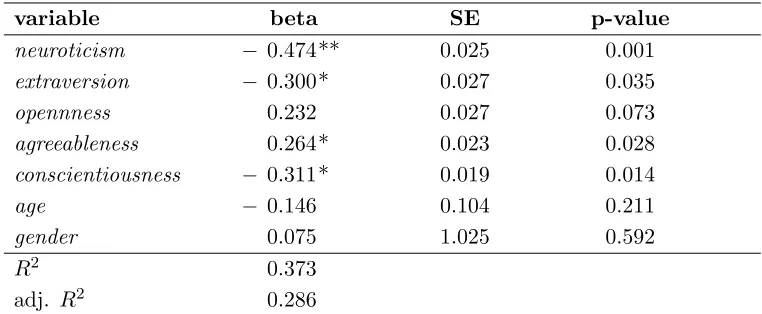
[image:12.612.106.487.378.535.2]For evidence on how personality influences the first player’s behavior, we focus on a regression analysis of the amount sent by Player 1. Table 2 presents the results from an OLS regression. The dependent variable is x, the amount sent by the trustor to the trustee. For the trustor, we explain the amount sent using the Big Five personality model: we use the five factors and test individually whether they influence the behavior of the first player.
Table 2. Regression onx, the amount sent by Player 1
variable beta SE p-value
neuroticism − 0.474** 0.025 0.001
extraversion − 0.300* 0.027 0.035
opennness 0.232 0.027 0.073
agreeableness 0.264* 0.023 0.028
conscientiousness − 0.311* 0.019 0.014
age − 0.146 0.104 0.211
gender 0.075 1.025 0.592
R2
0.373 adj. R2
0.286
This table shows the coefficients (2nd column), standard errors (3rd column) and p -values (4th column) from an OLS regression. The dependent variable is the amount sent by Player 1. Note: *, **, *** indicate significance at the 10%, 5% and 1% level respectively.
The regression on the amount sent by Player 1 (see Table 2) clearly shows a significant influence of some of the five factors on the first player’s behavior, namely of neuroticism,extraversion,agreeableness and consientiousness. Neuroticism has the strongest negative impact, followed by conscientiousness, which also has a significant negative impact on the amount sent. Agreeableness has a significant positive impact. Concerning openness, no significant influence was found. The
11
regression model explains 28% of the variance in the amount sent by the first player.
Considering these main results, we can confirm our hypothesis 2 referring to the impact of neuroticism, and hypothesis 3 referring to the influence of agreeable-ness. In line with hypothesis 2, the regression affirms that first players scoring high on neuroticism tend to send less money, as the beta value is significant and nega-tive (−0.474∗∗). Regarding the behavior of Player 1, the results of the regression support hypothesis 3. As the beta value is significant and positive (0.264∗), the as-sumption that first players scoring high onagreeableness tend to send more money is verified. Extraversion andopenness were the two factors whose influence we did not predict, as they might reinforce behavior in either direction. Our regression makes clear that openness does not have any influence at all. However, extraver-sion does impact the behavior of the first players: the higher their score, the less money they are willing to send (beta value −0.299∗). Hypothesis 4 left open what kind of influence conscientiousness might have on the first player’s behavior. The results of our regression give an answer about the direction of influence of this factor. As the beta value is significant and negative (−0.311∗), we find evidence that the higher the score of the first player on conscientiousness, the less money is sent.
To sum up, our regression model confirms our previous hypotheses regarding Player 1 and gives clear evidence that personality factors do influence the first player’s behavior, meaning that in weak situations, personality does matter and affect behavior.
5.3. Trustee Behavior. We now turn to the behavior of the second player. As described before, there is one clear difference between predicting the first player’s behavior and predicting the second player’s behavior: the behavior of Player 2 is most likely to be guided by reciprocal incentives, i.e., what the first player has sent to the second player will matter. We thus have a strong situation here, as opposed to the weak situation in which the first players find themselves. In line with the general search for interactions of personality variables with the environment in personality psychology, our main question is whether personality variables predict something beyond the “material,” situational characteristics, or whether it is only Player 1’s behavior that predicts the responses of Player 2.
Table 3. Correlations betweeny, the amount returned by Player 2,
x the amount sent by Player 1 and the personality factors
y x N E O A C
x 0.731∗∗∗ 1,000
0.000
N −0.021 0.000 1,000 1.000 1,000
E 0.127 0.077 −0.266 1.000 1.000 1.000 0.878
O 0.193 0.125 0.123 0.333 1.000 1.000 1.000 1.000 0.210
A −0.009 0.117 −0.203 0.166 0.020 1.000 1.000 1.000 1.000 1.000 1.000
C −0.046 −0.165 −0.297 0.144 −0.120 −0.006 1.000 1.000 1.000 0.472 1.000 1.000 1.000
*, **, *** indicate significance at the 10%, 5% and 1% level respectively. Abbreviations: y= amount returned by Pl. 2, x= amount sent by Pl. 1,N =neuroticism,E= extraver-sion,O =openness to experience,A=agreeableness,C = conscientiousness
the behavior of Player 2 and any of the personality factors, i.e., the situation determines the behavior more decisively than do the personality variables.
These main findings confirm our hypothesis 1, that if players find themselves in a strong situation, as the second players do, personality factors do not matter for explaining behavioral differences. In strong situations, the situation itself, in this case the amount Player 1 was willing to send to Player 2, is the only aspect having a significant influence on the behavior. However, as mentioned before, if players find themselves in a weak situation, as the first players do, personality factors do contribute greatly to explaining the behavioral differences.
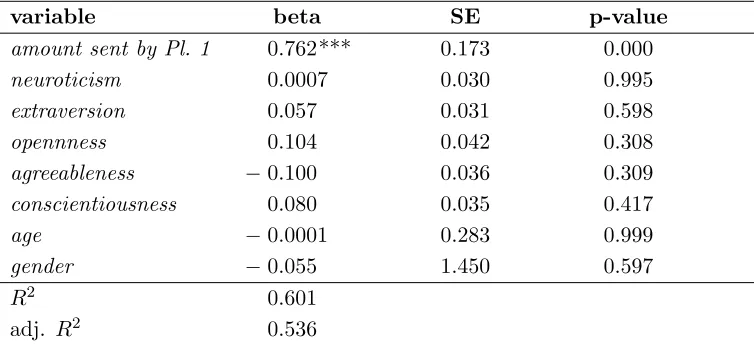
This conclusion is well supported by the results of the regression on the amount returned by Player 2 (see Table 4). These results again highlight that only the amount that Player 1 has sent to Player 2 contributes to an explanation of the amount Player 2 returns (the beta value of trust offer is significant: it is 0.762∗∗∗).12
12
Table 4. Regression ony, the amount returned by Player 2
variable beta SE p-value
amount sent by Pl. 1 0.762*** 0.173 0.000
neuroticism 0.0007 0.030 0.995
extraversion 0.057 0.031 0.598
opennness 0.104 0.042 0.308
agreeableness −0.100 0.036 0.309
conscientiousness 0.080 0.035 0.417
age −0.0001 0.283 0.999
gender −0.055 1.450 0.597
R2
0.601
adj. R2 0.536
This table shows the coefficients (2nd column), standard errors (3rd column) and p -values (4th column) from an OLS regression. The dependent variable is the amount returned by Player 2. Note: *, **, *** indicate significance at the 10%, 5% and 1% level respectively.
According to the results of the regression (see Table 4), parts of hypothesis 3 and hypothesis 4 have to be rejected, referring to the second players. Neither the level of the scores of agreeableness nor the level of the scores of consientiousness have a significant impact on the behavior of the second players. As noticed above, the only factor having a significant influence is the situational condition (in this case, the amount of money Player 2 received from Player 1), as the second players face a strong situation.
6. Discussion
To answer the question to what extent personality can contribute to explain small-scale economic behavior, we employed the Trust Game as an example. Our main finding is that for players who find themselves in a weak situation, person-ality variables do contribute significantly to explain their behavior. Contrarily, personality factors do not have predictive power for the behavior of players facing a strong situation.
Our results confirm most of our general and some of the more specific hy-potheses. First, we do find that personality variables contribute to an explanation of behavior. Trustor behavior can be explained to a large extent using personality variables. This is good news especially for personality psychologists, who so far have seldom validated their personality scales with the help of clear-cut behav-ioral experiments. It is also good news for all those experimental and behavbehav-ioral economists that are now beginning to use personality measures in their exper-iments. But, we have also confirmed the notion of strong and weak situations found in personality psychology: The first player’s behavior can be explained to a large extent (up to 28% of the variance) using personality variables, while the second player’s behavior is explained by the situation. This is in line with the find-ing of Fr´echette, Schotter, and Trevi˜no (2014), that personality does not correlate with behavior in a risky decision, but does correlate with behavior in ambiguous decisions. This is essentially good news for standard economics, as this means that if incentives or behavioral norms are clear and strongly point in a specific direction, most people, independently of their personality, will react to these incentives, and predictably so.
References
Allen, D. G., K. P. Weeks, andK. R. Moffitt(2005): “Turnover intentions and voluntary turnover: the moderating roles of self-monitoring, locus of control, proactive personality, and risk aversion.,” The Journal of Applied Psychology, 90(5), 980–90.
Almlund, M., A. L. Duckworth, J. J. Heckman, andT. D. Kautz(2011): “Personality psychology and economics,”NBER Working Paper Series.
Barrick, M. R., and M. K. Mount (1991): “The Big Five personality di-mensions and job performance: A meta-analysis,” Personnel Psychology, 44, 1–26.
Ben-Ner, A., and F. Halldorsson (2010): “Trusting and trustworthiness: What are they, how to measure them, and what affects them,” Journal of Eco-nomic Psychology, 31(1), 64–79.
Ben-Ner, A., F. Kong, and L. Putterman (2004): “Share and share alike? Gender-pairing, personality, and cognitive ability as determinants of giving,” Journal of Economic Psychology, 25(5), 581–589.
Berg, J., J. Dickhaut, and K. McCabe (1995): “Trust, Reciprocity and Social History,”Games and Economic Behavior, 10, 122–142.
Boone, C., B. De Brabander, and A. Van Witteloostuijn (1999): “The impact of personality on behavior in five Prisoner’s Dilemma games,” Journal of Economic Psychology, 20, 343–377.
Borghans, L., A. L. Duckworth, J. J. Heckman, and B. ter Weel (2008): “The Economics and Psychology of Personality Traits,” Journal of Hu-man Resources, 43, 972–1059.
Brandst¨atter, H., and W. G¨uth(2002): “Personality in dictator and ultima-tum games,”Central European Journal of Operations Research, 10(3), 191–215. Burks, S. V., J. P. Carpenter, and E. Verhoogen(2003): “Playing both roles in the trust game,” Journal of Economic Behavior & Organization, 51(2), 195–216.
Camerer, C. F. (2003): Behavioral Game Theory. Princeton University Press, Princeton, New Jersey.
Carver, C. S.,andM. F. Scheier(2008): Perspectives on Personality. Pearson Education, Boston.
Cattell, H. E. P., and J. M. Schuerger (2003): Essentials of 16PF Assess-ment. Wiley.
Cloninger, C. R., D. M. Svrakic, and T. R. Przybeck (1993): “A Psy-chobiological Model of Temperament and character,” Archieves of General Psy-chatry, 50(12), 975–990.
Costa, P. T., and R. R. McCrae(1992): Revised NEO Personality Inventory (NEO-PI R) and Neo Five Factor Inventory (NEO-FFI). Psychological Assess-ment Inventories, Odessa.
Cox, J. C.(2004): “How to identify trust and reciprocity,”Games and Economic Behavior, 46(2), 260–281.
Dohmen, T., A. Falk, D. Huffman, andU. Sunde(2010): “Are risk aversion and impatience related to cognitive ability?,” The American Economic Review, 100(3), 1238–1260.
Dudley, N. M., K. A. Orvis, J. E. Lebiecki, andJ. M. Cortina(2006): “A meta-analytic investigation of conscientiousness in the prediction of job perfor-mance: examining the intercorrelations and the incremental validity of narrow traits.,”The Journal of Applied Psychology, 91(1), 40–57.
Fahr, R., and B. Irlenbusch (2008): “Identifying personality traits to en-hance trust between organisations: an experimental approach,”Managerial and Decision Economics, 29(6), 469–487.
Fehr, E., and S. G¨achter (2000): “Fairness and Retaliation: The Economics of Reciprocity,” Journal of Economic Perspectives, 14(3), 159–182.
Filer, R. K. (1985): “The role of personality and tastes in determining occupa-tional structure,” Industrial & Labor Relations Review, 39(3), 412–424.
Fischbacher, U. (2007): “z-Tree: Zurich toolbox for ready-made economic ex-periments,” Experimental Economics, 10(2), 171–178.
Fr´echette, G. R., A. Schotter, and I. Trevi˜no (2014): “Personality, In-formation Acquisition and Choice under Uncertainty: An Experimental Study,” Mimeo.
Goldberg, L. R.(1981): “Language and Individual Differences: The Search for Universals in Personality Lexicons,” Review of Personality and Social Psychol-ogy, 2, 141–165.
Gunnthorsdottir, A., K. McCabe, and V. Smith (2002): “Using the Machiavellianism instrument to predict trustworthiness in a bargaining game,” Journal of Economic Psychology, 23(1), 49–66.
Johnson, N. D., and A. A. Mislin (2011): “Trust games: A meta-analysis,” Journal of Economic Psychology, 32(5), 865–889.
Judge, T. A., and J. E. Bono (2001): “Relationship of core self-evaluations traits–self-esteem, generalized self-efficacy, locus of control, and emotional stability–with job satisfaction and job performance: A meta-analysis.,” Jour-nal of Applied Psychology, 86(1), 80–92.
LePine, J. A., and L. Van Dyne (2001): “Voice and cooperative behavior as contrasting forms of contextual performance: Evidence of differential relation-ships with Big Five personality characteristics and cognitive ability,”Journal of Applied Psychology, 86(2), 326–336.
McCabe, K. A., S. J. Rassenti, and V. L. Smith (1998): “Reciprocity, trust, and payoff privacy in extensive form bargaining,” Games and Economic Behavior, 24(1-2), 10–24.
McCabe, K. A., M. L. Rigdon, and V. L. Smith(2003): “Positive reciprocity and intentions in trust games,”Journal of Economic Behavior & Organization, 52(2), 267–275.
McCrae, R. R., and P. T. Costa JR (2003): Personality in Adulthood, a Five-Factor Theory Perspective. Guilford Press, New York.
McCrae, R. R., and O. P. John (1992): “An Introduction to the five-factor Model and its Applications.,” Journal of Personality, 60(2), 175–215.
Mischel, W. (1968): Personality and assessment. Wiley, New York.
(1977): “The interaction of person and situation,” in Personality at the Crossroads: Current Issues in Interactional Psychology, ed. by D. Magnussen,
and N. Endler, pp. 333–352, Hillsdale, NJ. Lawrence Erlbaum.
Mueller, G., and E. Plug (2006): “Estimating the Effect of Personality on Male and Female Earnings,”Industrial and Labor Relations Review, 60(1), 3–22. M¨uller, J., and C. Schwieren (2012): “Can personality explain what is un-derlying women’s unwillingness to compete?,”Journal of Economic Psychology, 33, 448–460.
Ostendorf, F., and A. Angleitner (2004): NEO-Pers¨onlichkeitsinventar nach Costa und McCrae, revidierte Fassung (NEO-PR-I). Hogrefe, G¨ottingen. Ozer, D. J. (1985): “Correlation and the Coefficient of Determination,”
Psycho-logical Bulletin, 97(2), 307–315.
Ozer, D. J., and V. Benet-Mart´ınez(2006): “Personality and the prediction of consequential outcomes.,” Annual Review of Psychology, 57(8), 401–21. Rustichini, A., C. G. DeYoung, J. Anderson, and S. V. Burks (2012):
“Toward the Integration of Personality Theory and Decision Theory in the Ex-planation of Economic and Health Behavior,” IZA Discussion Paper Series, 6750, 1–37.
Schmitt, D. P., A. Realo, M. Voracek, and J. Allik (2008): “Why can’t a Man be More like a Woman? Sex Differences in Big Five Personality Traits Across 55 Cultures,” Journal of Personality and Social Psychology, 94(1), 168– 82.
Seibert, S. E., and M. L. Kraimer (2001): “The Five-Factor Model of Per-sonality and Career Success,”Journal of Vocational Behavior, 58(1), 1–21. Swope, K. J., J. Cadigan, P. M. Schmitt, and R. Shupp (2008):
“Per-sonality preferences in laboratory economics experiments,” Journal of Socio-Economics, 37(3), 998–1009.
Thielmann, I., and B. E. Hilbig (2015): “The Traits One Can Trust: Dis-secting Reciprocity and Kindness as Determinants of Trustworthy Behavior,” Personality and Social Psychology Bulletin, 41(11), 1523–1536.
Witteman, C., J. van den Bercken, L. Claes, and A. Godoy (2009): “Assessing Rational and Intuitive Thinking Styles,” European Journal of Psy-chological Assessment, 25(1), 39–47.
Appendix A. The Trust Game
Instructions. These instructions have been translated into English from the orig-inal German.
In this game you will play together with one other person in the laboratory. You are either Player A or Player B. This will be randomly determined by the computer. The other person (A or B) with whom you will play will also be randomly assigned by the computer.
Both PlayerAandB receive 10 experimental currency units (ECU). PlayerA
can decide whether she would like to send any ECU to Player B and if so, how many (only integer amounts are possible). The amount of ECU that Player A
sends to Player B is tripled. Consequently, Player B receives three units for each unit sent by Player A. Afterwards, Player B decides whether he wants to return any ECU to Player A and if so, how many. These units will not be tripled. This is the end of the game.
The experimental currency is converted into Euros as follows: 1 ECU = 0.30 Euro.
If you have any questions regarding these instructions, please raise your hand and one of the experimenters will come to answer your questions.
Appendix B. The Big Five Personality Model
[image:21.612.159.440.528.625.2]B.1. Descriptive Statistics of the Personality Scales. In Table 5 the descrip-tive statistics of the Big Five personality model are displayed.
Table 5. Descriptive Statistics of the Personality Scales
Variable n Mean SD Min Max
Neuroticism 126 91.985 23.666 27 155
Extraversion 126 116.020 21.564 32 158
Openness 126 124.478 16.781 72 180
Agreeableness 126 109.925 18.700 67 152
B.2. Factors and Facets. In Table 6 the five factors and the names of all facets are summarized.
Table 6. Names of the Factors and Facets
N Neuroticism N1 Anxiety
N2 Angry Hostility
N3 Depression
N4 Self-Consciousness
N5 Impulsiveness
N6 Vulnerability to Stress
E Extraversion E1 Warmth
E2 Gregariousness
E3 Assertiveness
E4 Activity
E5 Excitement-Seeking
E6 Positive Emotions
O Openness to Experience O1 Fantasy
O2 Aesthetics
O3 Feelings
O4 Actions
O5 Ideas
O6 Values
A Agreeableness A1 Trust
A2 Straightforwardness
A3 Altruism
A4 Compliance
A5 Modesty
A6 Tender-Mindedness
C Conscientiousness C1 Competence
C2 Order
C3 Dutifulness
C4 Achievement-Striving
C5 Self-Discipline