The Impact of Knowledge Management
Models for the Development of
Organizations
Mohajan, Haradhan
Assistant Professor, Premier University, Chittagong, Bangladesh.
10 January 2017
Online at
https://mpra.ub.uni-muenchen.de/83089/
The Impact of Knowledge Management Models for the
Development of Organizations
Haradhan Kumar Mohajan
Assistant Professor, Faculty of Business Studies, Premier University, Chittagong, Bangladesh
E-mail: [email protected]
Abstract
Knowledge is an essential item in our daily activities to perform the works efficiently. It is considered as the most important asset for every organization. Knowledge management is a system of acquiring, capturing, sharing, storing, developing, capitalizing, disseminating, and utilizing knowledge efficiently in organizations. This paper discusses some of the widely used knowledge management models (KMMs). The aim of KMMs is the substantial development of
the organizations. Due to recent global economic competition they become essential to all
communities. KMMs play vital roles for the rapid development in technology, and the emergence of new products and services in the society. The intention of this study is to investigate the theory and practice of the emerging and existing KMMs.
Keywords: KMMs, knowledge creation, organization, sense-making,
1. Introduction
In 1597, Francis Bacon wrote, “Knowledge is power” (Barclay 2000). At present knowledge and knowledge management (KM) become essential elements to both employees within organizations and to all global researchers. Interest on knowledge and KM has been seen in economics, management, information technology, anthropology, sociology, epistemology, psychology, and other disciplines (Quintas et al. 1997).
Knowledge is a fluid mix of experience, related information and expert insight that offers a structure for evaluating and integrating new experiences and information. It initiates and is applied in the mind of a knower. In organizations, it often becomes entrenched not only in documents but also in organizational routines, practices, methods, progressions, and norms (Davenport and Prusak 1997). Knowledge can be viewed as individual or collective. Individual knowledge exists in the heads of individuals, while collective knowledge exists in the collective actions of the groups and organizations (Nonaka 1994).
KM is a fast-moving field created by the collision of several others, including human resources, organizational development, change management, information technology, brand and reputation management, performance measurement, and evaluation (Bukowitz and Williams 1999).
Knowledge management models (KMMs) are the combination of data or information into a reusable format for the purpose of preserving, improving, sharing, aggregating and processing knowledge to stimulate intelligence. These are used for the organizations to collect, store and analyze knowledge to have an advantage over their competitors. These models are integral parts of organizations that have the desire to establish KM systems.
KMMs are presented here from Choo (1998), Weick (2001), Nonaka and Takeuchi (1995),
Hedlund and Nonaka (1993),von Krogh and Roos (1995), Wiig (1993), Boisot (1998), Lave and
Wenger (1991), Kakabadse (2003), Edvinsson (1997), Stankosky and Baldanza (2001), Kogut and Zander (1992), Demerest (1997), Frid (2003), Hariharan (2005), etc.
2. Literature Review
Chun Wei Choo (1998) has mentioned that the organizations use information strategically in sense making, knowledge creation, and decision making. Karl Weick is a primary author on sense-making as a socio-cognitive process within organization research (Weick 2001). Ikujiro Nonaka and Hirotaka Takeuchi (1995) have developed the knowledge creation model which is the interaction between tacit and explicit knowledge in an organization. Georg von Krogh and Johan Roos (1995) model provides a clear distinction between individual knowledge and social knowledge.
Karl M. Wiig’s KMM indicates how knowledge is built and used as individuals or as
organizations (Wiig 1993). Max H. Boisot provides a three-dimensional KKM with three axes uncodified to codified, concrete to abstract and undiffused to diffused (Boisot 1998). Etienne Wenger stated that the structure of the communities of practice (CoP) is based on three
components; domain, community and practice, and the CoP unifies three components,
knowledge, people, and experience (Wenger 1999). The Skandia Intellectual Capital KMM is developed by Leif Edvinsson (1997) which is extensively referred to in IC measurement and research. M. Stankosky and C. Baldanza (2001) have developed a conceptual framework for KM with four pillars organization, technology, leadership, and learning.
Bruce Kogut and Udo Zander KKM provides that there is a close connection between the nature of knowledge and the way of growth a company efficiently (Kogut and Zander 1992). M. Demerest identifies four phases of KM within an organization; knowledge construction, knowledge dissemination, knowledge use and knowledge embodiment (Demerest 1997). R. Frid has divided the KMM into five levels as; knowledge chaotic, knowledge aware, knowledge focused, knowledge managed, and knowledge centric (Frid 2003). Arun Hariharan discussed
360-degree model on six how themes. He showed that the 360-degree approach to KM is about
3. Methodology of the Study
The article is prepared on the basis of secondary data. We have used websites, books, previous published articles, conference papers, and various research reports to prepare this paper. Throughout the paper we have tried to discuss the existing KMMs in some details.
4. Objective of the Study
The objectives of the study are:
• To discuss various KMMs.
• To improve the quality of the organizations.
• To the development of KMMs.
5. The Choo KMM
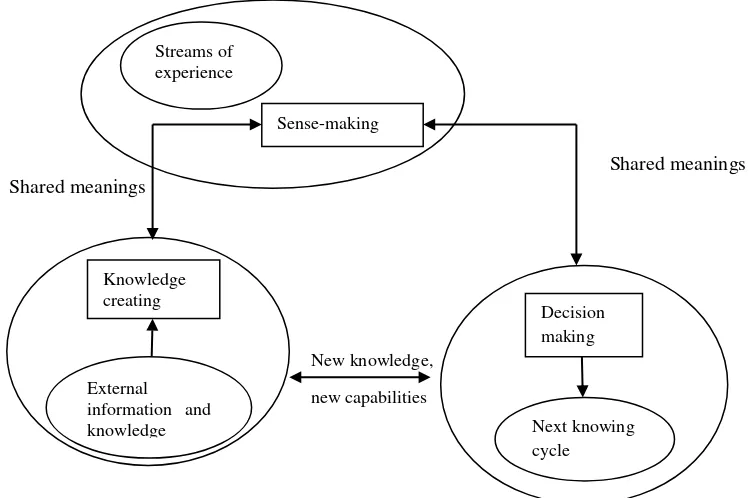
Chun Wei Choo (1998) has described a model of KM that stresses sense making, knowledge creation and decision making. The Choo KMM focuses on how information elements are selected and subsequently fed into organizational actions (Figure 1). Organizational action results from the concentration and absorption of information from the external environment into each successive cycle (Dalkir 2005). Every organization practices information to make sense of its environment, to make new knowledge, and to take decisions. These three highly
interconnected processes play a strategic role for the unfoldment of the organization’s knowledge
vision (Neto et al. 2009).
Shared meanings Shared meanings
New knowledge,
new capabilities
[image:4.612.125.502.413.662.2]
Figure 1:Choo’s KMM. Source: Choo (1998). Sense-making
Streams of experience
Decision making
Next knowing cycle
Knowledge creating
5.1 Weick’s Sense-MakingKMM
Karl Edward Weick introduced the concepts of loose coupling, mindfulness, and sense-making into organizational studies (Weick 2001). Sense-making is an imaginative concept and a micro level theory coined by Weick, which is widely used in organizations. This theory described how performance could be improved within well-structured and relatively stable organizational environments (Weick 1995). It is developed with the field of social psychology and has spread to a number of fields, including management and organization theory (Weber and Manning 2001). Sense-making is interruptions of events that individuals take for granted. They make sense of events by becoming aware of cues related with the interruptions, and the actively categorizing them into an internal frame of references. Their frames enable them to grasp what is actually happening (Bogner and Barr 2000). It is then followed by processes of understanding, explaining, attribution, extrapolation and prediction until they can finally derive some meaning
from the disruption (Starbuck and Milliken 1988). Hence, the concept sense-makingrefers to the
process by which individuals and organizations work out uncertainties, ambiguities, confusing, seeking information, ascribing meanings, inventions, and new situations which is involved in the human propensity with environmental stability (Romito et al. 2007, Grøtan et al. 2008). Weick et
al. (2005) define sense-making as being about “The interplay of action and interpretation rather
than the influence of evaluation and choice.” They show reason that sense-making is not a conscious human process, but a process that will come into play as an intuitive reaction.
According to Weick (1995), sense-making is based on seven properties as “i) grounded in
identity construction, ii) retrospective, iii) enactive of sensible environments, iv) social, v) ongoing, vi) focused on and by extracted cues, and vii) driven by plausibility rather than
accuracy.”
Identity: It is central event in sense-making. People think that they are in their context shapes what they enact and how they interpret events (Thurlow and Mills 2009, Watson 2009).
Retrospection: It provides the opportunity for sense-making. The point of retrospection in time affects what people notice (Dunford and Jones 2000).
Enactive of sensible environments: People enact the environments through the dialogues and narratives (Currie and Brown 2003). When people speak, and build narrative accounts, it helps them to understand what they think, organize their experiences, and control and predict events (Abolafia 2010). As a result they can reduce the complexity in the context of change environment (Kumar and Singhal 2012).
Social: Sense-making is grounded in both individual and social activity. The reasonable stories are preserved, retained or shared by social activity (Maitlis 2005).
Ongoing: Sense-making is ongoing; because the individuals simultaneously shape and react to the environments they face. It is also a feedback process, as individuals deduce their identity from the behavior of others towards them; they also try to influence this behavior (Thurlow and Mills 2009). Social sense-making may tend to create communities of practice (CoP) as ongoing venues for identity construction (Lave and Wenger 1991).
Plausibility over accuracy: People favor plausibility over accuracy in accounts of events and contexts (Currie and Brown 2003, Abolafia 2010).
Each of these seven aspects interacts and interlinks as the individuals interpret their events. Their interpretations manifest through written and spoken, which convey the sense they have made of events (Currie and Brown 2003).
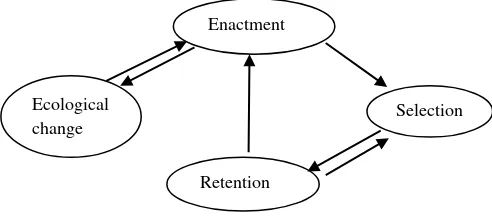
Weick suggests that sense-making in organizations consists of four incorporated processes of external changes as (Dalkir 2005, Weick 1979): i) ecological change, ii) enactment, iii) selection,
andiv) retention (Figure 2).
Ecological change: It is a modification in the flow of experience of social actors, which provides opportunities for social actors to make sense of them (Einhorn and Hogarth 1986). It is external to the organization which disturbs the flow of information to participants and indicates an
ecological change in the organization. Weick (1979) expresses that, “Ecological changes provide
the enactable environment, the raw materials for sense-making.”
Enactment: It is a concept that captures the role of action in organizing and sense-making. It is a crucial process for individuals and organizations alike, because all social actors are involved in it. It is the intersection between the activities of social actors and the ecological or environmental
changes (Saetre et al. 2003). It indicates that people try to construct, rearrange, single out, or
demolish specific elements of content. It clarifies the contents and issues to be used for the
subsequent selection process. According to Weick (1979) “Enactment is to organizing as variation is to natural selection.” Weick (2001) indicates “Enactment drives everything else in an
organization. How enactment is done is what an organization will know.”
[image:6.612.177.423.491.599.2]Selection: It indicates some kind of arranging of the enacted experiences to reduce their equivocality, which can be represented in the form of causal maps, or sequences, built on the enacted, or past experiences (Weick 1995). Later, certain causal maps achieve priority as they reduce equivocality continually than other causal maps in different perspectives.
Figure 2: Integration of sense-making processes. Source:Weick (1979, p. 132).
Retention: It involves the storage of the products of successful sense-making and furnishes the organization with an organizational memory of successful sense-making experiences. Weick
(1979) uses “The terms enacted environment and cause map to refer to retained content.” Hence,
causal maps are central to both organizing and sense-making.
Enactment
Ecological change
Selection
N. Wiley (1988) indicated that organizations are described under four, mutually-interrelated levels of sense-making frameworks for the construction of integrating with the process of knowledge creation as: i) the level of an individual who has thoughts, beliefs, feelings, desires, intentions, etc., which is called an intra-subjective level, ii) the level of social interaction at which actors create inter-subjective understandings, iii) the level of social structure where social reality characterized by generic subjectivity is formed and maintained, and iv) the level of organization culture or an extra-subjective level.
Weick’s theory could help to interpret the resulting social construction of meta-knowledge about the construction and use of KM artifacts. Sense making would serve a study in a number of critical ways that could assist the researcher to (Klein et al. 2006, p. 72):
• comprehend what was going on,
• improve the plausibility of alternative explanations and explain anomalies,
• clarify the past events described by the participants,
• suggest future choices and decision streams for other performance management based
organizations considering the architecture of a wiki as a KM system,
• explore the information collected with the support of a shadow guide, and
• promote the achievement of common ground to understand the social construction
activities, not just the collection of individual perspectives.
The two remaining components of theChoo KM model are described as follows:
5.2 Knowledge Creation Theory
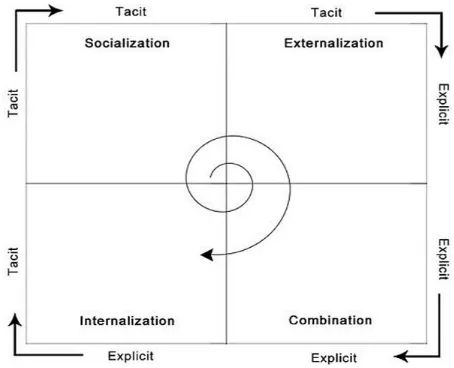
Figure 3: Knowledge creation process. Source: Nonaka and Takeuchi (1995).
i) Socialization (tacit to tacit): It includes the shared formation and communication of tacit knowledge among people who have a common culture and can work together effectively. Using this form the individuals gain tacit knowledge from another person through observation, intercommunication, discussion, analyzing, imitation and practice, and can gain new knowledge through shared experiences. They do not use language as the main channel of allocation. It is a direct practice rather than form reading manuals. Sharing of it can take place in a team meeting during which experiences are described and discussed (Nonaka and Takeuchi 1995). Humans learn to speak and survive in their culture almost entirely by socialization. People in an organization consult about what is important to them. They feed off the ideas of others, and the collective experience of sharing knowledge is a powerful means of creating new ideas. Individuals can also acquire tacit knowledge, create and share mutual trust during face-to-face interactions, sharing the same environment or during informal meetings. Knowledge and skills obtained is stored in tacit form (know-how). For example, communities of practice (CoP), collective or organizational memory are all phenomena that have been studied as best practice of the circulation of tacit knowledge (Nonaka 1994, Khan et al. 2013). For socialization fewer lectures and more labs, studios, and apprenticeships are needed. On-the-job training is a common example of socialization.
a phenomenon of the enunciation of collective tacit knowledge into an explicit formulation embracing a plan, actions and tactics (Baumard 2001).
iii). Combination (explicit to explicit): This is our most familiar process. We take explicit, explainable knowledge, combine it with other explicit knowledge and develop new explicit knowledge. Individuals exchange and combine their knowledge through mechanisms, such as telephone conversations, documents, meetings, including plans, charts, research and development, and technical papers or computerized communication networks. The combination of existent information can be facilitated by the selection, adding, grading, and categorization of explicit knowledge (Nonaka 1994). There are three basic phases to this pattern: i) capturing knowledge from inside and outside the organization and internalizing it, ii) disseminating the explicit knowledge through networks and systems, and iii) processing the explicit knowledge into a more usable format like documents, plans, and reports. Combination can be achieved globally through the communications media or by learning in formal settings using lectures, workshops, published papers, conferences, and seminars. For example, creative use of database to get student reports, sorting the courses, enrolling users, categorizing are combination process (Khan et al. 2013).
iv). Internalization (explicit to tacit): This is the process whereby something we learn becomes automatic. Conversion of this process is more difficult. In this process learning by doing, training and exercises allow the individuals to access the knowledge domain of interest from the group and the organization. It is very important in building, understanding and developing a learning culture (Khan et al. 2013). Individuals read, blend, and conceptualize their findings to create new insights, concepts and methods. Documentation assists people to internalize experiences, develop and broaden their tacit knowledge base (Roberts 2000). To understand this form the best method used is the practical example. Prisoners have the explicit knowledge of the surveillance tower. They recognize the possibility that they are being watched at any given moment, but they do not
know exactly the moment when the guardian is looking or not. The prisoners internalize the
knowledge and turn it into tacit knowledge; they know tacitly that they may be watched at any given time and they accept the possibility (Baumard 2001).
The SECI model focuses on the knowledge transformations between tacit and explicit knowledge, but the model does not provide larger issues on decision making theory (Dalkir 2005). But the results from the knowledge creation theory stimulate for the creation of satisfactory decision making process.
5.3 Decision Making Theory
The third component of Choo’s (1998) model is decision making. It is used to identify and
evaluate alternatives by processing the information and knowledge collected to date. Every
means the leave of the others, and iii) a completely rational decision would require information beyond the capability of the organization to collect, and information processing beyond the human capacity to perform (Neto et al. 2009).
Mintzberg et al. (1976) conceptualize the decision model into three phases with seven central routines by studying twenty-five strategic decision processes. The three phases are; i) identification, ii) development, and iii) selection.
Identification: It comprises of two routines: decision ‘recognition’ in which opportunities,
problems, and crisis are recognized and ‘diagnosis’ in which management seeks to comprehend the evoking stimuli and determine cause-effect relationships for the decision situation.
Development: It leads to the development of one or more solutions to a problem or crisis or to
the elaboration of an opportunity. It may be described in terms of two basic routines, search and
design. Search is to find ready-made solutions, and design is to develop custom-made solutions or to modify ready-made ones (Weick 1979). The information required to develop a new solution or modify an existing one is uncertain and less structured and defined than information required to evaluate a ready-made solution (Choo 1998).
Selection: It is logically considered to be the last step in the decision processes. It comprises of three routines: screen, evaluation-choice, and authorization. Screen is used first to reduce a large number of alternatives to a few feasible ones and to a number that can be stored and handled by time-constrained decision making. Evaluation may use three modes: judgment, bargaining, and analysis. In judgment, one individual makes a choice in his own mind with procedures that he cannot explain; in bargaining, selection is made by a group of decision makers with conflicting goals; and in analysis, factual evaluation is carried out. Decisions need to be authorized when the individual making the choice does not have the authority to commit the organization to a course of action (Deng 2006).
There are a wide range of decision making theories such as (Dalkir 2005):
• the theory of games and economic behavior (Bierman and Fernandez 1993),
• the chaos theory, emergent theory, and complexity theory (Simon 1969), and
• there is even a garbage can model (GCM) of decision making (Daft and Weick 1984).
The GCM of organizational decision making was developed in reference to explanations or interpretations of behaviors that at least appear to contradict classical theory. It was greatly influenced by the realization that extreme cases of aggregate uncertainty in decision environments would trigger behavioral responses, which, at least from a distance, appear to be
irrational (Dalkir 2005).
Organizational decision making theory was produced in the 1940s and 1950s by a number of theorists interested in how organizations came to make particular decisions in the Carnegie school (Simon 1957). Decision making analysis leads to more collaboration, information expertise and insight sharing among knowledge workers. H. A. Simon (1957) outlined the ways in which an individual can be bound in a decision making process so that he/she is limited by:
• individual values and conception of purpose, which may diverge from the organizational goals, and
• the extent of personal knowledge and information.
According to Choo (1998), there are four methods of decision making; i) the rational model is
the one with clear goals and clear rules and routines to achieve the goals (Simon 1976), ii) the
process model is for situations with clear goals but there are multiple options and alternative
solutions (Mintzberg et al. 1976), iii) the political model discusses the situation where there are
conflicting goals from different parties and each party is pretty clear how to achieve its own
interests (Allison 1971), and iv) the anarchymodel where both goals and procedures are unclear
(Cohen et al. 1972).
In real world, decisions could not be made based on complete rationales due to the limitation on
decision makers’ mental skills, the extend of knowledge and information possessed, and values
or conceptions of purpose which may diverge from organizational goals (Simon 1976).
The Choo KM model is the holistic treatment of key KM cycle processes extending to organizational decision making. It is well suited to simulations and hypothesis testing applications (Dalkir 2005).
6. Hedlund and Nonaka’s KMM
Knowledge transfer in organizations is not as simple as Nonaka’s simple SECI model. The
process is very complicated and complex. A more elaborate version of Nonaka’s model was
developed to describe the four levels of carriers or agents of knowledge in organizations (Hedlund 1994). The model builds on two primary distinctions: i) distinguish between tacit and articulated knowledge, and ii) distinguish between four different levels of carriers, or agents, of knowledge the individual, the group, the organization and the inter-organizational domains (important customers, suppliers, competitors, etc.) (Saini 2011).
Gunnar Hedlund and Ikujiro Nonaka (1993) argued that KM characteristics can have serious implications for the various types of activities such as, innovation and strategies, and this can
affect organizations’ success or failures. Hence, this suggests that the essence of organizations’
survival and success can depend on how they create, transfer and exploit their knowledge resources. They proposed a model in which knowledge flow is the interplay between articulated
and tacit knowledge within three forms of knowledge cognitive knowledge in the form of mental
constructs and precepts, skills, and knowledge embodied in products, well-defined services or
Table 1: Hedlund and Nonaka’s KMM. Source:Hedlund and Nonaka (1993).
Individual Group Organization Inter-organizational
domain Articulated knowledge
Cognitive, skills, embodied.
Knowing calculus
Quality circle’s documented analysis of its performance
Organization chart
Suppliers’ patents and documented practices
Tacit knowledge
Cognitive, skills, embodied.
Cross-cultural negotiation skills
Team coordination in complex works
Corporate culture
Customers’ attitudes to products and
expectations.
7. The von Krogh and Roos KMM
The first model that clearly distinguishes between individual knowledge and social knowledge is given by the Georg von Krogh and Johan Roos KM in 1995. They have taken an epistemological approach to manage organizational knowledge and have provided conceptual arguments for tacit knowledge being wholly a characteristic of individuals. They have also examined the nature of KM from the five factors which can prevent KM strategies as; employees, communication and connection, organizational structure and layout, links between members, and management of human resources (von Krogh and Roos 1995). This model analyzes the aspects of the following
questions (Cristea and Căpaţînă 2009, p.356):
• Why and how the knowledge gets to the workers of a company?
• Why and how the knowledge arrives at the organization?
• What does knowledge mean for the workers as well as the organization?
• What are the barriers of organizational KM?
This model indicates that there can be no knowledge without a knower and it needs to maintain links between the knowledge objects and those who are knowledgeable about them. It concludes that knowledge is to be found both in the mind of the people and in the connections between them. It enables overall set of organizational activities that positively affects knowledge creation and facilitates the relationships and conversations, sharing of local knowledge throughout the organization (von Krogh and Roos 1995).
F. Varela, a cognitivist perspective proposes that a cognitive system, whether it is a human brain or a computer, creates models of reality and that learning occurs when these representations are manipulated (Varela 1992).
A cognitive organizational epistemology views organizational knowledge as a self-organizing
system in which humans are transparent to the information from the outside. Humans take in
information through our senses, and we use this information to build our mental models. The
brain is a machine based on logic and deduction that does not allow any contradictory
propositions (Cristea and Căpaţînă 2009, p.356).
8. The Wiig KMM
is built and used as individuals or as organizations. The model is highly favored in KM, because it addresses the organization as a whole and includes business areas that are commonly found in most organizations. He proposes that the foundation of KM is comprised of the way knowledge is created, used in problem solving and decision making, and manifested cognitively as well as in culture, technology and procedures (Wiig 1997c).
Wiig focuses on the three conditions that need to be presented for an organization to run its business successfully as: i) it must have a business (products/services) and customers, ii) it must have resources (people, capital, and facilities), and iii) it must have the ability to act. The third point is emphasized in the Wiig KM cycle (Wiig 1993).
Wiig identifies the major purpose of KM as an effort “To make the enterprise intelligent-acting by facilitating the creation, commutation, deployment and use of quality knowledge.” He proposed an organizational KM cycle of four consecutive stages as (Wiig 1993): i) building, ii) holding, iii) pooling, and iv) using knowledge. This cycle can be presented in linearly, but some activities within these stages can be performed simultaneously or in reverse (Podgórski 2010).
Building knowledge: It consists of obtaining, analyzing, reconstructing, synthesizing, organizing, codifying and modeling knowledge. Obtaining knowledge indicates the activities of i) R&D projects, individual innovations, experimentation, reason with existing knowledge, hiring new people, ii) import knowledge from outside sources, and iii) observation of the real world (site/field visits, etc.). Analyze knowledge indicates; i) extract potential knowledge from obtained material, ii) abstract extracted materials, iii) identify patterns extracted, iv) explain relations between knowledge fragments, and v) verify that extracted materials kept their original meetings. Knowledge is organized for specific uses and according to an established organizational framework such as, standards and categories. Reconstruct and synthesize
knowledge is to i) generalize analyzed material to obtain broader principles, ii) generate
hypotheses to explain observations, iii) establish conformance between new and existing knowledge, and iv) update the total knowledge pool by incorporating the new knowledge. Codify and manage knowledge indicates; i) how we represent knowledge in our minds, ii) how we assemble the knowledge into a coherent model, iii) how we document the knowledge in books and manuals, and iv) how we encode it in order to post it to a knowledge repository (Wiig 1993). At this point knowledge is acquired and built from various sources. Experts and advisers, training courses, procedures and instructions, research, books, media, inspections and observations are needed for the building of organizational knowledge (Podgórski 2010).
Holding knowledge: This type is the remembering, accumulating and embedding knowledge in storehouse as documents which are gained as research reports, practical tips, case studies, etc. Remembering is the individual has retained the item of knowledge. Accumulating is the creating a computer-resident knowledge base and encoding knowledge so it can be stored in organizational memory. Embedding is the ensuring knowledge and is a part of business procedures. Archiving is the systematically retiring outdated, false, irrelevant knowledge from the active repository. Archiving typically involves storing the content in another, less costly or less bulky medium for less frequent future retrieval (Wiig 1997a). This type includes holding
tacit knowledge that can be found in company members’ minds and which can be extracted in
Pooling knowledge: It consists of coordinating, assembling, and accessing and retrieving knowledge. It indicates knowledge coordination that primarily relies on setting a knowledge resource network structure which is responsible for making certain resources available.
Coordinating is formed collaborative teams to work with particular content to create a ‘who knows what’ network. Assembling is the gather knowledge sources into a background library or repository to make later access/retrieval easier. It typically requires the formation of
collaborative teams to work with particular content in order to create a ‘who knows what’
network. Access and retrieval can get knowledge from the repository or through consultation with knowledgeable people about difficult problems, obtaining a second opinion from an expert, or discussing a difficult case with a peer. Collection of information about locating knowledge in documents, databases, expert networks is needed from all employees. So that, knowledge is acquired and built from various sources such as, experts and advisers, training courses, procedures and instructions, research, books, media, inspections, and observations (Wiig 1993, 1997c).
Using knowledge: It is ways of using practical knowledge such as, routine tasks, production and services mostly in any kind of decision-making within an organization at various management levels (Wiig 1997a). This can consist in using knowledge in routine tasks, productions and services in any kind of decision-making processes conducted at various management levels. Routine tasks typically use compiled knowledge that we use almost unconsciously or automatically. The services include using knowledge to identifying problems and their potential consequences, choosing knowledge suitable for solving these problems, searching for alternative solutions, assessing the advantages and disadvantages of those solutions, and planning and implementing selected solutions (Podgórski 2010).
Wiig focused on six strategies to organizational knowledge management process as follows (Wiig 1997b, Manasco 1996):
▪ Knowledge management as a business strategy which places KM as a strategy that spans
the entire organization.
▪ Managing intellectual assets strategy which is a focus on the existing knowledge that is
present within the organization and utilizing them or enhancing them fully.
▪ Personal knowledge asset responsibility strategy which is a strategy that supports
employees to develop their skills and knowledge, sharing it with others.
▪ Knowledge creation strategy which focuses on creating new knowledge through research
and development for shaping the future of the organization.
▪ Knowledge transfer strategy which is sharing and transferring best practices in support of
improving quality and efficiency throughout the organization.
▪ Customer‐focused knowledge strategy which focuses on understanding customer needs
and provide products and services that address those needs.
Wiig considers KM in organizations from three perspectives, each with different horizons and purposes (Wiig 1993):
Management perspective: It focuses on determining, organizing, directing, facilitating, and monitoring knowledge related practices and activities required to achieve the desired business strategies and objectives.
Hands-on perspective: It focuses on applying the expertise to conduct explicit knowledge related works.
Wiig also proposed classifying manageable knowledge into three principal forms: public
knowledge, shared knowledge, and personal knowledge (Cristea and Căpaţînă 2009). Each of these forms is further divided into passive and active knowledge. Public passive knowledge consists of books, standards and websites, and public active knowledge is formed by recognized experts, expert systems, etc. Written information on products, technologies, documented procedures, etc., is passive shared knowledge and informative systems uses in an enterprise, including the intranet are active shared knowledge. Personal passive knowledge includes
information, facts and events stored in an individual’s memory, and personal active knowledge includes skills, habits and an individual’s interpretation of procedures (Wiig 2004, Podgórski 2010).
Wiig (1993, 1999a) stresses that knowledge assetsthat must be applied, nurtured, preserved, and
used to the largest extent possible by both individuals and organizations; and knowledge related
processes to create, build, compile, organize, transform, transfer, pool, apply, and safeguard
knowledge. These knowledge related aspects must be carefully and explicitly managed in all affected areas.
A major advantage of the Wiig approach to the KM cycle is the clear and detailed description of how organizational memory is put into use in order to generate value for individuals, groups, and the organization itself. The ways in which knowledge can be applied and used are linked to decision making sequences and individual characteristics. Wiig also emphasizes the role of knowledge and skill, the business use of that knowledge, constraints that may prevent that knowledge from being fully used, opportunities and alternatives to managing that knowledge, and the expected value added to the organization (Dalkir 2005).
9. The Boisot I-Space KM Model
In 1987, Max H. Boisot describes a KMM for knowledge asset development that is three-dimensional. This model is based on the concept of informational asset which is different from a physical asset. It considers knowledge as either codified or uncodified and as difussed or
undiffused, within an organization. It has an extra dimension ‘abstraction’ to Nonaka’s SECI
model. Boisot distinguishes information from data by emphasizing that information is what an
observer will extract from data as a function of one’s expectations or prior knowledge. It is
Boisot (1998) proposes two key points as: i) the more easily data is converted to information the more easily it is diffused, and ii) the less the data is structured requires a shared context for its diffusion, the more diffusable it becomes.
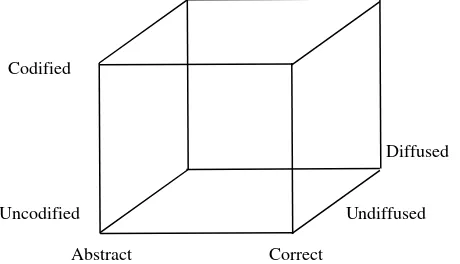
The model considers knowledge as either codified or uncodified and as diffused or undiffused,
within an organization. Boisot’s Information Space (I‐Space) philosophy describes three axes
which can be visualized as a cube as Figure 4 with the three‐dimensions (Dutta and Banerjee
2016): i) uncodified to codified, ii) concrete to abstract, and iii) undiffused to diffused.
Codified
Diffused
Uncodified Undiffused
[image:16.612.165.395.197.329.2]Abstract Correct
Figure 4: Boisot I-Space model. Source: Boisot (1998).
The Boisot KMM addresses the tacit form of knowledge by noting that in many situations, the loss of context due to codification may result in the loss of valuable content. The model incorporates a theoretical foundation of social learning and serves to link together content, information, and KM in a very effective way (Dalkir 2005).
Data is structured and understood through different codification and abstract processes. The term
codified in this case refers to knowledge that can be readily organized and prepared for transmission purposes such as, financial data. Lesser the number of categories, more abstract the codification scheme will be. Boisot model implies that in many situations the context loss because of the codification can lead also to the loss of important knowledge (Boisot 1998).
Codified undiffused knowledge is referred to as propriety knowledge and is intentionally
transmitted to a little group of people, on a ‘need to know’ basis. The uncodified referred on the way to as knowledge that cannot be easily prepared meant for transmission purposes such as, experiences. The model recommends that uncodified and undiffused knowledge is referred to as individual knowledge such as, experiences, views, perceptions, and ideas. The left quadrant of the model covers public knowledge and common sense knowledge (Table 2). Knowledge of public is codified and diffused such as, library, books, journals, newspapers, etc. Common sense knowledge which is comparatively diffused and uncodified can steadily develop through the process of socialization and internationalization (Boisot 1987, Haslinda and Sarinah 2009).
Table 2: Boisot’s knowledge category model. Source: Boisot (1998).
Codified
Propriety knowledge Public knowledge Personal knowledge Common sense knowledge Uncodified
Undiffused Diffused
This model suggests that there is a spread or diffusion of knowledge across organization as reflected in the horizontal dimension of the model. But the codified and uncodified categories in the model are discrete categories of knowledge. Again, the concept of diffused knowledge is rather general and lack clarity if it includes gathering knowledge within the organization or the idea of spreading it (Haslinda and Sarinah 2009).
The I‐Space develops a simple, intuitively plausible basis as; structured knowledge flows more
readily and extensively than unstructured knowledge (Boisot and Child 1996). The I‐Space takes
information structuring as being achieved through two cognitive activities: codification and abstraction. Codification articulates the categories that we draw upon to make sense of our world. Abstraction reduces the number of categories that we need to draw upon to apprehend a phenomenon. When two categories are highly correlated, one can stand instead of the other. Codification facilitates the categorical distinctions and associations required to achieve abstraction and abstraction in turn reduces the data processing load associated with the act of categorization (Canals et al. 2004).
The more codified and abstract indicate the larger the population that it can be diffused to in a given time period. Codification, abstraction, and diffusion, make up only one part of a wider social learning process (Boisot 1998). When knowledge may not fit in well with existing schema and may trigger a search for adjustments and adaptations. Piaget (1967) described it as a process
of assimilation and accommodation that we shall refer to as scanning. Boisot then describes a
Social Learning Cycle (SLC) that works within the I‐Space model. This process flows through
six phases as follows (Cristea and Căpaţînă 2009):
Scanning: Itinvolves knowledge obtained from the environment, which is uncodified. It can be fast when data are well codified and abstract, or very slow and random when data are uncodified and dependent of context. It identifies threats and opportunities in generally available but often fuzzy data, i.e., weak signals. In the context of some models, it discovers new visions, which to become the possession of an individual or group (Canals et al. 2004).
Problem solving: It offers structure and coherence through problems being solved with that knowledge (knowledge becomes codified). During this phase they are given a definite shape and a large amount of uncertainty initially associated with them is eliminated. Problem solving initiated in the uncodified region of I-space model is often hazardous and conflict generating (Boisot 1998).
abstracting often work together. Generalization of applying new codified visions is observed in a
large number of applications (Cristea and Căpaţînă 2009).
Diffusion: It shares newly created insights with a certain number of persons. The diffusion of well codified abstract content to a large number of persons will be technically less problematic than the uncodified case and content dependent (knowledge becomes diffused). Only a sharing of context between sender and receiver can increase the diffusion speed of uncodified knowledge. The probability of a shared context is inversely achieving proportional to population size (Canals et al. 2004).
Absorption: It is happened when the knowledge is applied to many scenarios, which produces new individual learning, which becomes uncodified because it returns to tacit knowledge (knowledge is absorbed and produces learnt behavior and so becomes uncodified or tacit). Over time, such codified insights come to acquire an obscurity of uncodified knowledge which helps to guide their application in particular circumstances. The new codified visions will interact with those are uncodified (Canals et al. 2004).
Impacting: It is performed when the abstract knowledge is integrated into organizational practices as rules, policies, and procedures (knowledge becomes concrete). It includes knowledge in real practices, technical rules, organizational rules or in behavioral practices. Absorption and impact often work in tandem (Boisot 1998).
The proposed SLC serves to link content, information, and knowledge management in a very effective way; the codification dimension is linked to categorization and classification, the abstraction dimension is linked to knowledge creation through analysis and understanding, and the diffusion dimension is linked to information access and transfer (Boisot and Canals 2004).
There is a strong potential to make use of the Boisot I-Space KM model as to map and manage
an organization’s knowledge assets as the social learning cycle. In the I‐Space, utility is achieved by moving up the space towards higher levels of codification and abstraction. Maximum value is
achieved in the I‐Space at the point where codification and abstraction are at a maximum and
where diffusion is at a minimum. The Boisot model appears to be somewhat less well known and less accessible, and as a result has not had widespread implementation. More extensive field-testing of this model would provide feedback regarding its applicability as well as more
guidelines on the best way to implement the I-Space approach (Boisot et al. 2003). Boisot’s
concept complements thinking about codification in terms of shaping knowledge expressions, so that they communicate to others (Davenport and Prusak 1997).
In moving around an SLC, an agent incurs both costs and risks. There is no guarantee that the
In Boisot’s model, the process of growing and developing knowledge assets within organizations
is always changing. This means that organizations need to adopt a dynamic KM strategy which accommodates the dynamicity of the organizational learning cycle (Boisot et al. 2003).
10. Wenger’s Communities of Practice (CoP) Model
One of the most important concepts in social learning theory is the notion of Communities of
Practice. Wenger’s Communities of Practice (CoP) is used to encourage interaction among the employees regardless of hierarchy, and availability of meeting rooms that are relevant to tacit KM. The term Communities of Practice was coined by Jean Lave and Etienne Wenger in their
landmark book on Situated Learning, who described it as “Groups of people informally bound
together by shared expertise and passion for a joint enterprise.” CoPs are learning groups which aim to collaborate and build knowledge together within specific areas of practice (Lave and Wenger 1991, Wenger and Snyder 2000).
The authors E. Wenger, R. McDermont and W. M. Snyder defined CoP as “Groups of people who share a concern, a set of problems, or a passion about a topic, and who deepen their knowledge and expertise in this area by interacting on an ongoing basis… these people do not necessarily work together every day, but they meet because they find value in their interactions… they discuss their situations, their aspirations, and their needs… they may create tools, standards, generic designs, manuals and other documents or they may simply develop a tacit understanding that they share.” In brief, groups of people who have a shared concern or passion for something they do and learn how to do it better as they interact regularly in their domain of interest. To share knowledge members become actively engaged in a social learning environment in which they develop and spread new ideas in an attempt to improve professional practice (Wenger et al. 2002).
CoP is considered as one of the common approaches and has been used to manage the creation and sharing of both tacit and explicit knowledge. It is not goal driven, like tasks and projects (Davenport and Hall 2002). Successful practitioners are active participants in CoP (Wenger 1999). If a firm can manage itself effectively, the CoP can be a rich environment that can
produce tangible knowledge (Irick 2007). This model takes knowledge and communicates it in a
more relaxed and communal environment utilizing storytelling or metaphors as the channel. It is meant to breakdown complex knowledge into a simple format.
A CoP has three main areas (Cummings and van Zee 2005):
• Domain, the sphere of knowledge and expertise held by members.
• Community, relationship, affinity, and the sense of belonging among members.
• Practice, the common set of frameworks, ideas, and tools members shares in their work
context.
The areas of activity of CoP are in the following functions (Wenger et al. 2002):
▪ Peer-to-peer help in problem solving.
▪ Developing and verifying best practices.
▪ Upgrading and distributing knowledge in daily use.
A CoP offers a flexible and effective approach for managing complexities of tacit knowledge. A CoP consists of individuals who are rich in the areas of knowledge and can enhance knowledge within the group through socialization. It has deeper and wider flat form of sharing knowledge which unlocks the confined individual knowledge. Sometimes specialists are invited to share with the CoP and it is while sharing that the people start to think creatively about new ways of development of organizations (Loyarte and Rivera 2007, Mungai 2014). Each CoP should have a Leader or Moderator who spearheads defining the objectives of the CoP and maintaining the focus of the community (Zhang and Watts 2008). An important strategy for communities is, they may extend past institutional boundaries through online CoP (Pavlin 2006). Swan and Newell (2000) contend that trust based rules of engagement are a critical factor to the success of this model.
At present the CoP is a mainstream KM strategy in the business sector, but is also increasingly adopted in the public and healthcare sector (Ranmuthugala et al. 2011). It provides a good background for KM initiatives in software engineering especially open source development.
Informal knowledge sharing opportunities within CoP are unwritten work routines, tools, stories, specialized language, and common wisdom that arise from experience. Stories are shared at
conferences and chance hallway meetings and all learning from each other’s thinking when
problem solving together (McDermott 1999).
Five characteristic elements of CoP are (Stein 2005): i) a knowledge domain of interest, ii) a set of interested and interconnected participants, iii) opportunities for on-going processes of sense making, knowledge sharing, and discovery within the domain of interest, iv) a set of resources related to the domain of interest including methods, tools, theories, practices, etc., that are acquired, retained and accessible by the community, and v) processes by which the community maintains and refreshes its membership.
The establishment of CoP may help partners and collaborators to overcome four barriers to knowledge sharing as follows (Lesser and Fontaine 2004):
Awareness: CoP increases community members’ awareness of one another’s knowledge to
share efficiently among the members to develop the community.
Access: CoP provides time and space for community members to connect with one another for better cooperation.
Application: CoP ensures that community members share the common language and understanding necessary to share their insights.
Perception: CoP creates an atmosphere where knowledge sharing among community members is respected and valued.
11. Kakabadse KKM
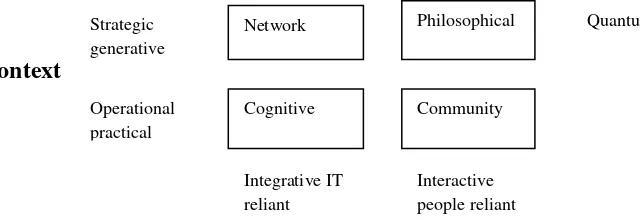
Context
Figure 5: Kakabadse KKM. Source: Kakabadse et al. (2003).
Philosophy based model: This model focuses on the organization’s view or philosophy of knowledge. It provides a high level perspective that requires reflections in areas of practice. Proponents of this model argue that KM needs not be technology centered, but the leading factor is top performers. It is concerned with the epistemology of knowledge or what constitutes knowledge, the relationship of the constituents and other notions such as, truth, justification, causation, doubt and revocability. It is mainly grounded on Socratic view of knowledge as justified true belief and wisdom as highest constituent in the knowledge continuum (Mwangi et al. 2012). The key cultural drivers are maintaining open communication, encouraging deep reflection and learning, creative abrasion and belief justification. Interesting questions created in
relation to this model is “What do we not know that we know?”
Cognitive model: It is deeply embedded in positivistic science as the tool for understanding a mechanical universe driven by single cause-effective relationships. This model is rooted on identification of knowledge as an economic asset and it should be managed and accounted as a part of normal business and a number of efforts are being made to develop procedures for measuring it. It requires careful capture, representation, storage, measurement, preservation and dissemination. It focuses on organizational perspective of knowledge and considers ICT as an
enabler of the KM process. The key focus is on reuse, replication, standardization and ‘weeding’
of outdated routines. Swan and Newell (2000) question the application of this model in rapidly changing environment characterized by technology discontinuity such as software development.
Network model: This model is based on socialization of knowledge and relationships of actors. It focuses on awareness of ideas that exist outside focal organizations that can be adapted for a vantage position. Knowledge work is seen as building social relationships, social capital and attending to reciprocity. It highlights the role of social patterns between individuals and interest groups in knowledge creation, acquisition, sharing and transfer. It inoculates the collaborative aspect of creating knowledge and sharing which is a key factor in software development especially in geographically dispersed teams (Hemetsberger and Reinhardt 2003). It indicates that knowledge is seen as requiring collaboration through networks, allowing teams to use the knowledge for the betterment of the organization. It put less emphasis on individual achievement and more on teamwork. It has the advantage of focusing on external sources of knowledge through interest and practice networks.
The Community of Practice (CoP) model of KM: We have discussed this model in section 10.
Strategic generative
Network
Cognitive Operational
practical
Philosophical
Integrative IT reliant
Community
Interactive people reliant
Quantum model: This model builds on the work of quantum physics. It is based on recent advances in quantum computing, the assumes that application of quantum computing to the constituents of knowledge will lead to high level complexity and improved rationality in decision making as actors in given scenarios in the context of application. It positions knowledge as
scenario‐driven instead of fact‐driven. It makes knowledge dynamic and adjustable to the
scenario instead of referring to the knowledge as a static fact, leaving little room for innovation. It is not appropriate for use in low resourced communities.
12. Skandia Intellectual Capital KMM
The KM was not only seen as the transfer of tacit and explicit knowledge but it has also been
argued as intellectual capital (IC) (Roos and Roos 1997). The Intellectual Capital KMM was
developed in 1994 by a giant Swedish insurance and financial services company called Skandia
as an approach for measuring its IC. Leif Edvinsson (1997), Skandia’s first Director of
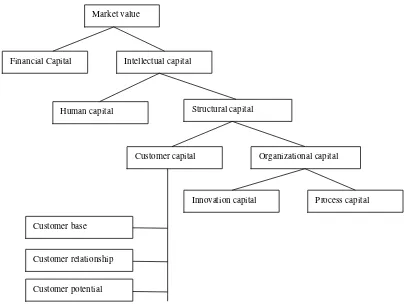
[image:22.612.94.503.317.623.2]Intellectual Capital, proposed the Skandia Intellectual Model (figure 6) which is extensively referred to in IC measurement and research. The model focuses on the importance of equity,
Figure 6: Skandia Intellectual Capital KMM. Source: Edvinsson (1997).
In this model, IC is comprised of human capital and structural capital (Figure 6). Human capital includes knowledge, know-how, skills and personnel expertise of an enterprise. It does not belong to a company but it is hired by the company for a period of time. It will be removed when
Market value
Financial Capital Intellectual capital
Human capital Structural capital
Customer capital Organizational capital
Innovation capital Process capital
Customer base
Customer relationship
staffs resign or retired from the company (Edvinsson et al. 2004). The human capital management is related to KM of employees including maintenance of knowledge base, encouragement, innovation and motivation of employees to transform their tacit knowledge to explicit knowledge (Zhou and Fink 2003). Structural capital is a composite element that includes organizational capital and customer capital. It consists of information and communication systems, management systems, patents and everything that systemizes knowledge of the company and makes it internal and explicit. It has seven main indicators as: business philosophy, organization structure, intellectual property (e.g., research and development), research and development (R&D), process technology, product technology, and IT investment.
Organizational capital is the knowledge that does not go home and stay at the organization. It consists of innovation capital (intellectual property and intangible assets) and process capital (databases and information systems). Customer capital is the external capital which includes the organizational relationships with external factors including customers, suppliers, partners and/or other stakeholders (Edvinsson 1997).
13. Stankosky and Baldanza’s KMM
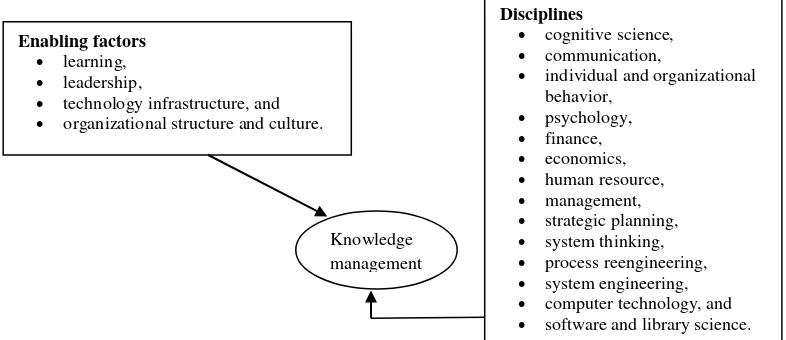
[image:23.612.86.479.445.615.2]Stankosky and Baldanza (2001) developed a KMM which presents the four major foundations of an organization which are important for the KM and its flows are; leadership, organization structure and culture, technology infrastructure, and learning (Figure 7). This framework presents that KM encompasses a wide range of disciplines that include cognitive science, communication, individual and organizational behavior, psychology, finance, economics, human resource, management, strategic planning, system thinking, process reengineering, system engineering, computer technologies, and software and library science. This model states that technology infrastructure should promote the efficient and effective capture of both tacit and explicit knowledge (Stankosky et al. 1999).
Figure 7: Stankosky and Baldanza’s KMM. Source: Stankosky and Baldanza (2001).
Leadership: It requires the leader, who can stay at the top of the organization, and provides leadership needed for cultural changes in the company. Leadership is responsible for practicing strategic planning and systems thinking approaches, making best use of resources, fostering a culture that encourages open dialogue and team learning, and for encouraging and rewarding risk taking, learning and knowledge sharing (Stankosky 2005). It deals with level decision-making
Enabling factors
• learning,
• leadership,
• technology infrastructure, and
• organizational structure and culture.
Knowledge management
Disciplines
• cognitive science,
• communication,
• individual and organizational behavior,
• psychology,
• finance,
• economics,
• human resource,
• management,
• strategic planning,
• system thinking,
• process reengineering,
• system engineering,
• computer technology, and
processes involving the values, objectives, knowledge requirements, knowledge sources,
prioritization and resource allocation of the organization’s knowledge assets. It stresses the need
for integrative management principles and techniques. Key elements for leadership are strategic planning, communication, system thinking and business culture (Stankosky and Baldanza 2001).
Organization structure: It should facilitate personal interactions and support communities of practice (CoP) to capture tacit and explicit knowledge within the organization. Organizational structure in an organization should instill trust among people within the organization and encourage free exchange of knowledge. It should also be concerned with managing change in order to achieve better results. The key elements of organizational structure are functions, processes, procedures, control, measures, formal and informal organizational structures, process improvement, business process reengineering, performance management system, and communication (Stankosky and Baldanza 2001).
Technology infrastructure: It deals with the various information technologies peculiar to supporting and/or enabling KM strategies and operations. It supports the collaboration and codification of KM in the entire organization. It promotes the efficient and effective capture of both tacit and explicit knowledge. By this strategy it is possible to exchange information without formal structures. The key elements of it are communication, virtual teams, electronic mail, intranet, internet, data warehousing, and decision support systems (Stankosky and Baldanza 2001).
Learning: It deals with organizational behavioral aspects and social engineering. It leverages knowledge and focuses on the principles and practices to ensure that individuals collaborate and share knowledge to the maximum. The role of learning is to manage information in order to build enterprise wide knowledge and use that knowledge to organizational learning, change and performance improvement. The key elements are learning communities, virtual teams, communication and a culture of trust (Stankosky and Baldanza 2001).
These four pillars must be balanced in order to avoid failing the whole system. The implementation of the four pillars brings balance in the company during introducing KMS.
14. Kogut and Zander’s KMM
Bruce Kogut and Udo Zander argue that there is a connection between the nature of knowledge and the way of growth a company efficiently. The knowledge-based view of the firm focuses the resource knowledge in the strategic management and proposes that knowledge is the most important resource in creating a sustainable competitive advantage (Figure 10). Their work is
focused on the idea that “What firms do better than markets is the creation and transfer of knowledge within the organization” (Kogut and Zander 1992). Kogut and Zander indicate that in the market view the following three reasons are essential for a company being successful (Kogut and Zander 1996):
▪ The way the company coordinates its activities.
▪ The way the company facilitates communication.
▪ The way the company supports learning, which indicates knowledge creation or the
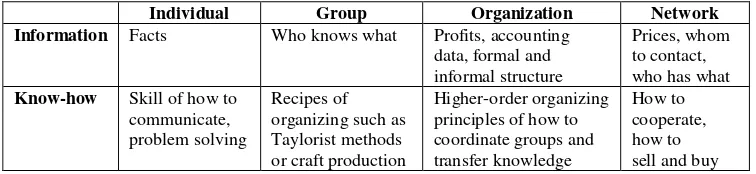
Knowledge is consists of information and know-how. Sharing and transferring of knowledge of individuals and groups within an organization is essential for the existence of organizations and to create network in the society (Table 3). Kogut and Zander have declared that knowledge is not only held by individuals but is also expressed in regularities by which members cooperate in a social community (Kogut and Zander 1992).
Table 3: Various types of knowledge. Source:Kogut and Zander (1992).
Individual Group Organization Network
Information Facts Who knows what Profits, accounting
data, formal and informal structure
Prices, whom to contact, who has what
Know-how Skill of how to communicate, problem solving
Recipes of organizing such as Taylorist methods or craft production
Higher-order organizing principles of how to coordinate groups and transfer knowledge
How to cooperate, how to sell and buy
As social communities firms act as “a repository of capabilities” that are determined by the
social knowledge embedded in enduring individual relationships structured by organizing
principles (Kogut and Zander 1993). The organizing principles refer to as “The organizing
knowledge that establishes the context of discourse and coordination among individuals with disparate expertise and that replicates the organization over time in correspondence to the changing expectations and identity of its members” (Kogut and Zander 1996).
Kogut and Zander (1992) assert that to create efficient organizations the following are necessary for the development of organizations:
• firms are efficient by which knowledge is created and transferred,
• a common understanding is developed by individuals and groups in a firm through
repeated interaction to transfer knowledge from ideas into production and markets,
• what a firm does is not depending on the market’s failure rather the efficiency in the
process of transformation relative to other firms, and
• the firm’s boundary is determined by the difference in knowledge and the embedded
capabilities between the creator and the users, and not market failure.
Kogut and Zander further extend their discussion on the concept of identity that individuals are
“unsocial sociality” where they have both a desire to become a member of community and at the
Figure 8: Kogut and Zander’s KMM. Kogut and Zander (1996).
12. Demerest KMM
Demerest’s KM model emphasizes on the construction of knowledge within an organization, with both scientific and social contributions. According to this model, the implementation of knowledge in an organization is not complete with explicit knowledge but also including the process of social interchange (Demerest 1997). The model does not give a clear definition of knowledge but presents a more holistic approach. Once knowledge is covered within the organization, there is a follow-up process of dissemination of adopted knowledge all through the entire organization and its environments (Rowley 2000). The model shows that there is a process of dissemination of the knowledge throughout the organization and its surrounding. The knowledge is seen as being of economic use in regard to organizational outputs. In this model the flows of knowledge transfer is extremely rapid and circulatory, as in the case for some forms of action learning (Saini 2011).
The model identifies four phases of KM within an organization as: knowledge construction, knowledge dissemination, knowledge use, and knowledge embodiment (Figure 9).
Knowledge construction: It is defined as the process of finding out or structuring a kind of
knowledge. This can include how to diagnose a specific client’s problem (Demerest 1997).
Knowledge dissemination: It involves human processes and technical infrastructure that encompasses knowledge such as, available documents for people to use in the organization, which can explain how to carry out certain tasks (Demerest 1997).
Knowledge use: It indicates the ultimate objective of the knowledge management system, which is the development of commercial value to clients (Demerest 1997).
Knowledge embodiment: It comprises the process of selecting storage place for the created knowledge which can be a document (Demerest 1997).
Knowledge creation
Knowledge transfer
Process and transformation of knowledge
Knowledge capabilities
Individual “unsocial society”