J. Range Manage.
56: 496-500 September 2003
Seed
germination of willow species from a desert riparian ecosystem
JAMES A. YOUNG AND CHARLIE D. CLEMENTS
Authors are Range Scientists, U.S. Department of Agriculture, Agricultural Research Service, Exotic and Invasive Weed Management, 920 Valley Road, Reno, Nev. 89512.
Abstract
The restoration of riverine riparian areas following mechani- cal, herbicidal, or biological control of the invasive species tamarisk (Tamarix ramosissima Ledeb.) is a major issue in the western United States. Recruitment of seedlings of native woody species is necessary in these restoration efforts. Species of willow (Salix) are often considered essential in these efforts. We studied the germination of seeds of tree willow (Salix lutes Nutt.) and coyote willow (S. exigua Nutt.) at a wide range of constant or alternating incubation temperatures. Seeds were collected from native stands in the delta of the Walker River in western Nevada over a 3 year period. Seed germination was very similar for both species. On 2 of the 3 years of testing the seeds had 100% germi- nation at some incubation temperatures and some germination over almost all of the 55 temperature regimes used in the experi- ments. A late frost in May of 2000 markedly reduced total germi- nation of both species, but did not greatly restrict the tempera- ture regimes where some germination occurred. Optimum ger- mination, defined as that not lower than the maximum observed minus one half the confidence interval at the 0.01 level of proba- bility, occurred over a very wide range of temperatures, but for tree willow only the temperature regimes 15/25 (15° C for 12 hours and 25° C for 8 hours in each 24 hour period) and 15/30° C always supported optimum germination. No temperature regime always supported optimum germination of coyote willow seeds, but the most frequent optima tended to be at lower temperatures than for tree willow. Because of the similarity in germination responses and overlapping phenology, seeds of these 2 species probably compete for germination safesites.
Key Words: Salix exigua, S. lutea, coyote and tree willow, incu- bation temperatures, seedbed temperatures
Willow species (Salix sp.) are important components of riparian communities throughout much of North America. They occur as both small to moderate sized trees and as shrubs. Many, but not all of the shrubby willows are browsed by wildlife or domestic livestock (Sampson 1924). Despite having flowers arranged in catkins, willow species are insect pollinated. When they flower, large numbers of insects are attracted to the catkins. Insectivorous birds follow their prey, making willow communities important habitats for birds. In the virtually treeless landscapes of the Great Basin, riverine willow communities often provide the only woody nesting cover for a variety of birds.
Manuscript accepted 7 Oct. 02.
Resumen
La restauracion de areas riberenas despues del control mecanico, quimico o biologico de la especie invasora "Tamarisk"
(Tamarix ramosissima Ledeb.) es un problema mayor en el oeste de Estados Unidos. El establecimiento de plantulas de especies leflosas nativas es necesario en estos esfuerzos de restauracion.
Especies de "Willow" (Salix) a menudo son consideradas esen- ciales en estas acciones de restauracion. Estudiamos la germi- nacion de semillas de "Tree willow" (Salix lutea Nutt.) y "Coyote willow" (S. exigua Nutt.) en un amplio rango de temperaturas de incubacion constantes y alternantes. Las semillas se colectaron durante un periodo de 3 anos en poblaciones nativas del delta del rio Walker en el oeste de Nevada. La germinacion de la semilla fue muy similar para ambas especies. En 2 de 3 anos de prueba, las semillas tuvieron 100% de germinacion en algunas de las temperaturas de incubacion y algo de germinacion en casi todos los 55 regimens de temperatura evaluados en el experimento.
Una helada tardia en Mayo de 2000 redujo marcadamente la germinacion total de ambas especies, pero no restringio grande- mente los regimenes de temperatura donde algo de germinacion ocurrio. La germinacion optima, definida como no menos que el maximo observado menos una mitad del intervalo de confianza a un nivel de significancia de 0.01, ocurrio en un amplio rango de temperaturas, pero para "Tree willow"solo los regimenes de temperatura 15/25 (15° C por 12 horas y 25° C por 8 horas en cada periodo de 24 horas) y 15/30° C siempre produjeron la maxima germinacion. No hubo un regimen de temperatura que mantuviera la germinacion optima para las semillas de "Coyote willow", pero la germinacion optima tiende a ser a mas bajas temperaturas que para el "Tree willow". Debido a la similitud en la respuestas de germinacion y la frenologia que se traslapa, las semillas de en estas dos especies probablemente compitan por sitios seguros para germinacion.
In the central Great Basin and extending throughout the Southwest, the exotic shrub or small tree tamarisk (Tamarix ramosissima Ledeb.) has invaded vast reaches of riverine habi- tats. On any specific sites it is an open question if tamarisk replaced the native woody species or the woody species were destroyed and tamarisk invaded the ecological void. Currently, limited releases have been made in the Great Basin of a biologi- cal control agent for the suppression of tamarisk. A beetle (Diorhabdo elongata), imported from Asia, shows promise for suppressing tamarisk. Will this biological suppression lead to seedling recruitment of the native woody species?
The western Great Basin riverine ripari- an areas most impacted by the invasion of tamarisk are the sink of the Humboldt River, the north sink of the Carson River in the Stillwater marsh area, and the delta of the Walker River. The Humboldt River sink is naturally treeless. The north dis- charge arm of the Carson River has well developed gallery forest of Fremont cot- tonwood (Populus fremontii S. Watson), almond willow (Salix amygduloides Anderson), tree willow (S. lutea Nutt.), coyote willow (S. exigua Nutt.), buffalo berry (Shepherdia argentea Nutt.) and the exotic Russian olive (Elaeagnus angusti- folius L.). In the Stillwater marsh itself, there are vast linear stands of tamarisk on water control structures and along road banks. The few Fremont cottonwoods pre- sent are probably adventive since tail water was delivered to the area as drainage from the Newlands Irrigation District.
The delta of the Walker River is the site of one of the most extensive stands of tamarisk. In 1909 the shore of Walker Lake was located just south of Schurz, Nevada. Up-stream diversion of water for agricultural, municipal, and wildlife habi- tat uses in both California and Nevada have resulted in a dramatic drop in lake level. The river currently periodically enters the lake about 25 km to the south and about 100 m lower in elevation than the 1909 shore level based on unpublished maps on file with the Walker River Paiute tribe. The vast lake plain exposed by this drying has been incised by the meandering Walker River as it attempts to erode to a new base level. Tamarisk, Fremont cotton- wood, tree, and coyote willow invasion has followed the dropping lake level.
Tamarisk has been the much more suc- cessful of these woody species. Coyote willow is the second most abundant
species, probably because it forms exten- sive clonal stands. Tree willow and Fremont cottonwood are both heavily preyed upon by beavers (Castor canaden- sis). Fremont cottonwood has also been utilized as a source of fuel wood.
Fremont cottonwood and the willow species belong to the family Salocaceae.
Tamarisk is a member of the completely un-related family Tamaricaceae. Despite having no phylogenetic relationship,
Fremont cottonwood, tree, and coyote wil- low all produce relatively small seeds that are wind dispersed with the aide of seed borne hairs, and have very short periods of seed of viability. The seeds of all of these species require quite specific moist seedbeds for germination and seedling establishment. As a first step in under-
standing the seed and seedbed ecology of these species, our purpose in this study was to investigate the germination of seeds of tree and coyote willow at a wide range of constant and alternating tempera- ture regimes.
Methods
Seeds of tree and coyote willow were harvested from native stands located in the Walker River delta (38° 53.539'N 118°
46.733°) Win 1999, 2000, and 2001. The seeds were collected at maturity in late May or early June each year. Seeds were collected from many different trees over an extensive area of the delta. The seeds were transported to the laboratory and the experiments established immediately, with as little time as possible between collec- tion and the seeds being wet in the germi- nation plates.
In all experiments 4 replications of 25 seeds each were used in a randomized block design. Seeds were placed on top of non-toxic commercial germination paper in closed Petri dishes and kept wet with tap water. Germination trials were con- ducted in the dark. Seeds were considered germinated when the radical emerged 5 mm. Germination counts were made after 1, 2, and 4 weeks incubation. Constant incubation temperatures were 0, 2, and 5 ° C and at 5 degree increments through 40°
C. In addition, alternating regimes includ- ed 16 hours at each constant temperature, plus 8 hours at each possible higher tem- perature per 24 hours. For example, 35° C alternated with 40° C only, while 0° C alternated with 2, 5,10,15, 20, 25, 30, 35, and 40° C. This made a total of 55 con- stant and alternating temperature regimes (Young et al. 1991).
The germination response of seeds of the 2 species of willow was compared using the seedbed temperature definitions (Young and Evans 1982):
a. Very cold: 0/0 (constant 0° C), 012 (0°
C for 16 hours and 2° C for 8 hours in each 24 hours), 0/5 and 2/2° C.
b. Cold: 0/10, 0/15, 2/5, 2/10, 2/15, 515,
and 5/10° C.
c. Cold fluctuating: 0/20, through 0/40° C and 2/20 through 2/40° C.
d. Fluctuating: 5/30 through 5/40° C, 10/35,10/40,15/40° C.
e. Moderate: 5/15 through 5/25, 10/10 through 10/30° C, 15/15 through
15/35° C, 20/20 through 30/35° C, and 25/35° C.
f. Warm: 20/40, 25/35, and 25/40° C, 30/30 through 30/40° C, 35/35, 35/40, and 40/40° C.
The categories of seedbed temperatures reflect germination environments of field seedbeds based on several years of moni- toring in the Great Basin (Evans et al.
1970, Evans and Young 1970, 1972).
Data from each base temperature and its alternating temperature regimes were used to generate a quadratic response surface with estimated means and confidence intervals at the 1 % level of probability (Young et al. 1980, Evans et al. 1982). A number of germination parameters were calculated from the quadratic response surfaces (Table 1) (Young and Evans 1982). Profiles were compared using the multiple response surface comparison method described by Palmquist et al.
1987.
Results and Discussion
The seeds of willow species are small, fragile, light, and sufficiently aerodynamic to be dispersed by the wind. The aerody- namics is enhanced by relative dense cov- ering of silky hairs. These hairs are many times longer than the diameter of the seed.
The seeds of most species of willow only remain viable for short periods of time (Young and Young 1992).
It is immediately apparent when you examine the temperature-germination pro- files for tree (Table 2) and coyote willow (Table 3) that the seeds of these species germinate over a wide range of constant or
alternating incubation temperatures.
Coyote willow seeds germinated at all 55 temperatures tested and tree willow seeds had some germination at all temperature regimes except a constant 40° C.
The second factor that is apparent when examining the profiles is the seeds of both species are highly viable with 100% ger- mination occurring at least at 1 tempera- ture regime (Tables 2 and 3). At least 90%
germination occurred over a wide range of temperatures.
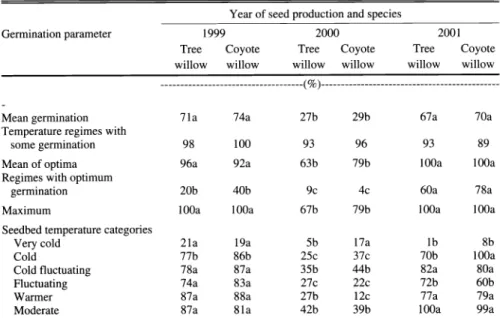
Germination responses were very simi- lar for the seeds of both species for the 1999 and 2001 seed production years (Table 4). In 2000 a severe frost occurred on May This dropped average germi- nation from an average of 67 to 74% for both species to 27 to 29%. Maximum ger- mination dropped from 100% to 67 to 79%. Despite the severe late frost, some germination occurred at 93 and 96% of the temperature tested for tree and coyote wil- low respectively.
JOURNAL OF RANGE MANAGEMENT 56(5) September 2003 497
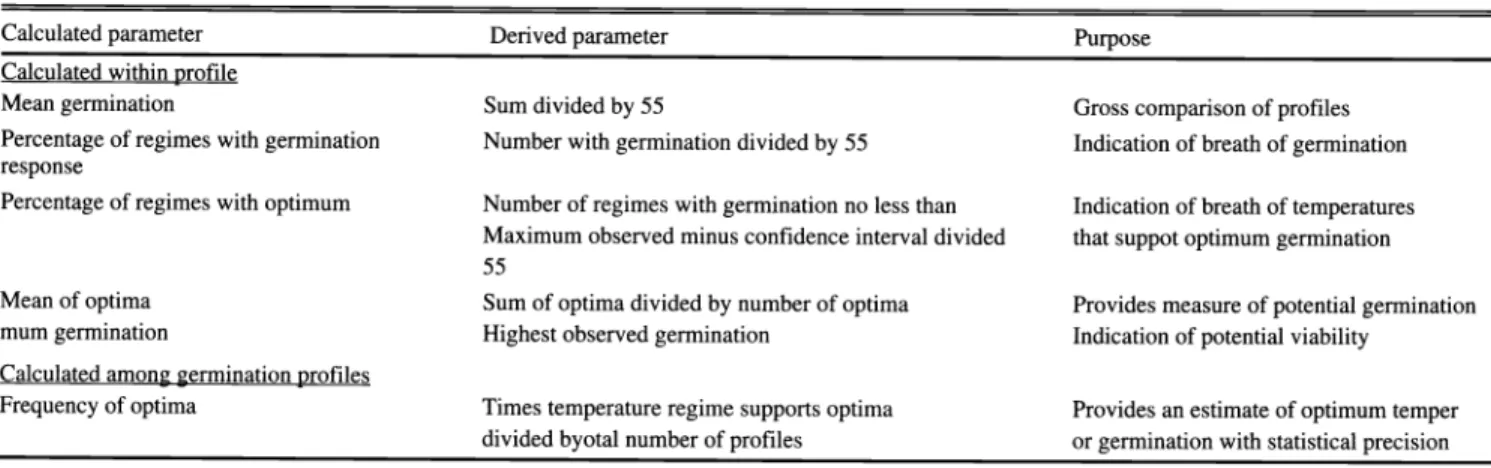
Table 1. Germination parameters calculated from quadratic response surfaces (Young and Evans 1982).
Calculated parameter Derived parameter Purpose
Calculated within profile
Mean germination Sum divided by 55 Gross comparison of profiles
Percentage of regimes with germination Number with germination divided by 55 Indication of breath of germination response
Percentage of regimes with optimum Number of regimes with germination no less than Indication of breath of temperatures Maximum observed minus confidence interval divided that suppot optimum germination 55
Mean of optima Sum of optima divided by number of optima Provides measure of potential germination
mum germination Highest observed germination Indication of potential viability
Calculated among germination profiles
Frequency of optima Times temperature regime supports optima Provides an estimate of optimum temper divided byotal number of profiles or germination with statistical precision
Table 2. Quadratic response surface with estimated percentage germination and confidence interval (P > 0.01) for seeds of tree willow incubated at 55 constant or alternating temperatures. Seed produced in the Walker River Delta in 1999.1
Cold period temperature C
0 2
Percentage germination Warm period temperature C
5 10 15 20 25 30 35 40
(C°)
0 15±11 24±10 90 ± 13 14
2 35 + 90±11
5 585±17 98±8* 80±8 88±11 96±6* 88±11 86±12 58±9
10 70±16 76±6 86±10 [100±4* 100±8]* 94±10 80±12
15 70±8 88±8 [100±10] *98±8* 90±8 90±11
20 90±13 80±19 88 ± 14 94±14* 96±9*
25 78 ± 12 80±9 98±1 84±14
30 90±9 84±10 80±16
35 76±16 60±18
40 0+20
Number following mean is one half the confidence interval as determined from regression equations used to develop response surface (Palmquist et al. 1987). The maximum calcu- lated germination is enclosed by brackets [ ]. Means not lower than the maximum and one half of its confidence interval, our definition of optimum germination, are marked with and asterisk *.
We define optimum germination by relating optima to the maximum germina- tion minus one half of its confidence inter- val at the 0.01 level of probability. Note that in the 3 years of testing the mean of optima and percentage of regimes support-
ing optima did not significantly vary between tree and coyote willow (Table 4).
Only in 2000 when the seed quality was lowered by frost damage was the mean of optima lower for both species. The per- centage of temperature regimes supporting
optimum germination differed significant- ly for both species for each year of seed production. Seed quality was exceptional for both species in 2001. To have 60 and 78% of the temperature regimes support- ing optimum germination when the maxi-
Table 3. Quadratic response surface with estimated percentage germination and confidence interval (P > 0.01) for seeds of coyote willow incubated at 55 constant or alternating temperatures. Seed produced in the Walker River Delta in 1999.1
Cold period temperature C
0 2
Percentage germination Warm period temperature C
5 10 15 20 25 30 35 40
(C°)
1 0+9 15+7 70±8 80±8 [100+101* 90±8* 90±8 85±11 80±9 80±11
2 15+7 72±6 90±11* 95±11* 90±10* 90±9* 90±9* 89±11 80±9
5 80±11 85±9 90±8* 92±9* 90±10* 84±10 85±10 80±7
10 90±11* 92±9* 86±9 84±7 82±6 80±8 78±11
15 70±11 89±9 90±8* 85±10 90±11* 85±8
20 85+7 90±9* 95±4* 90±10 80±9
25 80±11 96±7* 95±8* 90±9*
30 98±10* 86±5 80±12
35 95±10* 70 + 14
40 10 ± 14
Table 4. Comparison of temperature germination profiles for seeds of tree and coyote willow col- lected in the Walker River delta in 1999, 2000, and 2001.
Year of seed production and species
Germination parameter 1999 2000
Tree willow
Coyote
willow willow willow willow willow ---(%)---
Mean germination 71a 74a
Temperature regimes with
some germination 98
Mean of optima 96a 92a
Regimes with optimum
germination 20b
Maximum 100a 100a
Seedbed temperature categories
Very cold 21a
Cold 77b 86b
Cold fluctuating 78a 87a
Fluctuating 74a 83a
Warmer 87a 88a
Moderate 87a 81a
'Means within rows followed by the same letter are not significantly different at the 0.01 of probability based on over- lap of the confidence intervals (Palmquist et a1.1987).
mum observed is 100% exceeds the species potential of any of the some 800 temperature-germination profiles that have been completed in our laboratory.
In terms of categories of seedbed tem- peratures, the seeds of both species of wil- low had exceptional germination at every category except very cold temperatures (Table 4). Very cold temperatures are characteristic of seedbeds that freeze at night and barely thaw during the day.
Even in 2000 when the seed quality was damaged by frost, there was some germi- nation at very cold seedbed temperatures.
Surprisingly, in 2001 when overall germi- nation responses were the highest, the ger- mination of both species was the lowest at very cold temperatures, but the highest at the cold category of seedbed temperatures (Table 4).
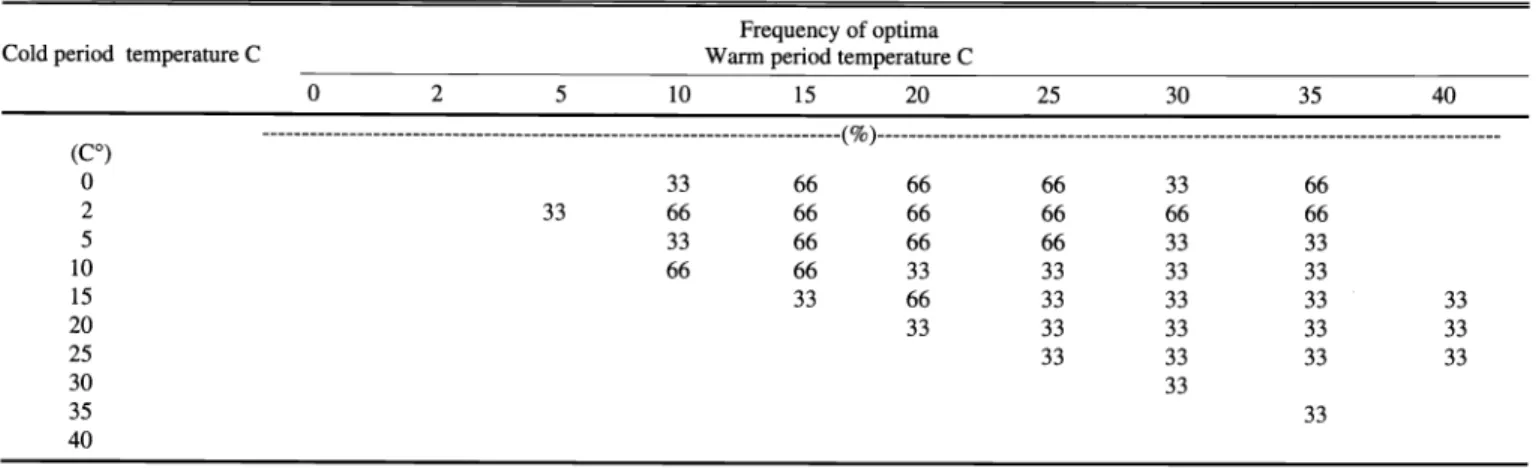
The frequency that a given temperature supports optimum germination provides an excellent indication of the true opti- mum temperature for germination of seeds of a given species. For tree willow seeds, only 15/25 ° C (16 hours at 15 ° C and 8
hours at 25° C in each 24 hours period) and 15/30° C always supported optimum germination (Table 5). For coyote willow seeds, no single temperature regime always supported optimum germination (Table 6).
Optima were spread over a vast range of temperatures from a constant 2° C to 30° C and included 10/40, 15/40, and 20/40° C.
Two thirds of the time 29% of the tempera- ture regimes supported optimum germina- tion. These temperatures were generally colder than the 100% constancy regimes for tree willow. Some of the 66% frequen- cy temperature regimes for optimum ger-
mination extended into regimes with 0° C cold period temperatures.
Despite their world-wide distribution and ecological importance, very little research has been conducted on the seed and seedbed ecology of the willow species. The seeds have a very transitory period of viability making them available for research purposes for only a very short period annually. The hair covered seeds are difficult to collect, process, and count.
In forestry and horticulture most species of willow can readily be propagated by cuttings. Junttila (1976) determined that for 4 species of willows from Norway, optimum temperatures for germination ranged from 26 to 32° C. The optima for tree and coyote willow seed extend broad- er than this range, but certainly cover these incubation temperatures. In one of the few other germination studies for wil- low seeds and incubation temperatures, Gorobets (1978) found that seeds of 2 species of Russian willows could germi- nate at a wide range of temperatures.
Tree willow and coyote willow grow in the Walker River Delta sympatricly. There growth forms are radically different. As the name implies, tree willow tends to form a single dominant trunk and becomes a small tree. Coyote willow occurs in dense clumps with multiple stems more or less the same size. Coyote willow clumps are much more abundant than the tree wil- lows, but beavers prefer tree willows and generally shun coyote willow stems. In the Walker River delta, cattle prefer the tree willow browse and there seldom is evi- dence of browsing on coyote willow.
Comparing the germination of these 2 species of willow, it is obvious that in terms of germination requirements for incubation temperature they are very simi- lar. They both produce super abundant, highly viable, widely distributed seeds.
Conventional observations and nursery
Table 5. Frequency that a given temperature regime supported optimum germination of seeds of tree willow collected in the Walker River delta from 1999 through 2001.
Cold period temperature C
Frequency of optima Warm period temperature C
0 2 5 10 15
0 33
2 66 66
5 33 33
3 33
15 33 66
20 33 66 3
25 33 33
30 33 33
35 33
4
JOURNAL OF RANGE MANAGEMENT 56(5) September 2003 499
Table 6. Frequency that a given temperature regime supported optimum germination of seeds of coyote willow collected in the Walker River delta from 1999 through 2001.
Cold period temperature C
Frequency of optima Warm period temperature C
0 2 5 10
(C°)
0 33
2 33 66
5 33 66
10 66 66
15 33 66
20 33 33
25 33 33
30 33
35 33
40
practices (Young and Young 1992), sug- gest that willow seeds must disperse to damp sandy to silt seedbeds soon after maturity to have a chance for seedling establishment. In the Walker River delta, tree and coyote willow seeds probably compete for the same safe sites for germi- nation and establishment. Their phenology of flowering and seed dispersal is quite close, but tree willow usually disperses seeds before coyote willow.
The management of riverine willow populations to enhance seedling recruit- ment is obviously a very complex under taking. This study provides a first step toward understanding the seed and seedbed ecology of these species.
Literature Cited
Evans, R. A. and J. A. Young. 1970. Plant lit- ter and establishment of alien annual species in rangeland communities. Weed Sci.
18:697-703.
Evans, R. A. and J. A. Young. 1972.
Microsite requirements for establishment of alien annual species in rangeland communi- ties. Weed Sci. 20:350-356.
Evans, R. A., D. A. Easi, D. N. Book, and J.
A. Young. 1982. Quadratic response surface analysis of seed germination trials. Weed Sci.
30:411-416.
Evans, R. A., H. R. Holbo, R. E. Eckert, Jr., and J. A. Young. 1970. Functional environ- ment of downy brome communities in rela- tion to weed control and revegetation. Weed Sci. 18:154-162.
Gorobets, A. M. 1978. Experimental-ecologi- cal study of seed germination. Germination of Salix phylicifolia and S. caprea seed.
Vestnik. Biologia Leningradski Univ. pp.
57-62.
Junttila, 0. 1976. Seed germination and viabil- ity in five Salix species. Astarte 9:19-24.
Palmquist, D. E., R. A. Evans, and J. A.
Young. 1987. Comparative analysis of tem- perature response surfaces. pp. 97-103 In: G.
W. Frasier and R. A. Evans (eds.) Seed and Seedbed Ecology of Rangeland Plants.
USDA, Agr. Res. Ser., Washington, D. C.
Sampson, A. W. 1924. Native American for- age plants. John Wiley and Sons, New York, N.Y.
Young, J. A. and R. A. Evans. 1982.
Temperature profiles for germination of cool season grasses. ARR-W-72, USDA, ARS, Oakland, Calif.
Young, J. A. and C. G. Young. 1992. Seeds of Woody Plants of North America. pp.
310-312 Salicaceae - Willow Family.
Dioscorides Press, Portland Ore.
Young, J. A., Palmquist, and R. A. Evans.
1991. Temperature profiles for germination of big sagebrush seeds from stands. J. Range
Manage. 44:385-390.
Young, J. A., B. L. Kay, H. George, and R.
A. Evans. 1980. Germination of three species of Atriplex. Agron. J. 72:705-709.