Proceedings of the 55th Annual Meeting of the Association for Computational Linguistics (Short Papers), pages 459–464 Vancouver, Canada, July 30 - August 4, 2017. c2017 Association for Computational Linguistics
Proceedings of the 55th Annual Meeting of the Association for Computational Linguistics (Short Papers), pages 459–464 Vancouver, Canada, July 30 - August 4, 2017. c2017 Association for Computational Linguistics
Multilingual Connotation Frames: A Case Study on Social Media
for Targeted Sentiment Analysis and Forecast
Hannah Rashkin† Eric Bell‡ Yejin Choi† Svitlana Volkova‡
†Paul G. Allen School of Computer Science & Engineering, University of Washington {hrashkin,yejin}@cs.washington.edu
‡Data Sciences and Analytics, Pacific Northwest National Laboratory {eric.bell,svitlana.volkova}@pnnl.gov
Abstract
People around the globe respond to ma-jor real world events through social me-dia. To study targeted public sentiments across many languages and geographic lo-cations, we introduce multilingual con-notation frames: an extension from En-glish connotation frames ofRashkin et al. (2016) with 10 additional European lan-guages, focusing on the implied senti-ments among event participants engaged in a frame. As a case study, we present large scale analysis on targeted public sen-timents toward salient events and entities using 1.2 million multilingual connotation frames extracted from Twitter.
1 Introduction
People around the globe use social media to ex-press their reflections and opinions on major real world events (Atefeh and Khreich,2015;Radinsky and Horvitz, 2013). In order to facilitate multi-lingual public sentiment tracking on social media, we introducemultilingual connotation frames,1 a
multilingual extension from English connotation frames ofRashkin et al.(2016) with 10 additional European languages, including low-resource lan-guages such as Polish, Finnish, and Russian.
Definition 1.1. Connotation Frames: A
frame-work for encoding predicate-specific connotative relationships implied by a predicate towards its ar-guments.
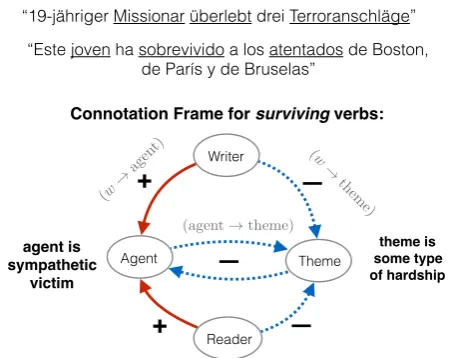
Figure1shows a selected subset of the conno-tation frames that is relevant in our study. See Rashkin et al.(2016) for the full description of the connotation frames.
1Publicly available at homes.cs.washington.
edu/~hrashkin/multicf.html.
English Verb: survive
Other languages: survivre, sobrevivir, überleben…
“L'incroyable miraculé des explosions à Brussels: ce Mormon avait déjà survécu aux attentats de Boston et de Paris”
“Este joven ha sobrevivido a los atentados de Boston, de París y de Bruselas”
“US teenager … also survived Boston Marathon bombing”
“19-jähriger Missionar überlebt drei Terroranschläge”
Example Tweets
Writer
=
Reader
Agent Theme
P(w !age
nt) P(w
!
the m
e)
P(agent!theme)
theme is some type of hardship
agent is sympathetic
victim
—
—
—
Connotation Frame for surviving verbs:
+
+
—
—
—
Figure 1: The connotation frame of“survive”with respect to directional sentiments among“writer”, “agent”, “theme”, and“reader”. The tweet examples show automatically in-duced multilingual connotation frames.
There are two important benefits to develop multilingual connotation frames. First, they serve as a unique lexical resource to enabletargeted sen-timent analysis, which rarely exists for most lan-guages.
Definition 1.2. Targeted Sentiment: A sentiment label indicating how a source entity feels about a target entity.
In the example shown in Figure 1, “teenager survived Boston Marathon bombing”, the conno-tation frame allows us to correctly interpret (im-plied) targeted sentiments including:
1. sentiment(teenager→bombing) = – 2. sentiment(writer→bombing) = –
3. sentiment(writer→teenager) = +
Second, they allow us to study a broad spectrum of sentiments including nuanced ones; in the
[image:1.595.307.534.285.464.2]Lang # Tuples Examples
[image:2.595.73.289.63.196.2]EN 643,004 (korea, fires, missile) ES 305,310 (acuerdo, vulnera, derecho) FR 85,286 (obama, quitte, cuba) PT 76,849 (valentino, renova, contrato) RU 28,511 (путин, обсуди, моста) DE 23,197 (seehofer, lösen, flüchtlingskrise) NL 14,091 (artiesten, bevestigd, komst) IT 13,586 (conte, lascia, nazionale) FI 2,859 (hans, tekemään, valintansa) SV 2,229 (rubio, avslutar, kampanj) PL 2,226 (papie˙z, wyrazi, zgod˛e)
Table 1: The number and the example of (agent, verb, theme) tuples extracted from tweets across languages.
amples discussed above, connotation frames allow us to infer (1) the likely sentiment among the event participants (e.g., a surviving teenager is likely to be negative toward the Boston bombing), and (2) the likely sentiment of the author towards events and entities (e.g., the writer is likely to be sympa-thetic toward the teenager while negative toward the incident), even though none of these sentiment implications are overtly expressed.
To validate the empirical utility of the new mul-tilingual connotation lexicon, we present a suc-cessful case study of large scale connotation anal-ysis (Section 4.1) and forecast (Section 4.2) based on connotation frames extracted from 1.2 million tweets in 10 different European languages span-ning over a 15 day period.
2 Multilingual Twitter Dataset
We obtained multilingual geo-located tweets span-ning Mar 15 – Mar 29, 2016. This 15 day dura-tion covers Brussels attacks on Mar 22 as well as one whole week before and after, allowing us to study the public sentiment dynamics in response to a major terrorist event. We focus on tweets that are likely to be about “news-worthy” topics by selecting tweets that came from trusted sources such as twitter-verified accounts or known news accounts, or contained hashtags #breaking or
#news.2 We used SyntaxNet dependency parser
(Andor et al., 2016) and trained additional Syn-taxNet models for 10 non-English languages us-ing Universal Dependencies annotations.3 We
extracted 1.2 million agent-verb-theme tuples as listed in Table1.
2We experimented with other automatic ways of find-ing news sources by identifyfind-ing popular hashtags, but this method did not translate well to other languages.
3http://universaldependencies.org/
0 1 0
.3 .4 .3
.3 .6 .1
.3 .4 .3
LSTM Fully connected
softmax layer
Input distribution
vectors
+ =
—
Mar 21
(UK
→
Brussels)
Mar 22
(UK
→
Brussels)
Mar 23
(UK
→
Brussels)
Mar 24
(UK
→
Brussels)
Predicted Distrib: Mar 25 (UK → Brussels)
}
}
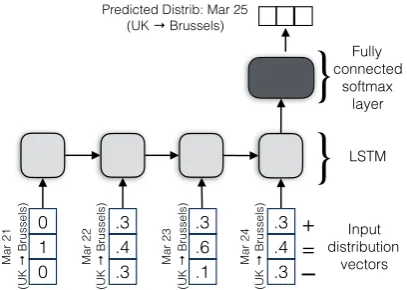
Figure 2: Diagram of LSTM model for predicting the distri-bution of perspectives from a location (e.g., UK) towards an entity (e.g., Brussels) on a given day (e.g., March 25), based on the previous days.
3 Methods
3.1 Multilingual Connotation Frames
We perform context-based projection of English connotation frames to 10 additional European lan-guages using large parallel corpora. Since conno-tation of a word arises from the context in which the word is used, we want to ensure the trans-lated connotation frames are used in similar con-texts. We use existing parallel corpora with auto-matic word-alignment: the Opus Corpus ( Tiede-mann,2012) using Multi-UN parallel data (Eisele and Chen,2010) for Russian and EuroParl parallel data (Koehn,2005) for all other languages.
More concretely, for each non-English verb, v0
(e.g.,assassinerin French), we compute the prob-ability of it being translated to English verbv by
counting the alignments.
We then define the connotation frame of v0,
F(v0), by transferring the connotation frame of the
English verbv∗,F(v∗), that has the highest
trans-lation probability:
v∗=argmaxvp(v|v0) F(v0) =F(v∗)
For example, the connotation frame forassassiner is propagated frommurder, the English word that it is aligned with the most.
3.2 Extracting Targeted Sentiments
[image:2.595.315.519.66.211.2]Brussels attacks +aftermath News story about Clinton “killing” mines Arrest of
terror suspect Abdeslam
terror suspect accepts arrest and extradition
most negative about terror
suspect Stories in English tweets from
Russia about how Apple had “assaulted” FBI by refusing to help in their investigations
Similar to the English tweets from Russia, the Russian tweets about Apple are also
less positive than towards most of the other entities.
+
[image:3.595.81.520.62.282.2]
-+
Figure 3: Heatmap of expected perspectives towards 13 named entities over 2 week period using only English tweets from European countries. Red is more positive, blue is more negative.
country by aggregating all sentiments of the writ-ers located in that country (e.g., the distribution of positive, neutral, and negative perspectives ex-pressed towards Obama in British tweets). The aggregated polarities can be represented as a 3-dimensional probability vector,p= [p+p=p−], as
will be used in the sentiment forecast task below. For other analysis, we summarize this polarity dis-tribution as a scalar score by taking the expected value of the polarity:E[p] =p+−p−.
3.3 Forecasting Sentiment Dynamics
We also study forecasting sentiment dynamics: predicting the sentiment distribution of the next day given the sentiment trend of previous days. For this task, we track the distribution of direc-tional sentiments from each country towards the hundred most-frequently-mentioned named enti-ties. At test-time, each model is given directional sentiment distributions for the previous 4 days as input and predicts tomorrow’s distribution (e.g., forecasting 1 day ahead). We also train models for predicting the distribution half a week later (fore-casting 4 days ahead).
We performed an additional experiment for En-glish (ENJ) where the perspectives of all
coun-tries are aggregated together in order to predict the global perspective. For all experiments, we use 10-fold cross-validation and measure the symmet-ric Kullback-Leibler (KL) divergence between the true distribution and the predicted one.
We experiment with Long Short-term Memory
models (LSTMs) (Hochreiter and Schmidhuber, 1997) to integrate the dynamic contextual infor-mation from the past, as depicted in 2. Hidden dimension is 16, and we use ADAM optimization with KL divergence as the objective. For imple-mentation, we use Keras4on top of Theano.5
Baselines We use two baselines. The first is
MEAN, the average distribution seen in the
train-ing data. The second are SVMs with linear ker-nels, which worked well in predicting influenza activity in a similar set-up (Santillana et al.,2015). For the baselines, we encode the distributions from the 4 previous days as a flattened 12-dim. vector, and each portion of the distribution is predicted separately.
4 Results
4.1 Connotation Analysis
For the most frequently mentioned named entities, we compute heatmaps of the expected perspective being expressed towards that entity.
In Figure 3A, we use the English tweets from European countries to plot the change in connota-tive polarity towards these entities over the course of the 15 day period. Generally, the changes in polarity from day-to-day seem to be gradual and frequently are similar to the day before. There are a couple of exceptions e.g., the polarity towards
4https://keras.io
5https://deeplearning.net/software/
Brussels changes abruptly on March 22 (the day of the Brussels attacks), reflecting the change in tone of all tweets related to Brussels at that time.
Overall, there are mostly positive polarities ex-pressed. This may reflect people’s tendency to avoid phrasing stories too harshly, choosing to be more euphemistic even when they discuss bad news.
In Figure 3B, we aggregated the polarities of these tweets by country of origin. While most of the polarities are positive-strongly positive, the tweets about Brussels and Belgium are more neu-tral or even slightly negative.
Lastly, in Figure 3C, we used all of the tweets from European countries to aggregate expected polarities in 11 different languages. Non-English languages show a much higher tendency towards positive scores, particularly the languages with less tweets (Polish, Finnish, Swedish).
en es ru fr de pt it nl pl fi sv
Mar 29 Mar 28 Mar 27 Mar 26 Mar 25 Mar 24 Mar 23 Mar 22Mar 21 Mar 20 Mar 19 Mar 18 Mar 17 Mar 16 Mar 15
[image:4.595.94.277.331.472.2]0.8 0.4 0.0 0.4 0.8
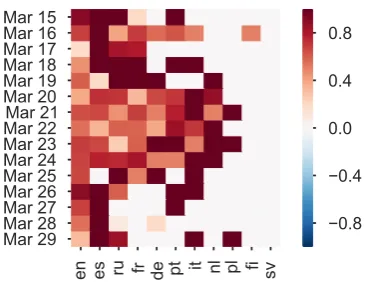
Figure 4: Heatmap of perspectives towards Obama over time in 11 different languages.
As a more detailed analysis, Figure 4 shows a heatmap of how the connotation expressed to-wards Obama shifts over time across different lan-guages. Obama was not discussed much in Finnish or Swedish, whereas he was discussed everyday in English, Spanish, and Russian. In the middle of the two week period, the perspective towards Obama drops slightly, most notably in Spanish, which overlaps with his controversial trip to Cuba (March 20 – 22).
4.2 Sentiment Dynamics
In Table 2, we summarize the results of our ex-periments for predicting targetted sentiment dy-namics. For each language, we report the average Kullback-Leibler divergence for the baselines and the LSTM model (higher scores are worse). We show prediction results in two settings: predicting
Forecast + 1 day Forecast + 4 days Data Mean SVM LSTM Mean SVM LSTM
ENJ 1.96 1.76 1.67 2.03 2.14 2.02
EN 4.88 1.94 1.79 5.12 3.91 3.91 RU 4.27 1.72 1.34 4.50 3.11 2.74 FR 2.23 1.80 1.76 4.33 3.24 3.12 ES 3.57 2.02 1.82 3.74 3.22 2.98 DE 4.43 2.24 1.77 4.73 3.61 3.55 NL 3.69 2.62 2.05 3.83 3.71 3.41 PT 3.84 1.97 2.04 3.94 3.03 3.11 IT 4.56 2.08 1.97 4.67 3.48 3.28 PL 4.01 1.67 1.46 4.06 3.37 3.32 SV 4.01 1.92 0.76 4.17 2.70 2.23 FI 4.90 2.04 1.84 4.99 4.14 4.20
Table 2: Average Kullback-Leibler divergence of output of the LSTM in predicting the distribution of writers’ perspec-tives per entity for 11 different languages. In the first row, the perspectives from all countries are aggregated together.
the distribution one day ahead vs. four days ahead. The LSTM outperforms the baselines in most languages with a few exceptions, such as Por-tuguese. All models perform worse at forecasting 4 days into the future than one day ahead, demon-strating how much connotation can vary over time as news events change, even in a small time period. On average, the LSTM achieves KL-divergence of 1.7 when predicting one day ahead and 3.26 when predicting 4 days ahead, lower than any of the baselines.
4.3 Error Analysis
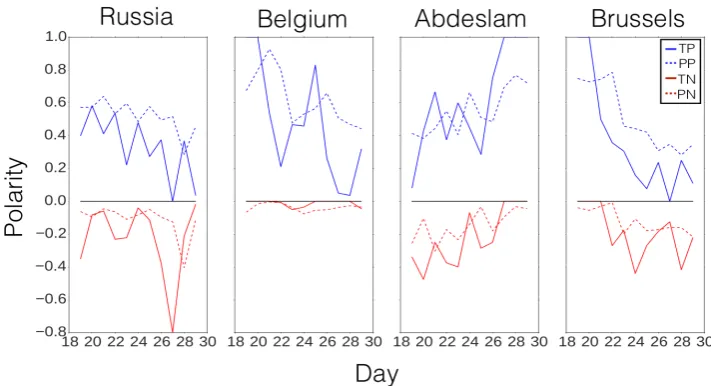
For error analysis, we removed entities from Fig-ure 3 from the training data and used them as a small test set for an LSTM trained on the remain-ing data in English with aggregation over all coun-tries. In Figure 5, we have plotted the predicted marginal probabilities of four entities with the pos-itive portion of the distribution (blue line) on the top half of the y-axis and the negative portion (red line) flipped onto the negative half of the axis.
The LSTM follows the general shape of the true curves, but frequently misses sudden spikes (e.g., the spike in negative polarity towards Russia on March 27th). In Table 3, we also report the KL divergences on predictions towards these entities. The model tends to perform less well at predicting sentiment towards entities where there were sud-den spikes in sentiment based on news stories.
5 Related Work
Figure 5: True versus predicted polarity distributions over time on three specific entities (TP: True Positive, PP: Predicted Positive, TN: True Negative, PN: Predicted Negative).
Entity KL Entity KL Entity KL
[image:5.595.116.472.65.258.2]Trump 0.12 England 0.14 EU 0.22 Obama 0.25 Turkey 0.30 Google 0.32 apple 0.37 Russia 0.76 Belgium 0.95 Clinton 1.13 Brussels 1.14 Abdeslam 1.79
Table 3: Error analysis on held-out entities.
Liu and Zhang, 2012), as well as targetted senti-ment (Deng and Wiebe,2015), implicit sentiment (Deng and Wiebe,2014;Feng et al.,2013;Greene and Resnik, 2009) and specific aspects of sub-jective language (Mohammad and Turney, 2010; Choi and Wiebe, 2014) in other domains. Pre-vious investigations include using targetted senti-ment to predict international relations (Chambers et al., 2015), analyzing stylistic elements to pre-dict tweet popularity (Tan et al., 2014), and ex-ploring the re-phrasing of social media posts ref-erencing specific news articles (Tan et al.,2016). Compared to most prior studies that focused on overt sentiment in English-only tweets, our work aims to study targeted implied sentiments across temporal, spatial, and linguistic borders.
Some work (Tsytsarau et al., 2014;O’Connor et al.,2010;De et al.,2016) has analyzed the tran-sition of overt sentiment over a period of time and related the shifts in sentiment to news events. A body of work has also used predictive signals in Twitter to track and sense upcoming unrest and protests in specific countries (Ramakrishnan et al., 2014;Goode et al.,2015), and the future progres-sion of flu activity based on multiple text sources (Santillana et al.,2015). In contrast, we focus on
predicting the sentiment dynamics in social media based on previous trends.
6 Conclusions
When reporting news, people write with their own implicit and explicit biases and judgments. An au-thor’s choice of language reveals connotations to-wards entities, which can be captured within the connotation frames that we have extended to 10 European languages.
This work is one of the first to present a large scale analysis of multilingual connotation dynam-ics, and helps explore multiple perspectives on di-verse issues across languages, time and countries – a critical piece in understanding journalistic por-trayal and biases.
7 Acknowledgments
References
Apoorv Agarwal, Boyi Xie, Ilia Vovsha, Owen Ram-bow, and Rebecca Passonneau. 2011. Sentiment analysis of twitter data. InProceedings of the work-shop on languages in social media. ACL, pages 30– 38.
Daniel Andor, Chris Alberti, David Weiss, Aliaksei Severyn, Alessandro Presta, Kuzman Ganchev, Slav Petrov, and Michael Collins. 2016. Globally nor-malized transition-based neural networks. In Pro-ceedings of ACL.
Farzindar Atefeh and Wael Khreich. 2015. A survey of techniques for event detection in twitter. Computa-tional Intelligence31(1):132–164.
Nathanael Chambers, Victor Bowen, Ethan Genco, Xisen Tian, Eric Young, Ganesh Harihara, and Eu-gene Yang. 2015. Identifying political sentiment be-tween nation states with social media. In Proceed-ings of EMNLP. pages 65–75.
Yoonjung Choi and Janyce Wiebe. 2014. +/-effectwordnet: Sense-level lexicon acquisition for opinion inference. InEMNLP. pages 1181–1191. Abir De, Isabel Valera, Niloy Ganguly, Sourangshu
Bhattacharya, and Manuel Gomez Rodriguez. 2016. Learning and forecasting opinion dynamics in social networks. InProceedings of NIPS.
Lingjia Deng and Janyce Wiebe. 2014. Sentiment propagation via implicature constraints. In EACL. pages 377–385.
Lingjia Deng and Janyce Wiebe. 2015. Mpqa 3.0: An entity/event-level sentiment corpus. In HLT-NAACL. pages 1323–1328.
Andreas Eisele and Yu Chen. 2010. Multiun: A mul-tilingual corpus from united nation documents. In Proceedings of LREC. pages 2868–2872.
Song Feng, Jun Seok Kang, Polina Kuznetsova, and Yejin Choi. 2013. Connotation lexicon: A dash of sentiment beneath the surface meaning. In ACL. pages 1774–1784.
Brian J Goode, Siddharth Krishnan, Michael Roan, and Naren Ramakrishnan. 2015. Pricing a protest: Fore-casting the dynamics of civil unrest activity in social media. PloS one10(10):e0139911.
Stephan Greene and Philip Resnik. 2009. More than words: Syntactic packaging and implicit sentiment. In Proceedings of NAACL-HLT. ACL, pages 503– 511.
Sepp Hochreiter and Jürgen Schmidhuber. 1997. Long short-term memory. Neural computation 9(8):1735–1780.
Philipp Koehn. 2005. Europarl: A parallel corpus for statistical machine translation. InMT summit. vol-ume 5, pages 79–86.
Efthymios Kouloumpis, Theresa Wilson, and Jo-hanna D Moore. 2011. Twitter sentiment analysis: The good the bad and the omg! InProceedings of ICWSM. AAAI.
Bing Liu and Lei Zhang. 2012. A survey of opinion mining and sentiment analysis. InMining text data, Springer, pages 415–463.
Saif M Mohammad and Peter D Turney. 2010. Emo-tions evoked by common words and phrases: Us-ing mechanical turk to create an emotion lexicon. In Proceedings of the NAACL HLT 2010 workshop on computational approaches to analysis and gen-eration of emotion in text. Association for Computa-tional Linguistics, pages 26–34.
Brendan O’Connor, Ramnath Balasubramanyan, Bryan Routledge, and Noah Smith. 2010. From tweets to polls: Linking text sentiment to public opinion time series. In Proceedings of ICWSM. 122-129, pages 1–2.
Alexander Pak and Patrick Paroubek. 2010. Twitter as a corpus for sentiment analysis and opinion mining. In Proceedings of LREC. volume 10, pages 1320– 1326.
Kira Radinsky and Eric Horvitz. 2013. Mining the web to predict future events. InProceedings of WSDM. ACM, pages 255–264.
Naren Ramakrishnan, Patrick Butler, Sathappan Muthiah, Nathan Self, Rupinder Khandpur, Parang Saraf, Wei Wang, Jose Cadena, Anil Vullikanti, Gizem Korkmaz, et al. 2014. ’beating the news’ with embers: forecasting civil unrest using open source indicators. In Proceedings of KDD. ACM, pages 1799–1808.
Hannah Rashkin, Sameer Singh, and Yejin Choi. 2016. Connotation frames: A data-driven investigation. In Proceedings of ACL.
Mauricio Santillana, André T Nguyen, Mark Dredze, Michael J Paul, Elaine O Nsoesie, and John S Brownstein. 2015. Combining search, social me-dia, and traditional data sources to improve influenza surveillance.PLoS Comput Biol11(10):e1004513.
Chenhao Tan, Adrien Friggeri, Menlo Park, and Menlo Park. 2016. Lost in Propagation? Unfolding News Cycles from the Source. InProceedings of AAAI.
Chenhao Tan, Lillian Lee, and Bo Pang. 2014. The effect of wording on message propagation: Topic-and author-controlled. InProceedings of ACL.
Jörg Tiedemann. 2012. Parallel data, tools and inter-faces in opus. InLREC. pages 2214–2218.