Proceedings of the 1st Workshop on Gender Bias in Natural Language Processing, pages 55–61 55
The Role of Protected Class Word Lists in Bias Identification of
Contextualized Word Representations
Jo˜ao Sedoc and Lyle Ungar
Computer and Information Science University of Pennsylvania
Philadelphia, PA 19104
[email protected], [email protected]
Abstract
Systemic bias in word embeddings has been widely reported and studied, and efforts made to debias them; however, new contextualized embeddings such as ELMo and BERT are only now being similarly studied. Standard de-biasing methods require large, heterogeneous lists of target words to identify the “bias sub-space”. We show that using new contextu-alized word embeddings in conceptor debias-ing allows us to more accurately debias word embeddings by breaking target word lists into more homogeneous subsets and then combin-ing (”Or’combin-ing”) the debiascombin-ing conceptors of the different subsets.
1 Introduction
Contextualized word representations are replac-ing word vectors in many natural language pro-cessing (NLP) tasks such as sentiment analysis, coreference resolution, question answering, tex-tual entailment, and named entity recognition ( Pe-ters et al., 2018;Devlin et al., 2018). However, ELMo and BERT have bias similar (Wang et al.,
2019; May et al., 2019; Kurita et al., 2019) to the well documented bias in traditional word em-bedding methods (Bolukbasi et al., 2016; Bha-tia, 2017;Caliskan et al., 2017;Nikhil Garg and Zou, 2018; Kiritchenko and Mohammad, 2018;
Rudinger et al.,2018;Zhang et al.,2018), and this could cause bias in NLP pipelines used for high stakes downstream tasks such as resume selection or bail setting algorithms (Hansen et al., 2015;
[image:1.595.311.524.224.376.2]Bolukbasi et al.,2016;Ayres,2002). Traditional word embeddings, such as word2vec (Mikolov et al.,2013), GloVe (Pennington et al.,2014), and Fasttext (Bojanowski et al., 2017) require large sets of target words, since debiasing is generally done in the space of the PCA of the word em-beddings. (If one only uses a two words, like
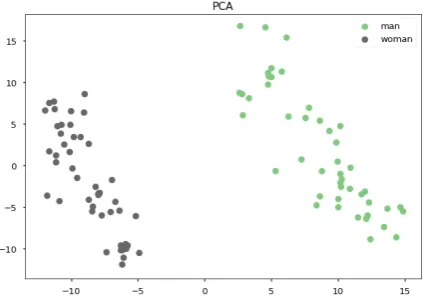
Figure 1: ELMo word representations of tokens ofman
andwomanprojected onto their first and second princi-pal components.
”man” and ”woman”, the PCA space is just a sin-gle vector pointing in the difference between those two vectors.) Context-sensitive embedding such as ELMo and BERT give an embedding for every token (based on its context), giving large numbers of embedding for each word (such as ”man”), so that principal components can be calculated even for word lists of size two as shown in Figure1.
Use of contextualized word embedding allows better debiasing by allowing one (as will be de-scribed below) to break up target word lists into smaller homogeneous subsets; it also gives better insight into where the bias may be coming from.
A number of debiasing methods have been pro-posed. Most of them use hard debiasing – zero-ing out one or more directions in the embeddzero-ing space, generally selected using principal compo-nents (Bolukbasi et al.,2016;Wang et al.,2019). In this paper, we use a soft debiasing method, con-ceptor debiasing, which also works in the prin-cipal component space, but does a softer shrink-age of the bias and close-by directions (Liu et al.,
2018).
Many debiasing algorithms rely entirely on so called “target lists” of protected classes in order to identify and mitigate the “bias subspace”; how-ever, to our knowledge no work examines the role of these target lists in defining this space. This in part due to the fact that in standard word embed-dings there is only one embedding for a token. In contrast, new contextualized word representations such as BERT and ELMo have a different embed-ding for each word token in a context. This allows us an opportunity to more closely examine what information target word lists are capturing.
This paper:
• Examines bias in ELMo and BERT, taking advantage of their context-sensitivity to give better visualizations.
• Shows how heterogeneity in content and size of the ”target list” of gendered or racially marked terms interferes with debiasing, and how conceptors on contextual embeddings can be used to address such target list hetero-geneity.
2 Related Work
NLP has begun tackling the problems that are lim-iting the achievement of fair and ethical AI (Hovy and Spruit,2016;Friedler et al.,2016), including techniques for mitigating demographic biases in models. In brief, a demographic bias is taken to mean a difference in model output based on gen-der (either of the data author or within the content itself) or selected demographic dimension (“pro-tected class”) such as race. Demographic biases manifest in many ways, from disparities in tagging and classification accuracy depending on author age and gender (Hovy,2015;Dixon et al.,2018), to over-amplification of demographic differences in language generation (Yatskar et al.,2016;Zhao et al.,2017), to diverging implicit associations be-tween words or concepts within embeddings or language models (Bolukbasi et al.,2016;Rudinger
et al.,2018).
Recent work ofWang et al.(2019) shows bias in ELMo and presents several examples of successful debiasing. However,May et al.(2019) found that bias in BERT may be more difficult to identify, but
Kurita et al.(2019) did indeed find bias in BERT. However, prior work has not focused on identify-ing word lists as a potential area of research.
3 Target Word Lists
To debias word embeddings, an appropriate word list representing the bias in question needs to be used to define the subspace.1For example, a gen-der word list might be a set of pronouns which are specific to a particular gender such ashe / sheor
himself / herself and gender specific words rep-resenting relationships likebrother / sister or un-cle / aunt. We test conceptor debiasing both us-ing the list of such pronouns2 used by Caliskan et al.(2017) and using a more comprehensive list of specific words that also includes gender-specific terms related to occupations, relationships and other commonly used words such as prince / princess andhost / hostess3. We further tested conceptor (Jaeger, 2014; Liu et al., 2018) (soft) debiasing using male and female names such as
Aaron / AliceorChris / Clary.4
Previous researchers used a variety of different word lists, but did not study the effect of word list selection; we show below that the word list mat-ters. However, we leave systematic study for fu-ture work.
3.1 Word Lists and Principal Components
Recall most debiasing methods rely on principal components of the matrix of embeddings of the target words. Hard debiasing methods remove the first or first several principal components ( Boluk-basi et al.,2016;Mu and Viswanath,2018). Con-ceptors, as explained below, do soft debiasing in the same principal component space.
Paired nouns and pronouns should provide bet-ter support for debiasing than names if we as-sume that the linguistic markers are unambiguous
1
Some methods also require a list of unbiased words as well, but we will not address those since conceptor debiasing does not require them.
2
https://github.com/jsedoc/ ConceptorDebias/tree/master/lists
3
https://github.com/uclanlp/corefBias,
https://github.com/uclanlp/gn_glove
4https://www.cs.cmu.edu/Groups/AI/
(a) BERT
[image:3.595.87.287.59.379.2](b) ELMo
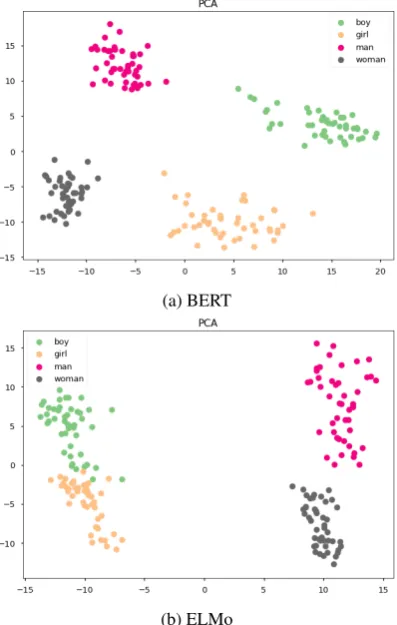
Figure 2: BERT and ELMo word representations of the union of the set of contextualized word representations of the pairsman / womanandMary / Johnprojected onto their first and second principal components.
(a counterexample is ”guys”), and there is no pol-ysemy. Names of people can also be ambiguous (e.g. “Pat”). A possible solution for this which we leave for future work is to regress the first few principal components of a word pair with the bi-nary attribute to verify that the pair is properly captures the attribute of interest on out-of-sample lists. In fact, for racial names Gaddis (2017)’s method (using linear regression) can be used to both filter and pair names. While this is difficult to achieve using word embeddings which are at the type level (i.e. one vector per word as in Fasttext and word2vec), for contextualized word represen-tations, which are token level (i.e. one vector per word and context), this is completely feasible.
Figure 1 shows how the pair man / woman
cleanly separates across the first principal com-ponent of the space of their contextualized repre-sentations. However, even though one word pair give good results, combining it with a second word pair can have unfortunate effects; debiasing be-comes more complicated if we add another pair of
words, sayMary / Johnto the pairman / woman, as shown in Figure2. The first principal compo-nent is now capturing pronoun vs proper noun dif-ference, which we do not desire to remove after debiasing.
(a) BERT
(b) ELMo
Figure 3: BERT and ELMo word representations of the union of the set of contextualized word representations of the pairsman / womanandboy / girlprojected onto their first and second principal components.
It is also critical to note that contextualized word embeddings are very rich, so while one might think the union of the contextualized word representations of man / woman and boy / girl
would yield a good gender direction, in fact we find that the first principal component of these four words is along the direction of adults vs. children (see Figure3). There is some separation between “husband” and “wife” in this dimension, but none between “boy” and “girl”. Similarly when names such as Mary / Johnare projected onto this sub-space, little separation occurs. Since most debias-ing methods remove or shrink these principal com-ponent directions, this combined word list does poorly for debiasing.
[image:3.595.322.521.145.458.2]contextu-(a) ELMo PCs ofmale / female.
[image:4.595.87.287.62.383.2](b) ELMo PC ofJohn / Mary
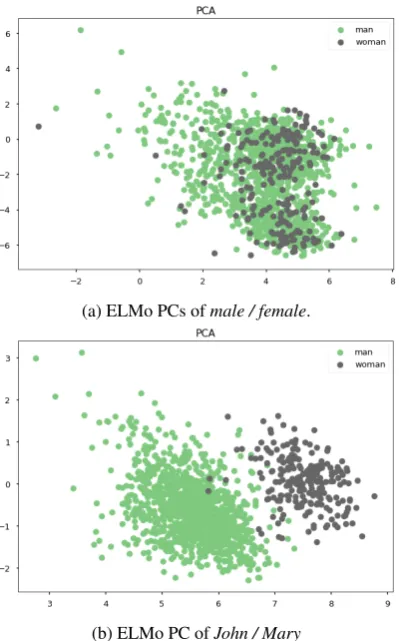
Figure 4: ELMo word representations ofman / woman
projected onto the first and second principal compo-nents defined by the pair (a)male / femaleand (b)John / Mary.
alized representations. Figure 4 shows that the ELMO vectors ofmanand /womanseparate nicely when projected on to the first two principal com-ponents of the Mary / John but fail to separate when projected on to the first two principal com-ponents of male / female. The word male / fe-maleword pair form a poor target list since they are, in fact, rarely used to refer to people; They are instead applied to animals (the male parrot) or to distinguish a break of the social bias (the male model).
Note that none of the above figures could have been generated using traditional word embed-dings; one cannot get two PCA dimensions for a target word list of only two words.
3.2 Conceptors
[image:4.595.310.524.63.215.2]Conceptors provide and effective, computationally cheap and mathematically elegant a way of do-ing soft debiasdo-ing of word embedddo-ings. As with many debiasing methods, the input is matrixZ of word embeddings corresponding to a set of target
Figure 5: BERT word representations of the union of the set of contextualized word representations of the pairshusband / wife andMary / John projected onto the first and second principal components.
words,Z. (These can either be one embedding per word type, for conventional embeddings, or one vector per word token, as we use here for context-sensitive embeddings; for best results,Zshould be mean-centered.) A conceptor matrix,C, is a reg-ularized identity map (in our case, from the origi-nal word embeddings to their biased versions) that minimizes
kZ−CZk2F+α−2kCk2F. (1)
where α−2 is a scalar parameter. As described in the orignal work on matrix conceptors (Jaeger,
2014;He and Jaeger,2018;Liu et al.,2019b,a)C
has a closed form solution:
C = 1
kZZ
>(1
kZZ
>+α−2I)−1. (2)
Intuitively,C is a soft projection matrix on the linear subspace that gives the largest shrinkage where the word embeddings Z have the highest variance. Once C has been learned, it can be ‘negated’ by subtracting it from the identity ma-trix and then applied to any word embeddings to shrink their bias directions.
Conceptors can represent laws of Boolean logic, such as NOT¬, AND∧, and OR∨. For two con-ceptorsC andB, we define the following opera-tions:
¬C:=I−C, (3)
C∧B :=(C−1+B−1−I)−1 (4)
C∨B :=¬(¬C∧ ¬B) (5)
(a) Original (b) Union ofhe / sheandboy / girl.
(c) Conceptor debiased usinghe / she (d) Conceptor debiased usingboy / girl
[image:5.595.75.529.61.582.2](e) Conceptor debiased using theunionofhe / she, boy / girl (f) Conceptor debiased usingORhe / she, boy / girl
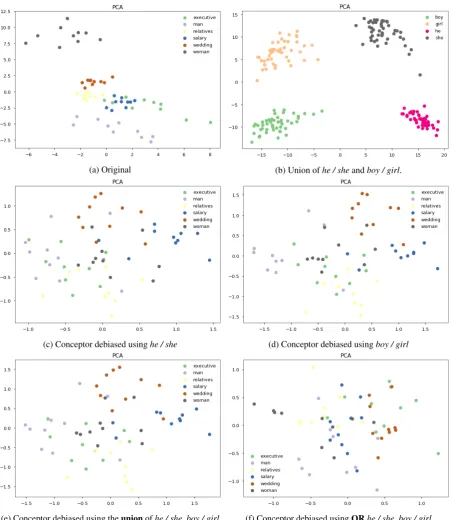
Figure 6: Effect of target word lists on debiasing BERT word representations. The union of the set of contextualized word representations ofcareer, business, family, children, man, woman projected on to the first two principal components ofhe / she.
debiasing conceptor. More generally, if we have
K conceptors,Ci derived from K different word lists, we call NOT(C1∨...∨CK)a debiasing con-ceptor.
Negated conceptors do soft debiasing, shrinking each principal component of the covariance matrix of the target word embeddingsZZ>based on the conceptor hyper-parameterα and the eigenvalues
σiofZZ>: α
−2
σi+α−2 . (Liu et al.,2018).
4 Conceptor Debiasing
can improve performance.
Figure6a shows that there is a gender bias us-ing career versus family words projected onto the gender space. Figure6shows that after debiasing using conceptor negation (Liu et al.,2018) (as de-fined above) there is substantially less bias.
Nonetheless, one should note that gender bias need not be in the first two dimensions. In fact recent work by Gonen and Goldberg (2019) has pointed out that most “debiasing” methods are simply mitigating bias and thus end task methods will potentially be able to undo this mitigation. As a result, we recommend that a method likeGaddis
(2017) be used to identify proper word lists.
5 Conclusion
We showed that one should take care when debias-ing word embedddebias-ings; well-chosen word lists gen-erally yield better subspaces than poorly-chosen ones. Combining heterogeneous words into a sin-gle word list presents a host of problems; a cou-ple of ’bad’ words like ”male/female” can signifi-cantly shift the dominant principal components of the bias space. Conversely, since PCA effectively weights words by their frequency of occurrence, combining small word lists (pronouns) with large word lists (names) means that the longer word lists carry more weight in the principal components (unless the rare words ’stick out’ a long way in a different direction).
Conceptor debiasing provides a simple way of addressing the problem of combining word lists of different types and sizes, improving perfor-mance over state-of-the art ‘hard’ debiasing meth-ods. Conceptor debiasing has the further benefit that conceptor negation methods allow one to learn separate conceptors for each word subset and then to OR them. The best results are obtained when lists are broken up into subsets of ‘similar’ words (pronouns, professions, names, etc). Similarly, conceptors for different protected subclasses such as gender and race can be OR’d to simultaneously debias for both classes. OR’ing has the advantage that word lists of different size are still treated as equally important–a key factor when lists such as pronouns, male and female names and black and white names may be of vastly different sizes.
Contextual embeddings such as ELMo and BERT, which give a different vector for each word token, work particularly well with special-ized word lists, since they produce a large number
of embeddings, allow principal components to be computed and used for debiasing even for lists of two words.
Finally, the main takeaway from this paper is that word lists matter, especially for debiasing contextualized word embeddings. Remember Fig-ures3and 4bwhere intuition fails entirely!
References
Ian Ayres. 2002. Outcome tests of racial disparities in police practices. Justice research and Policy, 4(1-2):131–142.
Sudeep Bhatia. 2017. The semantic representation of prejudice and stereotypes.Cognition, 164:46–60.
P. Bojanowski, E. Grave, A. Joulin, and T. Mikolov. 2017. Enriching word vectors with subword infor-mation. Transactions of the Association for Compu-tational Linguistics, 5:135–146.
Tolga Bolukbasi, Kai-Wei Chang, James Y Zou, Venkatesh Saligrama, and Adam T Kalai. 2016. Man is to computer programmer as woman is to homemaker? debiasing word embeddings. In Ad-vances in neural information processing systems, pages 4349–4357.
Aylin Caliskan, Joanna J Bryson, and Arvind Narayanan. 2017. Semantics derived automatically from language corpora contain human-like biases.
Science, 356(6334):183–186.
Jacob Devlin, Ming-Wei Chang, Kenton Lee, and Kristina Toutanova. 2018. Bert: Pre-training of deep bidirectional transformers for language understand-ing.arXiv preprint arXiv:1810.04805.
Lucas Dixon, John Li, Jeffrey Sorensen, Nithum Thain, and Lucy Vasserman. 2018. Measuring and mitigat-ing unintended bias in text classification. In Pro-ceedings of the 2018 AAAI/ACM Conference on AI, Ethics, and Society, pages 67–73. ACM.
Sorelle A Friedler, Carlos Scheidegger, and Suresh Venkatasubramanian. 2016. On the (im) possibility of fairness. arXiv preprint arXiv:1609.07236.
S Michael Gaddis. 2017. How black are lakisha and jamal? racial perceptions from names used in cor-respondence audit studies. Sociological Science, 4:469–489.
Hila Gonen and Yoav Goldberg. 2019. Lipstick on a pig: Debiasing methods cover up systematic gender biases in word embeddings but do not remove them. In North American Chapter of the Association for Computational Linguistics (NAACL).
X. He and H. Jaeger. 2018. Overcoming catas-trophic interference using conceptor-aided back-propagation. InInternational Conference on Learn-ing Representations.
Dirk Hovy. 2015. Demographic factors improve clas-sification performance. InProceedings of the 53rd Annual Meeting of the Association for Computa-tional Linguistics and the 7th InternaComputa-tional Joint Conference on Natural Language Processing (Vol-ume 1: Long Papers), volume 1, pages 752–762.
Dirk Hovy and Shannon L Spruit. 2016. The social impact of natural language processing. In Proceed-ings of the 54th Annual Meeting of the Association for Computational Linguistics (Volume 2: Short Pa-pers), volume 2, pages 591–598.
H. Jaeger. 2014. Controlling recurrent neural networks by conceptors. Technical report, Jacobs University Bremen.
Svetlana Kiritchenko and Saif Mohammad. 2018. Ex-amining gender and race bias in two hundred sen-timent analysis systems. In Proceedings of the Seventh Joint Conference on Lexical and Compu-tational Semantics, pages 43–53. Association for Computational Linguistics.
Keita Kurita, Nidhi Vyas, Ayush Pareek, Alan W. Black, and Yulia Tsvetkov. 2019.Measuring bias in contextualized word representations.
T. Liu, J. Sedoc, and L. Ungar. 2018. Correcting the common discourse bias in linear representation of sentences using conceptors. In Proceedings of ACM-BCB- 2018 Workshop on BioCreative/OHNLP Challenge, Washington, D.C., 2018.
T. Liu, L. Ungar, and J. Sedoc. 2019a. Continual learn-ing for sentence representations uslearn-ing conceptors. InProceedings of the NAACL HLT 2019.
T. Liu, L. Ungar, and J. Sedoc. 2019b. Unsupervised post-processing of word vectors via conceptor nega-tion. InProceedings of the Thirty-Third AAAI Con-ference on Artificial Intelligence (AAAI-2019), Hon-olulu.
Chandler May, Alex Wang, Shikha Bordia, Samuel R Bowman, and Rachel Rudinger. 2019. On measur-ing social biases in sentence encoders. In North American Chapter of the Association for Computa-tional Linguistics (NAACL).
T. Mikolov, I. Sutskever, K. Chen, G. S. Corrado, and J. Dean. 2013. Distributed representations of words and phrases and their compositionality. In C. J. C. Burges, L. Bottou, M. Welling, Z. Ghahramani, and K. Q. Weinberger, editors, Advances in Neural In-formation Processing Systems 26, pages 3111–3119. Curran Associates, Inc.
J. Mu and P. Viswanath. 2018. All-but-the-top: Sim-ple and effective postprocessing for word represen-tations. In International Conference on Learning Representations.
Dan Jurafsky Nikhil Garg, Londa Schiebinger and James Zou. 2018. Word embeddings quantify 100 years of gender and ethnic stereotypes. PNAS.
J. Pennington, R. Socher, and C. D. Manning. 2014. Glove: Global vectors for word representation. In
Proceedings of EMNLP, pages 1532–1543.
Matthew E. Peters, Mark Neumann, Mohit Iyyer, Matt Gardner, Christopher Clark, Kenton Lee, and Luke Zettlemoyer. 2018. Deep contextualized word rep-resentations. InProc. of NAACL.
Rachel Rudinger, Jason Naradowsky, Brian Leonard, and Benjamin Van Durme. 2018. Gender bias in coreference resolution. arXiv preprint arXiv:1804.09301.
Tianlu Wang, Jieyu Zhao, Mark Yatskar, Ryan Cot-terell, Vicente Ordonez, and Kai-Wei Chang. 2019. Gender bias in contextualized word embeddings. In North American Chapter of the Association for Computational Linguistics (NAACL).
Mark Yatskar, Luke Zettlemoyer, and Ali Farhadi. 2016. Situation recognition: Visual semantic role labeling for image understanding. InProceedings of the IEEE Conference on Computer Vision and Pat-tern Recognition, pages 5534–5542.
Brian Hu Zhang, Blake Lemoine, and Margaret Mitchell. 2018. Mitigating unwanted biases with adversarial learning. In Proceedings of the 2018 AAAI/ACM Conference on AI, Ethics, and Society, AIES ’18, pages 335–340, New York, NY, USA. ACM.