Proceedings of the 1st Workshop on NLP for Conversational AI, pages 60–67 60
DSTC7 Task 1: Noetic End-to-End Response Selection
Chulaka Gunasekara1 Jonathan K. Kummerfeld2
Lazaros Polymenakos1 Walter S. Lasecki2
T.J. Watson Research Center1 Computer Science & Engineering2 IBM Research AI University of Michigan
[email protected] {jkummerf,wlasecki}@umich.edu
Abstract
Goal-oriented dialogue in complex domains is an extremely challenging problem and there are relatively few datasets. This task pro-vided two new resources that presented dif-ferent challenges: one was focused but small, while the other was large but diverse. We also considered several new variations on the next utterance selection problem: (1) increasing the number of candidates, (2) including para-phrases, and (3) not including a correct option in the candidate set. Twenty teams partici-pated, developing a range of neural network models, including some that successfully in-corporated external data to boost performance. Both datasets have been publicly released, en-abling future work to build on these results, working towards robust goal-oriented dialogue systems.
1 Introduction
Automatic dialogue systems have great potential as a new form of user interface between people and computers. Unfortunately, there are relatively few large resources of human-human dialogues (Ser-ban et al.,2018), which are crucial for the develop-ment of robust statistical models. Evaluation also poses a challenge, as the output of an end-to-end dialogue system could be entirely reasonable, but not match the reference, either because it is a para-phrase, or it takes the conversation in a different, but still coherent, direction.
In this shared task, we introduced two new datasets and explored variations in task structure for research on goal-oriented dialogue. One of our datasets was carefully constructed with real people acting in a university student advising sce-nario. The other dataset was formed by applying a new disentanglement method (Kummerfeld et al., 2019) to extract conversations from an IRC chan-nel of technical help for the Ubuntu operating sys-tem. We structured the dialogue problem as next
utterance selection, in which participants receive partial dialogues and must select the next utter-ance from a set of options. Going beyond prior work, we considered larger sets of options, and variations with either additional incorrect options, paraphrases of the correct option, or no correct op-tion at all. These changes push the next utterance selection task towards real-world dialogue.
This task is not a continuation of prior DSTC tasks, but it is related to tasks 1 and 2 from DSTC6 (Perez et al., 2017; Hori and Hori, 2017). Like DSTC6 task 1, our task considers goal-oriented di-alogue and next utterance selection, but our data is from human-human conversations, whereas theirs was simulated. Like DSTC6 task 2, we use online resources to build a large collection of dialogues, but their dialogues were shorter (2 - 2.5 utterances per conversation) and came from a more diverse set of sources (1,242 twitter customer service ac-counts, and a range of films).
This paper provides an overview of (1) the task structure, (2) the datasets, (3) the evaluation met-rics, and (4) system results. Twenty teams par-ticipated, with one clear winner, scoring the high-est on all but one sub-task. The data and other resources associated with the task have been re-leased1to enable future work on this topic and to make accurate comparisons possible.
2 Task
This task pushed the state-of-the-art in goal-oriented dialogue systems in four directions deemed necessary for practical automated agents, using two new datasets. We sidestepped the chal-lenge of evaluating generated utterances by formu-lating the problem as next utterance selection, as proposed byLowe et al.(2015). At test time, par-ticipants were provided with partial conversations, each paired with a set of utterances that could be
1https://ibm.github.io/dstc7-noesis/
the next utterance in the conversation. Systems needed to rank these options, with the goal of plac-ing the true utterance first. Prior work used sets of 2 or 10 utterances. We make the task harder by ex-panding the size of the sets, and considered several advanced variations:
Subtask 1 100 candidates, including 1 correct
op-tion.
Subtask 2 120,000 candidates, including 1
cor-rect option (Ubuntu data only).
Subtask 3 100 candidates, including 1-5 correct
options that are paraphrases (Advising data only).
Subtask 4 100 candidates, including 0-1 correct
options.
Subtask 5 The same as subtask 1, but with access
to external information.
These subtasks push the capabilities of systems. In particular, when the number of candidates is small (2-10) and diverse, it is possible that sys-tems are learning to differentiate topics rather than learning dialogue. Our variations move towards a task that is more representative of the challenges involved in dialogue modeling.
As part of the challenge, we provided a baseline system that implemented the Dual-Encoder model fromLowe et al.(2015). This lowered the barrier to entry, encouraging broader participation in the task.
3 Data
We used two datasets containing goal-oriented di-alogues between two participants, but from very different domains. This challenge introduced the two datasets, and we kept the test set answers se-cret until after the challenge.2 To construct the partial conversations we randomly split each con-versation. Incorrect candidate utterances are se-lected by randomly sampling utterances from the dataset. For subtask 3 (paraphrases), the incor-rect candidates are sampled with paraphrases as well. For subtask 4 (no correct option sometimes), twenty percent of examples were randomly sam-pled and the correct utterance was replaced with an additional incorrect one.
2The entire datasets are now publicly available at https://ibm.github.io/dstc7-noesis/ public/datasets.html
10:30 <elmaya> is there a way to setup grub to not press the esc button for the menu choices?
10:31 <scaroo> elmaya, edit /boot/grub/ menu.lst and comment the ”hidemenu” line
10:32 <scaroo> elmaya, then run grub -install 10:32 <scaroo> grub-install
10:32 <elmaya> thanls scaroo 10:32 <elmaya> thanks
Figure 1: Example Ubuntu dialogue before our pre-processing.
Along with the datasets we provided additional sources of information. Participants were able to use the provided knowledge sources as is, or auto-matically transform them to appropriate represen-tations (e.g. knowledge graphs, continuous em-beddings, etc.) that were integrated with end-to-end dialogue systems so as to increase response accuracy.
3.1 Ubuntu
We constructed one dataset from the Ubuntu In-ternet Relay Chat (IRC) support channel, in which users help each other resolve technical problems related to the Ubuntu operating system. We con-sider only conversations in which one user asks a question and another helps them resolve their problem. We extracted conversations from the channel using the conversational disentanglement method described by Kummerfeld et al. (2019), trained with manually annotated data using Slate (Kummerfeld,2019).34 This approach is not per-fect, but we inspected one hundred dialogues and found seventy-five looked like reasonable conver-sations. SeeKummerfeld et al.(2019) for detailed analysis of the extraction process. We further ap-plied several filters to increase the quality of the extracted dialogues: (1) the first message is not directed, (2) there are exactly two participants (a questioner and a helper), not counting the channel bot, (3) no more than 80% of the messages are by a single participant, and (4) there are at least three turns. This approach produced 135,000 conversa-tions, and each was cut off at different points to create the necessary conversations for all the
sub-3 Previously,Lowe et al.(2015) extracted conversations from the same IRC logs, but with a heuristic method. Kum-merfeld et al.(2019) showed that the heuristic was far less effective than a trained statistical model.
Student Hi professor, I am looking for courses to take. Do you have any suggestions?
Advisor What topic do you prefer, computer science or electrical engineering?
Student I prefer electrical engineering.
Advisor Based on your background, I would like to suggest you take one of the two courses: EECS 550 Information Theory and EECS 551: Matrix Methods for Signal Process-ing, Data Analysis and Machine Learning FA 2012
Student Can you describe a little bit about EECS 550? Advisor This course contains a lot of concepts about source, channel, rate of transformation of in-formation, etc.
Student Sounds interesting. Do you know the class size of this course?
Advisor This is a relatively small class and the average size of it is around 12.
Student I would prefer class with larger class size. What is EECS 551 about?
Advisor This course is about theory and application of matrix methods to signal processing, data analysis and machine learning
Student What is the course size of EECS 551? Advisor It is around 71
Student I would take EECS 551. Thanks professor! Advisor You are welcome!
Figure 2: Example Advising dialogue.
tasks. For this setting, manual pages were pro-vided as a form of knowledge grounding.
Figure 1 shows an example dialogue from the dataset. For the actual challenge we identify the users as ‘speaker 1’ (the person asking the ques-tion) and ‘speaker 2’ (the person answering), and removed usernames from the messages (such as ‘elmaya’ in the example). We also combined con-secutive messages from a single user, and always cut conversations off so that the last speaker was the person asking the question. This meant sys-tems were learning to behave like the helpers, which fits the goal of developing a dialogue sys-tem to provide help.
3.2 Advising
Our second dataset is based on an entirely new col-lection of dialogues in which university students are being advised which classes to take. These were collected at the University of Michigan with IRB approval. Pairs of Michigan students play-acted the roles of a student and an advisor. We provided a persona for the student, describing the classes they had taken already, what year of their degree they were in, and several types of class preferences (workloads, class sizes, topic areas, time of day, etc.). Advisors did not know the stu-dent’s preferences, but did know what classes they
Property Advising Ubuntu
Dialogues 500 135,078
Utterances / Dialogue 18.6 10.0
Tokens / Utterance 9.6 9.9
Utterances / Unique utt. 4.4 1.1
Tokens / Unique tokens 10.5 22.9
Table 1: Comparison of the diversity of the underlying datasets. Advising is smaller and has longer conversa-tions, but less diversity in utterances. Tokens are based on splitting on whitespace.
had taken, what classes were available, and which were suggested (based on aggregate statistics from real student records). The data was collected over a year, with some data collected as part of courses in NLP and social computing, and some collected with paid participants.
In the shared task, we provide all of this in-formation - student preferences, and course infor-mation - to participants. 815 conversations were collected, and then the data was expanded by col-lecting 82,094 paraphrases using the crowdsourc-ing approach described byJiang et al.(2017). Of this data, 500 conversations were used for train-ing, 100 for development, and 100 for testing. The remaining 115 conversations were used as a source of negative candidates in the candidate sets. For the test data, 500 conversations were con-structed by cutting the conversations off at 5 points and using paraphrases to make 5 distinct conver-sations. The training data was provided in two forms. First, the 500 training conversations with a list of paraphrases for each utterance, which par-ticipants could use in any way. Second, 100,000 partial conversations generated by randomly se-lecting paraphrases for every message in each con-versation and selecting a random cutoff point.
Two versions of the test data were provided to participants. The first had some overlap with the training set in terms of source dialogues, while the second did not. We include results on both in this paper for completeness, but encourage all future work to only consider the second test set.
3.3 Comparison
or contain utterances from other conversations). Both have similar length utterances, but these val-ues are on the original Ubuntu dialogval-ues, before we merge consecutive messages from the same user. The Advising dialogues contain more mes-sages on average, but the Ubuntu dialogues cover a wider range of lengths (up to 118 messages). Interestingly, there is less diversity in tokens for Ubuntu, but more diversity in utterances.
4 Results
Twenty teams submitted entries for at least one subtask.5 Teams had 14 weeks to develop their systems with access to the training and valida-tion data, plus the external resources we provided. Additional external resources were not permitted, with the exception of pre-trained embeddings that were publicly available prior to the release of the data.
4.1 Participants
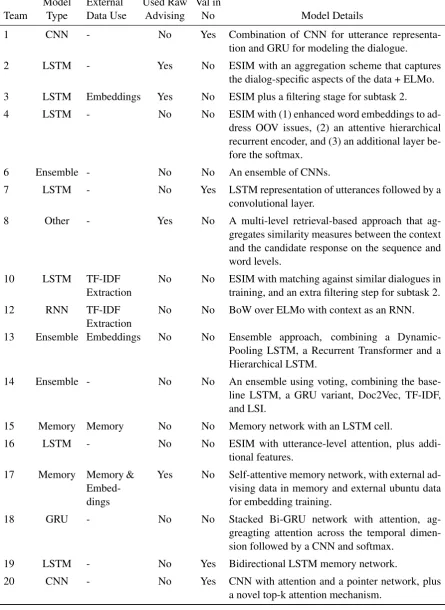
Table5presents a summary of approaches teams used. One clear trend was the use of the En-hanced LSTM model (ESIM, Chen et al., 2017), though each team modified it differently as they worked to improve performance on the task. Other approaches covered a wide range of neu-ral model components: Convolutional Neuneu-ral Net-works, Memory NetNet-works, the Transformer, At-tention, and Recurrent Neural Network variants. Two teams used ELMo word representations (Pe-ters et al., 2018), while three constructed ensem-bles. Several teams also incorporated more classi-cal approaches, such as TF-IDF based ranking, as part of their system.
We provided a range of data sources in the task, with the goal of enabling innovation in training methods. Six teams used the external data, while four teams used the raw form of the Advising data. The rules did not state whether the validation data could be used as additional training data at test time, and so we asked each team what they used. As Table 5 shows, only four teams trained their systems with the validation data.
4.2 Metrics
We considered a range of metrics when compar-ing models. Followcompar-ingLowe et al.(2015), we use Recall@N, where we count how often the correct
5Note that in the DSTC shared tasks participants remain anonymous, and so we refer to them using numbers.
answer is within the top N specified by a system. In prior work, there were either 2 or 10 candidates (including the correct one), and N was set at 1, 2, or 5. Our sets are larger, with 100 candidates, and so we considered larger values of N: 1, 10, and 50. 10 and 50 were chosen to correspond to 1 and 5 in prior work (the expanded candidate set means they correspond to the same fraction of the space of options). We also considered a widely used metric from the ranking literature: Mean Re-ciprocal Rank (MRR). Finally, for subtask 3 we measured Mean Average Precision (MAP) since there are multiple correct utterances in the set.
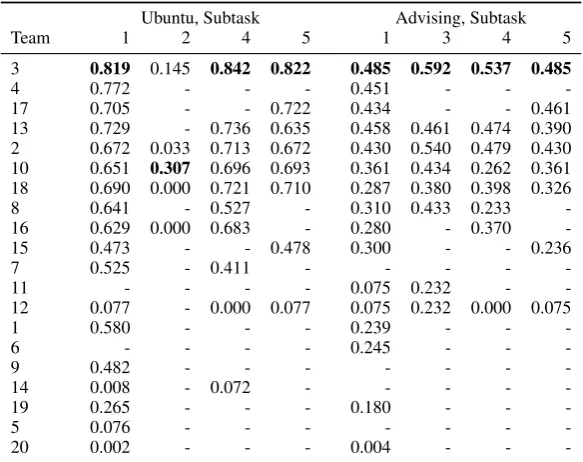
To determine a single winner for each subtask, we used the mean of Recall@10 and MRR, as pre-sented in Table2.
4.3 Discussion
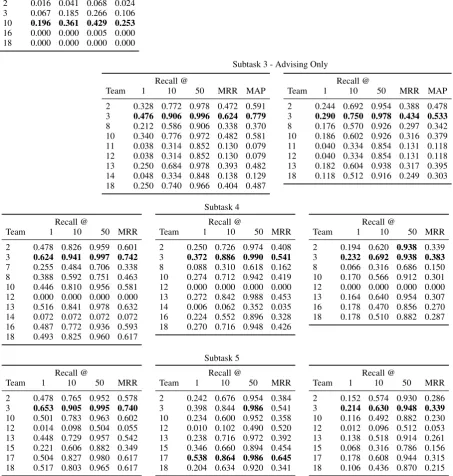
Table2 presents the overall scores for each team on each subtask, ordered by teams’ average rank. Table 4 presents the full set of results, including all metrics for all subtasks.
Overall Results Team 3 consistently scored
highest, winning all but one subtask. Looking at individual metrics, they had the best score 75% of the time on Ubuntu and all of the time on the final Advising test set. The subtask they were beaten on was Ubuntu-2, in which the set of can-didates was drastically expanded. Team 10 did best on that task, indicating that their extra filtering step provided a key advantage. They filtered the 120,000 sentence set down to 100 options using a TF-IDF based method, then applied their standard approach to that set.
Subtasks
1. The first subtask drew the most interest, with every team participating in it for one of the datasets. Performance varied substantially, covering a wide range for both datasets, par-ticularly on Ubuntu.
2. As expected, subtask 2 was more difficult than task 1, with consistently lower results. However, while the number of candidates was increased from 100 to 120,000, perfor-mance reached as high as half the level of task 1, which suggests systems could handle the large set effectively.
Ubuntu, Subtask Advising, Subtask
Team 1 2 4 5 1 3 4 5
3 0.819 0.145 0.842 0.822 0.485 0.592 0.537 0.485
4 0.772 - - - 0.451 - -
-17 0.705 - - 0.722 0.434 - - 0.461 13 0.729 - 0.736 0.635 0.458 0.461 0.474 0.390 2 0.672 0.033 0.713 0.672 0.430 0.540 0.479 0.430 10 0.651 0.307 0.696 0.693 0.361 0.434 0.262 0.361 18 0.690 0.000 0.721 0.710 0.287 0.380 0.398 0.326 8 0.641 - 0.527 - 0.310 0.433 0.233 -16 0.629 0.000 0.683 - 0.280 - 0.370 -15 0.473 - - 0.478 0.300 - - 0.236
7 0.525 - 0.411 - - - -
-11 - - - - 0.075 0.232 -
-12 0.077 - 0.000 0.077 0.075 0.232 0.000 0.075
1 0.580 - - - 0.239 - -
-6 - - - - 0.245 - -
-9 0.482 - - -
-14 0.008 - 0.072 - - - -
-19 0.265 - - - 0.180 - -
-5 0.076 - - -
-20 0.002 - - - 0.004 - -
-Table 2: Results, ordered by the average rank of each team across the subtasks they participated in. The top result in each column is in bold. For these results the metric is the average of MRR and Recall@10.
Recall @
Team 1 10 50 MRR
1 0.402 0.662 0.916 0.497 2 0.478 0.765 0.952 0.578 3 0.645 0.902 0.994 0.735
4 0.608 0.853 0.984 0.691 5 0.010 0.101 0.514 0.510 7 0.309 0.635 0.889 0.414 8 0.446 0.732 0.937 0.551 9 0.251 0.601 0.881 0.362 10 0.469 0.739 0.946 0.564 12 0.014 0.098 0.504 0.055 13 0.565 0.810 0.977 0.649 14 0.008 0.008 0.008 0.008 15 0.236 0.592 0.858 0.355 16 0.471 0.700 0.926 0.557 17 0.475 0.814 0.978 0.595 18 0.503 0.783 0.962 0.598 19 0.098 0.346 0.730 0.184 20 0.001 0.003 0.012 0.200
Recall @
Team 1 10 50 MRR
1 0.170 0.482 0.850 0.274 2 0.242 0.676 0.954 0.384 3 0.398 0.844 0.986 0.541 4 0.420 0.768 0.972 0.538 6 0.206 0.548 0.824 0.322 8 0.114 0.398 0.782 0.205 10 0.234 0.600 0.952 0.358 11 0.000 0.000 0.000 0.000 12 0.010 0.102 0.490 0.520 13 0.348 0.804 0.978 0.491 14 0.064 0.064 0.064 0.064 15 0.252 0.620 0.894 0.375 16 0.122 0.474 0.868 0.234 17 0.494 0.850 0.980 0.608
18 0.240 0.630 0.906 0.365 19 0.068 0.322 0.778 0.150 20 0.000 0.000 0.012 0.100
Recall @
Team 1 10 50 MRR
1 0.078 0.320 0.760 0.158 2 0.152 0.574 0.930 0.286 3 0.214 0.630 0.948 0.339
[image:5.595.153.445.62.293.2]4 0.194 0.582 0.908 0.320 6 0.088 0.320 0.728 0.169 8 0.100 0.420 0.802 0.200 10 0.116 0.492 0.882 0.230 11 0.012 0.096 0.512 0.053 12 0.012 0.096 0.512 0.053 13 0.170 0.610 0.952 0.306 15 0.074 0.420 0.834 0.180 16 0.064 0.398 0.800 0.161 17 0.180 0.562 0.940 0.307 18 0.086 0.390 0.836 0.184 19 0.038 0.250 0.730 0.111 20 0.000 0.006 0.014 0.001
Table 3: Subtask 1 results. The left table is for Ubuntu, the middle table is for the initial Advising test set, and the right table is for the final Advising test set. The best results are bolded.
MRR and MAP it is interesting to see that while the ranking of systems is the same, in some cases MAP was higher than MRR and in others it was lower.
4. For both datasets, results on subtask 4, where the correct answer was to choose no option 20% of the time, are generally similar. On av-erage, no metric shifted by more than 0.016, and some went up while others went down. This suggests that teams were able to effec-tively handle the added challenge.
5. Finally, on subtask 5 we see some slight gains in performance, but mostly similar results, indicating that effectively using external re-sources remains a challenge.
Advising Test Sets Table4provides a
[image:5.595.75.526.339.548.2]Subtask 2 - Ubuntu Only
Recall @
Team 1 10 50 MRR
2 0.016 0.041 0.068 0.024 3 0.067 0.185 0.266 0.106 10 0.196 0.361 0.429 0.253
16 0.000 0.000 0.005 0.000 18 0.000 0.000 0.000 0.000
Subtask 3 - Advising Only
Recall @
Team 1 10 50 MRR MAP
2 0.328 0.772 0.978 0.472 0.591 3 0.476 0.906 0.996 0.624 0.779
8 0.212 0.586 0.906 0.338 0.370 10 0.340 0.776 0.972 0.482 0.581 11 0.038 0.314 0.852 0.130 0.079 12 0.038 0.314 0.852 0.130 0.079 13 0.250 0.684 0.978 0.393 0.482 14 0.048 0.334 0.848 0.138 0.129 18 0.250 0.740 0.966 0.404 0.487
Recall @
Team 1 10 50 MRR MAP
2 0.244 0.692 0.954 0.388 0.478 3 0.290 0.750 0.978 0.434 0.533
8 0.176 0.570 0.926 0.297 0.342 10 0.186 0.602 0.926 0.316 0.379 11 0.040 0.334 0.854 0.131 0.118 12 0.040 0.334 0.854 0.131 0.118 13 0.182 0.604 0.938 0.317 0.395 18 0.118 0.512 0.916 0.249 0.303
Subtask 4
Recall @
Team 1 10 50 MRR
2 0.478 0.826 0.959 0.601 3 0.624 0.941 0.997 0.742
7 0.255 0.484 0.706 0.338 8 0.388 0.592 0.751 0.463 10 0.446 0.810 0.956 0.581 12 0.000 0.000 0.000 0.000 13 0.516 0.841 0.978 0.632 14 0.072 0.072 0.072 0.072 16 0.487 0.772 0.936 0.593 18 0.493 0.825 0.960 0.617
Recall @
Team 1 10 50 MRR
2 0.250 0.726 0.974 0.408 3 0.372 0.886 0.990 0.541
8 0.088 0.310 0.618 0.162 10 0.274 0.712 0.942 0.419 12 0.000 0.000 0.000 0.000 13 0.272 0.842 0.988 0.453 14 0.006 0.062 0.352 0.035 16 0.224 0.552 0.896 0.328 18 0.270 0.716 0.948 0.426
Recall @
Team 1 10 50 MRR
2 0.194 0.620 0.938 0.339 3 0.232 0.692 0.938 0.383
8 0.066 0.316 0.686 0.150 10 0.170 0.566 0.912 0.301 12 0.000 0.000 0.000 0.000 13 0.164 0.640 0.954 0.307 16 0.178 0.470 0.856 0.270 18 0.178 0.510 0.882 0.287
Subtask 5
Recall @
Team 1 10 50 MRR
2 0.478 0.765 0.952 0.578 3 0.653 0.905 0.995 0.740
10 0.501 0.783 0.963 0.602 12 0.014 0.098 0.504 0.055 13 0.448 0.729 0.957 0.542 15 0.221 0.606 0.882 0.349 17 0.504 0.827 0.980 0.617 18 0.517 0.803 0.965 0.617
Recall @
Team 1 10 50 MRR
2 0.242 0.676 0.954 0.384 3 0.398 0.844 0.986 0.541 10 0.234 0.600 0.952 0.358 12 0.010 0.102 0.490 0.520 13 0.238 0.716 0.972 0.392 15 0.346 0.660 0.894 0.454 17 0.538 0.864 0.986 0.645
18 0.204 0.634 0.920 0.341
Recall @
Team 1 10 50 MRR
2 0.152 0.574 0.930 0.286 3 0.214 0.630 0.948 0.339
[image:6.595.73.527.105.582.2]10 0.116 0.492 0.882 0.230 12 0.012 0.096 0.512 0.053 13 0.138 0.518 0.914 0.261 15 0.068 0.316 0.786 0.156 17 0.178 0.608 0.944 0.315 18 0.106 0.436 0.870 0.215
Table 4: Subtask 5 results. The left column of tables is for Ubuntu, the middle column is for the initial Advising test set, and the right column is for the final Advising test set. The best results are bolded.
the task considerably harder, though more real-istic. In general, system rankings were not sub-stantially impacted, with the exception of team 17, which did better on the original dataset. This may relate to their use of a memory network over the raw advising data, which may have led the model to match test dialogues with their corresponding training dialogues.
Metrics Finally, we can use Table4to compare
the MRR rank is outside the range of ranks given by the recall measures 9% of the time (on Ubuntu and the final Advising evaluation).
5 Future Work
This task provides the basis for a range of inter-esting new directions. We randomly selected neg-ative options, but other strategies could raise the difficulty, for example by selecting very similar candidates according to a simple model. For eval-uation, it would be interesting to explore human judgements, since by expanding the candidate sets we are introducing options that are potentially rea-sonable.
6 Conclusion
This task introduced two new datasets and three new variants of the next utterance selection task. Twenty teams attempted the challenge, with one clear winner. The datasets are being publicly re-leased, along with a baseline approach, in order to facilitate further work on this task. This resource will support the development of novel dialogue systems, pushing research towards more realistic and challenging settings.
7 Acknowledgements
This material is based in part upon work supported by IBM under contract 4915012629. Any opin-ions, findings, conclusions or recommendations expressed above are those of the authors and do not necessarily reflect the views of IBM.
References
Qian Chen, Xiaodan Zhu, Zhen-Hua Ling, Si Wei, Hui Jiang, and Diana Inkpen. 2017. Enhanced LSTM for natural language inference. InProceedings of the 55th Annual Meeting of the Association for Compu-tational Linguistics (Volume 1: Long Papers), vol-ume 1, pages 1657–1668.
Chiori Hori and Takaaki Hori. 2017. End-to-end con-versation modeling track in DSTC6. InDialog Sys-tem Technology Challenges 6.
Youxuan Jiang, Jonathan K. Kummerfeld, and Wal-ter S. Lasecki. 2017. Understanding task design trade-offs in crowdsourced paraphrase collection. In
Proceedings of the 55th Annual Meeting of the As-sociation for Computational Linguistics (Volume 2: Short Papers).
Jonathan K. Kummerfeld. 2019. Slate: A super-lightweight annotation tool for experts. In Proceed-ings of ACL 2019, System Demonstrations.
Jonathan K. Kummerfeld, Sai R. Gouravajhala, Joseph Peper, Chulaka Gunasekara, Vignesh Athreya, Siva Sankalp Patel, Lazaros Polymenakos, and Wal-ter S. Lasecki. 2019. A large-scale corpus for con-versation disentanglement.
Ryan Lowe, Nissan Pow, Iulian Serban, and Joelle Pineau. 2015. The ubuntu dialogue corpus: A large dataset for research in unstructured multi-turn dia-logue systems. InProceedings of the 16th Annual Meeting of the Special Interest Group on Discourse and Dialogue, pages 285–294.
Julien Perez, Y-Lan Boureau, and Antoine Bordes. 2017. Dialog system technology challenge 6 overview of track 1 - end-to-end goal-oriented di-alog learning. InDialog System Technology Chal-lenges 6.
Matthew Peters, Mark Neumann, Mohit Iyyer, Matt Gardner, Christopher Clark, Kenton Lee, and Luke Zettlemoyer. 2018. Deep contextualized word rep-resentations. In Proceedings of the 2018 Confer-ence of the North American Chapter of the Associ-ation for ComputAssoci-ational Linguistics: Human Lan-guage Technologies, Volume 1 (Long Papers), pages 2227–2237.
Model External Used Raw Val in
Team Type Data Use Advising No Model Details
1 CNN - No Yes Combination of CNN for utterance
representa-tion and GRU for modeling the dialogue.
2 LSTM - Yes No ESIM with an aggregation scheme that captures
the dialog-specific aspects of the data + ELMo.
3 LSTM Embeddings Yes No ESIM plus a filtering stage for subtask 2.
4 LSTM - No No ESIM with (1) enhanced word embeddings to
ad-dress OOV issues, (2) an attentive hierarchical recurrent encoder, and (3) an additional layer be-fore the softmax.
6 Ensemble - No No An ensemble of CNNs.
7 LSTM - No Yes LSTM representation of utterances followed by a
convolutional layer.
8 Other - Yes No A multi-level retrieval-based approach that
ag-gregates similarity measures between the context and the candidate response on the sequence and word levels.
10 LSTM TF-IDF
Extraction
No No ESIM with matching against similar dialogues in training, and an extra filtering step for subtask 2.
12 RNN TF-IDF
Extraction
No No BoW over ELMo with context as an RNN.
13 Ensemble Embeddings No No Ensemble approach, combining a
Dynamic-Pooling LSTM, a Recurrent Transformer and a Hierarchical LSTM.
14 Ensemble - No No An ensemble using voting, combining the
base-line LSTM, a GRU variant, Doc2Vec, TF-IDF, and LSI.
15 Memory Memory No No Memory network with an LSTM cell.
16 LSTM - No No ESIM with utterance-level attention, plus
addi-tional features.
17 Memory Memory &
Embed-dings
Yes No Self-attentive memory network, with external ad-vising data in memory and external ubuntu data for embedding training.
18 GRU - No No Stacked Bi-GRU network with attention,
ag-greagting attention across the temporal dimen-sion followed by a CNN and softmax.
19 LSTM - No Yes Bidirectional LSTM memory network.
20 CNN - No Yes CNN with attention and a pointer network, plus
[image:8.595.76.522.79.690.2]a novel top-k attention mechanism.