224
Arabic Dialect Identification
with Deep Learning and Hybrid Frequency Based Features
Youssef Fares Zeyad El-Zanaty Kareem Abdel-Salam Muhammed Ezzeldin Aliaa Mohamed Karim El-Awaad Marwan Torki
Faculty of Engineering, Alexandria University
{youssefe.fares, zeyadzanaty, karimamd95}@gmail.com, {not.muhammedezz, aliaamohamedali284, kelawaad}@gmail.com
Abstract
Studies on Dialectical Arabic are growing more important by the day as it becomes the primary written and spoken form of Arabic on-line in informal settings. Among the impor-tant problems that should be explored is that of dialect identification. This paper reports different techniques that can be applied to-wards such goal and reports their performance on the Multi Arabic Dialect Applications and Resources (MADAR) Arabic Dialect Corpora. Our results show that improving on traditional systems using frequency based features and non deep learning classifiers is a challenging task. We propose different models based on different word and document representations. Our top model is able to achieve an F1 macro averaged score of 65.66 on MADAR’s small-scale parallel corpus of 25 dialects and Modern Standard Arabic (MSA).
1 Introduction
Dialect identification is the task of identifying the dialect of a particular segment of speech or text of any size (i.e., word, sentence, or document) auto-matically. The task of Arabic Dialect identifica-tion has attracted more attenidentifica-tion recently. How-ever, most efforts focus on a smaller and more distinct number of dialects, dialects by country rather than by city for example. Fine grained or city-based Arabic dialect identification is the more challenging task of not only classifying dialect by country but also by city. As such, the similarity between classes grows higher and the task grows more challenging.
Other efforts that did tackle such fine grained di-alects and a larger number of classes have not ex-plored the use of state of the art embedding mod-els, language models and the use of deep learning in general.
The task remains challenging primarily because of the similarity between documents labeled with
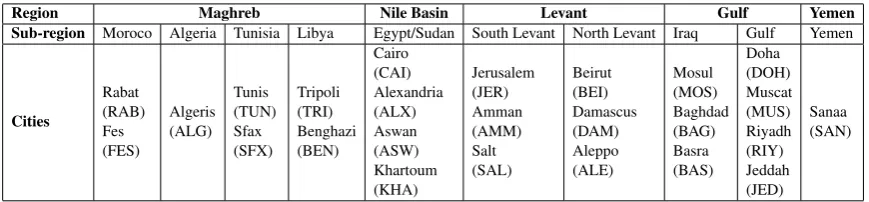
cities that are within the same country. The num-ber of samples available for each class is 1,600 for each of the 26 cities given in Table 1 from (Salameh and Bouamor,2018).
We report different data augmentation tech-niques used to expand the training set used. We also report the data analysis done on class simi-larity and model confusion from which we draw conclusions for suggested future work.
2 Data
The data used in all of the proposed system is one of the two parallel corpora made available by the Multi Arabic Dialect Applications and Re-sources (Bouamor et al.,2019) (MADAR) project: a 2,000-sentence parallel corpus with 25 parallel translations plus Modern Standard Arabic (MSA) which we will refer to as CORPUS-26 and the second corpus which has another 10,000 addi-tional sentences translated to five selected dialects, which we will refer to as CORPUS-6.
The metrics reported for each model on CORPUS-6 or CORPUS-26 are trained on the same corpus for which the accuracy is reported. No more additional data is used except augmenta-tions of the corpus used.
Data PreprocessingWe apply a generic trans-formation that removes punctuation, diacritization and vowel elongation.
Data AugmentationAlthough there is no class imbalance, the number of samples per class and the fine grained classes were motivation to ex-periment with different data augmentation tech-niques. We used the following methods inspired by (Ibrahim et al., 2018)’s work to augment al-ready existing documents:
Region Maghreb Nile Basin Levant Gulf Yemen Sub-region Moroco Algeria Tunisia Libya Egypt/Sudan South Levant North Levant Iraq Gulf Yemen
[image:2.595.82.517.61.162.2]Cities Rabat (RAB) Fes (FES) Algeris (ALG) Tunis (TUN) Sfax (SFX) Tripoli (TRI) Benghazi (BEN) Cairo (CAI) Alexandria (ALX) Aswan (ASW) Khartoum (KHA) Jerusalem (JER) Amman (AMM) Salt (SAL) Beirut (BEI) Damascus (DAM) Aleppo (ALE) Mosul (MOS) Baghdad (BAG) Basra (BAS) Doha (DOH) Muscat (MUS) Riyadh (RIY) Jeddah (JED) Sanaa (SAN)
Table 1: Different region, sub-region, and city dialects in the MADAR dataset.
and create a new comment with only unique words.
• Random Mask Augmentation: for each docu-ment, we create a different new document by randomly removing up to 20% of the original document words.
• Random Swap Augmentation: for each docu-ment, we create a different new document by randomly swapping up to 20% of the original document words.
• Random Concatenation Augmentation: we choose two documents with few number of words at random and append them forming a new one with longer length.
We report that using data augmentation pre-vented over-fitting when using deep learning as we chose between applying different techniques or us-ing the original document at random for each sam-ple in each epoch.
For non deep learning models, we used such augmentation to increase the size of the data used to around quadruple the original number of docu-ments, which resulted in a slight increase (close to 1%) in the baseline model accuracy.
3 Methodology
For such a complicated task we tried multiple ap-proaches using different techniques to achieve the best results. We started by tuning the baseline given in (Salameh and Bouamor, 2018) which is a Multinomial Naive Bayes (MNB) using TF-IDF character + word features (without the KenLM language model). Experiments concluded with n-gram ranges of one to five for character features and one-gram for word features. A grid-search using (Pedregosa et al.,2011) was applied to the MNB which delivered an F1-score of64.94%on the dev-set.
We then took to deep neural networks, the mod-els submitted are given inTable 2and experiments that lead to those submission are given inTable 3. We did not observe much improvement over the baseline (MNB) until our first submission model.
3.1 LSTM + CharCNN, FastText embeddings + LSTM and Baseline Ensemble
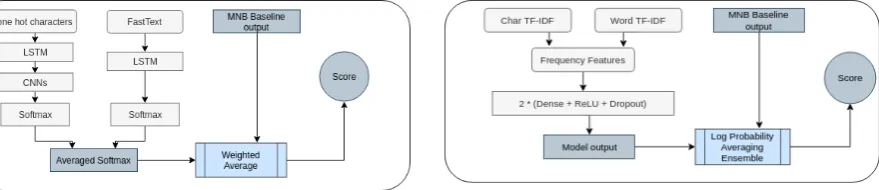
It is an ensemble of three models, the first being an adaptation of the character-level model proposed in (Ali,2018), which takes one-hot-encoded char-acter features to multiple (five in our case) con-volution layers with filter size of 256 -which is the same as the max length set for a sentence-preceded by a Gated Recurrent Unit (GRU) for context capturing of these features then a softmax layer for calculating log probabilities.
Model F1-Macro Precision-Macro Recall-Macro Accuracy ArbDialectID (Winning Team) 67.32% 67.60% 67.29% 67.29% LSTM +CharCNN, fastText embeddings + LSTM,
Baseline (1st submission) 65.36% 66.07% 65.38% 65.38% Char TFIDF + WordTFIDF + NN,
[image:3.595.96.506.62.140.2]Baseline (2nd submission) 65.66% 65.79% 65.75% 65.75% Bert + Document Pooling (3rd submission) 35.14% 42.61% 36.25% 36.25%
Table 2: Models submitted and their corresponding scores on the test-set.
Figure 1: 1st Submission Architecture
3.2 CharTFIDF + WordTFIDF + NN and
Baseline Ensemble
It is an ensemble of the MNB baseline and a deep learning model applied to baseline fea-tures. The deep learning model takes as input the frequency based features for which the MNB achieved 64.94% dev-set F1-score and improves it to65.57%.
The model architecture in Figure 2consists of two hidden fully connected layers followed by an output layer. The two hidden layers are followed by ReLU activations and dropout layers with 20% probability. The number of inputted features to the neural network is equal to the number of dimen-sions of the frequency based vectors (char-based and word-based). Adam optimizer (Kingma and Ba, 2014) is used for training with 3e-6 learning rate and the cross entropy loss as criterion.
The ensemble of the model produced with the baseline using log probability averaging produces 66.78%dev-set F1-score and65.66%test-set F1-score which is less than 2% below the winning team results and was ranked the seventh out of 19 submissions in the shared task competition.
3.3 Language-Model Based Models
We propose a number of other systems that pro-duced sub-optimal results on corpus-26 data, but are experiments worth mentioning towards other future ensembles and systems.
[image:3.595.85.525.182.277.2]i. A character level forward and backward language model trained using multi-layer RNNs
Figure 2: 2nd Submission Architecture
whose features are combined with fastText and bytepair (Heinzerling and Strube, 2017) subword embeddings produced 58% devset F1-score.
ii. A model using multi-lingual BERT (Devlin et al.,2018) and a multi-layer RNN for document representation also followed by a single layer lin-ear classifier reaches 55% dev-set F1-score.
iii. A model using Aravec (Mohammad et al.,
2017) word embeddings and a shallow LSTM for document representation (feeding word embed-ding sequence to LSTM and using hidden layers as features) produces 50% dev-set F1-score when using a one layer linear classifier.
4 Discussion
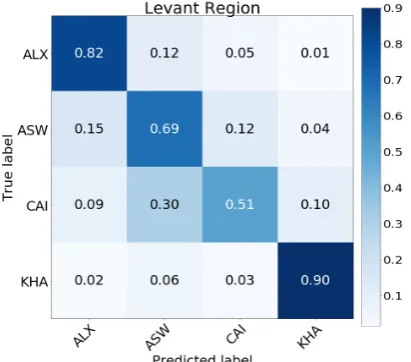
Multiple observations and experiments show that the fine-grained nature of classes is the most chal-lenging aspect of the task. Differentiating between Cairo and Alex or Beirut and Damascus is a much harder problem than differentiating between Lev-ant and Gulf for example. We report some results towards such conclusions when classifying by city within a single regions’ data as shown inFigure 3
andFigure 4.
Bench-marking all of the fore-mentioned mod-els on corpus-26 data with regions and MSA as classes instead of cities produces results compara-ble to that of corpus-6 data (80% at worst on the dev-set). So the higher scores reported on corpus-6 data are not only owing to the larger number of samples but also owing to the affinity between sub region classes in corpus-26.
Model Dev-set F1-score
Char TFIDF + WordTFIDF + NN, Baseline 66.6%
LSTM + CharCNN, fastText embeddings LSTM, Baseline 66.1% Character-level bi-directional LM (RNNs) + fastText + BytePair,
Linear Classifier 58%
[image:4.595.95.506.61.168.2]Bert + RNN Document Representation + Linear Classifier 55% AraVec Word Embeddings + Shallow LSTM with dropout 50%
[image:4.595.79.286.207.392.2]Table 3: Top scoring models on the dev-set
Figure 3: Confusion matrix for MNB classifier on Nile Basin region data and classes only
Figure 4: Confusion matrix for MNB classifier on Lev-ant region data and classes only
closely all of the deep learning based models plateau, is that coming up with a better system for this task may require the use of other external la-belled or unlala-belled data. With the internet rich with blogs that are country specific or city specific. We can use unlabelled data from specific sources
(e.g. tweets on Alexandria, Facebook posts from a public group based in Khartoum, and so on and so forth).
That can enable the training of embeddings from scratch on large data, and it can also be used on language model training improving the perfor-mance of models based on such techniques. The training of embeddings on such data specifically makes sense because of the percentage of out of vocab words and how they are handled in the em-bedding techniques we used. Because the embed-dings were for the most part trained themselves on MSA data. The out of vocab (OOV) words which were usually 10-20% of the words in the corpus-26 data, were handled by averaging the rest of the embeddings of all words in the document or by be-ing given a zero vector. Inconveniently, the OOV words are clearly the words we are most inter-ested in because they are most likely to be the di-alect specific words that differentiate between the classes. Therefore, if we are able to reduce the number of OOV words, the scores are expected to significantly improve. That can be achieved by the fore-mentioned training of embeddings on corpora that are not MSA only, or at least using smarter techniques to handle OOV words, such as character-based representation (Bojanowski et al.,
2016).
5 Conclusion
We introduce multiple neural network based mod-els built on word and document representations. We are able to produce results comparable to the MNB baseline on n-gram frequency based fea-tures despite of the small size of the dataset, which maybe an indication of even better results on larger data. We ensemble the neural network based models with the baseline to produce better results than the baseline.
[image:4.595.80.286.444.625.2]the language model based classifiers and ensem-bling using other techniques than probability av-eraging (e.g. stacking). We will also explore the training of embeddings on data that is comprised of diverse dialectical data, not only MSA, and bet-ter handling of OOV words when using embed-dings.
References
Mohamed Ali. 2018. Character level convolutional neural network for Arabic dialect identification. In
Proceedings of the Fifth Workshop on NLP for Sim-ilar Languages, Varieties and Dialects (VarDial 2018), pages 122–127, Santa Fe, New Mexico, USA. Association for Computational Linguistics.
Piotr Bojanowski, Edouard Grave, Armand Joulin, and Tomas Mikolov. 2016. Enriching Word Vectors with Subword Information. arXiv e-prints, page arXiv:1607.04606.
Houda Bouamor, Sabit Hassan, and Nizar Habash. 2019. The MADAR Shared Task on Arabic Fine-Grained Dialect Identification. InProceedings of the Fourth Arabic Natural Language Processing Work-shop (WANLP19), Florence, Italy.
Franc¸ois Chollet et al. 2015. Keras. https:// keras.io.
Jacob Devlin, Ming-Wei Chang, Kenton Lee, and Kristina Toutanova. 2018. BERT: Pre-training of Deep Bidirectional Transformers for Lan-guage Understanding. arXiv e-prints, page arXiv:1810.04805.
Benjamin Heinzerling and Michael Strube. 2017.
BPEmb: Tokenization-free Pre-trained Subword Embeddings in 275 Languages.arXiv e-prints, page arXiv:1710.02187.
Mai Ibrahim, Marwan Torki, and Nagwa El-Makky. 2018.Imbalanced toxic comments classification us-ing data augmentation and deep learnus-ing. In 2018 17th IEEE International Conference on Machine Learning and Applications (ICMLA), pages 875– 878.
Diederik P. Kingma and Jimmy Ba. 2014. Adam: A Method for Stochastic Optimization.arXiv e-prints, page arXiv:1412.6980.
Tomas Mikolov, Edouard Grave, Piotr Bojanowski, Christian Puhrsch, and Armand Joulin. 2018. Ad-vances in pre-training distributed word representa-tions. InProceedings of the International Confer-ence on Language Resources and Evaluation (LREC 2018).
Abu Bakr Mohammad, Kareem Eissa, and Samhaa El-Beltagy. 2017. Aravec: A set of arabic word embed-ding models for use in arabic nlp. Procedia Com-puter Science, 117:256–265.
Fabian Pedregosa, Ga¨el Varoquaux, Alexandre Gram-fort, Vincent Michel, Bertrand Thirion, Olivier Grisel, Mathieu Blondel, Peter Prettenhofer, Ron Weiss, Vincent Dubourg, Jake Vanderplas, Alexan-dre Passos, David Cournapeau, Matthieu Brucher, Matthieu Perrot, and ´Edouard Duchesnay. 2011.
Scikit-learn: Machine learning in python. J. Mach. Learn. Res., 12:2825–2830.
Mohammad Salameh and Houda Bouamor. 2018.