TECHNOLOGY OF COMPETENCE AND EFFECTS IN THE PEDAGOGICAL PROCESS
Doctor Education
ARTICLE INFO ABSTRACT
The article addresses the issue of teacher competence as an important factor in teaching and learning process. Outputs research plays the
resolution of the many variations of pedagogical problems encountered in contemporary school is necessary to conceptualize the idea of
developed a number of professional and personal competency, but fail to combine their best effective strategy. And this is because in practical life lost strategic goal. Competency technology is one technology that can combine certain individual competencies
professional case. As a foothold for constructing Competency technology used "effects" of the study "Visible Learning" Professor John Hattie. Discussed are such effects in the study were identified as unworkable, but Bulga
factors / effects that are possible core competency of operating technologies. Draws attention to the goal -
activities in the context of achieving a school purpose.
Copyright © 2016 Rumyana Ilcheva Neminska. This
unrestricted use, distribution, and reproduction in any medium, provided the original work is properly cited.
INTRODUCTION
A competence-technology of competence
In modern pedagogical literature is emerging definition, conceptualization, contextualization as a sign of efficiency in the educational occupational activities. This is useful in its own way
because of it come a number of theoretical and applied technology to optimize the educational process,
and practical. Understanding of competence structure is a major projection who serialization of this exhibition. The article examines only its charge and motivational effect in the design technology within the school to improve the quality
and learning in the classroom. The justification to be considered as a factor competence / effect of raising the quality of teaching and learning in the classroom is associated primarily with educational standards that need to reach students. When expected (standardized) student since first grade to work in an environment for initial formation of key
*Corresponding author: Rumyana Ilcheva Neminska Doctor Education, Faculty of Education, Trakya University
ISSN: 0975-833X
Article History:
Received 19th October, 2015
Received in revised form 22nd November, 2015
Accepted 07th December, 2015
Published online 31st January,2016
Key words:
Competence of technology, Learning,
Teacher, Methodology.
Citation: Rumyana Ilcheva Neminska, 2016. “Technology of
Research, 8, (01), 25877-25882.
RESEARCH ARTICLE
COMPETENCE AND EFFECTS IN THE PEDAGOGICAL PROCESS
*Rumyana Ilcheva Neminska
Doctor Education, Faculty of Education, Trakya University, Bulgaria
ABSTRACT
The article addresses the issue of teacher competence as an important factor in teaching and learning process. Outputs research plays the relation: a competence technology. Expressed position that a resolution of the many variations of pedagogical problems encountered in contemporary school is necessary to conceptualize the idea of Competency technology. Because Bulgarian teachers have eloped a number of professional and personal competency, but fail to combine their best effective strategy. And this is because in practical life lost strategic goal. Competency technology is one technology that can combine certain individual competencies
professional case. As a foothold for constructing Competency technology used "effects" of the study "Visible Learning" Professor John Hattie. Discussed are such effects in the study were identified as unworkable, but Bulgarian reforming educational system are a major trend. Outputs groups relevant factors / effects that are possible core competency of operating technologies. Draws attention to the
why construct one such technology: how and what to choose a teacher to activities in the context of achieving a school purpose.
This is an open access article distributed under the Creative Commons Att , and reproduction in any medium, provided the original work is properly cited.
is emerging research trend contextualization of competence the educational, social and in its own way a tendency theoretical and applied the educational process, both strategic competence in its global serialization is not the aim only its contextual in the design and planning of to improve the quality of teaching The justification to be considered as a factor competence / effect of raising the quality of teaching and learning in the classroom is associated primarily with educational standards that need to reach expected (standardized) student since first grade to work in an environment for initial formation of key
Rumyana Ilcheva Neminska,
Trakya University, Bulgaria.
competencies, it regulates new interdisciplinary basic position of teacher. Or in other words: the teacher himself "rearrange" their professional competencies, integrating them into a new interactive mode of action. The trend towards interdisciplinary activities in the curriculum implies that teachers must not only have a thorough knowledge and understanding of the content (which is the basis of any jurisdiction), and have developed skills and to deal effectively with it. Their own over / academic training should include a set of eff
practices, if the teacher look yourself in the new standards, he discovered four levels of knowledge: knowledge of the students; knowledge of himself; knowledge of effective techniques, interdisciplinary knowledge.
Here comes these idea to consider effect of raising the quality of classroom. It includes the issue of expectations of today's students of the modern teacher to students what is the context of pedagogical
classroom? The article advocates the understanding that professional pedagogical competence is linked to opportunities for acquiring knowledge of different exper
to the skills of the teacher to manage the pedagogical process in cognitive, emotional and motivational plan. Professional
International Journal of Current Research
Vol. 8, Issue, 01, pp.25877-25882, January, 2016
INTERNATIONAL
Technology of competence and effects in the pedagogical process”,
COMPETENCE AND EFFECTS IN THE PEDAGOGICAL PROCESS
, Bulgaria
The article addresses the issue of teacher competence as an important factor in teaching and learning technology. Expressed position that a resolution of the many variations of pedagogical problems encountered in contemporary school is Competency technology. Because Bulgarian teachers have eloped a number of professional and personal competency, but fail to combine their best effective strategy. And this is because in practical life lost strategic goal. Competency technology is one technology that can combine certain individual competencies to solve specific educational and professional case. As a foothold for constructing Competency technology used "effects" of the study "Visible Learning" Professor John Hattie. Discussed are such effects in the study were identified as rian reforming educational system are a major trend. Outputs groups relevant factors / effects that are possible core competency of operating technologies. Draws attention to the why construct one such technology: how and what to choose a teacher to operationalize the
is an open access article distributed under the Creative Commons Attribution License, which permits
new interdisciplinary basic position of teacher. Or in other words: the teacher himself "rearrange" their professional competencies, integrating them into a new interactive mode of action. The trend towards interdisciplinary plies that teachers must not only have a thorough knowledge and understanding of the content (which is the basis of any jurisdiction), and have developed skills and to deal effectively with it. Their own over / academic training should include a set of effective, interactive teaching practices, if the teacher look yourself in the new standards, he discovered four levels of knowledge: knowledge of the students; knowledge of himself; knowledge of effective techniques, interdisciplinary knowledge.
consider competence as a factor/ raising the quality of teaching and learning in the It includes the issue of meeting expectations: students to the teacher and expectations students. Here formed the question: pedagogical competence in a modern The article advocates the understanding that professional pedagogical competence is linked to opportunities for acquiring knowledge of different expert level; It is related to the skills of the teacher to manage the pedagogical process in cognitive, emotional and motivational plan. Professional INTERNATIONAL JOURNAL OF CURRENT RESEARCH
pedagogical competence is the core in various pedagogical technologies and is the winner of innovative and innovative teaching. In scientific fields such as social sciences, education management (see references.) Pedagogical competence is examined at the level of individual, team, group, organization thus considering various factors: psychological, interactive, organizational, managerial, social, economic, cultural (ethnic religious, gender, etc.).
In this exhibition pedagogical competence is seen as an integrative personal pedagogical resource, which ensures successful implementation of effective teaching strategies. Thus it is seen as an integrative construct of three factors:
- Success/effectiveness of the teacher himself, as measured by: -Professional development and concrete results, adequate to: -Social changes and expectations.
Pedagogical competence plays a key role in developing effective learning process, success and formation of quality education. In herently has a strong adaptive professional status quo, because her influence on the trends of social development, and hence the change in educational standards. At the same time the structure of pedagogical competence has a relatively static nature. It consists of three main elements:
- One competences - Learning objectives, - Activities.
One competences as structurally concept in the competence is regarded as specific strategies to solve problems and achieve educational and cognitive purposes. One competence is not just / knowledge itself and controlled strategy for acquiring knowledge; not only skill, mastered strategy for knowledge management; It is not only a motive but controlled strategy for motivation and self regulation / by knowledge. One competence is observable field, which recognizes the success/failure in the implementation of educational and cognitive task. Pedagogical competence include at least two integrated competencies, one trips and activity. In constructing the learning objectives, planning many activities and integration of two/more competencies define the concept of.
technology of competence“. The basic building block of
Competency technology is pedagogical competence.
Technological approach applied to the design of technology
competence, provides a variety of methodological strategies to develop effective models for solving the educational, social and educational problems.
In this sense, the technological approach develops the personality of the teacher and student, predicted and organize optimal use of resources; helps create new educational technologies. Technological approaches are not universal, but rather complement and develop methodological research areas; they are an important part of the theoretical and successful practices in pedagogy. The research approach was applied to the design of technology competency, develop professional curiosity, ability to place issues for study and research on cognitive tasks in a given context. Actively develop and conduct discovery to the problems, which is vital for students,
and therefore to develop technology competency in this direction. Only in this way, students will be able to cope with the dynamics of the future. The main contribution of the research approach in designing technology competency is the development of active learning style associated with the project-based and problem-oriented training (9). In summary it can be argued that the jurisdiction technology is an integrative concept, research displayed in the system of interdisciplinary teaching and learning through didactic and technological issues. Associated with the development of observable professional competencies; integration of appropriate technological competencies and skills for adaptive teaching and learning. Observable competencies (10, p.61) are structured in four levels:
Self-reflective associated with emotional intelligence of teacher;
Collaborative, connected with cooperation and exchange of values;
Discursive level - a higher rank for the development of meta-representative competence: plural thinking, methodological pluralism;
Mental level - thinking to myself as competence; thinking about the ways in which values, attitudes, ideologies shape pedagogical activities and actions, the ability to ask questions.
Competency technology aims to approximate fields in scientific disciplines, to develop methodological pluralism in academic teaching. And hence, variability and contextuality in the learning process. The use of technology does not modify the content and structure of the discipline and the opportunity to conceptualize in different environments and through different means. In this sense, technology competence is interpreted as adaptation and development of methods (methodology).
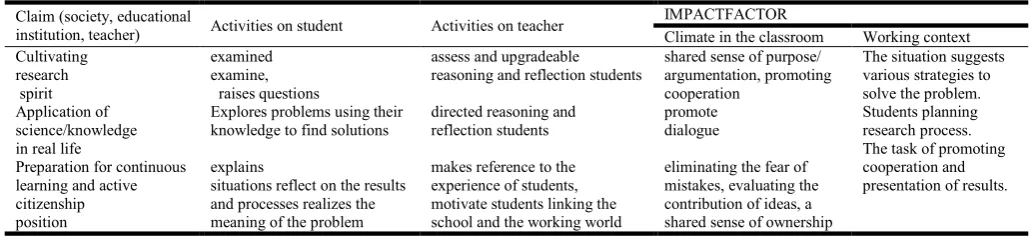
On the practical-application level she developed methods so that the focus is not so much on the accumulation of knowledge in the form of theories, but rather to change a methodological and technological system. The teacher ceases to be just an observer, but a participant in their own pedagogical and professional change. The increase in knowledge is measured not only by mathematical models of "cause and effect", but also with improved methods of pedagogical interaction. The context methods can be planned in advance if Competency technology to develop operationally frame - Table 1. It planned general predicates, actions and results.
1) Methods are learned and transmitted through their use in interactive contexts;
2) Methods facilitate coordination and resolution of educational and cognitive problems in their optimal target combination;
3) Methods change through imitation, enriched by experimentation and grow through innovation.
Technology of competence is actually a meticulous study of the teacher in their reflexive technologies that teach skills to adapt "on the fly" so that well working, they can become even better and best working for certain a learning community.
Technology of competence and effects in the pedagogical process
In a large study on the effects of education John Hattie considered various factors in developing quality teaching and learning process. "Visible learning" is systematic, long-term study about which factors and to what extent are involved in the learning process in the classroom. In research circles it remains as an open concept that verifies multiplied, adjusted. And yet, allows each factor to develop appropriate educational technology. In this sense, "Visible learning" can be seen as a guide for constructing competency technologies. In the original study the effects are divided into six main groups that influence the learning process and student achievement:
1. The personality of the student; 2. Home environment
3. School; 4. Curriculum;
5. Professionalism and personality of the teacher; 6. Pedagogical approaches.
For the purpose of this statement summarizing the effects1 of the applied different from those in the study conditions, contexts and influences. The aim is to seek to projections competency technologies working in the modern classroom of Bulgarian school. Through research approach to these effects seen their importance in structuring competency technologies aimed at new expectations of society to education.
1
Displayed effects in the study were138pcs.Overall, the effects displayed in the original study have range din value from -0.01 to1.00. They reflect the details of the context and activities in the pedagogical process that affect student performance. With regard to the purpose of the article: build technology competency here is made a summary analysis of the effects working in Bulgarian education
Group:"Competency technologies for planning and
organizing the learning process"
In this group are listed factors / effects that underlie the construction of competency technologies. Important effects that correspond to markers of reforming Bulgarian education are:
Open traditional spaces for learning. The study "Visible
Learning" this effect was recorded with low correlation to increasing student achievement. Different trends in the Bulgarian education is striving to develop the skills students learn in different conditions and variable context. Traditional opening spaces for learning is a basis for implementing interactive methods and effective communication with the natural and social environment. To this effect correlates and effect: "extracurricular activities." Planning activities to this effect has basic ways to open the traditional spaces for learning.
Style of teaching and learning style. Bringing styles
guarantees the efficiency of teaching and learning process. The successful organization of the lesson the teacher is important to know the level, interests and expectations of the class to master different styles and skills for interpretation of knowledge. An important element in constructing a competency technology aimed at the management of different learning styles, is the ability of the teacher to balance - to stimulate the leading individual style, but also to develop accompanying learning styles.
The planning group work within hours and the use of effective techniques to manage the activities of groups is an important element of technology competency. Leading factor is the ability of the teacher not only to organize the physical environment and to manage the process through various interactive - simulation and situational techniques; to motivate and encourage the group as a single entity and not as separate entities; be able to apply the correct approach to the situation.
Students control learning effect is designated as low to explore working in the classroom. In the context of a more efficient conduct of the educational process, this effect could extend its significance as a technique for passive involvement of students in the learning process. In the context of working with different, this technique finds its place in the planning of effective learning process.
[image:3.595.34.551.71.189.2] Mutual teaching. Competency technology is built around the planning of activities for utilization of educational and cognitive strategies such as summarizing, questioning, Table 1. Example operationally within the competence technology1
Claim (society, educational
institution, teacher) Activities on student Activities on teacher
IMPACTFACTOR
Climate in the classroom Working context
Cultivating research spirit
examined examine, raises questions
assess and upgradeable reasoning and reflection students
shared sense of purpose/ argumentation, promoting cooperation
The situation suggests various strategies to solve the problem. Students planning research process. The task of promoting cooperation and presentation of results. Application of
science/knowledge in real life
Explores problems using their knowledge to find solutions
directed reasoning and reflection students
promote dialogue
Preparation for continuous learning and active citizenship position
explains
situations reflect on the results and processes realizes the meaning of the problem
makes reference to the experience of students, motivate students linking the school and the working world
clarifying and forecasting; for dialogue between teacher and pupils, pupils and students. The participants in the learning process change roles with the main purpose is: to learn to monitor their own learning and thinking.
Group:"Competency technology research planning and teaching"
In this group are summarized effects by which competency technologies have growing role in adaptive and critical thinking among teachers and students.
Training for taking exams/test solving. The reason this
effect to be located here is that the expected results are: students to be able to organize their time, manage their knowledge and research to approach the examination of cases. Competency technology is built around the research context of simulations and simulation-based training. This effect is achieved by simulation-based training to develop skills to overcome errors and confidence.
Homework. Planning and implementation of homework is
seen as creative skill of the teacher to plan, be variable2. Unbearable, traditional, boring homework can undermine motivation and disrupt the skills and efforts of the students for a long time. Therefore research look the teacher can find a number of practical strategies for creative planning homework. Homework is the reflecting strong from home environment - displayed in the study as a very strong factor in student achievement. In this sense, the teacher could construct homework so that it has a role of intellectual stimulation at home to support social and psychological environment to encourage parent/family involvement. Thus the teacher sends an important message that respects the culture, life and being a student home. This is a reflexive message of efficiency.
Simulations and case studies. Research and creative
planning simulations, situations and cases related to mastery of the learning process is presented in the study of Hattie low (0.31) effect. Modern trends in Bulgarian education, however, supported and directed precisely to such technologies for the development of transversal/transferable skills and develop critical thinking. Planning of such interactive technologies is related to the ability of the teacher to monitor, design, analyze, make decisions to build simulation/situational models and how / what students will be motivated to participate. By planning simulations situations, case studies and games can provide training to reduce disruptive behavior - effect on its interactivity is included in this post.
Teaching learning strategies and skills for learning are two
effects in the study of Hattie with high efficiency. Competency technology is organized first at how the methods that the teacher will choose when planning activities; secondly, to how and where to apply them in the context of educational and cognitive tasks. The planning of such a teaching strategy goes beyond mere knowledge that the teacher teaches. The teacher sets the strategies for developing the confidence to achieve the objectives of
2Contains within itself possibilities for scalable performance and achievement
of learning objectives.
valuing knowledge through practical application. It is the teacher to understand the purpose of each strategy: when the chosen strategy is effective for developing skills, learning, self-regulation.
Мeta-cognitive strategies. Met cognitive strategies refer to
the ways of "thinking about thinking". In this aspect competency technologies are directed to methods of their planning - how to approach the task, how to assess progress, how to conduct monitoring of understanding; into account the three pillars in meto-cognitive strategy: problem, hypothesis, self-assessment. Competency constructive technology directed to:
- Awareness of students of their own potential and the way forward: I know, I know, I learned.
- Asking questions to yourself: How exactly do „I do that?“, a number contained questions directed at the process, the choice of strategy, self-assessment and summary.
Technology of competency aims students to realize and understand the strategy that used; students learn how best to apply metacognitive strategies.
Integrated curriculum and related educational programs.
Here again combined two effects presented in the study of Hattie relating to curricula. Their overall performance is in order - to emphasize research and creative approach to each of the programs, regardless of their specifics. Understanding of integrated programs in the study borders with the author's understanding of project-based and problem-oriented training. I aimed feasibility studies class, include science and social domains in different themed activities.
Accompanying programs are those that: support faster cognitive development of students; Нelp to overcome the cognitive difficulties of students. Technology of competency here is tied to a specific purpose and selection of appropriate methods and effective techniques leading to consequential practices. An important fact about the high value of the effect" accompanying curricula" is that the factor" remain in the class, repeating the Year" is a negative value (inoperative effect studied Anglo-American schools). That is what effect "accompanying curriculum" (can be understood and "concomitant program for reading comprehension) is an important, sustainable and growing technology competency of Bulgarian teacher. Preview of concepts. The main point here is that teachers have developed digital competencies and are in the process of mastering the various strategies for their educational inclusion. Competency technology involves not the process of visualization (development of graphical content, summarize the main ideas of what should be taught, synthesize and identify the big ideas, themes and relationships) and its method of use and inclusion in lesson. Includes original ideas of the teacher where and how to regulate the activities and learning through ICT.
Group: "Reflexive competency technologies"
Provide better feedback. Especially important role in this factor
is the ability of the teacher to model positive and communicative environment between themselves and the students. If the teacher is open to feedback on what students know and understand when they make mistakes when they have misconceptions, it can then react accordingly pedagogical constructive way. The focus of the competency technology is related to inclusive ways of feedback modeling positive and long-time school education feedback and mutually beneficial relationship.
Provide formative evaluation of teachers. This effect of
increasing student performance is directly related to the change in the position of teacher. Not only to assess the final outcome, and to monitor developments in the formation of knowledge. The question: "How am I doing?" To be asked not only by students and the teacher to himself? Just so the teacher will be able to adapt its technology competency; and find the way how to develop high expectations for every student.
Experts working in cooperation (7) Is one of the operating
effects that conceptually build the technology competency. One of the strongest ideas in the study "Visible Learning" is the idea that teachers learn from one another, talk together about planning pedagogical intentions, success criteria, progressive learning, ie what constructs them as good teachers, before being placed in the pedagogical practice. This model allows for ubiquitous clearer understanding of personal development uchenikovo in school curricula; develop skills for general professional development based on joint constructive criticism, advice and problem solving, as well as many other interactions. Experts working in cooperation leads to important debates about the quality of education, student outcomes - themes that underlie teaching and learning. Because when teachers have a common understanding of how students progress through the curriculum and strive to own the Outcome in the classroom stays individualism and egocentrism what is called "everything is permitted."
Expert shared responsibility for the development of students is
an important factor derived from the study of Hattie and structuring technology competence. Skill and understanding that the responsibility of the teacher should be seen in the context of developing joint expertise proposals; not to overlook a number of other influences and conditions for success/failure beyond the control of the individual teacher. Responsibility should be seen as the responsibility of everyone working together to improve student achievement: teachers, managers, leaders of school, parents, friends.
Summary
One of the fundamental ideas in the understanding of competence technology is that its variability and the great diversity is not seen as a barrier to effective learning. Attention is drawn to the opportunities this variability to improve the effectiveness of teachers who are not as successful; to form such levels through which all teachers to be sufficiently effective in their teaching. The main conclusion, which is important in this comment is that the high variability in teaching technology should be implied in training expertise and
standards. Here is not intended to achieve an incredibly high set of standards, and it is possible that all teachers have "the same impact as our best teachers"; the opportunity to reach the necessary level of expertise to practice efficiently.
Competency technology teacher as a leading effect in the educational learning process has five distinctive and recognizable supports.
Identified are the main ways (methods, tools, techniques) that are subjects of teaching. Knowledge is not static, it corresponds to different areas, and through technology competency adapt and integrate. In Competency technology has a large stock of strategies to support, prevent errors, develop creative initiatives of students.
Competency technology has the resources to create and manage an optimal climate for learning in the classroom, and the best climate for learning in the classroom is when there is trust. Students are afraid of mistakes, ridicule and negative assessments. Supporting and developing technology competency has a stock of strategies to overcome the mistakes of perception of mistakes and failures as a way to deserved success.
Variability. Competency technology ensures supply of resources for the conduct of a creative, research lesson. Teachers are specialists monitoring the current status of students and this resource would enable them to apply the version of the lesson, supporting the level of student involvement at the moment. In this sense, the methods and techniques of feedback are highly active factors in the learning process.
Workers and significant learning process Competency technology is one that provides all students challenge, conquering new priorities.
Workers and significant learning process Competency technology is one that has a positive impact on the results of the students. It is not limited only to improve and achieve results of the tests. It contains passion, style, condition for encouraging students to stay in school, helping them to develop deep and conceptual ideas by teaching them to develop multiple strategies for learning by encouraging them to take risks in their learning, helping them develop respect for themselves and others and helps them develop as active citizens who participate in our life.
REFERENCES
Bespalyko, VP. 1995. Education and training progressive technologies.
Clarin MV 2003. Тechnological approach to training.
Educational Technology, 5
Collins, A. & R. Halverson 2009. Rethinking Education in the Age of Technology: The Digital Revolution and Schooling in America. New York: Teachers College Press,
Dugger, W. E. and N. Naik 2001. Clarifying Misconceptions between Technology Education and Educational Technology. The TECHNOLOGY TEACHER.
Ganchev, N. and I. Ivanov 1984. Technological bases of the training. Dug «Konstantin of Preslav", c. Shumen.
Hattie Ranking: Influences And Effect Sizes Related To Student Achievement - http://visible-learning.org/hattie-ranking-influences-effect-sizes-learning-achievement/ Hattie, J. 2012. Visible Learning for Teachers: Maximizing
Impact on learning. Furst published 2012 by Routledge. Mizova, B. Tsvetanska, S. Research points to the problem of
social-communicative competence of pedagogical specialists magazine. Rhetoric and communication.
Neminska, R. 2015. Interdisciplinary training, LAP LAMBERT Academic Publishing.
Neminska, R. 2015. Simulation - Based training for teachers, Stara Zagora.
Pathak, R. P. & J. Chaudhary 2012. Educational Technology. Pearson Education India.
Spector, J. M. 2012. Foundations of Educational Technology: Integrative Approaches and Interdisciplinary Perspectives. Routledge.
TALIS 2014. The OECD Teaching and Learning International Survey. Early childhood and schools. Directorate for Education and Skills. The Organisation for Economic Co-operation and Development. http://www.oecd.org/edu/ school/talis.htm/