Merging Effluent Discharge Plumes from Multiport
Diffusers on a Sloping Beach
Anton Purnama
Department of Mathematics and Statistics, College of Science, Sultan Qaboos University, Muscat, Sultanate of Oman
Email: [email protected]
Received October 29, 2011; revised November 24, 2011; accepted December 3, 2011
ABSTRACT
Multiport diffusers are the effective engineering devices installed at the marine outfall systems for the steady discharge of effluent streams from the modern coastal plants, such as municipal sewage treatment, power generation and seawater desalination. A far field mathematical model using a two-dimensional advection-diffusion equation is presented for continuous discharges of effluent streams from multiple outfalls on a uniformly sloping beach with a current parallel to the shoreline. The analytical solutions are illustrated graphically to replicate and capture the merging process of effluent plumes in shallow coastal waters, and then asymptotic approximation will be made to the maximum shoreline’s con- centration to formulate effluent discharge plume dilution from a multiport diffuser.
Keywords: Effluent Discharge; Mathematical Model; Multiple Outfalls; Multiport Diffuser; Sloping Beach
1. Introduction
Along the highly populated coasts of the Arabian Gulf, Gulf of Oman and Red Sea, many large scale municipal sewage treatment and (co-location) power generation and seawater desalination plants are often found to be clus- tered together [1,2]. Desalination plants generate two pro- ducts, pure water and brine—a reject concentrate stream. The unwanted brine product is primarily seawater but at a more concentrated level, with a concentration factor of as high as 2.5 more than the typical seawater salinity. Most coastal plants continuously discharge brine streams back into the sea through a submerged outfall, and as a brine stream enters the receiving marine waters, it creates a high salinity plume. Without proper dilution, the brine plume will tend to sink and propagate down the slope for hundreds of meters, harming the ecosystem along the way, and most at risk are the benthic marine organisms living at the sea bottom [2,3]. An engineering solution utilizing the best available technology is required where a multiport diffuser would be installed at the pipe-end to rapidly dilute the concentrate [4-6]. A multiport diffuser is a linear structure consisting of many closely spaced ports designed to discharge a series of effluent streams into the receiving coastal water.
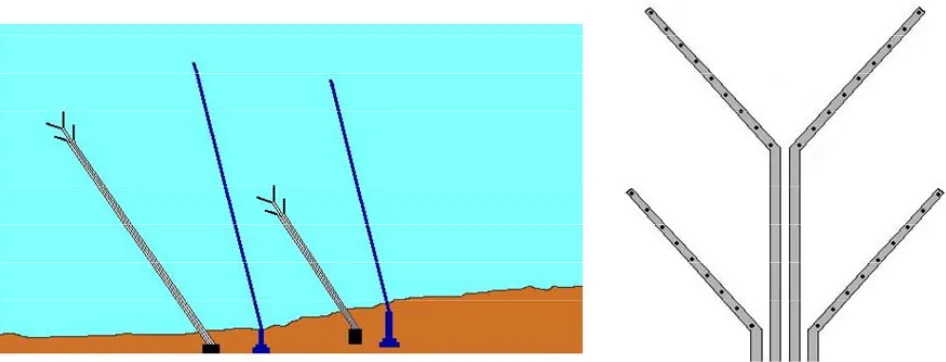
Figure 1 shows two marine outfall systems of the (up to four co-location) Barka power generation and seawater desalination plants in the Gulf of Oman [6]. Each outfall system is designed for a maximum capacity of 122,100
m3/h to discharge the cooling water from the power gen- eration plants and mix it with brine reject stream (and other effluents) from seawater desalination plants. The old (currently in use by the existing Barka I and II plants) outfall pipe length is about 650 m, while the new (not yet been used) outfall pipe length is about 1200 m, and the distance between the two discharge points is 1000 m. The old outfall system comprises of four parallel pipes angled at 62 degrees to the coastline, each with a diame- ter of 2.5 m, buried at 5 m below the seabed (not visible on the surface) and spaced equally at 4.8 m apart. Each pipe has a 62.4 m long multiport diffuser, consisting of nine ports equally spaced at 7.5 m apart, installed at the end of each outfall pipe. The multiport diffusers are ar- ranged in two nested V shapes as illustrated in Figure 1, and each pair diverges at an angle of 30degrees on either side of the outfall pipeline. The two internal pipes of length 653 m have its end at a depth of 9 m below the mean sea level, while the other two shorter external pipes of length 582 m end at a depth of 8.4 m. The ports of each diffuser are oriented in an alternating way each with an angle of 20 degrees to the diffuser pipe. The port di- ameter is 0.7 m and located at 1 m above the seabed, and the ports are oriented upwards with an angle of 10 de- grees against the horizontal.
Figure 1. Seawater intake and marine outfall systems of power and desalination plants at Barka, Oman (left), and the multi-port diffusers installed at the end of the outfall pipes (right).
cal models has been a key strategy for assessing the po- tential marine environmental impacts [2,3,6-9]. A clear understanding of these processes is needed so that pre- dictive models can be developed which form the basis of sound engineering design [4]. To demonstrate the effec- tiveness of a multiport diffuser in diluting the effluent stream, many laboratory and field experimental meas- urements have been carried out to derive several empiri- cal equations for the effluent plumes formed from the merging of individual port discharges [4,5]. However, no analytical or numerical computations have been done to model and reproduce the interaction and overlapping of multiple effluent plumes. As large scale coastal plants are built predominantly on the sloping sandy beaches, the analytical formulation for the effluent plume dilution of a multiport diffuser discharge is derived here to measure its effectiveness over the single outfall discharge.
2. Mathematical Model Formulation
Immediately after steady release from the multiport dif- fusers, vigorous and rapid mixing of the effluent stream is governed by the effluent buoyancy, momentum of the discharge and its interaction with the sea currents [3-5]. At the end of this mixing zone stage, adjacent effluent discharge plumes interact with each other and merge to form a rising curtain, which then continues to drift away with the longshore currents [6-9]. Because of relatively shallow water depth, it is observed that the elongated effluent plumes are spreading towards the shoreline and may cause concentration build-up in the coastal waters [7-9].
As we are only concerned with the effect of seabed depth profile, for simplicity the other complexities such as tidal motions, density and temperature are ignored. The shoreline is assumed to be straight and the sea wide,
and we assume that the outfall’s effluent plume is verti- cally well-mixed over the water depth. The coastal (drift) current is assumed to be steady with a speed U and remains in the x-direction parallel to the beach at all times. The dispersion mechanisms are represented by eddy diffusivities, and diffusion in the x-direction is ne-glected, as the effluent plumes in steady currents become very elongated in the x-direction. The variations in the y-direction of drift current U and coefficient of dispersiv-ity D are assumed as the power functions only of water depth h, and for application, we take U to be proportional to 1 2
0
h and D to 3 2 0
h . These scalings are appropriate for a turbulent shallow-water flow over a smooth bed [9-11].
We also consider the effluent stream to be steadily dis- charged at a rate from the (original) single outfall at the position
0 Q
x0 0 ,y0 h0
, where 0 is an arbi-trary reference water depth; at a different rate from the first (new) outfall at the position ( 1 0
h 1 Q
,
x h y1
h0); at a rate from the second (new) outfall at2 Q
x2 2 h0,y2 2 h0
Q
; and so on, where
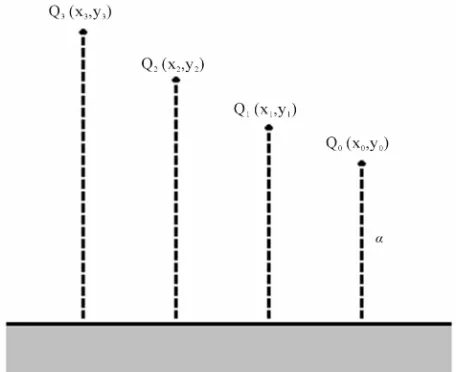
is the outfall’s (offshore) and (along the shore) sepa-ration distances. For a single outfall, the total effluent load is a function of 0. As illustrated in Figure 2, these
points
xk,yk
, where xk k h 0, yk
k
h0, represent a series of long sea outfalls, each discharging an effluent stream with rate k. Note that if both valuesof and are small compared to Q
, these points
represent the engineering design of a multiport line dif-fuser. For the Barka plant’s multiport diffusers [6],
0 3.75
h
m, h06.5m and h0576.5 m.
Fur-thermore, for a line diffuser with n ports, the total efflu-ent load is distributed into n individual discharges, so that each port discharges equally at a rate Qn Q n0 .
Figure 2. Definition diagram of multiple long sea outfalls.
increasingly linear as , where the beach slope and the beach is at ; following [7-9] and by applying a linear superposition, the two-dimensional far field advection-diffusion equation for effluent discharge plume concentration from the multiple outfalls is given by
h y my
0 y c m 1 n
0 n k k k chUc hD Q x x y y
x y y
k
, (1)with the boundary condition hD c y 0 at the beach , and is assumed to be ultimately dissolved into the ocean.
0
y c
is the Dirac delta function.
In order to solve Equation (1), the delta function rep- resentation of the point source term must be removed as it does not facilitate the solution. However, by doing so, the information about the source strength is also lost. For each long sea outfall at the position xxk kh0,
0k
yy k Q
h discharging effluent stream con-tinuously at a rate k,
k
k 0c
hUc hD
x y y
(2) is solved separately in the two regions and
k, and the solutions are then connected by the
matching condition
0 y yk
yy
lim , lim ,
k k
k
yyc x y yyck x y for all xxk.
Since no concentration is lost or produced anywhere, and the longitudinal dispersion has been neglected, the solution must also satisfy
0
d
k
hU c y Q
k for all xxk;that is, the flux of concentration by advection across any plane perpendicular to the flow direction must be equal
to the rate at which concentration is being released from the point source [9]
In terms of dimensionless quantities 2 * 0 , * 0 k k* 0 0 0
yy h x, x h c c Q h U , and by setting
1 2 3 2
0 * , and 0 * UU y DD y , using the Laplace transform
* , e * ,
k px
k k
x
c p y c x y x
d ,Equation (2) is transformed into a second-order ordi- nary differential equation
2
* *
* 2 *
* *
d 5d
0 2 d d k k k c c y p y
y c ,
which can be reduced to the modified Bessel’s equation
2
2 2
d d 9
0
d 4
d
u u
z z z
z z by writing
3 4* * , with 2 *
k
c y u z z py ,
where h U0 0 D0. The general solution in the two
regions is given by
3 4
* * 3 2 2 * for 0
k k
c A p y K py y y ,
and
3 4
* * 3 2 2 * for
k k
c B p y I py yy ,
where I3 2 and K3 2 are modified Bessel functions
[12].
Next, to obtain the particular solution, the functions
A p and B p
can be determined from the match- ing conditions
* * * *
3 2 3 2
* * * * * *
0
lim lim and
d d
k k
y k y k
k k k k k c c q
y c y y c y
p m
,where qk Q Qk 0. From the table of integrals [13]:
1 5 2
3 2 5 2
0
5 2
3 2 5 2
0
1
d a
1
d ,
x I ax x I a
a nd
x K ax x K a
a
and then using the property of the Bessel’s function
3 2 5 2 5 2 3 2
1 ( )
I z K z I z K z
z
,
3 2 3 4 3 2 3 4 2 2 , 2 2 .A p I p k
m k
B p K p k
m k and
Finally, using the inversion of the Laplace transform tabulated in [14], we obtain the exact solution in the form
3 2 3 4 * * * * * * * 1 2 exp . k k c qm x k k y
k y
y k
I
x k x k
After summing for all concentration k* from the
multiple outfalls, the analytical solution of Equa- tion (1) is given by
c 1 n
3 4 *0 * *
* * 3 2 * * 1 2 exp . n k k c q
m x k k y
k y
y k
I
x k x k
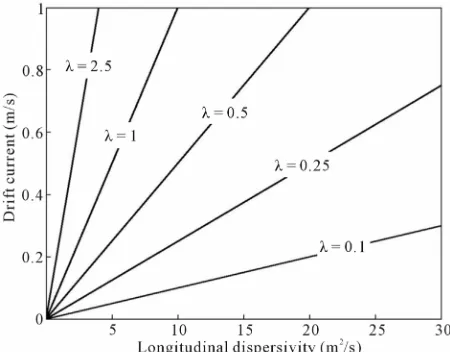
(3)As the water depth is gradually decreasing towards the beach, the effluent plumes are elongated and turning to- wards the beach, and the gentler the beach slope, the higher the buildup in concentration in the shallow water close to the beach [7,8]. This is expected since deeper water is a more efficient transport mechanism. The mod- el parameter h U0 0 D0 represents the effluent plume
elongation in the x-direction; the larger the values of , the more elongated the effluent plumes. To investi- gate the uncertainty in , Figure 3 shows the possible values of for some relevant measured values of 0
and 0 [8,11] in a shallow water depth 0 U
D h 10 m.
Larger values of are mostly due to a stronger drift current 0 with less longitudinal dispersivity 0. For
the quantitative illustration of the model applications, the
values of and
U D
0.
015
m 5 2 will be used in all
plots.
The other parameters related to the multiple outfalls are the (original) single outfall (offshore) distance, outfall’s (offshore) and (along the shore) separa- tion distances. Note that, for a multiport line diffuser with n ports, both values of and are smaller than
, and qk 1n1.
3. Multiport Diffuser Discharges
[image:4.595.310.535.87.263.2]For a large volume effluent discharge, the engineering practice is to distribute the effluent stream over a large expanse by installing a multiport diffuser at the end of a marine outfall to substantially improve the mixing and
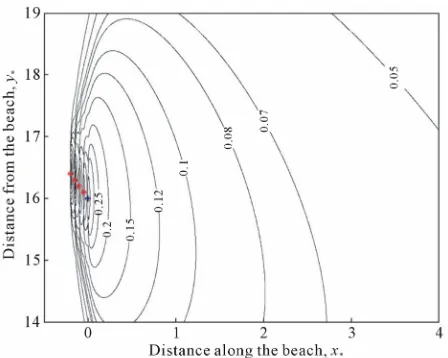
Figure 3. The model parameter λ for water depth h0 = 10 m. dilution of effluent plumes in the coastal waters [3-6]. By plotting the results of numerical integrations of Equation (3), the merging processes of effluent discharge plumes from a multiport diffuser with 5 ports are reproduced graphically in Figure 4, when the (original) single outfall distance 16 and the separation distances 0.05 and 0.1. The peakiness of the contour reflects the overlapping of effluent plumes near the line diffuser; it then drifts along and spreads towards the shoreline.
Again following [7-9], the appropriate measure for as- sessing the impact of effluent discharges from coastal plants would be the shoreline’s concentration values. In the limit as y*0 and replacing I3 2 in Equation (3)
by its asymptotic form [13], we obtain
*
5 2
0 * *
1 4 0 1 3 exp . n k c n m k
x k x k
(4)It is easy to see that for a single outfall when 0 , Equation (4) then reduces to
5 2* * * 4 0 exp 3 c x x m .
By differentiating, this concentration at the beach has a maximum value of
5 2 0m 0.61
c m ,
which occurs at x0*2 5 downstream of the out-
fall.
[image:4.595.62.288.300.371.2]Figure 4. Merging of effluent discharge plumes from a mul- tiport diffuser.
Figure 5. The shoreline’s concentration of effluent discharge from a multiport diffuser.
falls only changes the value of maximum concentration, but not its position. Note that the position of maximum concentration x0* is proportional to the model parame-
ter [8].
For the quantitative illustration, we consider a perpen- dicular line diffuser design, where the line diffuser with n ports is placed in the (offshore) y-direction perpen- dicular to the current direction, and it consists of a series of ports equally spaced by the offshore separation dis- tance . The maximum compounded concentration at the beach can be approximated by substituting *
* 0 x x
2 5
[8]. Using the fact that 0 and is small, we can linearize Equation (4), to approximate the maximum value of shoreline’s concentration as
* 0 0
1 5 1 1 2
n
m m
k
c c k
n
. (5)Finally, after summing for n ports, the maximum con- centration Equation (5) reduces to
* 0
5 1
4
m m
c c n
, (6) where is the (total) length of the line diffuser. As the number of ports increases and the single outfall dis- tance gets longer, the maximum shoreline’s concentra-tion Equaconcentra-tion (6) gets smaller than that of the single out-fall value.
n
Figure 6 shows the effluent plume (additional) dilu- tion (above that of the single outfall value), which is de-fined as the ratio of the initial concentration at the outfall discharge point to that at a given location, when 16
for three values of 0.005, 0.01 and 0.015. In par- ticular for a 9-port line diffuser, an additional dilution of 1.3 (above the single outfall dilution of 25.2) is obtained for 0.005, and it increases to 4.4 as in- creases to 0.015. Similarly, for 0.01, an addi- tional dilution of 8.4 can be achieved by increasing the number of ports to 21. This finding is in agreement with the general fact that a multiport diffuser improves the mixing of effluent plumes substantially with additional dilutions of up to about 20, mainly because the individual plumes are collapsed and swept away rapidly by the cur- rent.
4. Conclusion
The multiport diffusers are commonly designed in the form of a linear structure consisting of many closely spaced ports or nozzles which discharge a series of ef- fluent plumes into the receiving coastal waters. Such diffusers have increasingly been installed at the end of marine outfall pipelines from the modern coastal plants as part of an engineering solution to minimize the poten- tial environmental impacts of a large volume of effluent discharges. A mathematical model is developed to repli- cate and capture the process of merging effluent dis-
[image:5.595.309.538.532.707.2]charge plumes from a multiport diffuser on a sloping beach with a current parallel to the shoreline. The maxi- mum diffuser-induced shoreline concentration is then formulated, and the results for the perpendicular line dif- fuser (to the current direction) are in agreement with the fact that a multiport diffuser is capable of thoroughly mixing and diluting the effluent with additional dilutions of up to about 20 (above that of the single outfall value).
5. Acknowledgements
The author is grateful to Sultan Qaboos University for an Internal Grant IG/SCI/DOMS/10/11 which provided fi- nancial support for this work and to Dr. Hamdi Al-Bar- wani for his support and many helpful discussions.
REFERENCES
[1] S. Lattemann and T. Hopner, “Environmental Impact and Impact Assessment of Seawater Desalination,” Desalina- tion, Vol. 220, No. 1-3, 2008, pp. 1-15.
doi:10.1016/j.desal.2007.03.009
[2] D. A. Roberts, E. L. Johnston and N. A. Knott, “Impacts of Desalination Plant Discharges on the Marine Environ- ment: A Critical Review of Published Studies,” Water Research, Vol. 44, No. 18, 2010, pp. 5117-5128.
doi:10.1016/j.watres.2010.04.036
[3] T. Bleninger and G. H. Jirka, “Modelling and Environ- mentally Sound Management of Brine Discharges from Desalination Plants,” Desalination, Vol. 221, No. 1-3, 2008, pp. 585-597. doi:10.1016/j.desal.2007.02.059
[4] G. H. Jirka, “Integral Model of Turbulent Buoyant Jets in Unbounded Stratified Flows. Part 2. Plane Jet Dynamics Resulting from Multiport Diffuser Jets,” Environmental Fluid Dynamics, Vol. 6, 2006, pp. 43-100.
[5] P. J. W. Roberts and X. Tian, “New Experimental Tech- niques for Validation of Marine Discharge Models,” En- vironmental Modeling and Software, Vol. 19, No. 7-8, 2004, pp. 691-699. doi:10.1016/j.envsoft.2003.08.005
[6] A. Purnama, H. H. Al-Barwani, T. Bleninger and R. L. Do- neker, “CORMIX Simulations of Brine Discharges from Barka Plants, Oman,” Desalination and Water Treatment, Vol. 32, 2011, pp. 329-338. doi:10.5004/dwt.2011.2718
[7] H. H. Al-Barwani and A. Purnama, “Re-Assessing the Impact of Desalination Plants Brine Discharges on Erod- ing Beaches,” Desalination, Vol. 204, No. 1-3, 2007, pp. 94-101. doi:10.1016/j.desal.2006.03.536
[8] H. H. Al-Barwani and A. Purnama, “Analytical Solutions for Brine Discharge Plumes on a Sloping Beach,” De-salination and Water Treatment, Vol. 11, 2009, pp. 2-6. doi:10.5004/dwt.2009.835
[9] A. Kay, “The Effect of Cross-stream Depth Variations upon Contaminant dispersion in a Vertically Well-Mixed Current,” Estuarine and Coastal Shelf Science, Vol. 24, No. 2, 1987, pp. 177-204.
doi:10.1016/0272-7714(87)90064-3
[10] R. Smith, “Longitudinal Dispersion of Buoyant Conta- minant in a Shallow Channel,” Journal of Fluid Mechan- ics, Vol. 78, No. 4, 1976, pp. 677-688.
doi:10.1017/S0022112076002681
[11] D. W. Ostendorf, “Longshore Dispersion over a Flat Beach,” Journal of Geophysical Research, Vol. 87, No. C6, 1982, pp. 4241-4248. doi:10.1029/JC087iC06p04241
[12] G. M. Murphy, “Ordinary Differential Equations and Their Solutions,” D. Van Nostrand, London, 1960.
[13] I. S. Gradshteyn and I. Ryzhik, “Tables of Integrals, Se-ries and Products,” Academic Press, London, 1980.