http://dx.doi.org/10.4236/am.2012.34050 Published Online April 2012 (http://www.SciRP.org/journal/am)
Flexible GPBi-CG Method for Nonsymmetric
Linear Systems
*
Jia-Min Wang1, Tong-Xiang Gu2# 1
Chinese Academy of Engineering Physics, Beijing, China 2
Laboratory of Computational Physics, Institute of Applied Physics and Computational Mathematics, Beijing, China Email: #[email protected]
Received November 7,2011; revised February 22, 2012; accepted February 29, 2012
ABSTRACT
We present a flexible version of GPBi-CG algorithm which allows for the use of a different preconditioner at each step of the algorithm. In particular, a result of the flexibility of the variable preconditioner is to use any iterative method. For example, the standard GPBi-CG algorithm itself can be used as a preconditioner, as can other Krylov subspace methods or splitting methods. Numerical experiments are conducted for flexible GPBi-CG for a few matrices including some nonsymmetric matrices. These experiments illustrate the convergence and robustness of the flexible iterative method.
Keywords: Krylov Subspace Method; Flexible Preconditioning; Inner-Outer Iteration; GPBi-CG
1. Introduction
Krylov subspace methods are the iterative choice for solving linear system of the form
xb
A . (1) where the matrix A is assumed to be nonsingular. The strength of Krylov subspace methods are most apparent when combined with a preconditioner. We only consider right preconditioning in the paper. Thus one solves the equivalent linear system
1M Mx b
A . (2)
The preconditioner M is selected to be close to the matrix A. And the matrix AM1 is never formed ex- plicitly. Instead, when M v1 z is needed, one solves the corresponding system
Mzv. (3) In this paper, we present a flexible version of GPBi- CG, which allows the preconditioner M vary from one iteration to another. Let us denote the matrix n the
preconditioner used in the nth iteration. The need to allow for a variable preconditioner arises when the solution of (2) is not obtained exactly (say, by a direct method), but is approximated by a second (inner) iterative method.
M
In recent years, several flexible variants of Krylov sub- space methods have been established successfully. They
include flexible CG, which is applied on a symmetric positive definite matrix [1], flexible GMRES [2], flexible QMR [3], variable preconditioned GCR [4], flexible BiCG and flexible Bi-CGSTAB [5]. Preconditioning as this form is called flexible preconditioning, also known as variable or inexact preconditioning.
The paper is organized as follows. In the next section, we design the FGPBi-CG algorithm, which is a flexible version of GPBi-CG [6]. In Section 3, some numerical experiments will be conducted to illustrate the conver- gence of the algorithm. Furthermore, in some cases, it is shown that FGPBi-CG can achieve convergence to a tolerance when GPBi-CG is not convergent or even FBi-CGSTAB suffers stagnation. Finally we make some concluding remarks in Section 4.
Throughout the paper, x0 is the initial approximation,
0 0
r b Ax is the initial residual, and the norm used is 2-norm.
2. Flexible GPBi-CG Method
We describe the basic idea of variable preconditioning and how it is incorporated with the algorithm GPBi-CG in this section.
The expression M v1
1
is calculated at each iteration of the conventional preconditioned Krylov subspace me- thods. The object of preconditioning is to change the original coefficient matrix A into another matrix close to identity, i.e. AM I . Consequently, the following property that M v1
approximates A v1
can be verified easily.
*The project is partly supported by the NSF of China (No. 61170309,
No. 60973151, and No. 91130024) and the major project of scientific and technical development of China Academy of Engineering Physics (2011A0202012).
1 1
M v A v .
Thus, we consider obtaining an approximation of
1
A v instead of computing M v1 . That is, the follow- ing system (4) is roughly solved by an iterative method to a certain degree of accuracy that is not sufficient.
Azv. (4) Here, an approximation for the system (4) does not need to be solved at the same precision at each iteration. A stopping criteria has been established to make the pre- conditioner to be changed at each iteration. Different inner-loop can be applied to the system (4) including Krylov subspace methods and stationery iterative meth- ods.
The GPBi-CG algorithm proposed by Zhang [6], uses an unified way to derive a class generalizations of Bi-CG. By choosing different coefficients, namely, the following
and , the GPBi-CG algorithm will be reduced to other methods based on Bi-CG includes the well known CGS, Bi-CGSTAB, Bi-CGSTAB2.
Next we present a flexible version of GPBi-CG, which needs only some small modification of the GPBi-CG code.
ALGORITHM (FGP-BiCG with right preconditioner)
0
x is an initial guess, 0; is an arbitrary
vector, such that
, e.g., ; and set ,0
r b Ax
0,0 0 r r
* 0 r * * 0 0 r r0
1 1 0
t w 1
1,
;
For n0, until rn b do
1 1 1
n n n n n p r p u
solve M pnˆpn
*
*
0, 0, ˆ
n r rn r Ap
1 1 ˆ
n n n n n n
y t r w Ap
ˆ
n n n
t r Ap
solve M tnˆtn
ˆ ˆ
, , , ,
ˆ, ˆ , , ˆ ,
n n n n n n n
n n n n
y y At t y t At y
ˆ
At At y y y At At y
ˆ, ˆ , , ˆ ˆ,
ˆ, ˆ , , ˆ ˆ, n n n n n
n n n n
At At y t y At At t At At y y y At At y
(if n0, then
ˆ,
, 0ˆ, ˆ n
n n
At t At At
)
1 1
ˆ
n n n n n n n
u Ap t r u 1
n
u
1
n n n n n n
z r z
solve M znˆzn
1 ˆ ˆ
n n n
x x pz
1 ˆ
n n n n n
r t y A
* 0 1 * 0 , , n n n n n r r r r ˆ ˆ n nw At Ap
Enddo
at if we replace
Noted th Mn with M, a fixed precon-
di
erical experiments to tioner, the above algorithm e reduced to the stan- dard GPBi-CG method with right preconditioner.
3. Numerical Experiments
will b
In this section, we report some num
show the convergence behaviors of FGPBi-CG. In all cases the iteration was started with x0
0, 0,, 0
, andthe outer-loop is stopped when the relative residual norm
14 0 10
n
r r . In the following examples, we use stop- ping criterion for inner-loop as:
1) 1
l
n k
r Az ;
2) The maximum number of iterations of inner loop
max
lN . Here, ( )1
l k
z denotes the l-th approximation when com-
t
puting Azv at k-th steps of the outer-loop.
3.1. Examples for Toeplitz Matrix
In the first example, we consider a Toeplitz matrix of or- der 200 with a parameter .
4 0 1
0.7
4 0 1 0.7 4 0 1
4 0 4 A
In this experiment, we choose to be 3.79 and the inner iteration stopping criteria to be the maximum itera- tion is Nmax 50 and relative residuals range from
3
10
to 106. We can see from the Figure 1 that GPBi-CG converges faster than that of Bi-CGSTAB. When the standard GPBi-CG algorithm performs well, the flexible version of GPBi-CG is also convergent, but it need more computation. The results can be seen in Table 1. In the table, “FG(B)” denotes FGPBi-CG with precon- ditioning Bi-CGSTAB, and so on, while “MV” represents the number of matrix-vector multiplication, “OIt” denotes the number of outer iteration.
[image:2.595.54.262.378.737.2] [image:2.595.360.488.424.512.2]0 50 100 150 250 250 102
100
10–2
10–4
10–6
10–8
10–10
10–12
10–14
[image:3.595.63.286.85.258.2]BiCGSTAB GPBiCG
Figure 1. Convergence history of Bi-CGSTAB and GPBi-CG for Toeplitz matrix 1.
[image:3.595.310.534.86.259.2](G)
Table 1. Performance comparison: γ = 3.79.
FG(B) FG(G) FB(B) FB
MV OIt MV OIt MV OIt MV OIt
3
10 550 3 506 3 356 3 316 3
4
10 454 2 416 2 294 2 258 3
5
10 1102 4 528 2 736 4 332 2
6
10 574 2 550 2 374 2 350 2
specti ely. Becau GPBi-CG se th n era n sually converges faster than Bi-CGSTAB.
v se u d in e in er it tio u
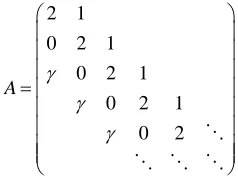
Now, we consider another Toeplitz matrix of order 200 with a parameter as following.
2 1
0 2 1
0 2 1
0 2 1
0 2
A
In this experiment, we choose e th
to be 1.9 and the inner iteration stopping criteria to b e maximum itera- tio
CG is c gen hile Bi-CGSTAB is not. As a result, w
We consider the finite difference discretization of the par- n is Nmax50 and relative residuals range from
3 10
to 106.
We can the Figure 2 and Table 2 that GPBi- onver t w
see from
hen Bi-CGSTAB is used as an inner iteration, the num- ber of matrix vector multiplication is not influenced by the inner relative residual stopping criteria, i.e., the inner iteration is not terminated until it reaches Nmax (the
larg-est iterative number of inner loop). For this reason, GPBi- CG used as the inner iteration performs better.
3.2. Examples for Model Problem
0 100 200 300 400 500 600 700 800 900 1000 105
100
10–5
10–10
10–15
BiCGSTAB GPBiCG
Figure 2. Convergence history of Bi-CGSTAB and GPBi-CG for Toeplitz matrix 2.
[image:3.595.60.288.311.391.2]FG(B) FG(G) FB(B) FB(G)
Table 2. Performance comparison: γ = 1.9.
MV OIt MV OIt MV OIt MV OIt
3
10 3926 13 1158 5 2626 13 758 5
4
10 3926 13 904 3 2626 13 574 3
5
10 3926 13 896 3 2626 13 604 3
6
10 3926 13 906 3 2626 13 606 2
tial differentia equ ion ( ,5,7l at [3 ])
x y
u xu yu u
f
(5)
at the exact solution to the discretized equation
on a unit square, where f is such th
Axb is x
1,1,,1
. The parameters and are chosen to have a nonsym- metric matrix. In our experiment, 10 and 100or 1000. The mesh is chosen of equal size in both dimension (32 nodes), and the corresponding matrix is thus of order 1024.
In the first example, we take 10, 100 and the inner iteration stopping criteria is N ranges from 30
max 6
.
3
to 70 and relative residuals is 10
For this choice, Figure 3 and Table show that both Bi-CGSTAB and GPBi-CG perform q well for this ex
uite
ample, flexible versions of these algorithms are also convergent. If the inner-loop stopping criterion is Nmax =
40 and 106
, the FBi-CGSTAB(Bi-CGSTAB) needs 316 matrix vector multiplications to reach the prescribed tolerance, faster than that of Bi-CGSTAB.
In the next experiment, we choose 10, 1000
and the inner iteration stopping criteria is N ranges
fro s 10
max
m 90 to 1000 and relative residuals i .
Neither Bi-CGSTAB nor GPBi-CG witho t precondi- tioning is convergent for this problem (see F gu e 4).
9
u
i r
[image:3.595.113.232.455.544.2]Figure 3. Convergence history of Bi-CGSTAB and GPBi-CG for β = 10, γ = 100.
[image:4.595.60.289.619.733.2]Figure 4. Convergence history of Bi-CGSTAB and GPBi-CG for β = 10 and γ = 1000.
Table 3. Performance comparison: β = 10, γ = 100. Table 4. Performance comparison: β = 10; γ = 1000.
FB(G) FG(G) FG(B) FG(G) FB(B) FB(G)
max N max
N
MV OIt MV O It
90
MV OIt MV OIt MV OIt MV OIt
2534 7 9576 18
30 910 5 1274 7 482 4 488 4
40 446 2 726 3 316 2 486 3
50
60 484
498
2 520
2 512
2 334
2 350
2 348
2 358 2
2 14
170 2728 4 4
200
0 3372 6 6736 8
4088
3208 4 4808 4
300 4720 500
4 3
12,606 7972
7 3
1000
4836
4880 2 6870 2
[image:4.595.308.536.620.734.2]CGSTAB, be ther are thr r-loops in the FGPBi-CG al m rat than t FBi-CGSTAB.
from able, we see FGPBi-CG (GPBi-CG c rges fo of t inner- stopping riteria. W appropriate stopp criteria is used in
4.
d to a certain degree of precision. In teration for solving Az = v is stopped
on Scientific C 4, 2000, pp. 1444-
cause e ee inne gorith her wo in
And this t )
1
onve r most he loop c
hen ing the inner
iteration, the flexible version will be a good choice.
Conclusion
We have formulated a flexible version of GPBi-CG for the large sparse nonsymmetric linear systems. The pre- conditioning is carried out by roughly solving Az = v by an iterative metho
our proposal, the i
according to satisfy a certain accuracy of approximation or the maximum number of iterations, so the precondi- tioner is changed at each outer iteration. Our numerical experiments show that FGPBi-CG is a viable alternative to GPBi-CG. And some examples show that FGPBi-CG is convergent when GPBi-CG suffers from stagnation.
REFERENCES
[1] Y. Notay, “Flexible Conjugate Gradients,” SIAM Journal
omputing, Vol. 22, No. 460. doi:10.1137/S1064827599362314
[2] Y. Saad, “A Flexible Inner-Outer Preconditioned GMRES Algorithm,” SIAM Journal on Scientific Computing, Vol. 14, No. 2, 1993, pp. 461-469. doi:10.1137/0914028 [3] D. B. Szyld and J. A. Vogel, “FQMR: A Flexible Quasi-
Minimal Residual Method with Inexact Preconditioning,” SIAM Journal on Scientific Computing, Vol. 23, No. 2, 2001, pp. 363-380. doi:10.1137/S106482750037336X [4] K. Abe and S.-L. Zhang, “A Variable Preconditioning Us-
ing the SOR Method For GCR-Like Methods,” Interna- tional Journal of Numerical Analysis and Modeling, Vol. 2, No.2, 2005, pp. 147-161.
[5] J. A. Vogel, “Flexible BiCG and Flexible Bi-CGSTAB for Nonsymmetric Linear Systems,” Applied Mathematics and Computation, Vol. 188, No. 1, 2007, pp. 226-233. doi:10.1016/j.amc.2006.09.116
[6] S.-L. Zhang, “GPBi-CG: Generalized Product-Type Meth- ods Baseed on Bi-CG for Solving Nonsymentric Linea Systems,” SIAM Journal on Sc
r ientific Computing, Vol. 18, No. 2, 1997, pp. 537-551.
doi:10.1137/S1064827592236313
[7] Y. Saad, “Iterative Method for Solving Linear Systems,” 2nd Edition, SIAM, Philadelphia, 2003.