doi:10.4236/ojst.2011.14019 Published Online December 2011 (http://www.SciRP.org/journal/ojst/).
The accuracy of brackets placement in direct bonding
technique: a comparison between the pole-like bracket
positioning gauge and the star-like bracket positioning gauge
Lahcen Ousehal, Laila Lazrak
Department of Orthodontics, Faculty of Dentistry, Casablanca, Morocco. Email: [email protected]
Received 13 April 2011; revised 24 June 2011; accepted 3 August 2011.
ABSTRACT
The accuracy of brackets placement is a key factor in successful orthodontic therapy. An in vitro study was conducted in ten models from a natural maxillary teeth model in order to compare the accuracy of brac- kets placement between two direct bonding instru- ments: the pole-like Bracket Positioning Gauge and the star-like Bracket Positioning Gauge. Our results have shown that: the star-like Bracket Positioning Gauge is more precise in placing brackets vertically, whereas the pole-like Bracket Positioning Gauge al-lows a better angulation of the bracket. Considering each tooth separately, there is no statistically signifi-cant difference between the two positioning gauges, except that the star-like gauge gives better results in bracket’s height for the second premolar and the ca-nine, whereas the pole-like gauge allows for a better positioning and a better vertical angulation of the brackets for the lateral incisor. No statistically signi- ficant difference was found between the two gauges on the mesiodistal position. Overall, the star-like gau- ge showed a better accuracy in positioning brackets.
Keywords:Direct Bonding; Pole-Like Gauge; Star-Like Gauge
1. INTRODUCTION
Good placement of orthodontic brackets guarantees a suc- cessful mechanical treatment [1]. Direct bonding is the technique that is most used by orthodontists in their dai- ly practice [2].
Two positioning instruments are available to the practi- tioner, the pole like gauge and the star like gauge also known as Boone gauge.
The question that arises is which of these two instru- ments is more accurate in terms of positioning orthodon-
tic brackets.
In literature, there are no studies comparing the pole like gauge and the star like gauge in bonding brackets. Our work has taken as objective to compare the accuracy of orthodontic bracket placement between two instruments of direct bonding: the star like and the pole like gauges.
2. MATERIALS AND METHODS
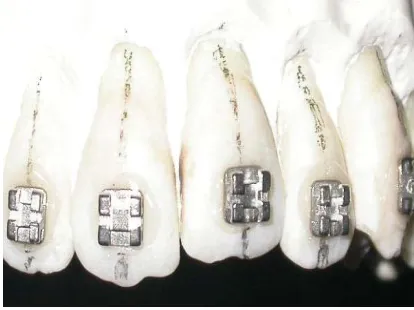
An experiment with a set of healthy natural teeth taken from 15 to 25 was conducted using a mold. Ten extra hard plaster models were made from the original model using alginate.
The natural teeth model was used for the ideal brack- ets’ placement.
Eleven sets of Edgwise standard metal brackets 022. 028 were used for the study.
The plaster models were mounted on mannequins to be close to the clinical conditions during the bonding of brackets.
The right hemi arch was reserved for direct bonding using the pole like gauge, and the left hemi arch was us- ed for direct bonding using the star like gauge.
Four experienced orthodontists have realized the bon- ding of brackets following the rules of correct bonding which are: the bracket axis should be parallel to the long axis of the tooth, the bracket should be centered in the crown, the height of bonding should be set to 4, 4.5 and 3.5 mm for the central incisors, bicuspids, canines and lateral incisors respectively.
The bonding material used is 3M TRANSBOND self cured composite resin.
Figure 1. Positioning the brackets on the reference model.
A metal ruler and a protractor scale 0.5 mm were used for linear and angular measures.
Standardized photographs of each bonded tooth of ten plaster models and the reference model have been taken with an analog camera (III Yascika dental eye.) The camera was fixed on a tripod allowing for an effective control of the vertical distance from which the images were taken.
The expansion used is 1/1 and the photographs were enlarged ten times to facilitate measurements.
Methods
The contour of the crown, the vertical center line and the horizontal center line of the bracket are drawn on a trac- ing paper laid over the photo of each tooth.
Each paper is laid over the picture of the natural tooth equivalent in the reference model.
Two linear measures and one angular measure were calculated between the ideal group and the tested group (Figure 2).
Figure 2. Tracing paper overlaid on the photo of the dog stuck by the direct method showing the different steps.
The height of the bracket: A zero value was assigned
to the bracket that bonded perfectly to the center.
A negative value was assigned when the vertical gap between the bracket bonded with the gauge and the ideal bracket is occlusal. Conversely, if the gap is cervical, a positive value is assigned.
Mesio distal inclination: The horizontal distance
be-tween the center of the ideal bracket and that of the test- ed bracket was measured to assess the mesio distal gap of the bracket. A positive value was assigned when the elevation of the tested bracket is mesial compared to that of the ideal bracket, and a negative value is assigned when the gap is distal.
Angulation:It is determined by the angle between the
horizontal center line of the ideal bracket and that of the tested bracket.
This measure is positive when the center line of the tested bracket is cervical relative to the ideal bracket and negative in the opposite case.
Statistical analysis: A statistical software (EPI-INFO)
was used in order to collect and analyze all the measure- ments. The Student T test was used for statistical com- parison of the results. The measurements were repeated for reproducibility and reliability of results. A paired t test has been realized and the t test is less than the calcu- lated t-test table, we can say there is no significant dif- ference between the 2 measurements.
3. RESULTS
Tables 1 and 2 show the averages and standard devia- tion for each group of teeth of the three measures: verti- cal, mesiodistal, and angular.
Vertical positioning: The comparison between the gr-
oup of teeth bonded with the star-like gauge and the pole- like gauge shows a very significant difference (P = 0.006) for the second premolar and a significant difference for the canine and the lateral incisor (Table 3).
The star-like gauge is more accurate for the second pre- molar and the canine. The pole-like gauge is more accu- rate for the lateral incisor.
Mesiodistal positioning:The comparison between the
group of teeth bonded with the star-like gauge and the pole-like gauge shows a significant difference for the fir- st premolar and the lateral incisor (Table 4). Indeed, the mesiodistal gap are opposed relatively to the center in the two groups. For the first premolar, we have a mesial gap of 0.32 mm on average for the group of teeth that bonded with the pole-like gauge, and a distal gap of 0, 46 mm for the group of teeth that bonded with the star- like gauge.
Similarly, for the lateral incisor, we have a mesial gap of 0.42 mm with the pole-like gauge, and a distal gap of 0.38 mm with the star-like gauge.
[image:2.595.57.288.514.691.2]Inclination of the bracket:The angular gap of the brac- ket shows a significant difference only for the lateral in-
[image:3.595.57.539.243.319.2]cisor (Table 5). The pole-like gauge is more accurate in this case.
Table 1. Mean values and standard deviation (STDV) of the vertical, the mesiodistal and the angular brackets’ position on the left hemi arch.
25 24 23 22 21
Teeth Mean STDV Mean STDV Mean STDV Mean STDV Mean STDV
Height (mm) –0.43 0.129 –0.46 0.314 –0.29 0.207 –0.38 0.109 –0.31 0.217
M-D (mm) 0.10 0.237 –0.45 0.228 –0.03 0.262 –0.38 0.230 0.01 0.242
Å (degrees) –0.32 0.228 –0.12 0.177 –0.17 0.130 –0.30 0.146 –0.24 0.133
Table 2. Mean values and standard deviation of the vertical, the mesiodistal and the angular brackets’ position on the right hemi arch.
15 14 13 12 11
Teeth Mean SDTV Mean SDTV Mean SDTV Mean SDTV Mean SDTV
Height (mm) –1.02 0.430 –0.38 0.204 –0.47 0.440 0.26 0.214 –0.005 0.281
M-D (mm) –0.04 0.205 0.32 0.155 0.32 0.216 0.42 0.116 0.03 0.155
Å (degrees) –0.23 0.131 –0.17 0.056 –0.21 0.228 0.16 0.168 –0.05 0.215
Table 3. Comparison of the vertical gaps between the star-like and the pole-like gauges.
Pole-like gauge Star-like gauge
Teeth
Mean (mm) SDTV Mean (mm) SDTV
P-value
2ndPM –1.020 0.430 –0.435 0.129 0.006**(S)
1st PM –0.315 0.204 –0.460 0.228 0.54
Canine –0.470 0.440 –0.030 0.262 0.05*(S)
Lateral incisor 0.260 0.214 –0.380 0.109 0.04*(S)
[image:3.595.55.540.347.460.2]Central incisor –0.005 0.281 –0.315 0.217 0.87
Table 4. Comparison of the mesiodistal gap between the star-like and the pole-like gauges.
Pole-like gauge Star-like gauge
Tooth
Mean (mm) SDTV Mean (mm) SDTV
P-value
2ndPM –0.040 0.205 0.105 0.237 0.66
1stPM 0.320 0.155 –0.460 0.428 0.04* (S)
Canine 0.328 0.216 –0.030 0.262 0.43
Lateral incisor 0.425 0.116 –0.380 0.230 0.03* (S)
[image:3.595.56.548.490.599.2]Central incisor –0.030 0.155 0.010 0.242 0.74
Table 5. Comparison of the inclination gaps between the star-like and the pole-like gauges.
Pole-like gauge Star-like gauge
Teeth
Mean (degrees) SDTV Mean (degrees) SDTV
P-value
2ndPM –0.235 0.131 –0.320 0.258 0.73
1stPM –0.173 0.056 –0.125 0.177 0.84
Canine –0.210 0.228 –0.170 0.130 0.86
Latéral Incisor 0.160 0.168 –0.305 0.146 0.04*(S)
[image:3.595.55.541.628.719.2]4. DISCUSSION
The objective of our work was to compare two instru-ments of direct bonding of brackets that are commonly used by orthodontists: the star-like gauge and the pole- like gauge.
We conducted our study on the maxillary arch because we believe that it is the arch in which the placement of brackets in direct bonding is the most difficult.
We have also reproduced (in part) the clinical condi- tions by mounting the models on mannequins and using the same adhesive product used in clinical practice.
The choice of experienced orthodontists in our study reduces errors related to the competence of the practi- tioner.
Similarly, the use of multiple practitioners is more re- alistic in that it avoids ending up with the same bonding errors related to a single practitioner.
The comparison between the two methods showed that the two instruments cause overall the same placement errors, but that we have more accuracy with the star-like gauge, especially for the vertical placement of brackets.
The photographic assessment is a reliable way to study the position of the bracket, provided the same pro- tocol and the same parameters are followed.
In our study, we used a system of rigid fixation and the same magnification for all pictures. This greatly reduces errors related to distortions of the photographic image.
The enlargement of the photographs was performed only for conveniently reading the various measures.
The pole-like gauge showed less accuracy in the verti- cal placement of bracket; this can be explained by its nature that allows it to be inclined too occlusally or too cervically, depending on the practitioner’s position rela- tive to the bonding tooth.
Our results showed a greater inclination of the bracket with the pole-like gauge on the lateral incisor.
The orthodontic literature has focused mainly on com- paring the accuracy of brackets placement between di- rect and indirect bonding [3-7]. No study has taken be-fore this one the objective of comparing bonding with the pole-like gauge and the star-like gauge.
BOHN CHAN KOO [8] conducted an in vitro study comparing the accuracy of bracket placement between direct and indirect technique.
For this, 19 sets of models of the same occlusion were divided into two groups, one for direct bonding (9 mod-els), the second for indirect bonding (9 models).
A model has been set aside for ideal bonding (compa- rison model). The bonding was done by nine experienc- ed orthodontists.
Direct bonding has been achieved by the star-like gauge similarly to our work, comparing the accuracy bonding on the basis of three measurements: vertical, angular, and
mesiodistal using enlarged photographs of each tooth. The author concluded that there is a gap between in- direct bonding and ideal bonding. This is consistent with our results on the direct bonding.
He also noted that for the maxillary second premolar, indirect bonding is more accurate, whereas for the max- illary lateral incisor, direct bonding was better for the in- clination of the bracket.
In our work we found that the pole-like gauge allows precise angle of the bracket for the lateral incisor, and we recorded largest gaps for the maxillary second premolar.
Similar results have been presented by BALUT [2]. In his work, he studied the accuracy of direct bonding on models having the same malocclusion. He found that the average inclination was 5.54˚ and 0.34 mm for the height.
Another study was conducted by Aguirre, KING and WALDRON [9]. It is a clinical evaluation done to de-termine the advantages and disadvantages of both tech-niques.
It focuses on 11 patients, 206 bonded brackets, and 189 measured brackets. The maxillary and mandibular arches are divided into hemi-arches, randomly bonding one side according to a technique different to the reverse side.
In direct technique [10], the brackets are positioned with the star-like gauge (gauge Boone UNITEK).
To assess the placement of brackets, photographs of each bonded tooth are taken in similar ways and are compared with the corresponding tooth on the other he- mi arch. To get accurate conclusions, the authors analy- zed in turn:
- Linear measurements. - Angular values.
Concerning the linear measurements (height place-ment), the results showed that neither techniques was 100% accurate. If we compare direct and indirect me- thods, no significant difference in the maxillary arch was found, except for the canines for which brackets bonded using the indirect technique are placed near the ideal height.
5. CONCLUSIONS
With the advent of straight-wire techniques, the position- ing of brackets has taken a significant role in the success of orthodontic treatment.
The placement of orthodontic brackets is a difficult but crucial, even in straight wire techniques, which use pre-informed brackets.
In this case, any small placement error leads all the brackets data to be distorted proportionally to the place-ment error.
In everyday practice, most orthodontists use two types of gauge for brackets placement: the star-like gauge and the pole-like gauge.
Our study revealed by comparing these two types of gauges that:
- The star-like gauge provides better placement of the vertical bracket, whereas the pole-like gauge allows for a better angle of the bracket.
- No statistically significant difference between these two gauges has been highlighted for the mesiodistal po-sition.
REFERENCES
[1] Andrews, L.F. (1976) The straight-wire appliance. Ex-plained and compared. Journal of Clinical Orthodontics,
10, 174-195.
[2] Balut, N., Klapper, L., Sandrik, J. and Bowman, D. (1992) Variations in bracket placement in the preadjusted or-thodontic appliances. American Journal of Oror-thodontics and Dentofacial Orthopedics, 102, 62-67.
doi:10.1016/0889-5406(92)70015-3
[3] Shpack, N. (2007) Bracket placement in lingual vs labial systems and direct vs indirect bonding. Angle Orthodon-tist, 77, 509-517.
doi:10.2319/0003-3219(2007)077[0509:BPILVL]2.0.CO ;2
[4] Hodge, T.M. (2004) A randomized clinical trial compar-ing the accuracy of direct versus indirect bracket place-ment. Journal of Orthodontics, 31, 132-137.
doi:10.1179/146531204225020427
[5] Wiechman, D. (2003) Customized brackets and Archwire for lingual orthodontic treatment. American Journal of Orthodontics and Dentofacial Orthopedics, 124, 593- 599. doi:10.1016/j.ajodo.2003.08.008
[6] Joiner, M. (2010) In-house precision bracket placement with the indirect bonding technique. American Journal of Orthodontics and Dentofacial Orthopedics, 137, 850-854. doi:10.1016/j.ajodo.2009.04.023
[7] Thomas, D.S., Salome, N., Hatch, J. and Rugh, J. (2007) Practice-based comparison of direct and indirect bonding. American Journal of Orthodontics and Dentofacial Or-thopedics, 132, 738-742.
doi:10.1016/j.ajodo.2006.01.037
[8] Koo, B.C. (1999) Comparison of the accuracy of brack-ets placement between direct and indirect bonding tech-niques. American Journal of Orthodontics and Dentofa-cial Orthopedics, 116, 346-351.
doi:10.1016/S0889-5406(99)70248-9
[9] Aguirre, M., King, G. and Waldron, J. (1982) Assessment of bracket placement and bond strength when comparing direct bonding to indirect bonding. American Journal of Orthodontics and Dentofacial Orthopedics, 82, 269-276. [10] Nassib, B. and Klapper, L. (1992) Variations in bracket