Prediction of Effective Elastic Modulus of Biphasic
Composite Materials
Anupama Upadhyay, Ramvir Singh*
Heat Transfer Laboratory, Department of Physics, University of Rajasthan, Jaipur, India Email: *[email protected]
Received November 8, 2011; revised December 15, 2011; accepted December 25, 2011
ABSTRACT
Two semi-empirical approaches for prediction of elastic modulus of biphasic composites have been proposed. Develop- ed relations are for pore free matrix and pore free filler and found to depend on nonlinear contribution of volume frac- tion of constituents as well as ratio of elastic properties of individual phases. These relations are applied for the calcula- tion of effective elastic modulus mainly for Al2O3-NiAl, SiC-Al, Alumina-Zirconia, Al-Al2O3, W-glass and Flax-Resin
composite materials. Theoretical predictions using developed relations are compared with experimental data. It is found that the predicted values of effective elastic modulus using modified relations are quite close to the experimental results.
Keywords: Elastic Modulus; Composite Material; Matrix-Inclusion
1. Introduction
Composite materials have been intensively developed since the 1960 because these are leading classes of engi- neering materials due to their outstanding properties i.e.
low weight in comparison with metals, high stiffness and strength as well as their high chemical resistance. Low cost fibers and resin materials have increased the use of composites in infrastructural applications such as build- ings and bridges. Carbon and composite nano-tubes have exclusive structural, energetic and mechanical properties i.e. exceptional stiffness and higher Young‘s modulus, highly resistant etc. Thus it is desirable to calculate the effective elastic properties from the knowledge of the structure of the composite material. The effective elastic properties are one of the most important properties that determine the mechanical performance of a material. The problem of determining the effective mechanical and transport properties of a composite material with com- plex microstructures is a challenging task to engineers and scientists because of its fundamental and techno- logical importance in almost every area of material sci- ence. This problem continues to be the focus of intense research, from design as well as theoretical point of view. Composites are widely being used in civil engineering and space vehicles/ sea vessels. Fiber reinforced compos- ite material’s elastic properties have been widely used in many structural applications varying from swimming po- ol diving board to advanced aerospace components.
The basic information required for the evaluation of
ropes. Lijma et al. [8] studied bending of nano tubes ex-perimentally using simulation techniques. Treacy et al. [9] experimentally determined the Young‘s modulus of car- bon multi wall nano tubes using thermal vibration analy- sis of cantilevered tubes by recording the force needed to bend anchored nanotubes. Chopra and Zetly [10] have also used thermal vibrational analysis for Young mo- dulus of multiwall Boron Nitride nano tubes. Garshasbin- ia and Jame [11] studied the mechanical properties in laminated composite plates using genetic algorithm by an optimized search procedure. Genetic algorithm provides the additional technique of evaluating material properties from the measured natural frequencies. The theoretical approaches found in the literature for predicting the ef-fective elastic properties by homogenizing the complex medium [12], an empirical parameter have been intro- duced for accounting the effect of structural variation on the results [13,14].
Zhang et al. [15] proposed the random location of ob-stacles in constructing an artificial random microstruc-ture. Some researchers have given upper and lower bou- nds, and derived theoretical relations and verified by ex-perimental data [16,17]. Synder et al. [13] gave a method to generate randomly distributed circular inclusions, digi- tal microtonographic information and statistical correla- tion functions have been adopted in reconstruction of the structures more accurately [17-19].Wang et al. [20] de- veloped a simpler method the random generation growth method (RGG), inspired by the spirit of cluster growing theory [21]. Robarts and Garboczi [22] used finite ele- ment method to study the influence of porosity and pore shape on the elastic properties of models, porous ceram- ics and found Young’s modulus and provided simple formula to predict elastic properties. Segurado and Llo- rca [23] developed a numerical approximation to the elastic properties of sphere reinforced composites. The elastic constants of the ensemble of spheres embedded in a continuous and isotropic elastic matrix were computed through the finite element analysis of the three-dimen- sional periodic unit cells, whose size was chosen as a compromise between the minimum size required to ob- tain accurate results in the statistical sense and the maxi- mum one imposed by the computational cost.
Three types of materials were studied: rigid spheres; spherical voids in an elastic matrix and a typical compos- ite made up of glass spheres in an epoxy resin. The moduli obtained for different unit cells showed very little scatter. Sahraoui and Mariez [24] studied the linear elas- tic properties of anisotropic open-cell foams to examine the elasticity of these kinds of porous materials through their microstructure. Warren and Kraynik [25] presented a theoretical model for the introduction of the linear elas- tic properties of open-cell foams. They considered three- dimensional open-cell foams in a tetrahedral unit cell and
derived a model for effective elastic constants, under the assumption that all possible orientations of the unit cell are equally probable in a representative volume element. The elastic constants are sensitive to the composition change. Ceramics have different bonding characteristics from those of metal. When ceramic is added or mixed into metal or vice-versa then heterogeneous interface is developed. That is why the elastic properties of the two phase materials generally deviate from the prediction calculated by using the rule of mixtures. These composite materials are very useful since their individual properties (i.e. of ceramics and metals) are different but effective properties of the composite demonstrate many significant applications in industry. Composites combine the proper- ties of two or more components; toughness of Al2O3 is
improved by the addition of NiAl [26]. Thermal stability is improved by adding Al into SiC [27]. We need the elastic properties of two phase systems for designing new composites and application based materials.
In this paper elastic moduli are calculated for several composites using two exclusively different semi empiri- cal approaches having dependence on volume fraction and elastic modulus of constituent phases and compared with experimental values. Experimental data given in
Tables 3 on the elastic properties of several composite materials are taken from the literature. The experimental data cover Al2O3-NiAl [26,28] only limited part of the
composition range for a certain composite. Here in our considered examples Al2O3-NiAl covers whole range of
the compositions [29].
2. Theoretical Formulation
Voigt [1] proposed the effective elastic modulus of the composite as
1 1 2 2
EE v E v (1)
with v1v21. This mixing rule is for the iso-strain
state. This model assumes the constituents of a composite to be in parallel arrangement subjected to the same strain. For the condition of isostress, Reuss [2] proposed a for- mula for the effective elastic modulus as
1 2 1 2 2 1
E E E
E v E v
(2)
where
E1: Elastic modulus of Filler;
E2: Elastic modulus of Matrix;
v1: Volume fraction of Filler;
v2: Volume fraction of Matrix.
is true only when the Poisson’s Ratio of the two phases is the same.
Considering the dependence of elastic modulus on the ratio of elastic modulus of individual phases, the formula for the effective elastic modulus of composite material, composed of two phases (matrix and filler), is proposed as
1
n n
eff s p
E E E (3) where
EsE v1 1E v2 2 (4)
1 2 1 2 2 1
p
E E E
E v E v
(5)
Equation (3) is solved for n in terms of Es, Ep and Eeff.
The solution is
1 1
1 2
1 2 1 1
2 1
1 ln
ln 1 1 2
eff eff
v v
E E
E E
n
E E v v
E E
(6)
Here
1 2 1
v v (7) Here we see from Equation (6) that n is a function of v1,
E1 and E2 respectively, so relation between n, v1, E1 and
E2 is obtained using curve fitting technique as:
4 3 2
nAx Bx Cx DxE (8) where
1 3 2 1
1
lnE
x v E
(9)
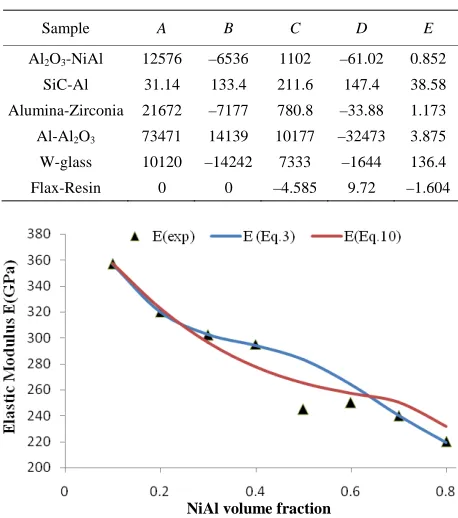
and A, B, C, D and E are constants, having different val- ues for different composite materials. Values of these con- stants for respective samples (composite materials) are given in Table 1. Thus we can calculate the effective Elastic modulus for a composite material from Equation (3), using the values of Es and Ep and the value of n for par-
ticular composite material calculated from Equation (8). We calculated the values of n for many samples using Equation (8) to obtain theoretical value of effective elas- tic modulus and compared with the experimental results for respective samples. Comparison is shown in graphs (Figure 1 to Figure 6).
We also propose another semi-empirical relation to ca- lculate effective elastic modulus having linear dependen- ce on elastic modulus E1 and E2 respectively. Proposed
formula is given as:
1 2
2
eff
v E E K E
v
1
[image:3.595.307.536.107.366.2](11)
Table 1. Values of constants A, B
A B C D E
(10)
Here
1 2 1
v v
and C for different com-posite samples.
Sample
Al2O3-NiAl 12576 –6536 1102 –61.02 0.852
SiC-Al 31.14 133.4 211.6 147.4 38.58
Alum onia
F
ina-Zirc 21672 –7177 780.8 –33.88 1.173
Al-Al2O3 73471 14139 10177 –32473 3.875
W-glass 10120 –14242 7333 –1644 136.4
lax-Resin 0 0 –4.585 9.72 –1.604
[image:3.595.307.539.112.367.2]NiAl volume fraction
Figure 1. Elastic Modulus of Al2O3-NiAl composite as a
function of NiAl content.
[image:3.595.307.539.401.537.2]Sic volume fraction
Figure 2. Elastic Modulus of SiC-Al composite as a function of SiC content.
Al2O3 volume fraction
Figure 3. Elastic Modulus of Al2O3-ZrO2 composite as a
[image:3.595.310.538.577.710.2]Figure 4. Elastic Modulus of Al-Al2O3 composite as a
func-tion of Al O content. 2 3
[image:4.595.58.289.282.424.2]Glass volume Fraction
Figure 5. Elastic Modulus of W-glass composite as a func-tion of Glass content.
Flax volume fraction
Figure 6. Elastic Modulus of Flax-Resin composite as a function of Flax content.
: Elastic modulus of Filler; ic modulus of Matrix;
and constant term K is and
E1
E2: Elast
v1: Volume fraction of Filler;
v2: Volume fraction of Matrix
written in term of volume fraction of filler phase as
2
KLx MxN (12)
where
1 3 2 1
1
lnE
x v E
(13)
L, M and N in Equation (12) ar ferent values for different compo
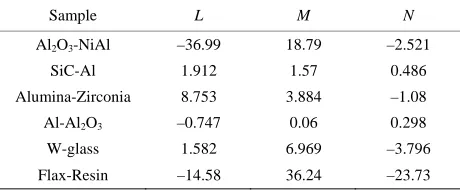
Particulate composite like Al O -NiAl, SiC-Al were pre-owder processing tech-e constants, having dif-site materials. Values of these constants for respective samples (composite mate-rials) are given in Table 2. We have calculated the value of K for respective samples using values of constants L,
M and N given in Table 2. Using these values of K in Equation.10, we can obtain the value of effective elastic modulus for various composite materials at different fil- ler concentrations. Apart from the data of Al2O3-NiAl
system, the available data for other ceramic-metal com-posites, SiC-Al, glass-W and Alumina-Zirconia, Al-Al2O3
Flax-Resin, are also compared in the present study to ve- rify our model predictions.
3. Results and Discussion
2 3
pared by using the conventional p
nique which show little dependence on orientation and the elastic constants are determined either by static methods such as the measurements of longitudinal de-formation or by dynamic method, such as the method applying by ultrasonic waves. The static methods usually determine only elastic modulus due to the difficulties involved in the measurement of the transverse strain [31].
The Voigt-Reuss model treats a laminated system. Each phase in the system is separated by another layer but actually composites are treated as composed of con-tinuous matrix and isolated phase. For example in SiC-Al composite the SiC particles are not sintered together in the SiC-Al composite. In another example in Al2O3-NiAl
both phases are continuous [29]. These two phases form an interpenetrating microstructure which is quite differ-ent from SiC-Al. Interface of the Al2O3-NiAl composite
is relatively weak and the Al2O3-NiAl system is sintered
at its solid state [28]. As any load is applied on the com-posite in the presence of weakly bonded isolated particles, the load is mainly sustained by the matrix alone. The strains along and perpendicular to the loading direction thus close to those of matrix alone. The existence of the
Table 2. Values of constants L, M and N for different com-posite samples.
Sample L M N
Al2O3-NiAl –36.99 18.79 –2.521
SiC-Al 1 1 0.
Al ia
A
.912 .57 486
umina-Zircon 8.753 3.884 –1.08
l-Al2O3 –0.747 0.06 0.298
W-glass 1.582 6.969 –3.796
[image:4.595.56.290.463.611.2] [image:4.595.308.538.638.733.2]e 3. Pre Elastic s in comp son with experimental values.
a) Al = 186 GPa, E(Al O 0 GPa [2
Tabl dicted Modulu ari
2O3-NiAl E1(NiAl) 2 2 3) = 40 6,29]
S. No. v1 Eeff(Eq
%Deviation (Equation (10)) uation (3)) GPa Eeff(Equation.(10)) GPa E(exp) GPa %Deviation (Equation (3))
1 0.1 356.97 357.31 357 0.007 0.087
2 0.2 319.86 322.89 320 0.042 0.904
3 0.3 302.42 296.44 302 –0.139 –1.839
4 0.4 294.26 277.46 295 0.249 –5.944
5 0.5 283.24 265.01 245 –15.609 8.188
6 0.6 264.01 257.44 250 –5.607 2.977
7 0.7 240.22 250.42 240 –0.094 4.345
8 0.8 219.46 231.47 220 0.243 5.216
b) S Al E1(S 33]
S. No. Eeff(Eq ) GPa Eeff(Equ )) GPa E(e Pa %Deviatio ation (3)) %Devia
iC- iC) = 450 GPa, E2(Al) = 70 GPa [32,
v1 uation (3) ation (10 xp) G n (Equ
tion (Equation (10))
1 0.1 88.72 89.79 89.7 1.085 0.110
2 0
c) Al 3-Zirc 1(Zirconi GPa, E2(Al2O3)
S. No. Eeff(Equ ) GPa Eeff(Equ )) GPa E a %Deviat tion (3)) %Devi uation
.15 98.44 98.30 99.36 0.919 –1.057
3 0.2 108.63 106.07 103.5 –4.957 2.487
4 0.25 116.70 113.27 116.61 –0.080 –2.856
5 0.3 123.12 120.15 119.37 –3.144 0.657
6 0.35 130.07 127.01 128.34 –1.35 –1.036
7. 0.4 140.56 134.25 135.93 –3.408 –1.234
2O onia E a) = 210 = 400 GPa [34]
v1 ation (3) ation (10 (exp) GP ion (Equa ation (Eq(10))
1 0.069 384.99 384.11 385 0.0003 –0.229
2 0
d) Al l2O3 E 3)=390 G l) = 69 GPa [35]
S. No. E (Eq )) GPa E (Equ )) GPa E(e Pa %Deviati tion (3)) %Devia (10))
.105 375.99 375.65 376 0.0002 –0.090
3 0.142 366.99 366.86 365 –0.547 0.510
4 0.18 358.31 357.73 353 –1.505 1.342
5 0.219 350.00 348.30 350 –0.0003 –0.485
6 0.304 333.00 327.62 333 –0.001 –1.614
7 0.726 251.04 254.48 251 –0.017 1.388
-A 1(Al2O Pa, E2(A
v1 eff uation (3 eff ation (10 xp) G on (Equa
tion (Equation
1 0.73 222.20 216.64 216.4 –2.680 0.113
2 0.8 251.52 242.04 241 –4.360 0.435
3 0.88 283.01 282.62 282.8 –0.070 –0.063
4 0.93 342.48 330.28 324.4 –5.570 1.813
5 0.95 372.62 368.15 366.4 –1.690 0.478
e) W lass E s) = 81 G ) = 355 GPa [32,
S. No. E (Eq )) GPa E (Equ )) GPa E( a %Deviati tion (3)) %Devia (10))
-G 1(Glas Pa, E2(W 36]
v1 eff uation (3 eff ation (10 exp) GP on (Equa tion (Equation
1 0.5 194.80 194.31 195.25 0.226 –0.477
2 0.6 156.32 160.81 156.2 –0.079 2.952
3 0.7 135.42 127.23 134.9 –0.390 –5.680
4 0.8 89.30 94.41 88.75 –0.625 6.388
5 0.9 67.86 66.49 67.45 –0.615 –1.411
f) F -Resin lax) = 4500 2(Resin) = 28000 GPa [37]
S. No. E (Eq )) GPa E (Equ )) GPa E( a %Deviat tion (3)) %Devi uation (10))
lax E1(F GPa, E
v1 eff uation (3 eff ation (8 exp) GP ion (Equa
ation (Eq
1 0.4 12918.11 12922.6 12917 –0.008 –0.043
2 0.5 15451.71 15462.53 15451 –0.004 –0.074
second ph affects the strain atrix. Wh an in enetrati structure is y the two phases one phase is closely constrained by the other
h experimental values of Elastic modulus fo
ase little to of the m
en terp ng micro formed b
one though they do not bond strongly together. The elas-tic behavior of matrix is thus affected by the presence of interpenetrating second phase. Alumina particles were well dispersed and well bonded to the matrix. Here we ignored the effect of porosity Thus these formulas can estimate the elastic modulus for non-porous materials only. Our proposed formula suits well for pore free matrix and pore free filler. With the knowledge of the correlation between the elastic moduli and porosity for a particular ceramic product we can determine elastic modulus of matrix with pore too. Since several investiga-tions in literature show that Young’s modulus decreases as porosity increases. By introducing porosity and poros-ity correction factor which takes account of geometrical variables such as pore size, shape and location. Only those composite materials which have considerable am- ount of porosity may show deviation between experimen- tal data and predictions that is too due to presence of thir- d phase air.
The values of effective elastic modulus obtained by the proposed approaches (Equations (3) and (10)) are compared wit
r different composites (Al2O3-NiAl, SiC-Al, Alumina-
Zir-conia, Al-Al2O3, W-glass and Flax-Resin). The basic
properties of each phase in these composites are also shown in Table 2. The model predictions proposed in the present study cover most of the experimental data. The experimental data of the composites are close to the pre- dictions made by our proposed formula. One may note that the Elastic modulus shows strong dependence on
2 1
E E , less dependence on v v1 2.This comparison for
all composites is shown in Table 3 and in Figures 1-6. Our proposed predictions seem good on comparison
ll some error is there d o the presence of air pores. Since we have neglected the pore effect and con
but sti ue t
-si
e to
experimental data and proposed is made in the present study. It shows on the micro structural character
ti nterface may ffect the elasti lus of
c te. The elast f the co
mate-rials depend strongly on elastic properties of individual
REFERENCES
ziehung Zwischen den Beiden
dered the pore free matrix. References are given in the respect- tive tables for the source of experimental data.
Results obtained from our proposed formula show good matching with the experimental values. Still a small difference is seen with the measured data. It may be du relative arbitrariness of data selection. Thus our rela- tions provide a satisfactory prediction in terms of the vo- lume fraction variations.
4. Conclusion
The comparison between models predictions
some dependence istics
of ceramic metal composites. The interconnectivity of each phase in a composite and the bonding
characteris-phases, and their concentration in a composite. This de-pendence is studied using two quite different semi-em- pirical approaches. In the first approach modified form of series and parallel combination is proposed to calculate effective elastic modulus, while as in second approach, we consider linear dependence of effective elastic modu- lus on elastic properties of the constituents and their re-spective volume fractions rere-spectively. Seven composites (Al2O3-NiAl, SiC-Al, Alumina-Zirconia, Al-Al2O3, W-
glass and Flax-Resin) are used for comparison to validate the modified relations. The calculated values of elastic modulus using both the theoretical predictions are in go- od agreement with the experimental values for all com- posite materials. The suggested theoretical results offer good approximation for elastic modulus.
5. Acknowledgements
A Junior Research fellowship awarded by CSIR-UGC to one of the authors (AU) is gratefully acknowledged.
cs of i also a c modu
omposi ic properties o mposite
[1] W. Voigt, “Ueber die Be
Elasticitätsconstanten Isotroper Körper,” Annalen der Phy- sik, Vol. 274, No. 12, 1889, pp. 573-587.
doi:10.1002/andp.18892741206
[2] A. Reuss and ng der Fließgrenze
von Mischkris astizit tsbedingung
posite
Ma-s and PhyMa-sicMa-s of SolidMa-s, Z. Angrew, “Berechnu
tallen auf Grund der Pl
für Einkristalle ,” ZAMM-Journal of Applied Mathemat-ics and MechanMathemat-ics, Vol. 9, No. 1, 1929, pp. 49-58. [3] R. Hill, “A Self-Consistent Mechanics of Com
terials,” Journal of the Mechanic
Vol. 13, No. 4, 1965, pp. 213-222. doi:10.1016/0022-5096(65)90010-4
[4] B. Budiansky, “On the Elastic Moduli of Some Heteroge-neous Materials,” Journal of the Mechanics and Physics of Solids, Vol. 13, 1965, pp. 223-227.
doi:10.1016/0022-5096(65)90011-6
[5] K. Yagi and L. Che, “Elastic Properties of Composite Ma-terial with Anisotropic Ellipsoidal Inhomogeneities,”
Pro-V. Khokhriakov, “A
ceedings of the Fifteenth International Offshore and Polar Engineering Conference, 19-24 June 2005, Seoul, pp. 551-556.
[6] J. M. Molina, S. S. Savinsky and N.
Tight Binding Model for Calculations of Structures and Properties of Graphite Nanotubes,” Journal of Chemical Physics,Vol. 104, No. 12, 1996, p. 4652.
doi:10.1063/1.471211
Flexibility of Carbon Nanotubes,” Journ Physics, Vol. 104, No. 5
al of Chemical
, 1996, p. 2089. doi:10.1063/1.470966
[9] M. M. J. Treacy, T. W. Ebbeson and J. M. Gibson, “Ex-ceptionally High Young’s Modulus Observed for Indi-vidual Carbon Nanotubes Nature,” Nature, Letters to Na-ture, Vol. 381, 1996, pp. 678-680. doi:10.1038/381678a0 [10] N. G. Chopra and A. Zettl, “Measureme
Modulus of a Multiwa
nt of the Elastic ll Boron Nitride Nanotube,” Solid State Communications, Vol. 105, No. 5, 1998, pp. 297-300. doi:10.1016/S0038-1098(97)10125-9
[11] N. Garshashbinia and J. E. Jam, “Properties in Laminated Composite Plates Using Genetic Algorithm,” Indian Poly-mer Journal,Vol. 14, No. 1, 2005, pp. 39-46.
[12] J. P. Watt, G. F. Davies and R. J. Cnnel, “Elastic Proper-ties of Composite Materials,” Reviews of Geophysics, Vol. 14, No .4, 1976, pp. 541-563.
doi:10.1029/RG014i004p00541
[13] K. A. Snyder, E. J. Garboczi and A. R. Day, “The Elastic Modulii of Simple Two Dimensional Isotropic Compos-ites, Computer Simulation and Effective Medium The-ory,” Journal of Applied Physics, Vol. 72, No. 12, 1992, pp. 5948-5955. doi:10.1063/1.351903
[14] M. T. Tilbrook and M. Hottman, “On the Mechanical Properties of Alumina Epoxy Composites with an Inter Penetrating Network Structure,” Materials Science and Engineering: A, Vol. 393, No. 1-2, 2005, pp. 170-178. doi:10.1016/j.msea.2004.10.004
[15] H. F. Zhang, X. S. Ge and H. Ye, “Randomly Mixed Model for Predicting the Effective Thermal Conductivity of Moist Porous Media,” Journal of Physics D: Applied Physic, Vol. 39, No. 1, 2006, pp. 220-226.
doi:10.1088/0022-3727/39/1/032
[16] Z. Hashin, “Analysis of Composite Materials—A Sur-vey,” Journal of Applied Mechanics, Vol. 50, No. 3, 1983, pp. 481-505. doi:10.1115/1.3167081
[17] S. Torquato, “Random Heterogeneous Materials: Micro Structures and Macroscopic Properties,” App
ics Reviews, Vol. 55, No. 4, 2002, p. B62.
lied
Mechan-doi:10.1115/1.1483342
[18] N. Losic, J. F. Thovert and P. M. Adler, “Reconstruction of Porous Media with Multiple Solid Phases,” Journal of Colloid and Interface Science, Vol. 186, No. 2, 1997, pp. 420-433. doi:10.1006/jcis.1996.4659
[19] D. S. Li, G. Saheli, M. Khaleel and H. “Quantitative Prediction
Mgarinestani, of Effective Conductivity in Ani-sotropic Heterogeneous Media Using Two Point Correla-tion FuncCorrela-tions,” Computational Materials Science, Vol. 38, No. 1, 2006, pp. 45-50.
doi:10.1016/j.commatsci.2006.01.004
[20] M. Wang, J. K. Wang, N. N. Pan and S. Y. Chen, “Meso- scopic Predictions of the Effective Thermal Conductivity of Micro Scale Random Porous Media,” Physical Review E, Vol. 75, No. 3, 2007, pp. 260-265.
[21] P. Meakin, “Fractals, Sca
librium,” Cambridge University Press,
ling and Growth Far from Equi-Cambridge, 1998.
x
[22] P. A. Roberts and E. J. Garboczi, “Elastic Properties of
Model Porous Ceramics,” Journal of the American Ce-ramic Society,Vol. 83, No. 12, 2000, pp. 3041-3048. doi:10.1111/j.1151-2916.2000.tb01680.
[23] J. Segurado and J. Llorca, “A Numerical Approximation to the Elastic Properties of Sphere-Reinforced Compos-ites,” Journal of the Mechanics and Physics of Solids, Vol. 50, No. 10, 2002, pp. 2107-2121.
doi:10.1016/S0022-5096(02)00021-2
[24] S. Sahraoui, E. Mariez and M. Etchessahar, “Linear Elas-tic Properties of Anisotropic Open-Cell Foams,” Journal of the Acoustical Society of America, Vol. 110, No. 1, 2001, pp. 635-637. doi:10.1121/1.1378351
[25] W. E. Warren and A. M. Kraynik Properties of Open-Cell Foams,” Jour
, “The Linear Elastic
nal of Applied Me-chanics, Vol. 55, No. 2, 1988, pp. 341-346.
doi:10.1115/1.3173680
[26] W. H. Tuan, Y. P. Pai, “Mechanical Properties of Al2O3-
Nial Composites,” Journal of the American Ceramic So-ciety,Vol. 82, No. 6, 1999, pp. 1624-1626.
doi:10.1111/j.1151-2916.1999.tb01974.x [27] M. F. Ashby, “Criteria for Selecting the Com
Composites,” Acta Meta
ponents of
llurgica et Materialia, Vol. 41, No. 5, 1993, pp. 1313-1335.
doi:10.1016/0956-7151(93)90242-K [28] W. H. Tuan, W. B. Chou, H. C. You and S. T.
Effects of Microstructure on the Mechanic
Chang, “The al Properties of Al2O3-Nial Composites,” Materials Chemistry and Physics,
Vol. 56, No. 2, 1998, p.157. doi:10.1016/S0254-0584(98)00168-0
[29] C. L. Hsieh, W. H. Tuan and T. T. Wu, “Elastic Behavior of a Model Two-Phase Material,” Journal of the Euro-pean Ceramic Society, Vol. 24, No. 15-16, 2004, pp. 3789- 3793. doi:10.1016/j.jeurceramsoc.2004.02.002
[30] R. Hill, “Elastic Properties o
Theoretical Principles,” Journal of the Mechan
f Reinforced Solids: Some
ics and Physics of Solids, Vol. 11, No. 5, 1963, pp. 357-372. doi:10.1016/0022-5096(63)90036-X
[31] W. Koster and H. Franz, “Poisson’s Ratio for Metals and Alloys,” Metallurgical Review,Vol. 6, No. 21, 1961, pp.
rial
2005, pp. 133-139.
erican Society for Composites—7th Technical
Con-e 1-56.
[32] C. L. Hsieh, W. H. Tuan and T. T. Wu, “Elastic Proper-ties of Ceramic-Metal Particulate Composite,” Mate Science and Engineering A, Vol. 393,
[33] L. C. Davis, J. Chen and M. F. Thorpe, “Predicting the Elastic Properties of Composite Materials,” Proceedings of the Am
ference, Pennsylvania, 13-15 October 1992, pp. 339-348. [34] W. Pabst, G. Ticha, E. Gregorova and E. Tynova,
“Effec-tive Elastic Properties of Alumina-Zirconia Composite Ceramics, Part-5 Tensile Modulus of Alumina-Zirconia Composite Ceramics,” Ceramics Silikaty, Vol. 49, No. 2, 2005, pp. 77-85.
[35] M. Wang and N. Pan, “Elastic Property of Multiphas Composites with Random Microstructures,” Journal of Computational Physics, Vol. 228, No. 16, 2009, pp. 5978- 5988. doi:10.1016/j.jcp.2009.05.007
the American Ceramic Society, Vol. 48, Glass,” Journal of
No. 10, 1965, pp. 548-549.
doi:10.1111/j.1151-2916.1965.tb14668.x
[37] D. Bolcu, G. Stanescu and M. Ursache, “Theoretical and
Experimental Study on Determination of the Elastic Prop-erties for Composite Materi
Physics, Vol. 56, No. 1, 2004, pp. 3-12.