Adaptability in Law Enforcement
Towards a conceptual framework of adaptive behaviour
Klara Blaimer
Student number 1578588
Master Thesis
March 2019
Faculty of Behavioural, Management and
Social Sciences
Supervisors:
dr. J.S. Oleszkiewicz dr. S. Zebel
Faculty of Behavioural, Management and Social Science Department of Psychology of Conflict, Risk & Safety University of Twente
Abstract
Adaptability is an area of concern in many fields including organizations, business,
decision-making, teaching and society. To this point, however, very little is known
about adaptability as a behavioural construct. Empirical data on adaptive thinking is
sparse and the literature base is largely conceptual. The aim of the study therefore is
twofold, first to come up with a conceptual framework about adaptability (including
the concepts of cognitive flexibility and goal orientation), second, to examine the
possibility to elicit and measure behavioural adaption in a controlled experiment. The
first goal was reached through scientific literature research. For the second aim,
participants (N = 78) were asked to take the role of an undercover agent and were
given some background information on the missions they had to complete. Critically,
during the missions participants faced an unexpected encounter, requiring the agent to
adjust their behaviour in order to complete the mission objective. Adaptive behaviour
was measured as behavioural, cognitive and emotional adjustment made as a response
to the situational change. Results indicated an initial success in eliciting and
measuring adaptive behaviour. Moreover, in the course of investigations, cognitive
flexibility and goal orientation appeared to be valuable to expand the present
paradigm.
Keywords: adaptability, resilience, naturalistic decision-making, cognitive flexibility,
Introduction
The world is changing faster than at any time in human history and is likely to change
even faster. The ongoing advancements of globalization and dynamic technological
environments place the modern society in swift changes (Santili, Marcionetti, Rochat,
Rossier & Nota, 2017). People nowadays find themselves having to develop skills
that differ substantially from the skills required in 20th century occupations. The idea
of Darwin’s work ‘On the Origin of the Species’ which describes that the species that
are most adaptable will survive changing situations is still relevant (Claeys, 2000). In
nature, organisms must be able to adapt to the circumstances of their environment to
survive. Referred to the human species nowadays this could be mirrored in actively
and continually adapt to the accelerating pace of change (e.g. adjust one's mindset and
behaviour).
People’s lives are characterized by frequent uncertainty, novelty and
unexpected events across their lifespan. Being able to adapt to changes in society is
one thing all people face, but people also have to deal with changing situations in
personal development, including major life events such as beginning school, adjusting
to peers or marriage as well as more ordinary events that occur on a daily basis
(Martin, Nejad, Colmar & Liem, 2012). Despite the need to adapt to changing
situations in personal development, adaptability is also relevant for professional
development. The world of work is much less predictable, and people face greater
challenges in adapting to changing tasks and demands. Being able to adapt therefore
seems to be a critical ingredient to succeed in light of new changing situations. This
recognition has fuelled growing interest in adaptability. To this point, however, very
adaptive thinking is sparse and the literature base is largely conceptual (Ward et al.,
2018).
Adaptability is an area of concern in many fields including organizations,
business, decision-making, teaching and society (Ward, Gore, Hutton, Conway &
Hoffman, 2018). Although adaptability has been studied in various contexts, there is
very little known about the behavioural construct. There do not exist any
evidence-based examinations, evaluations or training tools on adaptive behaviour (Ward et al.,
2018). The concept of adaptability is not entirely clear; few attempts have been made
to study adaptability as a competence, the acquisition, its assessment or its cultivation.
The aim of this study therefore is twofold: first, the possibility to elicit and measure
behavioural adaption will be examined; second, this study should serve as an attempt
to conceptualize adaptive behaviour on an empirical basis (based on literature
research). To narrow down the topic, the present study will limit itself to adaptability
in the law enforcement context; an example of a work environment that is prone to
uncertainty and change, and therefore high in need for adaptive employees.
Adaptability in a law enforcement context
As the world has become more dynamic and unpredictable, the need for adaptive
behaviour is of increasing importance in safety and security contexts. For the military,
it is important, for example, to be creative in making strategic plans during
unpredictable missions, or to be able to adapt to other cultures in foreign countries
during missions, as well as to physically adapt to extreme situations (Mun, Van der
Hulst, Oprins, Jetten, Van den Bosch & Schraagen, 2016). In a policing context, there
is a high demand for an adaptive workforce, since the nature of police work
continuously alters. That is, officers today work within complex task and
police operations but also a range of different anti-crime strategies, policing
technologies, evidence-based policing or predictive analytics (Huey, Kalyal &
Peladeau, 2017). Also the types of crime change according to requirements and
possibilities of time. Looking at the crime trends in the past century, it can be seen
that the nature of crime is changing, crimes nowadays concern less the familiar
household crimes but rather new types of crime involving cybercrime and terrorism
(Friedman, Grawert & Culen, 2017). The rise of concerns about terrorism and
organized crime has lead to a shift from reactive to proactive policing (Kruisbergen,
de Jong & Kleemans, 2011). This shift is accompanied by the use of increasingly
invasive investigative techniques, such as electronic surveillance or phone tapping. As
a consequence, police officers constantly have to adapt to new forensic techniques
and changes in legislation or judicial decision-making.
Moreover, they have to deal with different kinds of people who can be
anywhere imaginable on a very broad emotional spectrum. Hence, they are faced with
numerous personalities and a wide array of emotional responses, to which they have
to react appropriately in respect of attending to the right social cues (Alison, Alison,
Noone, Elntib & Christiansen, 2013). Police officers are often faced with situations
that can lead to undesirable consequence, at extreme even death (Harris, Eccles,
Freeman & Ward, 2017). Thus, policemen carry out a lot of responsibility and have to
make crucial decisions in extremely stressful conditions. In addition, the public has a
high expectation of police performance in handling such critical incidents (Au, Wong,
Leung & Chiu, 2018). It is therefore absolutely essential for a police officer to be able
to deal with and adapt to such situations.
However, although adaptability is recognized as an essential skill for police
evidence-based examinations, evaluations or training tools on adaptive behaviour.
The concept of adaptability is not entirely clear; few attempts have been made to
study adaptability as a competence, the acquisition, its assessment or its cultivation
(Ward et al., 2018). In the context of law enforcement, this is rather astonishing
considering that the modern society calls for police officers equipped with the ability
to adjust tactics to achieve objectives. This study, therefore, should serve as an
attempt to single out and examine adaptive behaviour by defining adaptability and
distinguishing it from other related constructs and creating an experimental paradigm.
Adaptability
The etymology of the word adaptability can be traced to the early 14th century,
derived from the Latin ‘adapto’ which means to fit or to adjust. Current definitions of
adaptability have changed slightly, ‘to adjust fittingly’ or ‘to make suitable to new
requirements’ (Schmidt, Eguchi, Austin & Gibb, 2010). The Cambridge English
dictionary (n.d) defines adaptability as ‘an ability to change in order to suit different
conditions’.
A review of the scientific literature reveals that there is not a widely accepted
definition of adaptability. In natural science, the definition of adaptability is disputed,
it broadly refers to ‘the development of genetic or behavioural characteristics which
enable organisms or systems to cope with environmental changes in order to survive
and reproduce’ (Smit & Wandel, 2006, p. 283).
In the psychological domain, adaptability is considered ‘the capacity to make
appropriate responses to changed or changing situations; the ability to modify or
adjust one’s behaviour in meeting different circumstances and different people’ (Van
den Bos, 2015, p.18). More cognitive-based models have quite recently supplemented
(2012) define adaptability as the cognitive, behavioural and affective adjustment to
change. Hereby, the cognitive component is defined as the evaluation of a new
situation and the capacity to adjust one's thinking to deal with changing, new and
uncertain demands. In terms of behaviour, the ability to attempt new behaviours or
adjust existing behaviours to successfully deal with new situations is what is referred
to. The affective component refers to the emotional response that is recognized as
being important for an individual’s motivation or willingness of managing changes
(Martin, Nejad, Colmar & Liem, 2012). In other words, adaptability involves a
change in behaviour, an expectation that this behavioural change is appropriate for the
specific situation and based on that a reactive response to change. Cognitive models
like these emphasize that psychological processes facilitate behaviour, and that these
processes are key to understanding the observed behaviour. Hence, in order to
properly examine and measure adaptability, it is important to unbundle related
constructs. In the case of adaptability, the most related constructs would be resilience,
buoyancy and coping (Martin et al., 2012).
Resilience, Buoyancy and Coping
Resilience is derived from the Latin ‘resilire’, which means ‘to bounce back’.
Originally resilience has its roots in physics and material science, and can also be
defined as flexibility, resistance or elasticity. In the psychological domain, resilience
has been defined as the process of successful adjustment despite challenging or
threatening circumstances (Howard & Johnson, 2000). Hence, resilience is a process
of responding to change but focuses more specifically on addressing adversities and
difficulties. It should be mentioned that these circumstantial adversities are
characterized in acute and chronic terms, and thus have a major impact on essential
insubstantial everyday challenges (see buoyancy). The associated principle of
resilience is that of a tumbler toy, a toy figure that always bounces back and returns to
its initial state (Fook, 2016). This principle illustrates the emphasis of the concept of
resilience, which is the ability to withstand and survive disturbances in order to return
to the baseline (Joseph, 2013).
Buoyancy is closely related with resilience, there is only one distinctive detail:
bouncy encompasses adjustments to less serious adversities and setbacks of daily life,
whereas resilience involves adjusting to more accumulative and impactful adversities
(Martin & Marsh, 2009). In other words, buoyancy is dealing with everyday
challenges that could be considered as minor adversity (low-level nature).
Coping refers to cognitive and behavioural efforts to manage challenging
demands that are perceived as difficult or beyond the individual’s resources. Similar
to resilience and buoyancy, coping involves a response to adversity. It is the mental
toughness that helps people dealing with hassles when demands seem too difficult to
handle (Martin et al., 2013).
As the definitions of adaptability, resilience, buoyancy and coping show, the
constructs share the features of completing an objective in a changing situation. The
difference seems to lie more in the type of situation. That is, resilience, buoyancy and
coping are primarily aimed at getting through or getting by, whereas adaptability can
apply on better dealing with changing situations that may actually be positive in
nature (Wellensiek, 2011).
In practice, however, it may not be as simple as that, since it could be argued
that combinations of flexible behaviour, for example being both resilient and adaptive
is what will produce observable outputs. Consequently, researchers have developed
understanding and flexible execution. The first article explicitly addressing
macrocognition, the way of describing cognitive functions as they naturally occur was
published in 2000 (Klein, Klein & Klein, 2000). However, investigations into the
nature of making decisions in natural setting began already in the 1980s. This line of
research is what now has become known as Natural Decision Making (Klein, Wright,
2016).
Naturalistic Decision Making
Naturalistic Decision Making (NDM) attempts to study how individuals make
decisions in real-world settings as opposed to controlled laboratory settings (Klein,
2008). NDM focuses on decision making in complex conditions, in the face of
uncertainty, with vague goals, high stakes, dynamic and changing environments, time
pressure and real-time reactions. One of the early works that led to the NDM
approach was an attempt to analyse the decision making of firefighters since they are
required to make decisions under conditions of uncertainty and time pressure in which
the consequences are at high stakes. However, NDM approach originated in the early
research on chess players. Investigations showed that grand masters differ from
novice chess players in their quick judgments; the masters identified the most
promising movements more rapidly, whereas novice players often failed to consider
the best moves (Kahneman & Klein, 2009). The rapid decision of the expert players
was explained by a perceptual skill in which complex patterns were recognized. Clase
and Simon (1973) claimed that chess experts have acquired a repertoire of
immediately recognizable patterns, which enables them to identify good moves
without having to calculate all possible contingencies. Based on this assumption,
intuition was defined as the ‘recognition of patterns stored in memory’ (Kahneman &
Researchers try to explain the concept by investigating the strategies of expert
decision makers.
According to Ward and colleagues (2018) expertise is a continuous learning
process that requires the ability to deal with change. However, it is important to
mention that expertise and adaptability aren’t interchangeable concepts, in order to
adequately define and examine adaptive skill, it is therefore important to differentiate
the concepts. To do so, first, the term expert needs to be defined. When one thinks of
an expert, qualities such as experienced, skilled, talented and perhaps even gifted
come to mind. Hoffman (1998) defined experts as individuals who have certain skills
or sub-domain specializations. Still, there could be doubt when to consider an
individual as an expert since there does not exist a golden standard for being an
expert. Definitions are rather sketchy; hence, the great challenge is to generate an
operational definition of expertise. Hoffman et al. 1993 argue that experts are very
skilled at their familiar tasks, while disruption of these tasks can cause the expert’s
superior performance to decline markedly. Ward et al. (2018) conversely consider
expertise best leveraged by examining challenging, non-routine cases where adaptive
skill is paramount. According to their research, it could be argued that expertise
requires a sufficient number of routine cases that might evoke the ability to adapt to
new, non-routine cases. Opposed to the more traditional definitions that suggest
expertise as highly domain specific with little evidence of transfer or adaption beyond
tasks that require familiar reasoning strategies, Ward et al. (2018) in their study
capture ‘adaptive expertise’.
Adaptive expertise is a term coined by Hatano and Inagaki (1984/ 1986), their
research focussed on differentiating routine from adaptive skill. Routine task
routine expertise was considered as being outstanding in terms of accuracy, speed and
performance. Still, routine expertise does not account for adapting to new problems.
Adaptive experts, in contrast, were described as being able to effectively perform
procedural skills in combination with having a conceptual understanding of those
procedures. Conceptual understanding was thereby considered the basis for being
adaptive and flexible. The rationale is founded on the assumption that a strong
conceptual understanding permits the development of a context-sensitive strategy.
This context sensitivity enables experts to identify key decision points in specific
situations, which allow immediate access to opportunities to deviate from the existing
procedure when variations of this procedure might be appropriate.
Taken together, Hatano and Inagaki (1986) conceptualized that both types of
expertise encompass the same extent of knowledge and therefore ability to perform
flawless in familiar situations. The difference becomes evident once confronted with
an unfamiliar situation, routine experts are likely to struggle with unexpected
demands, whereas adaptive experts are likely to overcome such situations and quickly
regain a high level of performance (Bohle, Stalmeijer, Königs, Segers & van
Merriënboer, 2014). Research conducted by Spiro et al. (1991) claims that in general,
experts’ mental representations permit better adjustment to changes, which implies
that experts are more adaptable than novices.
Cognitive flexibility theory
Although experts may perform better in unexpected situations than novices, even
experts are prone to biases such as the ‘reductive tendency’. Reductive tendency is
considered as people’s tendency to oversimplify, which can lead to significant
misconceptions and incorrect inferences. This construct comes from research
flexibility can be traced to research conducted in a medical context (Feltovich,
Hoffman, Woods & Roesler, 2004). Specifically, Felotvich and colleagues (2004)
examined how people learn and perform in situations that are cognitively demanding.
It has been found that students often deal with complexity by oversimplification,
which can lead to imprecise application of knowledge and incorrect inferences about
conditions, which are resistant to chance and can inhibit future adaption. In simple
terms, oversimplification refers to the tendency to view situations as simpler than they
are. Feltovich et al. (2004) argue that individuals tend to simplify and try to defend
simple understandings when they are confronted with a more complex situation than
expected. This can be explained by the fact, that humans are creatures of habits that
prefer familiar courses of actions over new ones (Laureiro-Martinuez & Brusoni,
2018). With this in mind, one could understand cognitive flexibility as the ability to
recognize when to rely on habits versus when to explore new strategies. Therefore,
cognitive flexibility could also be considered, as the plasticity required for adapting to
new demands. In line with the definition proposed from Laurero-Martinuez &
Brusoni (2018), Krems (1996) defined cognitive flexibility as the ability to recognize
ineffective strategies of action and subsequently make appropriate change to adapt to
the situation.
These definitions let assume cognitive flexibility being the same as
adaptability, in fact, some researchers use the terms interchangeably. Reviewing
scientific literature, it seems that the term flexibility is primarily used as ‘switching
smoothly between different strategies’, whereas adaptability is considered as
‘selecting the most appropriate strategy’ (Verschaffel, Luwel, Torbeyns & Van
multiple strategies, whereas adaptability focuses on making appropriate strategic
choices.
Based on what has been said so far, the question arises what it means to be
adaptive in one's strategic choices. Verschaffel et al. (2009) define an adaptive choice
of a strategy as the conscious or unconscious selection and use of the most
appropriate solution strategy on a given problem, in a particular situation, to a specific
individual. This choice of strategy among others may then depend on the goal
orientation of an individual.
Goal orientation
The concept of goal orientation emerged in the 1980s. Carol Dweck and colleagues
(1986) conducted research with grade school children, who had to work on a set of
solving tasks that they were able to successfully solve and a set of
problem-solving tasks that they were not able to solve. In their research, it was observed that
there were two distinct response patterns: a portion of children exhibited maladaptive
response pattern, whereas other children exhibited more adaptive response pattern.
The former ones were observed to have a loss of confidence in their ability and
feelings of helplessness and distress, their problem-solving strategies became random
and even counterproductive. The children who exhibited adaptive response pattern, on
the contrary, appeared to enjoy the challenge and remained confident that they have
the ability to solve the problems, their problem-solving strategies became more
productive (VandeWalle, 2018).
Additional investigation revealed, that the children tended to approach
activities with different underlying goals, developing ability and demonstrating
ability. Based on that finding, Dweck (1986) proposed the concept of goal orientation
goal orientation. The former one refers to ‘a preference to develop one’s competence
by acquiring new skills and mastering new situations’ whereas the latter one is
considered ‘a preference to demonstrate and validate one’s competence by seeking
favourable judgements and avoiding negative judgements from others’ (VandeWalle,
2018, p.163). To summarize, a learning goal focuses on effort as a means of
achieving ability, surmounting obstacles or increase ability. Performance goals, in
contrast, have its focus on issues of ability (e.g. confidence in ability; winning
positive judgements of own abilities and avoiding negative ones).
Based on these findings research was conducted with adults, the main focus of
investigations was if adults do have the same goal orientations as children. Moreover,
an issue was to examine how these orientations impact behaviour and performance
(preconditioned that adults have these orientations) (VandeWalle, 2018). Research
findings showed that adults hold learning and performance goal orientations. Further,
the influential processes of behaviour and performance were identified, prominent
among the processes were: cognitive framing, self-management procedures and the
pursuit of skill development.
Central to understanding how goal orientations influences behaviour and
performance are findings that both goal orientations are associated with different
cognitive frameworks for how situations are interpreted. More specifically, they are
associated with different implicit theories about personal abilities such as intelligence.
Learning goal orientation is associated with incremental implicit theory, stating that
ability can be developed with effort. Performance goal orientation, in contrast, is
associated with an entity implicit theory, viewing ability as a fixed attribute that is
Besides the different underlying theories learning and performance goals are
also associated with different beliefs about the value of effort and causes of success.
Learning goal orientation stresses the importance of effort for success. Effort hereby
is viewed as a means for developing additional capabilities needed for future mastery.
With a performance goal orientation, in contrast, exerting substantial efforts is
viewed as ineffective, because ability is seen as an innate attribute that is difficult to
change (VandeWalle, 2018). The connection between goal orientation and
adaptability can be made in that different goal orientations lead to different ways of
dealing with changing situations. As an example, assuming a performance goal
oriented individual performs poorly, he or she would not see any need in putting more
effort into the task or changing the task strategy since they view the outcome as a
reflection of their (in) ability. In contrast, a learning goal orientated individual would
tend to view poor performance as feedback to alter their strategy and put more effort
into the modification of their strategy and the task itself.
Studying adaptability as a behavioural construct
To capture adaptive behaviour, a novel experimental set-up inspired by observations
of police undercover training at the Los Angeles Police Department was developed
(S. Oleszkiewicz, September 2018). In its most simple terms, this paradigm plays
with three principle features: an objective, an expectation, and a potential violation of
that expectation. More precise, the participants will take the role of an undercover
agent who has to complete a mission objective (e.g., collect fingerprints from a
student advisor at the university). The agent receives a brief case file providing some
background information on the operation. However, during the mission the
undercover agent will face an encounter that is inherently unexpected in the situation
mission objective. Adaptability is then measured as behavioural, cognitive and
emotional adjustments.
The introduced paradigm is a first attempt to capture adaptive behaviour in a
controlled context. The main questions regarding this initial model are whether the
experimental design meets the needed requirements to elicit adaptive behaviour. First,
it will be examined whether the experimental set-up violates the participant's
expectations (otherwise adaptive behaviour would not be required). Moreover, we
aim to identify if the experimental paradigm elicits adaptive rather than resilient
behaviour. Last, it will be investigated if there can be seen any change in adaptive
behaviour in the course of the experiment. The main questions regarding the paradigm
can be summarized as follows:
• Does the experimental set-up violate the participant’s expectations?
• Does the experimental set-up elicit adaptive rather than resilient behaviour?
• Does the experimental set-up influence adaptive behaviour across the
operations?
Method
To capture adaptive behaviour, a novel experimental set-up inspired by observations
of police undercover training at the Los Angeles Police Department was developed
(S. Oleszkiewicz, September 2018). This experimental set-up plays with three
principle features: the participants have to complete a fixed task (an objective), they
receive some background information about the situation they will be encounter (an
expectation), however, in the course of the mission the agent will be confronted with
unexpected challenges (violation of the expectation) that require the adjustment of
The participants had to complete a total of three undercover operations (see
Appendix I for the instructions). As mentioned before, each operation included a
mission objective, an expectation and a violation of that expectation. The three
operations were called ‘Secret note operation', ‘Tap water operation’ and ‘Fingerprint
operation’, described below.
The Secret note operation. Participants were asked to collect a secret note
hidden in a book inside the office of a professor (mission objective). To collect the
note the participants needed to borrow the book from a professor who is unbeknownst
of the letter’s existence. Participants were informed that the professor is likely to be
nice towards them and willing to lend them the book (expectation). However, when
the participants arrived at the office, the professor is out on a business trip and they
encounter his assistant instead. The assistant is reluctant to lend the book simply
because it is not hers (violation of expectation).
The Tap water operation.Participants were asked to collect a sample of tap
water from the main distribution source located at the university reception (mission
objective). Participants were informed that the receptionist might be unwilling to step
away from her position to get them a glass of water (expectation). However, when the
participants approached the receptionist, the receptionist cannot speak any language
known to the participant (violation of expectation).
The Fingerprint operation.Participants were asked to collect the fingerprints
of a student advisor at the university (mission objective). In order to collect the
fingerprints, participants should let the advisor hold a paper with the participant’s
grades during a scheduled study consultation meeting (expectation). However, when
informs the participants that a colleague is just about to arrive to consult them on their
case (violation of expectation).
Experiment 1
Design
The current study has a repeated measures design (Operation 1, Operation 2,
Operation 3) that was counter-balanced in Order A (Secret note – Tap water –
Fingerprint) vs. Order B (Fingerprint – Tap water – Secret note).
Participants
Participants were recruited to take part in a study on being an undercover agent. The
sample consisted of 37 individuals (89% students). Of the respondents 23 (62%) were
male, 14 (38%) female. Participants’ age ranged between 19 and 31 years (M = 22.61,
SD = 2.58). Nationalities were distributed as follows: German (45%), Dutch (37%)
and others (18%). After removing participants that did not complete the full study (n
= 4), the final sample used in this study consisted of 33 participants. Participation was
on a voluntary basis and all respondents were compensated with 5€ (university
students also received 1 SONA credit). The study was approved by the ethical review
board of the University of Twente.
Procedure
Upon arrival, participants had to confirm that they agree with the informed consent.
Then the procedure was designed as follows. Participants received the instructions for
their first mission and were given approximately five minutes to prepare. They were
then escorted to the door of the room in which they had to perform their mission.
Time was measured from the moment when participants knocked on the door and
started their mission. After the completion of an operation, the participants were
was completed, participants received the instructions for their next mission. For
operations 2 and 3 the exact same procedure was followed. However, after the
conclusion of the third operation, the participants received an additional final
questionnaire. By completing the final questionnaire the experiment was over.
Interactions during the missions. Research assistants were used as
role-players who interacted with the participants during each mission. The participants met
a new role player for each mission. To keep high control, standardized protocols for
the role-play were developed (see Appendix II). There was one rule for all missions,
the assistants had to wait for three prompts, and on the forth they had to give in. (i.e.,
consent to the participant’s request). However, if participants wanted to give up or
accept a rejection, research assistants immediately had to turn to the final concession
phrase, thus they had to give in.
Materials
Between operations questionnaire. Immediately after each operation the
participants filled in the adaptability questionnaire (Martin et al., 2012, Collie &
Martin, 2016) and rated their perceived ability to adjust their behaviour, thinking and
feeling. The adaptability scale contains six questions about cognitive/behavioural
adjustment (e.g. I was able to think through a number of possible options to assist me
when the new situation arose) and three questions about emotional adjustments (e.g. I
was able to minimize frustration or irritation so that I could deal with it best) (see
Appendix IV). Participants were asked to indicate to what extents they agree with
each statement using a 7-point scale, with 1 meaning strongly agree and 7 meaning
strongly disagree.
After having filled in the adaptability scale, the participants rated the situation
change called for adaptive behaviour, three descriptors examined if the change would
call for resilient behaviour, and one descriptor examined if the situational change was
considered challenging. Participants were asked to rate to what extent they would
describe the situation on a 7-point rating scale, with 1 meaning not at all and 7
meaning very. The instruction stated: ‘Please describe to what extent you would
describe the situation you just encountered with words such as (e.g. a challenge) (1 –
Not at all; 7 – Very)’. The descriptors and corresponding situations are listed in Table
1.
Table 1
Descriptors and corresponding situations
Descriptor Situation
Situational change
Adaptive behaviour
a challenge (a situation that tests your abilities or is seen as difficult)
a change (a new or different situation) a novelty (an original or unusual situation) an uncertainty (an unsure or unknown situation)
Resilient behaviour a threat (a situation likely to cause damage or danger)
an adversity (a difficult or unpleasant situation)
a confrontation (a hostile or argumentative situation)
Final questionnaire. After all operations had been completed, the participants
answered four questions regarding demographics (age, gender, nationality and
affiliation). Moreover, participants were asked to rate their motivation to participate in
the study, how unexpected each operation was and if they had anticipated each
situational change. All question were answered on a 7-point rating scale, with 1
scale, but this time the participants were asked to consider the perspective of an
average person. This measure was included since individuals tend to deviate
positively from an objective view of themselves.
Results Experiment 1
As a first step, the data was screened for outliers. Participants that did not complete
the full study were removed and recorded as missing values (n = 4). Further, the
motivation of the participants to take part in the study was checked. A mean above 5
was considered as high. Participants were very motivated to complete their objective
during the three operations (M = 5.58, SD = 0.97) and they took on the operations (M
= 5.85, SD = 0.87), as well as their roles as special agents (M = 5.61, SD = 1.10) in a
serious manner.
Next, it was tested, whether the operations violated the participant’s
expectations. The first operation was perceived as very unexpected (M = 5.30, SD =
1.65), as well as the second operation (M = 5.36, SD = 1.59), the third operation was
unexpected (M = 4.42, SD = 1.50).
Adaptive behaviour versus resilient behaviour
To answer the question if the experimental set-up elicited adaptive rather than
resilient behaviour, first, the validity of the measurement was tested. In order to
measure the perception of the situation the participants were encountered, seven items
were used: change, novelty, threat, adversity, confrontation and challenge (see Table
1). To determine the number of constructs, and validate the measurement, a separate
factor analysis for each operation was conducted. The order of the missions was not
included in these analyses since it was not relevant.
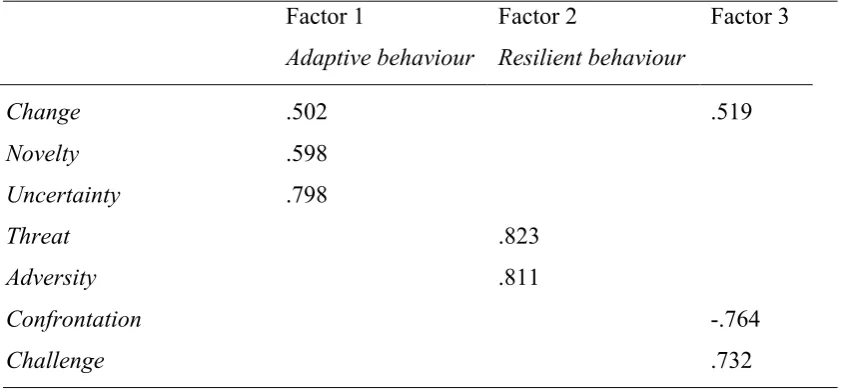
Factor analysis 1.Seven items were factor analysed using a principal
factor one was labelled adaptive behaviour, due to the loadings on: change,
uncertainty and novelty. The second factor derived from the analysis was labelled
resilient behaviour, this label was used due to the high loadings on: adversity and
threat. Moreover, there was a third factor explained by challenge, change and
[image:22.595.87.514.279.474.2]confrontation.
Table 2
Factor loadings principal component analysis with oblimin rotation Experiment 1 – Operation 1
Factor 1
Adaptive behaviour
Factor 2
Resilient behaviour
Factor 3
Change .502 .519
Novelty .598
Uncertainty .798
Threat .823
Adversity .811
Confrontation -.764
Challenge .732
Note. Factor loadings < .4 are suppressed
Factor analysis 2.The second factor analysis of operation two revealed two
factors. Six items (change, uncertainty, threat, adversity, confrontation and challenge)
were factor analysed using a principal components analysis with direct oblimin
rotation. The factor analysis yielded two factors, factor one was labelled adaptive
behaviour due to the loadings on: change, uncertainty and challenge. The second
factor was labelled resilient behaviour due to the loadings on: adversity, threat and
Table 3
Factor loadings principal component analysis with oblimin rotation Experiment 1 - Operation 2
Factor 1
Adaptive behaviour
Factor 2
Resilient behaviour
Change .872
Novelty * *
Uncertainty .648
Threat .769
Adversity .813
Confrontation -.428 .587
Challenge .756
Note. Factor loadings < .4 are suppressed. *missing value
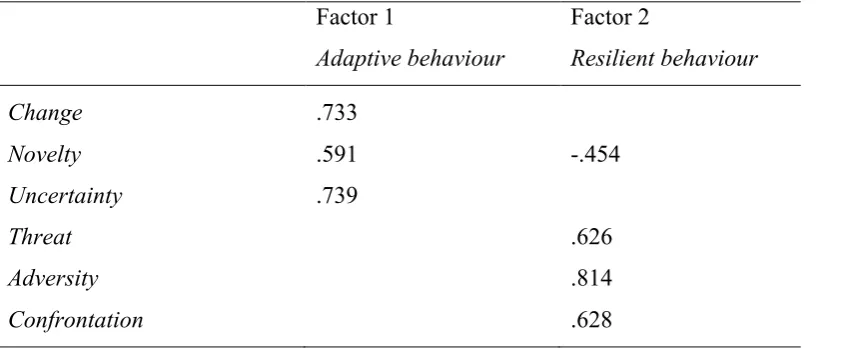
Factor analysis 3. The third factor analysis of the third operation yielded two
factors. The first factor was labelled adaptive behaviour, due to the loadings on:
change, uncertainty, novelty and challenge. Novelty loads on both factors, however,
more on factor one than on factor two. The second factor was labelled resilient
behaviour, due to the loadings on: adversity, confrontation and threat.
Table 4
Factor loadings principal component analysis with oblimin rotation Experiment 1- Operation 3
Factor 1
Adaptive behaviour
Factor 2
Resilient behaviour
Change .733
Novelty .591 -.454
Uncertainty .739
Threat .626
Adversity .814
[image:23.595.86.509.577.752.2]Challenge .765
Note. Factor loadings < .4 are suppressed
Overall, the factor analyses indicated, that the items represent distinct constructs.
The main factors (adaptive behaviour and resilient behaviour) seem to be valid across
the three mission operations. However, the third construct ‘situational change’ cannot
be measured adequately by one item (challenge).
Reliability. As a next step, the reliability of a scale out of the
above-mentioned items was tested. The adaptive behaviour scale contains 3 items, change,
novelty and uncertainty. Cronbach's alpha of the items was moderately reliable (α
=.620). The resilient behaviour scale consisting of the 3 items: threat, adversity and
confrontation was found to be reliable (α = .728).
Adaptive versus resilient behaviour. Finally, to answer the question if the
experimental set-up elicited adaptive rather than resilient behaviour, a paired sample
t-test was conducted. Adaptive behaviour score (M = 3,73, SD = .46)was statistically
significant higher than resilient behaviour score (M = 2,43, SD = .60), t(32) = 9,30, p
<.001. Hence, the experimental set-up elicited adaptive rather than resilient
behaviour.
Influence on adaptive behaviour
In order to answer the question whether the experimental set-up influenced adaptive
behaviour, an already validated Adaptability Scale (Martin et al., 2012, Collie &
Martin, 2016) was used. The reliability was tested separately for each mission.
Cronbach’s alpha was found highly reliable for the Secret note mission (α = .921), the
Tap water mission (α = .75), as well as for the Fingerprint mission (α = .890).
To explore whether the experimental set-up influenced adaptive behaviour
operation order (A, B) as the between-subject factor and the Adaptability Scale scores
for each operation as within factor was conducted. The within factor showed no
statistically significant main effect [Wilks’ Lambda = 0.859, F(2,52) = 2.468, p =
.102], the interaction between operation and order also showed no statistically
significant effect, [Wilks’ Lambda = 0.867, F (2,62) = 2.115, p = 0.138]. Indicating
no differences (increases or decreases) in adaptive behaviour across the operations
and between the orders.
Moreover, a repeated measures ANOVA with mission as within factor was
conducted. No statistically significant difference was found between the missions
[Wilks’ Lambda =.889, F(2,64) = 1.944, p = 0.16].
Last, to test whether there was a difference in the Adaptability Scale for the
participants themselves and how they rated the Adaptability Scale from the
perspective of an average person, a paired sample t-test was conducted. There was a
statistically significant difference between their own rating (M = 1.36, SD = .31) and
the rating for another person (M = 3.30, SD = .75), p = <.001, t(32) = -16.34.
Experiment 2
Participants
A total of 41 university students were recruited to take part in a study on being an
undercover agent via SONA (Radboud Research Participation System) for students
from the University of Twente. Of the respondents, 22 (54 %) were female and 19 (46
%) male. Participants’ age was ranged from 19 to 29 years (M = 21.93, SD = 2.16).
Nationalities were distributed as follows: German (59%), Dutch (15%) and others
by 5€ and one SONA credit. The ethical review board at the University of Twente
approved the study.
Materials
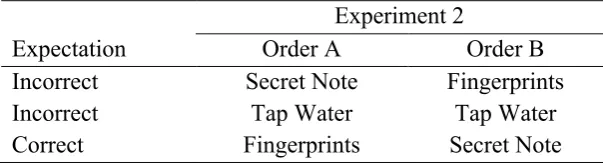
This experiment used the same materials and procedure as experiments 1. The only
difference from Experiment 1 was a modification to the design. For the last operation
participants were provided with a correct indication. The participant’s expectation of
the mission to complete was not violated (Table 5). That is, for Order A, the
participants were given correct background information about the Fingerprint mission
(i.e., that the study advisor was on the way to leave the country). In addition, for
Order B, the participants were given correct background information about the Secret
[image:26.595.120.422.423.505.2]note mission (i.e. that explained that the professor was away on a business trip).
Table 5
The order and background descriptions of the missions
Experiment 2
Expectation Order A Order B Incorrect Secret Note Fingerprints Incorrect Tap Water Tap Water Correct Fingerprints Secret Note
Results Experiment 2
For this experiment, the same analyses as in Experiment 1 were conducted.
Participants were very motivated to complete their objective during the three
operations (M = 6.15, SD = 0.85). They also took on the operations (M = 5.71, SD =
1.06) and their roles as special agents (M = 5.76, SD = 1.04) in a serious manner.
The first operation was perceived as very unexpected (M = 5.41, SD = 1.82),
as well as the second operation (M = 5.59, SD = 1.449), the third operation was less
To answer the question whether the experimental set-up elicits adaptive rather
than resilient behaviour, the validity of the measurement was tested. Again, three
separate factor analyses were conducted to check whether the seven items indeed
represent distinct constructs.
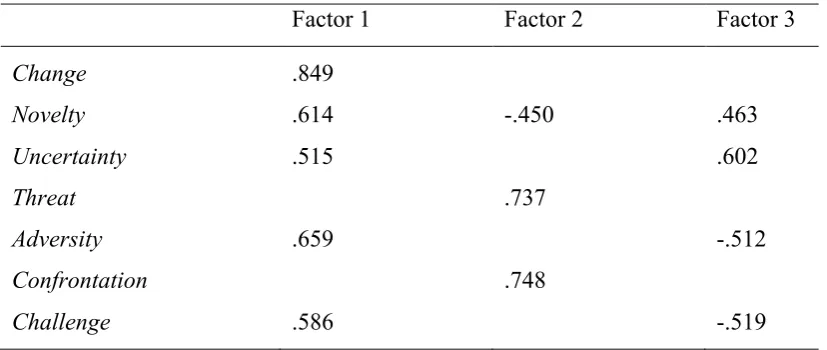
Factor analysis 1. The first factor analysis of operation one yielded three
factors. Seven items (change, novelty, uncertainty, threat, adversity, confrontation and
challenge) were factor analysed using a principal components analysis with direct
[image:27.595.84.498.381.556.2]oblimin rotation. See Table 6 for the factor loadings.
Table 6
Factor loadings principal component analysis with oblimin rotation in Experiment 2 - Operation 1
Factor 1 Factor 2 Factor 3
Change .849
Novelty .614 -.450 .463
Uncertainty .515 .602
Threat .737
Adversity .659 -.512
Confrontation .748
Challenge .586 -.519
Note. Factor loadings < .4 are suppressed
Factor analysis 2. The second factor analysis of operation two indicated two
factors. All items load on Factor 1. The other factor is explained by change, novelty,
Table 7
Factor loadings principal component analysis with oblimin rotation in Experiment 2- Operation 2
Factor 1 Factor 2
Change .510 .676
Novelty .685 .551
Uncertainty .757
Threat .594 -.484
Adversity .824
Confrontation .649 -.521
Challenge .517
Note. Factor loadings < .4 are suppressed
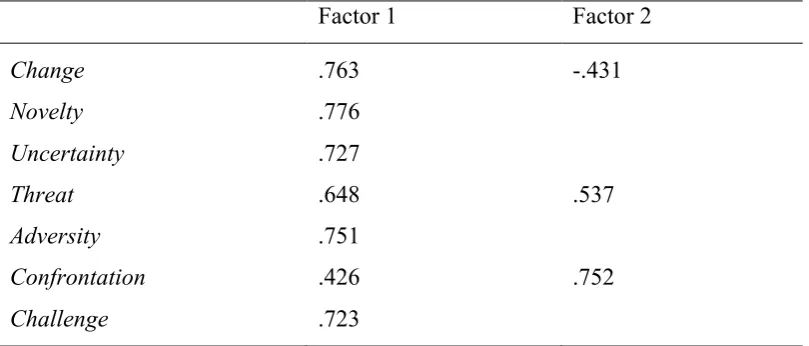
Factor analysis 3. The third factor analysis of operation three yielded two
factors. All items load on factor 1. Factor 2 is explained by change, threat and
confrontation.
Table 8
Factor loadings principal component analysis with oblimin rotation in Experiment 2- Operation 3
Factor 1 Factor 2
Change .763 -.431
Novelty .776
Uncertainty .727
Threat .648 .537
Adversity .751
Confrontation .426 .752
Challenge .723
[image:28.595.85.490.528.701.2]Overall, there can be seen a recurring theme, that is, that change, novelty and
uncertainty (meant to measure adaptive behaviour) always load on the same factor.
While the items threat and confrontation (meant to measure resilient behaviour) load
on a separate factor.
Reliability. As a next step, the reliability of a scale out of the
above-mentioned items was tested. The adaptive behaviour scale contains 3 items, change,
novelty and uncertainty. Cronbach's alpha of the items was found to be reliable (α
=.792). The resilient behaviour scale consisting of the 2 items: threat and
confrontation was found highly reliable (α = .804).
Adaptive versus resilient behaviour. Finally, to answer the question if the
experimental set-up elicited adaptive rather than resilient behaviour, a paired sample
t-test was conducted. Adaptive behaviour score (M = 5,05, SD = .91)was statistically
significant higher than resilient behaviour score (M = 2,90, SD = 1.23), t(40) = -10,45,
p <.001. Hence, the experimental set-up elicited adaptive rather than resilient
behaviour.
Influence on adaptive behaviour
In order to check whether the experimental set-up influenced adaptive behaviour, an
already validated Adaptability Scale (Martin et al., 2012, Collie & Martin, 2016) was
used. Three separate reliability tests were conducted for each mission. Cronbach’s
alpha was found highly reliable for the Secret note mission (α = .884), the Tap water
mission (α = .940), as well as for the Fingerprint mission (α = .920).
Next, a repeated measures ANOVA with the counterbalanced operation order
(A, B) as the between-subject factor and the Adaptability Scale scores for each
operation as within factor was conducted. The within factor showed no statistically
indicating no difference across the operations. Furthermore, no significant difference
was found between the orders [F(1,39) = 0.011, p = .917)]. However, there was a
significant interaction effect [Wilks’ Lambda = 0.78, F(2,78) = 5.353, p = .009],
indicating a difference between Order A and Order B across the different operations.
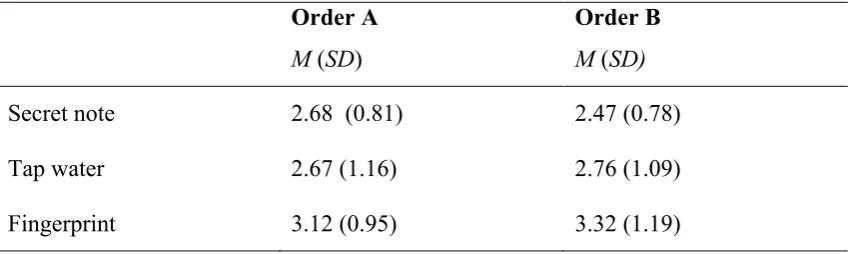
On average, during the Fingerprint mission participants perceived their ability to
adapt the lowest (see Table 9). Indicating, participants in Order A (Secret note – Tap
water – Fingerprint) became less adaptive in the course of the missions, whereas
participants in Order B (Fingerprint – Tap water – Secret note) became more
[image:30.595.86.512.373.500.2]adaptive.
Table 9
Means and SD of the Adaptability Scale across the missions
Order A
M (SD)
Order B
M (SD)
Secret note 2.68 (0.81) 2.47 (0.78)
Tap water 2.67 (1.16) 2.76 (1.09)
Fingerprint 3.12 (0.95) 3.32 (1.19)
Further, a repeated measures ANOVA with mission as within factor was
conducted, there was a statistically significant difference between the missions
[Wilks’ Lambda = .788, F(2,80) = 5.237, p = .01]. Pairwise comparisons using
multiple paired t-test with a Bonferroni correction showed a significant difference
between the Secret note mission and the Fingerprint mission (p = .007). The
Fingerprint mission scores were statistically significant higher (M = 3,22, SD = .166)
than the Secret note scores (M = 2,58, SD = .124). Indicating, that the Fingerprint
Moreover, to check whether there was a difference in the Adaptability Scale
scores for the participants themselves and how they rated the Adaptability Scale from
the perspective of an average person, a paired sample t-test was conducted. There was
a statistically significant difference between their own rating (M = 2.84, SD = .68) and
the rating for another person (M = 3.13, SD = .60), p = .02, t(40) = -2.42.
Discussion
The goal of the study was twofold: first, to come up with a conceptual framework
about adaptability; second, to examine the possibility to elicit and measure
behavioural adaption. In essence, results showed an initial success in eliciting and
measuring adaptability.
Experiment 1
As was shown in Experiment 1, participants were highly motivated to take part in the
study, increasing the likelihood of attentive participation, which in turn could have a
positive effect on the validity of the study. Moreover, they took on the operations and
their roles as special agents in a serious manner, which also adds to the validity of the
experimental set-up.
As desired, participants experienced a violation of their expectation. This was
important as the operations were supposed to be unexpected, so that participants were
required to adapt to a changing situation. The first two operations both had high mean
scores, indicating the operations were successful in violating the participant’s
expectations. However, the third operation indicated a lower mean score. It could
possibly be that participants had a learning effect during the course of the operations.
Since the operations followed each other within a short time, participants already
Moreover, to be sure that adaptive rather than resilient behaviour was elicited,
firstly factor analyses were conducted; results yielded two main factors, adaptive and
resilient behaviour. Further analyses showed that the experimental set-up elicited
adaptive behaviour rather than resilient behaviour, indicating an initial success in
eliciting and measuring adaptive behaviour.
Furthermore, it was investigated if there can be identified any change in
adaptive behaviour across the missions or between the order. Results indicated no
difference in the participant’s ability to adapt their behaviour. There was not found
any difference across the missions nor between Order A (Secret note – Tap water –
Fingerprint) and Order B (Fingerprint – Tap water – Secret note). In other words,
adaptive behaviour did not show to improve in the course of the experiment.
Last, it was examined how participants scored the Adaptability Scale from the
perspective of an average person. This measure was included since individuals tend to
deviate positively from an objective view of themselves. It was expected that
participants would overestimate their abilities. Results indeed indicate a significant
difference between the mean score of oneself and the mean score of an average
person. Participants evaluated themselves as more adaptable than an average person.
Experiment 2
Experiment 2 showed similar results regarding the participant’s motivation to take
part in the study. Participants were highly motivated and took on the operations and
their roles as special agents in a serious manner. There were also found similar pattern
regarding participant’s experienced violation of their expectation. The first two
operations both had high mean scores; whereas the third operation indicated a lower
mean score. However, in Experiment 2 participants in the third operation were
mean the third operation is not representative of a person’s adaptive behaviour but
rather their ability to successfully achieve a task in a more predictable situation.
Moreover, as in Experiment 1, Experiment 2 elicited adaptive rather than
resilient behaviour. Factor analyses showed that the items used to measure adaptive
behaviour (change, novelty, uncertainty) always load on one factor, while two out of
three items (threat and confrontation) used to measure resilient behaviour always load
on another factor. Therefore, further analyses were conducted without the third item
(adversity) that was used to measure resilient behaviour. Results indicated, that
Experiment 2 also elicited adaptive rather than resilient behaviour.
Further, it was tested, whether the experimental set-up influenced the ability
to adapt across the operations. Results indicated no main effect across the operations,
indicating adaptive behaviour was not influenced across the operations. However,
between the Order (A, B) there was found an interaction effect, indicating that there
was a difference between the orders. More precise, participants in Order A (Secret
note – Tap water – Fingerprint) became less adaptive, whereas participants in Order B
(Fingerprint – Tap water – Secret note) became more adaptive. A possible explanation
for this interaction effect could be the reason that the Fingerprint mission was
perceived as more difficult than the Secret note mission. As participants in Order A
began with the Secret note mission followed by the Tap water and Fingerprint
mission, this could explain the decline in adaptive behaviour in Order A. Contrary,
participants in Order B began with the most difficult mission therefore improved
during the operations.
Limitations
A possible explanation for the different results of Experiment 1 and 2 could be that
were built up at exactly the same way, except for one modification in Experiment 2.
That is, for the last operation participants were provided with a correct indication. The
participant’s expectation of the mission to complete was not violated. However,
results show different pattern on the same measures were this modification was not
relevant. Hence, the experimental set-up seemed to be implemented differently. This
could be affected by the fact, that different research assistants implemented the
experiments. It seems that the different research teams performed the Experiments
differently. To remedy this, in a following experiment, the implementation has to
become more standardized.
Another possible explanation for the different results could be caused by
individual differences of the participants. As mentioned earlier, individuals for
example possess different goal orientations that lead to different strategies of handling
a situation, or they differ in their cognitive flexibility. Therefore, it is suggested to
include such possible predictive factors of adaptability in further investigations.
Moreover, the fact that the research assistants were students could have
affected how participants perceived the scenarios. It seemed that participants
sometimes did not get the situation right, for example during the Secret note operation
(see Appendix I) participants did not immediately recognize, that the person they
encounter was not the person they expected. Thus, the actors were not authentic
enough which probably made important features less explicit.
Further, the location could have affected the authenticity of the experiments;
the experiments were conducted in the Research Lab of the University of Twente, a
setting very different from a typical undercover environment. However, as
participants indicated that they took on the operations and their roles as special agents
be advisable for further investigation to use other locations in order to provide more
authenticity.
Another limitation is connected to the short duration of the experiments. The
missions were relatively short and participants seemed taken by surprise, which to a
certain extent was intended. However, the participants may have had insufficient time
to adapt to the situation. The results of Experiment 2 let speculate, that this particular
was the case during the Fingerprint mission. This mission was perceived as the most
difficult to adapt. The scenario was built up in a way, that participants hardly get the
chance to become familiar with the situation, limiting the quality of their adaption
(see Appendix II). Participants entered the office and found the person from whom
they had to collect a fingerprint in a hurry, irrespective of their expectation it was hard
to adapt to this hectic situation.
Furthermore, if adaptability changed across the operations was measured by
means of a self-report scale. It is known, that when evaluating the self relative to
others, individuals demonstrate a wide range of self-serving biases (Hornsey, 2003).
In particular, individuals are prone to biases such as the above-average effect, also
known as superiority bias, described as a positive illusion relating to the self (Modic
& Lea, 2013). More precise, individuals tend to overestimate their own abilities in
relation to others. As the results of the comparison between the ratings on the
Adaptability Scale about themselves and the ratings from the perspective of an
average person show, participants tend to overestimate their own ability to adapt over
the ability of an average person. Therefore, for further investigations, it would be
desirable to use expanded, more objective measurements to examine adaptive
Towards a conceptual framework of adaptive behaviour
This study was a first attempt to capture adaptive behaviour in a controlled laboratory
setting. The results of the two experiments clearly show that the measurement has to
be expanded. First, since the items used to demonstrate a situational change where not
clearly distinguishable, more items have to be included. Moreover, to achieve more
accurate outcomes, the framework of adaptability has to be expanded, by for example
possible predictive factors. Based on the findings of the introduction cognitive
flexibility and goal orientation could be constructs valuable to include in further
investigations. Both possibly could predict or generally influence adaptive behaviour.
Cognitive flexibility is considered as the plasticity required for adapting to new
demands (Laurero-Martinuez & Brusoni, 2018). It is defined as a person’s awareness
that in any given situation there are alternative strategies of action available, as well
as a person’s willingness to be flexible (Martin & Rubin, 1995). In other words,
cognitive flexibility is considered as the ability to recognize ineffective strategies of
action and subsequently making appropriate changes to adapt to the situation. This
could indicate, that cognitive flexibility is a prerequisite for recognizing the need for
action in a changing situation and could therefore serve as a predictor of adaptive
behaviour.
Goal orientation, another concept that could be valuable for further
investigations is seen as an underlying factor that influences one's choice of strategy
of action (VandeWalle, 2018). The concept of goal orientation stresses different
approaches to deal with changing situations, a distinction is made between learning
goal orientation and performance goal orientation. The former stresses the
importance of effort for success, and is also considered as the preference to develop
view of one's ability that is difficult to develop, therefore, exerting substantial efforts
for success is viewed as ineffective (Dweck, 1986). Since goal orientation is seen as a
factor influencing one's choice of strategy in a new or changing situation it could also
be of predictive value for adaptive behaviour. As an example, assuming a
performance goal oriented individual performs poorly, he or she would not see any
need in putting more effort into the task or changing the task strategy since they view
the outcome as a reflection of their (in) ability. In contrast, a learning goal orientated
individual would tend to view poor performance as feedback to alter their strategy and
put more effort into the modification of their strategy and the task itself. This leads to
the assumption that learning goal oriented individuals would be more adaptable than
performance goal oriented individuals. Due to that, goal orientation could be a
beneficial construct to further examine adaptive behaviour.
In sum, the constructs of cognitive flexibility and goal orientation could be
helpful for a better understanding of the concept of adaptive behaviour. It therefore is
suggested to further investigate the predictive value of both constructs regarding
adaptability.
Conclusion
The present study was a first step towards a conceptualization of adaptability. The
possibility to elicit and measure behavioural adaption was examined in a behavioural
experiment. Results indicated an initial success to elicit adaptive behaviour in a
controlled laboratory setting. However, to better examine the role of adaptability in
goal achievement, more concepts and dependent variables have to be included. In the
course of the investigation, cognitive flexibility and gaol orientation appeared to be
lays the foundation for examining behavioural principles of adaptability. In general,
more research is needed to measure adaptive success, specifically, the role of
References
Alison, L., Alison, E., Noone, G., Elntib, S., & Christiansen, P. (2013). Why tough tactics fail and rapport gets results: Observing rapport-based interpersonal techniques to generate useful information from terrorists. Psychology, Public
Policy, & Law, 19, 411-431.
Birkinshaw, J., & Gibson, C. (2004). Building an ambidextrous organisation.
Bohle Carbonell, K., Stalmeijer, R. E., Könings, K. D., Segers, M., & van
Merriënboer, J. J. G. (2014). How experts deal with novel situations: A review of adaptive expertise. Educational Research Review, 12, 14–29.
Broadhurst, R. (2006). Developments in the global law enforcement of cyber-crime. Policing: An International Journal of Police Strategies & Management, 29(3), 408-433.
Cambridge English dictionary (n.d.). Retrieved from January 30, 2019 from: https://dictionary.cambridge.org/dictionary/english/adaptability
Claeys, G. (2000). The" Survival of the Fittest" and the Origins of Social Darwinism. Journal of the History of Ideas, 61(2), 223-240.
Collie, R. J., & Martin, A. J. (2016). Adaptability: An important capacity for effective teachers. Educational Practice and Theory, 38(1), 27-39.
Doppler, K., & Lauterburg, C. (2008). Change management: den Unternehmenswandel gestalten. Campus Verlag.
Dweck, C. S. (1986). Motivational processes affecting learning. American psychologist, 41(10), 1040.
Erdogmus, H., & Favaro, J. (2002). Keep your options open: Extreme programming and the economics of flexibility. Extreme programming perspectives, 503-552. Feltovich, P. J., Hoffman, R. R., Woods, D., & Roesler, A. (2004). Keeping it too
simple: How the reductive tendency affects cognitive engineering. IEEE Intelligent Systems, 19(3), 90-94.
Friedman, M., Grawert, A. C., & Cullen, J. (2017). Crime Trends, 1990-2016 (pp. 1-27). New York, NY: Brennan Center for Justice at New York University School of Law.
Harris, K. R., Eccles, D. W., Freeman, C., & Ward, P. (2017). ‘Gun! Gun! Gun!’: An exploration of law enforcement officers’ decision-making and coping under stress during actual events. Ergonomics, 60(8), 1112-1122.
Hatano, G., & Inagaki, K. (1984). Two courses of expertise. Research and Clinical Center for Child Development Annual Report, 6, 27-36.
http://hdl.handle.net/2115/25206
Hatano, G., & Inagaki, K. (1986). Two courses of expertise. In H. Stevenson, H. Azuma, and K. Hakuta (Eds.), Child development and education in Japan (pp. 262–272). New York: W. H. Freeman.
Hoffman, R. R. (1998). How can expertise be defined? Implications of research from cognitive psychology. In Exploring expertise (pp. 81-100). Palgrave Macmillan, London.
Hornsey, M. J. (2003). Linking superiority bias in the interpersonal
Howard, S., & Johnson, B. (2000). Resilient and non-resilient behaviour in adolescents (Vol. 183, pp. 1-6). Canberra, ACT: Australian Institute of Criminology.
Huang, J. L., Ryan, A. M., Zabel, K. L., & Palmer, A. (2014). Personality and adaptive performance at work: A meta-analytic investigation. Journal of Applied Psychology, 99(1), 162.
Huey, L., Kalyal, H., & Peladeau, H. (2017). Preparing police recruits of the future: An educational needs assessment.
Joseph, J. (2013). Resilience as embedded neoliberalism: a governmentality approach. Resilience, 1(1), 38-52.
Jundt, D. K., Shoss, M. K., & Huang, J. L. (2015). Individual adaptive performance in organizations: A review. Journal of Organizational Behavior, 36(S1), S53-S71. Klein, D. E., Klein, H. A., & Klein, G. (2000). Macrocognition: Linking cognitive
psychology and cognitive ergonomics. In Proc. 5th Int’l Conf. Human Interactions with Complex Systems (pp. 173-177).
Klein, G. (2007a). Flexecution, as a paradigm for replanning, Part 1. IEEE Intelligent
Systems, 22, 79-83.
Klein, G. (2007b). Flexecution, part 2: Understanding and Supporting Flexible Execution. IEEE Intelligent Systems, 22, 108-112.