Original citation:
Warwick Business School (Including: Nicolini, Davide, Mengis, Jeanne and Swan, Jacky). (2012) Understanding the role of objects in cross-disciplinary collaboration. Organization Science, Volume 23 . pp. 612-629. ISSN 1047-7039
Permanent WRAP url:
http://wrap.warwick.ac.uk/57858 Copyright and reuse:
The Warwick Research Archive Portal (WRAP) makes this work of researchers of the University of Warwick available open access under the following conditions. Copyright © and all moral rights to the version of the paper presented here belong to the individual author(s) and/or other copyright owners. To the extent reasonable and practicable the material made available in WRAP has been checked for eligibility before being made available.
Copies of full items can be used for personal research or study, educational, or not-for-profit purposes without prior permission or charge. Provided that the authors, title and full bibliographic details are credited, a hyperlink and/or URL is given for the original metadata page and the content is not changed in any way.
Publisher’s statement:
http://dx.doi.org/10.1287/orsc.1110.0664 A note on versions:
The version presented here may differ from the published version or, version of record, if you wish to cite this item you are advised to consult the publisher’s version. Please see the ‘permanent WRAP url’ above for details on accessing the published version and note that access may require a subscription.
Understanding the Role of Objects in
Cross-Disciplinary Collaboration
Davide Nicolini
IKON
Warwick Business School University of Warwick,
Coventry CV4 7AL United Kingdom
Jeanne Mengis
University of Lugano, 6900 Lugano, Switzerland
& IKON
Warwick Business School University of Warwick,
Coventry CV4 7AL United Kingdom
Jacky Swan
IKON
Warwick Business School University of Warwick,
Coventry CV4 7AL United Kingdom
Published in Organization Science 23 (2012): 612-629.
ABSTRACT
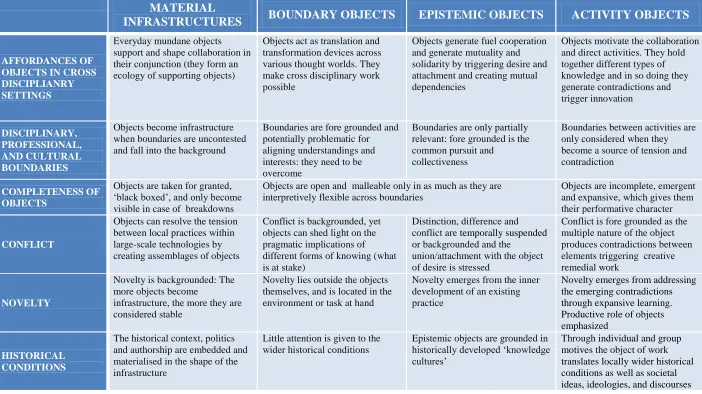
In this paper we make a case for the use of multiple theoretical perspectives – theory on boundary
objects, epistemic objects, cultural historical activity theory and objects as infrastructure - to
understand the role of objects in cross-disciplinary collaboration. A pluralist approach highlights
that objects perform at least three types of work in this context: they motivate collaboration; they
allow participants to work across different types of boundaries; and they constitute the
fundamental infrastructure of the activity. Building on the results of an empirical study we
illustrate the insights that each theoretical lens affords into practices of collaboration and develop
a novel analytical framework that organizes objects according to the active work they perform.
Our framework can help shed new light on the phenomenon, especially with regards the shifting
status of objects and sources of conflict (and change) in collaboration. After discussing these
novel insights, we outline directions for future research stemming from a pluralist approach. We
INTRODUCTION
One of the most notable characteristics of post industrial society is that work is increasingly
accomplished through collaboration amongst interdependent groups of disciplinary specialists
(Bechky 2006; Clegg et al. 2002; Lawler et al. 1992). A mounting number of social theorists
have argued, moreover, that a characteristic feature of modern sociality is that it is
increasingly mediated by objects and material artifacts (Knorr Cetina 1997). In this paper we
build upon previous research on the role of objects in cross-disciplinary collaboration by
making a case for the use of multiple theoretical perspectives. Such a pluralist approach
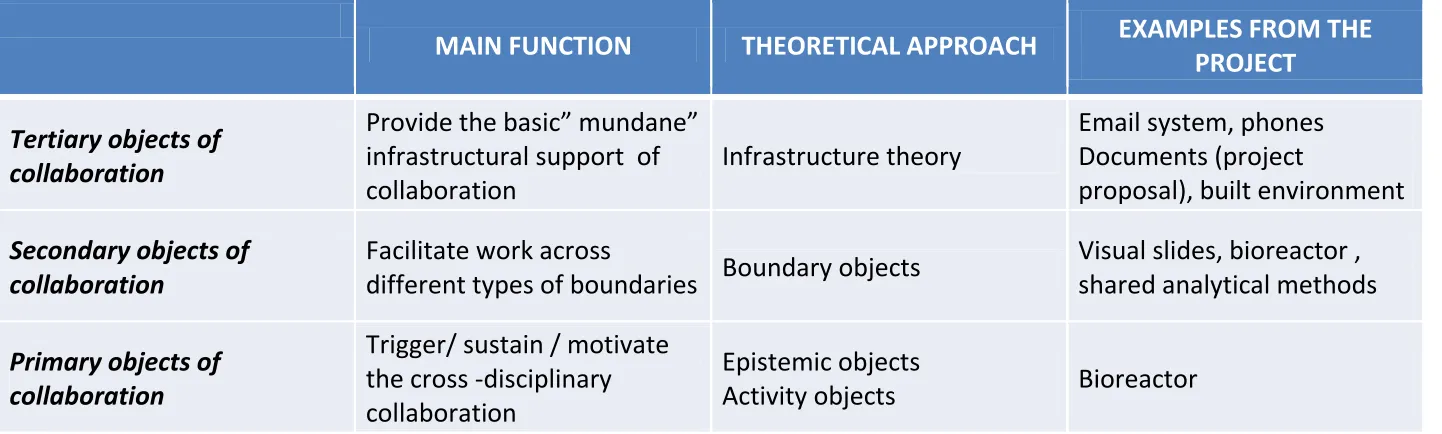
highlights that objects can perform at least three types of work to support cross-disciplinary
collaboration: they provide the motives and drive for collaboration to emerge; they allow
participants to work across different types of boundaries; and they constitute the fundamental
infrastructure of the activity.
Our contribution is threefold. First, we develop a novel analytical framework that
organizes objects according to the roles they play in collaboration and the theoretical lens
taken. Second, we argue that examining the role of objects through different theoretical
lenses allows us to see that the role and function of particular objects can change during the
course of collaboration. The same object can thus take center stage or shift into the
background at different times. The key finding here is that the type work objects perform in
conditions of collaboration derive not only from their inherent nature but also from the nature
and unfolding of the activity itself. Third, we argue that a pluralist perspective allows us to
better understand sources of conflict and potential breakdown in collaboration. Here we
observe that a particular object can assume a different type of role for the different actors
engaged in collaboration at any moment in time - an object being motivational for some
source of conflict in collaborative work – one not recognized previously - that can impede (or
drive) further collaboration.
We illustrate our arguments by drawing from a longitudinal study of the day-to-day
practices of collaboration amongst scientists engaged in a cross-disciplinary project in the
domain of biomedical engineering. Thus we follow the advice of authors such as Orlikowski
(2002) who suggest that the work performed by objects becomes apparent only when we
focus on how experts from various disciplines collaborate in practice, starting from the
premise that cross-disciplinary collaboration is a social accomplishment. While we do not
subscribe to the idea that objects alone can explain cross-disciplinary working, recent work
does suggest that objects perform an active role that needs to be unpacked and better
understood (Carlile 2004; Okhuysen and Bechky 2009; Orlikowski 2007).
We stand, of course, in a long line of authors who addressed these issues (see Orlikowski
2010; Rafaeli and Pratt 2006 for a discussion). In organization science, interest in objects and
artifacts has gone hand in hand with the development of so-called ‘practice-based’ studies
(Nicolini 2010; Orlikowski 2002; Orlikowski 2007; Osterlund and Carlile 2003) and the
parallel raising of emphasis on the social and material nature of organizational practices. As
Orlikowski (2007) puts it, the practice-based approach re-specifies organizing processes in
terms of practices and foregrounds that “materiality is integral to organizing, positing that the
social and the material are constitutively entangled in everyday life” (p. 1437). We submit,
however, that in organization science there has been a tendency to give prominence to one
specific approach - the notion of “boundary object” (Carlile 2002, 2004; Leigh Star 2010;
Levina and Vaast 2005; Star and Griesemer 1989). Indeed, this approach has sometimes been
stretched so far from its original formulation that its utility has been questioned (Zeiss and
Groenewegen 2009). In short, when all objects become boundary objects, the explanatory
In this paper we try to reverse this tendency by mobilizing, instead, a plurality of
alternate theories to study the role that objects play in supporting cross-disciplinary
collaboration. Accordingly, we look at objects as boundary devices but also as epistemic
things, objects of activities, and infrastructures. Building on our empirical study we illustrate
the insights that each of these approaches affords into practices of collaboration. By working
these theories together we are then in the position to offer a more systematized account of the
role that objects play collaboration and to propose new avenues for research.
The paper is organized as follows. We start by introducing four approaches to the study
of object is cross-disciplinary collaboration. We then use our case study of the development
of a new bioreactor to foreground what each approach has to offer by way of understanding
the different roles that objects play in this context. After discussing their commonalities and
differences, we propose an analytical framework that provides a systematic way to
investigate the work objects perform in cross-disciplinary activities from a pluralist
perspective. We conclude with a discussion of the novel insights and implications that this
framework offers for the understanding of collaborative work.
EXPLORING CROSS-DISCIPLINARY WORK THROUGH OBJECTS
The idea that objects should be included in explanations of collaboration is not new. Almost
half a century ago, researchers from the Tavistock Institute theorized coordination in
workgroups as part of a “socio-technical system”, indicating that material technologies and
artifacts played a central role in organizing processes (Trist and Bamforth 1951). This idea
has subsequently become a characterizing trait of contemporary social studies of technology
as, with authors such as Latour (1996; 2005) arguing that the stability of human social orders
beyond particular contexts of action can only be explained when one allows for the work
at a distance and to make our interaction endure beyond the present. What makes human
sociality distinctive, then, is that practices are not merely constellations of intersubjectivity,
they are also constellations of “interobjectivity” (Latour 1996, p. 234). Latour is only one of
many contributors to a now large body of work which, according to Suchman (2007),
provides compelling empirical demonstrations of ‘how capacities for action can be
reconceived on foundations quite different from those of a humanist preoccupation with the
individual actor living in a world of separate things’ (p.261).
Focusing on the role of objects also complements recent work on collaboration,
especially by authors belonging to the North American interactionist sociology of work
(Bechky 2003, 2006; Strauss 1993) and organization communication traditions (Taylor and
Robichaud 2004). While these authors have contributed significantly to understanding of the
practices of collaboration (and coordination) - bringing to the fore the intricacies of the
processes and its emergent, provisional, and often conflictual nature - they have, nonetheless,
tended to foreground human agency as the main source of alignment1. Thus, their main focus
has been on discursive practices and interpretation processes that allow people with different
backgrounds to work together. In this paper, in contrast, we analyse in detail the work
performed by objects in cross-disciplinary collaboration persuaded that an orientation
towards objects is likely to significantly improve the understanding. Following Star (2010)
we understand objects as something people act toward and with (p.603). While the material
dimension of objects matters, such materiality derives from action, not from a sense of
prefabricated stuff or ‘thing’-ness (ibid). A theory or representation can thus be powerful
objects with very concrete material consequences (Swan et al. 2007).
1 For an extensive discussion on a more general “artifact myopia” in organization and management studies see
Conceptualizing objects in cross-disciplinary collaboration: beyond boundary objects
Much recent organization and management literature has accounted for the role of
objects in cross-disciplinary collaboration using the notion of ‘boundary objects’. The idea
derives from the field of science studies and it highlights the capacity of certain types of
artifacts to support collaboration across diverse specialist groups by acting as “boundary
objects” (Carlile 2002, 2004; Carlile and Rebentisch 2003; Levina 2005; Star and Griesemer
1989). Boundary objects are defined by their capacity to serve as bridges between
intersecting social and cultural worlds. Anchored in, and thus meaningful across, these
worlds, they create the conditions for collaboration whilst, by way of their interpretive
flexibility, not requiring “deep sharing”.
While the concept of boundary object is extremely powerful, in recent years it has been
used increasingly as a sort of “deus ex machina”, a one fits all explanation that is mobilised
any time collaboration across boundaries is discussed and is attached (often incongruously )to
a disparate array of artifacts and situations (Star 2010). However, if the idea of boundary
object is stretched to explain all the types of work performed by material and symbolic
entities, then its original heuristic capacity to explain phenomena of collaboration, thought
mediation and translation, is lost (see Zeiss and Groenewegen 2009 for a discussion). The
notion works extremely well when used to shed light on how, through an object that resides
amid different social worlds, groups cooperate without consensus, tacking “back-and-forth
between both forms of the object” (Star 2010, p.605). However, when used as a ‘catch-all’
notion, it precludes deeper analytical inquiry. Hence Trompette and Vink (2009) suggest that
in many cases “the fact of qualifying an artifact as a boundary object would therefore appear
to dispense authors of even marginally-nuanced analysis...[the] complexity of interactions
between social worlds is often forgotten to the benefit of simplified modelization of the
We argue that stretching the idea of boundary object to the point where it tries to explain
everything (therefore explaining nothing) is, in fact, unnecessary because other
complementary theories exist that can provide persuasive accounts of some of the phenomena
under discussion. For example, a different take on the study of objects and collaboration is
manifest in the work of Knorr Cetina (1997; 1999) who suggests that the capacity of objects
to support collaboration derives from their being experienced as “epistemic things”
(Rheinberger 1997: 28). Objects becomes epistemic when they embody what one does not yet
know. Because of this open ended nature, they acquire a deep emotional holding power and
generate intimate attachment which creates social bonds, either because their complexity
requires joining forces, or because the drive and desire towards the same object constitutes
the basis for mutual recognition and sense of belonging (or both, Knorr Cetina 1997).
Further explanation on the role of objects stems from Activity Theory - a development of
Vygotsky’s psychological tradition (Kaptelinin and Nardi 2006). Authors within this
tradition (that predates the idea of boundary objects) emphasize that collective action is
inherently object oriented and that the pursuit of some kind of object(ive) is what motivates
collaborative work. The collective object of an activity is thus the organizer and motivator of
the community that revolves (and evolves) around it. In contrast to the other two traditions,
however, Activity Theory scholars underscore that, because of its collective origin, the object
of the activity is, by definition, emergent, fragmented, and contradictory. Collaborative action
is thus maintained around the pursuit of a partially shared, partially fragmented, and partially
disputed object (Miettinen and Virkkunen 2005). Finally, to these approaches one can add a
fourth which, whilst not specifically associated with the study of cross-disciplinary work,
helps complete the picture. This approach stresses that we take notice, also, of the host of
work activities. Although they are often forgotten, numerous “boring objects” (Star 1999)
combine to structure, anchor, and enable collaborative work2.
Whilst these four approaches have their own distinctive followers, debates, and studies,
our contention is that they also share a number of common basic assumptions and, hence, can
and should be used together. For example, all agree that collaboration and sociality are
practical accomplishments; that social action is mediated by material and symbolic artifacts;
that social phenomena such as groups, communities, and institutions are the results of
organizing work (not given entities); that social structures are both mediums for, and
outcomes of, human activities; that action and environment are mutually and recursively
constituted; and that human actors are driven both by rational consideration and emotions,
desires, and passion. At the same time, each approach illuminates different ways in which
objects trigger and support collaborative work across specialist groups and ‘thought worlds’
(Dougherty 1992). We should, therefore, resist using any one of them to cover the whole
wide spectrum of phenomena involved in cross-disciplinary collaboration.
In the sections that follow, then, we mobilize these multiple theoretical ‘lenses’ in order
to develop new insights into the role objects play in the accomplishment of collaborative
work. The empirical study, next, demonstrates how, when used in combination, these theories
can produce a level of understanding about the role of objects in collaboration that none of
them could achieve when used in isolation. The novel insights that derive from this
juxtaposition of approaches comprise the final part of the article, together with signposts for
further research.
2 As we explain later in the paper, we treat this aspect last as infrastructures often only become visible once
METHODS AND EMPIRICAL CONTEXT
The data discussed below are drawn from an 18-month focused ethnography of
cross-disciplinary working in a scientific research project conducted at an internationally renowned
British research institution. A focused ethnography takes a particular phenomenon or
situation delimited in time and space, instead of an entire cultural system, as its object of
inquiry (Alvesson 1996). In other words, our approach was to zoom in on the actual practice
of collaborative working (Nicolini 2009). One author attended most of the monthly or
bimonthly scientific project meetings (nine in total, of which five were taped and later
transcribed), and took part in other formal and informal events and gatherings, from lunches
and impromptu meetings to seminars and presentations. Several periods of observation (about
three weeks in total) were also conducted in each of the laboratories involved in the project in
order to document in detail the scientists’ work in the context of their daily routines. Where
possible, the observation was integrated with pictures and short videos.
In addition, semi-structured and ethnographic interviews (Spradley 1979) were
conducted with all the members of the research community (n=23) at three different points in
time, generating sequences of interviews for the same scientist. All interviews and the five
meetings were transcribed verbatim. In order to facilitate joint analysis and increase
confidence in the findings, the third series of interviews was conducted jointly by two of the
authors. The dialogue and “triangulation” between researchers was especially helpful in
surfacing the interactional micro politics implicit in the interviewing process (Silverman
2007). This was helpful during the analysis phase as we could take into account, not only
what the respondent told us, but also what they were trying to achieve when talking with us
(see: Gubrium and Holstein 2007; Silverman 2007 ). For example, by reflecting together on
how the interviews unfolded we realized how much the senior members were trying to take
role figured predominantly. Finally, we collected all project documents and scientific papers
produced during the initiative.
Analysis and interpretation
Data analysis was carried out collaboratively amongst the three authors using field notes,
interim ethnographic reports, and the transcripts of the interviews and meetings. At first, we
worked independently and inductively, interrogating the data for emergent contents and
interactional patterns, and recursively going back and forth between transcripts, original
recordings, and field notes (Yanow and Schwartz-Shea 2006).
Our attention to the role of objects emerged during the observation, in the form of a
puzzle generated by a discrepancy between what we observed and the results of previous
studies by Knorr Cetina (1997 – as discussed below). After identifying this particular theme,
we worked separately generating interpretive hypotheses, and met at regular intervals to
compare notes and discuss possible meanings. We moved back and forth between data and
theories, interrogating our field materials to check whether our emerging claims were
supported by the data and, conversely, whether the theory helped us making sense of our
empirics (Yanow and Schwartz-Shea 2006). The process continued throughout a writing
process that was very much a collaborative effort. It follows that, while this paper is strongly
grounded in an observational study, it (the paper, not the study) is not an ethnography of
collaboration. Rather, the aim of the paper is to comment on the affordance of different
theories, using empirics as illustrations. Accordingly, the field materials are intended mostly
for illustrative purposes and in order to allow our argument to 'come to life' and not as a
complete description of the process of collaboration, a task that goes beyond the aims and
The Bioreactor project
The observed project was a complex and ‘ground breaking’ attempt by a
cross-disciplinary group of scientists to develop a bioreactor, introducing engineering principles
into the culture of stem cells. According to one of the Principal Investigators:
“Right now, stem cell culture is actually more art than science. … What I want to do
is to (...) introduce engineering principles, so the ultimate goal would be to culture
cells reproducibly”.
The reactor was thus aimed at removing an existing bottleneck in the growth of stem cells
constituted by the lack of real-time, on-line, in-situ, quantitative information with respect to
cellular behavior. The long term expectation was to develop a system capable of generating
reproducible, well-characterized, regenerated “designer” tissues and organs that would meet
strict regulatory criteria for clinical applications.
The construction of the bioreactor was uncharted territory in that it involved developing
a novel, three-dimensional environment for growing cells, putting in place a monitoring
system, and finding out which parameters, when manipulated, influenced the stem cell
culture (and how they interacted with each other). This endeavor required the integration of
expertise of scientists from different disciplinary backgrounds and involved academics from
different departments and research centers (namely, biomedical engineering, chemical
engineering, bioengineering and bio processing, molecular microbiology and infection) plus
several external experts in the field of hematology (blood stem cells were used for the
experiments), stem cell biology, bio sensing, and electronics. The bulk of the work was
carried out by three small groups of researchers, each comprising a senior scientist and one or
more junior researchers in charge of, respectively: building the sensors; designing and
manufacturing the bio processing module (the “electronics bit”); and assembling the whole
Most development work was carried out independently by the three groups in their own
labs, with the groups working from milestones agreed at monthly meetings. Between
meetings, scientists communicated on an ad hoc basis via email, phone calls, and mutual
visits. Although the project members originally thought about using project repositories and
other IT facilities to support cooperation, they intentionally settled for an open, informal, and
‘low tech’ way of interacting.
BOUNDARY OBJECTS: MAKING COLLABORATION POSSIBLE
Theory on boundary objects (Bartel and Garud 2003; Bechky 2003; Boland and Tenkasi
1995; Carlile 2002, 2004; Levina and Vaast 2005; Pawlowski and Robey 2004; Star and
Griesemer 1989) suggests that objects become boundary objects when they function as
translation and transformation devices at the disciplinary or professional boundaries between
different work communities. Boundary objects are thus flexible, epistemic artifacts that
‘inhabit several intersecting social worlds and satisfy the information requirements of each of
them’ (Star and Griesemer 1989, p. 393). They are flexible because they can have different
meanings in the various communities, professional groups, departments, etc., and yet their
structure is common to all these groups so that they are recognizable to them and can serve as
a means of translation. A large array of objects have been discussed as boundary objects,
including repositories, standardized forms, sketches and drawings, workflow matrices
(Carlile 2002; Star and Griesemer 1989), physical and IT objects, prototypes (Bechky 2003;
Carlile 2002; Pawlowski and Robey 2004), and more abstract objects such as metaphors
(Koskinen 2005), narratives (Bartel and Garud 2003; Boland and Tenkasi 1995), or processes
and methods (Swan et al. 2007).
‘Boundary objects’ are ascribed particular functions. First, they provide a shared language
other side of the boundary (Carlile 2002). This structure has to be sufficiently loose to allow
for interpretive flexibility across the knowledge boundary so that it can be enacted and
appropriated by the various working communities (Bartel and Garud 2003; Star and
Griesemer 1989). Second, they provide concrete means to specify and learn about differences
and dependencies across a boundary (Carlile 2002). Their tangible nature makes it possible,
not only to uncover different meanings and perspectives, but also to understand the concrete
implications of these differences, thus enabling ‘perspective taking’ (Boland and Tenkasi
1995). Finally, boundary objects provide a form of ‘reification’ around which the practices of
the various actors and the co-constructions of an emergent, shared meaning can be
coordinated (Wenger 1998).
While boundary objects are seen to play an important role in coordinating
cross-disciplinary work, boundary-spanning activities, like face-to-face meetings, visits to each
other’s loci of practice, or internships, are necessary to support their role (Levina and Vaast
2005; Wenger 1998). These collaborations form around boundary objects and are also
mediated through them. The combination of reification (through the objects) and participation
(through involvement in meetings) is important to surface and clarify the ambiguity that is
inherent in objects used in various contexts of practice.
Boundary objects within the bioreactor project included the joint papers, shared analytical
methods (i.e. DOE method), representations of results of the experiments (e.g. in PowerPoint
slides) and the bioreactor itself, with its constituent elements (i.e. sensors, electronic board,
connectors, computer). In the following discussion we focus in particular on two of them: the
bioreactor (and its components) and the PowerPoint slides showing experimental results.
The Bioreactor - Containing and Fostering Learning across Boundaries
The bioreactor represented not only the direct object(ive) of the project, it was also the
object that coordinated the work across the multidisciplinary team often without making it
necessary that the various sub-teams learn much from each other. An example that illustrated
this point was the collaboration between the sensor specialists and bioengineers. The sensor
specialists developed the sensors, calibrated them, and physically brought them to the
laboratory of the bioengineers, who then installed them in the bioreactor and carried out the
experiments. The bioreactor (or parts of it) recurrently brought the two experts together and
provided them the ground where collaboration could unfold, as in the occasion captured in
Figure 1, where the sensor specialist is seen discussing the results of the experiment with the
bioengineer in the bioprocessing laboratory.
Figure 1 here
The bioreactor constituted, in a very real sense, the physical centre and organizer of many
encounters. Handling parts (as in the picture), and referencing the reactor in discourse and
documents, allowed these experts to work together and to reconcile different meanings given
to the topic on which they collaborated, particularly concerning the importance afforded to
certain aspects (each of them aimed at publishing in different journal that would value one
type of data over the others). The modularity of the bioreactor facilitated the multiple
translations necessary for the project to proceed. Thus each component enabled and
supported cooperation between two or more selected groups of scientists, so that the
collaboration emerged more as an intricate pattern of situated exchanges and local
translations rather than a single well ordered project. The bioreactor example reminds us,
then, that boundary objects often constitute configurations so that translation does not depend
only on one object, but on many. The bioreactor functioned as a boundary object also by
focus on two objects, the actual sensors (on the table, on a white piece of cloth) and their
translated representations (on the notebook held by one of the researchers). The reactor thus
appears both in the material and ideational dimensions and that it is in virtue of this
multiplicity that it can work as translation operator (Star and Griesemer 1989).
This example of the bioreactor also illustrates that boundary objects delimit the need to
learn across the boundary of practice. This because they carry details that can be understood
by both parties, but neither party is required to understand the full context of use by the other
as the object itself takes care of performing such mediation. As one bioengineer stated:
“I don’t need to understand how sensors work. I need to know very little about them,
for example, whether they are working or not and how I can tell. Then later, how do I
convert the potential into the actual meaning of that concentration.”
The boundary object thus allows the researcher to operate in condition of partial
ignorance. However, what was learned through the interaction with the boundary object
regarded the dependencies across the specialized practices of the various groups (Carlile
2002). This was illustrated by an example of collaboration between the sensor and electronics
specialists. As one biologist put it, regarding the connector piece between the sensors and the
electronic board:
“The connection of the sensor created a lot of problems. It was not only inconvenient,
bulky, and heavy, but the connection was not good enough. (..) We didn’t realize that
until we physically built the elements together and started working together...”
(Researcher)
Thus, whilst during the early development stage the concept of the bioreactor acted as a
boundary object, its gradual transformation into a material object changed both the
The collaboration was shaped by the material nature of the object, and not only by its
functional qualities.
Visual Slides: Sensemaking around an Interpretatively Flexible Artifact
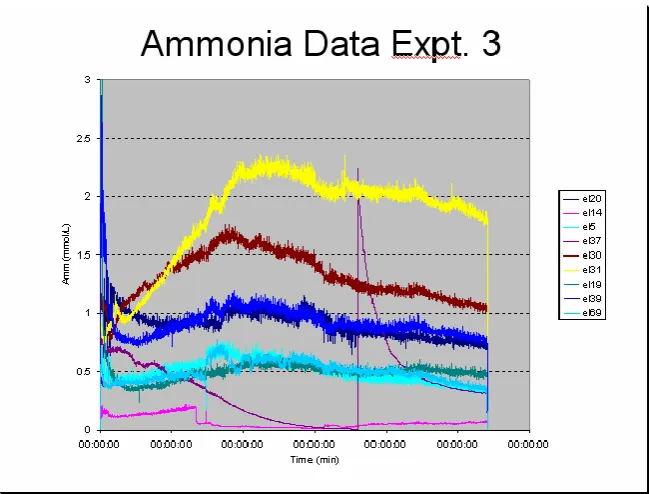
The slides projected during the monthly meetings and smaller, informal work gatherings
(as depicted in Figure 2) comprised another interesting boundary object. These meetings
usually involved sub-teams and individuals reporting separately on progress with their parts
of the bioreactor, but also on conferences, commercialization steps, or joint papers. These
interactions visibly switched gear when structured around a projected slide showing, for
example, the results of the groups’ experimental work on the bioreactor, with discussions
quickly becoming very focused and participative, as the following excerpt shows.
Figure 2 here
The junior bioengineer who has conducted the latest experiment with the bioreactor
is presenting the results standing near to the slide screen. After illustrating the results
of a failed experiment in which the cell culture was contaminated she puts up a new
slide (see Figure 2) and says:
Junior bioengineer: “But then we had the second set of data and unfortunately one of
these sensors went bad again for whatever reason. We’re not quite sure. You see this
weird trend. It just starts dropping (…)”
The ensuing activity aimed at interpreting the meaning of the “weird trend” is
conducted with people standing in turn and getting close to the screen. Point at the
projection they start generating, discussing, discarding or simply left hanging for
further consideration a number of working hypotheses:
Senior electronics specialist: “Is the process taking into account calibration?”
Senior sensor specialist: “(…) do you all smooth the raw voltage before you do that
conversion?”
Junior electronics specialist: “We do Y readings, right? “ (several talking at once)
Senior bioengineer: “Can you go back? This noise, are we sure this is noise?” (…)
The exchange is conducted like a nicely choreographed dance, with people
approaching the screen, pointing at the curve, and then going back to their seats.
The group, faced with an apparently inexplicable result (sudden drop of ammonia), used
the slide in a way analogous to the drawings and doodles used by the designers described by
Henderson (1991) and the architects studied by Ewenstein and Whyte (2009). Like the
professional model maker in Henderson’s account who “walks across the room to fetch a
drawing so that he can point to its various parts” (1991, p. 448), the scientists working on the
bioreactor used the projection to organize their collaborative discovery. This was made
possible by the tangibility of the object. Its material presence also helped to break up the
linear flow of the discussion (“Can you go back?”). The slide thus provided a means to
anchor or ‘reify’ (Wenger 1998) an agreed upon, albeit tentative, understanding. It not only
translated between the various ways of knowing of the specialists, but also acted as a
mnemonic device for the shared understanding developed in their earlier discussion around
the visual, being flexible enough to anchor and refer to the meanings developing within the
conversation and to allow for deliberations about future action and collaboration.
EPISTEMIC OBJECTS: COLLABORATION AS THE ORGANIZATION OF
DESIRE
While the notion of boundary object sheds light on the process of cross-disciplinary work, it
purpose, we can mobilize the idea of the epistemic object, originally introduced by
Rheinberger (1997) as an attempt to foreground the power of material objects (in contrast to
ideas or concepts) as driving forces in knowledge development. According to Rheinberger, an
object of investigation which is in the process of being materially defined functions as an
‘epistemic thing’. Epistemic things and objects embody what one does not yet know. They are
open-ended and work as a source of interest and motivation by virtue of their “opacity, their
surplus, their material transcendence”, which is “what arouses interest in them and keeps
them alive as targets of research” (Rheinberger 2005, p. 406).
This concept has been further developed by Knorr Cetina (1997; 1999), who explored
more deeply the power stemming from this particular category of objects. First, building on
psychoanalytical categories, she traced the source of this power to the dynamic of ‘wanting’
and lacks of fulfillment generated by the object. In simple terms, knowledge objects resemble
an open drawer filled with folders extending indefinitely (Knorr Cetina 1997, p. 12). It is this
lack of completeness that generates energy and emotional investment on part of the scientist.
The attempt to fill this void fuels the attachment for the object but also, paradoxically,
specifies ever further issues and lacks, so that the process is self fuelling. Second she argued
that epistemic objects, and the pattern of wanting they generate, keep together not only
individuals with their objects, but also collections of individuals.
How working on something that may never exist is a source of motivation
In our study we saw how the epistemic object could, in certain conditions, account for the
drive that kept the project team in motion. Consider, for example, the following snapshot:
"I follow S. through the lab while he is preparing the polymer he will use to build the
new prototype sensor. S. moves between the hood where he is cooking “a new batch”
and the experiment bench. I ask whether he is going to be here for long. He nods
this makes him frustrated. “I’ll be here as long as it needs. It might take several long
nights. It is between me and it now. No matter how long it takes” (From field notes).
This is a typical example of pulsion to know which is fuelled by the fact that it remains
largely unfulfilled (Knorr Cetina 1997, p. 22). We can assume that what drove the young
researcher to spend long hours in the lab was not only his (very low) remuneration or the
promise of a glowing academic career, but also the sense of lack produced by the unfinished
nature of the object. Unlike other material artifacts (e.g. pipettes, flasks), the epistemic object
(the possibility of a new sensor) triggered a form of desire and attachment which had a
libidinal, rather than calculative, origin. Such desire, however, was destined to remain
partially unfulfilled, as the final knowledge of sensors could never be fully attained. Any time
the researcher came closer to capturing it, he/she would articulate new possibilities, which in
turn extended the need to move forward. The researcher was thus caught in a self
perpetuating process of object-centered sociality based on the mutuality between object and
expert subject (Knorr Cetina 1997).
As Knorr-Cetina observed, emotional investment towards the epistemic object was not
limited to individuals but also operated as the engine of solidarity among groups of scientists
from different disciplines. Consider the following excerpts from one of the interviews:
“Things fell in place really in April. Sensors were working, M. and A. went to the
USA for the live demo of the bioreactor…and he won an award…We are riding high
on excitement in terms of the technical aspects that are working, but [we have a new
challenge] unless we show functionality, we would have ultimately failed...it’s the
whole thing we are presenting, not individual components…” (Senior researcher)
The bioreactor raised new questions while answering others so that the solidarity was
At the same time, blue sky talk and discussions about possible future applications were a
constant in most of the meetings. The researchers, in particular the Lead Investigator, often
talked about the next generation of reactors (“once we crack this one, we can move to a 3D
one”), new applications (“we could use the reactor to measure cow fertility …it is a big
market in the US”) and new challenges (“in terms of electronics the next step could be
miniaturization”). By prospecting a landscape of further puzzles and new possibilities for
future satisfaction, stemming from an object that had only partially revealed what it had to
offer, she attracted the attention of her colleagues and tried to foster closeness. He was, in a
real sense, organizing by desire - gelling the group by stimulating attachment and a desire to
know.
How the nature of the object induces different ways of working
A feature of the idea of epistemic objects, that is not central to boundary object theory, is that
it explains why solidarity happens, but also what form it may take. The idea here is that the
‘structure of wanting’ generated by the object is partially reflected in the organization of the
scientific practices that emerge around it. The incompleteness of the object described above
does not, in fact, simply occur or ‘turn up’. In modern society (both scientific research and
elsewhere) generating questions and trying to answer depends on a complex division of labor
and interdependencies. The emergence of an epistemic object introduces a form of a
collective obligation towards it - an emotional affiliation that becomes a morally binding
force among the co-researchers. Any infraction of the collaboration can now be subtly
construed as an infringement of the collective obligations towards the ‘structure of lacks’
displayed by the object. The object, in effect, turns a collection of researchers into a ‘proto
community’.
How such proto communities will be organized cannot be considered in isolation from
(in part) the differences she found between the ways of organizing scientific work in high
energy physics and molecular biology to the nature of their epistemic objects. She argues that
high energy physics is organized in terms of large, lengthy and complex experiments which
require collective activity among experts from different institutions. Molecular biology, in
contrast, is organized around physical laboratories in which individuals remain the central
epistemic subjects. These laboratories typically exhibit a hierarchical, ‘two level’ structure in
which a limited number of senior scientists oversee the work of a larger number of ‘junior’
colleagues working on individual projects. In contrast to members of high energy physics
projects, these researchers were connected either by being co-located or because they
provided each other assistance, and not because they co-produced knowledge.
Contemporary high energy physics is also characterized by a “negative, self referential
episteme built around sign systems”, while molecular biology “is orientated towards positive
knowledge build from the manipulation of objects in an experiential regime” (Knorr Cetina
1999, p. 80). These differences in the nature of the epistemic object and the practices of
knowing explain, she suggests, why high energy physics moved away from the “lab model”
and toward liberal circulation of knowledge, liquid social relationships, and an equalitarian
form of management driven by content and not by hierarchical positions. In this ‘post
communitarian’ sociality, where cognition is distributed and collaboration is the norm,
interaction is based neither on altruism nor commonality but, instead, on the requirements of
the object itself.
The same principle was operating in our study, although our analysis revealed an
interesting twist. First, the bioreactor project was run by a small group of ‘equals’ from three
different departments who contributed in an egalitarian manner. Second, there was a lot of
communication, with researchers visibly crossing disciplinary boundaries and working in
people to contact each other across departments to discuss how to interpret data. This is not,
according to Knorr Cetina, how molecular biologists usually act.
Things became clearer when we focused in on nature of the object, especially during the
monthly project meetings. All participants noted that these meetings were quite different
from other events. The crucial defining characteristic was that, instead of being (only) forums
in which people reported progress, showed off results, and fought for resources, they were
sites where actual cross-disciplinary work was accomplished. During each meeting there
were several moments in which the pattern of interaction shifted gears: existing disciplinary
barriers seemed to disappear and people asked open questions across occupational
boundaries. This change of gear consistently corresponded with the appearance of (a
representation of) the object – the presentation of slides - in the room. Consider how the
interaction around the ammonia slide (discussed above) continued:
Sen. bioengineer: “Can you go back? This noise, are we sure this is noise?”(…)
Sen. sensor specialist: “That’s what my question is, whether it was noise” (…)
Second sen. electronics specialist: “It’s not the electronics” (…)
Sen. sensor specialist: “So it’s clearly not the electronics, and the next question is, if
you had one of the sensors, back to when concentration wasn’t changing, you hoped,
would that show it?” (…)
Sen. bioengineer: “Can you go back again? Can I ask you something – we see in the
beginning, let’s take this one, the noise, would that correspond to the stability and the
longevity of the sensors? I tend to believe that this is noise” (…)
Second sen. electronics specialist: “Have you recorded which day of the week it is on
which place in the graph? (…) “We could say you expect funny things to happen on
Saturday and on Monday”.
Second sen. electronics specialist: “Power lines are changing. The noise environment
is changing. The electromagnetic environment is changing and so on. (…) There was
a famous case in the States. They built a wonderful system of gravitational detectors
and they had a positive reading for gravitational noise. It turned out it was one power
plant dropping off line. The signals arrived in the correct synchronizations and there
was a very sizable disturbance on all detectors”
In this example, the appearance of the epistemic object generated collective problem
solving sustained by discursive practices such as questioning, framing (i.e., connecting clues
in the light of others until the whole acquires some sense), probing, and telling ‘war stories’.
Although events like this are well documented (Orr 1996), they tend be reported within
established occupational communities where those interacting share a common background.
What was important in this cross-disciplinary context was that the apparent shift in patterns
of interacting could not be attributed to some form of pre-existing solidarity but was, instead,
induced by the object which infused energy and passion and participated in organizing the
interaction. None of the experts or sub-teams alone could make sense of what the object
threw at them. These molecular biologists were behaving like Knorr Cetina’s high energy
physicists because their epistemic object was of a similar nature - the scientists were not
discussing natural phenomena but representations, or an “order of signs” (Knorr Cetina 1997,
p.64). These were inherently ambiguous and in need of interpretation; the focus was on
understanding the “negative” (e.g. the limits of the machinery) as well as the positive (e.g. the
likely behavior of stem cells). Of course leadership skills, good intentions, egalitarian beliefs,
rational calculation, and unconscious drives were all at work. However, the pattern of
interaction among these experts could not be understood without making reference to their
object of work. In short, they felt like a community and worked as a community because of
ACTIVITY THEORY: COLLABORATING WHITOUT SHARING
A third way of explaining cross-disciplinary collaboration through objects is offered by
Cultural Historical Activity Theory, a tradition stemming from the work of Vygotsky and
Leont’ev (Engeström 1987; Kaptelinin and Nardi 2006; Leont’ev 1978). As with the
approaches above, this suggests that human activity is always object mediated in that it
depends on an array of cultural artifacts for its accomplishment (Engeström 1995; Leont’ev
1978). These artifacts enable purposeful action, connect agents to their social surroundings,
and embed into the activity the history that they embody. Activities are also oriented toward
an object. Objects are thus understood as “prospective outcomes that motivate and direct
activities, around which activities are coordinated, and in which activities are crystallized
(…) when the activities are complete” (Kaptelinin and Nardi 2006, p. 66).
According to Activity Theory, objects provide the direction, motivation and meaning for
the activity. In the words of Leont’ev “the object of an activity is its true motive” (Leont’ev
1978, p. 66). This is similar to the idea of epistemic objects. The proponents of this approach,
however, identify three additional characteristics of objects - their emergent, fragmented, and
constantly expanding nature - which shed further light on cross-disciplinary collaboration
(Engeström 1987; Miettinen and Virkkunen 2005). Objects are depicted, then, not only
instruments of translation (as per boundary objects) and sources of attraction (as per
epistemic objects), but also as triggers of contradictions and negotiation. Recognizing these
characteristics helps us to explain the potentially conflictual nature of collaborative activity.
The Emergent Nature of the Object of Work
Cultural Historical Activity Theory highlights, on the one hand, that collaborative activity
used, and the position and identity each member will assume all depend on the particular
object of work. On the other hand, the theory prescribes that such object is also the result of
the interests of the community that gathers around it (Miettinen and Virkkunen 2005). The
object is, in this sense, partly given and partly emergent; it is both projective (constructed
through the negotiation or ignoring of the different interests represented in the community)
and objective (instantiated in, and through, the product and services that are the outcomes of
the activity). Because of its material manifestation, the object can always retroact on the
community that generated it and ‘bite back’, as (Engeström and Blackler 2005) colorfully put
it.
Think, for example, about the patient as the object of work of different professionals in the
same hospital. Each of them will have a slightly different way of constructing the object of
their common activity: while for the surgeon the patient is a body to repair, the nurse will see
it as person to care, and the administrator as a client to charge (and satisfy). The organization
of care in the hospital (length of stay, for example) depends, in part, on how these different
views of the object are worked together. Dissatisfied patients may then, quite overtly, ‘bite
back’.
In the case of the bioreactor the projected shape of the final artifact and the composition of
the community that would pursue it emerged in the early phases of the project:
“… S. got an idea of what he wanted to do he asked around who was in a good
position for taking care of such aspect […] the “thing” kept on changing at every
round of mails […]” (Senior Researcher)
The functional complexity (Law 2002) of the artifact was thus directly linked to the division
of labor and the people it forced to collaborate. Each constituent group, however, retained its
collective object. This in turn affected both the imagined and the realized nature of the object
itself:
“The original target of the project was much more ambitious…Then the [funding
body] required that we reduce the scope and the money for the project…certain things
had to go…the partnership was thus remodeled accordingly […]” (Senior
Researcher)
The object of work could not, however, exist exclusively in the realm of imagination.
Rather it held different elements together because it was concretely present in the world. As
one of the researcher put it: “It was mostly after we had something concrete that we really
started working together”. The object of the activity was a moving target, reflecting the
historically embedded, and continuously evolving, practices and expectations of collaborating
scientists.
Community without Unity
Viewing the object from the perspective of Activity Theory suggests that it can be
regarded as a 'problem space' into which actors bring various skills and conceptual tools to
negotiate the object(ive). It follows that the object is necessarily partial - it is not visible in its
entirety to any one of the participants. At the same, because it is composed of heterogeneous
elements (each rooted in a different professional practice and discourse), the object is
inherently multiple and may hold together orientations, interests and interpretations that are
potentially contradictory (Miettinen 2005; Miettinen and Virkkunen 2005). Cultural
Historical Activity Theory highlights, then, that the socio-material community performed by
the object is not an integrated whole in which parts move in harmony but, rather, a
‘community without unity’ where contradictions and conflicts abound.
In the bioreactor case, one example of the contradictory nature of the object of activity
“We electronic engineers operate in terms of nanoseconds. You [biologists] work
with minutes, hours, and weeks. If you need [to gather data every so many] minutes
electronics is superfluous…or at least we have nowhere to publish our results”
(Electronics Engineer).
Here temporal misalignment became a problem for the electronic engineers in that the object
failed to serve one of the main interests of the group ("we cannot publish"). Differing
temporalities also became an issue when expectations and delivery times did not match. For
example, building, testing, and calibrating sensors followed a tempo which was at times
much longer than the pace of other disciplines, which created misunderstandings and
frictions.
A second type of contradiction, often apparent in cross-disciplinary work, came from the
tension between divergent interests. In the bioreactor project this was particularly evident
between academic and commercial interests. Commercial considerations were continually
introduced into the conversations around the bioreactor through references to potential
practical applications and marketability of the emerging object. This in turn created conflict
between the members in the group:
“They think about commercializing this product, but I am still in the stage of just
proving that the science is working and just to prove the concept that could be helpful
for this particular approach. I think that’s the difference” (Senior Researcher)
The constructed and realized nature of the object thus regulated the degree of involvement
of the partners to its joint creation, creating a community where some were more equal than
others. At the same time, the object, even when materialized, could hold diverging
interpretations that generated other types of conflict.
"We took a decision not to patent anything because we don't believe that any of the
that works, then there is a way to protect it and so forth, but the keyword is something
that works" (Senior Researcher)
In sum, viewing collaboration through the lens of Activity Theory highlights that the
object is not only in transition, it is also multiple, heterogeneous and potentially conflictual
(Law 2002). The mutuality performed by the object is thus far from a smooth fusion of
intents and goals - an ideal that underpins many models of collaboration. It is important to
add, however, that the contradictions generated by the fragmented nature of the object are not
necessarily barriers to collaboration but also opportunities for innovation. This because, when
surfaced, they can trigger ‘expansive’ learning (Engeström 1987). For example, the conflict
emerging from the temporal misalignment between disciplines, outlined above, resulted in
the enrolment of a new member in the project. The enlargement of the team, in turn, triggered
a reshuffling in the division of labor and a redefinition of the identities of the members in the
sensor group as well as the nature of the reactor (the expert had slightly different ideas on
which type of sensors to use). As the newcomer was a very senior researcher, the existing
sensor expert automatically became relatively junior, also creating the conditions for new
issues to emerge. The contradictions stemming from the complex nature of the object
became, then, an inexhaustible source of change which kept the socio-technical whole in
constant motion.
THE MATERIAL INFRASTRUCTURE OF COLLABORATION
The three theories discussed above foreground a number of important and, at times, critical
ways in which objects enable and sustain cross-disciplinary work. It should be added,
however, that only rarely do objects take centre stage in discussion. Most of the time, in fact,
“M. enters the small room she shares with another researcher. She quickly checks her
emails efficiently opening and closing several messages. She finally slows down to
read one of them. She then turns towards me. With her usual patient smile she
announces: “This is from S. Something came up…The meeting has been postponed by
two hours. I have to tell all the other people…sorry” . She then reaches for a piece of
paper hanging on the side of her computer screen. This is a phone list of all the
members of the team. Holding it in front of her, she picks up the computer and smiling
again she tells me “I will call A. first…she is the only one usually on time…I need to
catch her before she leaves the lab…”(From field notes)
Think of the humble “phone number list” in this example. It is not certainly a major
motivational factor; neither has it inspired any significant boundary spanning. Yet, without it,
collaboration would be much more difficult. Taken alone it seems insignificant; but when
considered as a part of the complex ecology of objects that supports the daily work of the
group (including email and telephone), its work becomes more apparent. Orlikowski (2007)
uses the term ‘scaffolding’ to describe the work of this ecology of mundane objects, or the
‘stuff’ of everyday life. Recognising limitations of the scaffolding metaphor (Swan 2006), we
prefer to use the term ‘material infrastructure’ (after Star and Ruhleder 1996).
Star and Ruhleder (1996) make a case for a broad understanding of the notion of
infrastructure as any web of objects “that emerges for people in practice” and allows them “to
resolve the tension between local and global” (p.112). In their view, “an infrastructure occurs
when local practices are afforded by a larger-scale technology, which can be used in a
natural, ready-to-hand fashion” (ibid.) Accordingly, assemblages of objects become
infrastructures in relation to specific organised practices. Infrastructures are not external to
practice - they are never “already there” ready to be used - but are a way of looking at certain
not what is an infrastructure” (p.113). All types of objects can potentially become
infrastructure. As such, they are ‘black-boxed’ or invisible at one moment, but can become
the very topic of an activity at a different time. For example, the computer system used to
support the circulation of emails in our case, until a decade ago was the focus of the attention
of scores of researchers, practitioners, and organizations.
The perceived stability of infrastructure is, therefore, only an optical effect due to the
fact that infrastructures are embedded and “sunk into, inside of, other structures, rather like
Russian dolls (Star and Ruhleder, 1996, p.113). In the example above we fore-grounded the
computer but we took the electric power it uses for granted. The more ‘sunk in’ is an
infrastructure, the more we tend to consider it stable. For this reason some authors propose a
distinction between universal service infrastructures and work oriented situated
infrastructures (Hanseth and Lundberg, 2001). The former provide (in principle) services to
all citizens, while the latter are developed to support specific work tasks and work practices
(p. 365). This distinction can be fruitfully used as an analytical tool to distinguish between
the mundane objects that support cross-disciplinary collaboration in our case study, as
illustrated next.
The work oriented infrastructure
All forms collaborations need to be set up in the first place. We are very used to describing
this aspect of collaboration in terms of human agents (leaders, projects managers and the like)
and forget that objects also play an active role. For example, when asked how the project
came about, the senior investigators invoked first a canonical “intersubjective” explanation:
“We had individual working relationships. C. and M. had worked together. T. and C.
had worked together. So … we had these meetings all in a group, trying to come up
On closer inspection, however, the process was heavily supported by a complex array of
material artefacts:
“I didn’t know S. before. I had heard of him but I never met him in person. I was
involved via email. All the initial exchanges were conducted via email…He circulated
a high level proposal and then asked each of the teams to fill in the gaps...each one
had to write their own bit… I believe we had a meeting only very late, to ensure that
the whole thing looked like a project and not like pieces assembled together…which
is very often what happens in multidisciplinary meetings…” (Senior investigator)
The story here is one of interobjectivity. The collaboration was effectively structured
through the circulation of a document (the project proposal). This material object operated as
an intermediary which translated and aligned different interests (Latour, 2005). “Filling the
gaps” in this document, as the informant put it, helped in aligning competencies and
stabilising reciprocal roles in an exercise of mutual enrolment. When sent to the Funding
body, the document cemented the collaboration, entangling the mutual commitment in a
further web of material implications that would make dissolving the partnership much harder
than had it been based on a verbal agreement only.
A number of other, equally invisible things supported and facilitated collective work
once the project was set up. For example, the senior researchers talked about the need and
importance of establishing a “project repository”. However, one of the junior researchers was
more sceptical:
“ yeah, they talk about this project repository all the time…but I do not think it will
happen…to stay in touch we use mostly email…see (she says pointing at the screen of
her computer to the folder with all the emails she received from others) we work
This extract shows how the email system actively, albeit silently, supported cross-disciplinary
collaboration. It should be added that their being an infrastructure is not a quality of the
object per se but a relational property emerging from the specific practice. That emails have
become a situated infrastructure for this group, becoming deeply entangled in their practices
of collaboration, does not imply that this is the case for all forms of collaboration.
The service infrastructure
The array of work-oriented objects discussed above are also nested within, and built upon, a
further set of “sunk in” infrastructural arrangements – what Hanseth and Lundberg (2001)
call the universal service infrastructure. These arrangements (e.g., the power grid that
provides the electricity) are further removed, taken for granted, and learned as part of
membership. For this reason, in normal conditions the infrastructure tends to become
“invisible” (Star and Ruhleder, 1996). Consider the following example, derived from our
fieldwork:
“The meeting is taking place is a lecture theatre as the usual meeting room is now
busy [the meeting has been postponed]. The members of the team are sitting scattered
across several of the long rows of desks. They struggle to face each other turning
uncomfortably on the chairs which rigidly face the blackboard at the bottom. A. has
brought the first prototype of the new sensor. The small object is passed from hand to
hand while A. explains the challenges she faces. People have to stand up and carry
the object around to the other members. A. has to stop several times. One of the
participants as to ask her twice to repeat what she says as he was busy circulating the
artefact. One of the members of the team whispers to me “I hate this room…it is so
much easier to work upstairs [in the meeting room where the group usually meets].