Original citation:
Hu, Xiao-Bing, Wang, Ming-Shou , Leeson, Mark S., Di Paolo, Ezequiel A. and Liu, Hao. (2015)
A deterministic agent-based path optimization method by mimicking the spreading of
ripples. Evolutionary Computation, 24 (2). pp. 319-346.
Permanent WRAP URL:
http://wrap.warwick.ac.uk/69625
Copyright and reuse:
The Warwick Research Archive Portal (WRAP) makes this work of researchers of the
University of Warwick available open access under the following conditions.
This article is made available under the Creative Commons Attribution 3.0 (CC BY 3.0) license
and may be reused according to the conditions of the license. For more details see:
http://creativecommons.org/licenses/by/3.0/
A note on versions:
The version presented in WRAP is the published version, or, version of record, and may be
cited as it appears here.
Xiao-Bing Hu
dr [email protected] State Key Laboratory of Earth Surface Processes and Resource Ecology,Beijing Normal University, Beijing, 100875, China; School of Engineering, University of Warwick, Coventry, CV4 7AL, UK
Ming Wang
[email protected]State Key Laboratory of Earth Surface Processes and Resource Ecology, Beijing Normal University, Beijing, 100875, China
Mark S. Leeson
[email protected]School of Engineering, University of Warwick, Coventry, CV4 7AL, UK
Ezequiel A. Di Paolo
[email protected]Ikerbasque, Basque Science Foundation, Centre for Research on Life,
Mind and Society, University of the Basque Country, San Sebastian, 20080, Spain
Hao Liu
[email protected]Beijing Metropolitan Traffic Information Center, Beijing, 100161, China
doi:10.1162/EVCO_a_00156
Abstract
Inspirations from nature have contributed fundamentally to the development of evo-lutionary computation. Learning from the natural ripple-spreading phenomenon, this article proposes a novel ripple-spreading algorithm (RSA) for the path optimization problem (POP). In nature, a ripple spreads at a constant speed in all directions, and the node closest to the source is the first to be reached. This very simple principle forms the foundation of the proposed RSA. In contrast to most deterministic top-down central-ized path optimization methods, such as Dijkstra’s algorithm, the RSA is a bottom-up decentralized agent-based simulation model. Moreover, it is distinguished from other agent-based algorithms, such as genetic algorithms and ant colony optimization, by being a deterministic method that can always guarantee the global optimal solution with very good scalability. Here, the RSA is specifically applied to four different POPs. The comparative simulation results illustrate the advantages of the RSA in terms of effectiveness and efficiency. Thanks to the agent-based and deterministic features, the RSA opens new opportunities to attack some problems, such as calculating the exact complete Pareto front in multiobjective optimization and determining thekth shortest project time in project management, which are very difficult, if not impossible, for existing methods to resolve. The ripple-spreading optimization principle and the new distinguishing features and capacities of the RSA enrich the theoretical foundations of evolutionary computation.
Keywords
Agent-based model, deterministic algorithms, ripple-spreading algorithm, path opti-mization.
Manuscript received: November 14, 2013; revised: October 14, 2014, February 6, 2015, and April 21, 2015; accepted: April 27, 2015.
1
Introduction
Learning from nature is a foundation of evolutionary computation (EC) because many successful EC methods are actually inspired by certain natural systems or phenomena (Holland, 1975; Russell and Norvig, 2010; B¨ack et al., 1997). For instance, genetic al-gorithms (GAs) are inspired by natural selection and evolutionary processes, artificial neural networks by the animal brain, particle swarm optimization (PSO) by the learning behavior within a population, and ant colony optimization (ACO) by the foraging be-havior of ants. This paper aims to investigate the optimization principle reflected by the natural ripple-spreading phenomenon, which may add fundamentally new elements to the study of EC.
We have reported on ripple-spreading models and algorithms for a wide range of problems and applications (Hu et al., 2011; Liao et al., 2013; Hu and Di Paolo, 2011; Hu et al., 2010). The motivation of these has been to take inspiration from the natural ripple-spreading phenomenon to study and resolve a variety of optimization problems in daily life. The basic hypothesis behind the ripple-spreading models and algorithms is the following. Ripple spreading reflects certain fundamental organizing principles in nature, and such principles are to be found in many systems and problems around us. Taking this inspiration when developing models and algorithms in the study of such scenarios, we are likely to better match or reflect the embedded organizing system principles, and therefore generate more effective solutions.
For instance, a theoretical ripple-spreading model for complex networks was pro-posed to study the spreading influence of local events in many real-world complex systems (Hu et al., 2011). The model was then successfully applied to simulate epi-demic dynamics (Liao et al., 2013). The natural ripple-spreading phenomenon can also help to design algorithms to solve complex optimization problems, such as aircraft sequencing and network coding problems (Hu et al., 2011; Hu and Di Paolo, 2011). In these algorithms, a problem-dependent ripple-spreading process is integrated with a GA, in order to improve the overall optimization performance.
This paper is particularly concerned with a fundamental question for the study of ripple-spreading models and algorithms: Does the natural ripple-spreading phe-nomenon also reflect certain optimization principles? Put another way, can we develop an optimization algorithm that has nothing to do with GAs or any other optimization algorithm but is purely based on mimicking the natural ripple-spreading phenomenon? So far the optimization aspect of ripple-spreading models and algorithms has been pro-vided by a GA (Hu et al., 2011; Liao et al., 2013; Hu and Di Paolo, 2011; Hu et al., 2010). This paper shows that the ripple-spreading phenomenon itself reflects an optimization principle. A ripple spreads out at the same speed in all directions, and therefore it al-ways reaches spatial points in order according to the distance from the ripple epicenter, i.e., it always reaches the closest point first.
the introduction of the ripple-spreading process in the RSA makes all the difference. In fact, the RSA resembles a bottom-up decentralized agent-based simulation model rather than a top-down centralized optimization algorithm, and therefore belongs to the family of EC, but the output of the model is deterministically the optimal solution thanks to the natural optimization principle simulated. Because of the agent-based and deterministic features, the RSA opens new opportunities to address some problems, such as the calculation of the exact complete Pareto front and the determination of thekth shortest project times, which are very difficult, if not impossible, for existing methods to resolve.
The remainder of this paper is organized as follows. Section 2 explains the POP and reviews existing methods. Section 3 describes the proposed RSA. Section 4 gives theoretical analyses of some important properties of the new method, and Section 5 gives some simulation results. The paper ends with conclusions and discussion of future work.
2
Path Optimization Problem and Existing Algorithms
2.1 Problem Description of POPs
The POP is a classical optimization problem and has a very wide set of realistic appli-cations such as in transportation systems, communication systems, Internet protocols, logistic optimization, process planning, and job scheduling (Fu et al., 2006). This study investigates four POPs: one-to-one POP, one-to-all POP, many-to-many POP, and thek shortest paths problem (k-SPP). A general mathematical description of a POP is given here. The POP aims to find the best route through a given route network, so as to travel from source to destination or connect them most efficiently in terms of some specific considerations. Let us assume that a route networkG(V,E) is composed of node setV and connection setE.VhasNNdifferent nodes, including the source and the destination, and then this route network can be recorded as anNN×NN adjacency matrixA. The
matrix entryA(i, j)>0,i=1, . . . , NN andj =1, . . . , NN, means there is a connection,
i.e., a direct route from nodeito nodej. Otherwise,A(i, j)=0 means no direct route, and it is assumed thatA(i, i)=0, i.e., no self-connecting route is allowed. The nonzero value of matrix entryA(i,j) usually has a particular meaning. For instance, in the tradi-tional POP,A(i,j) is the physical route length, but actually it can be defined as anything, such as traveling time or fuel consumption. Therefore, for the sake of generality, here we define the meaning of the nonzero entry value as routecostrather than routelength. First we consider the one-to-one POP, where two different nodes in the route net-work are specified as source and destination, respectively. A feasible route connecting the source and destination can be denoted as an integer vector R. The value of each vector entryR(i) is the serial number of the associated node, wherei=1, . . . , NL, and
NL≥2 indicate how many nodes are included in this route.R(1) is the source andR(NL)
is the destination, and the cost of routeRis
f(R)=
NL−1
i=1
A(R(i), R(i+1)). (1)
Now we can mathematically describe the one-to-one POP as the following mini-mization problem:
min
R∈Rf(R), (2)
whereR is the set of all feasible routes connecting the source and destination. In this
ifi=j,i=1, . . . , NL, andj =1, . . . , NL; and (2) two successive nodes in a route must
have a connection between them, i.e.,A(R(i), R(i+1))>0.
The one-to-all POP can be viewed as a set of (NN−1) one-to-one POPs. In the
one-to-all POP, a source node is specified, and then for every other node in the route network, we need to find the shortest path to the source. Let nodenSbe the specified source node, and nodenDbe the current destination node. Then the one-to-all POP can
be formulated as
nD=1,...,NN,nD=ns
min
R∈Rf(R). (3)
The many-to-many POP has a set of source nodes as well as a set of destination nodes, and its goal is, for every source node, to find the associated shortest path con-necting to one node, it does not matter which one, in the destination set (Drezner et al., 2002; Gastner and Newman, 2006; Yan et al., 2011). Let SN and DN be the sets of
source nodes and destination nodes, respectively. If noden∈SN, thenn /∈DN. The
mathematical formulation of many-to-many POP is as follows:
nS∈SN
min
R∈R,nD∈DN
f(R). (4)
In the kshortest paths problem (k-SPP) (Yen, 1971; Eppstein, 1998; Aljazzar and Leue, 2011), for a given pair of source nodenSand destination nodenD, we need to find kroutesR1∗, . . . , Rk∗, such that
f(R∗i)≤f(R),for anyR ∈R− {R∗1, . . . , R∗i}, i∈ {1, . . . , k}. (5)
2.2 Review of Existing Algorithms for POPs
Existing methods for the POP can be classified into two categories: stochastic and de-terministic. The former, such as EC, are often confronted with optimality and scalability problems (Holland, 1975; Russell and Norvig, 2010) and therefore are not practicably popular in real-world POP applications (the goal of proposing the RSA in this article as a new EC method is to change this situation). Since the RSA can always guarantee opti-mality and has a very good scalability, we compare it with other methods that can also guarantee optimality with good scalability. Therefore in this study we ignore stochastic search methods and only compare it with deterministic search methods, which ex-hibit much better performance in terms of both optimality and scalability, and therefore dominate real-world POP applications. Simply speaking, a deterministic search method organizes its search operations according to a certain specific rule, and as a result, for a given route network, the method outputs a unique repeatable solution (the solution given by a stochastic search method is rarely repeatable). The three most popular rules adopted in a deterministic search method are breadth-first search, depth-first search, and best-first search.
evaluation rule or function that attempts to predict how close the end of a route is to the destination (Russell and Norvig, 2010; Pearl, 1984). Both breadth-first search and depth-first search are complete but often with a poor scalability. Therefore, limits on search depth or width may be introduced and may then cause optimality to be lost. Best-first search cannot guarantee optimality if the heuristic evaluation rule/function is not properly chosen.
One of the most acknowledged best-first search methods is theA∗ algorithm, be-cause it is optimally efficient for any heuristic evaluation function, meaning that no algorithm employing the same heuristic function will expand fewer nodes than A∗
(Hart et al., 1968; Dechter and Pearl, 1985; Hart et al., 1972; Korf et al., 2001). If the heuristic function is admissible, meaning that it never overestimates the actual minimal cost of reaching the destination, thenA∗is itself optimal if we do not use a closed set. If a closed set is used, then the heuristic function must also be monotonic (or consistent) for A∗ to be optimal (Dechter and Pearl, 1985). However, sometimes it is difficult to find an admissible heuristic function to guarantee optimality, for example, in the case of randomly weighted route networks.
To search general weighted route networks, uniform-cost search is probably the best method to date. Typically, the search algorithm involves expanding nodes by adding all unexpanded neighboring nodes that are connected by direct connection to the set of visited nodes. The uniform-cost search is complete and optimal if the cost of each step exceeds some positive bound (Russell and Norvig, 2010). Dijkstra’s algorithm, which is perhaps better known, can be regarded as a variant of uniform-cost search, where there is no goal state and processing continues until all nodes have been removed from the priority queue, i.e., until shortest paths to all nodes (not just a goal node) have been determined (Dijkstra, 1959; Misa and Frana, 2010; Sniedovich, 2006). Dijkstra’s algorithm does not use any heuristic function and can be viewed as a special case ofA∗
where the heuristic function is the constant zero.
These deterministic search methods were originally proposed predominantly for the one-to-one POP and then were widely extended to resolve all kinds of POPs. For instance, Dijkstra’s algorithm can apply to the one-to-all POP and many-to-many POP in an almost straightforward manner. For thek-SPP, as reviewed by Mohanta and Pod-dar (2012), the most popular methodology is to find the first shortest route and let
i=1; remove from the original route network each combination of those connections that appear in the firstishortest routes, and find the first shortest route in the recon-structed route network; the shortest one in all such new first shortest routes is the (i+1)th shortest route; increment i=i+1, and repeat reconstructing the route net-work and calculating the associated first shortest route, untili=k. Any method that can resolve the one-to-one POP can be employed in thek-SPP, and the focus often shifts to reconstructing route networks (Yen, 1971; Eppstein, 1998; Aljazzar and Leue, 2011).
3
Ripple-Spreading Algorithm
3.1 Optimization Principle of the RSA
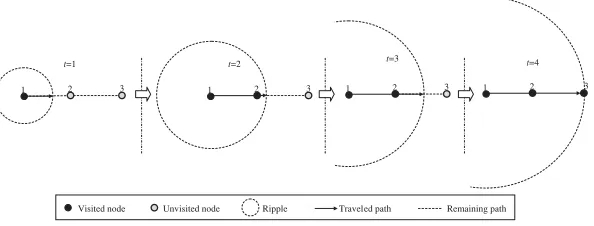
Figure 1: Basic idea of the RSA.
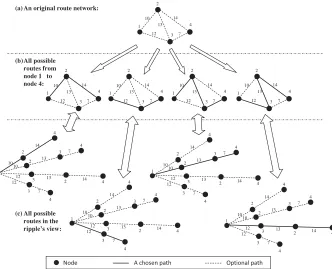
[image:7.504.106.403.292.405.2]Figure 2: Ripple spreading is a very natural process to find the shortest route.
Now we examine why a ripple can find the shortest route through a network. For the sake of simplicity, we assume there is a route network as shown in Figure 2a, with source node 1 and destination node 4. As shown in Figure 2b, there are four possible zigzag routes to travel from node 1 to node 4. From the ripple’s view point, a zigzag route is no different from a straight-line route, as long as they are of the same length. Therefore, the four possible zigzag routes in Figure 2b are actually equivalent to four straight-line routes that radiate out from node 1 in four different directions, as shown in Figure 2c. The four straight-line routes in Figure 2c end at four different spatial points, which actually stand for the same node in the route network, i.e., node 4. Now, one can see that the problem of searching for the shortest zigzag route in the route network Figure 2a becomes a new problem of finding the straight-line route in Figure 2c so that a ripple reaches the end at the earliest time. Because of the optimization principle in the natural ripple-spreading phenomenon, we know that such a straight-line route corresponds to the shortest zigzag route in the original route network.
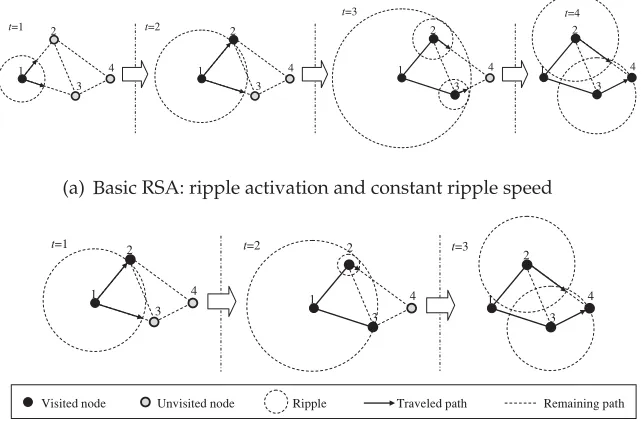
Figure 3: Two different RSAs.
3.2 RSA for One-to-One POP
In this section we only consider the one-to-one POP. We develop the first RSA by implementing both ripple spreading from nodes and ripple activation between nodes. Simply speaking, this resembles a relay race between ripples of nodes, as illustrated in Figure 3a. The first ripple starts from the source, i.e., node 1. When a ripple reaches a directly connected but unvisited node, that new node is activated to generate its own ripple. When all of those nodes that are directly connected to the epicenter node of a ripple are visited (not necessarily by the same ripple), that ripple then stops and is eliminated. When the destination node, i.e., nodeNN, is visited for the first time, the relay race is done. During the entire process, all ripples always travel at the same preset constant speed. This basic RSA can be mathematically described as follows. For the sake of simplicity but without losing generality, we assume hereafter that in a one-to-one POP, the source and the destination are always node 1 and nodeNN, respectively. In the relay race, each node has a ripple, and the ripple of node i is called ripplei. Let FR(i)=j >0 mean that ripple ihas been activated by ripple j. Let rR(i) denote
the current radius of ripplei. LetI ARandAR denote the sets of inactive and active
ripples, respectively.
Step 1 Choose a constant ripple-spreading speeds. InitializeFR(i)=0, andrR(i)=
0,i=1, . . . , NN. InitializeI AR= {1, . . . , NN}, andAR= ∅. Let the current
time bet =0.
Step 2 SetFR(1)=1. LetI AR=I AR− {1}, andAR =AR+ {1}.
Step 3 IfFR(NN)=0, do:
Step 3.2 For anyi∈AR, letrR(i)=rR(i)+s. If (A(i, j)>0) and (j ∈I AR)
and (rR(i)≥A(i, j)) and
(rR(j)≤rR(i)−A(i, j)), (6)
then letrR(j)=rR(i)−A(i, j), andFR(j)=i.
Step 3.3 For any ripple j that has just had its radius updated in step 3.2 during the current timet, letAR=AR+ {j}, andI AR=I AR−
{j}.
Step 3.4 For anyi∈AR, ifFR(j)>0 for everyjwithA(i, j)>0, then let
AR =AR− {i}.
Step 4 The best route is determined by tracking back fromFR(NN), as
R(i)=
NN, ifi=NL
FR(R(i+1)), ifi < NL
, (7)
and the associated total route cost is
CR =
NL−1
i=1
A(R(i), R(i+1)). (8)
For the sake of optimality, the speed in step 1 must satisfy
0< s≤amin, (9)
whereaminis the minimal cost associated with the connections (see Section 4). Step 2 starts the first ripple from the source, and this is a self-generated ripple asFR(1)=1. The
loop of step 3 repeats until the destination, i.e., nodeNN, has been reached by a ripple. Step 3.1 lets time elapse for one time unit. Step 3.2 first increases the radius of each active ripple iby the ripple-spreading speeds. Then, step 3.2 checks whether ripples iarrive at those nodes, represented byj, that connect to nodeiand whose ripples are currently inactive. If node jis reached by ripplei, then step 3.2 updates the radius of ripplej, and records that ripplejhas been activated by ripplei. It should be noted that, assuming nodejhas not been reached by timet−1, then nodejcould be reached by several ripples during the current timet. In such a case, Eq. (6) in step 3.2 guarantees that the ripple that arrives at nodejfirst eventually is used to setrR(j) andFR(j). After
all currently active ripples have been processed in step 3.2, step 3.3 updates the sets of active and inactive ripples according to newly activated ripples in step 3.2, and step 3.4 removes any active ripple whose connected nodes have all been reached.
Note that ifsamin, then step 3 may be repeated many times without any new
node being reached, which will diminish the computational efficiency of the basic RSA. Therefore, the best way is to simply set s=amin. However, even with an s=amin, if
aminis far smaller than route costs of most connections, it is still likely that the step 3 will be repeated many times before reaching a new node. Therefore, to improve the computational efficiency of the basic RSA, we can adopt a variable ripple-spreading speed and get an improved RSA, as follows.
Step 1 InitializeFR(i),rR(i),I AR,AR, andt, as in the basic RSA.
Step 2 Set the current ripple-spreading speed ass=min(A(1, j)) for anyA(1, j)>
0. LetFR(1)=1. UpdateI ARandARaccordingly, as in the basic RSA.
Step 3.1 Lett=t+1. Set a temporary speedsT = ∞.
Step 3.2 For anyi∈AR, letrR(i)=rR(i)+s, and updaterR(j) andFR(j)
as per the basic RSA. Also, in order to guarantee that at least one unvisited node will be reached by a ripple during next time instant
t+1, update the temporary speedsTas follows. If (A(i, j)>0) and (rR(i)< A(i, j)) and (sT > A(i, j)−rR(i)), let sT =A(i, j)−rR(i).
Otherwise, if (A(i, j)>0) and (rR(i)=A(i, j)) and (sT> min(A(j, k))
for anyA(j, k)>0 andk=i), letsT =min(A(j, k)).
Step 3.3 As per the basic RSA, updateI ARandARbased on the result of
step 3.2.
Step 3.4 Update the speed for next time instant:s=sT.
Step 4 Determine the best route according to Eqs.(7) and (8).
In this improved RSA, one can see that the ripple-spreading speedschanges from time to time, so that at every time instant, at least one unvisited node is reached by a ripple. The improved RSA is illustrated in Figure 3b. Compared to Figure 3a, the basic RSA takes 4 time units to reach the destination, while the improved RSA takes only 3 time units. At the time instantt=3 in Figure 3a, no new node is reached by either ripple, which means this is purely a ripple-spreading step and no actual searching work is done. Obviously, this purely ripple-spreading step diminishes the computational efficiency of the basic RSA. Thanks to variable speed, there is no purely ripple-spreading step in the improved RSA. As a result, the improved RSA may gain some computational efficiency versus the basic RSA with constant ripple-spreading speed.
From step 3.2 one can see that although the ripple speed varies from time to time, all ripples spread at the same speedsduring a time instant. This fact guarantees the op-timality of the improved RSA, i.e., the best route is always determined by backtracking from the ripple that reaches the destination first.
In the basic RSA and the improved RSA, each node can be viewed as an agent. We only need to define how a node should behave in terms of generating and spreading its own ripple, and do not need to do any route search (e.g., calculating the current route length from the source to an intermediate node, or comparing and sorting intermediate nodes according to their current route lengths), and the optimal route will automatically emerge as the result of the ripple relay race between nodes. This is exactly what an agent-based model does: agents behave independently of the model’s purpose, and then the collective effect of all of their behaviors rather surprisingly assists the specific purpose.
3.3 Extending RSA to Other POPs
First we apply the RSA concept to the one-to-all POP. Actually, we do not need to make any modification to the two RSAs in Section 3.2, except changing the termination criterion of step 3 to the following.
Step 3 If there is at least one node that has not been reached by any ripple, then perform step 3.1 to step 3.4.
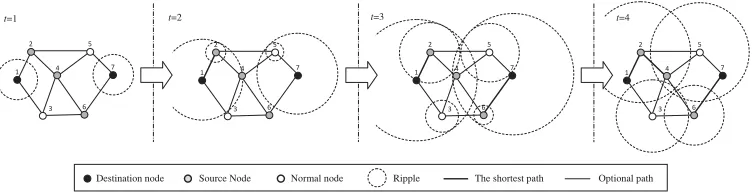
Figure 4: RSA for the many-to-many POP.
which reveals that the shortest route from node 1 to node 2 is the direct connection between them. Node 3 has been reached at timet=3, which implies that the shortest route from node 1 to node 3 is the associated direct connection. At timet =4, the ripple of node 3 has reached node 4, which determines that shortest route from node 1 to node 4 is 1→3→4. Now it is clear that the shortest routes from node 1 to all other nodes have been identified by simulating a ripple-spreading process.
In both the one-to-one POP and the one-to-all POP, there is only one source. There-fore, at the beginning of the ripple relay race, i.e., in step 2, only one initial ripple is activated at the source. To extend to the many-to-many POP, we simply need to activate initial ripples at all sources simultaneously to start the ripple relay race. Actually, for the sake of convenience from the viewpoint of algorithm design, in the RSA for the many-to-many POP, we reverse destinations and sources. In other words, we start the ripple relay race from destination nodes, and stop the simulation once every source has been reached by at least one ripple. In the many-to-many POP, every source must travel to at least one destination, whilst a destination may connect to no source through the shortest routes. Therefore, reversing destinations and sources makes it much easier and more efficient to check whether the termination criterion is satisfied.
Figure 5: Ripple relay race to identify thekshortest paths.
(see Section 5), this parallel computing capability gives the proposed RSA significant computational efficiency.
So far in the simulation of ripple relay races, each node can be triggered to generate no more than one ripple, which is enough for finding the first shortest route. To extend the RSA to thek-SPP, i.e., to find thekshortest paths, we need to allow every node to be able to generate multiple ripples (Hu et al., 2013b). Actually, it is straightforward to extend the optimization principle in the natural ripple-spreading phenomenon to the k-SPP. A ripple travels at the same speed in all directions, so it reaches spatial points in order according to their distances to the ripple epicenter, i.e., the closest spatial point is the first to be reached by the ripple, and thekth closest spatial point is thekth to be reached. In the simulation of a ripple relay race where each node may generate multiple ripples, once a ripple reaches a node (not the destination), no matter whether the node has already generated any ripples, a new ripple will be generated at the node. Then, in a similar fashion as in the basic RSA for the one-to-one POP, assuming a ripple of node ireaches nodej, the new ripple will spread along all connections of nodejexcept the connection between nodeiand nodej. The ripple will die when it has reached all nodes (except nodei) connected to nodej. If two ripples arrive at the same node at the same time, then two new ripples will be triggered at the node with exactly the same radius.
t =4, identifying the second shortest path 1→3→4. During time instantt =4, ripple 2 also triggers ripple 4 at node 2, and ripple 3 triggers ripple 5 at node 3. At timet =5, ripple 4 reaches the destination, discovering the third shortest path 1→3→2→4. At timet =6, ripple 5 reaches the destination, finding the worst path 1→2→3→4. From Figure 5, one can see clearly that we do not need to reconstruct any route network, as we never use thekbest routes to calculate the (k+1)th best route. This feature of the RSA distinguishes it from most existing methods for thek-SPP.
Although this paper only focuses on the four mentioned POPs, the potential of the RSA does not stop there. In fact, it opens up new opportunities to attack problems that existing methods can barely resolve. From the algorithms reported here, one can see that the key to extending the RSA to a new problem is to define problem-specific ripple-spreading behavior for agents. Hu et al. (2013b) applied the RSA to find thekth shortest project time in project management. Thekth shortest project time problem is superficially similar to thek-SPP, but actually existingk-SPP methods are not applicable because a project activity often has to wait to start until some other relevant project activities have progressed to certain stage (e.g., 50% completed). This means that a node may not be accessible even though it is physically connected to the end of the current path. When a node becomes accessible depends wholly on some other relevant nodes’ accessibility, and it is very likely that such other relevant nodes are not included in the current path. Therefore, traditional top-down centralizedk-SPP algorithms can really help little. As a bottom-up decentralized agent-based simulation model, the RSA can address the node accessibility issue in a very straightforward way, i.e., by simply modifying the node behavior in the RSA for the k-SPP as follows. A node cannot generate its own ripples until it has been reached by the first ripple of each of those relevant nodes. Then the deterministic feature of the RSA guarantees that thekth shortest project time will be found. The capability to find the generalkth best solution sheds a little light on another problem that used to look impossible: calculating the exact complete Pareto front for discrete multiobjective problems (MOPs) (Hu et al., 2013a) rather than just finding an approximation, which still dominates MOP practices (Deb et al., 2002; Knowles and Corne, 2000).
4
Theoretical Analyses of the RSA
For the sake of simplicity, our discussion in this section focuses mainly on the RSA for the one-to-one POP, which may serve as a guideline to analyze future developments in RSA.
4.1 Completeness of the RSA
4.2 Optimality of RSA
First, let us examine how the optimization principle of the natural ripple-spreading phenomenon can guarantee the global optimal solution.
THEOREM1:In the RSA, the best route is the route traveled by the first ripple that reaches the destination.
PROOF: Assume Theorem 1 is false, in other words, there exists another route that is better but takes more time to reach the destination. Now, suppose the first ripple that reaches the destination takesT1time units, and the cost of the route it travels along is f(R1). There is another ripple that reaches the destination at time instantT2> T1, and the associated route cost isf(R2)< f(R1).
In the RSA, all ripples travel at the same cost speed during a given time instant. Let
s(t)>0 be the ripple speed of time instantt,t=1, . . . , T2. Because each time instant is a time unit in the RSA, then
f(R1)=
T1
t=1
s(t), f(R2)=
T2
t=1
s(t). (10)
If Theorem 1 is false, then one has f(R2)< f(R1), i.e.,f(R2)−f(R1)<0, which means
f(R2)−f(R1)=
T2
t=T1+1
s(t)<0. (11)
However, this is impossible because the ripple speeds(t) is always positive. There-fore, Theorem 1 must be true.
Clearly, Theorem 1 is also the theoretical statement of the optimization principle of the natural ripple-spreading phenomenon. As mentioned in Section 3.2, the basic RSA may lose optimality if the speed does not satisfy Condition (9) due to the overtraveling problem. Here we give the theoretical analysis. Consider a general scenario as follows. Suppose that at time instantt, nodenand nodemare two newly visited nodes, and their ripples, i.e., ripplenand ripplem, are spreading out. The best route from the source to nodenhas a costCR,n, and to nodemhas a costCR,m. Nodemhas a direct connection
to nodeh. There is a route from noden, passingKintermediate nodes (nodek1to node
kK), to nodeh, and the cost associated with this route is
CR =A(n, k1)+
K
i=2
A(ki−1, ki)+A(kK, h). (12)
According to the operation process of the basic RSA described in Section 3.2, only those unvisited nodes that have a direct connection to a current newly visited node are considered to have the possibility of being visited in the next time instant. This opera-tional restriction is actually embedded in all RSAs proposed in Section 3. Because of this operational restriction, only nodek1and nodehin this scenario have the possibility to
be visited at time instantt+1. Now we have the following two propositions to address the relation between the ripple speed and the optimality of the basic RSA.
PROPOSITION 1:Suppose CR,n+CR< CR,m+A(m, h) in the relevant scenario. Then if the
PROOF: Let the speeds > A(m, h), which obviously does not satisfy Condition (9). There-fore at time instant t+1, nodeh will become a visited node, but nodek2 to nodekK
remain unvisited because of the operational restriction. Once a node becomes visited, it will never be considered again in a future time instant in the RSA. This means, if it is finalized thatFR(h)=mat time instantt+1, it can never be changed again. Assuming
nodehis included in the final route, then obviously this route is not the optimal, be-causeCR,n+CR < CR,m+A(m, h), in other words, we can replace the direct connection
between nodemand nodehwith the route from nodento nodehby passing nodek1to
nodekK, and the resulting route is better.
PROPOSITION2:Condition (9) can always guarantee the optimality of the basic RSA.
PROOF: Suppose that the actual best route is composed of noden1to nodenL1in order, wheren1=1 andnL1=NN. The cost of the best route isCR1. Another route is composed of nodem1to nodemL2in order, andm1=1 andmL2=NN. This is another route from the source to the destination, and its cost isCR2> CR1.
First, we assume that except for node 1 and nodeNN, these two routes share no other nodes. Further, we assume that node nL1−1 and nodemL2−1 become or remain
newly visited nodes at time instantt1andt2, respectively, and their ripples reach node
NNat time instantt1+1 andt2+1, respectively. Next we need to prove that the case of t1> t2is impossible when Condition (9) is satisfied.
Assumet1> t2is the case, then there must be a nodenx, 1≤x < L1−1, in the actual
best route that becomes or remains as a newly visited node at time instantt2. Suppose
the cost from node 1 to nodenxalong the actual best route isCR1,t2, and the cost from node 1 to nodemL2−1along the second route isCR2,t2. Then because all ripples travel at the same speed in the basic RSA, we have at time instantt2
CR1,t2+rR(nx)=CR2,t2+rR(mL2−1). (13)
Because
CR1=CR1,t2+
L1−1
i=x
A(ni, ni+1), CR2=CR2,t2+A(mL2−1, NN), (14)
then,
CR2−CR1=(A(mL2−1, NN)−rR(mL2−1))−
L1−1
i=x
A(ni, ni+1)−rR(nx)
. (15)
In the basic RSA, we always haverR(i)< A(i, j) if nodejhas not been visited yet.
Therefore, forx < L1−1, we have
L1−1
i=x
A(ni, ni+1)−rR(nx)> L1−1
i=x+1
A(ni, ni+1)≥amin. (16)
Because the ripple of nodemL2−1reaches nodeNN at time instantt2+1, we must
have, according to Condition (9),
A(mL2−1, NN)−rR(mL2−1)≤s≤amin. (17)
means the basic RSA can find the actual best route when it shares no nodes with other routes except node 1 and nodeNN.
In the case where the best route shares nodes besides node 1 and node NN with other routes, we can divide the two routes into segments at shared nodes, and make sure each pair of route segments only share their starting node and end node. Then we know from the first part of this proof that, when Condition (9) is satisfied, the basic RSA can find the best segment of each pair. Therefore it can eventually find the best route from node 1 to nodeNN.
Now we prove the optimality of the improved RSA of Section 3.2. To this end, we have the following proposition.
PROPOSITION3:The optimality of the improved RSA is guaranteed if the variable speed satisfies
0≤s(t)≤amin(t), (18)
whereamin(t) is defined as the minimal remaining cost along a direct connection of every current
newly visited node to its unvisited end node, i.e.,amin(t)=min(A(i, j)−rR(i)), for alli∈AR
that hasFR(i)>0 at time instant t.
PROOF: The proof of this proposition is similar to the proof of Proposition 2, except that Eqs. (16) and (17) become
L1−1
i=x
A(ni, ni+1)−rR(nx)≥ L1−1
i=x+1
A(ni, ni+1)> amin(t2), (19)
A(mL2−1, NN)−rR(mL2−1)≤s(t2)≤amin(t2), (20)
respectively. Then from Eq. (15), Eq. (19), and Eq. (20), we can still deduce that the case oft1> t2is impossible. Since in the improved RSA we haves(t)=amin(t) at any timet,
which satisfies Condition (18), then, like the proof of Proposition 2, the algorithm can
guarantee the optimal solution.
4.3 Time Complexity of the RSA
The basic computational step in the RSA is the spreading of a ripple along a connection in a time unit. The basic computational step simply includes an addition operation and a comparison operation: increasing the radius of a ripple by the ripple-spreading speed, and then comparing the new radius with the length of a connection. Suppose a network hasNNnodes. In the basic RSA, each node can generate no more than one ripple. As-sume, on average, each node hasNACconnections, and it takesNATUtime units for a rip-ple to travel through a connection. Then, in the worst case, the source node needsNAC×
NAT U basic computational steps, the destination node needs no steps, and for the rest
(NN−2) nodes, each needs no more than (NAC−1)×NAT Usteps. Therefore,
approxi-matelyNAC×NAT U+(NN−2)×(NAC−1)×NAT U basic computational steps need to
be conducted before the shortest path can be found. This means the computational com-plexity of the basic RSA can be assessed asO(NN×NAC×NAT U). It is well known that
computational complexity of Dijkstra’s algorithm isO(NN×log(NN)+(NN×NAC)/2).
This time complexity analysis is helpful to estimate whether the RSA is suitable for a specific network system. For example, if log(NN) is larger thanNAC×NAT U, which is
4.4 Relation of the RSA to Other Methods
Compared with the deterministic methods reviewed in Section 2.2, which are all com-prehensively defined search algorithms, the proposed RSA is actually a simulation model rather than an algorithm. Basically, a comprehensively defined search algorithm can be viewed to follow a top-down, centralized methodology of calculation. The top goal is clearly defined to find the shortest route, and a certain heuristic search rule or logic (such as breadth-first search, depth-first search, or best-first search) is explicitly executed to process all necessary nodes. In such methods, nodes are objects to be pro-cessed in a centralized manner. The RSA is different in that it follows a bottom-up, decentralized methodology of simulation, and no explicit search rules or logics are em-ployed. Nodes are not objects to be processed but are actually agents that can behave independently in a decentralized manner. In other words, we do not define any search rule or logic in the RSA, but simply define how each node will behave, i.e., under what circumstances a node will generate a ripple and how the ripple will then spread. As is well known, in an agent-based simulation model, the behavior of an agent usually has no obvious link to the collective behavior of the model. This is exactly what hap-pens in the RSA. The behavior of a node is to generate and spread ripples, while the collective behavior of the model is to determine the first shortest route via the ripple that reaches the destination first. In a centralized search algorithm, nodes are processed one by one serially according to a certain global ranking or sorting mechanism (e.g., calculating and sorting path lengths from the source to intermediate nodes). In the decentralized simulation model of the RSA, nodes behave in parallel or simultaneously to generate and spread ripples (there is no need to calculate any path length during the relay race). Therefore, the proposed RSA is much more like well-acknowledged agent-based evolutionary algorithms, such as ACO and PSO. However, evolutionary algorithms have a stochastic nature, which means their outputs are not repeatable and therefore cannot practically guarantee to find global optima every time. The proposed RSA is completely different, as it is a deterministic method, and its output is unique for a given route network, and the result is always globally optimal thanks to the opti-mization principle reflected in the natural ripple-spreading phenomenon. It should be noted that despite the fundamental decentralized nature of the revised RSA, applying variable speed is a global measure. Therefore, it is worth further investigation concern-ing the role and benefits of introducconcern-ing suitable global measures into the decentralized RSA.
Figure 6: Search efficiency of different methods.
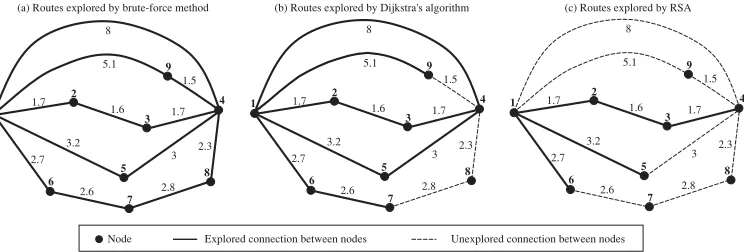
clearly illustrates that because of the ripple-spreading process, the RSA may narrow down the solution space for search.
It is well established that Bellman’s optimization principle is the theoretical foun-dation of dynamic programming, which guarantees the optimality of many search methods such as theA∗algorithm and Dijkstra’s algorithm (Sniedovich, 1986). Now we turn to the examination of the relation between Bellman’s optimization principle and the optimization principle of the ripple-spreading phenomenon. Bellman’s principle is stated as follows: ”An optimal policy has the property that, whatever the initial state and initial decision are, the remaining decisions must constitute an optimal policy with regard to the state resulting from the first decision” (Bellman, 1957). In the context of route optimization, after starting from the source, no matter which intermediate node we approach, the remaining route must be the shortest route from that intermediate node to the destination. Therefore, in dynamic programming, we first calculate the shortest distances from the destination to all those nodes that have a direct connection to the destination. Then, based on the results, we progress to calculate the shortest distances from the destination to all those nodes that have a direct connection to those already calculated nodes, until the source is reached. Note that in route optimization the source and the destination are usually reversible. Then both theA∗ algorithm and Dijkstra’s algorithm exactly follow the dynamic programming practice, and calculate the shortest distances from the source to intermediate nodes from the nearest to the farthest, until the destination is reached. We can view the simulation process of the RSA at the macro level as following coincidentally the centralized strategy described by the Bellman’s optimization principle. However, at the micro level, the RSA never calculates any shortest distance from the source to any intermediate node, but the decentralized behavior of nodes defined according to the ripple-spreading optimization principle can automatically ensure the realization of optimal remaining decisions in Bellman’s statement.
Here we use the k-SPP to illustrate that the centralized nature of dynamic pro-gramming is disadvantageous when compared with the decentralized nature of the simulation model of the RSA. To apply a dynamic programming method, such as the
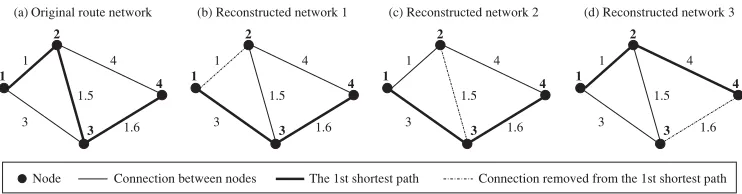
Figure 7: Reconstructing route networks for Dijkstra’s algorithm.
which is generated by removing one of the three connections that together compose the first shortest path 1→2→3→4 (Figures 7b–7d). Then based on each reconstructed route network, we apply Dijkstra’s algorithm to calculate the associated first shortest path. The associated first shortest paths in Figures 7b–7d are 1→3→4, 1→3→4, and 1→2→4, respectively. Among these associated first shortest paths, 1→3→4 is the shortest. Therefore, we know the second shortest path in the original route network of Figure 7a is 1→3→4. The methods following the practice of dynamic programming often focus on how to reconstruct route networks efficiently (Yen, 1971; Eppstein, 1998; Aljazzar and Leue, 2011). The RSA for thek-SPP, discussed in Section 3.3, is completely different because we never need to reconstruct any route network but simply simulate micro ripple-activating and spreading behaviors at nodes in the original route network, and the macro outputs of the simulation process are automatically thekshortest paths (e.g., see Fig. 5).
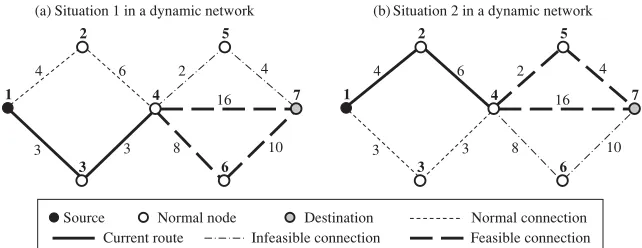
Furthermore, the decentralized RSA can achieve what is beyond the capability of centralized dynamic programming. In the dynamic network of Hu et al. (2014), whether an unexplored connection is feasible or not depends on which connections have been explored. Figure 8 gives an example, where the feasibility of unexplored connections from node 4 to node 7 depends on how node 4 is reached by the current route. If node 4 is reached from node 3, then only long connections are feasible to node 7, while if node 4 is reached from node 2, then some short connections become feasible. This violates the Bellman’s optimization condition. Therefore, all dynamic programming methods such asA∗ and Dijkstra’s algorithm will lose the global optimality, and the best path they find has a cost of 22 in the case of Figure 8. Surprisingly, the RSA for thek-SPP can still guarantee the global optimality in this dynamic network to find the globally optimal path with a cost of 16. This is another “impossible becomes possible” example thanks to the RSA, which also implies that there is a fundamental difference between the RSA and those methods based on the Bellman optimization principle.
5
Simulation Results
5.1 Simulation Setup
Figure 8: A dynamic network where the feasibility of unexplored connections depends on current route.
1985), in the other three sets of experiments, we only use Dijkstra’s algorithm for comparative purposes. Actually, in thek-SPP set, the RSA is compared with the well-known Yen’s algorithm (Yen, 1971) and Dijkstra’s algorithm is employed by Yen’s algorithm to calculate the first shortest paths in reconstructed route networks.
The networks used in the experiments are generated as follows. First, we randomly disturb the locations ofNNnodes, which are originally evenly distributed in a rectangu-lar area defined by [−1000 1000 −1000 1000]. We let the minimal distance between any two of the evenly distributed nodes bedEDN. Then a random disturbance is within the range [−dEDN/3, dEDN/3]. Then we establish connections between nodes according to
two network models. For some networks (denoted WS), the model in Watts and Strogatz (1998) is used, in order to get Poisson degree distribution. For other networks (denoted BA), the model in Barab´asi and Albert (1999) is used, in order to generate scale-free topologies with power-law degree distribution. In some WS networks, each node on average has four connections, i.e.,NAC=4, while in other WS networks,NAC=8. In
some BA networks, the power coefficient is set ase=1, while in other BA networks,
e=2. Basically, a larger e means a more significant power-law degree distribution. Finally, we calculate the cost of each established connection. There are two different definitions of route cost: straight-line distance between nodes and random weight. Net-works with random weights (within the range of [1 10] in this study) as route cost are especially used to illustrated that theA∗algorithm may lose optimality, while both Dijkstra’s algorithm and the proposed RSA can always guarantee finding global optima. For a given set of experimental parameters (WS model or BA model,NAC,e,NN, and so on), we randomly generate 100 route networks. Since all algorithms in this study are deterministic, we apply them to each network only once. Then we compare their average results based on the 100 networks of the given set of experimental parameters. Note that in all experiments, a route network is recorded not as an adjacency matrix as described in Section 2.1, but instead to reduce the memory demand a list of established connections between nodes is adopted. All methods are coded and all tests are conducted in a MATLABR environment on a personal computer with a 2.6 GHz CPU, 2 GB memory and the Windows XP operating system.
Table 1: Test results for the one-to-one POP (straight-line distance,NN =1,000).
WS Model (Poisson Distribution)
BA Model (Power-Law Distribution,
NAC=4)
NAC=4 NAC=8 e=1 e=2
Runtime(s) Runtime(s) Runtime(s) Runtime(s)
Mean SD Obj. Mean SD Obj. Mean SD Obj. Mean SD Obj.
RSA1-1 0.10 0.02 3415.38 0.12 0.02 3326.15 0.01 0.02 3472.03 0.12 0.03 3586.47 RSA1-2 0.08 0.01 3415.38 0.09 0.02 3326.15 0.08 0.02 3472.03 0.10 0.02 3586.47
A∗1-1 0.06 0.01 3415.38 0.09 0.01 3326.15 0.08 0.01 3472.03 0.10 0.01 3586.47
A∗1-2 0.14 0.02 3415.38 0.17 0.02 3326.15 0.16 0.02 3472.03 0.22 0.03 3586.47 Dijkstra1 0.04 0.01 3415.38 0.06 0.01 3326.15 0.05 0.01 3472.03 0.06 0.01 3586.47
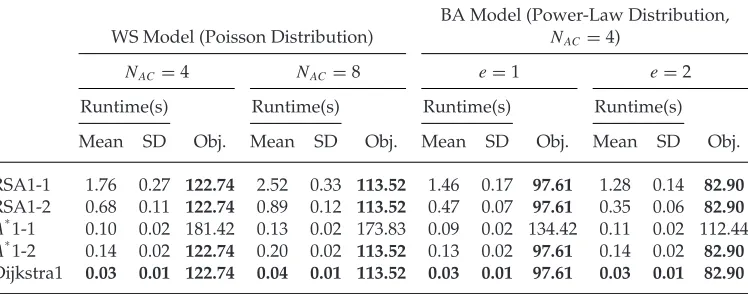
Table 2: Test results for the one-to-one POP (random weight,NN =1,000).
WS Model (Poisson Distribution)
BA Model (Power-Law Distribution,
NAC=4)
NAC=4 NAC=8 e=1 e=2
Runtime(s) Runtime(s) Runtime(s) Runtime(s)
Mean SD Obj. Mean SD Obj. Mean SD Obj. Mean SD Obj.
RSA1-1 1.76 0.27 122.74 2.52 0.33 113.52 1.46 0.17 97.61 1.28 0.14 82.90 RSA1-2 0.68 0.11 122.74 0.89 0.12 113.52 0.47 0.07 97.61 0.35 0.06 82.90
A∗1-1 0.10 0.02 181.42 0.13 0.02 173.83 0.09 0.02 134.42 0.11 0.02 112.44
A∗1-2 0.14 0.02 122.74 0.20 0.02 113.52 0.13 0.02 97.61 0.14 0.02 82.90 Dijkstra1 0.03 0.01 122.74 0.04 0.01 113.52 0.03 0.01 97.61 0.03 0.01 82.90
5.2 One-to-One POP Experimental Results
First, we consider the set of one-to-one POP experiments by comparing the RSA with theA∗ algorithm and Dijkstra’s algorithm. In this set, the total number of nodes in a route network isNN =1,000. The source is the left bottom node, and the destination is
the right top node. Both RSAs, i.e., the basic RSA and the improved RSA, are tested here, and they are denoted RSA1-1 and RSA1-2, respectively. There are also two versions of the A∗ algorithm used in this set: one version, denoted A∗1-1, chooses the heuristic function to be the straight-line distance from the last node of the current route to the destination node, and the other version, denotedA∗1-2, always sets the heuristic function to zero. Dijkstra’s algorithm here is denoted Dijkstra1. The results of runtime (given as mean value and standard deviation) and average route cost (the value of the objective function, Obj) are presented in Table 1 (straight-line distance) and Table 2 (random weight), which show the following.
[image:22.504.67.441.291.438.2]Therefore, no matter how many networks are used, the average Obj values of the four algorithms should be the same. Tables 1 and 2 show that these four algorithms always have the same average Obj values, which is consistent with the theoretical analysis. This empirically confirms the optimality of these four algorithms.
• A∗1-1 can guarantee optimality when the connection cost is defined as the physical straight-line distance between nodes (Table 1) but often loses opti-mality in the case of random weights (Table 2). This is because the heuristic function ofA∗1-1 is admissible in the case of Table 1: the straight-line distance from a node to the destination is always no larger than the actual minimal cost from that node to the destination. However, in the case of Table 2, the random weights of connections have nothing to do with straight-line distances. There-fore, the heuristic function of A∗1-1 is no longer admissible and then cannot guarantee the optimality ofA∗1-1 (Table 2).
• In terms of computational time, on average, Dijkstra1 is the most efficient. In the case of physical straight-line distance as connection cost, 1, RSA1-2, A∗1-1, and A∗1-2, are comparable to each other. In the case of random weight, the performance of either RSA1-1 or RSA1-2 drops greatly, which can be explained as follows. Connections between nodes usually have different costs, and this is described as unevenness in connection costs, which can be roughly measured by the ratio between the maximal connection cost and the minimal one in a network. This ratio is about 3 in the experiments of Table 1, and about 10 in those of Table 2. A large ratio usually means a largerNATU. As analyzed in Section 4.3, the time complexity ofA∗or Dijkstra’s algorithm is only determined byNNandNAC, while the time complexity of RSA is directly influenced byNATU. Therefore, theA∗and Dijkstra algorithms are quite robust against the unevenness in connection costs, while the RSA is sensitive.
• As analyzed in Section 3.2, because of using a variable ripple-spreading speed, RSA1-2 is more computationally efficient than RSA1-1.
• In terms of the absolute value of SD, the RSA in general has the largest SD. This is also understandable based on the theoretical result in Section 4.3. The time complexity of RSA isO(NN×NAC×NAT U). For eitherA∗or Dijkstra, the time
complexity is mainly determined byNNandNAC. Therefore, once the pair of (NN, NAC) is given and fixed, other network parameters such as node locations
and degree distribution have relatively much smaller influence on the runtime. However, in the case of the RSA, even for a fixed pair of (NN, NAC), different
node locations or degree distribution may lead to rather different NATU and then cause the runtime to vary more significantly. One might argue that the RSA has smaller values of SD/mean. However, SD/mean makes little sense here because the runtimes in this section are too small, which might be largely biased by computer performance uncertainties.
• For a given definition of connection cost and network models, the values ofNAC andehave similar influences on all algorithms. For example, in WS networks, no matter which definition of connection cost is employed, all algorithms have larger runtimes in theNAC =8 case than in theNAC =4 case because a
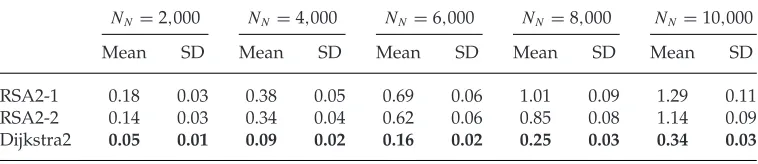
Table 3: Runtimes (second) of different algorithms in one-to-all POP (straight-line dis-tance).
NN=2,000 NN=4,000 NN=6,000 NN =8,000 NN=10,000
Mean SD Mean SD Mean SD Mean SD Mean SD
RSA2-1 0.18 0.03 0.38 0.05 0.69 0.06 1.01 0.09 1.29 0.11 RSA2-2 0.14 0.03 0.34 0.04 0.62 0.06 0.85 0.08 1.14 0.09 Dijkstra2 0.05 0.01 0.09 0.02 0.16 0.02 0.25 0.03 0.34 0.03
nodes usually means smaller shortest paths. In BA networks with straight-line distance as connection cost, all algorithms have larger runtimes and Obj values fore=2 than fore=1 because a largereimplies the shortest path between a pair of nodes is more likely to go around some hub nodes, and going around hub nodes usually means a long physical distance. However, in BA networks with random weight as connection cost, all algorithms have smaller runtimes and Obj values for e=2 than for e=1. This is because going around hub nodes usually means fewer connections are included in the shortest path, and because of the random weights and smaller connection numbers, this usually produces smaller path costs.
• Tables 1 and 2 show that for the one-to-one POP, Dijkstra’s algorithm is better than theA∗ algorithm; the proposed RSA could be comparable to Dijkstra’s algorithm; and the performance gap between the RSA and Dijkstra’s algorithm is the most significant in the case of the WS model withNAC =4. Therefore,
in the next three sets of experiments, because of limited space, we compare the RSA with Dijkstra’s algorithm using the WS model with NAC=4 and
changingNNto form different problem scales, and we only analyze runtimes, as optimality is always guaranteed.
5.3 One-to-All POP Experimental Results
The second set is one-to-all tests, and the network scale is increased toNN =2,000, 4,000,
6,000, 8,000 and 10,000, respectively. In each test case, the source is randomly chosen from theNNnodes. As discussed in Section 3.3, it is very easy to extend the RSA to the one-to-all POP just by changing their termination criteria, and the extended RSAs are denoted as RSA2-1 and RSA2-2, respectively. The one-to-one Dijkstra’s algorithm can also be applied to the one-to-all POP by simply changing the termination criterion, and the resulting algorithm is labeled Dijkstra2. The main results are given in Table 3, which shows the following.
• In terms of the mean value of runtime, Dijkstra2 is better than RSA2-2 and than RSA2-1.
• In terms of the absolute value of SD, Dijkstra2 is also better than RSA2-2.
5.4 Many-to-Many POP Experimental Results
Table 4: Runtimes (second) of different algorithms in many-to-many POP (straight-line distance).
NN=20,000 NN =40,000 NN=60,000 NN=80,000 NN=100,000
Mean SD Mean SD Mean SD Mean SD Mean SD
RSA3-1 1.01 0.09 2.10 0.19 3.89 0.27 8.01 0.53 17.37 0.86 RSA3-2 0.97 0.08 1.96 0.17 3.24 0.24 5.85 0.41 11.69 0.69 Dijkstra3-1 7.13 0.41 25.32 1.38 51.85 2.41 128.32 4.95 276.90 8.47 Dijkstra3-2 6.42 0.37 21.93 1.21 46.69 2.12 98.13 4.02 165.82 5.62
network scale is further increased toNN=20,000, 40,000, 60,000, 80,000 and 100,000,
respectively. For a given NN, we randomly choose 20% nodes as destinations, and set the rest as sources. As explained in Section 3.3, the basic RSA and the improved RSA can be extended to the many-to-many POP by simply starting initial ripples at all destination nodes simultaneously, and the modified RSAs are denoted RSA3-1 and RSA3-2, respectively. There are two ways to extend the one-to-one Dijkstra’s algorithm, i.e., Dijkstra1, to the many-to-many POP. We can run Dijkstra1 for every unvisited source node, and each run of Dijkstra1 will stop once a destination node is reached (no matter which one). We denote this Dijkstra’s algorithm as Dijkstra3-1. We can also start Dijkstra’s algorithm from the set of all destination nodes. In the one-to-one Dijkstra’s algorithm, there is only one node (either the source or the destination) in the initial search front. Now we can set the initial search front as the whole set of destinations and then keep expanding the search front until all sources are visited. The resulting method is called Dijkstra3-2. In contrast to Dijkstra3-1, we can get the results in only one run of Dijkstra3-2, just as in RSA3-1 and RSA3-2. The average results are given in Table 4, which clearly shows the following.
• In terms of computational efficiency, both RSA3-1 and RSA3-2, i.e., the basic RSA and the improved RSA, are faster than either Dijkstra3-1 or Dijkstra3-2 (the RSA is about ten times faster than Dijkstra’s algorithm). By analyzing the values of SD/mean, one can see again that Dijkstra’s algorithm has more stable runtimes.
Table 5: Runtimes (second) of different algorithms in thek-SPP (straight-line distance).
k=2 k=4 k=6 k=8 k=10
NN Mean SD Mean SD Mean SD Mean SD Mean SD
16 Yen 0.01 0.00 0.01 0.00 0.03 0.01 0.07 0.01 0.16 0.03 RSA4 0.01 0.00 0.02 0.00 0.02 0.01 0.03 0.01 0.03 0.02 25 Yen 0.01 0.00 0.02 0.00 0.05 0.01 0.11 0.02 0.36 0.05 RSA4 0.05 0.02 0.10 0.01 0.13 0.04 0.15 0.04 0.18 0.04 36 Yen 0.02 0.01 0.08 0.02 0.33 0.05 1.79 0.10 7.14 0.38 RSA4 0.15 0.04 0.39 0.06 0.65 0.07 0.93 0.08 1.17 0.12 49 Yen 0.08 0.02 0.38 0.06 1.86 0.11 8.92 0.41 41.33 1.72 RSA4 0.64 0.06 1.19 0.09 3.52 0.22 6.37 0.42 8.87 0.69 64 Yen 0.26 0.04 1.48 0.09 8.49 0.49 49.52 2.07 293.27 10.27 RSA4 2.89 0.21 6.29 0.48 16.25 0.99 27.90 1.83 41.29 2.35
• One may notice that the RSA for a many-to-many POP with NN =20,000
(Table 4) is faster than the RSA for a one-to-all POP withNN =10,000 (Table
3). This is because in a one-to-all POP withNN =10,000, the largest number
of nodes in the shortest routes is easily over 100, while in a many-to-many POP withNN =20,000, the largest number of nodes in the shortest routes is
often just a few tens. Therefore, based on the analysis in Section 4.3, the time complexity of the RSA in a one-to-all POP with NN =10,000 is greater than
that in a many-to-many POP withNN =20,000.
5.5 k-SPP Experimental Results
Now we move to thek-SPP. In this set of tests, the network scale is set asNN =16, 25,
36, 49, and 64, respectively, because the scalability of the algorithms tested still needs to be improved in future work. The experimental results with these smallNNvalues can fairly demonstrate the fundamental difference between the RSA and existing methods for thek-SPP. Another parameter of this set is the number of best paths that need to be calculated, and it is set ask=2, 4, 6, 8, and 10, respectively. In each test case, the source is the left bottom node, and the destination is the right top node. Here for the sake of simplicity in programming, only the basic RSA is extended for thek-SPP, denoted RSA4. Yen’s algorithm, denoted Yen, is used for comparative purposes, and the one-to-one Dijkstra’s algorithm is integrated in Yen to calculate the first shortest path. The results are given in Table 5, from which one may make the following observations.
• In terms of computational efficiency, RSA4 is clearly better than Yen in those test cases with a large k, such as k=10. Basically, Yen’s algorithm is more sensitive to the change inkbecause a largerkimplies an exponentially heavier computational load to reconstruct route networks. As discussed in Section 5.2, the runtimes of RSA4 are relatively more unstable than those of Yen, as shown by the SD values.
the concern of thek-SPP. For example, in the method of Hu et al. (2013a) to calculate the complete Pareto front of a multiobjective optimization problem, it is crucial to have a method capable of finding thekbest solutions to each of the single-objective optimization problems, and thekmay vary within a large range.
6
Conclusions and Future Work
Inspiration from nature often brings surprises, which has been demonstrated repeatedly by many successful advances in evolutionary computation (EC). This paper focuses on the natural ripple-spreading phenomenon and attempts to apply its underlying prin-ciple to design effective algorithms for the path optimization problem (POP). Inspired by the fact that a ripple travels at the same speed in all directions and therefore al-ways reaches the closest spatial point first, a deterministic bottom-up decentralized agent-based simulation model is proposed to search the optimal path through a route network. The proposed RSA is complete and optimal, and it also has a good scalabil-ity because of its computational efficiency. Through comparison with some of the best route optimization algorithms via simulation, the proposed RSA is tested in four kinds of POPs and demonstrates a very effective performance. This paper shows that from the ripple-spreading optimization principle, to the combination of agent-based and de-terministic features, to the new opportunities of tackling some complex problems, the proposed RSA is largely distinguished from existing methods and therefore enriches the theoretical foundations of EC.
More theoretical, technical, and implemental efforts are needed in the future to ex-plore the full potentials of the RSA, for example, studying in depth where the strength of the RSA comes from, investigating the roles of local node behaviors and global measures of setting time-varying ripple-spreading speed, improving the computational efficiency of the RSA for thek-SPP, developing effective purpose-designed RSAs for real-world POPs as well as other kinds of optimization problems, analyzing the computational complexity of such purpose-designed RSAs, technically realizing the parallel comput-ing capability of the RSA, and understandcomput-ing the influence of experimental parameters such as the topology of networks, the unevenness of connection costs, and the percent-age of destination nodes. Basically, the proposed RSA is a promising concept, and many things can and need to be done.
Acknowledgments
This work was supported in part by the National Natural Science Foundation of China (Grant No. 61472041), the National Basic Research Program of China (Grant No. 2012CB955404), the Foun-dation for Innovative Research Groups of the National Natural Science FounFoun-dation of China (Grant No.41321001), and the Seventh Framework Programme (FP7) of the European Union (Grant No. PIOF-GA-2011-299725). The authors would also like to thank Dr. Matthew D. Hig-gins and Miss Tianyao Miao, who assisted with preparing the final version of this article with LaTex.
References
Aljazzar, H., and Leue, S. (2011). K*: A heuristic search algorithm for finding thekshortest paths. Artificial Intelligence, 175(18): 2129–2154.