August 2019
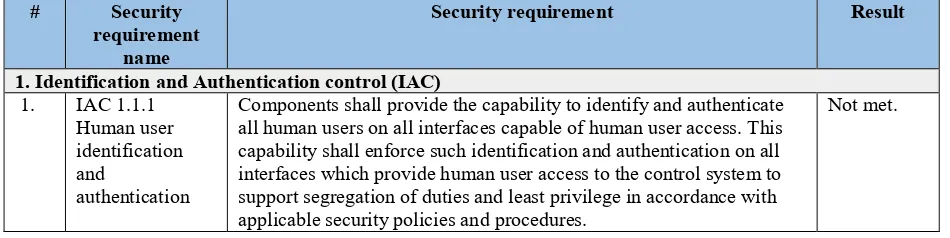
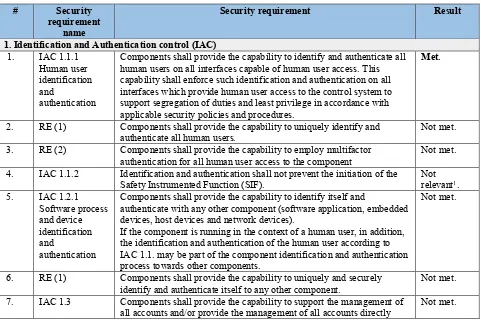
MASTER THESIS
“Standardized Security Assessment Framework
for ICS Devices and pilot project”
University of Twente
Faculty of Electrical Engineering, Mathematics and Computer Science
Author: Anna Prudnikova (1924818)
2
Title page
Student name:
Anna Prudnikova
Student number:
1924818
Telephone:
+79166907159
E-mail:
[email protected]
Topic of Master Thesis:
Standardized Security Assessment Framework for ICS Devices and
pilot project
Company:
Secura B.V.
3
Acknowledgment
During six months of the research and writing my Master Thesis I received support and help
from a lot of different people. I would like to thank everyone involved and give specific
acknowledgment to the following people.
First of all, I would like to thank my supervisor Dr. Jeroen van der Ham, who supported me
during the whole process of writing my Master Thesis, provided a valuable feedback and
recommended me a company which can provide me with an internship position and support me
with conducting the research. The company Secura B.V. happened to be a perfect match.
I would also like to thank the company Secura B.V., where I was working on my thesis for six
months, especially for providing resources and devices for performing pilot part of my project.
My special gratitude goes to my supervisor within the company Razvan Venter who gave me
guidance in creating the framework and helped me to outline structure and timeline of my thesis.
Moreover, I would like to thank Jos Wetzel, who supported me in technical questions of
programming and testing devices during evaluation process.
4
Abstract
The modern world becomes more and more digitalized. The information technologies (IT) keep
penetrating all spheres of our life. This major trend of digitalization also changed the industrial
sector; Industrial Control Systems (ICS) become more interconnected and the boundaries
between classic IT systems and ICS become less clear. IT protocols such as IP or TCP tend to
be used within ICS due to their simplicity and widespread. This trend leads to the fact that ICS
that originally were not designed to be secure against state of the art cyber-attacks become
vulnerable.
One of the main problem within the cyber security domain of ICS is the lack of regulation.
Manufactures do not have obligations to make their devices secure. Currently there exist a
number of different best practice documents in the domain, but presented requirements overlap
or sometimes even contradict each other, which complicates their efficient application. None
of the existing documents could be used to perform an in-depth analysis of ICS devices security.
To address this problem we created Standardized Security Assessment Framework for ICS
Devices, which could be used by all actors involved in industrial processes: industrial
companies, certification laboratories and IT integrators or manufacturers of ICS devices to
assess and eventually strengthen the cyber security level of ICS devices.
The created framework is based on five different documents related to ICS cyber security that
were chosen as the most relevant ones based on specific parameters. From those five
documents, we identified more than two hundred requirements (227), performed an overlapping
process to identify relevant requirements for ICS devices and eventually presented one hundred
forty (140) requirements.
To finalize the created framework, we performed an evaluation process (or so-called pilot
project) by testing three different devices, in order to assess compliance with all included
requirements. This process allowed to further improve the Framework and revealed that
twenty-three of original requirements were either not relevant for single devices (only relevant on
system level) and therefore were deleted or partly/completely repeated other requirements and
in this case – merged. Thus, the final version of the Framework contains one hundred seventeen
requirements (117). Additionally, for every requirement from the Framework we created
excessive guidance with description of methods and tools needed to perform the assessing
process of compliance.
5
Table of Contents
Acknowledgment ... 3
Abstract ... 4
Table of Contents ... 5
1.
Introduction / Motivation of the topic ... 7
1.1.
Introduction to ICS ... 7
1.2.
Problem statement ... 8
1.3.
Research questions ... 8
1.4.
Relevance ... 9
1.5.
Structure of the thesis ... 10
2.
Literature review ... 11
2.1.
Brief overview on ICS security ... 11
2.2.
ICS security standards ... 11
2.3.
ICS certification schemes ... 14
3.
Research methodology ... 18
3.1.
Conceptual model ... 18
4.
Research results ... 20
4.1.
Selection of ICS security standards and relevant requirements ... 20
4.2.
Design of Standardized Security Assessment Framework ... 21
4.3.
Requirements overlapping ... 22
4.4.
Concept of security levels ... 23
4.5.
Methods and tools used for testing ... 24
4.6.
Final Standardized Security Assessment Framework ... 25
5.
Evaluation process ... 51
5.1.
Testing methodology ... 51
5.2.
Testing results of PLC 1 ... 52
5.3.
Testing results of PLC 2 ... 64
5.4.
Testing results of the Switch ... 75
5.5.
Comparison of testing results ... 87
6.
Discussion ... 89
6.1.
Analysis of the results and recommendations ... 89
6.2.
Limitations ... 99
7.
Conclusion and Future work ... 100
7
1.
Introduction / Motivation of the topic
1.1.
Introduction to ICS
Industrial Control System (ICS) is a general term used to describe different types of control
systems that are used for industrial process control. ICS term includes different devices, systems
and networks. ICS are normally used in a number of industries such as water, electrical, oil and
gas, transportation, chemical, automotive, food and many more [1].
There exist several types of possible ICS systems, such as Supervisory Control and Data
Acquisition (SCADA) systems, Distributed Control Systems (DCS) or Safety Instrumented
Systems. Additionally, major parts of ICS are specific devices, such as Programmable Logic
Controllers (PLC), Remote Terminal Units (RTU), specific industrial network devices. A PLC
is one of the most sophisticated type of ICS devices and is a form of industrial computer that is
designed to function in harsh industrial conditions. A PLC is typically used to directly control
industrial processes. Moreover, a PLC could be also used in civil applications, such as
controlling traffic lights.
[image:7.595.203.380.360.530.2]The difference between different types of ICS is presented in the Figure 1. Difference between
ICS/SCADA/DCS/PLC.
Figure 1. Difference between ICS/SCADA/DCS/PLC.
Industrial control systems in modern understanding have been around since 1950 [2]. The first
PLC was developed in USA in 1968. New technologies keep emerging, such as the Internet of
Things (IoT), cloud computing or connected cars. This major trend of digitalization can also be
referred to as Industry 4.0 or the 4
thindustrial revolution. Overall, Industry 4.0 refers to
manufactory automation (“smart factories”), describes the way we produce goods, and
characterizes the industrial sector nowadays. Thus, industrial control systems have also faced
major changes in their design – turning into cyber-physical systems instead of simply physical.
ICS become more interconnected and the boundaries between classic IT systems and ICS
become less clear. IT protocols such as IP, TCP tend to be used within ICS due to their
simplicity and widespread.
Historically, there was a separation between Operational Technologies (OT), which could be
roughly explained as hardware and software that is used for controlling physical embedded
devices, and IT. Therefore, ICS were considered to be “air-gapped” from classical IT and the
ICS
SCADA
8
Internet and thus were considered to be secure from possible security attacks. Unfortunately,
recent cyber security incidents within ICS domain proved this theory to be wrong [3, 4].
1.2.
Problem statement
With this rise of IT field, questions of cyber security keep getting more priority. In the recent
years, the severity and frequency of cyber-attacks is increasing. All of those trends lead to the
fact that ICS, that originally were not designed to be secure against state of the art cyber-attacks
and are supposed to be used in place for 10-20 years, become vulnerable. The number of
reported incidents in the sphere of ICS rises, the most severe example being the malware
Stuxnet [3]. Stuxnet was specifically designed to target PLC and caused major damage to Iran’s
nuclear program in 2010. This was the first major incident to cause disturbances of ICS. As an
example of recent malware specific to ICS, we could refer to TRITON [4]. TRITON was
targeting Safety Instrumented Systems (SIS) causing them to falsely enter safe mode and thus
shutting down the whole industrial process.
Recent studies [4, 6] show an overall increase of awareness of industrial companies regarding
cyber security issues and their preparedness to take actions to prevail them. Unfortunately, the
maturity of ICS cybersecurity still remains low, but trending to increase steadily. The experts
in [3] claim that “managing risks and compliance is the key” to cybersecurity in the industrial
environment. At the same time, the level of compliance to guidance and regulations in the
sphere of ICS is relatively low. It could be explained by the fact that currently there exist
multiple guidelines, recommendations and standards that often overlap or even contradict each
other in their requirements. Thus, there is a clear need of a unified framework that could be
used by industrial companies to build their security upon and to be able to test it. Creating such
a framework is the goal of this research. By all means, compliance to cyber security guidelines
does not always mean high level of cyber security but it could be considered as a first major
step, especially for the companies that do not have required expertise in security.
Meanwhile, there is another part of the problem – the lack of mandatory cyber security
certification schemes that allows vendors of ICS equipment to keep producing insecure devices.
Majority of manufacturers are unaware of any existing standards or recommendations in the
domain of ICS cyber security.
To overcome these issues there exists a need of creating a single unified framework for
assessing cyber security of ICS that would combine all relevant requirements and provide
guidelines on how to assess them. Moreover, this framework should be highly advertised and
accepted on a European or even international level. As a starting point for the Master Thesis, it
was decided to focus on the security assessment of ICS devices and possible certification
schemes. The final name of created framework is “Standardized Security Assessment
Framework for ICS Devices” (hereinafter referred to as the Framework or created framework).
1.3.
Research questions
Taking into consideration the problem stated in section 1.2, we are going to formulate two main
research question as followed:
9
2.
How the requirements presented in the created framework could be tested to assess the
cyber security for ICS devices?
To be able to answer the main research questions we need to answer a number of subquestions:
1.
What are the most relevant standards for ICS cyber security based on country/zone of
influence, organization-developer, scope, requirements elaboration?
2.
How could the requirements from selected standards be merged together to create a
single framework for assessing the cyber security of ICS devices?
3.
What types of security levels could be introduced within the framework for the purpose
of a certification scheme?
4.
How to test all the requirements introduced within the framework?
5.
What tools should be used for testing?
6.
Is it technically feasible to test all the requirements introduced within the framework?
7.
In which way can the framework be used for testing and certification?
1.4.
Relevance
1.4.1.
Academic relevance
With the rise of awareness in the field of ICS cyber security, more and more new guidelines
(recommendation, standards, checklists) keep emerging in different countries. Even though
those documents have slightly different focus, they all aim at the same goal – increase maturity
of cyber security for industry. The problem here is that not all of those documents work well
together, because there is no solid basis to which they can refer and be further adapted to
specific needs. Moreover, they all are presented in different formats: recommendations,
guidelines, standards. This leads to complication when it comes to choosing which source to
implement and to follow. The value of the current research for academic purposes is that we
are providing this basis based on already existing standards that proved their value and are
currently being used in ICS industry. The ultimate goal is to be able to create a single framework
that could be used by different countries and be adapted for their use cases. Current research is
a first step towards reaching this goal. By analysing and performing the overlap of more than
two hundred requirements from five different documents (guidelines, recommendations,
standards) we simplified the future work for academic field and allowed to avoid duplication
of work. Additionally, we tried to make all requirements less ambiguous and add more detailed
explanation to avoid possible misinterpretations.
1.4.2.
Industry relevance
Even though current research is highly relevant for the academic field, it is even more relevant
for practical implementation within ICS industry. For industries, the main added advantage of
our research is the description of methods and tools that are required to assess compliance. For
every requirement, we introduced explanation on how this requirement should be tested, what
information could be found in documentation and what possible tools (software of hardware)
could be required to perform the technical assessment.
10
comes in hand. It explains what types of tests should be sufficient to assess the compliance of
each requirement and how to proceed with the assessment process. Currently Secura B.V. is
actively involved in improving the assessment methodology, together with certification bodies.
Moreover, combining of five most complete guidelines allows to address cyber security for ICS
devices from all perspectives. The framework has a highly practical approach which has not
been introduced before. It is especially relevant to industrial companies that use ICS devices to
control industrial processes but are not used to consider cyber security when it comes to
introducing new devices within their systems. Following the guidelines presented in the
Framework they can assess the security level of ICS devices they currently use without support
from IT integrators which will allow to cut financial expenses for those companies. For
manufacturers of ICS devices following the created framework during testing process would
allow to strengthen overall security of their devices, since it will allow them to identify all
possible weak features and identify how they can be improved.
To summarize, the created framework could be used by:
Testing laboratories and certification bodies for cyber security to provide extensive
assessment for the tested devices;
Industrial companies to assess if certain devices should be introduced within their
systems and which risks it could bring;
Manufacturers (vendors) creating ICS devices to assess their security;
1.5.
Structure of the thesis
In chapter two we are going to introduce the literature overview. It contains three main parts:
general background on ICS security, discussion about different standards related to ICS security
and identification of possible existing certification schemes.
Chapter three provides a description for research methodology and steps that were taken in
order to answer stated research questions and all related subquestions.
In chapter four we provide research results, including information regarding choosing of
relevant requirements and overlapping them and the final version of Standardized Security
Assessment Framework for ICS Devices.
Chapter five reports on evaluation process (pilot project) including results of testing of three
different ICS devices in accordance with created framework. Additionally in this chapter we
provide comparison of testing results.
In chapter six we discuss the obtained results and provid recommendation for securing the tested
ICS devices based on the assessment, by implementing it in cooperation with certain security
systems. Moreover, we reflect on limitations that we faced during the research project.
11
2.
Literature review
2.1.
Brief overview on ICS security
Until recently, ICS were considered secure due to their isolation from internet and classical IT
infrastructure, which is why they were not build to be secure and resilient against potential
cyber security attacks. Introduction of open standards such as Ethernet, TCP/IP and
web-technologies within operation technology to increase connectivity opened the door for attackers
to exploit vulnerable systems.
First major researches in the field of ICS security started to emerge in the beginning of 2000
thand gained the focus of research society after the incident with Stuxnet [3] together with the
first attempts to introduce guidelines. The main topics of research were different: starting from
analysing myths and actual facts behind ICS cyber security in [7] and finishing at outlining
main challenges that ICS face [8].
The main conclusion that could be derived from the publications is that the ICS field is currently
in a transition from being completely closed and isolated, to interconnectivity and that it will
take some time for industries to be able to keep up with rising cyber security challenges. The
key of doing so is by raising awareness, that cyber threats are real and they need to be addressed.
For our research we are going to focus on identifying and analyzing the most relevant standards
for ICS cyber security that support the process of raising awareness and securing ICS.
2.2.
ICS security standards
As was mentioned in Part 1 of this document, currently there exist a number of different
guidelines, recommendations and regulations in the area of ICS cyber security. The short
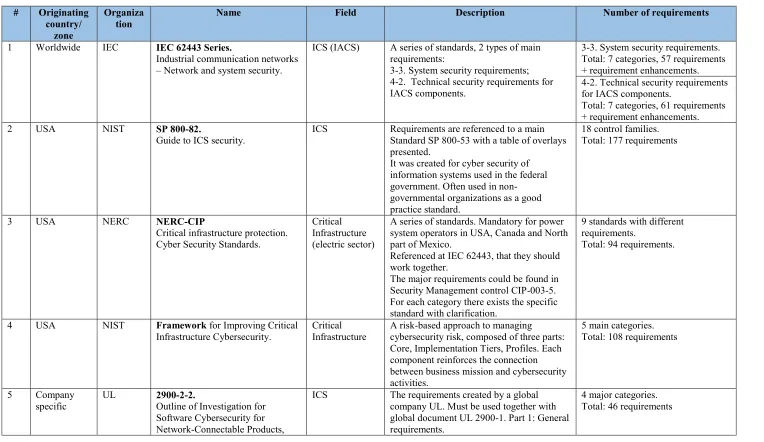
description of these documents could be found in Table 1. List of all possible standards /
guidelines / recommendations for ICS cybersecurity. Further, you can find brief analysis for all
eight regulatory documents:
1.
IEC62443 series. Industrial communication networks – Network and system security
[9].
2.
NIST SP800-82. Guide to ICS security [10].
3.
NERC-CIP. Version 5 CIP Cyber Security Standards [11].
4.
NIST Framework for Improving Critical Infrastructure Cybersecurity [12]
5.
UL2900-2-2. Outline of Investigation for Software Cybersecurity for
Network-Connectable Products, Part 2-2: Particular requirements for ICS [13].
6.
ENISA. Indispensable baseline security requirements for the procurement of secure ICT
products and services [14].
7.
NCSC. Checklist security of ICS/SCADA systems [15].
8.
MSB. Guide to increased security in industrial information and control systems [16].
2.2.1.
IEC62443 Series
IEC 62443 [9] is a series of standards created by the International Electrotechnical Commission
(IEC), the international standards and conformity assessment body for all fields of
electro-technology.
12
different standards, together providing a flexible framework to secure industrial and automation
control systems (IACS). The main security requirements for IACS products are introduced in
two of these standards:
1.
IEC 62443-4-2, Security for Industrial Automation and Control Systems: Technical
Security Requirements for IACS Components.
2.
IEC 62443-3-3, System Security Requirements and Security Level.
For the purpose of creating the Framework we focused on requirements from IEC 62443-4-2
and IEC 62443-3-3. Overall, both standards contain seven categories of basic requirements,
defined as Functional Requirements (FR). Requirements include both technical and
procedural/process aspects related to the product in scope.
Moreover, the series of standards introduces the concept of security levels (SL). The standards
define four security levels for IACS products and systems, which would test the increasing level
of security features used to protect against penetration within the system/component.
Additionally, they introduce three different types of security levels: target SL, achieved SL and
capabilities SL.
2.2.2.
NIST SP800-82
NIST SP800-82 [10] is a special publication (SP) “Guide to Industrial Control Systems
Security” developed by National Institute of Standards and Technology (NIST) which is
responsible for creating guidelines for all spheres of technology from the electronic health
records to smart electric power grid for USA.
The publication is based on another publication by NIST “IT Security for Industrial Control
Systems” (NISTIR6859), currently withdrawn. NIST SP800-82 outlines guidelines for securing
ICS including all possible types such as Supervisory Control and Data Acquisition (SCADA),
Distributed Control Systems (DCS) and Programmable Logic Controllers (PLC). The
publication provides information about ICS and their typical topologies, points to specific ICS
vulnerabilities and threats and gives recommendations on how to secure ICS.
NIST SP800-82 specifies eighteen control families for possible security measures in correlation
with NIST SP800-53 “Security and Privacy Controls for Federal Information Systems and
Organizations” [17]. The standard contains both technical and organizational related
requirements.
2.2.3.
NERC-CIP
NERC-CIP [11] is a series of standards for Critical Infrastructure Protection (CIP) developed
by the North-American Reliability Corporation (NERC), which is a non-profit international
regulatory authority responsible for developing and enforcing Reliability Standards to secure
power grids in the United States, Canada and north Mexico.
13
Moreover, NERC-CIP introduces the Cyber System Categorization standard, which outlines
the basics on how to classify bulk electric systems (BES) to further identify relevant
requirements.
2.2.4.
NIST Framework for Improving Critical Infrastructure Cybersecurity
Framework for Improving Critical Infrastructure Cybersecurity [12] is a publication created by
NIST in 2018.
It describes a recommendatory risk management framework for critical infrastructure of USA
to support management of cyber security risks for all involved parties. It outlines the basic
guidelines to identify and manage risks and gives recommendation on how those guidelines
could be adapted by any organization based on their used technologies. Additionally, it gives
references to different widely accepted standards and guidelines for supported technologies.
With support of this framework organizations can:
-
outline their current cyber security state;
-
specify their target cyber security state;
-
identify the processes to continuously improve their state of cyber security;
-
assess the progress in reaching the target state;
-
raise awareness of different stakeholders about possible cyber security risks.
The document is purely process-related and does not provide any technical recommendations
on securing ICS.
2.2.5.
UL2900-2-2
UL2900-2-2 [13] is a standard that outlines requirements for Industrial Control Systems
developed by a global certification company Underwriters Laboratories (UL).
The goal of the standard is to be able to test and validate ICS. It addresses testing criteria for
assessing cyber security of software components of ICS. It contains four main categories of
requirements: risk controls, risk management, vulnerabilities and exploits, software weakness
analysis with overall more than forty requirements presented.
UL2900-2-2 should be considered together with another standard developed by UL –
2900-1-1 [2900-1-18] that specifies general requirements for network-connectable devices to receive extra
guidance for certain requirements.
2.2.6.
ENISA
ENISA “Indispensable baseline security requirements for the procurement of secure ICT
products and services” [14] is a paper developed by European Union Agency for Network and
Information Security, which is a center of expertise for cyber security in Europe with main
focus on network and information security.
14
known standards, instead it should be used as an addition to them. It specifies ten main
categories of the requirements with almost forty requirements included. Most of these
requirements are process related.
2.2.7.
NCSC. Checklist security of ICS/SCADA systems
Checklist security of ICS/SCADA systems [15] was developed by National Cyber Security
Center (NCSC) of Ministry of Security and Justice of the Netherlands. NCSC is the central
information hub and main center of expertise in the field of cyber security in the Netherlands.
The Checklist was published in 2016 and outlines both organizational and technical measures
to ensure cyber security of ICS domain.
It outlines seven main organizational measures, ten technical and operational measures and give
brief explanation and references to all of them. The presented measures are introduced on a
high level and do not explain how those measures should be tested or implemented.
2.2.8.
MSB. Guide to increased security in industrial information and control systems
Guide to increased security in industrial information and control systems was created by
Swedish Civil Contingency Agency (MSB). MSB is responsible for preparing society for major
accidents and crises, the Director of the Agency is appointed by the Swedish government.
The guide provides seventeen basic recommendations for increasing security of ICS. The
provided recommendations are high level and contain both process related and technical
recommendations. For each recommendation, the reference to another regulatory document is
provided together with some examples and description of possible problems.
The main focus of this guide is to raise awareness about ICS security and provide explanation
on why is it important to all actors involved in industrial processes.
2.3.
ICS certification schemes
During the research, we additionally studied possible certification schemes for ICS. All
certification schemes are based on IEC62443 series of standards, as the only
worldwide-recognized ICS cyber security standard. Currently there exist two world worldwide-recognized certification
schemes for ICS:
-
ISASecure™ certifications;
-
IECEE certifications.
Moreover, there exist independent certification schemes, such as a scheme offered by TÜV
SÜD.
The brief overview of existing certification schemes is introduced below.
2.3.1.
ISASecure
ISASecure™ is a conformance certification program for independent certification of industrial
automation and control products and systems. It is managed by ISCI – non-profit automation
controls industry consortium.
15
-
ISASecure Embedded Device Security Assurance (EDSA) Certification based on
IEC62443-4-2);
-
ISASecure System Security Assurance (SSA) Certification (based on IEC62443-3-3);
-
ISASecure Security Development Lifecycle Assurance (SDLA) Certification (based on
IEC62443-4-1).
ISASecure offers certification for off-the-shelf ICS systems, ICS devices and product
development security lifecycle.
Currently there exist three accredited ISASecure Certification bodies from different countries.
ISASecure certified thirty five ICS devices and systems. The first certificate was issued in 2017.
2.3.2.
IECEE
IECEE is International Electrotechnical Comission (IEC) System of Conformity Assessment
Schemes for Electrotechnical Equipment and Components based on IEC International
Standards.
IECEE offers five certification schemes according to IEC62443 series of standards:
-
IEC 62443-2-4. Security for industrial automation and control systems - Part 2-4:
Security program requirements for IACS service providers;
-
IEC 62443-2-4/AMD1. Amendment 1 - Security for industrial automation and control
systems - Part 2-4: Security program requirements for IACS service providers;
-
IEC 62443-3-3. Industrial communication networks - Network and system security -
Part 3-3: System security requirements and security levels.
-
IEC 62443-4-1. Security for industrial automation and control systems - Part 4-1: Secure
product development lifecycle requirements ;
-
IEC62443-4-2. Security for industrial automation and control systems - Part 4-2:
Technical security requirements for IACS components.
The first certification scheme was included in IECEE System in 2017 for IEC 62443-2-4. In
total, there are thirty five certification bodies included in the scheme.
2.3.3.
TÜV SÜD
TÜV SÜD is a technical service corporation based in Germany and working in the fields of
industry, mobility and certification.
The company offers certification for product manufacturers, system integrators and control
system operators for three standards of the IEC62443 series:
-
IEC 62443-3-3. Industrial communication networks - Network and system security -
Part 3-3: System security requirements and security levels.
-
IEC 62443-4-1. Security for industrial automation and control systems - Part 4-1: Secure
product development lifecycle requirements ;
-
IEC62443-4-2. Security for industrial automation and control systems - Part 4-2:
Technical security requirements for IACS components.
16
Table 1. List of all possible standards / guidelines / recommendations for ICS cybersecurity
# Originating country/
zone
Organiza
tion Name Field Description Number of requirements
1 Worldwide IEC IEC 62443 Series.
Industrial communication networks – Network and system security.
ICS (IACS) A series of standards, 2 types of main requirements:
3-3. System security requirements; 4-2. Technical security requirements for IACS components.
3-3. System security requirements. Total: 7 categories, 57 requirements + requirement enhancements. 4-2. Technical security requirements for IACS components.
Total: 7 categories, 61 requirements + requirement enhancements.
2 USA NIST SP 800-82.
Guide to ICS security.
ICS Requirements are referenced to a main
Standard SP 800-53 with a table of overlays presented.
It was created for cyber security of information systems used in the federal government. Often used in non-governmental organizations as a good practice standard.
18 control families. Total: 177 requirements
3 USA NERC NERC-CIP
Critical infrastructure protection. Cyber Security Standards.
Critical Infrastructure (electric sector)
A series of standards. Mandatory for power system operators in USA, Canada and North part of Mexico.
Referenced at IEC 62443, that they should work together.
The major requirements could be found in Security Management control CIP-003-5. For each category there exists the specific standard with clarification.
9 standards with different requirements.
Total: 94 requirements.
4 USA NIST Framework for Improving Critical
Infrastructure Cybersecurity. Critical Infrastructure A risk-based approach to managing cybersecurity risk, composed of three parts: Core, Implementation Tiers, Profiles. Each component reinforces the connection between business mission and cybersecurity activities.
5 main categories. Total: 108 requirements
5 Company
specific
UL 2900-2-2.
Outline of Investigation for Software Cybersecurity for Network-Connectable Products,
ICS The requirements created by a global
company UL. Must be used together with global document UL 2900-1. Part 1: General requirements.
17
Part 2-2: Particular requirements for ICS.
6 EU ENISA Indispensable baseline security
requirements for the procurement of secure ICT products and services.
General ICT Generic requirements for the procurement of ICT products and services
10 categories.
Total: 39 requirements.
7 NL NCSC
(National Cyber Security Center)
Checklist security of ICS/SCADA
systems. ICS Organizational and technical measures that are considered as good practice. Not detailed, high level requirements.
7 organizational measures, 10 technical measures. Total: 17 requirements.
8 Sweden Swedish
Civil Contingen cy Agency (MSB)
Guide to increased security in industrial information and control systems.
ICS 17 general recommendations with references
for each and one of them to the standard they are derived from, more like a summary. For each recommendation there are given objectives, that are actual actions to be taken.
18
3.
Research methodology
3.1.
Conceptual model
Considering the nature of formulated research questions, we used Design Science (DS) research
methodology to tackle them. This is a research methodology that was specifically designed to
perform researches in the area of information technology. For our research we used
methodology proposed in [19], the definition they use is as follows:
“Design science…creates and evaluates IT artifacts intended to solve identified
organizational problems”.
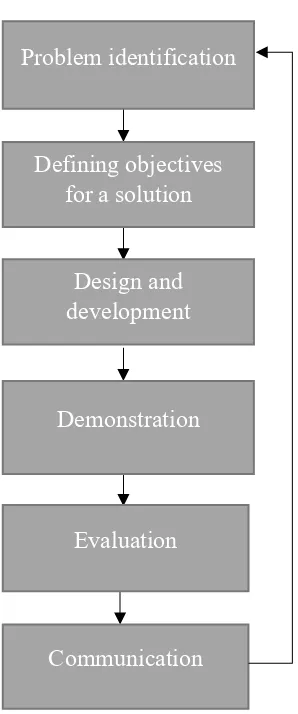
There are six main activities identified in [19]:
1.
Problem identification and motivation.
2.
Defining the objectives for a solution.
3.
Design and development.
[image:18.595.220.369.348.705.2]4.
Demonstration.
5.
Evaluation.
6.
Communication.
Figure 2. Design Science research methodology
Defining objectives
for a solution
Design and
development
Demonstration
Evaluation
19
The methodology could be used as a cycle (Figure 2. Design Science research methodology)
with iterations that help shaping the final solution and could possibly lead to changing of an
original identified problem and objections for the solution.
[image:19.595.69.527.200.289.2]To adapt the proposed methodology for the identified research questions we performed six
following steps presented in Table 2. Correlation between research steps and results presented
in the Thesis.
Table 2. Correlation between research steps and results presented in the Thesis
# Step Part of the Thesis
1 Problem identification and motivation 1
2 Defining the objectives for creating a framework 1
3 Framework development 2, 4
4 Defining methods/tools for testing process 4
5 Testing process 4
6 Reporting results 5, 6
3.1.1.
Correlation of research questions with DS research methodology
[image:19.595.73.529.374.646.2]The exact research methods of research methodology DS used to answer research questions are
presented in Table 3. Correlation of research questions with DS research methodology.
Table 3. Correlation of research questions with DS research methodology
# Research question Step of DS research
methodology Main research questions
1 What standards for ICS cyber security could be considered most relevant and how to merge all introduced requirements in chosen standards into a single framework for assessing cyber security of ICS devices?
1-3
2 How requirements presented in the created framework could be tested
to assess cyber security for ICS devices? 4-5
Sub-questions
1 What are the most relevant standards for ICS cyber security based on country/zone of influence, organization-developer, scope, requirements elaboration?
2-3
2 How could be requirements from selected standards be merged together to create a single framework for assessing cyber security of ICS
devices?
3
3 What types of security levels could be introduced within a framework
for certification scheme? 3
4 How to test all the requirements introduced within the framework? 4
5 What tools should be used for testing? 4
6 Is it technically feasible to test all the requirements introduced within
the framework? 5
20
4.
Research results
4.1.
Selection of ICS security standards and relevant requirements
As was discussed in Chapter 3 of the Master Thesis eight different guidelines (standards,
recommendations, checklists etc.) regarding ICS security were analyzed. The performed
analysis revealed that not all of the selected standards are relevant to the main goal of the Master
Thesis. Therefore, we further analyzed the standards and compared them based on a number of
parameters. The important parameters for comparison are:
type of the document (standards, guidelines, recommendations etc.);
status (mandatory, recommendatory);
zone of influence (worldwide, USA, Europe);
type of included requirements (technical, administrative);
scope (system-related, device-related).
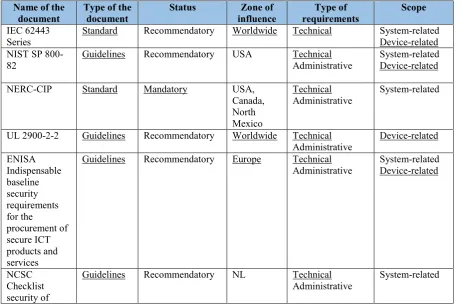
For our Framework we selected the documents that fit at least three of five following criteria:
type: standard or guidelines;
status: mandatory;
zone of influence: worldwide or Europe;
type of requirements: technical;
scope: devices-related.
[image:20.595.70.532.461.768.2]The result of analysis is Presented in Table 4. Comparison analysis of ICS regulatory
documents. Underlined are the parameters that follow previously described criteria.
Table 4. Comparison analysis of ICS regulatory documents.
Name of the
document Type of the document Status influence Zone of requirements Type of Scope IEC 62443
Series Standard Recommendatory Worldwide Technical System-related Device-related NIST SP
800-82 Guidelines Recommendatory USA Technical Administrative System-related Device-related
NERC-CIP Standard Mandatory USA,
Canada, North Mexico
Technical
Administrative System-related
UL 2900-2-2 Guidelines Recommendatory Worldwide Technical
Administrative
Device-related
ENISA Indispensable baseline security requirements for the
procurement of secure ICT products and services
Guidelines Recommendatory Europe Technical
Administrative System-related Device-related
NCSC Checklist security of
Guidelines Recommendatory NL Technical
21
ICS/SCADA systems Guide to increased security in industrial information and control systems
Guidelines Recommendatory Sweden Administrative System-related
NIST
Framework for Improving Critical Infrastructure Cybersecurity
Framework Recommendatory USA Administrative System-related
Therefore, this leads us to five final documents that were used to create the Framework:
1.
IEC62443 series. Industrial communication networks – Network and system security
[9].
2.
NIST SP800-82. Guide to ICS security [10].
3.
NERC-CIP. Version 5 CIP Cyber Security Standards [11].
4.
UL2900-2-2. Outline of Investigation for Software Cybersecurity for
Network-Connectable Products, Part 2-2: Particular requirements for ICS [12].
5.
ENISA. Indispensable baseline security requirements for the procurement of secure ICT
products and services [13].
4.2.
Design of Standardized Security Assessment Framework
To simplify navigation in the created framework it was decided to create it in the format of an
Excel file. To fully represent all collected information during the analysis of related regulatory
documents the Framework contains following parts (each represented in a form of separate
sheet):
Document info.
Basic information about the Framework.
Relevant standards.
Description of chosen as relevant standards in part 4.1 of this
Thesis.
All requirements.
All possible requirements taken from five chosen standards.
All requirements (commented).
All possible requirements with extra comments on
how they were integrated further.
Merged requirements.
The final requirements of the Framework after overlapping
process with a comment field to trace the original requirement.
Security levels (SL).
Dedicated Security Level (SL) for each of final requirements.
Methods/tools.
Description of methods and tools that are used for testing of the final
requirements.
IEC62443-3-3 checklist.
Correlation between final requirements of the Framework and
IEC62443-3-3.
Appendix 1.
Requirements for Secure Mechanisms for Storing Sensitive Data and
Personally Identifiable data.
22
More detailed description of main parts of the Framework is presented in Parts 4.3-4.5 of
the Master Thesis.
4.3.
Requirements overlapping
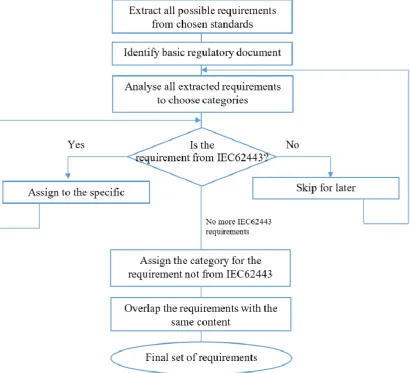
As a first step to overlap requirements into a single framework we extracted all possible
requirements from five chosen in Part 4.1 standards and included them into a single table.
Overall, there were identified sixteen different categories for requirements and in total two
hundred twenty seven requirements.
Next, we identified the major document that was going to be used as a basis
1for our Framework.
The only analysed document that has a status of a standard and thus could be considered as a
priority to all the rest of the chosen documents is IEC62443-4-2.
As a further step, we analysed all extracted requirements to create a limited number of
categories. Based on the selected standard we identified seven possible groups of which all the
requirements could be part of (five of those groups completely correlate with the fundamental
requirements from IEC62443-4-2). Those groups are as follows:
1. Identification and Authentication control (IAC).
2. Use control (UC).
3. Audit and accountability (AU).
4. System integrity and authenticity (SIA).
5. Data confidentiality (DC).
6. System and communication protection (SCP).
7. Security by design (SD).
Next step was to assign categories for all extracted requirements. First, we started with
requirements from IEC62443-4-2 since it was chosen as a basis
.After we put all requirements
from IEC62443-4-2 into dedicated categories, we started with dividing all the rest of
requirements into the same categories. As a result, we received the same amount of
requirements but split into seven categories.
Finally, since a lot of requirements overlap each other we performed an integration procedure.
Requirements from IEC62443-4-2 were taken as basic requirements. Additionally, some of the
requirements have so-called “Requirement Enhancements” that could be used to strengthen the
security. Rest of the requirements were processed in three different ways:
fully overlapping requirements – merged with basic requirements;
partly overlapping – added as extra part for basic requirement;
not overlapping – taken as new basic requirements.
Eventually this led us to one hundred seventeen requirements (one hundred thirsty six with
enhancements) divided into seven categories. The process of overlapping could be traced back
1 By basis we mean that all requirements from the chosen document will be considered as main ones, requirements
23
by following the information from “comment” part in the excel file of the Framework (sheet
“Merged requirements”).
[image:23.595.89.500.154.527.2]The whole process of overlapping of the requirements could be presented in a form of simplified
logic diagram (Figure 3. Simplified logic diagram for overlapping process of requirements).
Figure 3. Simplified logic diagram for overlapping process of requirements
4.4.
Concept of security levels
Another important part of the Framework is the concept of Security Level (SL). The basic idea
of SL was taken from series of standards IEC62443 [9]. The series of standards introduce three
different types of SL:
Target SL (SL-T).
Represents the necessary level of security that needs to be achieved
for a particular IACS or a certain zone. Normally is chosen by industrial company by
means of performing risk assessment.
24
Capabilities SL (SL-C).
Represents a maximum possible SL that could be achieved if
the component / system is properly configured.
Could be done by industrial company
or by system provider.
Four possible levels are introduced [9]:
SL 1.
Protection against casual or coincidental violation.
SL 2.
Protection against intentional violating using simple means with low resources,
generic skills and low motivation.
SL 3.
Protection against intentional violating using sophisticated means with moderate
resources, system specific skills and moderate motivation.
SL 4.
Protection against intentional violation using sophisticated means with extended
resources, system specific skills and high motivation.
The goal of this work is to enable the process of assessing and certifying ICS devices. Usually,
any certification process states the level of certification which was achieved; in our case –
security level. Thus, for the Framework it was decided to simplify the concept of security levels
and leave only one type that could be used for certification purposes. The gradation system of
four possible SL stays the same.
For every requirement from the Framework, a correlated SL was assigned. For requirements
from IEC62443-4-2 the same level was assigned as used in the standard. Since only this
standard introduces the concept of SL, for the rest of the requirements, the SL was chosen based
on its content and similarity to requirements from IEC62443-4-2. Most of those requirements
are more advanced comparing to requirements from IEC62443-4-2. Taking into consideration
that most of the device currently are barely able to meet requirements for SL 1 for more
advanced requirements we assigned SL 3 and SL 4 from gradation presented within the
Framework.
4.5.
Methods and tools used for testing
Additionally to perform the pilot project for the Master Thesis we added to the Framework a
separate table with description of methods and tools which shall be used to assess security of
ICS devices.
There are three main methods presented:
-
reviewing the documentation for the tested device;
-
technical verification by testing process;
-
analysing the firmware.
Every requirement could be tested either by using one of those methods or a set of methods
combined.
For each device, the vendor normally provides extensive documentation that is delivered
together with the device or could be accessed via Internet through official vendor web-sites.
Additionally, vendor web-sites commonly contain the section with answering users’ questions.
Analyzing all this documentation and all relevant information found on the Internet is an
essential step in assessing security of a device.
25
information, thus technical testing is the only way to assess whether requirement is met or not
met. To simplify testing process on Step 5 we provided brief description on how to proceed
with testing for every requirement.
In cases when no information could be found in documentation or on-line and there is no clear
way to test any particular requirement we attempted to analyse the devices’ firmware. However,
in most cases ICS devices have proprietary firmware installed that requires performing
reverse-engineering, which is out of scope of current Master Thesis due to complexity and high time
consummation.
Different tools could be used to perform technical testing. Most of the tools are typical for
penetration testing, the description of tools used for assessment is presented in Part 5. Of the
Master Thesis.
Some of the requirements could be tested without a need for external tools but only require
established connection with a tested device with a personal computer (PC). Those requirements
are usually assessed to verify that some functions of the device are implemented as described
in documentation.
4.6.
Final Standardized Security Assessment Framework
The final version of the Standardized Security Assessment Framework for ICS [20] in excel
file could be provided upon request.
In the Master Thesis we included the merged requirements of the Framework which are
presented in Table 5. Framework
1.
The table has following columns:
-
Category
. The name of one of the seven group for requirements.
-
Requirement name
. The name of the requirement.
-
Description.
The full description and explanation what the requirement mean.
-
Possible enhancements.
Additional measures that should be implemented.
-
Type
. There are three main types of requirements: ICS specific (specifically formulated
to be relevant to ICS), General (relevant to IT in general), device specific (depend on
type of ICS device: HDR, NDR, EDR). ICS specific and General requirements are
relevant to all types of devices; device specific depend on the type of the device.
-
Security level
. The reference to SL (in terms of created framework).
1 The exact source for every requirement is not include in the Master Thesis, since some of the Standards are not
26
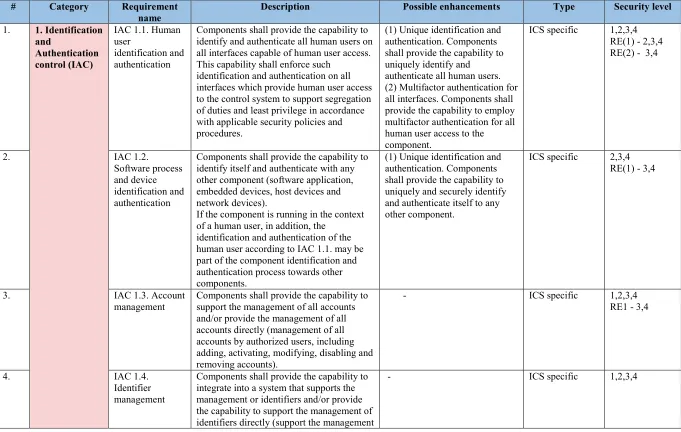
Table 5. Framework
# Category Requirement
name Description Possible enhancements Type Security level
1. 1. Identification and
Authentication control (IAC)
IAC 1.1. Human user
identification and authentication
Components shall provide the capability to identify and authenticate all human users on all interfaces capable of human user access. This capability shall enforce such
identification and authentication on all interfaces which provide human user access to the control system to support segregation of duties and least privilege in accordance with applicable security policies and procedures.
(1) Unique identification and authentication. Components shall provide the capability to uniquely identify and authenticate all human users. (2) Multifactor authentication for all interfaces. Components shall provide the capability to employ multifactor authentication for all human user access to the component.
ICS specific 1,2,3,4 RE(1) - 2,3,4 RE(2) - 3,4
2. IAC 1.2.
Software process and device identification and authentication
Components shall provide the capability to identify itself and authenticate with any other component (software application, embedded devices, host devices and network devices).
If the component is running in the context of a human user, in addition, the
identification and authentication of the human user according to IAC 1.1. may be part of the component identification and authentication process towards other components.
(1) Unique identification and authentication. Components shall provide the capability to uniquely and securely identify and authenticate itself to any other component.
ICS specific 2,3,4
RE(1) - 3,4
3. IAC 1.3. Account
management Components shall provide the capability to support the management of all accounts and/or provide the management of all accounts directly (management of all accounts by authorized users, including adding, activating, modifying, disabling and removing accounts).
- ICS specific 1,2,3,4
RE1 - 3,4
4. IAC 1.4.
Identifier management
Components shall provide the capability to integrate into a system that supports the management or identifiers and/or provide the capability to support the management of identifiers directly (support the management
27
of identifiers by user, group, role or control system interface).
5. IAC 1.5.
Authenticator management
Components shall provide the capability to: a) support the use of initial authenticator content;
b) support the recognition of changes to default authenticators made at installation time;
c) function properly with periodic authenticator change/refresh operation; d) protect authenticators from unauthorized disclosure and modification when stored, used and transmitted.
(1) Hardware security for authenticators. The authenticators on which the component rely shall be protected via hardware mechanisms.
ICS specific 1,2,3,4 RE(1) - 3,4
6. IAC 1.6 Wireless
access management
A network device supporting wireless access management shall provide the capability to identify and authenticate all users (humans, software processes or devices) engaged in wireless communication.
(1) Unique identification and authentication
The network device shall provide the capability to uniquely identify and
authenticate all users (humans, software processes or devices) engaged in wireless
communication.
Specific (NDR) 1,2,3,4 RE(1) - 2,3,4
7. Services that are accessible over a wireless
interface shall require user authentication prior to access.
Exception: Services that report status, do not provide command and control functionality or general use of the
component or do not transmit sensitive data or personally identifiable data AND only output status or historical transaction data, etc., may provide unauthenticated access.
- General 1,2,3,4
8. IAC 1.7 Strength
of password-based
authentication
For components that utilize password-based authentication, those components shall provide or integrate into a system that provides the capability to enforce configurable password strength based on minimum length and variety of character types.
(1) Password generation and lifetime restrictions for human users.
Components shall provide, or integrate into a system that provides, the capability to prevent
28
The password complexity must be configurable by the administrator and be either technically or procedurally enforced with following password parameters: - minimal password length at least of eight characters (or the maximum length supported by the component); - maximum password length;
- minimum password that is the lesser of three or more different types of characters (e.g., uppercase alphabetic, lowercase alphabetic, numeric, nonalphanumeric) or the maximum complexity supported by the component);
- minimum and maximum usage period; - prevention of re-use of previous passwords;
- maximum number of password changes per time (e.g. per day).
any given human user account from reusing a password for a configurable number of generations. In addition, the component shall provide the capability to enforce password minimum and maximum lifetime restrictions for human users. These capabilities shall conform to commonly accepted security industry practices.
(2) Password lifetime restrictions for all users.
Components shall provide, or integrate into a system that provides, the capability to enforce
password minimum and maximum lifetime restrictions for all users.
9. IAC 1.8
Password protection
If the component uses a user name-and-password mechanism for authenticating users:
a) the component shall use a secure mechanism complying with the requirements in Appendix 1 to store the passwords, they shall not be stored in plaintext;
b) authentication error messages provided by the component shall not allow for enumerating valid user names; d) the component shall protect against dictionary attacks and brute force attacks; e) the component shall have no hardcoded passwords that cannot be removed or altered.
- General 3,4
10. IAC 1.9
Password For password-only authentication for interactive user access it shall be possible to change the password at any given moment
29
changes
enforcement to enforce the policy of password regular update.
11. IAC 1.10 Public
key infrastructure certificates
When public key infrastructure (PKI) is utilized, the component shall provide or integrate into a system that provides the capability to interact and operate in accordance with commonly accepted best practices or obtain public key certificates from an existing PKI.
- General 2,3,4
12. For high availability components, the
failure of the certificate authority shall not interrupt essential functions.
- General 1,2,3,4
13. IAC 1.11
Strength of public key-based authentication
For components that utilize public-key-based authentication, those components shall provide directly or integrate into a system that provides the capability within the same ICS environment to:
a) validate certificates by checking the validity of the signature of a given certificate;
b) validate the certificate chain or, in the case of self-signed certificates, by deploying leaf certificates to all hosts that communicate with the subject to which the certificate is issued;
c) validate certificates by checking a given certificate's revocation status;
d) establish user (human, software process or device) control of the corresponding private key;
e) map the authenticated identity to a user (human, software process or device) by checking either subject name, common name or distinguished name against the requested destination;
f) ensure that the algorithms and keys used for the symmetric key authentication comply with
DC 5.3 Use of cryptography.
(1) Hardware security for public key-based authentication. The component shall provide the capability to protect the relevant private keys via hardware.
General 2,3,4
30
14. If the component uses other mechanisms
for authentication besides username and password, the mechanism used for authentication shall require as many operations to circumvent as determining the actual mechanism.
- General 3,4
15. IAC 1.12
Authenticator feedback
When a component provides an
authentication capability, the component shall provide the
capability to obscure feedback of authentication information during the authentication process.
- General 1,2,3,4
16. IAC 1.13
Unsuccessful login attempts
When a component provides an
authentication capability, the component shall provide the capability to:
a) enforce a limit of a configurable number of consecutive invalid access attempts by any user (human, software process or device) during a configurable time period; or
b) generate alerts after a threshold of unsuccessful authentication attempts ; c) deny access for a specified period of time or until unlocked by an administrator when this limit has been reached.
- General 1,2,3,4
17. Accounts used for essential functions shall
not be locked out, even temporarily.
- General 1,2,3,4
18. IAC 1.14 System
use notification When a component provides local human user access/HMI, it shall provide the capability to display a system use
notification message before authenticating. The system use notification message shall be configurable by authorized personnel.
- General 1,2,3,4
19. IAC 1.15 Access
via untrusted networks (remote interface)
Components that are accessible over a remote interface shall require user authentication prior to access.
Exception: Services that report status, do not provide command and control functionality or general use of the
31
component or do not transmit sensitive data or personally identifiable data AND only output status or historical transaction data, etc., may provide unauthenticated access but will need to be documented
20. The network device supporting device
access into a network shall provide the capability to monitor and control all methods of access to the network device via untrusted networks.
(1) Explicit access request approval.
The network device shall provide the capability to deny access requests via untrusted networks
unless explicitly approved by an assigned role.
Specific (NDR) 1,2,3,4 RE(1) - 3,4
21. IAC 1.16
Strength of symmetric key-based
authentication
For components that utilize symmetric keys, the component shall provide the capability to:
a) establish the mutual trust using the symmetric key;
s) store securely the shared secret (the authentication is valid as long as the shared secret remains secret);
t) restrict access to the shared secret; u) ensure that the algorithms and keys used for the symmetric key authentication comply with DC 5.3 Use of cryptography.
(1) Hardware security for symmetric key-based authentication.
The component shall provide the capability to protect the relevant private keys via hardware mechanisms
General 1,2,3,4
RE(1) - 2,3,4
22. 2. Use control (UC)
UC 2.1 Authorization enforcement
Components shall provide an authorization enforcement mechanism for all identified and
authenticated human users based on their assigned responsibilities and least privilege. Access to data shall only be given after successful authentication and authorization. Without successful authentication and authorization, the system shall not allow any activities.
(1) Authorization enforcement for all users.
Components shall provide an authorization enforcement mechanism for all users based on their assigned responsibilities and least privilege.
(2) Permission mapping to roles. Components shall, directly or through a compensating security mechanism, provide for an authorized role to define and modify the mapping of permissions to roles for all
General 1,2,3,4