Behaviour of Roofing Materials Facing to
Micro-Organisms
Marielle Fassier1, Céline Faugeron2, Vincent Gloaguen2, Céline Ducroquetz1, Olivier Dupont1 1Centre Technique de Matériaux Naturels de Construction, Paris, France
2Laboratoire de Chimie des Substances Naturelles, Limoges, France Email: [email protected]
Received September 18, 2012; revised October 20, 2012; accepted October 29, 2012
ABSTRACT
An accelerated water-streaming test was used to evaluate several roofing materials regarding their behavior to coloniza- tion by algae, by closely reproducing the phenomenon of natural biological soiling. A set of roofing materials with de- fined physical and chemical characteristics was thus investigated against the colonization by algae. Porosity, roughness and chemical composition showed to be factors of influence in the establishment of those micro-organisms.
Keywords: Building Materials; Fired Clay Products; Water-Streaming Test; Micro-Organisms; Colonization
1. Introduction
Algae and cyanobacteria are the first colonizers of the sheathing of the buildings in humid areas after bacteria which are omnipresent. In fact, algae and cyanobacteria colonize all the surfaces where humidity is high. So they develop in marine area but also on land substrates such as plants, rocks, grounds or even building materials [1]. These micro-organisms are present in the air in the form of spores, cells or filaments and have, in case of enough lights, humidity and nutriments, the capacity to adapt their morphology and their physiology to colonize the different types of products quoted above.
On buildings, the accumulation of micro-organisms is translated by the presence of greener black spots in con- tinental area and by red spots in coastal area [2-5]. These spots appear most of the time near the outlet pipes, the architectural flaws, and the fallout of drainpipes or the ventilation of conditioning.
Beside an unaesthetic aspect, the presence of micro- organisms on the buildings causes physical and chemical damage to the materials. In fact, algae and cyanobacteria present on the surface of the material can cause for ex- ample the dissolution of the carbonate of calcium in the case of buildings made in stone or in concrete [5]. Except this case, the presence of micro-organisms on the surface of buildings promotes the penetration of the water in the porous network of the material which leads, first, to a inflating and the appearance of cracks and then to an increase of the humidity rate in the material which is propitious to the acceleration of the process of coloniza- tion [1].
At the present time, there are different means to fight against the micro-organisms such as the mechanical cleaning, the chemical cleaning or the hydrofugation. However, these treatments are, most of the time, toxic for the environment, not very effective and very expansive.
Algae and cyanobacteria form a series of varied spe-cies of unicellular and pluricellular plants which size is generally between 0.5 µm and 1 mm. These organisms are photo-autotrophe and need an environment vivid in light and humidity useful to their photosynthesis reaction.
Green algae, presented on building, are eukaryote or- ganisms which the wall is composed of a rigid fibrillaire part and of a mucilagineuse part whereas cyanobacteria are prokaryote organisms composed of a wall formed by peptidoglycans and lipoproteins.
The colonization of the substrate by micro-organisms shows a dynamic aspect. Bacteria colonize quickly the surface of the material and they are followed by the es- tablishment of algae and cyanobacteria. This establish- ment can be divided into five steps which are the follow- ings: The development of an organic biofilm which ab- sorbs ions and organic molecules at the surface of the material, the transport of micro-organisms on the surface and the formation of co-aggregates of micro-organisms, the reversible adhesion of micro-organisms and aggre- gates, the co-adhesion of micro-organisms each other and the irreversible adhesion of micro-organisms on the sur- face of material by the secretion of exo polymers [1]. This adhesion of micro-organisms is influenced by the topography, the chemical composition and the surface tension of the substrate.
due to the uprooting, from a colonized substrate, of spores, cells or fragments of filaments and their transport, algae and cyanobacteria develop on very various surfaces [6]. The biological development of algae and cyanobac- teria is influenced by several environmental factors such as light, humidity, pluviometry, outside temperature, wind, atmospheric pollution and vegetal environment [1] but also by the physical and chemical characteristics of the colonized material such as porosity, roughness, surface tension and pH.
Researches on facades led during the twenty last years by Rindi and Gaylarde have allowed to list algae and cyanobacteria presented most of the time on buildings [1,7-9].
Concerning algae, Klebsormidium Flaccidum seems to be the most frequent with a presence rate of 55%. It fol- lows by Trebouxiaspp, Stichococcus Bacillaris, Chloro- sarcinopsis Minoe, Chlorella cf Mir and Bilis which have respectively a presence rate of 49%, 46%, 28% and 27%.
For the cyanobacteria, the most represented on facades is Cyanosarana Parthenonensis with a presence rate of 28% followed by Chroococcus Lithophilus, Calothrix Pulvinata, Leptolyngbya Foveolarum, Gloeocapsa San-guinea and Phormidium Vorium which respectively have a presence rate of 21%, 21%, 18%, 15% and 13%.
As Klebsormidium Flaccidum is the specie of algae the most present on the surfaces of building materials, it has been withheld for this study. The physical, chemical and surface characteristics of the different roofing prod-ucts have been determined. According to previous stud-ies, these criteria could have an influence on the coloni-zation of substrates by micro-organisms and that is why they have been retained. This study aims to confirm these observations and to establish correlations between the physical and chemical parameters of products and their ability to be colonized by micro-organisms.
2. Experimental
2.1. Klebsormidium Flaccidum
Klebsormidium Flaccidum is a filamentous algae hard- wearing to area strongly dehydrated even if it grows, most of the time, in area which have a high humidity.
This algae is composed of cells to barred-shaped, forming long filaments slightly constricted at cross-walls, one parietal and cup-shaped chloroplast, covering about 2/3 of the cells, with one clearly visible pyrenoid (L = 5 - 25 µm, w = 4 - 12 µm) [10,11].
The culture of Klebsormidium Flaccidum is realized in a modified Bold’s basal medium composed of three mother solutions individually pressure-sealed, after their preparation, at 120˚C for 20 minutes. 1 liter of liquid culture medium is composed of 10 mL of solution A, 10 mL of solution B and 1 mL of solution trace introduced
in 1 liter of ultra-pure water. The medium is adjusted at pH 7 and then pressure-sealed before the introduction of the strain of algae [6].
Each Erlenmeyer flask is put on magnetic agitator, to oxygenate again the medium to have a better reproduce- tion and to homogenize the suspension, in anair-condi- tioned culture room at 20˚C ± 0.5˚C where the light in-tensity is controlled (white light) and the photoperiod is 16 h/8 h (light/darkness).
The dosage of algae contained in the 2 liters Erlen- meyer flasks is determined by the measurement of the dry mass of the algae. A known volume of algae suspen- sion is filtered on membranes in micro fibers of glass which have a porosity of 1, 2 µm (Whatman GF/C). These membranes are dried at 105˚C for 3 hours. Then, the dry algae mass is determined and attributed to the filtered volume.
2.2. Analysis
2.2.1. pH Measurement
Before pH measurement, materials are grinded to ob- tain powders which are dispersed in pure water and shaken with a magnetic agitator. This measurement is realized with a pHmeterCyberscan pH 1100 (Eutech instruments).
2.2.2. Roughness Measurement
The surface of a bright or not material is not a per- fectly polished surface. In fact, it presents a lot of micro or macro geometric irregularities which are defined by comparison with an average line and are classified into two categories: peak and hollow. All these surface flaws form the roughness.
The surface roughness can be determined by the mea- surement of some parameters such as:
Rp: The maximal peak observed on the analyzed length;
Rc: The maximal hollow observed on the analyzed length;
Rt: The total roughness. It corresponds to the total of the maximal peak and the maximal hollow observed on the analyzed length;
Ra: The average distances difference between succes-sive peaks and hollows. It corresponds to the differ-ence between the average distance and the average line.
When visual and tactile comparisons are not sufficient to distinguish a difference of roughness between two sur- faces, it is necessary to use a roughness device. This de- vice is composes of an induction transducer which has a diamond point. The variations in the generated tensions are located by a sensor and then converted in different roughness parameters by the electronic of the device.
device TR 110 TIMe (Phynix). The obtained value is the average of fifty measurements realized on a sample of the substrate.
2.2.3. Contact Angle Measurement
Among the techniques used to determine the surface ten-sion of a liquid put on a solid the measurement of the contact angle of the solid is the technique the most used. This technique consists in putting a drop of a liquid on the surface of a solid and in reading the angle between this drop and the substrate. The measured value allows going back to the surface energy of the solid due to the Young equation:
SV SL LVcos
where γLV is the superficial tension of the liquid in pres- ence of vapour, γSL, the interfacial tension between the solid and the liquid, γSV, the superficial tension of the solid in presence of liquid and θ, the contact angle be- tween the liquid and the solid surface.
The experimental device used is composed of a light source and of a digital camera allowing taking a photo- graph of the drop. The damping angle is measured with software from digitized pictures. The drop is put on the solid surface with a syringe. The horizontality of the sub- strate is precisely adjusted. The software used allows digitizing the outline of the drop by the analysis of the pictures taken by the digital camera. To conclude, this software determines the static contact angle, of the liquid on the surface, thanks to interpolation methods by poly- nomials or by arcs of the circle.
2.2.4. Porosity Measurement
The determination of the density with a helium pycno- meter is realized like that: the device precisely measures the variation of gaseous volume caused by the introduc- tion of the sample in a calibrated enclosure. The volume is calculated from the pressure transfer observed when the gas passes from the cell containing the sample (pres- sure P2) to the reference cell (pressure P1). This method
is based on the Mariotte’s law.
ech cell exp 1 2
V V V P / P 1
The volume of the cell, Vcell, and the expansion vol-
ume Vexp are constants. The maximal accuracy is ±0.1%
on the volume and ±0.001 g on the weighing. Then, the density is given by the relation:
V
m
where m is the sample mass and V, the sample volume. This measure has been realized with a helium pycno- meter ACCUPYC 1330 (Micromeritics). From the densi- ties of the bulkyand the grinded sample, the opened po- rosity has been deduced to use the equation:
grinded bulky
grindedP
2.2.5. The Water-Streaming Test
To evaluate the behavior of building materials facing with the presence of micro-organisms, an experimental device has been developed. This device simulates speed- ing up the colonization, by algae, on the exposed surface of materials.
The principle of the water-streaming test consists in the dampening of the surface of the material by water streaming which is comparable to the rain flow on fa- cades or roof tiles of buildings.
This device, developed by Boulon and Dubosc, is composed of a closed box where the humidity is rela- tively high, favorable to the development of micro-or- ganisms [12]. In this box, the samples are put back to back on two supports in stainless steel at an angle of 45˚
to increase the colonization process. At regular time in- tervals, the samples are sprayed by the Klebsormidium- Flaccidum culture, kept at a constant temperature by a thermo-regulator, presented in the bottom of the box. This spraying is realized by a ramp pierced by holes which have a constant diameter at equal distance each other. Moreover, the box is installed in a room where the temperature and the relative humidity are controlled and have two footlights composed of two neon tubes which have a known intensity (1500 lux, 30 W) and according to a photo period controlled (12 h/12 h).
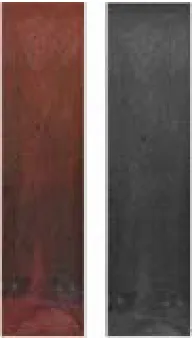
At regular time intervals, the biological development is evaluated by pictures analysis. The kinetic of coloniza- tion on the surface of materials is evaluated by pictures analysis. The surface of the samples installed in the wa- ter-streaming test is digitized at regular time intervals with an office scanner. Then, the digitized pictures are treated to digitize the signal as on the Figure 1.
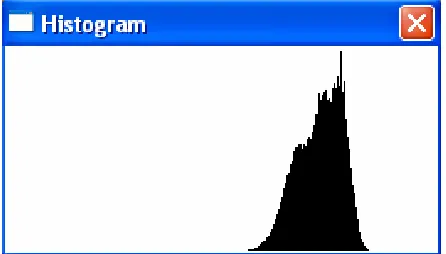
Then, the digitized pictures are treated with a pictures
[image:3.595.375.472.539.708.2]Figure 2. Histogram of the digitized picture representing the number of pixels in function of their intensity.
analysis program to establish ahistogram (Figure 2) rep-
resenting the number of pixels in function of their inten- sity.
In this treatment, the intensity 0 is attributed to the black pixels and the white pixels correspond to the inten- sity 255. At the end, to make the area corresponding to the colonization of the micro-organisms more detectable, a threshold is realized for the maximal intensity of the peaks of the histogram. So, the micro-organisms seem to be white on the black support. Then, the percentage of colonization on the sample is obtained making the ratio between the pixels corresponding to the micro-organisms and the total number of pixels. To the end, a graph show- ing the evolution of the growing of micro-organisms in function of the exposure time in the water-streaming test is drawn for each sample series.
2.3. Materials
During this study, the materials used are the followings: Slate: It is a metamorphic rock belonging to the family of clayey shales. It is generally composed of silica, alu- mina, iron oxide, magnesia, potash and soda. It is hard- wearing and its color can vary from the white to the black. Slate can be rectangular or scale-shaped. Its thick- ness varies between 3 and 9 mm.
Concrete: It is a powdery material, making with water or a saline solution, a binding agent able to agglomerate varied substances when it hardens. This hydraulic bond- ing agent hardens quickly and reaches in few days its maximal resistance. So, after hardening, this paste keeps its resistance and its tenacity even under water. A ho- mogenous mixture is realized by humid, half-humid, half dry or dry way and then the mixture is introduced in a tubular rotary kiln, lightly sloped, at a temperature about 2000˚C. A sudden and fast cooling of the mixture leads to the elaboration of the clinker. The composition of the concretes is a mixture of calcium silicates and calcium aluminates due to the combination of the lime with silica, alumina and iron oxide.
Glass: Glass is a hard, fragile, brittle and transparent to the visible radiation material, most of the time derived from siliceous sand. This is an amorphous material hav- ing an important structural disorder and the phenomenon of vitreous transition. It is generally composed of silica and flux. This material has good compatibility with most of chemical compounds exception to hydrofluoric acide.
Fibrocement: It is a building material composed of concrete reinforced by synthetic or natural fibers.
Clay roofing tiles: A roof tile is, most of the time, a fired clay product used as a roofing element. Fired clay products are made from fired clays at high temperature. So, the firing temperature is between 800˚C and 1150˚C to confer to the products a low porosity, a mechanical resistance, functionality and a surface aspect. The surface aspect depends of several parameters such as the choice of the raw materials, the drawing of the pattern and the process of fabrication. These products can be without coating, with a silicone coating or with a glazed coating.
3. Results and Discussion
3.1. Physical and Chemical Characteristics of the Roofing Products
The physical, chemical and surface characteristics of the different roofing products have been determined and summed up in the Table 1. These characteristics are the
porosity, the contact angle, the roughness and the pH. Thanks to the porosity of the roofing products and par- ticularly to their porosity rate, it is possible to divide the roofing products into two categories. In fact, fired clay roofing tiles, which have or not a silicone coating, show a high porosity such as the concrete tiles. The noticed porosity is between 15% and 33%. Concerning the fibro- cement sheets they have also a high porosity about 30%. Contrary, the glass tiles and the slates show a low poros- ity widely inferior to the previous products because it does not exceed 1%.
[image:4.595.309.537.599.736.2]Concerning the contact angle of the surface of these different roofing products, it is very different from one
Table 1. Physical, chemical and surface characteristics of the roofing products.
Material Porosity (%) Contact angle (˚) Roughness (µm) pH Fired clay tile
without coating 14.9 48.5 5.1 8.4
Fired clay tile with
a silicone coating 29.4 67.5 4.4 8.2
Concrete tile 33.0 0.0 7.9 11.6
Glass tile 0.5 30.0 2.5
Slate 0.7 20.0 3.8
product to another but stays however in the area of hy- drophilicity. In fact, the values of the static contact angle of a drop of water deposited on the surface of the differ- ent materials does not exceed 68˚ which means that all the products cannot prevent water to stagnate at their surface provoking its streaming. So, these materials are propitious to their colonization by micro-organisms due to the fact of the presence of water at their surface. How- ever, it seems that when a water drop is deposited on the surface of a concrete tile or on a fibrocement sheet, a state of total damping is observed. This lets to think that these materials will be more favorable to the coloniza- tion by micro-organisms then the others and so the colo- nization will be faster and higher.
The average roughness of the surface of the different products is spread between 2.5 and 7.9 µm. The differ- ence between the values is not very important but the higher value observed for the concrete tile lets to think that this product will be easier colonized by the micro- organisms than the others and precisely than the glass tile which has the average roughness lower.
Concerning the pH values, they show that all the products have a basic surface which is propitious to their colonization by micro-organisms. In fact, algae are in- clined to hang on substrates which have pH values be- tween 9 and 11 [1]. These observations let to think that concrete tile, having a pH value about 11.6, such as the fibrocement sheet (pH ≈ 9.9), are more propitious to the colonization by micro-organisms than the others. So the colonization of their surface by algae will be faster and higher.
3.2. Behavior of the Roofing Materials Facing with Micro-Organisms
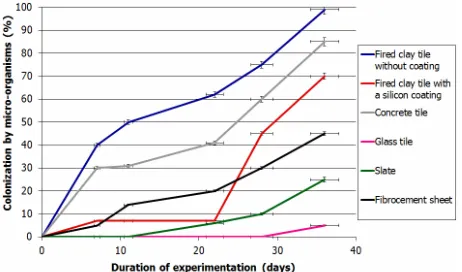
Concerning the roofing products, trials have been real- ized to compare their resistance to micro-organisms. The results are presented on Figure 3.
First, it is important to notice that whatever the coating
Figure 3. Kinetic of colonization and of growth of micro- organisms on the surface of three samples of several roofing materials.
or the material, the colonization of the surface by micro- organisms does not appear after the same duration passed in the time passed in the water-streaming test. For the samples of fired clay tile without coating, between the 1st and the 9th day, the colonization and the proliferation of micro-organisms on the surface of the samples is very high and very important. In fact, the surface of the sam-ples is covered at 57% after nine days of exposure. This development is linear with regard to the exposure time during this period. Between the 9th and the 20th day, the proliferation of algae keeps accelerating becoming ex-tremely important. After twenty days of exposure in the water-streaming test, the surface of the samples of fired clay tile is covered at 61%. Between the 20th and the 32nd day of exposure, the speed of colonization of mi-cro-organisms strongly reduces to become independent of time. In fact, the rate of colonization becomes nearly constant to reach a total covering of the samples of 99% at the end of the experience. To conclude, the fired clay tile shows a fast and important greening.
[image:5.595.58.289.558.694.2]the experiment. The micro-organisms do not find hang- ing points, they cannot develop and they are washed by the successive watering. Silicone products, showing a hydrophobic surface, promote water streaming on their surface and so the slowdown in the colonization of sur- faces by micro-organisms during this period. However, after twenty days of exposure, the silicone layer at the surface of samples is damaged by the successive water streaming and the behavior of the surface of the product becomes comparable to the behavior of a fired clay tile without coating. The colonization and the proliferation of micro-organisms become more important and the final covering rate of the samples reaches 70%.
For the concrete tile, their behavior facing the green- ing is comparable to the behavior of a fired clay tile without coating. In fact, between the 1st and the 7th day, the colonization and the proliferation of micro-organisms at the surface of the samples are very high and very im- portant. The surface of the samples is covered at 30% after seven days of exposure. This development is linear with regard to time exposure during this period. Between the 7th and the 22nd day, the proliferation of algae stays notable but the speed decreases with regard to the first period of the experiment. So, after twenty two days of exposure in the water-streaming test, the surface of the samples on concrete tile is covered about 41%. Between the 22nd and the 36th day of exposure, the speed of colo- nization of micro-organisms strongly increases with re- gard to the exposure time. In fact, the colonization rate becomes very important and high to reach a final cover- ing of the samples of 85% at the end of the experiment. To conclude, concrete tile shows a fast and important greening from the beginning of the experiment. Micro- organisms find hanging and development points easily and they are uniformly distributed at the surface of the samples. The covering rate is important and reaches a final value of 85% of the surface.
For the fibrocement sheet, the kinetic of colonization of micro-organisms at their surface is comparable to the kinetic observed on fired clay tile without coating but the rate and the speed of proliferation of micro-organisms stay lower. So, between the 1st and the 7th day, the colo- nization and the proliferation of micro-organisms at the surface of the samples are limited and low. In fact, the surface of the samples is covered at 5% after seven days of exposure. This development is linear with regard to the exposure time during this period. Between the 7th and the 11th day, the proliferation of algae is so impor-tant and the development of algae at the surface of sam-ples becomes faster and more present. So, after eleven days of exposure in the water-streaming test, the surface of samples is covered at 14%. Between the 11th and the 20th day of exposure, the speed of colonization of mi-cro-organisms seems to stagnate and become
independ-ent of the exposure time. Algae stay at the surface of the samples but do not grow. The colonization rate stays around 20% of the surface. Then, between the 22nd and the 36th day of exposure, the colonization and the prolif-eration of micro-organisms at the surface of the fibro-cement sheet continue and are very strong. The devel-opment of algae is faster and more important than in the previous period of the trial. The final covering of the samples is about 45%. To conclude, the fibrocement sheet shows a more limited greening than the fired clay tile without coating at the beginning of the trial. However, the colonization of micro-organisms intensifies and be-comes faster after about twenty days of exposure in the water-streaming test. So it seems that after a certain ex-posure time, the surface of the samples of fibrocement sheet is totally saturated with water and shows a biologi-cal layer and a nutritive medium propitious to the fixing and the development of micro-organisms. The final cov-ering rate reaches 45% of the surface.
Concerning the slate, it is important to notice that the colonization by micro-organisms appears on these sur- faces only after eleven days of exposure. Then, between the 11th and the 28th day, the colonization and the prolif- eration of micro-organisms at the surface of the samples are limited and low. In fact, the surface of the samples is covered at about 10% after twenty eight days of exposure. This development is linear with regard to the exposure time during this period. Between the 28th and the 36th day, the proliferation slightly increases but so significant and the development of algae at the surface of the sam-ples becomes more important and present. So, after thirty six days of exposure in the water-streaming test, the sur-face of the samples is covered at about 25%. To conclude, the samples of slate show an important delay of greening with regard of fired clay tile without coating. In fact, the greening appears only after eleven days of exposure in the water-streaming test. At the end of this period, algae develop at the surface of the samples but slowly and it is limited because the final covering after thirty six days of exposure does not exceed 25%. So, these products show the property to delay so important the greening with re- gard to the fired clay product without coating thanks to, in majority, their physical, chemical and surface proper- ties.
delay of greening with regard to the fired clay tile with-out coating. In fact, the greening appears only after twenty eight days of exposure in the water-streaming test. Further to this period, algae develop at the surface of the samples but this development is slow and limited be-cause the final covering after thirty six days of exposure dos not exceed 6%. So these products show the property to delay so important the greening with regard to the fired clay tile without coating thanks to, in majority, their physical, chemical and surface characteristics.
4. Conclusions
The analysis of physical, chemical and surface character- istics of roofing products allows putting above differ- ences between materials and doing supposition with re- gard to their behavior facing micro-organisms. The ana- lysis of curves representing the percentage of coloniza- tion of these surfaces by micro-organisms allows con- firming these suppositions.
In fact, it appears that:
More the porosity is high, more the colonization of substrates, by micro-organisms, is fast and important;
More the contact angle of the surface of the products is low, that is to say more water is inclined to spread on the support, more the colonization of substrates is fast and important;
More the average roughness of the surface of the sub- strates is high, more the colonization of supports is fast and important;
For basic pH values, micro-organisms hold on the substrates and develop easier at the surface of sub- strates.
For the future, it could be interesting to observe the behavior of the building materials in front of micro-or- ganisms when they are treated with commercial hydro- fuge solutions. This future study can be interesting to evaluate the efficiency of these commercial products against micro-organisms.
REFERENCES
[1] H. Barbebrousse, B. Ruot, C. Yéprémian and G. Boulon, “An Assessment of Façade Coatings against Colonisation by Aerial and Cyanobacteria,” Building and Environment, Vol. 42, No. 7, 2007, pp. 2555-2561.
doi:10.1016/j.buildenv.2006.07.031
[2] P. Berdahl, H. Akbari, R. Levinson and W. A. Miller, “Weathering of Roofing Materials—An Overview,” Con-struction and Building Materials, Vol. 22, No. 4, 2008, pp. 423-433. doi:10.1016/j.conbuildmat.2006.10.015 [3] D. M. John, “Algae Growths on Buildings: A General
Review and Methods of Treatment,” Biodeterioration Abstracts, Vol. 2, No. 67, 1988, pp. 81-102.
[4] R. J. Lombardo, H. Barberousse, G. Tell and A. Couté, “Factors Involved in the Colonization of Building Fa-cades by Algae and Cyanobacteria in France,” Biofouling, Vol. 22, No. 2, 2006, pp. 69-77.
doi:10.1080/08927010600564712
[5] H. E. Schlichting, “Some Subaerial Algae from Ireland,”
British Phycological Journal, Vol. 10, No. 3, 1975, pp. 257-261. doi:10.1080/00071617500650251
[6] H. C. Bold, “Arbornealgae: Their Abundance and Het-erogeneity,” Science, Vol. 143, No. 3606, 1964, pp. 583- 585. doi:10.1126/science.143.3606.583
[7] C. C. Gaylarde, P. M. Gaylarde, J. Copp and B. Neilan, “Polyphasic Detection of Cyanobacteria in Terrestrial Biofilms,” Biofouling, Vol. 20, No. 2, 2004, pp. 71-79. doi:10.1080/08927010410001681237
[8] F. Rindi and M. D. Guiry, “Composition and Distribution of Subarial Algal Assemblages in Galway City, Western Ireland,” Cryptogamie-Algologie, Vol. 24, No. 3, 2003, pp. 245-267.
[9] F. Rindi and M. D. Guiry, “Composition and Spatial Variability of Terrestrial Algal Assemblages Occurring at the Bases of Urban Walls in Europe,” Phycologia, Vol. 43, No. 3, 2004, pp. 225-235.
doi:10.2216/i0031-8884-43-3-225.1
[10] M. A. Shirakawa, K. Loh, V. M. John, M. E. S. Silva and C. C. Gaylarde, “Biodeterioration of Painted Mortar Sur-faces in Tropical Urban and Coastal Situations: Com-parison of Four Paint Formulations,” International Bio-deterioration & Biodegradation, Vol. 65, No. 5, 2011, pp. 669-674. doi:10.1016/j.ibiod.2011.03.004
[11] K. D. Stewart and K. R. Mattox, “Structural Evolution in the Flagellated Cells of Green Algae and Land Plants,”
Biosystems, Vol. 10, No. 1-2, 1978, pp. 145-152. doi:10.1016/0303-2647(78)90036-9