Munich Personal RePEc Archive
Designing Matching Mechanisms under
Constraints: An Approach from Discrete
Convex Analysis
Kojima, Fuhito and Tamura, Akihisa and Yokoo, Makoto
Stanford University, Keio University, Kyushu University
30 April 2014
Designing Matching Mechanisms under Constraints:
An Approach from Discrete Convex Analysis
∗Fuhito Kojima
Akihisa Tamura
Makoto Yokoo
†. First version: April 22, 2014 This version: May 9, 2018
Abstract
We consider two-sided matching problems where agents on one side of the market (hospitals) are required to satisfy certain distributional constraints. We show that when the preferences and constraints of the hospitals can be represented by an M♮-concave function, (i) the
generalized Deferred Acceptance (DA) mechanism is strategyproof for doctors, (ii) it produces the doctor-optimal stable matching, and (iii) its time complexity is proportional to the square of the number of pos-sible contracts. Furthermore, we provide sufficient conditions under which the generalized DA mechanism satisfies these desirable prop-erties. These conditions are applicable to various existing works and
∗Accepted for publication in Journal of Economic Theory
enable new applications as well, thereby providing a recipe for devel-oping desirable mechanisms in practice.
JEL Classification: C78, D61, D63
Keywords: two-sided matching, many-to-one matching, market
de-sign, matching with contracts, matching with constraints, M♮-concavity, strategyproofness, deferred acceptance.
1
Introduction
The theory of two-sided matching has been extensively developed, and it has been applied to design clearinghouse mechanisms in various markets in practice.1 As the theory has been applied to increasingly diverse types of
en-vironments, however, researchers and practitioners have encountered various forms of distributional constraints. As these features have been precluded from consideration until recently, they pose new challenges for market de-signers.
The regional maximum quotas provide an example of distributional con-straints. Under the regional maximum quotas, each agent on one side of the market (who we call a hospital) belongs to a region, and there is an upper bound on the number of agents on the other side (who we call doctors) who can be matched in each region. Regional maximum quotas exist in many markets in practice. A case in point is medical residency matching in Japan. Although the match organizers initially employed the standard Deferred Ac-ceptance (DA) mechanism (Gale and Shapley, 1962), it was criticized as placing too many doctors in urban areas and causing doctor shortages in rural areas. To address this criticism, the Japanese government now imposes a regional maximum quota on each region of the country. Regulations that are mathematically isomorphic to regional maximum quotas are utilized in various contexts, such as Chinese graduate admission, Ukrainian college ad-mission, and Scottish probationary teacher matching, among others (Kamada and Kojima, 2012, 2015).
Furthermore, there are many matching problems in whichminimum quo-tas are imposed. School districts may need at least a certain number of students in each school in order for the school to operate, as in college ad-missions in Hungary (Biro, Fleiner, Irving, and Manlove, 2010). The
cadet-1See Roth and Sotomayor (1990) for a comprehensive survey of many results in this
branch matching program organized by United States Military Academy im-poses minimum quotas on the number of cadets who must be assigned to each branch (S¨onmez and Switzer, 2013). Yet another type of constraints takes the form of diversity constraints. Public schools are often required to satisfy balance between different types of students, typically in terms of so-cioeconomic status (Ehlers, Hafalir, Yenmez, and Yildirim, 2014). Several mechanisms have been proposed for each of these various constraints, but previous studies have focused on tailoring mechanisms to specific settings, rather than providing a general framework.2
This paper develops a general framework for handling various distribu-tional constraints in the setting of matching with contracts (Hatfield and Milgrom, 2005). We begin with a simple model in which, on one side of the market, there exists just one hypothetical representative agent, the hospi-tals. Although extremely simple, this model proves useful. More specifically, we offer methods to aggregate the preferences of individual hospitals and
distributional constraints into a preference of this representative agent and, as detailed later, use this aggregation to help analyze matching with con-straints.3
For this model with the hospitals, the crux of our analysis is to asso-ciate the preference of the hospitals with a mathematical concept called M♮-concavity (Murota and Shioura, 1999).4 M♮-concavity is an adaptation
of concavity to functions on discrete domains, and has been studied exten-sively in discrete convex analysis, a branch of discrete mathematics. We
2Examples of papers that accommodate specific constraints include Ehlers, Hafalir,
Yenmez, and Yildirim (2014); Fragiadakis, Iwasaki, Troyan, Ueda, and Yokoo (2016); Goto, Iwasaki, Kawasaki, Kurata, Yasuda, and Yokoo (2016); Goto, Iwasaki, Kawasaki, Yasuda, and Yokoo (2014); Kamada and Kojima (2015). Needless to say, we do not claim to subsume all the results in the existing studies. For instance, Kamada and Kojima (2017a) allow for general choice functions that satisfy substitutability, while our study focuses on choice functions that satisfy M♮-concavity, which is a stronger requirement.
Another notable example is the study of matching with minimum quotas by Fragiadakis and Troyan (2017). Their mechanisms are different from ours, and whether there is any way to reduce their problem to our framework, or even any matching framework with substitutability, is an open question.
3In fact, our results readily generalize for cases with multiple, separate hospitals each
of which satisfies M♮-concavity. The assumption of exactly one agent on the hospital
side is made for simplicity only and, as stated above, that model proves sufficient for our purposes. A similar technique has been used by Kamada and Kojima (2017a).
4The letter M in M♮-concavity comes from “matroid,” a mathematical structure that
show that if the hospitals’ aggregated preference can be represented by an M♮-concave function, then the following key properties in two-sided
match-ing hold: (i) the generalized Deferred Acceptance (DA) mechanism (Hatfield and Milgrom, 2005) is strategyproof for doctors, (ii) the resulting match-ing is stable (in the sense of Hatfield and Milgrom (2005)) and optimal for each doctor among all stable matchings, and (iii) the time complexity of the generalized DA mechanism is proportional to the square of the number of possible contracts.
Equipped with this general result, we study conditions under which the hospitals’ preference can be represented by an M♮-concave function. We start
by separating the preference of the hospitals into two parts. More specifically, we divide the preference of the hospitals into hard distributional constraints for the contracts to be feasible, and soft preferences over a family of feasible contracts. Drawing upon techniques from discrete convex analysis, we first show that if the hospitals’ preference is represented by an M♮-concave
func-tion, then a family of the sets of contracts that satisfy hard distributional constraints (which we call hospital-feasible contracts) must constitute a ma-troid. Next, we show that if the hard distributional constraints constitute a matroid and the soft preferences satisfy certain easy-to-verify conditions (e.g., they can be represented as a sum of values associated with individual con-tracts), then the hospitals’ preference can be represented by an M♮-concave
function; thus the generalized DA mechanism satisfies desirable properties. One of the main motivations of our work is to provide an easy-to-use recipe, or a toolkit, for organizing matching mechanisms under constraints. Although our general result is stated in terms of the abstract M♮-concavity
2014; Kamada and Kojima, 2015, 2017a,b), regional minimum quotas (Goto, Iwasaki, Kawasaki, Kurata, Yasuda, and Yokoo, 2016), diversity require-ments in school choice (Ehlers, Hafalir, Yenmez, and Yildirim, 2014), the student-project allocation problem (Abraham, Irving, and Manlove, 2007), and the cadet-branch matching program (S¨onmez and Switzer, 2013).5
We further demonstrate the applicability of our methodology by intro-ducing a novel application. We examine a case in which constraints are defined based on the distance from a given ideal distribution. To our knowl-edge, no mechanism with desirable properties has been found in this setting before, but our general methodology enables us to find such a mechanism straightforwardly.6 As such, we believe that this study contributes to the
ad-vance of practical market design (or “economic engineering”) as emphasized in the recent literature (see Roth (2002) and Milgrom (2009) for instance), by providing tools for organizing matching clearinghouses in practice.
The rest of this paper is organized as follows. First, in the rest of this section, we discuss related literature. In Section 2, we introduce our model. In Section 3, we prove that when the hospitals’ preference is represented as an M♮-concave function, the above-mentioned key properties hold. In
Section 4, we present several sufficient conditions under which the general-ized DA satisfies these key properties. Then, in Section 5, we examine an existing application (regional maximum quotas) and a new application (dis-tance constraints) on two-sided, many-to-one matching problems and show that the sufficient conditions described in the previous section hold in these cases. Furthermore, in Section 6, we discuss how to modify distributional constraints and soft preferences when applying our framework. Finally, Sec-tion 7 concludes this paper. Proofs are deferred to the online appendix unless noted otherwise.
Related literature
Although matching with constraints is a fairly new research topic, questions related to this issue have been studied in the literature in various specific contexts. In the U.K. medical match in the 20th century, some hospitals
pre-5Most of these results are presented in the online appendix.
6In the online appendix, we examine another novel application. Specifically, we study
ferred to hire at most one female doctor (Roth, 1991). In school choice, many schools are subject to diversity constraints in terms of socioeconomic sta-tus and academic performance (Abdulkadiro˘glu, 2005; Abdulkadiro˘glu and S¨onmez, 2003; Echenique and Yenmez, 2015; Ehlers, Hafalir, Yenmez, and Yildirim, 2014; Hafalir, Yenmez, and Yildirim, 2013; Kojima, 2012). Con-straints placed oversetsof agents have been studied in the context of student-project allocations (Abraham, Irving, and Manlove, 2007), college admission (Biro, Fleiner, Irving, and Manlove, 2010), and medical residency matching (Goto, Iwasaki, Kawasaki, Kurata, Yasuda, and Yokoo, 2016; Goto, Iwasaki, Kawasaki, Yasuda, and Yokoo, 2014; Kamada and Kojima, 2015, 2017a,b). Our marginal contribution over these existing studies is to present a unified framework and analyze these specific markets as well as others using a single technique: as will be seen below, our theory can be applied to a wide variety of existing applications as well as new ones (Section 5).
Our paper is at the intersection of discrete mathematics and economics. In the former research field, there is a vast literature on discrete optimization. Its insight has been used in a broad range of applications such as schedul-ing, facility location, and structural analysis of engineering systems among others: see Murota (2000) or Schrijver (2003) or Korte and Vygen (2012), for instance. Recent advances in discrete convex analysis have found appli-cations in exchange economies with indivisible goods (Murota, 2003; Murota and Tamura, 2003; Sun and Yang, 2006), systems analysis (Murota, 2003), inventory management (Huh and Janakiraman, 2010; Zipkin, 2008) and auc-tion (Murota, Shioura, and Yang, 2013). As this long, and yet partial, list suggests, techniques from this literature can be applied to a wide variety of problems. We add matching problems to this list. As suggested by our analysis, results from discrete convex analysis may provide useful tools for studying matching specifically as well as economics in general.
This paper is not the first to apply discrete convex analysis to matching problems.7 Fujishige and Tamura (2006, 2007) and Murota and Yokoi (2015)
apply discrete convex analysis to study matching problems, and some of our analysis draws upon their results.8 9 Our marginal contributions are twofold.
7See the survey paper by Murota (2016) on applications of discrete convex analysis to
economics.
8More specifically, these works deal with a many-to-many matching problem, in which
a doctor/worker can work at multiple hospitals/firms. Fujishige and Tamura (2006, 2007) also consider continuous transfer and quasilinear payoff functions.
match-First, while incentive issues are not a central topic in these existing studies, they are one of the main issues in our analysis, i.e., we apply our technique to show that the generalized DA mechanism is strategyproof for doctors. Such a strategic question is a natural issue in economics, but it is rarely studied in the optimization literature. In this sense, we provide new economic questions to the discrete optimization literature. Second, we are the first to establish that various constraints found in practice can be addressed by the technique of discrete convex analysis.
This paper uses the framework of matching with contracts due to Hat-field and Milgrom (2005).10 They identify a set of conditions for key results
in matching with contracts. More specifically, if the choice function of ev-ery hospital satisfies substitutability, the law of aggregate demand, and the irrelevance of rejected contracts, then a generalized DA mechanism finds a stable allocation, and the mechanism is strategyproof for doctors.11 Hatfield
and Kojima (2009, 2010) further show that the generalized DA mechanism is group strategyproof for doctors.12Our analysis draws upon those studies, but
it makes at least three marginal contributions over them. First, we provide three sufficient conditions for the key results to hold, where the requirements over soft preferences are elementary. Thus, basically all one needs to show is that the given hard distributional constraints produce a matroid. Second, there exists a vast literature on matroid theory, and what kinds of constraints produce a matroid is well-understood. Therefore, it usually suffices to show that the hard distributional constraints can be mapped into existing results in matroid theory. Lastly, the time complexity of the generalized DA
mecha-ing. His analysis is a special case of a more recent contribution by Fujishige and Tamura (2007).
10Fleiner (2003) obtains some of the results including the existence of a stable allocation
in a framework that is more general than the model of Hatfield and Milgrom (2005). On the other hand, he does not show results regarding incentives, which are important for our purposes.
11Hatfield and Milgrom (2005) implicitly assume the irrelevance of rejected contracts
throughout their analysis. Ayg¨un and S¨onmez (2013) point this out and show that this condition is important for the conclusions of Hatfield and Milgrom (2005), while showing that substitutability and the law of aggregate demand imply the irrelevance of rejected contracts.
12Other contributions in matching with contracts include Hatfield and Kojima (2008),
nism is polynomial under M♮-concavity while this property is not guaranteed
under general substitutable preferences. This property is very important in practical application.
As stated above, one of the main goals of our paper is to identify a class of payoff functions that is general enough to represent various distributional constraints and preferences, while being tractable enough so that desirable normative properties can be established. Although this research program is still in its infancy, there are notable contributions. Hatfield and Milgrom (2005) set the agenda by introducing a family of payoff functions called en-dowed assignment valuations. A variant of this class of functions is proposed by Milgrom (2009) and further studied by Budish, Che, Kojima, and Mil-grom (2013), while Ostrovsky and Paes Leme (2015) propose a new class of payoff functions called matroid-based valuations. We contribute to this line of research in several ways. First, we identify a superclass of payoff functions, M♮-concave functions, as the key to our approach.13 Second, in addition to
various sufficient conditions, we identify a necessary condition for a payoff function to allow the use of our theory in terms of the matroid structure.
This paper is part of the literature on practical market design, both in terms of content and in terms of approach. As advocated by Roth (2002), recent market design theory has focused on solving practical problems by providing detailed and concrete solutions.14 Real problems often share
com-mon basic features, but differ substantially in details. For instance, differ-ent school districts share some common goals such as efficiency, stability (fairness) and incentive compatibility, but can differ in some details such as diversity constraints, structure of school priorities, and authoritative power of individual schools (Abdulkadiro˘glu, Pathak, and Roth, 2005, 2009; Ab-dulkadiro˘glu, Pathak, Roth, and S¨onmez, 2005, 2006). In this respect, our contributions are twofold. First, our framework provides mechanisms that can be applied to a variety of existing problems as discussed earlier. Second,
13Ostrovsky and Paes Leme (2015) demonstrate that the class of endowed assignment
valuations is a strict subset of the matroid-based valuations. The matroid-based valuations is a subset of the class of valuations that satisfy the gross substitutes condition. The gross substitutes condition is equivalent to M♮-concavity (Fujishige and Yang, 2003). As
Ostrovsky and Paes Leme (2015) mention, it is still an open question whether the matroid-based valuations is equivalent to the class of valuations that satisfy the gross substitutes condition.
14Auction market design emphasizes the importance of addressing practical problems
we develop a theory of matching under constraints that could be applied to new problems that have not been found yet but may be found in the future. Finally, this paper is part of the literature on matching and market design. The field is too large to even casually summarize here. Instead, we refer inter-ested readers to surveys by Roth and Sotomayor (1990), Roth (2008), S¨onmez and ¨Unver (2011), Abdulkadiro˘glu and S¨onmez (2013), Pathak (2016), and Kojima (2016).
2
Model
A market is a tuple (D, H, X,(≻d)d∈D, f). D is a finite set of doctors and
H is a finite set of hospitals. X is a finite set of contracts. Each contract x ∈X is bilateral, in the sense that x is associated with exactly one doctor xD ∈ D and exactly one hospital xH ∈ H. Each contract can also contain
some terms of contracts such as working time and wages. Each≻drepresents
the strict preference of each doctor d over acceptable contracts within Xd=
{x ∈ X | xD =d}.15 We assume each contract x ∈ X is acceptable for xH:
if a hospital considers a contract unacceptable, it is not included in X. For notational simplicity, for X′ ⊆ X and x ∈ X, we write X′+x and X′ −x
to represent X′∪ {x} and X′\ {x}, respectively. Also, when x =∅, X′+x
means nothing is added to X′, and X′ −x means nothing is removed from
X′.
We assume some distributional constraints are enforced on feasible con-tracts. We assume such distributional constraints and hospital preferences are aggregated into a preference of a representative agent, which we call “the hospitals” (Section 5 and Appendix C illustrate in detail how such aggrega-tions can be done in various applicaaggrega-tions). The preference of the hospitals is represented by a payoff function f : 2X → R∪ {−∞}, where R is the
set of all real numbers. For two sets of contracts X′, X′′ ⊆X, the hospitals
strictly prefer X′ over X′′ if and only if f(X′) > f(X′′) holds. If X′ ⊆ X
violates some distributional constraint, then f(X′) = −∞. We assume f is
normalized by f(∅) = 0.16 Also, we assume f is unique-selecting, i.e., for all
15More precisely, we assume that for each doctord, the set of acceptable contracts for
dis given as a subset ofXd, and≻d represents a strict preferences over that set. Clearly,
it is equivalent to a (more standard) model in which we let≻d be a strict preference over
Xd∪ {∅}where∅is the outside option, and say that a contract xis acceptable ifx≻d∅.
be-X′ ⊆X, |arg max
X′′⊆X′f(X′′)|= 1 holds.17
Now, we introduce several concepts used in this paper.
Definition 1 (feasibility). For a subset of contracts X′ ⊆ X, we say X′ is hospital-feasible if f(X′)̸= −∞. We say X′ is doctor-feasible if for all
d ∈ D, either (i) X′
d = {x} and x is acceptable for d, or (ii) Xd′ = ∅ holds,
where X′
d = {x ∈ X′ | xD = d}. We say X′ is feasible if it is doctor- and
hospital-feasible. We call a feasible set of contracts a matching.
With a slight abuse of notation, for two sets of contractsX′ and X′′, we
denote X′
d≻d Xd′′ if either (i) Xd′ ={x′}, Xd′′ ={x′′}, and x′ ≻dx′′ for some
x′, x′′ ∈X
d that are acceptable ford, or (ii)Xd′ ={x′}for some x′ ∈Xd that
is acceptable for d and X′′
d =∅. Furthermore, we denote Xd′ ⪰dXd′′ if either
X′
d ≻d Xd′′ or Xd′ = Xd′′. Also, we use notations like x ≻d Xd′ or Xd′ ≻d x,
where x is a contract andX′ is a matching. Furthermore, for X′
d ⊆ Xd, we
say X′
d is acceptable fordif either (i) Xd′ ={x}and x is acceptable ford, or
(ii) X′
d=∅ holds.
For each doctor d, its choice function Chd specifies her most preferred
contract within X′ ⊆X, i.e., Ch
d(X′) ={x}, where x is the most preferred
acceptable contract in X′
d if one exists, and Chd(X′) =∅ if no such contract
exists. Then, the choice function of all doctorsChD is defined asChD(X′) :=
∪
d∈DChd(X′).
For the hospitals, their choice function ChH is defined by ChH(X′) =
arg maxX′′⊆X′f(X′′) for each X′ ⊆X. Since we assume payoff function f is
unique-selecting, ChH is uniquely determined by f.
Note that ifX′ contains multiple contracts that are related to the same
doctor d,ChH is allowed to choose them simultaneously.
Definition 2 (stability (Hatfield and Milgrom, 2005)). We say a matching X′ is stable if X′ = Ch
H(X′) = ChD(X′) and there exists no x ∈ X\X′
such that x∈ChH(X′+x) andx∈ChD(X′+x).18
cause it implies that∅ is hospital-feasible.
17Observe that strict preference of the hospitals, a standard assumption in matching
theory, implies f is unique-selecting, but the converse does not hold. Also we note that if
f is not unique-selecting, we can obtain a unique-selecting function by modifyingf very slightly. Let us define a total order relation onX, and for eachx∈X, let rank(x) represent the position ofxwithinX according to this relation, i.e., rank(x) =i ifxis ranked i-th. Also, let v(x) denote ϵ·2−rank(x), where ϵis a sufficiently small positive number. Then,
f(X′)+∑
x∈X′v(x) is unique-selecting and arg max[f(X′)+
∑
x∈X′v(x)]⊆arg maxf(X′).
We sometimes refer to the stability concept in Definition 2 as Hatfield-Milgrom (HM)-stability when we discuss the relation with other stability concepts.
LetX be the set of all stable matchings. We say X′ ∈ X is the doctor-optimal stable matching if X′
d⪰d Xd′′ for all X′′ ∈ X and d∈D.19
A mechanismφis a function that takes a profile of preferences of doctors
≻D as an input and returns a matching X′ ⊆ X. Let ≻D\{d} denote a
profile of preferences of doctors except d, and (≻d,≻D\{d}) denote a profile
of preferences of all doctors, where d’s preference is ≻d and the profile of
preferences of other doctors is ≻D\{d}. We say φ is strategyproof for doctors if φd((≻d,≻D\{d}))⪰dφd((≻′d,≻D\{d})) holds for alld,≻d,≻′d, and
≻D\{d}.
Let us introduce three properties of the choice function of the hospitals. If ChH satisfies these conditions, the generalized DA satisfies several desirable
properties (Ayg¨un and S¨onmez, 2013; Hatfield and Milgrom, 2005).
Irrelevance of rejected contracts: for any X′ ⊆ X and any x ∈ X \X′,
ChH(X′) = ChH(X′+x) holds whenever x /∈ChH(X′+x).
Substitutability (the substitutes condition): for anyX′, X′′ ⊆X withX′ ⊆
X′′, Re
H(X′)⊆ReH(X′′) holds, where ReH(Y) = (Y \ChH(Y)).
Law of aggregate demand: for anyX′, X′′ ⊆XwithX′ ⊆X′′,|Ch
H(X′)| ≤
|ChH(X′′)|.
3
M
♮-concavity and the generalized DA
mech-anism
This section introduces the concept of M♮-concavity, which imposes a
re-striction on the way that the hospitals evaluate sets of contracts. Then we show that if the preference of the hospitals is represented as an M♮-concave
function, then a number of key conclusions in matching theory hold.
a block by a coalition that includes multiple doctors is allowed. Such a concept is identical to our definition if the hospitals have substitutable preferences.
19As in the case of the term stability, when we explicitly consider a set of matchings
y z
r
r r
r
d d
✛ ✲ ✛ ✲
g(y)g(y+d)
[image:13.612.155.457.108.219.2]g(z−d) g(z)
Figure 1: Concavity of a continuous-variable function
Definition 3 (M♮-concavity (Murota and Shioura, 1999)). We say that f is
M♮-concave if for allY, Z ⊆X andy∈Y \Z, there existsz ∈(Z\Y)∪ {∅}
such that f(Y) +f(Z)≤f(Y −y+z) +f(Z −z+y) holds.
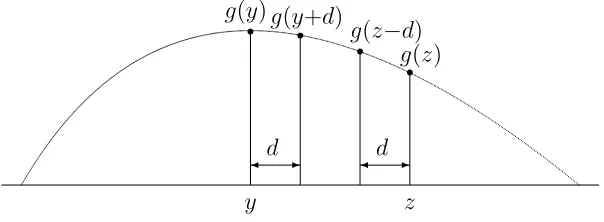
M♮-concavity is a discrete analogue of concavity of continuous-variable
functions. To help develop intuition of M♮-concavity, consider a
continuous-variable function g : R → R. We say g is concave if for all y, z ∈ R and λ such that 0 ≤λ≤1, the following condition holds:
g(y) +g(z)≤g(y+d) +g(z−d),
where d = λ(z −y).20 Assume y < z. Then, y+d is a point reached from
y by moving d to the right, and z−d is a point reached from z by moving d to the left (Figure 1). In a discrete domain, we can interpret Y −y+z is a point reached from Y by moving one-step closer to Z, and Z −z+y is a point reached from Z by moving one-step closer to Y. Thus, M♮-concavity
is a counterpart of concavity, adapted to make sense in the discrete domain. In our context, M♮-concavity is a requirement that contracts are
substi-tutable in a particular manner. To be more precise, we can immediately derive the following proposition.
Proposition 1. Assume f is M♮-concave. For any Y ⊊X and z ∈X\Y, (i) ChH(Y +z) = ChH(Y), or (ii) ChH(Y +z) = ChH(Y) +z, or (iii)
ChH(Y +z) =ChH(Y)−y+z for some y∈ChH(Y)\ChH(Y +z). Proof. Let Y∗ = Ch
H(Y) and Z∗ = ChH(Y +z). If z ̸∈ Z∗, since Y∗ ⊆
Y and Z∗ ⊆ Y ⊊ Z = Y + z hold and f is unique-selecting, Y∗ =
20This definition is equivalent to the most common definition that g(λy+ (1−λ)z)≥
arg maxX′′⊆Y f(X′′) = Z∗ holds. Thus, let us assume z ∈ Z∗. Since f is
M♮-concave, either (a) there exists y ∈ Y∗\Z∗ such that f(Z∗) +f(Y∗) ≤
f(Z∗−z+y)+f(Y∗−y+z) holds, or (b)f(Z∗)+f(Y∗)≤f(Z∗−z)+f(Y∗+z) holds. Assume (a) andZ∗ ̸=Y∗−y+zhold. SinceZ∗ = arg max
Z′⊆Y+zf(Z′),
Y∗ − y+z ⊆ Y +z, and f is unique-selecting, f(Z∗) > f(Y∗ −y +z)
holds. Also, since Y∗ = arg maxY′⊆Y f(Y′) and Z∗ −z +y ⊆ Y, f(Y∗) >
f(Z∗−z+y) holds. Thus, f(Z∗) +f(Y∗)> f(Z∗−z+y) +f(Y∗−y+z)
holds. This is a contradiction. Thus, if (a) holds, Z∗ = Y∗ −y+z, i.e.,
ChH(Y +z) = ChH(Y)−y+z, holds. Assume (b) and Z∗ ̸= Y∗+z hold.
SinceZ∗ = arg max
Z′⊆Y+zf(Z′) andY∗+z ⊆Y+z,f(Z∗)> f(Y∗+z) holds.
Also, since Y∗ = arg max
Y′⊆Y f(Y′) and Z∗ −z ⊆ Y, f(Y∗) > f(Z∗ −z)
holds. Thus, f(Z∗) +f(Y∗)> f(Z∗ −z) +f(Y∗+z) holds. This is a
con-tradiction. Thus, if (b) holds, Z∗ =Y∗+z, i.e.,Ch
H(Y +z) = ChH(Y) +z,
holds.
This proposition provides a specific sense in which contracts are viewed as substitutable when the payoff function is M♮-concave. When a new
con-tract z becomes available, the new chosen set of contractsChH(Y +z) is (i)
unchanged from the original chosen set ChH(Y) or (ii) obtained by addingz
to ChH(Y) or (iii) obtained by replacing exactly one contract y inChH(Y)
with z. In particular, no contract that is not chosen from the original set is chosen, that is, contracts are substitutable. Note also that at most one con-tract becomes newly rejected, and that happens only when the new concon-tract is accepted. Therefore, from Proposition 1, we can immediately derive the following properties.21
Corollary 1. If f is M♮-concave, thenCh
H satisfies substitutability, the law of aggregate demand, and the irrelevance of rejected contracts.
The converse of Corollary 1 does not hold in general. That is, there exists a choice function ChH such that it satisfies irrelevance of rejected
contracts, substitutabiilty, and the law aggregate demand, but there exists no M♮-concave payoff function which represents Ch
H. For example, let us
assume that the preference of H on X ={a, b, c} is
{b, c} ≻H {a, b} ≻H {a, c} ≻H {a} ≻H {b} ≻H {c} ≻H ∅ ≻H {a, b, c},
21Fujishige and Tamura (2006) show that substitutability holds iff is M♮-concave and
and that, for each X′ ⊆X,Ch
H(X′) is defined as the most preferred subset
of X′. It is easy to show that Ch
H satisfies irrelevance of rejected contracts,
substitutability and law of aggregate demand. Suppose thatChH is described
by a payoff functionf. In this case,f must satisfy the following inequalities:
f({b, c})> f({a, b})> f({a, c})> f({a})> f({b})> f({c})> f(∅) = 0
and f({a, b, c}) = −∞. This function f is not M♮-concave because for Y =
{b, c}, Z ={a} and b∈Y \Z, the following inequality must hold:
f({b, c}) +f({a})>max{f({c}) +f({a, b}), f({a, c}) +f({b})},
which contradicts the definition of M♮-concavity.
Actually, it is possible to characterize M♮-concavity based on
substi-tutability (Farooq and Shioura, 2005; Farooq and Tamura, 2004). More precisely, a function f : Zn → R ∪ {−∞} with a bounded effective do-main is M♮-concave if and only if for all linear functions p : Zn → R,
f +p satisfies substitutability, where the effective domain of f is defined by {x ∈ Zn | f(x) ̸= −∞}. Furthermore, Fujishige and Yang (2003) show that M♮-concavity is equivalent to the gross substitutes condition due to
Kelso and Crawford (1982), as well as the single improvement property due to Gul and Stacchetti (1999).
The generalized DA mechanism (Hatfield and Milgrom, 2005) is a gen-eralized version of the well-known deferred acceptance algorithm (Gale and Shapley, 1962), which is adapted for the ‘matching with contracts’ model.22
Mechanism 1 (Generalized Deferred Acceptance (DA) mechanism).
Apply the following stages from k= 1.
Stage k ≥1
Step 1 Each doctor offers her most preferred contract which has not been rejected before Stage k. If no remaining contract is acceptable ford, d does not make any offer. Let X′ be the set of contracts that are offered
in this Step.
Step 2 The hospitals tentatively accept ChH(X′) and reject all other
con-tracts in X′.
22In Hatfield and Milgrom (2005), this mechanism is called generalized Gale-Shapley
Step 3 If all the contracts in X′ are tentatively accepted in Step 2, then let
X′ be the final matching and terminate the mechanism. Otherwise, go
to Stage k+ 1.
Now we are ready to show that the fact thatf is M♮-concave guarantees
that the generalized DA mechanism satisfies several desirable properties. The following lemma immediately follows from existing results in discrete convex analysis.
Lemma 1. Suppose that the preference of the hospitals can be represented by an M♮-concave function f. Then, the generalized DA mechanism is strat-egyproof for doctors. Also, it always produces a stable matching, and the obtained matching is the doctor-optimal stable matching.
Proof. By Corollary 1, if f is M♮-concave, then Ch
H satisfies the irrelevance
of rejected contracts, substitutability, and the law of aggregate demand. Hat-field and Milgrom (2005) show that if ChH satisfies these three conditions,
then the generalized DA mechanism is strategyproof for doctors, and it ob-tains the doctor-optimal stable matching.
This lemma shows that the generalized DA mechanism produces a desir-able matching, and incentive compatibility for doctors are guaranteed. These are the key properties emphasized in the theoretical matching literature (see Hatfield and Milgrom (2005) for example) as well as in the literature on prac-tical market design (see, for instance, Abdulkadiro˘glu and S¨onmez (2003) and Abdulkadiro˘glu, Pathak, and Roth (2009)).
Next, we show that M♮-concavity also guarantees efficient computation.
Theorem 1. Suppose that the preference of the hospitals can be represented by an M♮-concave function f. Then, the time complexity of the generalized DA mechanism is proportional to |X|2.
Proof. At Step 1 in Mechanism 1, the calculation of ChD is O(|X|) in
to-tal, because each (rejected) doctor selects her most preferred contract which has not been rejected. Hence the time complexity of the generalized DA mechanism depends on calculations of ChH. At Step 2 in Mechanism 1, we
calculate ChH(X′) by adding newly offered contracts one by one. More
pre-cisely, we use the next relation which is guaranteed by substitutability and irrelevance of rejected contracts,
where X′′ and {y
1, y2, . . . , yk} are the tentatively accepted contracts at the
previous stage (or initially X′′ = ∅) and the newly offered contracts in X′
at Step 1, respectively. By Proposition 1 and the fact X′′ = ChH(X′′),
ChH(X′′ +y1) is determined by calculating f exactly |X′′|+ 1 times, and
hence, at most |X| times.23 In the same way as above, we can determine
ChH(X′) by calculating f at most k · |X| times. Since each contract is
selected as a newly offered contract at most once in the generalized DA mechanism, the calculation of ChH is O(T(f)· |X|2) in total, where T(f)
denotes the time required to calculate f. Thus, the time complexity of the generalized DA mechanism is O(T(f)· |X|2).
This theorem shows that the desired outcome can be easily computed by the algorithm. This property is not guaranteed for the general substitutable preference case. While sometimes de-emphasized in the literature, we em-phasize that efficient computability is crucial for the actual implementation of the mechanism in practical market design.
Overall, these results suggest that the generalized DA mechanism is a compelling mechanism if preferences and constraints can be aggregated into an M♮-concave function. The remainder of this paper demonstrates that such
an aggregation is indeed possible in various applied environments.
4
Conditions for M
♮-concavity
In this section, we investigate conditions under which payoff function f be-comes M♮-concave. Without loss of generality, we can assume payoff function
f is represented by the summation of two parts, i.e., f(X′) = f(Xb ′) +f(Xe ′),
wherefbrepresents hard distributional constraints for hospital-feasibility and e
f represents soft preferences over hospital-feasible contracts. More specifi-cally, fb(X′) returns 0 if X′ is hospital-feasible and −∞ otherwise, while
e
f(X′) returns a bounded non-negative value.
Let domf = domfb={X′ | X′ ⊆ X,fb(X′)̸= −∞} be the effective
do-main of f (or equivalently f). In the present context, domb f represents the family of hospital-feasible sets of contracts. In this section, we first show a
23To be more precise, Ch
H(X′′+y1) is either X′′, X′′+y1, or X′′−x+y1, where
x ∈ X′′. Thus, to obtain Ch
H(X′′+y1), it is sufficient to apply f to these |X′′|+ 1
necessary condition on f, namely, the effective domain ofb fb(or equivalently f) must constitute a mathematical structure called matroid. Next, we iden-tify three sufficient conditions so that f becomes M♮-concave, assuming the
effective domain of fbconstitutes a matroid.
Let us first introduce the concept of matroid (Oxley, 2011).
Definition 4(matroid).LetXbe a finite set, andF be a family of subsets of X. We say a pair (X,F) is amatroidif it satisfies the following conditions.
1. ∅ ∈ F.
2. If X′ ∈ F and X′′ ⊆X′, then X′′ ∈ F holds.
3. IfX′, X′′ ∈ F and|X′|>|X′′|, then there exists x∈X′\X′′ such that
X′′+x∈ F.
The term “matroid” is created from “matrix” and “-oid”, i.e., a matroid is something similar to a matrix, and the concept of a matroid is an abstraction of some properties of matrices. To get an idea, suppose that A is a matrix and X is the set of column vectors of A. Let us assume F is a family of subsets ofX, such that for eachX′ ∈ F, all column vectors inX′ are linearly
independent. It is clear that conditions 1 and 2 of the above definition hold. Also, if X′ has more elements than X′′, we can always choose x ∈ X′ \X′′ such thatX′′+xbecomes linearly independent. Therefore condition 3 is also
satisfied, which shows that (X,F) in this example is a matroid.
The concept of matroid has been utilized in matching theory. For exam-ple, Roth, S¨onmez, and ¨Unver (2005) show that the sets of simultaneously matchable patients induces a matroid. As we will see in this paper, matroids play an essential role in our analysis of matching under constraints.
Now we are ready to present one of the connections between matroids and our theory of matching with constraints. The following lemma holds.
Lemma 2. Under the assumption ∅ ∈domfb, fbis M♮-concave if and only if
(X,domfb) is a matroid.24
Intuitively, if any of the matroid conditions is violated, we can create a situation wheref(Xb ′) = fb(X′′) = 0, but eitherf(Xb ′−x+y) orfb(X′′+x−y)
becomes −∞ for some X′, X′′, x∈X′\X′′, and y∈X′′\X′ ∪ {∅}.
24Murota and Shioura (1999) show that the effective domain domf of an M♮-concave
This lemma suggests that the matroid structure plays an important role in our analysis. In particular, it is easy to see that the “only if” part implies that a matroid structure is needed in order for the function f =fb+feto be M♮concave. This means that, in order to utilize the theory of M♮-concavity
in our analysis of matching with constraints, it is necessary for the sets of hospital-feasible contracts to constitute a matroid.
Now that we have found the necessity of a matroid structure for our analysis, let us turn to sufficient conditions. More specifically, we assume that (X,domf) = (X,domfb) is a matroid and examine conditions on f,e i.e., the soft preference of the hospitals, for guaranteeing that f = fb+feis M♮-concave. This task would have been easy if the sum of two M♮-concave
functions were always M♮-concave, since the hard constraint part fbis M♮
-concave if domfbis a matroid (Lemma 2). However, the following example demonstrates that the sum of two M♮-concave functions is not guaranteed to
be M♮-concave.
Example 1. AssumeX ={x1, x2, x3}. f1(X′) is 0 if eitherX′ ⊆ {x1, x2}or
X′ ⊆ {x
1, x3}, and otherwise,−∞. f2(X′) is 0 if eitherX′ ⊆ {x2, x3}orX′ ⊆
{x1, x3}, and otherwise, −∞. Since (X,domf1) and (X,domf2) are
ma-troids, bothf1 andf2 are M♮-concave from Lemma 2. However,f =f1+f2is
not M♮-concave, since (X,domf), where domf ={∅,{x
1},{x2},{x3},{x1, x3}},
is not a matroid. To see this, observe that when X′ = {x
1, x3}, X′′ ={x2},
we have X′, X′′ ∈ domf and |X′| > |X′′|, but there exists no x ∈ X′ \X′′
such that X′′ + x ∈ domf holds (note that if f
2 has some special form,
e.g., f2(X′) is of the form ∑x∈X′v(x), we can guarantee thatf =f1+f2 is
M♮-concave as long as f
1 is M♮-concave, as shown in Condition 1).
The above example shows the mere fact that bothfbandfeare M♮-concave
is not sufficient for guaranteeing M♮-concavity of f = fb+f. Nevertheless,e
we demonstrate that a number of simple sufficient conditions exist when the hard constraint part induces a matroid. More specifically, we assume (X,domfb) constitutes a matroid, and introduce three sufficient conditions to guarantee that f is M♮-concave: (1)feis a sum of contract values, (2)fbis
time complexity is proportional to|X|2. As will be seen in Section 5 and the
online appendix, most stability concepts in existing works can be understood as stability with respect to one of these M♮-concave functions.
Let us introduce the first condition, which provides a simple but very general method for obtaining an M♮-concave function.
Definition 5 (sum of contract values). We say feis a sum of contract values if f(Xe ′) = ∑
x∈X′v(x), where v :X →(0,∞) is a function such that
x̸=x′ implies v(x)̸=v(x′).
As indicated by the name, function fein this definition is written as a sum of values of individual contracts, where v(x) is interpreted as the value of contract x. Note that we assume each value is positive, and different contracts are assigned different values.
Now we are ready to present our first condition.
Condition 1. Assume (X,domf)b is a matroid (or equivalently, fbis M♮ -concave and∅ ∈domfb) andfe(X′)is a sum of contract values, thenf =fb+fe
is M♮-concave.
Proof. Let us assume fe(X′) is represented as ∑
x∈X′v(x). Since fbis M♮
-concave, for any Z, Y ⊆X, for any y∈Y \Z, there existsz ∈(Z\Y)∪ {∅}
such thatfb(Y)+fb(Z)≤f(Yb −y+z)+f(Zb −z+y) holds. On the other hand, we have ∑x∈Y−y+zv(x) +∑x∈Z−z+yv(x) = ∑x∈Y v(x) +∑x∈Zv(x). Thus, f(Y) +f(Z)≤f(Y −y+z) +f(Z−z+y) holds, so f is M♮-concave.
This class of functions is equivalent to the class ofweighted matroids (Ed-monds, 1971). Ostrovsky and Paes Leme (2015) show that a weighted ma-troid satisfies the gross substitute condition.
The second sufficient condition for M♮-concavity is based on an idea of
grouping contracts. We begin by formally introducing the concept of a group of contracts.
Definition 6 (group of contracts). Let G = {g1, . . . , gn} be a partition of
X, i.e., g ∩g′ = ∅ for any g, g′ ∈ G with g ̸=g′ and ∪
g∈Gg =X. We refer
to each element g of G as a group of contracts (or simply a group) in G, and G as groups.
One division of contracts into groups that we use in this paper is based on hospitals, that is, we let each gi represent the set of contracts related to
Kamada and Kojima (2014) introduce a concept called an order-respecting preferences, which models a variety of preferences of the hospitals. Using the concept of groups of contracts, we now introduce a class of payoff functions that represent this class of preferences.
Definition 7 (order-respecting payoff function). For groups G, an order-respecting payoff function feis given as follows:
e
f(X′) =∑
g∈G
Vg(|X′∩g|) +
∑
x∈X′
v(x),
where v : X → (0,∞) is a function such that x ≠ x′ implies v(x) ̸= v(x′),
and Vg :Z+→(0,∞) is a concave function.
Now, we introduce a further condition on a matroid so thatfb+febecomes M♮-concave, when feis an order-respecting payoff function.
Definition 8 (symmetry of groups). Let (X,F) be a matroid and G be a partition of X. We say that G is symmetric in (X,F) if for all g ∈G, for all x, x′ ∈ g, and for all X′ ⊊ X such that {x, x′} ∩X′ = ∅, X′+x ∈ F if
and only if X′+x′ ∈ F holds.
Now, we are ready to define our second condition.
Condition 2. If(X,domf)b is a matroid,Gis symmetric in(X,domfb), and
e
f is an order-respecting payoff function for G, thenf =fb+feis M♮-concave.
Finally, we introduce the third sufficient condition. The crucial concept we use is the laminar family defined below.
Definition 9 (laminar family). T is a laminar family of subsets of X if for any Y, Z ∈ T, one of the following conditions holds:
1. Y ∩Z =∅,
2. Y ⊆Z, or
3. Z ⊆Y.
We say f(X′) =∑
T∈T fT(|X′∩T|) is alaminar concave function ifT is
In words, a family of sets T is said to be a laminar family if it has a structure that can be described as layers or a hierarchy. More specifically, for any pair of sets in this family, either they are disjoint from each other or one of them is a subset of the other. Laminar families have been used for mechanism design in two-sided matching (Biro, Fleiner, Irving, and Manlove, 2010; Kamada and Kojima, 2017a), indivisible object allocation (Budish, Che, Kojima, and Milgrom, 2013), and auction (Milgrom, 2009).
A laminar family of subsets of contracts naturally induces a matroid, a structure we call a laminar matroid, as defined below.
Definition 10 (laminar matroid). We say (X,F) is alaminar matroidon a laminar family T if it is constructed as follows:
• For each T ∈ T, a positive integerqT is given.
• F is defined as{X′ ⊆X | |X′ ∩T| ≤q
T (∀T ∈ T)}.
To show a laminar matroid is a matroid, let us introduce a simple matroid and methods for creating new matroids. (X,F) is said to be a uniform matroid if F ={X′ |X′ ⊆X,|X′| ≤k} for some non-negative integer k.
For a set of matroids (X1,F1), . . . ,(Xk,Fk), where each Xi is disjoint,
their direct sum is defined as (X,F), where X = ∪1≤i≤kXi, F = {X′ |
X′ = ∪
1≤i≤kXi′, where Xi′ ∈ Fi}. Assume (X,F) is a matroid and k is a
non-negative integer. Then, its k-truncation is defined as (X,F˜), where ˜
F ={X′ ∈ F | |X′| ≤k}.
It is obvious that conditions 1 and 2 of a matroid hold in the above three cases. For a uniform matroid, if X′, X′′ ∈ F and |X′| >|X′′| hold, then for
any x∈X′ \X′′, it follows that |X′′+x| ≤ |X′| ≤ k, soX′′+x∈ F holds.
Thus, a uniform matroid is a matroid. For a direct sum, if X′, X′′ ∈ F and
|X′| > |X′′|, then for some i, |X′∩X
i| > |X′′∩Xi| holds. By this and the
assumption that (Xi,Fi) is a matroid, there existsx∈(X′∩Xi)\(X′′∩Xi)
such that (X′′∩Xi) +x∈ Fi holds. Therefore X′′+x ∈ F holds, showing
that a directed sum of matroids is a matroid. Finally, for k-truncation, if X′, X′′ ∈F˜ and |X′|>|X′′|, then there always exists x∈X′\X′′ such that
X′′+x∈ F, sinceX′, X′′ ∈ F holds. Since we also have|X′′+x| ≤ |X′| ≤k,
it follows that X′′+x∈F˜. Thus, a k-truncation of a matroid is a matroid.
Condition 3. Assume (X,domf)b is a laminar matroid on a laminar family
T, andfeis a laminar concave function on T, then f =fb+feis M♮-concave.
5
Applications
As emphasized in Introduction, one of the main motivations of our work is to provide an easy-to-use recipe, or a toolkit, for organizing matching mecha-nisms under constraints. To demonstrate the effectiveness our recipe/toolkit, we examine numerous applications of our method to two-sided, many-to-one matching problems. Specifically, this section presents one existing appli-cation (regional maximum quotas) as well as one new appliappli-cation (distance constraints), while relegating many others to the online appendix.25We show
that the sufficient conditions described in Section 4 hold in these cases. For existing applications, these findings allow us to reproduce key results and, for some applications, show stronger results.
Before describing how to apply our framework to particular applications, let us summarize our recipe. Consider a mechanism designer who is faced with a matching problem with constraints, and imagine that she has some initial ideas on what hard distributional constraints exist and what kind of stability properties are desired. We suggest the mechanism designer to perform the following two steps.
1. Check whether (X,F), where F is the family of hospital-feasible sets of contracts, is a matroid. If not, modify distributional constraints so that (X,F) becomes a matroid.
2. Composefe, which reflects stability, such that it satisfies one of the suffi-cient conditions described in this paper. Modify the stability definition as necessary, by adding more desirable properties, relaxing excessively demanding requirements, or simply introducing tie-breaking.
25Specifically, the online appendix examines the following existing applications: the
If these two steps are successful, the job of the mechanism designer is done, because she can use an off-the-shelf mechanism, i.e., the generalized DA mechanism. More specifically, our analysis from the preceding sections guar-antees that the generalized DA mechanism satisfies desirable properties. The cases we discuss in this section illustrate how the above recipe works. Fur-thermore, in Section 6, we discuss how to modify constraints and stability definitions when applying this recipe.
The advantages of using this recipe over using other general frameworks (e.g., Hatfield and Milgrom (2005), Hatfield and Kojima (2009, 2010)) are as follows. To use our recipe, basically all one needs to show is that the given hard distributional constraints produce a matroid, since the requirements over soft preferences are usually elementary as described in Conditions 1–3. There exists a vast literature on matroid theory, and what kinds of constraints produce a matroid is well-understood. Therefore, it usually suffices to show that the hard distributional constraints can be mapped into existing results in matroid theory. Furthermore, by using our recipe, the time complexity of the generalized DA mechanism is guaranteed to be polynomial.
5.1
Regional maximum quotas (Goto, Iwasaki, Kawasaki,
Yasuda, and Yokoo, 2014; Kamada and Kojima,
2015)
5.1.1 Model
A market is a tuple (D, H, X, R,(≻d)d∈D,(≻h)h∈H,(qh)h∈H,(qr)r∈R). D is a
finite set of doctors and H is a finite set of hospitals. X is a finite set of contracts. A contract x ∈ X is a pair (d, h), which represents a matching between doctor dand hospitalh. (≻d)d∈D is a profile of doctors’ preferences,
i.e., each ≻d represents the strict preference of each doctordover acceptable
contracts in Xd = {(d, h) ∈ X | h ∈ H}. (≻h)h∈H is a profile of hospitals’
preferences, i.e., each≻h represents the preference of each hospitalhover the
contracts that are related to it. (qh)h∈H is a profile of hospitals’ maximum
quotas, i.e., eachqh represents the maximum quota of hospitalh. We assume
hospitals are grouped into regions R={r1, . . . , rn}, where each region r is a
subset of hospitals. (qr)r∈R is a profile of regional maximum quotas, i.e., each
is included in exactly one region, that is, regions partition H.26
5.1.2 Feasibility
For each r ∈ R, let X′
r denote
∪
h∈rXh′. We say X′ is hospital-feasible if
|X′
h| ≤ qh for all h ∈ H, and |Xr′| ≤ qr for all r ∈ R. We say X′ ⊆ X is
doctor-feasible if X′
d is acceptable for all d. Then, we say X′ is feasible if it
is doctor- and hospital-feasible.
5.1.3 Stability
First, let us define the concept of a blocking pair.
Definition 11. For a matching X′, we say (d, h) ∈ X \X′ is a blocking pairif (i) (d, h) is acceptable fordand (d, h)≻dXd′, and (ii) either|Xh′|< qh
or there exists (d′, h)∈X′ such that (d, h)≻
h (d′, h).27
We say a matching X′ is strongly stable (Kamada and Kojima, 2017b)
if the following condition holds: if (d, h), where h ∈ r, is a blocking pair (Definition 11) then (i) |X′
r| = qr, (ii) (d′, h) ≻h (d, h) for all (d′, h) ∈ Xh′,
and (iii) if (d, h′)∈X′, thenh′ ̸∈r. In words, a matching is strongly stable if
satisfying the desire of a blocking pair by matching them results in a violation of a regional maximum quota. To be more precise, assume (d, h) is a blocking pair. Then, if (d, h′)∈X′, then h′ ̸∈r (condition (iii)). Moreover, moving d
toh necessarily involves filling a vacant seat at hbecause no existing doctor at h is less preferred to d (condition (ii)). Thus, if we move d to h from her current match (which can be h′ or the option of being unmatched), the
regional maximum quota of r is violated since |X′
r| is already qr (condition
(i)).
A strongly stable matching does not necessarily exist (Kamada and Ko-jima, 2017b). Thus, we need to consider a weaker definition of stability in order to guarantee the existence. Kamada and Kojima (2015) introduce a weaker stability concept, which we call Kamada-Kojima (KK)-stability. We
26Kamada and Kojima (2017a) consider a more general case where regions are
hierar-chical. We can generalize our results to such a case by utilizing the fact that contracts related to each region form a laminar family.
27Note that we denoteX′
d≻dXd′′ if either (i)Xd′ ={x′},Xd′′={x′′}, andx′ ≻dx′′ for
some x′, x′′ ∈ X
d that are acceptable for d, or (ii) Xd′ ={x′} for some x′ ∈Xd that is
acceptable fordandX′′
say a matching X′ is KK-stable if the following condition holds: if (d, h),
where h∈r, is a blocking pair then (i) |X′
r|=qr, (ii) (d′, h)≻h (d, h) for all
(d′, h) ∈ Xh′, and (iii) if (d, h′) ∈X′, then either h′ ̸∈ r or|Xh′′| − |Xh′| ≤1.
The second part of condition (iii) accounts for the difference between KK-stability and strong KK-stability; (d, h) is not regarded as a legitimate blocking pair if h and h′ are in the same region and moving d from h′ to h does not strictly decrease the imbalance of doctors between these hospitals.
Goto, Iwasaki, Kawasaki, Yasuda, and Yokoo (2014) assume there exists a total preference ordering ≻H overX, i.e., x1 ≻H x2 ≻H x3 ≻H . . .. Here, we
assume ≻H respects each ≻h, i.e., if (d, h) ≻h (d′, h), then (d, h) ≻H (d′, h)
holds. Goto, Iwasaki, Kawasaki, Yasuda, and Yokoo (2014) introduce a weaker stability concept than strong stability based on this ordering, which we call contract-order-stability.28 We say a matchingX′ is contract-order-stable(Goto, Iwasaki, Kawasaki, Yasuda, and Yokoo, 2014) if the following condition holds: if (d, h), where h ∈ r, is a blocking pair then (i) |X′
r| =qr
and (ii) (d′, h′)≻
H (d, h) for all h′ ∈ r and (d′, h′) ∈ Xh′′. We note that the
condition (ii) includes the cases where d′ = d or h′ =h. When d = d′, the
condition (ii) means that (d, h) is not regarded as a legitimate blocking pair when the hospitals prefer (d, h′) to (d, h).
5.1.4 Mechanism
Fix a round-robin ordering among hospitals; without loss of generality, de-note it as h1, h2, . . . h|H|. Kamada and Kojima (2015) present a mechanism
called the Flexible Deferred Acceptance (FDA) mechanism, which utilizes this ordering. Roughly speaking, the FDA mechanism allows each hospital to sequentially accept one contract at a time according to the given round-robin ordering, subject to regional maximum quotas. Formally, the FDA mechanism is defined as follows.29
Mechanism 2 (FDA).
Apply the following stages from k= 1.
28A contract-order stable matching is identical to a regionally fair and regionally
non-wasteful matching defined in Goto, Iwasaki, Kawasaki, Yasuda, and Yokoo (2014).
29To be more precise, Kamada and Kojima (2015) allow a target capacity for each
Stage k ≥1
Step 1 Each doctor applies to her most preferred hospital by which she has not been rejected before Stagek. If no remaining hospital is acceptable for d, d does not apply to any hospital. Reset X′ as ∅.
Step 2 For each r, iterate the following procedure until all doctors applying to hospitals in r are either tentatively accepted or rejected:
1. Choose the hospital with the smallest index in the region first, the hospital with the second-smallest index second, and so forth and, after the last hospital, go back to the first hospital.
2. Choose doctor d who is applying to h and is not tentatively ac-cepted or rejected yet, and is the most preferred according to ≻h
among the current applicants. If there exists no such doctor, then go to the procedure for the next hospital.
3. If|X′
h|< qhand|Xr′|< qr,dis tentatively accepted byhand (d, h)
is added to X′. Then go to the procedure for the next hospital.
4. Otherwise, d is rejected by h. Then go to the procedure for the next hospital.
Step 3 If all the doctors are tentatively accepted in Step 2, then let X′ be
the final matching and terminate the mechanism. Otherwise, go to Stage k+ 1.
Kamada and Kojima (2015) show that the FDA mechanism is strate-gyproof for doctors and obtains a KK-stable matching.
Goto, Iwasaki, Kawasaki, Yasuda, and Yokoo (2014) introduce a different mechanism, called Priority-List based Deferred Acceptance (PLDA) mecha-nism, which utilizes the total preference ordering ≻H. Formally, the PLDA
mechanism is defined as follows.
Mechanism 3 (PLDA).
Apply the following stages from k= 1.
Stage k ≥1
Step 2 For each r, iterate the following procedure until all doctors applying to hospitals in r are either tentatively accepted or rejected:
1. Choose (d, h), where d is applying to h, d is not tentatively ac-cepted or rejected yet, and (d, h) has the highest priority according to≻H among the current applicants to hospitals in r.
2. If |X′
h| < qh and |Xr′| < qr, d is tentatively accepted by h and
(d, h) is added toX′. Then go to the procedure for the next pair.
3. Otherwise, d is rejected by h. Then go to the procedure for the next pair.
Step 3 If all the doctors who make applications in this stage are tentatively accepted in Step 2, then let X′ be the final matching and terminate
the mechanism. Otherwise, go to Stage k+ 1.
Goto, Iwasaki, Kawasaki, Yasuda, and Yokoo (2014) show that the PLDA mechanism is strategyproof for doctors and obtains a contract-order-stable matching.
5.1.5 Representation in our model
Let us definefb(X′) as 0 if X′ is hospital-feasible, i.e., |X′
h| ≤qh for allh and
|X′
r| ≤qr for all r, and otherwise, −∞. Then, (X,domf) is a laminar ma-b
troid, since T ={Xr1, Xr2, . . . , Xrn, Xh1, Xh2, . . . , Xh|H|} is a laminar family
of X.
First, we study KK-stability. As in Kamada and Kojima (2015), fix a round-robin ordering over hospitals, h1, h2, . . . , h|H|. Let vhi(j) denote the
value associated with the j-th choice of hospital hi. Then, define vhi(j) as
C(C−|H|·j−i) whereCis a large positive constant. LetVh(k) :=∑kj=1vh(j).
It is clear that Vh is concave. Then, define f(Xe ′) as follows:
e
f(X′) = ∑
h∈H
Vh(|Xh′|) +
∑
x∈X′
v(x), (1)
wherev(·) is a function representing contract values as in Definition 5 (where, for eachh,v((d, h))> v((d′, h)) if and only if (d, h)≻
h (d′, h)), andC≫v(x)
for all x ∈ X. By choosing G as {Xh1, Xh2, . . . , Xh|H|}, it is clear that G is
The FDA mechanism is identical to the generalized DA mechanism where ChH is defined as the maximizer of function f defined above.
The following proposition holds.
Proposition 2. HM-stability (based onfein equation(1)) implies KK-stability.
Proof. To show that HM-stability implies KK-stability, assume X′ is not
KK-stable, i.e., there exists a blocking pair (d, h), where h ∈ r and (i)
|X′
r| < qr, or (ii) there exists (d′, h) ∈ Xh′ such that (d, h) ≻h (d′, h)
holds, or (iii) there exists (d, h′) ∈ X′, where h′ ∈ r and |X′
h′| − |Xh′| > 1
holds. In any of these cases, clearly (d, h) ∈ ChD(X′ + (d, h)). In case
(i), obviously (d, h)∈ arg maxX′′⊆X′+(d,h)f(X′′) because adding (d, h) to X′
does not violate the regional maximum quota for f. In case (ii), (d, h) ∈
arg maxX′′⊆X′+(d,h)f(X′′) because adding (d, h) and subtracting (d′, h)∈Xh′
such that (d, h) ≻h (d′, h) from X′, the resulting matching does not violate
the regional maximum quota for r. In case (iii), by the construction of f, (d, h) ∈ arg maxX′′⊆X′+(d,h)f(X′′). Thus, for each of the cases (i)–(iii), it
follows that (d, h) ∈ ChH(X′ + (d, h)), which implies X′ is not HM-stable.
Thus, HM-stability implies KK-stability.
We note that KK-stability does not imply HM-stability. To see this, let us consider the following case. There are two hospitals h1 and h2, both of
them belong to region r, and qr = 1. There are two doctors d1 and d2. We
assume h1 ≻d1 h2, h2 ≻d2 h1, d1 ≻h1 d2, and d2 ≻h2 d1 hold. The
round-robin ordering over hospitals is defined as h1, h2. X′ = {(d2, h2)} is clearly
KK-stable, but it is not HM-stable since (d1, h1) ∈ ChD(X′+ (d1, h1)) and
(d1, h1)∈ChH(X′+ (d1, h1)) hold.
The FDA (and the generalized DA) mechanism is not guaranteed to ob-tain the doctor-optimal KK-stable matching. In fact, there is a case where the doctor-optimal KK-stable matching does not even exist. Note that the main focus of Kamada and Kojima (2015) is two-sided matching such as la-bor market matching, so optimality for one side of the market is not the main requirement. Note also that, despite the fact that the FDA (and hence the generalized DA) mechanism does not lead to doctor-optimality, the mecha-nism is still strategyproof for doctors.
Alternatively, we can definef(Xe ′) asC
1·|X′|−∑h∈HC2·|Xh′|2+
∑
h∈HCh·
|X′
h|+
∑
x∈X′v(x), whereC1 ≫C2 ≫Ch ≫v(x) for allhand x, andCh1 ≫