The New Approximate Calculation Method for the First
Order Reliability
*
Gangli Hao1,2, Xuli Liang1,2, Shujian Zhang3
1School of Engineering, Shijiazhuang University of Economics, Shijiazhuang, China 2Key Laboratory of Water Resources Sustainable Utilization and Exploit, Shijiazhuang, China
3Hebei Color Arima Geotechnical Engineering Co., Ltd., Sanhe, China
Email: [email protected]
Received January 6, 2013; revised February 6, 2013; accepted February 13, 2013
ABSTRACT
The new method is presented for computing engineering structure reliability by direct searching the next checking point and accelerating convergence based on the analysis of errors in the center point method and borrowing ideas form the merits of the other First-Order Second Moment (FOSM) methods. The idea of the direct searching method is construct- ing a new explicit searching formula to make the new checking point being more closed to the failure surface based on the results of the center point method. The new checking point has steepest descent character because the searching path is the gradient of the approximate surface. An example shows that the method presented in this article has well preci- sion. Although the direct searching formula may not reach the globally optimal point, the error can be controlled owing to the locally optimal plan at each searching step.
Keywords: Reliability; First-Order Second Moment (FOSM); Direct Searching
1. Introduction
There are a lot of uncertainties in the analysis of engi- neering structure [1], the distribution type of the random variable is various, the functions of the member do not follow the normal distribution, which are generally non- linear, therefore, it is hard to calculate the reliability in- dex of the structure directly. At the present, the first- order second moment method (FOSM) is widely used as the approximate calculation method, which is. The com- mon first-order second moment methods are center point method, checking point method, mapping transformation method, practical analysis, design point and gradient op- timization method etc. The first-order second moment method is accepted in the engineering due to its simple calculation and the calculation precision can meet the en- gineering application requirement in the most cases.
Because of its direct and simple characteristic, the center point method is firstly used in the engineering as the primary estimation of the structure reliability. But the center point method does not consider the real distribu- tion of the random variables, which only consider their mean value and variance and implicitly assume the each random variable is normal distribution or logarithmic normal distribution. Both the theory and practice indicate [2,3], the calculation error of the center point method is
big for the nonlinear limit state equation, as a result, re- liability indexes which obtained from different format of nonlinear limit state equation with the same mechanical meaning differ greatly, it is inconvenient in the real ap- plication and could not meet the requirement of engi- neering accuracy. Both the checking point method and mapping transformation method select the design check- ing point as the linearization point of the nonlinear func- tion, which could get reliability index with higher accu- racy and ensure the uniqueness of reliability index for the same member, but the two methods are implicit and the calculation process are complex, which need several dou- ble iteration and the selection of initial values have im- pact on the iteration process, therefore, they are not easy to be applied in the real engineering. Hence, it should put forward some simplified algorithms with less calculation and good accuracy, there are practical analysis method [4] and design point method [5]. The gradient optimization method [6] is also an implicit method, which calculate the problem as an optimization question, thus, the calcu- lation of the reliability index is convenient, the advantage is more obvious especially for the complex index, it could reduce the calculation effective.
The basic principal of the first order reliability method is the linear expansion of the function, which use the linear function as the former function, so it could get the ap- proximate solution. Hasofer, Lind [7] define the smallest *This work was jointly supported by Hall of Hebei province science
distance between the failure surface point (checking point) and the mean point as the reliability index, which has solved the problem of simple reliability index. Rack- witz, Fiessler [8] has dealt with non-normal distribution of random variables used the equivalent normal variable method. Shinozuka [9] has pointed out the checking point is the largest probability density point on the structure function surface, the search of the checking point could use the ordinary constraint optimization algorithm. Der Kiureghian [10] has put forward the method to deal with many checking points in the optimized analysis. Bjerager [11] has deduced the sensitivity of the first order reliabil- ity index used the check point coordinates. There also ap- pear a lot of new reliability calculation methods during the solution of nonlinear function problem, such as the two order reliability method, selective sampling method (Harbitz [12]) etc. Guan [13] has suggested selecting se- veral points on the function surface near the checking point, and constructing multi tangent planes to fit the real nonlinear function surface, the similar idea is such as the method which is proposed by Mahadevan [14]. The im- proved reliability methods are in the theoretical discus-sion stage, while the traditional FORM are still used in the real practice.
The computational accuracy of the center point me- thod is not high, even if not considering the influence of the variable distribution pattern, there are two reasons as follows. Firstly, the mean point is assumed as the lin- earization point for the method, while the mean point is far away from the failure boundary, thus, if the original nonlinear limit state equation is made Taylor series ex- pansion about the point and the reliability index is calcu- lated, the calculation error is larger than taking the ex- pansion point for design checking point. Secondly, the center point method only take a linear cut for the Taylor series expansion and does not consider the influence of higher order, which is also an important reason caused error. Due to the above two reasons, the reliability index is different for the same structure when limit state equa- tions with different format are given. Based on the analy- sis of the defect of center point method and advantage of other methods, a new approximate calculation method which is suitable for engineering application and with high calculation accuracy is proposed in the paper.
2. Direct Searching Method
Generally, the random variables which have impact on the structure reliability are assumed as X ii
1,2, , n
, the function is:
1, 2, , nZg X X X (1)
Limit state equation is:
1, 2, , n 0Z g X X X
The structure function is made Taylor series expansion about the point X0i
i1,2, , n
thus,
0
0
01 02 0 0
1 2 2 0 2 1 , , , 2 n
n i i
i i X
n
i i
i i X
g
Z g X X X X X
X
X X g
X
(3)Record X
X X1, 2, , Xn
, X0
X01,X02, , X0n
,therefore, the format of Formula (3) could be trans- formed as follows
0 0 0 0 2 2 0 2 X X g Z g X X XX g X X X (4)
where, Xi is the vector point, g X
i is the functionof each component, which is not the overall function of
i
X . The symbol represent the point multiplication
operation between components, and the transposed sym- bol of the component is not used here, a scalar could be obtained through corresponding item multiplication if the two components could be multiplied. The power time of the vector represents each.
The simple vector expression is adopted in the follow- ing deduction.
The expression of linear structure function could be got through only taking the linear item.
00 0
0
X
g Z g X g X X X
X
A X X b
(5) where, 0 X g A X
, bg X
0 .Take mean value and variance for the Formula (5), thus
0m Z A m X X b (6)
2
2Z A X
(7)
2
02A m X X b
m Z
Z A X
(8)
The structure function is expanded about the center point at this time, generally speaking, the center point is far away from the failure surface, which cause a large calculation error, so a new checking point would be con- structed in the following, which is near the failure sur- face. In fact, the Formula (5) is the one order approxima- tion for the failure surface, whose geometrical signifi- cance is a hyperplane in n-dimensional space, while the
geometrical significance of the failure surface is a curved surface in -dimensional space, if a suitable point on the plane is taken as the checking point, it could make the smallest distance between the checking point and the failure surface smaller than the smallest distance between the center point and the failure surface. The structure function is made Taylor series expansion about the checking point again, and the linear item is taken to be analyzed, it could predict that the accuracy of the reli- ability index is higher than the Taylor series expansion about the center point.
n
Construct:
1 2
b 0 X A X
A
(9) Substitute the Formula (9) into Formula (5), it could satisfy
1 0
0Z A X X b (10)
Moreover, Z g X
is made Taylor series expan-sion about the checking point X1, it could obtain
1 1 1 1 X gZ g X X X
X
A X X b
(11)
Note, here A and b are
1
X and b = g(X1),
respectively, which are not distinguished from
A g X
Aand b in
the Formula (5) for convenience of writing, in fact, it is not necessary for the careful distinction. Similarly, a new series of expectancy values, variances and reliability in- dexes of the structure function could be obtained based on the Formula (11).
1
m Z A m X X b (12)
2
2Z A X
(13)
2
12
A m X X b m ZZ A X
(14)
The direct search method has finish a iterative process for the reliability index, and it should point out, the itera- tive process is explicit.
If the obtained reliability index does not meet the ac- curacy requirement, new checking point could be con- structed sequentially
2 2 1
3 2
b
The obtained seriesAand bare:
0 1 2
, , ,
X X X
g g g
A
X X X
(16)
0 , 1 , 2 ,
b g X g X g X (17)
We can see that, seriesAis the reflection of structure
function for sensitivity index of each random variable, called sensitivity series; while series b represent the
approximation degree between the checking point and failure surface, from the iterative process it could know,
limb0 (18)
It could be called residual series, which is used to judge whether the iterative process is terminated.
3. Analysis of Examples
A straight-bar with circular section, the tension force is , the diameter and stress yield limit Fy are
assumed as the random variables, which the mean value and variance are
5
10 N
P d
2 2
3 cm, 0.3 cm
29000 N/cm , 2500 N/cm
y y d d F F m m
Now calculate the tensile reliability index [15,16]. Internal force and stress were established with repre- sentation of the limit state equation of Z1 and Z2,
there is
21 π , 0 4 y y d
Z g F d F P (19)
2 2 4 , π y y P Z g F d Fd 0
(20) When Z10, the iterative results used the direct
searching method are seen in Table 1.
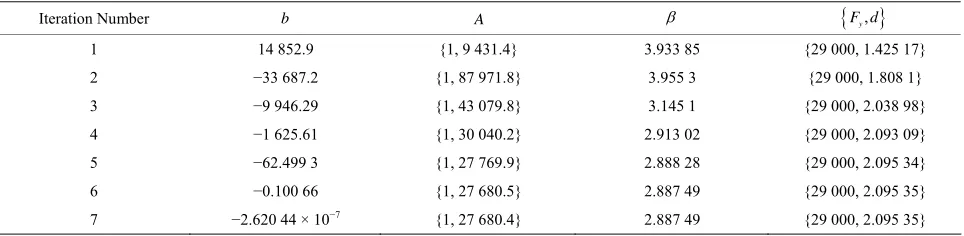
Tables 1 and 2 indicate, after several simple iterative,
the reliability index obtained used the direct searching method converge to a certain value. In the example, the convergent value is same for different structure function. But it should note that, the cases is not always as the above, because the nature of the direct searching method is the searching the point which is most near the failure surface on the approximation failure surface, because the checking point here is not the actual checking point on the failure surface, therefore, the reliability degree for different failure surfaces could converge to different val- ues, but the differences is little, they would distribute in a small neighborhood of the reliability index. The geomet- ric meaning of the reliability index is the smallest dis- tance from the failure boundary to the mean point. Be- cause the direct searching method limit the final search- ing point almost locate on the failure surface used the scale of b (it take 106 in the example), as a result, the 2
X A X A
b X A X
Table 1. Iterative results in the direct searching method.
Iteration Number b A
F dy,1 104 989 {7.068 58, 136 659} 2.351 68 {29 000, 2.231 75} 2 13 443 {3.911 83, 101 663} 2.858 27 {29 000, 2.099 52} 3 398.25 {3.462 01, 95 639.4} 2.887 {29 000, 2.095 35}
4 0.394 934 {3.448 29, 95 449.7} 2.887 49 {29 000, 2.095 35} 5 3.899 33 × 10−7 {3.448 28, 95 449.6} 2.887 49 {29 000, 2.095 35}
Table 2. Iterative results in the direct searching method.
IterationNumber b A
F dy,1 14 852.9 {1, 9 431.4} 3.933 85 {29 000, 1.425 17} 2 −33 687.2 {1, 87 971.8} 3.955 3 {29 000, 1.808 1}
3 −9 946.29 {1, 43 079.8} 3.145 1 {29 000, 2.038 98} 4 −1 625.61 {1, 30 040.2} 2.913 02 {29 000, 2.093 09} 5 −62.499 3 {1, 27 769.9} 2.888 28 {29 000, 2.095 34}
6 −0.100 66 {1, 27 680.5} 2.887 49 {29 000, 2.095 35} 7 −2.620 44 × 10−7 {1, 27 680.4} 2.887 49 {29 000, 2.095 35}
final obtained distance from the approximation failure boundary to mean point is larger than the distance ob- tained by checking method, therefore, the reliability in- dex obtained by the direct searching method is radical.
Moreover, the proposed method is with good conver- gence property, and could satisfy the engineering accu- racy, it is an explicit calculation method with relatively simple and accurate characteristic.
4. Conclusion
When the structure reliability degree is calculated used the direct method, if the limit state formula is different for the same mechanics problem, generally the structure reliability index is different, which is the insurmountabil- ity. Although the searching point obtained by the direct searching method proposed in the paper is not the global optimum, but each step of searching is local optimum, it make the searching result meet the accuracy requirement and with considerable guiding significance. The direct searching method is based on keeping accuracy, because the process of iteration is very simple, direct and vivid, and as a way of displaying the format, which is the check- ing point method is lacking of.
REFERENCES
[1] G. F. Zhao, “Theory and Application of Reliability in Engineering Structure,” Dalian University of Technology Press, Dalian, 1996, pp. 1-2. (In Chinese)
[2] S. W. Wu, “Structural Reliability Analysis,” China Com- munications Press, Beijing, 1996, pp. 22-31. (In Chinese) [3] G. F. Zhao, J. Y. Cao and K. Q. Zhang, “Engineering
Structural Reliability,” Wate Conservancy and Hydro- power Press, Beijing, 1984, pp. 51-65. (In Chinese) [4] Y. G. Li and G. F. Zhao, “The First Order Reliability
Method of General Stochastic Space,” Journal of Dalian University of Technology, Vol. S1, 1993, pp. 1-5. (In Chi-
nese)
[5] G. Q. Li and W. J. Yang, “A Simplified Calculating Method on Reliability,” Journal of Changsha Communi- cations Universrty, Vol. 15, No. 3, 1999, pp. 62-67.
[6] Q. X. Wu, T. R. Lv and S. W. Wu. “Computing of Struc- tural Reliability Index for Correlated Variables,” Applied Mathematics: A Journal of Chinese Universities, Vol. 3, 1987, pp. 323-329.
[7] A. M. Hasofer and N. C. Lind, “Exact and Invariant Sec- ond-Moment Code Format,” Journal of the Engineering Mechanics Division, Vol. 100, No. 1, 1974, pp. 111-121. [8] R. Rackwitz and B. Fiessler, “Structural Reliability under
Combined Random Load Sequences Computers and Struc- tures,” Computers and Structures, Vol. 9, No. 5, 1978, pp.
489-494. doi:10.1016/0045-7949(78)90046-9
[9] M. Shinozuka, “Basic Analysis of Structural Safety,”
Journal of Structural Engineering, Vol. 109, No. 3, 1983,
pp. 721-740.
doi:10.1061/(ASCE)0733-9445(1983)109:3(721)
[10] A. Der Kiureghian and T. Dakessian, “Multiple Design Points in First and Second-Order Reliability,” Structural Safety, Vol. 20, No. 1, 1998, pp. 37-49.
doi:10.1016/S0167-4730(97)00026-X
[11] P. Bjerager and S. Krenk, “Sensitivity Measures in Struc- tural Reliability Analysis,” Reliability and Optimization of Structural Systems, Proceedings of the First IFIP WG
7.5 Working Conference, Springer-Verlag, Aalborg, 1987, pp. 459-470.
[image:4.595.58.540.218.336.2]ure Calculation,” Structural Safety, Vol. 3, No. 2, 1986,
pp. 109-115. doi:10.1016/0167-4730(86)90012-3
[13] X. L. Guan and R. E. Melchers, “Multi-Tangent-Plane Surface Method for Reliability Calculation,” Journal of Engineering Mechanics, Vol. 123, No. 10, 1997, pp. 996-
1002. doi:10.1061/(ASCE)0733-9399(1997)123:10(996) [14] S. Mahadevan and P. Shi, “Multiple Linearization Me-
thod for Nonlinear Reliability Analysis,” Journal of En-
gineering Mechanics, Vol. 127, No. 11, 2001, pp. 1165-
1173. doi:10.1061/(ASCE)0733-9399(2001)127:11(1165) [15] Q. X. Wu, “Structural Reliability Analysis and Random
Finite Element Method,” China Machine Press, Beijing, 2005, pp. 63-73. (In Chinese)