Attacks on Anonymization-Based Privacy-Preserving:
A Survey for Data Mining and Data Publishing
Abou-el-ela Abdou Hussien1, Nermin Hamza2, Hesham A. Hefny2
1Department of Computer Science, Faculty of Science and Humanities, Shaqra University, Shaqra, KSA
2Department of Computer and Information Sciences, Institute of Statistical Studies and Research, Cairo University,Giza,Egypt Email: [email protected], [email protected], [email protected]
Received December 23, 2012; revised January 24, 2013; accepted February 2, 2013
Copyright © 2013 Abou-el-ela Abdou Hussien et al. This is an open access article distributed under the Creative Commons
Attribu-tion License, which permits unrestricted use, distribuAttribu-tion, and reproducAttribu-tion in any medium, provided the original work is properly cited.
ABSTRACT
Data mining is the extraction of vast interesting patterns or knowledge from huge amount of data. The initial idea of privacy-preserving data mining PPDM was to extend traditional data mining techniques to work with the data modified to mask sensitive information. The key issues were how to modify the data and how to recover the data mining result from the modified data. Privacy-preserving data mining considers the problem of running data mining algorithms on confidential data that is not supposed to be revealed even to the party running the algorithm. In contrast, pri- vacy-preserving data publishing (PPDP) may not necessarily be tied to a specific data mining task, and the data mining task may be unknown at the time of data publishing. PPDP studies how to transform raw data into a version that is im-munized against privacy attacks but that still supports effective data mining tasks. Privacy-preserving for both data mining (PPDM) and data publishing (PPDP) has become increasingly popular because it allows sharing of privacy sen-sitive data for analysis purposes. One well studied approach is the k-anonymity model [1] which in turn led to other models such as confidence bounding, l-diversity, t-closeness, (α,k)-anonymity, etc. In particular, all known mechanisms try to minimize information loss and such an attempt provides a loophole for attacks. The aim of this paper is to present a survey for most of the common attacks techniques for anonymization-based PPDM & PPDP and explain their effects on Data Privacy.
Keywords: Privacy; k-Anonymity; Data Mining; Privacy-Preserving Data Publishing; Privacy-Preserving Data Mining
1. Introduction
Although data mining is potentially useful, many data holders are reluctant to provide their data for data mining for the fear of violating individual privacy. In recent years, study has been made to ensure that the sensitive informa-tion of individuals cannot be identified easily. One well studied approach is the k-anonymity model [1] which in turn led to other models such as confidence bounding, l- diversity [2], (α,k)-anonymity [3], t-closeness [4]. These models assume that the data or table T contains: (1) a quasi-identifier (QID), which is a set of attributes (e.g., a QID may be {Date of birth, Zipcode, Sex}) in T which can be used to identify an individual, and (2) sensitive attributes, attributes in T which may contain some sensi-tive values (e.g., HIV of attribute Disease) of individuals. Often, it is also assumed that each tuple in T corresponds to an individual and no two tuples refer to the same indi- vidual. All tuples with the same QID value form an
equivalence class, which we call QID-EC. The table T is said to satisfy k-anonymity if the size of every equiva- lence class is greater than or equal to k. The intuition of k-anonymity is to make sure that each individual is indis-tinguishable from other k – 1 individuals. In this paper, we present some attacks for anonymization-based PPDM & PPDP and explain their effects. The paper is organized as follows: Section 2 explains anonymity models, Sec- tion 3 presents related research directions, Section 4 dis- cusses anonymization-based attacks, and Section 4 con- cludes the paper and presents future works.
2. Anonymity Models
cussed as follows.
2.1. k-Anonymity
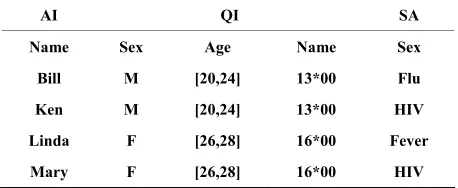
k-anonymity [1] is one of the most classic models, which technique that prevents joining attacks by generalizing and/or suppressing portions of the released microdata so that no individual can be uniquely distinguished from a group of size k. In the k-anonymous tables, a data set is k-anonymous (k ≥ 1) if each record in the data set is in- distinguishable from at least (k − 1) other records within the same data set. The larger the value of k, the better the privacy is protected. k-anonymity can ensure that indi- viduals cannot be uniquely identified by linking attacks. Let T (i.e. TABLE) is a relation storing private informa- tion about a set of individuals. The attributes in T are classified in four categories: an identifier (AI), a sensitive attribute (SA), quasi-identifier attributes (QI) and other unimportant attributes. For example, we have a raw medical data set as in Table 1. Attributes sex, age and postcode form the quasi-identifier. Two unique patient records 1 and 2 may be re-identified easily since their combinations of sex, age and postcode are unique. The table is generalized as a 2-anonymous table as in Table 2. This table makes the two patients less likely to be re- identified.
However, while k-anonymity protects against identity disclosure, it does not provide sufficient protection against attribute disclosure by the homogeneous attack and the background knowledge attack.
2.2. Extending Models
Since k-anonymity does not provide sufficient protection
Table 1. Raw medical data set.
AI QI SA
Name Sex Age Postcode Illness
Bill M 20 13000 Flu
Ken M 24 13500 HIV
Linda F 26 16500 Fever
[image:2.595.58.287.642.736.2]Mary F 28 16400 HIV
Table 2. A 2-anonymos data set of Table 1.
AI QI SA
Name Sex Age Name Sex
Bill M [20,24] 13*00 Flu
Ken M [20,24] 13*00 HIV
Linda F [26,28] 16*00 Fever
Mary F [26,28] 16*00 HIV
against attribute disclosure. The paper in [2] proposes the model of l-diversity. The notion of l-diversity attempts to solve this problem by requiring that each equivalence class has at least l well-represented value for each sensi- tive attribute. The technology of l-diversity has some advantages than k-anonymity. Because k-anonymity dataset permits strong attacks due to lack of diversity in the sensitive attributes. In this model, an equivalence class is said to have l-diversity if there are at least l well-represented value for the sensitive attribute. Be- cause there are semantic relationships among the attrib- ute values, and different values have very different levels of sensitivity. An extending model called t-closeness is proposed in [3], which requires that the distribution of a sensitive attribute in any equivalence class is close to the distribution of the attribute in the overall table. That is, a table is said to have t-closeness if all equivalence classes have t-closeness. The paper in [4] extends the k-anonymity model to the (α,k)-anonymity model to limit the confi- dence of the implications from the quasi-identifier to a sensitive value (attribute) to within a in order to protect the sensitive information from being inferred by strong implications. After anonymization, in any equivalence class, the frequency (in fraction) of a sensitive value is no more than α. The paper in [5] proposes such a k-ano- nymization model for transactional databases. Assuming that the maximum knowledge of an adversary is at most m items in a specific transaction, it wants to prevent him from distinguishing the transaction from a set of k pub-lished transactions in the database. LeFevre et al. in [6] propose the notion of multidimensional k-anonymity [7] where data generalization is over multi-dimension at a time, and [8] extend multidimensional generalization to anonymize data for a specific task such as classification. Recently, m-invariance is introduced by Xiaokui Xiao and Yufei Tao in [9] in order to effectively limit the risk of privacy disclosure in re-publication. The paper in [10] proposes a generalization technique called HD-composi- tion to offer protection on serial publishing with perma- nent sensitive values. It involves two major roles, holder and decoy. Decoys are responsible for protecting perma- nent sensitive value holder which is a dynamic setting. According k-anonymity does not take into account per- sonal anonymity requirements, personalized anonymity model is also introduced in [11]. The core of the model is the concept of personalized anonymity, i.e., a person can specify the degree of privacy protection for her/his sensi- tive values.
3. Related Research Areas
curity systems [14], and monitoring and surveillance systems [15], it gives a wrong impression that data min- ing is a technique for privacy intrusion. This lack of trust has become an obstacle to the benefit of the technology. For example, the potentially beneficial data mining re- search project, Terrorism Information Awareness (TIA), was terminated by the US Congress due to its contro- versial procedures of collecting, sharing, and analyzing the trails left by individuals [14].
Motivated by the privacy concerns on data mining tools, a research area called privacy-reserving data min- ing (PPDM) emerged in 2000 [16,17]. The initial idea of PPDM was to extend traditional data mining techniques to work with the data modified to mask sensitive infor- mation. The key issues were how to modify the data and how to recover the data mining result from the modified data. The solutions were often tightly coupled with the data mining algorithms under consideration. In contrast, privacy-preserving data publishing (PPDP) may not nec- essarily tie to a specific data mining task, and the data mining task is sometimes unknown at the time of data publishing. Furthermore, some PPDP solutions empha- size preserving the data truthfulness at the record level, but PPDM solutions often do not preserve such property.
PPDP Differs from PPDM in Several Major Ways as Follows
1) PPDP focuses on techniques for publishing data, not techniques for data mining. In fact, it is expected that standard data mining techniques are applied on the pub- lished data. In contrast, the data holder in PPDM needs to randomize the data in such a way that data mining results can be recovered from the randomized data. To do so, the data holder must understand the data mining tasks and algorithms involved. This level of involvement is not expected of the data holder in PPDP who usually is not an expert in data mining.
2) Both randomization and encryption do not preserve the truthfulness of values at the record level; therefore, the released data are basically meaningless to the recipi- ents. In such a case, the data holder in PPDM may con- sider releasing the data mining results rather than the scrambled data.
3) PPDP primarily “anonymizes” the data by hiding the identity of record owners, whereas PPDM seeks to directly hide the sensitive data. Excellent surveys and books in randomization [16,18-23] and cryptographic techniques [17,24,25] for PPDM can be found in the ex-isting literature.
A family of research work [26-33] called privacy- preserving distributed data mining (PPDDM) [17] aims at performing some data mining task on a set of private databases owned by different parties. It follows the prin-
ciple of Secure Multiparty Computation (SMC) [34,35], and prohibits any data sharing other than the final data mining result. Clifton et al. [17] present a suite of SMC operations, like secure sum, secure set union, secure size of set intersection, and scalar product, that are useful for many data mining tasks. In contrast, PPDP does not per- form the actual data mining task, but concerns with how to publish the data so that the anonymous data are useful for data mining. We can say that PPDP protects privacy at the data level while PPDDM protects privacy at the process level. They address different privacy models and data mining scenarios.
model. One may consider that privacy-reserving data publishing is a special case of the non-interactive query model.
4. Anonimization-Based Attacks
In this paper, we study the case where the adversary has some additional knowledge about the mechanism in-volved in the anonymization and launches an attack based on this knowledge. We distinguish heir between both PPDM and PPDP attacks.
4.1. Privacy-Preserving Data Publishing PPDP Attacks
In this section we present Attacks for anonimization- based attacks in privacy-preserving data publishing and we study mainly minimality attack.
Minimality Attack
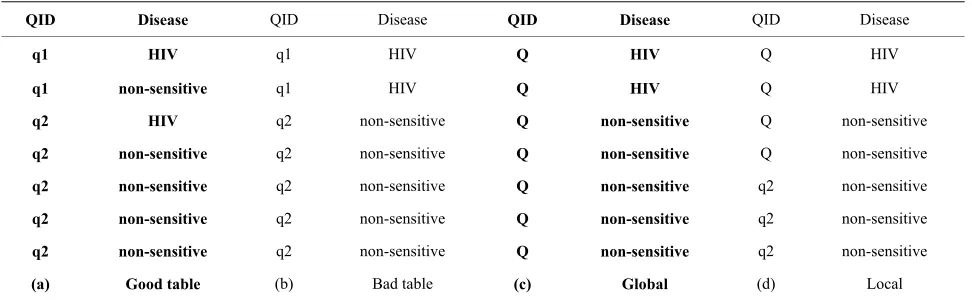
In Table 3(a), assume that the QID values of q1 and q2 can be generalized to Q and assume only one sensitive attribute “disease”, in which HIV is a sensitive value. For example, q1 may be {Nov 1930, Z3972, M}, q2 may be {Dec 1930, Z3972, M} and Q is {Nov/Dec 1930, Z3972, M}. (Note that q1 and q2 may also be generalized val- ues). A tuple associated with HIV is said to be a sensitive tuple. For each equivalence class, at most half of the tu- ples are sensitive. Hence, the table satisfies 2-diversity. As observed in LeFevre et al. [2005], existing ap- proaches of anonymization for data publishing have an implicit principle: “For any anonymization mechanism, it is desirable to define some notion of minimality”. Intui- tively, a k-anonymization should not generalize, suppress, or dis- tort the data more than it is necessary to achieve k-ano- nymity”. Based on this minimality principle, Ta-
ble 3(a) will not be generalized. In fact the aforesaid no- tion of minimality is too strong since almost all known anonymization problems for data publishing are NP-hard, many existing algorithms are heuristical and only attain
local minima. We shall later give a more relaxed notion of the minimality principle in order to cover both the optimal as well as the heuristical algorithms. For now, we assume that mimimality principle means that a QID-EC will not be generalized unnecessarily. Next, consider a slightly different table, Table 3(b). Here, the set of tuples for q1 violates 2-diversity because the pro- portion of the sensitive tuples is greater than 1/2. Thus, this table will be anonymized to a generalized table by generalizing the QID values as shown in Table 3(c) by global recoding [11]. In global recoding, all occurrences of an attribute value are recoded to the same value. If local recoding [Sweeney, 2002a; Aggarwal et al., 2005a, 2005b] is adopted, occurrences of the same value of an attribute may be recoded to different values. Such an anonymization is shown in Table 3(d). These ano- nymized tables satisfy 2-diversity. The question we are interested in is whether these tables really protect indi- vidual privacy. In most previous works [Sweeney, 2002b; LeFevre et al., 2006, 2005; Xiao and Tao, 2006b], the knowledge of the adversary involves an external table Te.
such as a voter registration list that maps QIDs to indi- viduals. As in many previous works, we assume that each tuple in Te maps to one individual and no two tuples map
to the same individual. The same is also assumed in the table T to be published. Let us first consider the case when T and Te are mapped to the same set of individuals. Table 4(a) is an example of Te. Assume further that the
adversary knows the goal of 2-diversity, s/he also knows whether it is a global or local recoding, and Table 4(a) is available as the external table Te. With the notion of
minimality in anonymization, the adversary reasons as follows: From the published Table 3(c), there are 2 sen- sitive tuples in total. From Te, there are 2 tuples with QID
[image:4.595.56.542.581.731.2]= q1 and 5 tuples with QID = q2. Hence, the equivalence class for q2 in the original table must already satisfy 2-diversity, because even if both sensitive tuples have QID = q2, the proportion of sensitive values in the class for q2 is only 2/5.
Table 3. 2-diversity: Global and local recoding.
QID Disease QID Disease QID Disease QID Disease
q1 HIV q1 HIV Q HIV Q HIV
q1 non-sensitive q1 HIV Q HIV Q HIV
q2 HIV q2 non-sensitive Q non-sensitive Q non-sensitive
q2 non-sensitive q2 non-sensitive Q non-sensitive Q non-sensitive
q2 non-sensitive q2 non-sensitive Q non-sensitive q2 non-sensitive
q2 non-sensitive q2 non-sensitive Q non-sensitive q2 non-sensitive
q2 non-sensitive q2 non-sensitive Q non-sensitive q2 non-sensitive
Table 4. Te: External table available to the adversary.
Name QID
QID
Name QID
QID
Andre q1
q1
Andre q1
q1
Kim q1
q1
Kim q1
q1
Jeremy q2
q2
Jeremy q2
q2
Victoria q2
q2
Victoria q2
q2
Ellen q2
q2
Ellen q2
q2
Sally q2
q2
Sally q2
q2
Ben q2
q2
Ben q2
q2
Tim q4
q4
Joseph q4
q4
multiset (d)
(c)Individual QID
multiset (b)
(a) Individual QID
Since generalization has taken place, at least one equivalence class in the original table T must have vio-lated 2-diversity, because otherwise no generalization will take place according to minimality. The adversary concludes that q1 has violated 2-diversity, and that is possible only if both tuples with QID = q1 have a disease value of “HIV”. The adversary therefore discovers that Andre and Kim are linked to “HIV”. In some previous works, it is assumed that the set of individuals in the ex-ternal table Te can be a superset of that for the published
table. Table 4(c) shows such a case, where there is no tuple for Tim and Joseph in Table 3(a) and Table 3(b). If it is known that q4 cannot be generalized to Q (e.g., q4 = {Nov 1930, Z3972, F} and Q = {Jan/Feb 1990, Z3972, M}), then the adversary can be certain that the tuples with QID = q4 are not in the original table. Thus, the tuples with QID = q4 in Te do not have any effect on the previous reasoning of the adversary and, therefore, the same conclusion can be drawn. We call such an attack based on the minimality principle a minimality attack.
Observation 1. If a table T is anonymized to T* which satisfies l-diversity, it can suffer from a minimality attack. This is true for both global and local recoding and for the cases when the set of individuals related to Te is a super-
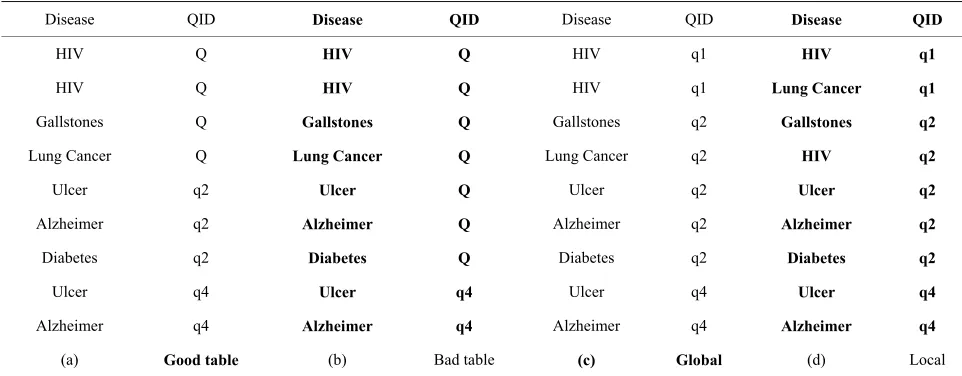
set of that related to T. In the preceding example, some values in the sensitive attribute Disease are not sensitive. Would it help if all values in the sensitive attributes are sensitive? In the tables in Table 5, we assume that all values for Disease are sensitive. Table 5(a) satisfies 2-diversity but Table 5(b) does not. Suppose anonymiza- tion of Table 5(b) results in Table 5(c) by global re- coding and Table 5(d) by local recoding.
The adversary is armed with the external table Table 4(c) and the knowledge of the goal of 2-diversity, s/he can launch an attack by reasoning as follows: With 5 tuples for QID = q2 and each sensitive value appearing at
most twice, there cannot be any violation of 2-diversity for the tuples with QID = q2. There must have been a violation for QID = q1. For a violation to take place, both tuples with QID = q1 must be linked to the same disease. Since HIV is the only disease that appears twice, Andre and Kim must have contracted HIV.
Observation 2. Minimality attack is possible whether the sensitive attribute contains non-sensitive values or not. Recall that the intended objective of 2-diversity is to make sure that an adversary cannot deduce with a prob-ability above 1/2 that an individual is linked to any sensi-tive value. Thus, the published tables violate this objec-tive. The previous attacks to Andre would also be suc-cessful if the knowledge of the external table Table 4(a)
is replaced by that of a multiset of the QID values as shown in Table 4(b) plus the QID value of Andre; or if
Table 4(c) is replaced by the multiset in Table 4(d) plus the QID value of Andre. Note that the multisets in Ta-bles 4(b) and (d) are inherently available in the published data if the bucketization technique as in Xiao and Tao [2006a], Zhang et al. [2007], or Martin et al. [2007] is used.
Observation 3. The minimality attacks to an individual t would also be successful if the knowledge of the exter- nal table Te (which is either a superset of individuals of
the published table or not) is replaced by that of a mul- tiset of the QID values of the external table Te plus the
QID value of t. A strong requirement of 3-diversity is used to achieve the original intended requirement of 2-diversity.
It is natural to ask whether there is a privacy breach if the data publisher generalizes the table a little more than minimal. In this case, we say that the anonymization al-gorithm follows a near to minimality principle. Suppose the intended objective is to generate a table which
Table 5. 2-diversity (where all values in Disease are sensitive): Global and local recoding.
QID Disease
QID Disease
QID Disease
QID Disease
q1 HIV
q1 HIV
Q HIV
Q HIV
q1 Lung Cancer
q1 HIV
Q HIV
Q HIV
q2 Gallstones
q2 Gallstones
Q Gallstones
Q Gallstones
q2 HIV
q2 Lung Cancer
Q Lung Cancer
Q Lung Cancer
q2 Ulcer
q2 Ulcer
Q Ulcer
q2 Ulcer
q2 Alzheimer
q2 Alzheimer
Q Alzheimer
q2 Alzheimer
q2 Diabetes
q2 Diabetes
Q Diabetes
q2 Diabetes
q4 Ulcer
q4 Ulcer
q4 Ulcer
q4 Ulcer
q4 Alzheimer
q4 Alzheimer
q4 Alzheimer
q4 Alzheimer
Local (d)
Global (c)
Bad table (b)
Good table
(a)
to minimality principle, the publisher generates a table which satisfies a stronger privacy requirement of 3-di- versity. Again we assume that the adversary knows that the algorithm adopted guarantees 3-diversity while minimizing the information loss. Does a published table which satisfies 3-diversity guarantee that the probability that an individual is linked to a sensitive value is at most 1/2? The answer is interestingly no. Consider Table 6. Suppose our original intended privacy requirement is 2- diversity because we want to guarantee that the probabil-ity that an individual is linked to a sensitive value is at most 1/2. Based on the near to minimality principle, a stronger 3-diversity is attained instead. Table 6(a) satis-fies 3-diversity but Table 6(b) does not. Thus, Tables 6(c) and 6(d) are generated by global recoding and local recoding, respectively. By similar arguments, with the knowledge of a strong requirement 3-diversity and Table 6(c), the adversary can also deduce that the probability that an individual with QID value = q1 is equal to 2/3 which is greater than the intended maximum disclosure probability of 1/2. This is because the two HIV values must be linked to the tuples with QID = q1. Otherwise, there will be no violation of 3-diversity and there is no need for generalization. Similar arguments can be made to Table 6(d). We call this kind of attack the near-to-minimality attack.
Observation 4. Near-to-minimality attack is possible when the anonymization algorithm follows the near to minimality principle. From the preceding discussion, we described the attack by minimality and the attack by near-to-minimality are successful under the principles of minimality principle and near-to-minimality principles used in the anonymization algorithm. Both are based on some knowledge about the algorithm, let us call an attack based on such knowledge an attack by mechanism. Hence minimality or near-minimality attack are under
this bigger class of attack.
4.2. Privacy-Preserving Data Mining (PPDM) Attacks
Various attacks are addressed from a privacy-preserving perspective. In the following subsections the most com- mon attacks are discussed.
4.2.1. Background Knowledge Attack
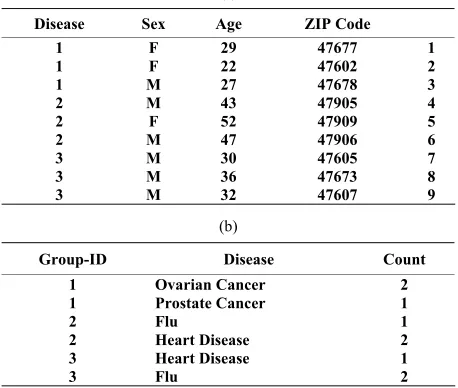
Recently, Xiao and Tao [42] introduced Anatomy as an alternative anonymization technique to generalization. Anatomy releases all the quasi-identifier and sensitive data directly into two separate tables. For example, the original table shown in Table 7 is decomposed into two tables, the quasi-identifier table (QIT) in Table 8(a) and the sensitive table (ST) in Table 8(b). The QIT table and the ST table are then released. The authors also proposed an anatomizing algorithm to compute the anatomized tables. The algorithm first hashes the records into buckets based on the sensitive attribute, i.e., records with the same sensitive values are in the same bucket. Then the algorithm iteratively obtains the ! buckets that currently have the largest number of records and selects one record from each of the ! buckets to form a group. Each re- maining record is then assigned to an existing group.
Table 6. Illustration of near to minimality principle. QID Disease QID Disease QID Disease QID Disease q1 HIV q1 HIV Q HIV Q HIV q1 non-sensitive q1 HIV Q HIV Q HIV q1 non-sensitive q1 non-sensitive Q non-sensitive Q non-sensitive q2 HIV q2 non-sensitive Q non-sensitive Q non-sensitive q2 non-sensitive q2 non-sensitive Q non-sensitive Q non-sensitive q2 non-sensitive q2 non-sensitive Q non-sensitive Q non-sensitive q2 non-sensitive q2 non-sensitive Q non-sensitive q2 non-sensitive q2 non-sensitive q2 non-sensitive Q non-sensitive q2 non-sensitive q2 non-sensitive q2 non-sensitive Q non-sensitive q2 non-sensitive Local (d) Global (c) Bad table (b) Good table (a)
Table 7. Original patients table.
ZIP Code Age Sex Disease 1 47677 29 F Ovarian Cancer 2 47602 22 F Ovarian Cancer 3 47678 27 M Prostate Cancer 4 47905 43 M Flu 5 47909 52 F Heart Disease 6 47906 47 M Heart Disease 7 47605 30 M Heart Disease 8 47673 36 M Flu 9 47607 32 M Flu
Table 8. (a) The quasi-identifier table (QIT); (b) The sensi-tive table (ST).
(a) ZIP Code Age Sex Disease 1 2 3 47677 47602 47678 29 22 27 F F M 1 1 1 4 5 6 47905 47909 47906 43 52 47 M F M 2 2 2 7 8 9 47605 47673 47607 30 36 32 M M M 3 3 3 (b) Count Disease Group-ID 2 1 Ovarian Cancer Prostate Cancer 1 1 1 2 Flu Heart Disease 2 2 1 2 Heart Disease Flu 3 3
records with similar quasi-id values together). Therefore, it is likely that one may be grouping records with in-compatible sensitive attribute values together.
4.2.2. Unsorted Matching Attack
This attack is based on the order in which tuples appear in the released table. While we have maintained the use of a relational model, and so the order of tuples cannot be assumed, in real-world use this is often a problem. It can be corrected of course, by randomly sorting the tuples of the solution. Otherwise, the release of a related table can leak sensitive information.
From Figure 1 we can see that this attack is based on the order in which tuples appear in the released table.
Solution: Random shuffling of rows.
4.2.3. Complementary Release Attack
It is more common that the attributes that constitute the quasi-identifier are themselves a subset of the attributes released. As a result, when a k-minimal solution, which we will call table T is released, it should be considered as joining other external information. Therefore, subsequent releases of generalizations of the same privately held information must consider all of the released attributes of T a quasi-identifier to prohibit linking on T, unless of course, subsequent releases are themselves generaliza-tions of T.
From Figure 2 we find that Different releases can be linked together to compromise k-anonymity.
Solution:
1) Consider all of the released tables before release the new one, and try to avoid linking.
[image:7.595.58.287.535.729.2]Race Zip Race Zip Race Zip Asian 02138 Person 02138 Asian 02130
Asian 02139 Person 02139 Asian 02130 Asian 02141 Person 02141 Asian 02140 Asian 02142 Person 02142 Asian 02140
Black 02138 Person 02138 Black 02130 Black 02139 Person 02139 Black 02130 Black 02141 Person 02141 Black 02140
Black 02142 Person 02142 Black 02140 White 02138 Person 02138 White 02130 White 02139 Person 02139 White 02130 White 02141 Person 02141 White 02140
[image:8.595.55.286.84.286.2]White 02142 Person 02142 White 02140 PT GT1 GT2
Figure 1. Demonstrate unsorted matching attack.
4.2.4. Temporal Attack
Data collections are dynamic. Tuples are added, changed, and removed constantly. As a result, releases of general- ized data over time can be subject to a temporal inference attack.
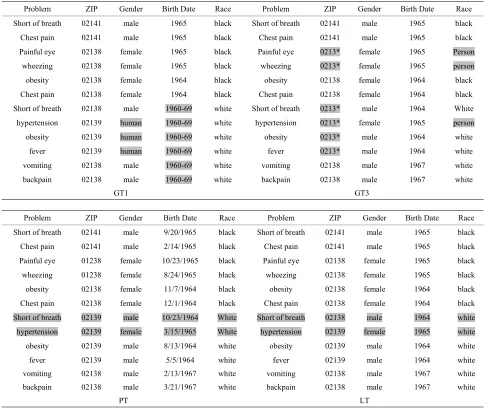
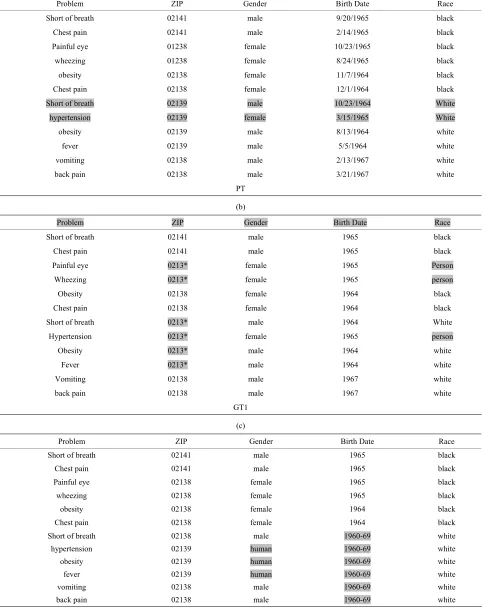
From Figures 3(a), (b) and (c), we see that adding or removing tuples may compromise k-anonymity protec- tion.
Solution: Subsequent releases must use the already re- leased table.
4.2.5. Homogeneity Attack and Background Knowledge Attack
In this subsection we present two major attacks, the ho-mogeneity attack and background knowledge attack [43], along with unsorted matching attack, complementary release attack and temporal attack, and we show that how they can be used to compromise a k-anonymous dataset.
Race Birth Date Gender ZIP Problem Race Birth Date Gender ZIP Problem black 1965 male 02141
Short of breath black
1965 male
02141 Short of breath
black 1965 male 02141 Chest pain black 1965 male 02141 Chest pain Person 1965 female 0213* Painful eye black 1965 female 02138 Painful eye person 1965 female 0213* wheezing black 1965 female 02138 wheezing black 1964 female 02138 obesity black 1964 female 02138 obesity black 1964 female 02138 Chest pain black 1964 female 02138 Chest pain White 1964 male 0213*
Short of breath white
1960-69 male
02138 Short of breath
person 1965 female 0213* hypertension white 1960-69 human 02139 hypertension white 1964 male 0213* obesity white 1960-69 human 02139 obesity white 1964 male 0213* fever white 1960-69 human 02139 fever white 1967 male 02138 vomiting white 1960-69 male 02138 vomiting white 1967 male 02138 backpain white 1960-69 male 02138 backpain GT3 GT1 Race Birth Date Gender ZIP Problem Race Birth Date Gender ZIP Problem black 1965 male 02141
Short of breath black
9/20/1965 male
02141 Short of breath
black 1965 male 02141 Chest pain black 2/14/1965 male 02141 Chest pain black 1965 female 02138 Painful eye black 10/23/1965 female 01238 Painful eye black 1965 female 02138 wheezing black 8/24/1965 female 01238 wheezing black 1964 female 02138 obesity black 11/7/1964 female 02138 obesity black 1964 female 02138 Chest pain black 12/1/1964 female 02138 Chest pain white 1964 male 02138
Short of breath White
10/23/1964 male
02139 Short of breath
white 1965 female 02139 hypertension White 3/15/1965 female 02139 hypertension white 1964 male 02139 obesity white 8/13/1964 male 02139 obesity white 1964 male 02139 fever white 5/5/1964 male 02139 fever white 1967 male 02138 vomiting white 2/13/1967 male 02138 vomiting white 1967 male 02138 backpain white 3/21/1967 male 02138 backpain LT PT
[image:8.595.55.543.313.725.2](a)
Race Birth Date
Gender ZIP
Problem
black 9/20/1965
male 02141
Short of breath
black 2/14/1965
male 02141
Chest pain
black 10/23/1965
female 01238
Painful eye
black 8/24/1965
female 01238
wheezing
black 11/7/1964
female 02138
obesity
black 12/1/1964
female 02138
Chest pain
White 10/23/1964
male 02139
Short of breath
White 3/15/1965
female 02139
hypertension
white 8/13/1964
male 02139
obesity
white 5/5/1964
male 02139
fever
white 2/13/1967
male 02138
vomiting
white 3/21/1967
male 02138
back pain
PT
(b)
Race Birth Date
Gender ZIP
Problem
black 1965
male 02141
Short of breath
black 1965
male 02141
Chest pain
Person 1965
female 0213*
Painful eye
person 1965
female 0213*
Wheezing
black 1964
female 02138
Obesity
black 1964
female 02138
Chest pain
White 1964
male 0213*
Short of breath
person 1965
female 0213*
Hypertension
white 1964
male 0213*
Obesity
white 1964
male 0213*
Fever
white 1967
male 02138
Vomiting
white 1967
male 02138
back pain
GT1
(c)
Race Birth Date
Gender ZIP
Problem
black 1965
male 02141
Short of breath
black 1965
male 02141
Chest pain
black 1965
female 02138
Painful eye
black 1965
female 02138
wheezing
black 1964
female 02138
obesity
black 1964
female 02138
Chest pain
white 1960-69
male 02138
Short of breath
white 1960-69
human 02139
hypertension
white 1960-69
human 02139
obesity
white 1960-69
human 02139
fever
white 1960-69
male 02138
vomiting
white 1960-69
male 02138
[image:9.595.57.540.102.709.2]back pain
Figure 3. Adding or removing tuples; (a) black 9/7/65 male 02139 headache, black 11/4/65 male 02139 rash; (c) black 1965 ale 02139 rash; black 1965 male 02139 headache.
m
So here new definition arise l-diversity. l-diversity pro- vides privacy even when the data publisher does not know what kind of knowledge is possessed by the ad- versary. The main idea behind l-diversity is the require- ment that the values of the sensitive attributes are well- represented in each group.
Even when sufficient care is taken to identify the QI, the k-anonymity is still vulnerable to attacks. The com- mon attacks are unsorted matching attacks, complemen- tary release attacks and temporal attacks. Fortunately, these attacks can be prevented by some best practices. But the two major attacks, Homogeneity and Background attacks disclose the individuals’ sensitive information. K-anonymity does not protect against attacks based on background knowledge because k-anonymity can create groups that leak information.
Observation: k-anonymity does not provide privacy in case of Homogeneity and Background attacks.
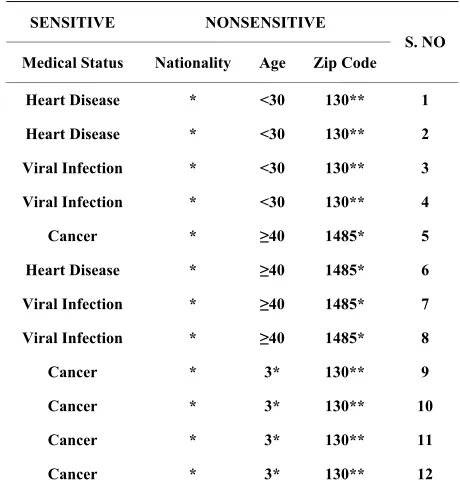
Homogeneity Attack: Suppose A and B are enemies and A wants to infer B’s medical status which is present in Table 9. A knows B’s ZIP Code is 13053 and his age is 35. So using this knowledge A knows that B’s records belong from record no. 9,10,11,12 have Cancer. So A concludes that B has Cancer. This situation or attack is implies that k-anonymity can create groups which are responsible for leakage of information. This happens due to the lack of diversity in the sensitive attribute. This problem suggests that in addition to k-anonymity, the disinfected table should also ensure “diversity” all tuples that share the same values of their quasi-identifiers should have diverse values for their sensitive attributes.
[image:10.595.307.537.102.347.2]Background Knowledge Attack: Suppose C and D are two aggressive neighbors and C wants to infer D’s pri-vate data, let the medical status, from the pripri-vate table PT.
Table 9 shows a 4-anonymous private table with patient micro data which satisfies k-anonymity. So for a single value, C finds 3 more values. So if he wants to infer D’s medical status, he has four options for disease. This is k-anonymity principle. But C knows some general details about D as his ZIP Code is 14853 and age above 50. So using these values as quasi-identifiers, C concludes that D’s record is present in records 5,6,7,8. But here C has three options of disease, Cancer, Heart Disease and Viral infection. Here C uses his background knowledge and concludes that D has Heart Disease because D has low blood pressure and he avoids fatty meals.
So, we can say that k-anonymity does not protect against attacks based on background knowledge. We have demonstrated (using the homogeneity and back-ground knowledge attacks) that a k-anonymous table may disclose sensitive information. Since both of these attacks are plausible in real life, we need a stronger defi-nition of privacy that takes into account diversity and background knowledge. The k-anonymity may suffer
Table 9. 4-anonymous inpatient microdata.
NONSENSITIVE SENSITIVE
S. NO Zip Code
Age Nationality Medical Status
1 130** <30
* Heart Disease
2 130** <30
* Heart Disease
3 130** <30
* Viral Infection
4 130** <30
* Viral Infection
5 1485* ≥40
* Cancer
6 1485* ≥40
* Heart Disease
7 1485* ≥40
* Viral Infection
8 1485* ≥40
* Viral Infection
9 130** 3*
* Cancer
10 130**
3* *
Cancer
11 130**
3* *
Cancer
12 130**
3* *
Cancer
with this aspect also.
5. Conclusion
REFERENCES
[1] P. Samarati and L. Sweeney, “Protecting Privacy When Disclosing Information: k-Anonymity and Its Enforce- ment through Generalization and Suppression,” Technical Report SRI-CSL-98-04, 1998.
[2] A. Machanavajjhala, J. Gehrke, et al., “l -Diversity: Pri-
vacy beyond k-Anonymity,” Proceeding of ICDE, April
2006.
[3] N. Li, T. Li and S. Venkatasubramanian, “t-Closeness: Privacy Beyond k-Anonymity and l-Diversity,” Proceed- ings of ICDE, 2007, pp. 106-115.
[4] R. C. Wong, J. Li, A. W. Fu, et a1., “(α,k)-Anonymity:
An Enhaned k-Anonymity Model for Privacy-Preserving Data Publishing,” In: Proceedings of the 12th ACM SIGKDD, ACM Press, New York, 2006, pp. 754-759.
[5] M. Terrovitis, N. Mamoulis and Kalnis, “Privacy Pre-serving Anonymization of Set-Valued Data,” VLDB,
Auckland, 2008, pp. 115-125.
[6] K. LeFevre, D. J. DeWitt and R. Ramakrishnan, “Incog- nito: Efficient Full-Domain k-Anonymity,” In: Proceed-ings of the ACM SIGMOD International Conference on Management of Data, Baltimore, June 2005, pp. 49-60.
[7] X. Ye, L. Jin and B. Li, “A Multi-Dimensional K-Anony- mity Model for Hierarchical Data, Electronic Commerce and Security,” 2008 International Symposium, Beijing,
August 2008, pp. 327-332.
[8] K. LeFevre, D. J. DeWitt and R. Ramakrishnan, “Work- load-Aware Anonymization,” Proceedings of the 12th ACM SIGKDD International Conference on Knowledge Discovery and Data Mining, Philadelphia, August 2006,
pp.277-286. doi:10.1145/1150402.1150435
[9] X. Xiao and Y. Tao, “M-Invariance: Towards Privacy- Preserving Re-Publication of Dynamic Datasets,” In: Pro- ceedings of SIGMOD, ACM Press, New York, 2007, pp.
689-700.
[10] Y. Bu, A. Wai-Chee Fu, et al., “Privacy-Preserving Serial
Data Publishing By Role Composition,” VLDB, Auckland,
2008, pp. 845-856.
[11] X. Xiao and Y. Tao, “Personalized Privacy Preservation, Proceedings of ACM Conference on Management of Data (SIGMOD),” ACM Press, New York, 2006, pp. 785-790. [12] “Business for Social Responsibility,” BSR Report on
Privacy, 1999. http://www.bsr.org/
[13] B. Krishnamurthy, “Privacy vs. Security in the Aftermath of the September 11 Terrorist Attacks,” November 2001. http://www.scu.edu/ethics/publications/briefings/privacy. html
[14] J. W. Seifert, “Data Mining and Homeland Security: An Overview,” CRS Report for Congress, (RL31798), Janu- ary 2006. http://www.fas.org/sgp/crs/intel/RL31798.pdf [15] T. Fawcett and F. Provost, “Activity Monitoring: Notic-
ing Interesting Changes in Behavior,” Proceedings of the
5th ACM International Conference on Knowledge Dis- covery and Data Mining (SIGKDD), San Diego, 1999, pp.
53-62. doi:10.1145/312129.312195
[16] R. Agrawal and R. Srikant, “Privacy-Preserving Data Mining,” Proceedings of ACM International Conference
on Management of Data (SIGMOD), Dallas, 2000, pp.
439-450.
[17] C. Clifton, M. Kantarcioglu, J. Vaidya, X. Lin and M. Y. Zhu, “Tools for Privacy-Preserving Distributed Data Min- ing,” ACM SIGKDD Explorations Newsletter, Vol. 4, No.
2, 2002, pp. 28-34. doi:10.1145/772862.772867
[18] N. R. Adam and J. C. Wortman, “Security Control Meth- ods for Statistical Databases,” ACM Computer Surveys,
Vol. 21, No. 4, 1989, pp. 515-556. doi:10.1145/76894.76895
[19] S. Agrawal and J. R. Haritsa, “A Framework for High- Accuracy Privacy-Preserving Mining,” Proceedings of the 21st IEEE International Conference on Data Engi- neering (ICDE), Tokyo, April 2005, pp. 193-204.
doi:10.1109/ICDE.2005.8
[20] A. Evfimievski, “Randomization in Privacy-Preserving Data Mining,” ACM SIGKDD Explorations Newsletter,
Vol. 4, No. 2, 2002, pp. 43-48. doi:10.1145/772862.772869
[21] K. Liu, H. Kargupta and J. Ryan, “Random Projection- Based Multiplicative Perturbation for Privacy-Preserving Distributed Data Mining,” IEEE Transactions on Knowl- edge and Data Engineering (TKDE), Vol. 18, No. 1, 2006,
pp. 92-106. doi:10.1109/TKDE.2006.14
[22] A. Shoshani, “Statistical Databases: Characteristics, Prob- lems and Some Solutions,” Proceedings of the 8th Very Large Data Bases (VLDB), Mexico City, September 1982,
pp. 208-213.
[23] V. S. Verykios, E. Bertino, I. N. Fovino, L. P. Provenza, Y. Saygin and Y. Theodoridis, “State-of-the-Art in Pri- vacy Preserving Data Mining,” ACM SIGMOD Record,
Vol. 3, No. 1, 2004, pp. 50-57. doi:10.1145/974121.974131
[24] B. Pinkas, “Cryptographic Techniques for Privacy-Preser- ving Data Mining,” ACM SIGKDD Explorations News- letter, Vol. 4, No. 2, 2002, pp. 12-19.
doi:10.1145/772862.772865
[25] J. Vaidya, C. W. Clifton and M. Zhu, “Privacy-Preserving Data Mining,” 2006.
[26] W. Du, Y. S. Han and S. Chen, “Privacy-Preserving Mul- tivariate Statistical Analysis: Linear Regression and Clas- sification,” Proceedings of the SIAM International Con- ference on Data Mining (SDM), Florida, 2004.
[27] W. Du and Z. Zhan, “Building Decision Tree Classifier on Private Data,” Workshop on Privacy, Security, and Data Mining at the 2002 IEEE International Conference on Data Mining, Maebashi City, December 2002.
[28] A. W. C. Fu, R. C. W. Wong and K. Wang, “Privacy-Pre- serving Frequent Pattern Mining across Private Data-bases,” Proceedings of the 5th IEEE International Con- ference on Data Mining (ICDM), Houston, November
2005, pp. 613-616.
[29] M. Kantarcioglu and C. Clifton, “Privacy-Preserving Data Mining of Association Rules on Horizontally Partitioned Data,” IEEE Transactions on Knowledge and Data Engi- neering (TKDE), Vol. 16, No. 9, 2004, pp. 1026-1037.
doi:10.1109/TKDE.2004.45
Distributed K-Nn Classifier,” Proceedings of the 8th European Conference on Principles and Practice of Knowledge Discovery in Databases (PKDD), Pisa, Sep-
tember 2004, pp. 279-290.
[31] J. Vaidya and C. Clifton, “Privacy-Preserving Association Rule Mining in Vertically Partitioned Data,” Proceedings of the 8th ACM International Conference on Knowledge Discovery and Data Mining (SIGKDD), Edmonton, 2002.
pp. 639-644.
[32] J. Vaidya and C. Clifton, “Privacy-Preserving k-Means Clustering over Vertically Partitioned Data,” Proceedings of the 9th ACM International Conference on Knowledge Discovery and Data Mining (SIGKDD), Washington,
2003, pp. 206-215.
[33] Z. Yang, S. Zhong and R. N. Wright, “Privacy-Preserving Classification of Customer Data without Loss of Accu- racy,” Proceedings of the 5th SIAM International Con-ference on Data Mining (SDM), Newport Beach, 2005, pp.
92-102.
[34] A. C. Yao, “Protocols for Secure Computations,” Pro-ceedingsof the 23rd IEEE Symposium on Foundations of Computer Science, Washington DC, 1982, pp. 160-164. [35] A. C. Yao, “How to Generate and Exchange Secrets,”
Proceedings of the 27th Annual IEEE Symposium on Foundations of Computer Science, 1986, pp. 162-167. [36] R. Brand, “Microdata Protection through Noise
Addi-tion,” Inference Control in Statistical Databases, From Theory to Practice, London, 2002, pp. 97-116.
[37] Confidentiality and Data Access Committee, “Report on Statistical Disclosure Limitation Methodology,” Techni-
cal Report 22, Office of Management and Budget, De-cember 2005.
[38] A. Blum, C. Dwork, F. McSherry and K. Nissim, “Prac- tical Privacy: The Sulq Framework,” Proceedingsof the
24th ACM Symposium on Principles of Database Sys- tems (PODS), Baltimore, June 2005, pp. 128-138.
[39] I. Dinur and K. Nissim, “Revealing Information While Preserving Privacy,” Proceedingsof the 22nd ACM Sym-posium on Principles of Database Systems (PODS), San
Diego, June 2003, pp. 202-210.
[40] C. Dwork, “Differential Privacy: A Survey of Results,”
Proceedingsof the 5th International Conference on The-ory and Applications of Models of Computation (TAMC),
Xi’an, April 2008, pp. 1-19.
[41] A. Blum, K. Ligett and A. Roth, “A Learning Theory Approach to Non-Interactive Database Privacy,” Pro- ceedingsof the 40th annual ACM Symposium on Theory of Computing (STOC), Victoria, 2008, pp. 609-618.
[42] X. Xiao and Y. Tao, “Anatomy: Simple and Effective Privacy-Preservation,” Proceedings of the International Conference on Very Large Data Bases (VLDB), Seoul,
2006, pp. 139-150.
[43] N. Maheshwarkar, K. Pathak and V. Chourey, “Privacy Issues for k-Anonymity Model,” International Journal of Engineering Research, Vol. 1, No. 4, 2011, pp. 1857-
1861. doi:10.1109/DBTA.2009.74
[44] X. Hu, Z. Sun, Y. Wu, W. Hu and J. Dong, “k-Anonymi- ty Based on Sensitive Tuples,” First International Work- shop on Database Technology and Applications, Wuhan,