Improvements to a Novel Device Simulating Pneumatic
Intussusception Reduction
Steffan K. Soosman1, Joseph C. Li2, Glade E. Roper3, Anthony S. Wexler4, Rebecca Stein-Wexler3, Thomas Ray Sanchez3*
1
John A. Burns School of Medicine, University of Hawaii, Honolulu, USA 2
School of Medicine, University of California at Davis, Sacramento, USA 3
Department of Radiology, University of California at Davis, Sacramento, USA 4
Department of Mechanical and Aerospace Engineering, University of California at Davis, Civil and Environmental Engineering, Land, Air, and Water Resources, Davis, USA
Email: *[email protected]
Received December 7, 2012; revised March 1, 2013; accepted March 9, 2013
Copyright © 2013 Steffan K. Soosman et al. This is an open access article distributed under the Creative Commons Attribution Li-cense, which permits unrestricted use, distribution, and reproduction in any medium, provided the original work is properly cited.
ABSTRACT
Objectives: Intussusception, an uncommon but important cause of acute abdomen during infancy and early childhood, can be safely and effectively treated by fluoroscopic air reduction. Although pediatric radiology fellows report ample opportunity to practice intussusception reduction, radiology residents report few opportunities to participate in this pro-cedure. Adequate training to reduce intussusception is essential, as successful reduction obviates the need for surgery. A teaching device that simulates intussusception reduction could help radiology residents develop the skills necessary to
perform this procedure. Materials and Methods: We report on improvements made to a training device developed in
2010 by Stein-Wexler et al. Since then we have simplified the manufacturing process, added several unique patient
cases, improved the software so that adding patient scenarios is easier, and improved the graphic interface to make the simulation more realistic and facilitate feedback. Results: The simulator is now a customizable and robust standalone package. A thorough instructor’s manual and improvements to the graphic design-such as embedded checklists, built-in
feedback mechanisms, and a more intuitive interface-make the simulator easier to use. Conclusion: We have improved
our previously-reported teaching device for intussusception reduction and produced a robust simulator. We plan to make this device available to programs that train physicians in pneumatic intussusception reduction.
Keywords: Intussusception; Reduction; Simulator; Teaching
1. Introduction
Intussusception is an uncommon but important factor to consider in pediatric cases of acute abdomen. The inci- dence has been estimated at 0.5 - 2.3 cases per 1000 live births in the USA [1,2]. First-line treatment for pediatric intussusception is enema reduction under the supervision of a radiologist. Both air and liquid enemas have been shown to be effective and safe [3], but air reduction is more likely to result in a successful reduction, causes less radiation exposure, and causes less peritoneal contamina-tion in the event of perforacontamina-tion [4].
However, since intussusception is relatively uncom-mon, radiology residents have few opportunities to per-form a supervised reduction. A survey found that senior radiology residents on average reported participating in
only 2 cases during their entire residency; 22% had been involved in no reductions, and 21% had been involved only once [5]. A more recent survey found that pediatric radiology fellows have more experience with reducing intussusception, with respondents reporting an average of 6.9 reductions [6]. Meyer et al. [7] demonstrated that a radiologist must participate in at least 4 to 6 reductions to gain sufficient skill and confidence in this technique; by these criteria, the typical pediatric radiology fellow re-ceives adequate training in intussusception reduction, but the typical radiology resident does not.
When a child presents with intussusception, a suc-cessful air reduction will obviate the need for surgery. It would be nice if all children could be treated at special-ized pediatric hospitals, but many children with intus-susception present at community hospitals that do not have pediatric radiologists on staff. It is therefore essen-*
tial that general radiologists be comfortable with this procedure.
In 2010, Stein-Wexler et al. [8] created a prototype for a training device that simulates the reduction procedure. Feedback about this device has led us to make improve-ments that transform it into a robust and versatile simu-lator that will be offered to programs that wish to sup-plement patient-based learning with a simulation model.
2. Materials and Methods
The authors sought to improve the prototype of the in-tussusception reduction simulator [8] with the goal of producing a device that other radiology training pro-grams could purchase and use. The original design in-cludes a custom machined polyvinyl chloride chamber and spring piston assembly that approximates the stress and strain properties of the colon. The trainee uses a standard aneroid bulb and gauge insufflator to pump air into the chamber. The pressure within the chamber is continuously monitored, and the software displays fluoro- scopic still images of intussusception reduction when the trainee pushes a simulated fluoroscopic trigger.
We sought to improve the design of the simulator with the following goals:
1) Simplify the manufacturing process to reduce cost and complexity. Instead of using custom-machined parts, we tested modular and prefabricated materials that de-crease cost per unit, dede-crease the risk of mechanical fail-ure, and simplify maintenance.
2) Redesign the software to accommodate multiple tient scenarios. The original device included a single pa-tient scenario, hard-coded into software, including clini-cal images, a stipulated ease of reduction, and the prob-ability of perforation. We set out to redesign the program so that different patient scenarios could be added as in-dependent “case files”, each containing a unique patient presentation with associated clinical images. The ease of reduction and the probability of perforation are appropri-ate to the different clinical histories.
3) Provide feedback at multiple key stages for the trainee before and after the procedure. We include brief- ing and de-briefing stages, so the instructor has multiple opportunities for teaching and feedback, as well as the opportunity to review performance upon completion.
4) Improve the simulation experience by simplifying the graphical interface, adding the ability to stop the pro- cedure and notify surgeons, and improving the quality of the fluoroscopic images. The original graphical interface was overly complex, and the user did not receive visual feedback that an image was taken. We set out to remove clutter from the screen and make the fluoroscopic image “flash” after every simulated exposure.
5) Create a comprehensive reference document for
both the instructor and trainee.
This project study was IRB approved.
3. Results
We accomplished our goals as follows, resulting in a more robust and customizable training device:
1) The main pressure chamber of the original device was custom-machined from polyvinyl chloride, with ports drilled in it to allow for pressure sensing and air input. We found that a prefabricated 150 cc luer-lock syringe with a three-way stopcock attached worked just as well, and obviated the need to compromise the volume by drilling inlet ports. This modular approach to assem-bly saves considerable time and expense, and allows damaged or malfunctioning parts to be easily replaced.
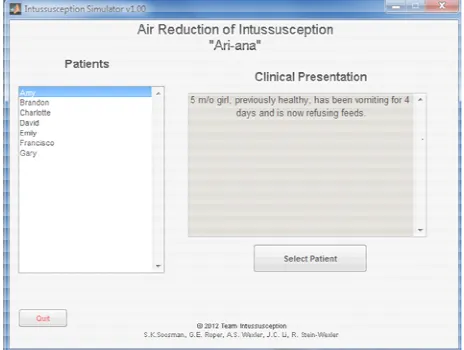
2) The software was reprogrammed so that cases are no longer hard-coded in the program. The new version of the software is more flexible—each case is now a self- contained file. When the user starts the program, it dis-plays a list of the patients loaded onto the computer (Figure 1). The instructor or trainee chooses a patient from the list. Each case file includes the patient name, fluoroscopic images from an actual patient depicting dif-ferent stages of reduction; pre-procedural and post-pro- cedural images; and both abridged and detailed clinical presentation descriptions. Each case is customized to fit the corresponding clinical scenario, including the prob-ability that the reduction will progress or retrogress and the probability of perforation at each stage of the reduc-tion. It is now easy to add, delete, or modify cases in the case library, extending the utility of the simulator.
3) Pre-procedure and post-procedure stages were
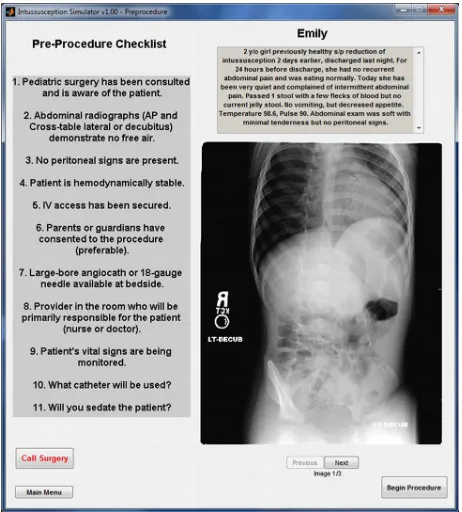
added to the simulator. The pre-procedure window (
[image:2.595.307.539.513.688.2]Fig-ure 2) appears after the user selects a patient from the
main menu and includes a detailed clinical presentation and pre-procedure radiographs and/or ultrasound images. After reviewing the images, the trainee must decide whether to begin the procedure or—upon recognizing pre-existing pneumoperitoneum—to refer the patient to surgical services, terminating the scenario. In addition, a debriefing window now displays when the trainee exits each case (Figure 3). This post-procedural window pre-sents an image of the last stage of reduction reached prior to termination, as well as a graph that plots the pressure within the system over the course of the simulation. If the intussusceptum is completely reduced and post-proce- dure radiographs are available, the trainee may review them. Post-procedure images are not offered if the reduc-tion is incomplete, if they are not available for that spe-cific patient, or if the bowel perforates.
[image:3.595.57.288.84.340.2]4) We added a button to the screen that allows the trainee to terminate the procedure and refer to surgery at any time during the reduction. The trainee is expected to exercise this option if an image of pneumoperitoneum is displayed. The scenario immediately ends and the de-briefing window is displayed, providing the opportunity for the instructor to review the case with the trainee. We also added more realistic image feedback—the screen flashes every time the trainee touches the simulated fluoroscopy button. This better mimics the functionality of the fluoroscope and provides the trainee with feedback that an image was taken, even if no significant progress Figure 2. The pre-procedure interface. Scout radiographs,
ultrasound and other pertinent images can be reviewed for the selected patient. A more detailed clinical presentation is also delineated at the top right. The embedded checklist on the left side of the interface reviews decision points and encourages discussion between the instructor and the trainee.
[image:3.595.129.468.429.659.2]is made.
5) We have written a user’s manual that includes in-formation about intussusception and reduction, recom-mended reading, instructions for using the simulator, and initial setup procedures. We also include (for the in-structor) a detailed description of each simulated patient that includes the clinical presentation, the ease of reduc-tion, representative images from each reduction scenario with the salient features highlighted, and the predicted outcome of the reduction.
4. Discussion
Fluoroscopically guided hydrostatic intussusception re-duction was one of the first interventional radiology pro-cedures. First described by George M. Retan in 1927 [9], this method was popularized in Ravitch and McCune’s 1948 experimental study [10]. Since then, fluoroscopi-cally guided reduction has become the treatment of choice for uncomplicated cases of intussusception in childhood. While many centers outside of the United States use US to guide reductions [11,12], most pediatric radiologists in the United States and 90% of pediatric radiologists in European teaching hospitals prefer to re-duce intussusceptions under fluoroscopic guidance [13].
Although the radiologist can use either air or liquid to reduce intussusception, reduction with air tends to cause smaller perforations and consequently less fecal perito-neal contamination [4]. Furthermore, the filling speed of air is approximately seven times faster than liquid, yielding a stronger force of reduction [14] and—accord- ing to some—increased probability of reduction [15]. It also exposes the patient to less radiation due to shorter fluoroscopic times and lower kVp and mA settings [7,16]. As a practical matter, air is less messy than liquid. For these reasons, pediatric radiologists increasingly favor a pneumatic approach [15,17]. We therefore built [8] and have now improved a simulator based on air reduction technique.
Due to the relatively low incidence of intussusception, radiology residents have little opportunity for supervised learning of the reduction procedure. In 2010, we devel-oped our original device with the following goals in mind:
1) Include an air leak, forcing the trainee to recognize and address air loss and consequent pressure drops due to an inadequate seal.
2) Allow the reduction to proceed at variable levels of difficulty and speed depending to some degree on ran-dom chance, but mostly subject to the control of the in-structor.
3) Present realistically challenging images to the trainee.
4) Have a higher-than-realistic likelihood of
perfora-tion so that the trainee has the opportunity to recognize this complication and then practice treating the poten-tially fatal complication of tension pneumoperitoneum.
5) Encourage effective multi-tasking by requiring the trainee to simultaneously control the insufflator, monitor pressure, deliver radiation, interpret images, ensure a tight seal, and act quickly if perforation occurs.
With these improvements, the simulator is now a ver-satile and robust package. The transition to modular pa-tient case files constitutes a major improvement. We have created seven different patients, and each offers a unique challenge to the trainee. For example, one patient has an intussusception that cannot be reduced, another is easily reduced, a third has no intussusception, and a fourth demonstrates free intraperitoneal air on the scout image. The detailed clinical presentation of each case may suggest the outcome of the procedure. However, although on average each case will tend to result in a certain outcome, the use of random number generators allows unexpected outcomes to occur as well, assuring that no two reductions of the same patient are exactly the same.
The original device was codenamed “LUCY” in hom-age to the toy doll that housed the pressure chamber. In light of the improvements and additional features made to LUCY, we have changed the simulator’s name to ARI-ana, an acronym for Air Reduction of Intussuscep-tion.
This device has several limitations. First and foremost, using a simulator is inherently artificial. We found that instructor and trainee fatigue made it necessary to accel-erate the entire experience, compressing a sometimes lengthy procedure into just a few minutes. Furthermore, as described above, the probability of a perforation dur-ing the reduction is, by design, higher with this simulator than in real life. In addition, this device depends on the educational interaction between instructor and trainee—it is designed to supplement rather than replace the experi-ence of reducing an intussusception in a real patient.
5. Conclusion
REFERENCES
[1] J. Bruce, Y. S. Huh, D. R. Cooney, M. P. Karp, J. E. Al-len and T. C. Jewett Jr., “Intussusception: Evolution of Current Management,” Journal of Pediatric Gastroen-terology and Nutrition, Vol. 6, No. 5, 1987, pp. 663-674. doi:10.1097/00005176-198709000-00003
[2] M. B. Rennels, U. D. Parashar, R. C. Holman, C. T. Le, H. G. Chang and R. I. Glass, “Lack of an Apparent Associa-tion between IntussuscepAssocia-tion and Wild or Vaccine Rota-virus Infection,” Pediatric Infectious Disease Journal, Vol. 17, No. 10, 1998, pp. 924-925.
doi:10.1097/00006454-199810000-00018
[3] S. W. Beasley and N. A. Myers, “Intussusception: Cur-rent Views,” Pediatric Surgery International. Vol. 14, No. 3, 1998, p.157. doi:10.1007/s003830050473
[4] A. Danerman, D. J. Alton, S. Ein, D. Wesson, R. Su-perina and P. Thorner, “Perforation during Attempted In-tussusception Reduction in Children—A Comparison of Perforation with Barium and Air,” Pediatric Radiology, Vol. 25, No. 2, 1995, pp. 81-88.
doi:10.1007/BF02010311
[5] C. Bateni, R. Stein-Wexler, S. L. Wootton-Gorges and C. S. Li, “Radiology Residents’ Experience with Intussus-ception Reduction,” Pediatric Radiology, Vol. 41, No. 6, 2011, pp. 21-26. doi:10.1007/s00247-010-1923-0
[6] R. Stein-Wexler, C. Bateni, S. L. Wootton-Gorges, C. S. Li, “Pediatric Radiology Fellows’ Experience with intus-susception Reduction,” Pediatric Radiology, Vol. 41, No. 11, 2011, pp. 1365-1368. doi:10.1007/s00247-011-2095-2
[7] J. S. Meyer, B. C. Dangman, C. Buonomo and J. A. Ber-lin, “Air and Liquid Contrast Agents in the Management of Intussusception: A Controlled, Randomized Trial,”
Radiology, Vol. 188, No. 2, 1993, pp. 507-511.
[8] R. Stein-Wexler, T. Sanchez, G. E. Roper, et al., “An Interactive Teaching Device Simulating Intussusception Reduction,” Pediatric Radiology, Vol. 40, No. 11, 2010, pp. 1810-1815.doi:10.1007/s00247-010-1764-x
[9] V. G. McDermott, “Childhood Intussusception and
Ap-proaches to Treatment: A Historical Review,” Pediatric Radiology, Vol. 24, No. 3, 1994, pp. 153-155.
doi:10.1007/BF02012174
[10] M. M. Ravitch and C. R. McCune, “Reduction of Intus-susception by Hydrostatic Pressure; An Experimental Study,” Bulletin of the Johns Hopkins Hospital, Vol. 82, No. 5, 1948, pp. 550-568.
[11] T. W. Riebel, R. Nasir and K. Weber, “US-Guided Hy-drostatic Reduction of Intussusception in Children,” Ra-diology, Vol. 188, No. 2, 1993, pp. 513-516.
[12] G. D. Wang and S. J. Liu, “Enema Reduction of Intus-susception by Hydrostatic Pressue under Ultrasound Guidance: A Report of 377 Cases,” Journal of Pedatric Surgery, Vol. 23, No. 9, 1988, pp. 814-818.
doi:10.1016/S0022-3468(88)80229-X
[13] P. Schmit, W. K. Rohrschneider and D. Christmann, “In-testinal Intussusception Survey about Diagnostic and Nonsurgical Therapeutic Procedures,” Pediatric Radiol-ogy, Vol. 29, No. 10, 1999, pp. 752-761.
doi:10.1007/s002470050689
[14] T. Schmitz-Rode, C. Müller-Leisse and G. Alzen, “Com-parative Examination of Various Rectal Tubes and Con-trast Media for the Reduction of Intussusceptions,” Pedi-atric Radiology, Vol. 21, No. 5, 1991, pp. 341-345. doi:10.1007/BF02011482
[15] A. Daneman and O. Navarro, “Intussusception Part 2: An Update on the Evolution of Management,” Pediatric Ra-diology, Vol. 34, No. 2, 2004, pp. 97-108.
doi:10.1007/s00247-003-1082-7
[16] E. Phelan, J. F. de Campo and G. Malecky, “Comparison of Oxygen and Barium Reduction of Ileocolic Intussus-ception,” American Journal of Roentgenolog , Vol. 150, No. 6, 1988, pp. 1349-1352.doi:10.2214/ajr.150.6.1349
[17] J. S. Meyer, “The Current Radiologic Management of In-tussusception: A Survey and Review,” Pediatric Radiol-ogy, Vol. 22, No. 5, 1992, pp. 323-325.