Agent Interaction for Bioinformatics Data Management
K. Bryson , M. Luck
, M. Joy , D.T. Jones
Department of Computer Science, University of Warwick, CV4 7AL, UK
Electronics and Computer Science, University of Southampton, SO17 1BJ, UK Department of Biological Sciences, Brunel University, UB8 3PH, UK
EMAIL: bryson, M.S.Joy @dcs.warwick.ac.uk,[email protected],
Abstract
As genome projects produce increasingly large quantities of sequence data, fast and reliable sequence analysis methods are required. Basic methods for comparing pairs of sequences or detecting patterns are well-developed, and now the key problem in analysing this genomic data is how to integrate the software and primary databases in a flexible and robust way. The wide range of available programs conform to very different input, output and processing requirements, typically with little consideration given to issues of integration. Key to addressing these issues appropriately is not to consider them as a result of the biological domain, but instead as an in-formation processing problem that suggests nothing as much as an agent-based approach. In this paper, we introduce GeneWeaver, a multi-agent system for bioinformatics, and describe in detail the agent interactions which allow the integration and management of analysis methods and data. The system does not offer new methods but instead manages existing databases and analysis tools in an effective and flexible way, and facilitates easy and dynamic growth.
1
Introduction
The agent metaphor has been extremely successful in engaging wide interest and research, with some substantial success in terms of development of large agent systems. Apart from the obvious reasons of impact and intuition, the swell of interest in agents has typically been attributed to key changes and advances in the technological landscape over a number of years in recent times. Perhaps the most dramatic of these changes has been the emergence of the World-Wide Web (WWW), a double-edged sword which, on the one hand has opened up a wealth of resources in an accessible way and provided ready technologies for remote distribution of information that brings with it, on the other hand, a new set of problems relating to information gathering, for example [16, 20]. As far as agents are concerned, both the benefits and the difficulties that have arisen as a result of the Web are grist to the mill of agent research and development. The distribution of information and associated technologies lend themselves almost ideally to use by, in and for multi-agent systems. The dual aspect of this interaction with the WWW has thus been a major driving force.
the CORBA distributed computing platform [38] to handle low-level interoperation of heterogeneous distributed components, is a valuable piece of technology that can underpin the development of agent systems without the need for re-invention of fundamental techniques.
It has been argued elsewhere [29] that the success of agent systems is due to the timely coinci-dence of a maturity in some related fields and specific developments in others that have converged in a particular way, catalysed by the agent metaphor, to describe the current state of the art. With this maturing of the technology, and the increasing acceptance of agents and their deployment in commer-cial and industrial applications, agents can be regarded as moving out of the laboratory. The adoption of agent technology for use in fielded applications is an important milestone in the development of the field, and marks the start of the transition from prototypes and demonstrators to the commercial products that can provide further impetus.
In this paper, we describe a multi-agent system that involves all of these issues in its application to the very real and demanding problems of data integration and management for the life sciences. The vast quantities of data being rapidly generated by various sequencing efforts, the global distribution of available but remote databases that are continually updated, the existence of numerous analysis programs to be applied to sequence data in pursuit of determining protein structure and function, all point to the suitability of an agent-based approach.
We begin with a brief introduction to the problem domain, and explain how it leads to the current situation in which systems such as the one we describe here are vital. Then we introduce the proto-type GeneWeaver agent community, a multi-agent system for managing the task of genome analysis, describing the agents involved, and the agent architecture. It should be noted that GeneWeaver can also be viewed as providing a more generic framework for a range of such agent-based systems. Fi-nally, inter-agent communication in support of data and techniqe management is described, and some relevant data management protocols and scenarios are presented.
2
Genome Analysis and Protein Structure Prediction
The Human Genome Project [12] has been running since 1990 as a multi-billion dollar project, origi-nally to find the estimated 100,000 or more human genes and to determine the sequence of the 3-billion DNA basepairs making up the human genome. A draft of the sequence has now been published [14] and it is estimated that we have between 20,000 and 30,000 genes. However, sequencing the human genome is only the beginning, and a substantial effort now needs to take place to organise and make sense of the data so that it may be used by life scientists in treating disease, for example. Moreover, the human genome is not the only genome being sequenced, with over one hundred other genomes having already been sequenced, and the flood of data constantly increasing, including organisms rang-ing in size from small viruses to mice. All the data needs to be analysed and integrated to provide a coherent and useful overall picture.
2.1 Flow of Biological Information
In this section, we begin by outlining the biology underlying the problem domain, but of necessity give only a brief treatment. The interested reader can refer to numerous introductory texts, such as [26].
AUGCAA ... UUG
MQ ... L
X + Y −> XY
... ATGCAA ... TTGTAA ...
Protein Sequence
Protein Structure
Protein Function RNA Sequence
(transcription)
(folding) (translation)
Structure Recognition Methods Structure Similarity Methods
Methods Similarity ORF
Methods Detection DNA Sequence
[image:3.612.80.530.58.269.2]Sequence
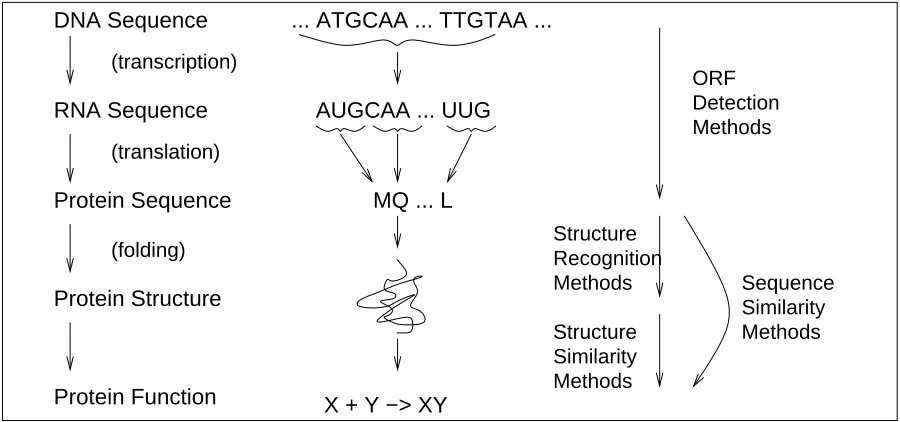
Figure 1: The flow of biological information within a cell and its computational processing.
genes of the organism. Similar to DNA, the data in each RNA molecule can be represented by a string
composed from four letters (G, C, A and U) in which the T from the DNA is now replaced by U, as illustrated in Figure 1. Typically, the RNA molecules are then translated into protein molecules that can be represented as strings composed from 20 different letters. Each consecutive group of 3 RNA letters is translated into a single protein letter according to the genetic code for the organism. The protein molecule then folds into a precise three-dimensional structure, which usually contains a number of active sites on its surface where other proteins or small molecules may bind, and this gives the protein its unique biological function. For example, Figure 1 shows a resulting protein with the function of taking two molecules (X and Y) and combining them into a single molecule (XY). This would only be one small part of an enormous network of such reactions, which would result in the overall function of the particular type of cell.
While this very simplified view of the cellular processes involved offers some insight into the un-derlying biology, some more complicated stages (such as RNA processing) have been omitted com-pletely. In addition, although our presentation has suggested that one process is universal, there are exceptions to the general rules, as with the HIV virus, which stores its genome using RNA instead of DNA, but we will not consider such issues further in this paper.
2.2 Computational Processing
As indicated above, the rate at which this primary genetic data is being produced at present, is ex-tremely rapid, and increasing. There is consequently a huge amount of genome data that is freely available across the Internet, typically stored in flat file databases providing DNA sequences. The problem of working out what each gene does, especially in light of the potential benefits of doing so, is therefore correspondingly pressing, and one which is meriting much attention from various scientific communities.
Traditionally, the first task for the bioinformatician is to use what are known as ORF detection
methods on the DNA to determine the different protein sequences that are encoded in it. For each
protein sequence, a variety of techniqes, such as sequence similarity and motif detection, may be used to try to elucidate the function of the protein. Similarly, a range of structure recognition techniques may be used to determine the three-dimensional structure of the protein which may then, in turn, help in determining its function.
This process of identifying genes and predicting the structure of the encoded proteins is thus fairly labour-intensive, made worse by requiring substantial expert knowledge concerning the available anal-ysis techniques and the underlying data. However, the steps involved are all computer-based tasks: scanning sequence databases for similar sequences, collecting the matching sequences, constructing alignments of the sequences, and trying to infer the function of the sequence from annotations of the matched proteins (for which the function is already known). All of this requires use of the wide range of available tools for these tasks, which sometimes offer results that agree, but often do not (though they typically provide confidence scores that enable relatively easy interpretation).
Many tools are available to perform these tasks, but they are generally standalone programs that are not integrated with each other and require expert users to perform each stage manually and com-bine them in appropriate ways. For example, the process of trying to find a matching sequence might result in turning up an annotated gene, but the annotations include a lot of spurious information as well as the important functional information. The problem here is distilling this relevant information, which is not at all difficult for an expert, but which might prove problematic for a less experienced user. With the amount of data that is being generated, this kind of expertise is critical.
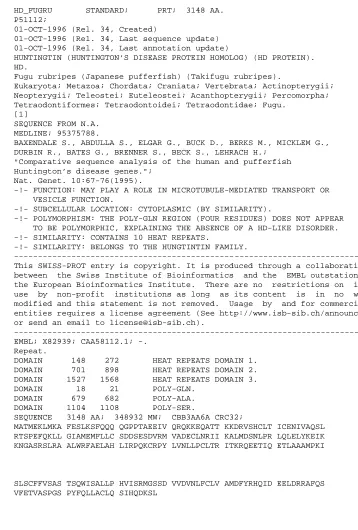
Finally, the information gained from this analysis is added back into relevant databases as a re-source in its own right, with entries usually including large amounts of natural language in addition to the raw data. For example, a very small entry of the data held about a protein in the SWISSPROT database is shown in Figure 2. The updating of this data over time as new information emerges adds an additional dimension to the data management requirements. Analysis programs may generate or modify data that other programs also use, requiring the different sources of information and the differ-ent programs to be managed effectively to ensure that the systems as a whole is coherdiffer-ent, consistdiffer-ent and synchronised.
ID HD_FUGRU STANDARD; PRT; 3148 AA. AC P51112;
DT 01-OCT-1996 (Rel. 34, Created)
DT 01-OCT-1996 (Rel. 34, Last sequence update) DT 01-OCT-1996 (Rel. 34, Last annotation update)
DE HUNTINGTIN (HUNTINGTON’S DISEASE PROTEIN HOMOLOG) (HD PROTEIN). GN HD.
OS Fugu rubripes (Japanese pufferfish) (Takifugu rubripes).
OC Eukaryota; Metazoa; Chordata; Craniata; Vertebrata; Actinopterygii; OC Neopterygii; Teleostei; Euteleostei; Acanthopterygii; Percomorpha; OC Tetraodontiformes; Tetraodontoidei; Tetraodontidae; Fugu.
RN [1]
RP SEQUENCE FROM N.A. RX MEDLINE; 95375788.
RA BAXENDALE S., ABDULLA S., ELGAR G., BUCK D., BERKS M., MICKLEM G., RA DURBIN R., BATES G., BRENNER S., BECK S., LEHRACH H.;
RT "Comparative sequence analysis of the human and pufferfish RT Huntington’s disease genes.";
RL Nat. Genet. 10:67-76(1995).
CC -!- FUNCTION: MAY PLAY A ROLE IN MICROTUBULE-MEDIATED TRANSPORT OR CC VESICLE FUNCTION.
CC -!- SUBCELLULAR LOCATION: CYTOPLASMIC (BY SIMILARITY).
CC -!- POLYMORPHISM: THE POLY-GLN REGION (FOUR RESIDUES) DOES NOT APPEAR CC TO BE POLYMORPHIC, EXPLAINING THE ABSENCE OF A HD-LIKE DISORDER. CC -!- SIMILARITY: CONTAINS 10 HEAT REPEATS.
CC -!- SIMILARITY: BELONGS TO THE HUNGTINTIN FAMILY.
CC --- ---CC This SWISS-PROT entry is copyright. It is produced through a collaboration CC between the Swiss Institute of Bioinformatics and the EMBL outstation -CC the European Bioinformatics Institute. There are no restrictions on its CC use by non-profit institutions as long as its content is in no way CC modified and this statement is not removed. Usage by and for commercial CC entities requires a license agreement (See http://www.isb-sib.ch/announce/ CC or send an email to [email protected]).
CC --- ---DR EMBL; X82939; CAA58112.1; -.
KW Repeat.
FT DOMAIN 148 272 HEAT REPEATS DOMAIN 1. FT DOMAIN 701 898 HEAT REPEATS DOMAIN 2. FT DOMAIN 1527 1568 HEAT REPEATS DOMAIN 3. FT DOMAIN 18 21 POLY-GLN.
FT DOMAIN 679 682 POLY-ALA. FT DOMAIN 1104 1108 POLY-SER.
SQ SEQUENCE 3148 AA; 348932 MW; CBB3AA6A CRC32;
MATMEKLMKA FESLKSFQQQ QGPPTAEEIV QRQKKEQATT KKDRVSHCLT ICENIVAQSL RTSPEFQKLL GIAMEMFLLC SDDSESDVRM VADECLNRII KALMDSNLPR LQLELYKEIK KNGASRSLRA ALWRFAELAH LIRPQKCRPY LVNLLPCLTR ITKRQEETIQ ETLAAAMPKI .
. .
SLSCFFVSAS TSQWISALLP HVISRMGSSD VVDVNLFCLV AMDFYRHQID EELDRRAFQS VFETVASPGS PYFQLLACLQ SIHQDKSL
[image:5.612.91.449.101.631.2]//
MEMSAT Agent
Internet
Internet Blast Agent
Swiss Agent PIR Agent PDB Agent
NRDB Agent Agent
[image:6.612.79.535.60.229.2]HInf (genome)
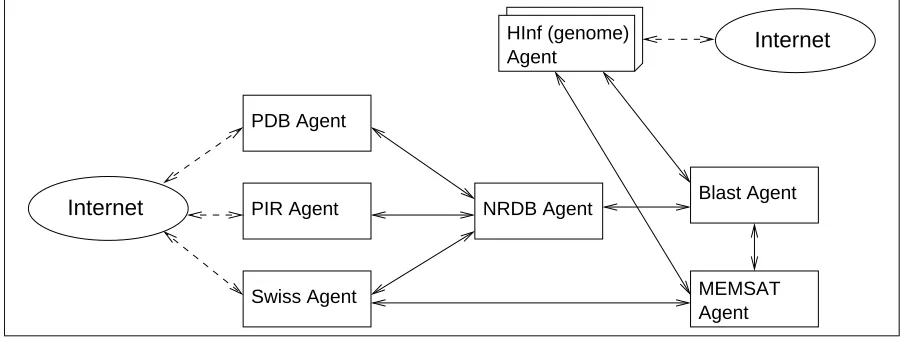
Figure 3: GeneWeaver agent community
3
GeneWeaver Agent Community
GeneWeaver is a multi-agent system aimed at addressing many of the problems concerning the man-agement of data and analysis techniques in the domain of bioinformatics, as discussed until now. It comprises a community of agents that interact with each other, each performing some distinct task, in an effort to automate the processes involved in, for example, determining protein function. Agents in the system can be concerned with management of the primary databases, performing sequence analy-ses using existing tools, or with storing and presenting resulting information. The important point to note is that the system does not offer new methods for performing these tasks, but organises existing ones for the most effective and flexible operation. This section provides an overview of the system through the agents within it.
Figure 3 illustrates the overall perspective of GeneWeaver in that it contains the different classes of agents and shows how they inter-relate. At the left side, PDB agent, PIR agent and SWISS agent all manage the primary sequence databases indicated by their names (as described later), and interact with the NRDB (non-redundant database) agent, which combines their data. At the right edge of the figure, the calculation agents (including the BLASTagent and the MEMSATagent that perform specific analysis tasks) attempt to annotate sequences in the genomes using relevant programs, again indicated by their names. Finally, at the top, a number of genome agents manage the genomes for particular organisms, and request analysis from the calculation agents. At each point of external interaction, agents typically receive and provide information via the Internet. In the figure, dashed lines indicate agents communicating to and from the Internet using http or ftp protocols. Solid lines represent the main communication pathways between the agents using an agent communication language. The broker agent (see below) is omitted for clarity.
There are five types of agent present in the GeneWeaver community.
Broker agents, which are not shown in Figure 3 since they are facilitators rather than points of
functionality, are needed to register information about other agents in the community.
Primary database agents are needed to manage remote primary sequence databases, and keep
the data contained in them up-to-date and in a format that allows other agents to query that data.
Non-redundant database agents construct and maintain non-redundant databases from the data
Calculation agents encapsulate some pre-existing methods or tools for analysis of sequence
data, and attempt to determine the structure or function of a sequence. Whenever possible, they are also responsible for constructing and managing any underlying data that they rely on.
Genome agents are responsible for managing the genomic information for a particular organism.
Each of these agents is considered in more detail below.
3.1 Broker Agents
The potential size of the GeneWeaver agent community can be large, with the number of agents determined by the number of external databases used, the number of sequence comparison programs, and the extent of various other utility functions. Since each of these aspects must be wrapped up in an agent, with numerous interactions required between agents, brokers are needed to provide what is, in effect, a yellow pages service for all agents in the system. (Different forms of services offered might range from the simple yellow pages service to more sophisticated matchmaking [27, 28], but such issues are beyond the scope of this paper.)
A broker provides information about all the agents currently present in the community, including the communication methods they support. Each agent is required to register information about itself with the broker to be recognized within the community. Conversely, agents can query the broker for information about other agents in the community. They may also subscribe to the broker’s information and will be notified when it changes as, for example, when agents join or leave the community.
3.2 Primary Database Agents
Although the principle of combining different methods and different information sources seems sim-ple, in practice there are a number of difficulties that must be faced. Primary data sources (the primary sequence data banks and the structure data banks, for example) encode their information in different ways, not only in terms of the basic formatting, but also in the terminology used. For example, differ-ent keyword sets are used for each data bank so that understanding and interpreting the data (both of primary data sources and the results from analysis programs) is not a trivial task.
Primary databases are provided externally, under the control of third-parties who may change them at any time. In many cases, the data is largely unstructured, and is often available in the form of flat files. The methods of delivery vary, but have included email transfer of data, FTP downloads and, more recently, retrieval through the web. Each primary database consists of a number of sequence files, which are text files formatted in a particular sequence format. A sequence file usually contains data for a number of protein sequence entries, with each such sequence entry providing a description of the protein and its amino acid sequence (see Figure 2 for an example).
For example, the Protein Data Bank (PDB) [10], which was established in 1971, is an international repository for the processing and distribution of experimentally-determined structure data that is grow-ing dramatically. Similarly, SWISSPROT is a curated protein sequence database with a high level of annotation of protein function, and is supplemented by another database, TrEMBL [6]. Many other such sequence databases are also available (eg. the PIR International Protein Sequence Database [8]), and a list of more than 200 of the main biological databases was recently compiled [9]. The sheer number and variety indicates the importance of wrapping them up and providing them to the agent community in a uniform manner, but we will not provide an exhaustive list here.
agent queries the appropriate FTP site on a regular basis to see if any of the files making up the database have changed. If so, the agent determines the changes that are required to the entries in its copy of the database to update it to a current version. Other agents can then query the primary database agent to obtain information about a particular primary database, the files making up the database or the individual sequence entries in the database. Agents can also subscribe to this information if they want to be notified when it changes.
3.3 Non-Redundant Database Agents
A non-redundant database (NRDB) is one constructed from a number of primary databases with en-tries that are deemed to provide duplicate information excluded. There are three main categories of non-redundant database, storing DNA sequences, protein sequences and protein structures respec-tively. Further classifications of non-redundant databases may result from considering the number and quality of primary databases used in the construction of the non-redundant database, or from the specifc notion of redundant information that is used. For example, some non-redundant protein sequence databases only regard sequences as redundant if they have identical residue strings, while others regard sequences as redundant if they have more than 90% of residues identical. Each type of non-redundant database has its specific uses in bioinformatics.
Now, a single agent in the GeneWeaver community manages each different type of non-redundant database. In the initial prototype community, there is only one NRDB agent, which constructs a non-redundant database from protein sequences held by all the primary database agents in the community using identical residue strings as the definition of redundancy. Hence the non-redundant database contains no sequences that have residue strings identical to any other sequence in the non-redundant database. Each of these non-redundant sequences is annotated with database cross-references indicat-ing which sequence in the primary database has the most detailed annotation for this residue strindicat-ing.
In general, an NRDB agent subscribes to agents managing primary databases from which it wishes to derive its database. It builds up the non-redundant database by adding any new entries that have been added or modified in the primary databases since the non-redundant database was last updated.
3.4 Calculation Agents
Calculation agents apply particular skills to try to identify the structure or function of particular se-quences of genomic data. A variety of techniques are used in a range of available programs, including similarity (homology) searches of greater or lesser sensitivity (eg. BLAST [2, 3] and FASTA [34, 35]), the use of sequence motif patterns (eg. InterPro [5]), sequence alignment (eg. ClustalW [37]), sec-ondary structure prediction (eg. PhD [36], PSIPRED [23]), membrane topology prediction (eg. MEM-SAT [25]), fold recognition (eg. Threader [24], GenThreader [22]), and so on. For example, BLAST (Basic Local Alignment Search Tool) is a set of rapid similarity search programs that explore all avail-able sequence databases [2]. The search can be performed by a remote server through web pages or have results returned by email, or on a local machine.
Now, some of the methods take longer to run than others, while some provide more accurate or
confident results than others. In consequence, it is often necessary to use more than one of these tools
depending on the results at any particular stage. While a high confidence is desirable, time-consuming methods should be avoided if their results are not needed.
tools are encapsulated in an agent wrapper so that existing applications such as BLAST can become independent agents in the GeneWeaver community.
A second consideration when managing these methods is the presence of dependencies between the methods. For instance, different sequence similarity web servers may be asked to search the SWISSPROT database, but each server will probably be searching a different version of the database, returning results that may refer to different entries. A more complicated dependence results when one program actually uses another internally. For example, the MEMSAT method uses an internal version of the BLAST method during its processing. The version of BLAST used, and the version of its underlying database, is hidden within the MEMSAT method itself. These underlying dependencies between the different methods can result in subtle inconsistencies in the different results.
In order to deal with this consistency problem, the calculation agents attempt to make these de-pendencies explicit. Whenever possible, a calculation agent constructs the underlying databases or parameters that its encapsulated analysis techniques depend on, using the data and methods available from other agents in the community. For instance, the BLASTcalculation agent shown in Figure 3 uses the NRDB agent’s non-redundant database to construct the database it searches. Similarly, the MEMSATagent constructs training parameters for its method by using membrane topology sequences held by the SWISS agent. The MEMSATagent also uses the BLAST agent when it needs to carry out the BLAST method during its internal processing. These interactions, shown in Figure 3, result in a system that has an additional degree of data and method integration beyond just externally combin-ing the results obtained from different methods. (In addition, since the MEMSATagent re-trains itself when new membrane topology sequences are added to the SWISSPROT database, its ability to predict membrane topologies for proteins improves over time. This can be seen as a rather specialized form of learning using data and methods that become available in the community.)
3.5 Genome Agents
Each genome agent manages the genome information for a particular organism. This can consist of the DNA sequences making up the genome of the organism together with the protein sequences expressed by the DNA sequences. Data such as known protein homologues and other derived results are stored together with their relationship to the nucleic acid or protein sequences. The primary data for the genomes, either DNA or expressed protein sequences, is obtained through FTP from a primary data source. Like the primary databases, these are under the control of third-parties and may be modified at any time. Genome agents check these sources of data on a regular basis, update their data accordingly when any changes occur, and apply the methods available in the community to annotate the genomes with functional and structural information. These derived results also need to be managed, and possibly recalculated, when the underlying genome data is modified by third-parties, or when the version of the method employed is updated.
4
Agent Architecture
inter-Interaction
Action Control Communication
Meta−Store Motivation
Data Store Analysis Tool
Actions Goals
Data Meta Goals Interactions
Data Messages
Other Agents
[image:10.612.82.530.60.282.2]Messages
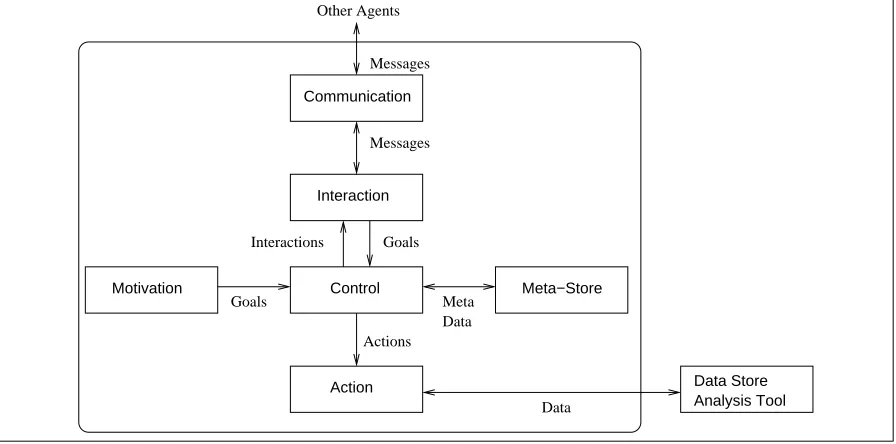
Figure 4: GeneWeaver agent architecture.
agent communication given in the following section. A more extensive description of the internal structure of the agents is presented in [11].
4.1 Motivation Module
Since each agent in the GeneWeaver community has different responsibilities and is required to per-form different tasks, distinct high-level direction must be provided in each case to cause essentially the same architecture to function in different ways. The conceptual organisation of GeneWeaver agents thus involves the use of some high-level motivations that cause goals specific to the agent’s tasks and responsibilities to be generated and performed [30, 31]. An agent is therefore initialised with the motivations required to carry out its responsibilities effectively. For example, all agents (except brokers) are motivated to register themselves with a broker agent, and will generate goals and actions to do so until they have succeeded. Similarly, a primary database agent has a motivation to cause the generation of specific goals and actions to update the primary database on a regular basis in order to ensure that it is up-to-date; and a non-redundant protein agent is motivated to subscribe to a bro-ker for information on primary database agents and to subscribe to these latter agents for all relevant information.
4.2 Control Module
determines whether the information in the meta-store should be modified as a result of performing an action.
4.3 Action Module
The action module is responsible for managing and performing skills that modify the underlying data being manipulated by the agent. The resulting actions typically involve performing operations on some input data and may (optionally) result in some output. In this respect, they are likely to use and modify data in the agent’s data store. The action module is thus critically important in terms of the agent functionality in this domain, since it is the only module that can interface to the data store and thus provides the only way to modify the data the agent is working with. (In the case of calculation agents, the same would apply to the analysis tools instead of the databases.) Each agent’s action module is instantiated with a number of skills (or types of action) that the agent can perform. The action module is invoked by the control module, and can also cause the control module to invoke message-passing actions in the interaction module when needed as part of an overall task. This might occur when another agent is needed to perform an action for the overall plan.
4.4 Interaction and Communications Modules
The interaction module handles the higher level interaction between different agents. Several pos-sible types of interaction exist, each of them following a particular fixed interaction protocol. The interactions are key to agent cooperation and will be extensively described in the next section.
The interaction module is initialised with the types of interaction it can service (or the types of provider actions it can initiate). For example, the broker is the only agent that initiates its interaction module with a register action to service requests to register with it from other agents. The particular actions an agent is able to provide to others are recorded in its meta store so that it has an accurate picture of its capabilities.
Now, the communications module for one agent interacts with communications modules of other agents, using particular transport protocols. It also passes messages on to the agent itself for interpre-tation and processing, as well as accepting outgoing messages to be sent out to others. In this way, one agent interacts with another through their respective communications modules.
The mechanics of the interaction of agents in the community is achieved through message-passing communication using a number of transport protocols such as RMI [15] and CORBA [38], which is handled by the communications module.
4.5 Meta Store
The meta-store simply provides a repository for the information that is required by an individual agent for correct and efficient functioning. It contains relevant information about the types of skills, plans and interactions supported by different agents within the community. For example, the meta-data con-tained in this repository will enumerate the properties and capabilities of the agent, including aspects such as the protocols the agent can use, the skills that can be executed, and the agent’s motivations. As other modules are instantiated on initialisation, this information is added to the meta-store. Thus, as the action module is initialised, the skills that can be performed by it are added to the repository.
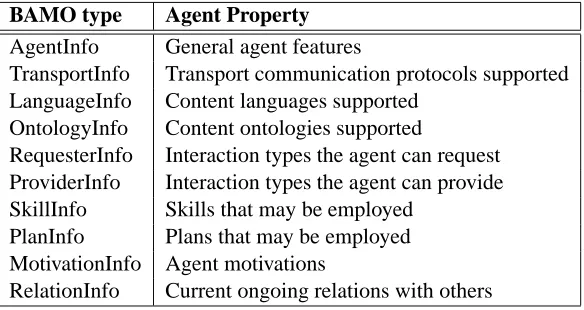
BAMO type Agent Property
AgentInfo General agent features
TransportInfo Transport communication protocols supported LanguageInfo Content languages supported
OntologyInfo Content ontologies supported
RequesterInfo Interaction types the agent can request ProviderInfo Interaction types the agent can provide SkillInfo Skills that may be employed
PlanInfo Plans that may be employed MotivationInfo Agent motivations
[image:12.612.157.449.58.213.2]RelationInfo Current ongoing relations with others
Table 1: Types of meta-data present in the BioAgent Meta Ontology
about itself or other agents may be included. The only significant interaction is with the control module which records information in the meta-store as appropriate, and also uses it in decision-making.
5
Agent Communication
5.1 The BioAgent Language (BAL)
Agents in the GeneWeaver community communicate with each other using the BioAgent Language (BAL), which is constructed along the lines of KQML [32], with similar performatives, but is both dra-matically reduced in range, and tailored to the particular kinds of interactions likely in GeneWeaver. Specifically, the data content of the BAL messages is vital, since the data is the key resource in the system, and it is extremely large in quantity. In this section, we describe BAL and show how it is used by agents for critical interactions.
BAL interactions lie at the highest level of communication, and consist of a number of messages being passed between agents following a fixed protocol for the particular type of interaction. Within an interaction, specific communication between agents is accomplished by sending BAL messages, which follow a simple speech-act structure by which a performative is associated with a particular kind of content. Depending on the performative, the content may consist of an ordered list containing query expressions, data, meta-data or simple strings. BAL messages employ language and ontology fields to indicate the language used for the content and the meanings assigned to symbols used.
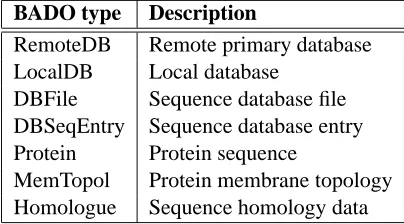
The BioAgent Content Language (BACL) is a very simple language used to represent meta-data, data and query expressions. The BioAgent Meta Ontology (BAMO) defines the different types of meta-data (Table 1) and their meanings. This is the information used by the agent community to manage and organise itself, more details of which can be found in [11]. The BioAgent Data Ontology (BADO) defines the data types employed (Table 2). These are simply the major artefacts in this domain.
BADO type Description
RemoteDB Remote primary database LocalDB Local database
DBFile Sequence database file DBSeqEntry Sequence database entry Protein Protein sequence
[image:13.612.200.402.59.171.2]MemTopol Protein membrane topology Homologue Sequence homology data
Table 2: Types of data present in the BioAgent Data Ontology.
Sender: <sender id> Receiver: <receiver id>
Transport: <transport protocol> Language: <content language> Ontology: <content ontology> Perform: <performative> Ref: <reference string> Page: <page number> Content: <content>
The sender id and receiver id are in the form Swiss007f000001, which specifies the name of the agent (in this case SWISS) followed by 10 hexadecimal digits. The last 8 digits specify the IP address of the physical machine the agent resides on, with the first two digits specifying a particular
office (0 to 100) on the machine. Each agent must have a unique name within a particular office.
Essentially, an office is a running process that permits a number of agents to be placed within it, each agent existing as a number of threads within the process. In our current implementation, each office is a Java Virtual Machine, and it permits a variety of configurations. A large number of agents may be placed into a single office for a small memory footprint, although this makes them more dependent on each other if, for example, one of them causes a thread deadlock. By using a separate office for each agent, the community is more robust to failure in any one agent, but this uses correspondingly more resources.
Currently three transport protocols are used: rmi, corba anddirect. RMI is the default protocol supported by all the agents within the Java implementation of GeneWeaver, while CORBA allows agents implemented in different languages to be supported as long as they conform to the BAL language specification. Such agents, running under a different management system, would need to be allocated their own range of office numbers. For example, 101 to 150 could be allocated for agents running under a C++ management system. Thedirect protocol is used to communicate between agents in the same office (or process) simply by using synchronized methods. It permits the configuration in which a community of agents can cooperate in the same office (including a broker) without the need for any network communication, and allows agents to make their services available only to other agents in the same office, providing a secure form of agent hiding.
A unique reference string is generated by the agent initiating an interaction as a means of identify-ing and keepidentify-ing track of the course of that interaction, especially when there may be several concurrent interactions taking place. It is used in all messages that are part of the particular interaction. The op-tional components of BAL messages are determined by the kind of message (and hence performative) under consideration.
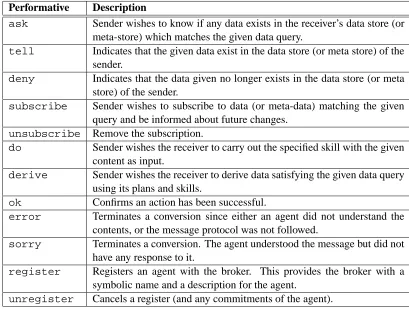
Performative Description
ask Sender wishes to know if any data exists in the receiver’s data store (or meta-store) which matches the given data query.
tell Indicates that the given data exist in the data store (or meta store) of the sender.
deny Indicates that the data given no longer exists in the data store (or meta store) of the sender.
subscribe Sender wishes to subscribe to data (or meta-data) matching the given query and be informed about future changes.
unsubscribe Remove the subscription.
do Sender wishes the receiver to carry out the specified skill with the given content as input.
derive Sender wishes the receiver to derive data satisfying the given data query using its plans and skills.
ok Confirms an action has been successful.
error Terminates a conversion since either an agent did not understand the contents, or the message protocol was not followed.
sorry Terminates a conversion. The agent understood the message but did not have any response to it.
register Registers an agent with the broker. This provides the broker with a symbolic name and a description for the agent.
[image:14.612.95.504.58.367.2]unregister Cancels a register (and any commitments of the agent).
Table 3: Description of BAL performatives.
wide-range of languages to represent data and data queries, including SQL, XML, XQL and ASN-1 [ASN-1], and several ontologies are being developed for use within different sub-fields [7, ASN-13]. Currently, however, we employ a simple content language and simple ontologies, although it is clearly beneficial to permit different languages and ontologies to be used within specialized sub-communities of agents. The page count is used, for example, when a long list of data items which cannot efficiently (or appropriately) be included in a single message, needs to be sent between agents, and it may be necessary to split it into multiple messages. With vast amounts of data being generated daily in this domain, this is not an unlikely event. The need to use a page count to split data among messages in this way applies only to tell and deny performatives when used to transfer large amounts of data.
Now, the contents of the messages vary according to the kind of performative used, and are enu-merated in Table 4. These may be ordered lists of query expressions, data, meta-data or simple strings.
5.2 BAL Interactions
Performative Content
ask Data or meta-data query.
tell List of data or meta-data items, page number required.
deny List of data or meta-data items, page number required.
subscribe Data or meta-data query providing what to subscribe to.
unsubscribe No content (reference string used to determine what to unsubscribe).
do Meta-data specifying the Skill to do, followed by a list of data specifying the input.
derive Data query specifying the required data to derive followed by a list of data which may be used.
ok No content.
error String giving reason for error.
sorry String giving reason for failure.
register AgentInfo meta-data for the agent registering.
[image:15.612.94.508.55.273.2]unregister No content (reference string used to determine what to unregister).
Table 4: Content types of different performatives.
An example of registration is as follows. The SWISS agent (which is a primary database agent) registers itself with the BROKERby sending a register message as follows.
Sender: Swiss007f000001 Receiver: Broker007f000001 Transport: rmi
Language: BACL Ontology: BAMO Perform: register
Ref: Swiss007f000001_0 Content:
AgentInfo( ID = 0,
OWNER = Swiss007f000001, TYPE = PrimaryDB,
MOD_TIME = 2001-04-04T19:40:35+0100 LOCAL_MOD_TIME = 2001-04-04T19:40:35+0100
AGENT_URL = "http://insulin.brunel.ac.uk/˜bryson/agents /swiss/index.html", DESCRIPTION = "Swiss agent which manages the SWISSPROT database."
)
The content of the message consists of a single meta-data item of type AgentInfo that includes ID, OWNER, TYPE, MOD TIME and LOCAL MOD TIME fields. The OWNER field identifies the agent that owns the meta-data item, while ID provides a unique identifier for the item within that particular agent. The MOD TIME field gives the time, in ISO format, of the last change to the actual data item (as held by the owner), whereas LOCAL MOD TIME gives the time the item was last changed in the local agent (since agents may have copies of data owned by other agents). In addition, there are also AGENT URL, DESCRIPTION and TYPE fields to provide further information about the particular agent, such as the location of its home web page. If the BROKERpermits registration, it will reply with the following ok message.
Sender: Broker007f000001 Receiver: Swiss007f000001 Transport: rmi
Perform: ok
5.3 Interaction Scenarios
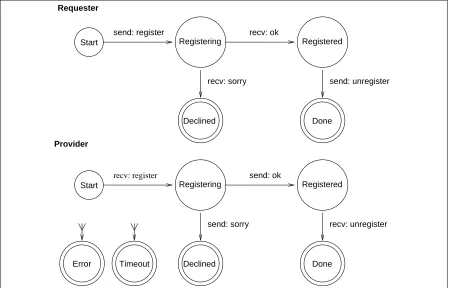
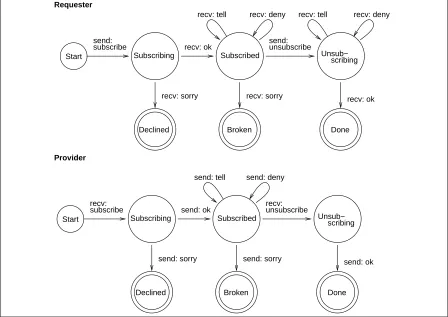
We have described the modular framework of an agent together with the language used for inter-agent communication. In this section, we show how these aspects come together to enable effective agent operations for the management and integration of data and methods within the agent community. We describe four general scenarios that result from just setting up the appropriate motivations, interac-tions, skills and plans in the agents. In each scenario, the goals adopted by agents on either side of the interaction are described together with the protocol followed and the messages sent as part of that protocol. The complete interactions are illustrated with state transition diagrams, which come in parts: one for the requester and one for the provider. The diagrams are largely self-explanatory, and serve to illustrate the discussion, so only a cursory explanation of them (as opposed to the interactions) is given.
5.3.1 Registering with a Broker
Each agent (other than brokers) has a motivation to register with a broker, which will lead to the generation of a goal with the aim of forming a register relationship with a broker agent. (We denote goals with the aim of making or breaking relationships between agents as relationship goals.) The control module satisfies this goal by examining the meta-store for information on a suitable broker, and then initiating a register interaction using the interaction module. This causes a register message to be sent to the broker agent via the communications module, and the agent then waits for a response. For example, the primary database agent, SWISS agent, which manages the SWISSPROT database, sends the register message above to the broker agent.
On receiving the register message, the broker starts its side of the interaction, resulting in a
reg-ister relationship goal being passed to its control module. In turn, the control module satisfies this
relationship goal using an appropriate plan, which causes the broker agent to subscribe (see next sec-tion) to relevant meta-data of the registering agent such as the agent’s skills, databases and plans. This allows the broker to keep track of any relevant changes in information about the agent, such as when one of its skills is updated. In addition, the broker agent updates its meta-store to include details of the registered agent. If the registration plan is successful, this will result in an ok message being returned by the broker’s side of the interaction (as shown above).
Finally, on receiving an ok message from the broker, the registering agent’s relationship goal is satisfied, with the intensity of the relevant motivation to register being lowered since it is now satisfied. This reduction in intensity enables other motivations of the agent to become active.
Alternatively, the broker may not allow the agent to register. For instance, a security policy may only allow agents running on certain hosts to register, or the community organized by the broker may be of a specialized type that does not include primary database agents, In such cases, a sorry reponse might result. This interaction scenario is illustrated by Figure 5.
Sender: Broker007f000001 Receiver: Swiss007f000001 Transport: rmi
Perform: sorry
Ref: Swiss007f000001_0 Content:
Start
Declined
Done Error Timeout
Done
Declined
Registering Registered
Registered Registering
Requester
Provider
recv: register send: ok
recv: unregister send: sorry
send: register recv: ok
send: unregister recv: sorry
[image:17.612.81.530.59.347.2]Start
Figure 5: State transition diagram for the registration interaction protocol.
5.3.2 Broker Subscription Scenario
The non-redundant database (NRDB) agent is motivated to subscribe to the broker for information about all agents owning local primary databases containing protein sequences. This motivation is typ-ically activated (through having the highest intensity level) once the agent has successfully registered, and causes a relationship goal of type subscribe to be sent to the control module. The control module satisfies this relationship goal by querying the meta-store for all brokers with which it is cur-rently registered. For each broker, the control module creates a subscribe interaction which, in turn, results in a subscribe message being sent.
Sender: NRDB007f000001 Receiver: Broker007f000001 Transport: rmi
Language: BACL Ontology: BADO Perform: subscribe
Ref: NRDB007f000001_21 Content:
LocalDB(
ID?, OWNER?, SOURCE?, QUALITY?, TYPE?, NAME?, MOD_TIME?, LOCAL_MOD_TIME?, DESCRIPTION? )
to be performed on its meta-store on a regular basis to provide the required information, resulting in
tell and deny messages being sent back to the requester, giving information about currently registered
agents, and those that have deregistered. Such periodic queries continue until the interaction is halted on receipt of an unsubscribe message from the requester. The following example message illustrates the kind of response that might be received in this way from the broker.
Sender: Broker007f000001 Receiver: NRDB007f000001 Transport: rmi
Language: BACL Ontology: BADO Perform: tell
Ref: NRDB007f000001_21 Page: 0
Content: LocalDB(
ID = 11,
OWNER = Swiss007f000001, SOURCE = SWISSPROT, QUALITY = 90, TYPE = PROTEIN, NAME = SWISSPROT,
MOD_TIME = 2001-04-04T20:07:21+0100, LOCAL_MOD_TIME = 2001-04-04T20:08:11+0100,
DESCRIPTION = "SWISSPROT manually annoted protein database" )
Later in the session, a deny message may be sent if, for example, the SWISS agent deregisters from the broker.
Back at the requester’s end, tell goals are instantiated as a result of any received tell and deny messages, and cause the control module to carry out an appropriate plan. In this case, the result is to add information to the meta-store, or delete information from the meta-store as appropriate. This interaction scenario is illustrated by the state-transition diagrams of Figure 6.
5.3.3 Subscribe Interaction Scenarios
The subscribe interaction is also used in a number of other places in the prototype, such as when the non-redundant database (NRDB) agent is motivated to subscribe to primary database agents for sequence data. Typically, this motivation becomes active after the agent has successfully subscribed to the broker for information on agents owning local primary databases, so that the intensity of that motivation decreases. The NRDB agent then forms subscribe interaction relationships with each of these agents to obtain information about their primary databases. The subscription remains in force while both agents are present in the community, allowing the NRDB agent to maintain its database with the latest information known throughout the community.
Calculation agents also use the subscribe interaction. The BLASTagent subscribes to the NRDB agent so that it can ensure that the database it searches with BLAST is up-to-date. Similarly, the MEMSATagent subscribes to the SWISSagent for information about membrane proteins so that it can keep its method trained with the most recent data.
In general, subscription to another agent for particular types of data may be regarded as a data
push protocol, in that new or modified data is pushed onto the requester agent as it becomes available.
Start
Declined
Subscribed
Subscribing Unsub−
scribing
Done
Start Subscribing Subscribed
Done Unsub− scribing Broken
Broken Declined
Requester
recv: ok
recv: tell
subscribe send:
recv: tell
recv: sorry recv: ok
recv: deny recv: deny
send: unsubscribe
Provider
send: ok subscribe
recv:
send: tell
send: ok send: deny
recv: unsubscribe recv: sorry
[image:19.612.81.529.62.379.2]send: sorry send: sorry
Figure 6: State transition diagram for the subscription interaction protocol. The Error and Timeout states are not shown for clarity.
5.3.4 Calculation Agent Requests
The main concern of previous scenarios has been the manipulation of data and meta-data. However, agents also have plans, involving sequences of action, that may be used to satisfy goals by either manipulating the agent’s meta-store or by decomposing a goal into a number of sub-goals which may then be tackled. This section deals with scenarios involving interactions that use skills combined with
plans to satisfy goals.
Suppose a genome agent is initiated with a number of motivations: registering with a suitable broker, subscribing to the broker for information about the skills and plans available in the commu-nity, updating its genome data using an external data source and annotating this genome data. Now, deriving different types of annotation is brought about by different motivations. For example, the motivation to determine homologues for the proteins expressed by the genome provides functional annotation, while the motivation to determine membrane topologies for these proteins provides a form of structural information.
We will examine the motivation to determine membrane topologies in more detail since this in-volves both derive and do interactions.
module determines how to satisfy this goal by inspecting the meta-store. Suppose that it finds that
it does not have a local skill or plan itself to satisfy deriving a membrane topology, but is aware of another agent in the community, the MEMSAT agent, which contains a suitable plan. To utilise this plan, the control module creates a derive interaction, resulting in a derive message being sent to the MEMSATagent.
Sender: HInf007f000001 Receiver: Memsat007f000001 Transport: rmi
Language: BACL Ontology: BADO Perform: derive
Ref: HInf007f000001_42 Content:
MemTopol(
N_LOC?, OTHER_LOC?, N_LOC_SIDE?, SPANS?, QUALITY?, DERIVED?, SEQ_REF = 74_HInf007f000001 )
On receiving this message, the interaction module of the MEMSATagent creates a derive goal that is sent to its control module which, in turn, finds a suitable plan to accomplish the goal and executes it. Now, this plan is fairly complicated and involves three stages. The first involves obtaining the residue string of the sequence to analyse if this is not already provided. This can be satisfied by a
query interaction (described later) to obtain the information from the genome agent. The second stage
involves creating a do goal requesting that the BLAST skill be used to determine a sequence profile for the sequence. Since this is a well-specified task, it is satisfied by using a do interaction to request the BLAST agent perform the calculation. Finally, a second do goal requesting that the MEMSAT method be applied to this profile generates the result, which is satisfied by using the MEMSAT skill local to the agent. If all the stages of the plan are successful, the original derive goal will be satisfied, causing the MEMSATagent to send a tell message providing the result. The genome agent then uses this information to annotate the sequence.
Both the derive and do interaction protocols are presented in Figure 7. This diagram also shows the query interaction, which involves an initial ask message, but is otherwise very similar to the others. It simply allows a one-off query of the data held by another agent, without receiving further updates; it is useful in the scenario above when the initial derive goal does not contain all the required information for the plan.
Note that these protocols may generate a number of pages of results, with a page number of zero indicating the last page.
5.4 Summary
Start
Declined Done
Doing Responding
recv: sorry send: derive
send: ask send: do
Requester
send: ok
recv: tell (page=0) recv: tell (page>0)
Provider
Start
Declined Done
Doing Responding
send: sorry recv: derive
recv: ask recv: do
recv: ok
[image:21.612.82.529.60.391.2]send: tell (page=0) send: tell (page>0)
Figure 7: State transition diagram for the do, derive and query interaction protocols. The Error and
Timeout states are not shown for clarity.
that need to be considered (for example in relation to the potential use of different data languages [1] and ontologies [7, 13] to provide a consistent language for the description of biological data) but these are separate concerns and we do not consider them further here. It should be clear though that since the BAL interaction language is at a higher level it permits different underlying content languages to be employed.
6
Discussion and Conclusions
The problems raised by the surge of information being added to biological databases demand a sig-nificant effort in order to solve them. This is particularly important because of the potential benefits that an understanding of the information locked away in these databases might bring. In this paper we have introduced the GeneWeaver agent community for just this purpose, and described the architec-ture of the individual agents within it. Concentrating on the fundamental aspects of agent interaction, we have directed attention towards specific scenarios concerned with the management and integration of distributed databases and analysis methods.
number of databases and analysis software using Perl code, in a largely monolithic fashion. The de-signs have been successful, but require that all the resources are held locally, raising possible concerns about extensibility and scalability.
Adopting a more distributed approach, MAGPIE [18] treats each genome as an individual project to which a number of remote or local methods may be applied. in a highly configurable manner. For instance, remote web servers may be used, distributing both the computational load and the manage-ment responsibilities for the underlying databases and tools. However, the data employed by most remote servers is consequently hidden so that there is potential for the data used by different servers to be inconsistent. External sites may have very different policies on how often they update their un-derlying data, resulting in variations in the quality of output from servers based on similar methods. Also, the updating of external servers is generally not notified to the system so that it may respond by recalculating appropriate data.
In essence, when using external servers, the management of the methods and data is hidden. This can be remedied by providing distributed systems in which the different servers become an integral part of the framework, as in EDITtoTrEMBL [33]. Its distributed analysis modules provide
meta-data about their analysis methods, so that appropriate methods can be chosen, in a similar way to the meta-data used within GeneWeaver to choose appropriate agents.
Although EDITtoTrEMBL is similar to the approach we adopt, a number of key differences exist between the architectures. In particular, EDITtoTrEMBL has a single thread of control (the dispatcher
module) which drives its analysis modules in essentially a client-server fashion. The dispatcher
mod-ule has the single goal of extending the annotation of a TrEMBL formatted sequence using the analysis
modules. While this suffices for the particular application, GeneWeaver provides a more generic and
extensible framework in which future goals of the system may not be entirely anticipated. For this reason, each agent has its own thread of control, driven by its own motivations and goals, resulting in a system which has a more peer-to-peer architecture. This allows new agents joining the community not only to provide services to the community, but to bring new goals which may be achieved by the community.
Secondly, the systems differ in the nature of the interactions between the distributed components. In our terminology the analysis modules of EDITtoTrEMBL deal with one type of interaction, a
do interaction with a DBSeqEntry as input, resulting in additional annotation being added to the
DBSeqEntry. Essentially, the distributed components are dealing with one type of goal, to apply a
particular analysis method to a sequence entry. By contrast, to facilitate a cooperative community
the GeneWeaver architecture employs a much richer interaction language, with relationships that may persist over long periods of time, allowing agents within the community to benefit from interactions with others. For example, the MEMSAT agent can improve its analysis as the community of agents discover more examples of membrane proteins. In turn, the genome agents benefit from the MEMSAT agent being more accurate, since they use it for satisfying their annotation goals.
Agent systems that are heavily embedded in application to other scientific domains differ from much early work in the field of information agents, which achieved high visibility and was responsible to some extent for driving the agent field forward. For example, agents for traversing and searching the web, and email and news filtering agents exemplified a large body of work at one end of the spectrum. These kinds of systems were not the only agents being developed, but occupied a central position in the perception of the work being done. The application of techniques developed for these relatively well-defined problems, however, has transferred into more general areas, and in more sophisticated and extensive systems. Electronic commerce is just one example of the natural extension and elaboration of earlier work and its application to an exciting new domain of activity [19].
do-mains that are less intuitively obvious possibilities for agent systems deployment, but no less deserving or appropriate. This is because the successful development and use of agent systems by those who are unaware of the hype, and less concerned with the issues of the technology per se but more concerned with the benefits that it delivers, is more likely to sustain the agent paradigm in the longer-term. In this respect, the work described in this paper on the application of agent technology to bioinformatics, in order to make sense of the vast amounts of data that are being generated at an ever-increasing pace and stored at globally distributed but accessible sites, demonstrates the suitability of the agent paradigm in yet another very different domain.
The particular value of these efforts to the agent community is in solving problems that have not been created by the very technology (or related technology) that is being used to solve them. These problems and domains are pre-existent and decoupled from the solutions, and consequently provide what might be considered an objective demonstration of the utility of agent systems. For the cynics — and there are many — this is an acid test. More importantly, perhaps, they address a fundamental need in the biological sciences.
Acknowledgements
The work described in this paper is supported by funding from the Bioinformatics programme of the UK’s EPSRC and BBSRC.
References
[1] F. Achard, G. Vaysseix, and E. Barillot. XML, bioinformatics and data integration.
Bioinfor-matics, 17:115–125, 2001.
[2] S.F. Altschul, W. Gish, W. Miller, E.W. Myers, and D.J. Lipman. Basic local alignment search tool. J Mol Biol, 215:403–10, 1990.
[3] S.F. Altschul, T.L. Madden, A.A. Schaffer, J. Zhang, Z. Zhang, W. Miller, and D.J. Lipman. Gapped BLAST and PSI-BLAST: a new generation of protein database search programs.
Nu-cleic Acids Res, 25:3389–402, 1997.
[4] M.A. Andrade, N.P. Brown, C. Leroy, S. Hoersch, de Daruvar A., C. Reich, A. Franchini, J. Tamames, A. Valencia, C. Ouzounis, and C. Sander. Automated genome sequence analy-sis and annotation. Bioinformatics, 15:391–412, 1999.
[5] R. Apweiler, T.K. Attwood, A. Bairoch, A. Bateman, E. Birney, M. Biswas, P. Bucher, L. Cerutti, F. Corpet, M.D. Croning, R. Durbin, L. Falquet, W. Fleischmann, J. Gouzy, H. Hermjakob, N. Hulo, I. Jonassen, D. Kahn, A. Kanapin, Y. Karavidopoulou, R. Lopez, B. Marx, N.J. Mul-der, T.M. Oinn, M. Pagni, and F. Servant. The InterPro database, an integrated documentation resource for protein families, domains and functional sites. Nucleic Acids Res, 29:37–40, 2001.
[6] A. Bairoch and R. Apweiler. The SWISS-PROT protein sequence database and its supplement TrEMBL in 2000. Nucleic Acids Res, 28:45–8, 2000.
[8] W.C. Barker, J.S. Garavelliand P.B. McGarvey, C.R. Marzec, B.C. Orcutt, G.Y. Srinivasarao, L.-S.L. Yeh, R.S. Ledley, H.-W. Mewes, F. Pfeiffer, A. Tsugita, and C. Wu. The PIR-international protein sequence database. Nucleic Acids Research, 27(1):39–43, 1999.
[9] A.D. Baxevanis. The molecular biology database collection: an updated compilation of biologi-cal database resources. Nucleic Acids Res., 29:1–10, 2001.
[10] F.C. Bernstein, T.F. Koetzle, G.J. Williams, E.E. Meyer, M.D. Brice, J.R. Rodgers, O. Kennard, T. Shimanouchi, and M. Tasumi. The Protein Data Bank: a computer-based archival file for macromolecular structures. J Mol Biol, 112:535–42, 1977.
[11] K. Bryson, M. Luck, M. Joy, and D.T. Jones. Applying agents to bioinformatics in GeneWeaver. In Cooperative Information Agents IV, volume 1860 of LNAI, pages 60–71, 2000.
[12] F.S. Collins, A. Patrinos, E. Jordan, A. Chakravarti, R. Gesteland, L. Walters, and the members of the DOE and NIH planning groups. New goals for the U.S. human genome project: 1998-2003. Science, 282:682–689, 1998.
[13] THE GENE ONTOLOGY CONSORTIUM. Gene Ontology: tool for the unification of biology.
Nature Genetics, 25:25–29, 2000.
[14] THE GENOME INTERNATIONAL SEQUENCING CONSORTIUM. Initial sequencing and analysis of the human genome. Nature, 409:860–921, 2001.
[15] J. Farley. Java Distributed Computing. O’Reilly, 1998.
[16] J.D. Foss. Brokering the info-underworld. In Agent Technology: Foundations, Applications, and
Markets, pages 105–123. Springer, 1998.
[17] D. Frishman, K. Albermann, J. Hani, K. Heumann, A. Metanomski, A. Zollner, and H.W. Mewes. Functional and structural genomics using PEDANT. Bioinformatics, 17:44–57, 2001.
[18] T. Gaasterland, A. Sczyrba, E. Thomas, G. Aytekin-Kurban, P. Gordon, and C.W. Sensen. MAGPIE/EGRET annotation of the 2.9-mb drosophila melanogaster adh region. Genome Res., 10:502–510, 2000.
[19] R.H. Guttman, A.G. Moukas, and P. Maes. Agent-mediated electronic commerce: A survey.
Knowledge Engineering Review, 13:147–159, 1998.
[20] M.N. Huhns and M.P. Singh. Multiagent systems in information-rich environments. In
Cooper-ative Information Agents II, volume 1435 of LNAI, pages 79–93, 1998.
[21] N. R. Jennings and T. Wittig. ARCHON: Theory and practice. In Distributed Artificial
Intelli-gence: Theory and Praxis, pages 179–195. Kluwer Academic Press, 1992.
[22] D.T. Jones. GenTHREADER: an efficient and reliable protein fold recognition method for ge-nomic sequences. J Mol Biol, 287:797–815, 1999.
[23] D.T. Jones. Protein secondary structure prediction based on position-specific scoring matrices.
J Mol Biol, 292:195–202, 1999.
[25] D.T. Jones, W.R. Taylor, and J.M. Thornton. A model recognition approach to the prediction of all-helical membrane protein structure and topology. Biochemistry, 33:3038–3049, 1994.
[26] P. Kitcher. The Lives to Come: The Genetic Revolution and Human Possibilities. Penguin, 1996.
[27] D. Kuokka and L. Harada. Matchmaking for information agents. In Proceedings of the
Four-teenth International Joint Conference on Artificial Intelligence (IJCAI-95), volume 1188 of LNCS, pages 672–679, 1995.
[28] D. Kuokka and L. Harada. On using KQML for matchmaking. In Proceedings of the First
International Conference on Multi–Agent Systems, pages 239–245. MIT Press, 1995.
[29] M. Luck. From definition to deployment: What next for agent-based systems? Knowledge Engineering Review, 14:119–124, 1999.
[30] M. Luck and M. d’Inverno. Engagement and cooperation in motivated agent modelling. In
Dis-tributed Artificial Intelligence Architecture and Modelling: Proceedings of the First Australian Workshop on Distributed Artificial Intelligence, volume 1087 of LNAI, pages 70–84, 1996.
[31] M. Luck and M. d’Inverno. Motivated behaviour for goal adoption. In Multi-Agent Systems:
Theories, Languages and Applications - Proceedings of the Fourth Australian Workshop on Dis-tributed Artificial Intelligence, volume 1544 of LNAI, pages 58–73, 1998.
[32] J. Mayfield, Y. Labrou, and T. Finin. Evaluation of KQML as an agent communication language. In Intelligent Agents: Theories, Architectures, and Languages, volume 1037 of LNAI, pages 347–360, 1996.
[33] S. Moller, U. Leser, W. Fleischmann, and R. Apweiler. EDITtoTrEMBL: a distributed approach to high-quality automated protein sequence annotation. Bioinformatics, 15:219–227, 1999.
[34] W.R. Pearson. Rapid and sensitive sequence comparison with FASTP and FASTA. Methods
Enzymol, 183:63–98, 1990.
[35] W.R. Pearson. Effective protein sequence comparison. Methods Enzymol, 266:227–58, 1996.
[36] B. Rost and C. Sander. Improved prediction of protein secondary structure by use of sequence profiles and neural networks. Proc. Natl. Acad. Sci. USA, 90:7558–7562, 1993.
[37] J.D. Thompson, D.G. Higgins, and T.J. Gibson. CLUSTAL W: improving the sensitivity of pro-gressive multiple sequence alignment through sequence weighting, position-specific gap penal-ties and weight matrix choice. Nucleic Acids Res, 22:4673–80, 1994.
[38] G. Vossen. The CORBA specification for cooperation in heterogeneous information systems. In Peter Kandzia and Matthias Klusch, editors, Proceedings of the First International Workshop on